CV Tag: COVID-19

  • Machine Learning for Covid-19 Risk Awareness from Contact Tracing – Max Planck Lecture

    Machine Learning for Covid-19 Risk Awareness from Contact Tracing – Max Planck Lecture

    The Covid-19 pandemic has spread rapidly worldwide, overwhelming manual contact tracing in many countries, resulting in widespread lockdowns for emergency containment. Large-scale digital contact tracing (DCT) has emerged as a potential solution to resume economic and social activity without triggering a second outbreak. Various DCT methods have been proposed, each making trade-offs between privacy, mobility restriction, and public health. Many approaches model infection and encounters as binary events. With such approaches, called binary contact tracing, once a case is confirmed by a positive lab test result, it is propagated to people who were contacts of the infected person, typically recommending that these individuals should self-quarantine. This approach ignores the inherent uncertainty in contacts and the infection process, which could be used to tailor messaging to high-risk individuals, and prompt proactive testing or earlier self-quarantine. It also does not make use of observations such as symptoms or pre-existing medical conditions, which could be used to make more accurate risk predictions. Methods which may use such information have been proposed, but these typically require access to the graph of social interactions and/or centralization of sensitive personal data, which is incompatible with reasonable privacy and security constraints. We use an agent-based epidemiological simulation to develop and test ML methods that can be deployed to a smartphone to locally predict an individual's risk of infection from their contact history and other information, while respecting strong privacy and security constraints. We use this risk score to provide personalized recommendations to the user via an app, an approach we call probabilistic risk awareness (PRA). We show that PRA can significantly reduce spread of the disease compared to other methods, for equivalent average mobility and realistic assumptions about app adoption, and thereby save lives.


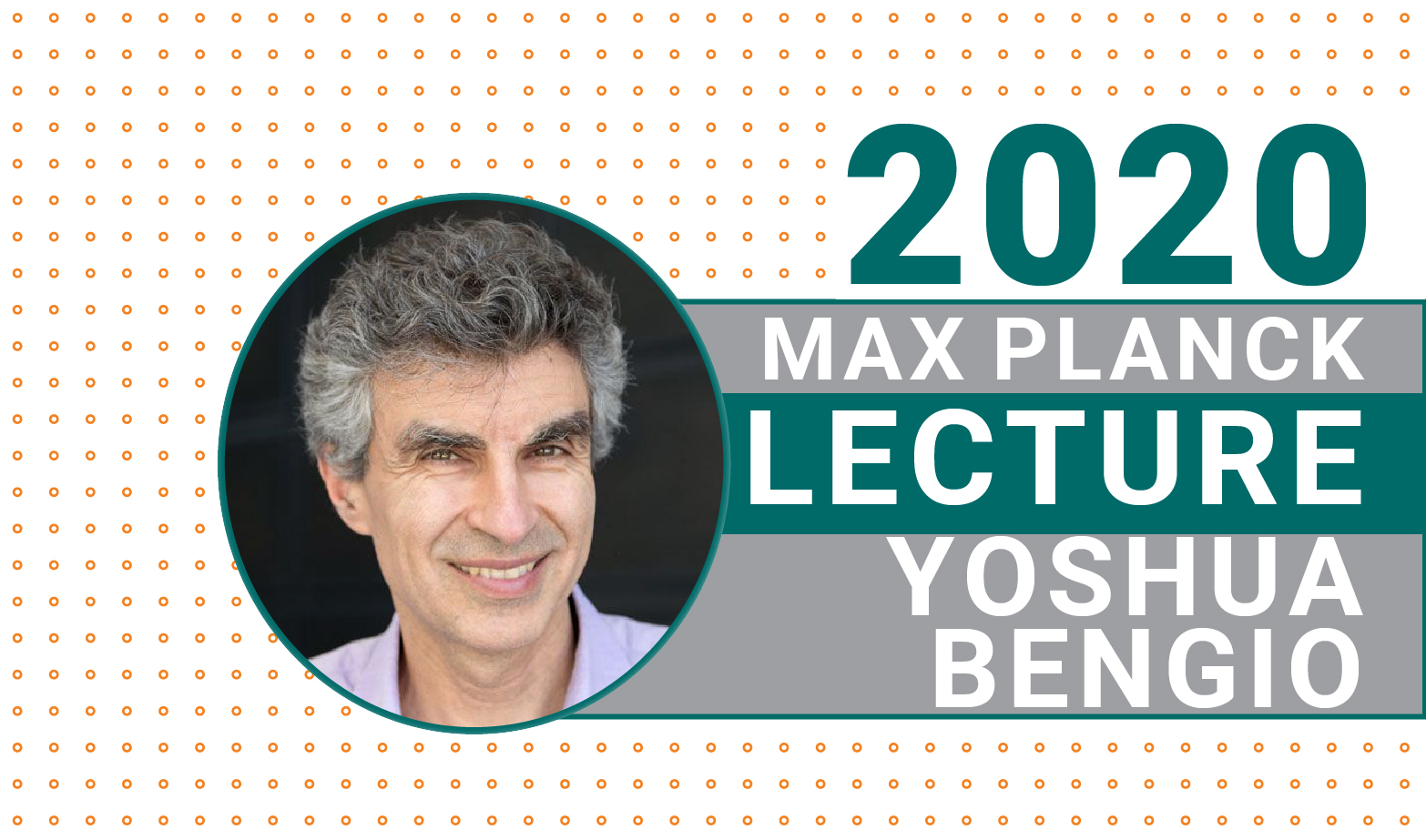
    As you may have read on Twitter, Professor Geoffrey Hinton has decided to cancel his talk at the 2020 Max Planck Lecture for scientific reasons. While we are very sorry that Professor Hinton will not be able to speak, we are pleased to announce that one of his fellow Alan Turing Award recipients has generously offered to hold the lecture. 


    Live transmission will take place on the event website on the day of the talk at 5:30 pm CEST.


    Biography: 

    Yoshua Bengio is recognized as one of the world’s leading experts in artificial intelligence and a pioneer in deep learning. Since 1993, he has been a professor in the Department of Computer Science and Operational Research at the Université de Montréal. He is the founder and scientific director of Mila, the Quebec Institute of Artificial Intelligence, the world’s largest university-based research group in deep learning. He is a member of the NeurIPS board and co-founder and general chair for the ICLR conference, as well as program director of the CIFAR program on Learning in Machines and Brains.In 2018, Yoshua Bengio ranked as the computer scientist with the most new citations, worldwide, thanks to his many publications. In 2019, he received the ACM A.M. Turing Award, “the Nobel Prize of Computing”, jointly with Geoffrey Hinton and Yann LeCun for conceptual and engineering breakthroughs that have made deep neural networks a critical component of computing. In 2020 he was nominated Fellow of the Royal Society of London.


    About the Max Planck Lecture

    In the past, Max Planck Lecture was hosted by Stuttgart’s Max Planck institutes, the Max Planck Institute for Intelligent Systems (MPI-IS) and the Max Planck Institute for Solid State Research (MPI-FKF). Since 2003, these two institutes have alternately organized the Max Planck Lecture once per year. 

    The Max Planck Lecture is given by outstanding scientists and leaders who are internationally recognized in their field. MPI-IS is delighted to announce that our 2020 speaker is Professor Yoshua Bengio from Université de Montréal.

    Max Planck Lectures are designed to be accessible to a wide audience including scientists, industry practitioners, government decision makers, and the general public interested in science and technology.

    Previous Max Planck Lectures.


  • ELLIS against Covid-19

    ELLIS against Covid-19

    Agenda

    * Speakers and talk titles are subject to change

    * All times in Central European Summer Time (CEST)

    Time Session
    1:30pm 1:35pm

    Introduction

    • Sepp Hochreiter
    1:35pm – 2:20pm

    Epidemiology & modeling

    • Peter Grünwald (10 min): The BCG CORONA and BCG-CORONA-ELDERLY Clinical Trials.
    • Alessandro Betti, Marco Gori (10 min): Learning the Dynamic SIR Model: An Optimal Control Approach
    • Johannes Zierenberg (10 min): Inferring COVID-19 spreading rates and potential change points for case number forecasts
    • Questions & discussion (15 min)

    2:20pm – 3:05pm

    Data, privacy and ML challenges

    • Antti Honkela (10 min): Privacy-preserving contact statistics collection for COVID-19 epidemic management
    • Thomas M. Hermans and Andre Loesekrug-Pietri (5 min):  The JEDI Grand Challenge
    • Kostas Kavoussanakis (5 min): Rapid Assistance in Modelling the Pandemic (RAMP)
    • Rolf Apweiler (10 min):  The European COVID-19 Research Data Platform 
    • Questions & discussion (15 min)

    3:05pm – 3:30pm

    Images

    • Victoria Schpacovitch, Katharina Morik (10 min): Resource optimising real-time analysis of artifactious image sequences for the detection of nano-objects
    • Plamen Angelov (5 min): COVID-19 CT Scan Classification via Explainable Deep Learning
    • Questions & discussion (10 min)
    3:30pm – 3:35pm

    Concluding discussion


    Send questions and comments to the speakers here: https://forms.gle/pBohVJyVQBYNbNy36

    The event will be livestreamed. You can watch it on YouTube: https://youtu.be/3VsKaiJB4Mc

  • ELLIS against Covid-19

    ELLIS against Covid-19

    Agenda

    * Speakers and talk titles are subject to change

    * All times in Central European Summer Time (CEST)

    Time Session
    1:30pm 1:40pm

    Introduction

    • Max Welling
    1:40pm – 2:40pm

    Diagnostics: molecular and imaging

    • Fabian Theis (15 min): "Leveraging single-cell transcriptomics to understand the molecular basis for SARS-CoV-2 distribution in the population"
    • Victor Greiff (15 min): "Methods for mining the adaptive immune repertoire for SARS-CoV-2 diagnostics and therapeutics"
    • Clarisa Sanchez (15 min): "CT analysis using machine learning to address COVID-19"
    • Questions & Discussion (15 min)
    2:40pm – 3:20pm

    Modeling and tracing

    • Bernhard Schölkopf (15 min): "COVID-19 machine learning projects at Max Planck Institute"
    • Luca Feretti (15 min): "Quantifying SARS-CoV-2 transmission suggests epidemic control with digital contact tracing"
    • Questions & Discussion (10 min)
    3:20pm – 3:50pm

    Data & platforms

    • Mads Nielsen (5 min): "Overview of Danish ICU risk assessment study"
    • Russ Taylor (5 min): "Telerobotics for Intensive Care Unit"
    • Cecilia Mascolo (5 min): "Mobile Health Diagnostics through Audio Signals: a COVID-19 case study"
    • Questions & Discussion (15 min)
    3:50pm – 4:00pm

    Concluding discussions

    • General Discussion and Wrap-Ups (10 min)
    • End of meeting


    Send questions and comments to the speakers here: https://forms.gle/u1YngqpimVPuwYZT6

  • ELLIS against Covid-19

    ELLIS against Covid-19

    Agenda

    * Speakers and talk titles are subject to change

    * All times in Central European Summer Time (CEST)

    Time Session
    1:30pm 1:45pm

    Introduction

    1:45pm – 2:30pm

    Outbreak prediction / tracking & epidemiological modelling

    • Nuria Oliver (15 min): "Data Science to fight against COVID-19" (link to recording)
    • Richard Neher (15 min): "Tracking SARS-Cov-2 using viral genomes and projecting its spread" (link to recording)
    • Questions & Discussion
    2:30pm – 2:55pm

    Viral & host genome sequencing

    • Chris Mason (15 min): "A Rapid, International COVID-19 and Microbial Monitoring Network" (link to recording)
    • Questions & Discussion
    2:55pm – 3:40pm

    Drug development

    • Guenter Klambauer (15 min): "Screening for SARS-CoV inhibitors" (link to recording)
    • Yoshua Bengio (15 min): "COVID-19 research at MILA" (link to recording)
    • Questions & Discussion
    3:40pm – 4:05pm

    Healthcare management

    • Mihaela van der Schaar (15 min): "Using machine learning and PHE data to help hospitals cope with COVID-19" (link to recording)
    • Questions & Discussion
    4:05pm – 4:30pm

    Data, resource, open challenges & community platforms

    • Fred Hamprecht (5 min): "COVID: volunteering for machine learners" (link to recording)
    • Devvret Rishi (5 min): "Understanding COVID-19 with the help of a million data scientists" (link to recording)
    • Questions
    4:30pm – 5:00pm

    Concluding discussions