CV Tag: IMPRS-IS

  • Ph.D. opportunities at the IMPRS-IS

    Ph.D. opportunities at the IMPRS-IS

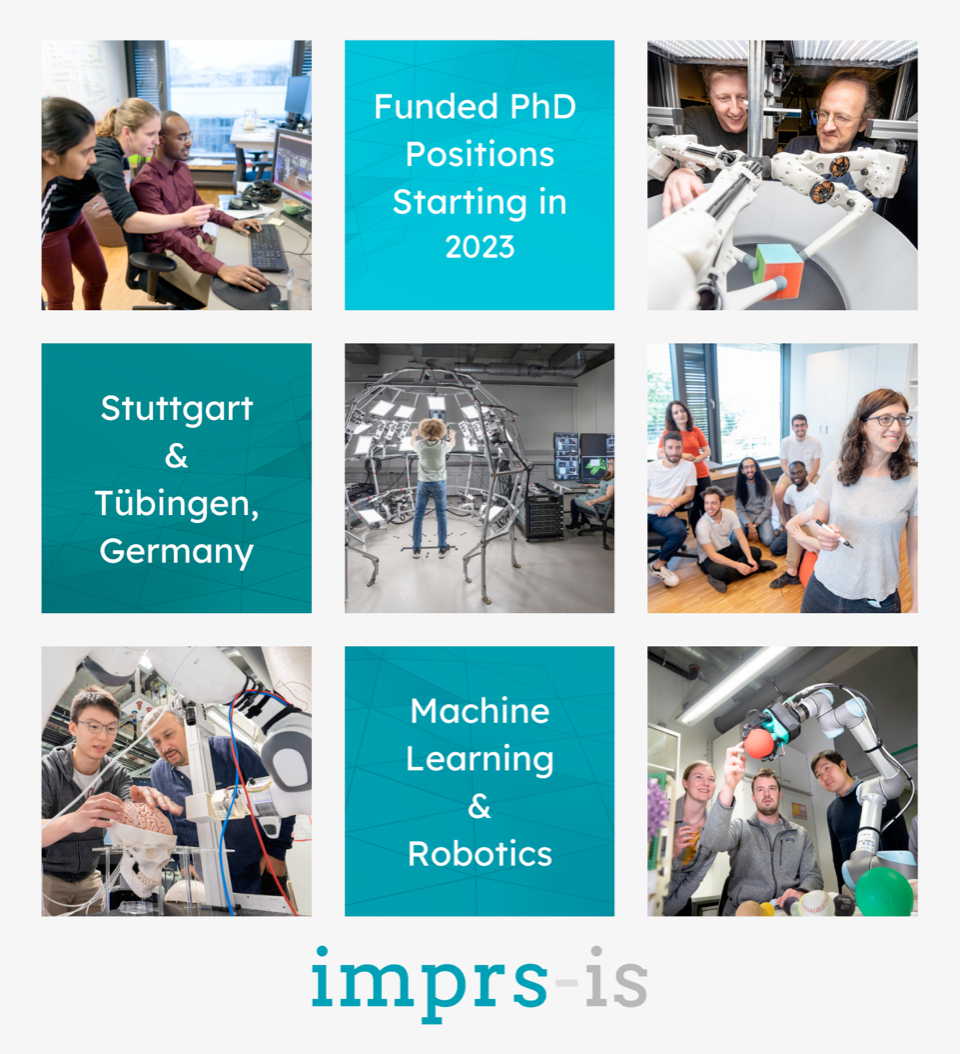
    This school is a key element of Baden-Württemberg’s Cyber Valley initiative to accelerate basic research and commercial development in artificial intelligence and robotics. We seek students who want to earn a doctorate while contributing to world-leading research in areas such as:

    • Biomedical Technology
    • Computational Cognitive Science
    • Computer Vision and Graphics
    • Control Systems and Optimization
    • Data Science
    • Haptics and Human-Computer Interaction
    • Machine Learning
    • Micro- and Nano-Robotics
    • Neuroscience
    • Perceptual Inference
    • Robotics and Human-Robot Interaction
    • Soft Robotics and Materials

    Find out more about the Ph.D. opportunities by visiting https://imprs.is.mpg.de or checking out the full job ad here. You can apply until November 1, 2022.

  • Cyber Valley Start-up Incubation Program

    Cyber Valley Start-up Incubation Program

    Inhalt

    Ihr braucht kein Team, keine Vorkenntnisse und kein Gründungsprojekt. Alle Werkzeuge, die ihr für eine erfolgreiche Gründung benötigt, werden euch zur Verfügung gestellt. Gemeinsam mit erfahrenen Start-up Coaches erhaltet ihr Einblicke in Themen wie Team Building, Marktanalyse, Proto- und Pretotyping, Businessmodelle und Start-up Pitches. Am Ende bekommt ihr die Chance, euer Start-up Projekt vor einer hochklassigen Jury zu präsentieren und ihr könnt wertvolle Preise gewinnen.

    Zielgruppe

    Der Inkubator richtet sich an alle Wissenschaftler:innen aus dem Cyber Valley Ökosystem – und darüber hinaus. Doktorand:innen der International Max Planck Research School for Intelligent Systems (IMPRS-IS) erhalten darüber hinaus 3 Credit Points, wenn sie den Kurs erfolgreich absolvieren.

    Ablauf und Termine

    Der Inkubator ist als sechswöchiges Programm geplant mit jeweils einem Vor-Ort-Workshop pro Woche (10:00–18:00). Die einzelnen Termine werden abwechselnd in Stuttgart und Tübingen stattfinden. Es wird einen Shuttlebus für Teilnehmer:innen des jeweils anderen Standortes geben. Sollte die Pandemie Vor-Ort-Veranstaltungen nicht erlauben, wird die Veranstaltung virtuell stattfinden. Die Termine sind:

    • Freitag, 1. April 2022
    • Freitag, 8. April 2022
    • Freitag, 22. April 2022
    • Freitag, 29. April 2022
    • Freitag, 6. Mai 2022
    • Freitag, 13. Mai 2022 (finales Pitch Event)

    Bewerbung

    Um sich für das Cyber Valley Start-up Incubation Program zu bewerben, wird ein Lebenslauf und ein Motivationsschreiben benötigt. Aus dem Motivationsschreiben (ca. eine Seite) soll hervorgehen, warum die Bewerber:innen sich für das Programm interessieren und welches Problem aus ihrem (Forschungs-)Alltag sie mit einem Start-up gerne lösen möchten. Doktorand:innen benötigen außerdem eine schriftliche Erlaubnis ihrer Doktormutter oder ihres Doktorvaters, dass sie an den sechs Terminen teilnehmen dürfen (eine E-Mail genügt).

    Nur noch wenige Plätze verfügbar. Bitte sendet euren Lebenslauf, euer Motivationsschreiben und die schriftliche Erlaubnis eurer Doktormutter bzw. eures Doktorvaters an tobias.duerr@cyber-valley.de.

    Sprache

    Das Programm wird in englischer Sprache angeboten.

    Fragen?

    Wendet euch gerne an Tobias Dürr, wenn ihr Fragen habt.


  • Zweiter Workshop, Mental Effort

    Zweiter Workshop, Mental Effort

    Detaillierte Beschreibung des Workshops, der in englischer Sprache abgehalten wird:

    We can all feel exhausted after a day of work, even if we have spent it sitting at a desk. The intuitive concept of mental effort pervades virtually all domains of human information processing and has become an indispensable ingredient for general theories of cognition. However, inconsistent use of the term across cognitive sciences, including cognitive psychology, education, human-factors engineering and artificial intelligence, makes it one of the least well-defined theoretical constructs across fields.

    The purpose of our two-day workshop is to bridge this gap by (a) offering hands-on tutorials on different computational approaches used to model mental effort and by (b) fostering discussion about the operationalization of mental effort among scientists from different research communities and modeling backgrounds.

    Key questions of discussion will include (but are not limited to):

    ● What are the experimental phenomena that lay a foundation for theories of mental effort?

    ● What is the common ground in operationalizing mental effort across different domains of cognitive science?

    ● Which modeling approach(es) is (are) best suited to answer which questions regarding mental effort?

    The workshop is specifically designed to attract scholars with expertise in different modeling

    Call for abstracts and registration

    Are you working on a project or thesis related to mental effort and want to discuss your ideas?

    If so, we are inviting you to present a poster during our virtual poster session.

    Registration and Call for Submission Closes: July 15, 2021