CV Tag: Industry Partners

  • Another milestone for AI from the Stuttgart region

    Another milestone for AI from the Stuttgart region

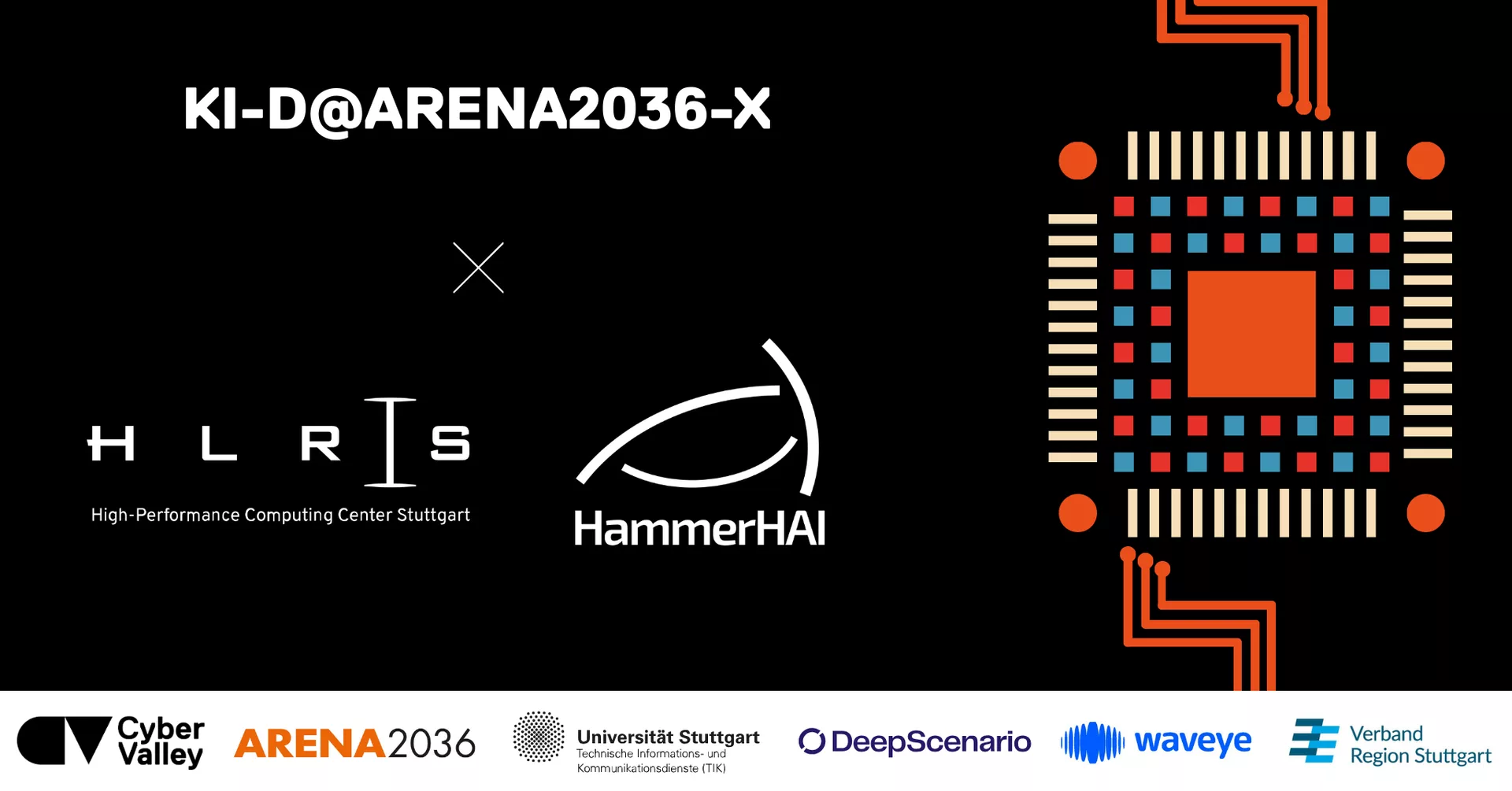
    The future of Artificial Intelligence (AI) is taking an important step forward in the heart of Baden-Württemberg: the High-Performance Computing Center Stuttgart (HLRS) is joining the ‘KI-D@ARENA2036-X” program as a new partner, contributing its expertise and computing capacity. 

    The program is jointly driven by ARENA2036, Cyber Valley GmbH, DeepScenario, waveye, and the Technical Information and Communication Services of the University of Stuttgart (TIK).

    With HLRS joining the initiative, the program gains an important new partner. This collaboration provides access to the infrastructure project HammerHAI. Starting in mid-year, extensive AI computing resources will be available across the entire development chain—from smaller systems directly integrated into machines or devices to powerful high-performance computing systems. This will make it possible to train and deploy very large and complex AI models.

    Infrastructure designed to accelerate AI development

    As part of the initiative, the partners are building an open IT and data infrastructure, including access to a data space for the sovereign exchange of data. The goal is to provide companies with easy access to powerful resources for AI applications—from the initial idea to practical deployment within companies. At the center of this effort is the networking of AI systems and data. Companies will be able to use the provided infrastructure without having to build large technical systems themselves. Access will be offered at competitive costs. Start-ups as well as small and medium-sized enterprises (SMEs) will particularly benefit, strengthening their innovative capacity and competitiveness.

    This will create a scalable, transparent, and collaboratively designed system in Baden-Württemberg. Instead of a black-box approach, the project deliberately focuses on an open infrastructure.

    This infrastructure is built on three key components:

    Integrating own hardware

    Companies can integrate their own computing hardware, allowing them to flexibly expand available computing capacity and address individual requirements.

    Shared data space

    A scalable, collaborative data space with marketplaces enables different organizations to work together on datasets, AI models, and concrete use cases.

    High-performance computing with HammerHAI

    Powerful high-performance computing resources enable the training and deployment of particularly large AI models.


    A program that accelerates companies

    Participating companies in the ‘KI-D@ARENA2036-X’ program benefit from practical access to powerful AI infrastructure and a strong innovation network.

    The program offers, among other things:

    • the opportunity to test and implement new ideas and proof-of-concepts without high upfront investments
    • access to powerful high-performance IT without having to operate their own data center
    • professional exchange with other AI developers facing similar technological challenges
    • a real-world testing environment at ARENA2036 that brings together requirements from different industries

    This means the program not only supports companies in their projects—it actively accelerates the development and implementation of new AI applications.

    Voices from the project team

    Prof. Dr. Peter Middendorf, Rector of the University of Stuttgart:

    “The IT and data infrastructure of ‘KI-D@ARENA2036-X’ is another important building block in our innovation ecosystem. The University of Stuttgart contributes to the success of this project through its Technical Information and Communication Services and as a partner of ARENA2036. I am therefore particularly pleased that the High-Performance Computing Center Stuttgart (HLRS) is now joining as another strong partner. With its powerful computing infrastructure, HLRS will support companies and start-ups in testing and optimizing state-of-the-art AI applications.”

    Dr. Alexander Lahl, Regional Director of the Verband Region Stuttgart:

    “Together with the HammerHAI infrastructure project, an important nucleus for AI development is emerging in the region. Start-ups and especially small and medium-sized enterprises will benefit greatly from this initiative. Through our support, we are significantly strengthening the Stuttgart Region as a location for AI applications and data infrastructures. At the same time, this project highlights the importance of collaboration across research, industry, and regional partners.”

    Michael Kaiser, Managing Director of Wirtschaftsförderung Region Stuttgart GmbH (WRS):

    “The collaboration between ‘KI-D@ARENA2036-X’ and HLRS and its European AI Factory HammerHAI is another important building block for the AI ecosystem of the Stuttgart Region. It enables companies to train and use very large AI models using efficient high-performance computers—without having to operate their own data center. This opens up new opportunities in AI development and application, especially for small and medium-sized companies.”

    Angelina Jukic, Program Manager at Cyber Valley GmbH:

    “Our goal within the KI-D@ARENA2036-X program is to create a highly connected ecosystem that brings together research, start-ups, and industry. This will make the development and training of AI models more efficient. HammerHAI is one of Germany’s leading AI computing infrastructures and works together with ARENA2036 on forward-looking solutions.”


    Project status and outlook

    Following the successful establishment of the basic infrastructure during the first year of the project, the program will enable operational access to the available computing and data resources in 2026.

    About the KI-D@ARENA2036-X program

    The KI-D@ARENA2036-X program is jointly implemented by ARENA2036, Cyber Valley GmbH, DeepScenario, waveye, and the Technical Information and Communication Services (TIK) of the University of Stuttgart. The goal is to build a collaborative infrastructure that accelerates AI innovation in Baden-Württemberg while ensuring security, transparency, and long-term economic sustainability.

    The program is funded by the Verband Region Stuttgart within the Co-Financing Program for Artificial Intelligence from 2024 to 2027 with a total of €685,000.

    Presscontact:

    Silke Dutz

    Public Outreach Manager      

    Email: silke.dutz@cyber-valley.de   

  • 2016: The foundation of an AI ecosystem

    2016: The foundation of an AI ecosystem

    In 2016, important actors from science, industry, and politics founded the Cyber Valley Consortium, which became the first Innovation Campus in Baden-Württemberg. Ten years on in 2026, we’re revisiting the most important milestones from the last decade. Each month, we’ll focus on a particular year since Cyber Valley’s beginning.

    This month, we’re returning to 2016 to look back at Cyber Valley’s foundation. Back then, the AI boom and the wholesale use of LLMs were still some years away. Actors from science, industry, and politics in Baden-Württemberg nevertheless knew that this technology would play an essential role in the state’s future.  

    Baden-Württemberg was already in an unrivalled position to create AI for the benefit of future society since it is home to several top AI research institutions: the Max Planck Institute for Intelligent Systems, the University of Stuttgart, the University of Tübingen, Fraunhofer-Gesellschaft, and Karlsruhe Institute of Technology (KIT). The next step was to apply their cutting-edge research to solving real-world problems.

    This was where Cyber Valley came in. In 2016, the Cyber Valley Consortium was founded with the mission of advocating for the research, development, application, and acceptance of AI and modern robotics. Cyber Valley was to unite excellent research with practical application to build the AI of tomorrow in Baden-Württemberg.

    At its founding, Cyber Valley Consortium consisted of the Max Planck Society (which includes the Max Planck Institute for Intelligent Systems, MPI-IS), the state of Baden-Württemberg, and the Universities of Stuttgart and Tübingen, alongside partners from industry: Amazon, BMW, Bosch, IAV, Mercedes-Benz Group, Porsche AG, and ZF Friedrichshafen. Other research institutions joined later, including Fraunhofer-Gesellschaft (in 2019), KIT, and ELLIS Institute Tübingen (both 2024).

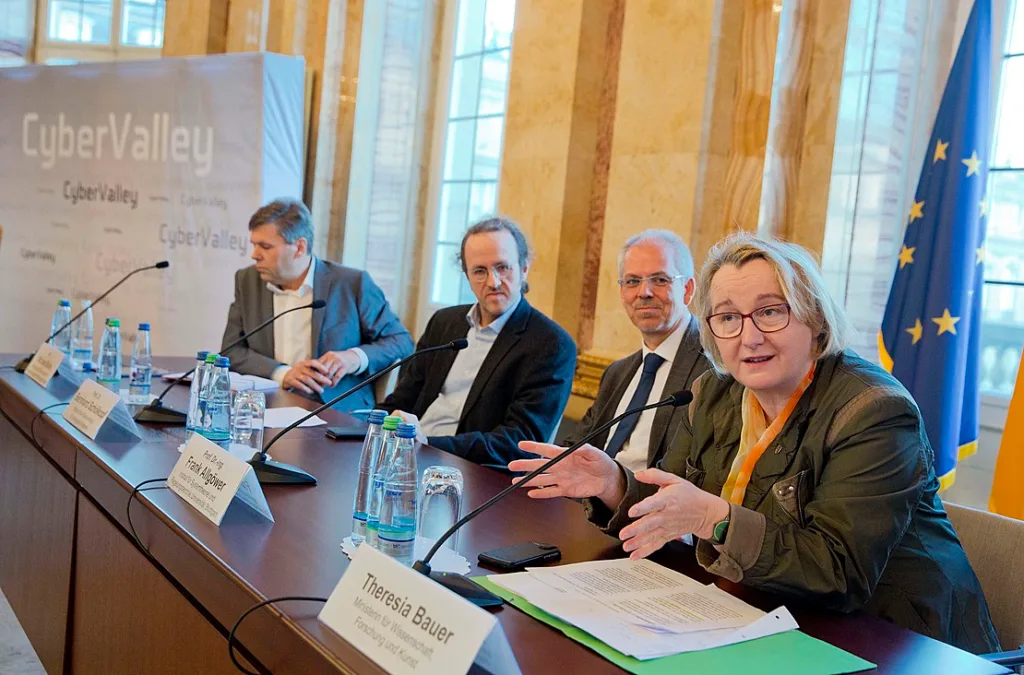
    Winfried Kretschmann, Minister-President of Baden-Württemberg, Theresia Bauer, who was then Minister of Science, Research and Art in Baden-Württemberg, and Martin Stratmann, who was then President of the Max Planck Society, launched the consortium on December 15, 2016, in Stuttgart’s Neues Schloss along with other participants from the consortium, including Bernhard Schölkopf(MPI-IS), Frank Allgöwer (University of Stuttgart) and Bernd Engler (University of Tübingen). The result was one of the largest research–industry partnerships for AI and modern robotics in Europe.

    Photo: MPI-IS / U. Regenscheit

    Theresia Bauer, Managing Director of the Baden-Württemberg-Stiftung, and Baden-Württemberg’s Minister of Science, Research and Art at the time of Cyber Valley’s founding:

    “At the time, I was thrilled by the great opportunity to bundle the excellent research landscape in the fields of AI and computer science in a condensed innovation ecosystem and make it more attractive for top international talent. When Cyber Valley was founded, I hoped that this concentration of cutting-edge research, the promotion of young talent, and responsible innovation would have what it takes to develop great appeal and grow rapidly. Today, you can see that we have succeeded in developing such a positive dynamic, which has a far-reaching impact on science, business, and the entire location.”

    Bernhard Schölkopf, Scientific Director of the ELLIS Institute Tübingen and Director of Empirical Inference at MPI-IS:

    “We started Cyber Valley with the belief that AI has the potential to change the world, and with the goal to do so in a positive way. This is now commonplace, but launching in 2016 gave us a head start and with a number of exciting start-ups, outstanding research institutions, and initiatives such as ELLIS and MP-AIX, we now have one of the most vibrant AI ecosystems in Europe.”

    Michael Black, Director of Perceiving Systems at MPI-IS:

    “The goal of Cyber Valley has always been to give Germany the chance to build a new high-growth economy around AI. In 2016, AI was not in the headlines, but we believed that we had the raw materials needed to succeed. Through the partnership of government, academia, and industry, we grew the AI faculty, attracted top researchers, built a top graduate program, trained hundreds of AI scientists, attracted investment, and helped launch a network of start-ups. These start-ups were always the goal and they hold the promise of a new Germany economy.” 

    Photo: MPI-IS / U. Regenscheit

    Peter Middendorf, Rector of the University of Stuttgart:

    “From the very beginning, the University of Stuttgart pursued the goal of pooling expertise in artificial intelligence and particularly in robotics, within and for the Stuttgart region. Together with the University of Tübingen, the Max Planck Institute for Intelligent Systems, and other partners, we have played a decisive role in shaping and advancing Cyber Valley. This strong network has given rise to excellent research, new professorships, and innovative projects, which we continue to actively drive forward – soon also in the new Cyber Valley building here in Stuttgart.” 

    Philipp Hennig, Director of Tübingen AI Center, University of Tübingen:

    “The world was a different place ten years ago, but even then it was clear that Europe, Germany, and Baden-Württemberg had to increase their efforts to stay relevant for AI. A decade later, I’m glad that we got the political mandate to get started then. The urgency of our tasks has only grown since then; but so have our opportunities.” 

    Bernhard Beckert, Dean of the KIT Department of Informatics:

    “When Cyber Valley was founded in 2016, we saw its potential to increase the visibility of AI research in Baden-Württemberg and to build a regional network that connects talent and accelerates scientific progress. Today, more than ever, this collaborative approach remains essential for supporting responsible AI development and for strengthening the region’s position within an increasingly complex international environment.”

    Matthias Tröndle, Head of the Scientific Coordination Office, MPI-IS:

    “When we founded Cyber Valley in 2016, we envisioned creating a bold innovation ecosystem focused on artificial intelligence at a time when its transformative impact was not yet widely recognized. By bringing together universities, non-university research institutions, industry, start-ups, foundations, and government in an unprecedented partnership, we broke new ground. The outstanding success of Cyber Valley has since made it a blueprint for subsequent innovation campuses.” 

    To celebrate Cyber Valley’s ten-year anniversary, we’ll be sharing a variety of content across our website and social media channels reflecting on milestones from the last decade. Stay tuned for the next instalments!

  • Navigating Investment Landscapes with SPRIND

    Navigating Investment Landscapes with SPRIND

    Leading the charge: Mirko Holzer 

    At the forefront of this initiative is Mirko Holzer, Deputy Director AI &Robotics  at SPRIND. With deep expertise in innovation management, Holzer ensures that promising start-ups and researchers get the resources they need to bring their groundbreaking ideas to life.  

    Holzer explains: “The partnership with Cyber Valley combines the best of both worlds: promising start-ups from first-class AI research meet the bold, unconventional funding culture of SPRIND. Together, we create an environment in which visionary ideas are not only conceived but also implemented. We look forward to supporting the next generation of AI pioneers and taking innovation in Germany to the next level!” 

    How to secure funding with SPRIND 

    SPRIND offers flexible financing models to help start-ups transform research into real-world applications. If traditional venture capital isn’t enough, SPRIND can step in with direct investments. 

    The step-by-step guide to getting funded 

    1. Research and eligibility: Ensure your AI venture aligns with SPRIND’s mission of breakthrough innovation. They look for high-impact, high-risk ideas with real-world applications. 

    2. Connecting with SPRIND: Early engagement with Mirko Holzer and his team is encouraged, as they can provide insights into the best funding options. 

    3. Preparing a proposal: SPRIND seeks strong teams, groundbreaking ideas, and a clear path to impact. Highlighting how innovation stands out is important. 

    4. Funding models and terms: SPRIND offers grants for research and development, equity investments, convertible loans, and co-investments with private investors, covering up to 70% of a financing round. 

    5. Validation phase: Selected teams can enter a validation phase, receiving expert coaching while participating in SPRIND’s network.  

    6. Showcase at VENTURE SPRIND: Top teams can present their ideas at SPRIND’s flagship event, where top investors and industry leaders gather to discover groundbreaking innovations.   

    “Research and development are incredibly expensive, and we can cover a large part of the development costs. The rest is covered by private investment,” explains Holzer. “Our financing is usually in the single-digit million range but can be higher if we see the potential and the need for it.” 


    Success Story: Polybot’s Journey 

    Polybot – one of the latest Cyber Valley projects supported by SPRIND – is a next-generation agricultural robot. SPRIND has provided Polybot with a seven-month validation contract starting in February 2025, giving them financial support, coaching, and access to a powerful innovation network. This partnership will turn Polybot’s cutting-edge research into real-world applications, strengthening Baden-Württemberg as an innovation hub. 

    Polybot’s team will: 

    • Join SPRIND’s expert-led programs 

    • Work closely with innovation managers 

    • Gain access to valuable investor networks 

    • Showcase their technology at VENTURE SPRIND 

    “SPRIND not only provides financial support but is also very active in the entire innovation landscape. This starts with the improvement of IP regulations and spin-off conditions through high-level workshops on VC funding and team building and extends to the organization of international venture events. These programs are just as valuable to us as the financial support,” says Wieland Brendel, Polybot project leader. 

    The collaboration between Cyber Valley and SPRIND demonstrates the potential of artificial intelligence research when applied to solving real-world problems, encouraging bold thinking and exploring uncharted territories in the field. 

    About SPRIND     

    SPRIND is Germany’s Federal Agency for Breakthrough Innovation, dedicated to funding transformative ventures that tackle the world’s toughest challenges, with a strong focus on AI. Their mission is to identify radical thinkers, invest in high-risk ideas, and connect teams with powerful networks across industry, academia, and government. SPRIND's comprehensive support includes financing, team building, and connecting innovators with key networks, ensuring that transformative progress aligns with fundamental humanistic values. 

  • Cyber Valley unites AI and robotics expertise for the healthcare sector

    Cyber Valley unites AI and robotics expertise for the healthcare sector

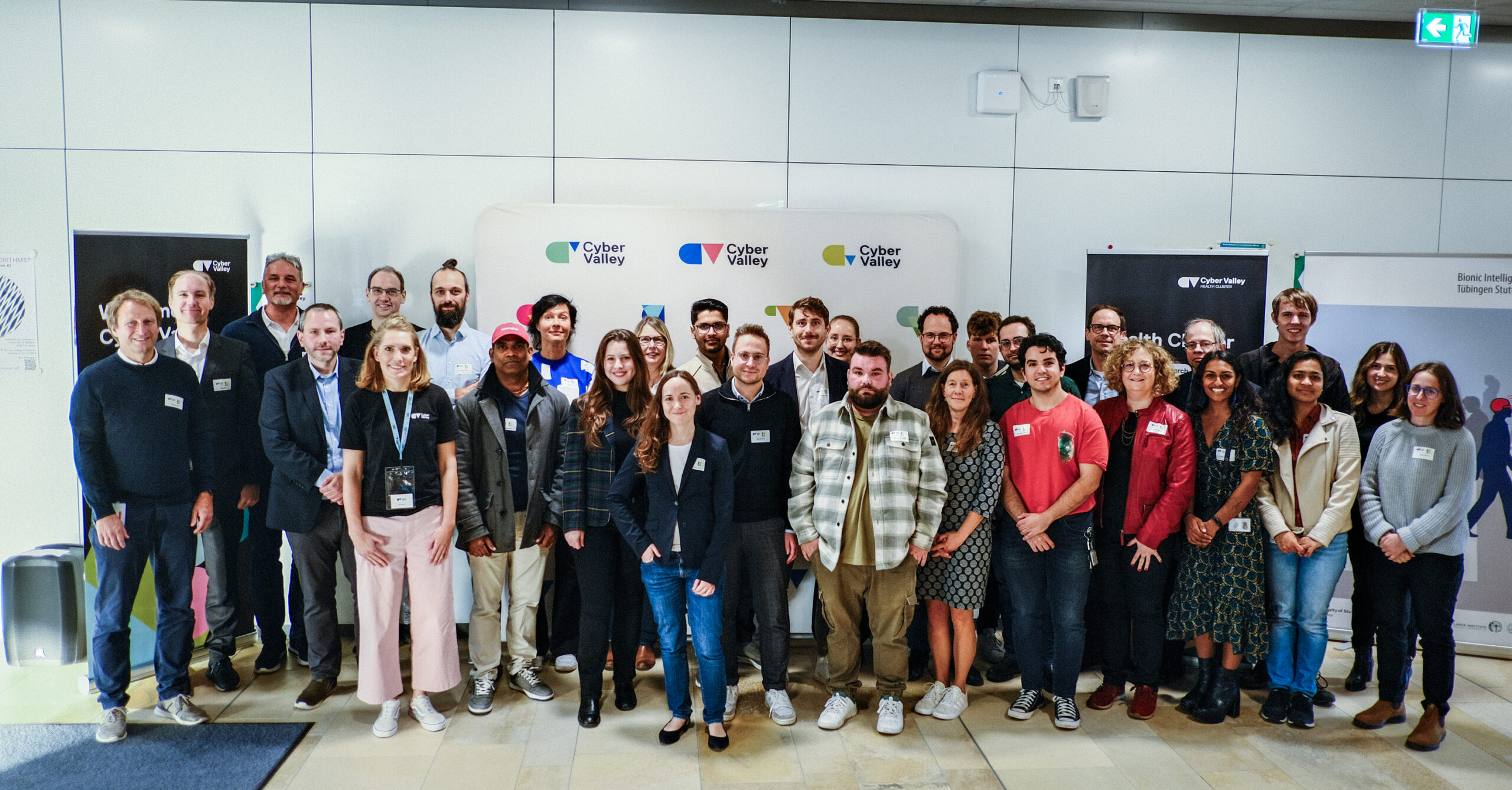
    Stuttgart, October 28, 2024 – The Cyber Valley Health Cluster officially launched last Thursday with a public kickoff event in Tübingen. This initiative launched by Cyber Valley aims to unite the forces of science, industry, and start-ups to improve people’s long-term health through artificial intelligence and modern robotics. 

    Collaboration between research and industry for AI-driven health technologies 

    The Cyber Valley Health Cluster aims to integrate research, practice, and technology. It promotes joint projects between AI experts, scientists, and companies to develop innovative solutions for current and future challenges in the healthcare sector. The Health Cluster emphasizes interdisciplinary knowledge exchange, enabling new approaches and solutions that go beyond individual technological advances.  

    Rebecca C. Reisch, Managing Director of Cyber Valley GmbH, highlights the importance of this collaboration: “The Cyber Valley Health Cluster is more than an academic endeavor; it’s a collaborative alliance that encourages exchange between industry, start-ups, and research. The Health Cluster is where AI-based solutions can be developed to address the most pressing challenges in modern medicine and beyond.”

    Strong Cyber Valley Partners and Friends are already on board  

    The Cyber Valley Health Cluster is backed by strong partnerships. Among the already confirmed Cyber Valley Partners are well-known players such as Boehringer Ingelheim, ZEISS, the University of Tübingen, the University of Stuttgart, and the Max Planck Institute for Intelligent Systems (MPI-IS). These partners are investing significantly in the Cyber Valley Community and are playing a central role in the further development of the Health Cluster. 

    In addition, the Cyber Valley Health Cluster is supported by numerous committed Cyber Valley Friends who enrich the network with their expertise and connections. These include Immatics, Cegat, Ovesco, BIOPRO Baden-Württemberg, BioRegio STERN Management, as well as the Medical Innovations Incubator, and the start-ups Osora and Cerebri.  Further candidates are already under consideration.  

    Reisch emphasizes the role of the Cyber Valley Community: “Together with our Partners and Friends, we are creating an environment that drives the development of technologies that are not only groundbreaking but also practical and ethical. Because only by working together do we have the chance to establish Baden-Württemberg and the whole of Germany at the forefront of global AI health innovations.” 

    Long-term goal: a lasting healthcare alliance 

    The Cyber Valley Health Cluster supports start-ups and innovation projects to create real value by generating new jobs and health solutions. Health Cluster participants moreover benefit from extensive connections and new networking opportunities that enable the development of pioneering healthcare solutions and rapid knowledge transfer between research and industry. 

    The long-term goal of the Cyber Valley Health Cluster is to create a lasting and active community, pooling health expertise to enable interdisciplinary teams to tackle global health challenges. Further events and interaction formats are planned for the Cyber Valley Health Cluster in the coming months. 

    About Cyber Valley 

    Cyber Valley is Europe’s largest and leading center for excellence in artificial intelligence and modern robotics. Its mission and public mandate are to advocate for the research, development, application, and acceptance of technologies and methods in the field of intelligent systems. Cyber Valley encourages entrepreneurship by uniting scientific excellence with innovation and technology transfer. In addition, Cyber Valley facilitates critical reflection on the ethical and social implications of AI through public engagement. Cyber Valley envisions a future in which the full potential of intelligent systems is leveraged for the greater good of the world. 

    Media Contact: 

    Laura Neusser 
    Public Outreach Manager 
    Cyber Valley GmbH 
    laura.neusser@cyber-valley.de 

  • Cyber Valley Days: Inclusive, diverse, and innovative

    Cyber Valley Days: Inclusive, diverse, and innovative

    In the following interview, Angelina Jukic, Program Manager at Cyber Valley GmbH, shares her experiences of the three-day event.

    What was your personal highlight during Cyber Valley Days?

    My personal highlight during Cyber Valley Days was The AI Incubator Demo Day. As program manager, I had the privilege of guiding young entrepreneurs and researchers as they developed their AI-driven business ideas, alongside my colleague Paul-David Bittner and three experienced coaches: Ralf Allrutz, Olga Mordvinova, and Michael Raschke. Watching the program participants confidently pitch their innovative solutions during Cyber Valley Days to a diverse audience of our community, such as investors and industry experts, was incredibly inspiring.

    What was the most memorable interaction you had during Cyber Valley Days?

    One of the most memorable interactions I had during Cyber Valley Days was meeting with our Japanese program partners. Our discussions were particularly enriching as we explored various opportunities for collaboration. We delved into potential projects that could benefit both our regions. The unique insights and innovative approaches they shared were not only enlightening but also opened exciting possibilities for future joint ventures. This interaction underscored the value of international partnerships and highlighted the global reach and impact of our AI initiatives.

    In what ways did Cyber Valley Days reveal the innovative, collaborative, and diverse culture of the Cyber Valley Community?

    The variety of sessions and activities, such as the Expo, the investor day, and more, allowed different AI communities within our company to come together and share their projects. The cross-functional interactions emphasized our collaborative spirit. Additionally, the diversity of ideas and perspectives presented throughout the event underscored our commitment to fostering an inclusive environment where innovations thrive.

    What was your biggest surprise?

    My biggest surprise during Cyber Valley Days was realizing just how large and diverse our AI community already is. It was impressive to see the range of different AI applications being developed within our community. All in all, Cyber Valley Days showed how our community has the potential to drive significant advancements in AI technology.

    Read further interviews with Alina Benze (Business Development Manager, Corporates), Rebecca Beiter (Director of Communication & Society), Janell Lia-Breitmeyer (Scientific Coordinator), and Paul-David Bittner (Business Development Manager, Start-ups) to discover their perspectives on Cyber Valley Days. 

  • Amazon and Max Planck Society announce recipients of gift awards

    Amazon and Max Planck Society announce recipients of gift awards

    In line with that goal, the Science Hub is sponsoring the following research projects:

    • “Non-verbal interpersonal synchrony analysis tool (nVISA-online)”: Senya Polikovsky, research engineer, Max Planck Institute for Intelligent Systems

    “Interpersonal synchrony (In-Sync), the spontaneous synchronization of behavioral, affective, and even physiological responses in contexts of social interaction, offers a useful insight into the quality and smoothness of interactions between social partners. Automatic assessment of In-Sync could provide objective tools for studying the interactive abilities of people with psychiatric conditions and the degree of therapeutic alliance in psychotherapy, as well as online human-to-human and avatar-to-human interactions. Body movement dynamics are central to the analysis of In-Sync. Besides that, facial expression, gaze interaction, audio signals, and physiological measures such as electrodermal activity, heart rate variability, or breathing rates can be used to detect In-Sync. The goal of our proposed research is to extend In-Sync analysis to online scenarios. We would like to identify the instruments and the procedures for the detection of In-Sync in online therapy sessions.”

    • “Accurate 3D body shape and clothing estimation from a single image”: Gerard Pons-Moll, senior researcher, Max Planck Institute for Informatics, and professor, University of Tübingen, endowed by the Carl Zeiss Foundation

    “This research aims to reconstruct a 3-D digital human from a single RGB photograph, using a combination of 3-D neural implicit functions to represent worn garments and a parametric model to represent and control the pose and shape of the underlying body. A key novelty is to incorporate feedback in the deep body estimation network, ensuring that the 3-D body mesh is consistent with its projection onto the photo.”

    • “Learning clothing pressure fields via high-fidelity finite element analysis”: Gokhan Serhat, research scientist, Max Planck Institute for Intelligent Systems, and assistant professor, KU Leuven

    “Accurate estimation of clothing pressure on the human body is crucial to understanding physical factors that influence clothing comfort. Such estimation requires the ability to express contact pressure fields in terms of different body sizes and types and garment sizes and material properties. However, such pressure fields are generally too complex to be modeled by analytical methods. Experimentation also has certain drawbacks, since it does not provide information about internal stresses, and precise measurement of the contact pressure between a pair of curved soft bodies is difficult. The intricate anatomy of the human body may require elaborate finite-element models with several thousand elements for capturing deformation mechanics accurately. Such large models inherently induce high computational costs and are likely to suffer from the aforementioned numerical issues. The proposed study aims to address this problem by developing a deformation model based on deep neural networks trained with the data from finite-element analysis.”

    • “Material estimation of clothing for controllable human avatars”: Justus Thies, research group leader, Max Planck Institute for Intelligent Systems, and professor, Technical University Darmstadt

    “A key challenge for controllable human avatars is the reconstruction and animation of clothing. While data-driven, person-specific reconstruction methods show promising results, the extrapolation to novel poses with realistic deformations of clothing is limited. In contrast to data-driven methods, physics simulation can be used to model the dynamically changing clothing. In this project, we want to explore material estimation of human clothing for such simulations. Specifically, we are interested in predicting material properties such as stiffness or stretch that influence the motion-dependent deformation of the clothing. Besides these mechanical material properties, we are also interested in predicting material properties for the appearance of clothing that allow for re-renderings under novel poses.”

  • SimTech METEOR Competition 2024

    SimTech METEOR Competition 2024

    The SimTech METEOR competition was launched by the Knowledge Transfer Committee headed by Professor and SimTech scientist Jörg Fehr from the Institute of Engineering and Computational Mechanics at the University of Stuttgart.

    The competition stands out for its directness and efficiency by focusing on the rapid transfer of basic knowledge into the development of new technical products, materials and processes. A special feature is its rapid processing: in just three months after the submission deadline on February 23, 2024, the funding decisions will be announced in May 2024.

    The selection committee will decide which research questions and challenges will be supported with up to €100,000 each. This targeted funding not only enables the implementation of innovative ideas, but also combines them with an efficient use of funds.

    The SimTech METEOR competition is particularly relevant for companies and institutions, as it promotes the transfer and exchange between industry and research. The speed of knowledge transfer ensures that fundamental findings can flow directly into the development of new products, processes, and methods.

    Companies and institutions based in Germany are eligible to participate, regardless of their size. Preference is given to small companies and institutions based on a list of criteria.

    The SimTech METEOR competition focuses on the close integration of research and industry to tackle the challenges of the future together. The deadline for submissions is February 23, 2024. Join us and actively shape the future of technological innovation!

  • Cyber Valley forms a new partnership with ARENA2036

    Cyber Valley forms a new partnership with ARENA2036

    ARENA2036 is a research campus and innovation hub focused on shaping the future of mobility and production. Its location in Stuttgart ­– a focal point of the German automotive industry ­– offers a flexible factory space where partners from different professional backgrounds can collaborate under one roof. Here, scientists, engineers, and companies meet to create innovative solutions for not only the automotive and production industries but also other sectors.

    “ARENA2036 is committed to collaborating with leading experts in the field of artificial intelligence”, says Dr. Clemens Ackermann, Deputy Managing Director of ARENA2036. “The cooperation with Cyber Valley opens up additional opportunities for us in AI research and application. This helps us to rethink conventional production processes and develop intelligent, sustainable solutions for the mobility requirements of the future. With this powerful mix of AI know-how and our expertise in manufacturing and automotive, we are looking forward to an exciting time of innovation and transformation.”

    About Cyber Valley

    Cyber Valley is Europe’s largest research consortium in artificial intelligence (AI) and modern robotics. Cyber Valley has a public mandate to advocate for entrepreneurship, research, development, application, and acceptance of technologies and methods in the field of intelligent systems. The company envisions a future where the full potential of intelligent systems is leveraged for the greater good of the world.

    The Cyber Valley Community connects partners from science, industry, and society together, along with AI researchers and entrepreneurs. The Cyber Valley GmbH, funded by the state of Baden-Württemberg, acts as the central organizer, service provider, and host for this community. The GmbH is located in Stuttgart and Tübingen, but the Cyber Valley Community has a far wider reach: As a national and European driving force, we attract the best people from around the world to create the future with AI.

    About ARENA2036

    ARENA2036 stands for “Active Research Environment for the Next generation of Automobiles” and is the innovation platform for mobility and production of the future. The research campus is part of the funding initiative “Research Campus – Public-Private Partnership for Innovations” in Germany. ARENA2036 is supported by the Federal Ministry of Education and Research (BMBF) and is run as a registered association with over 50 members from science and industry. The innovation platform based in Stuttgart stands for cooperation under one roof between science and industry. ARENA2036 wants to contribute to actively shaping work, mobility, and production of the future in the context of digitalization. The partners are active in various disciplines – from the automotive industry, aerospace technology, textile, and materials research to industrial science.

  • Cyber Valley Meet-up #04

    Cyber Valley Meet-up #04

    We invite you to this relaxed meeting for all start-ups, research groups, PhD students and interested people who want to learn more about Cyber Valley. Cyber Valley Meet-up #04 will be held in cooperation with BRYCKE, a project of the business development of the city of Stuttgart. BRYCKE is a space as well as a community that connects visions, innovative products and people. BRYCKE is an open, lively, inspiring place in downtown Stuttgart where ideas are presented and brought to life together.


    What:

    • Pitches – Who wants to pitch their idea at the Meet-up? Feel free to contact us.
      • Pitch: BRYCKE and Business development (Sebastian Reutter, Vinz Leo Hofmann and Tobias Dürr) 
      • Pitch: LBBW Venture Capital (Markus Kazmaier)
      • Pitch: Early phase investors at Grazia Equity (Benedikt Battke)
      • Pitch: nanoAR technology, learning from nature (Zhaolu Diao)
      • Pitch: TREEO: Pioneer in nature-based climate solutions (Stefan Ferber)
         
    • Open discussion and exchange

    … while enjoying pizza, salad, and a cold drink of your choice. We would also like to know what your expectations are for Cyber Valley.


    When?

    Thursday, 20 April 2023, 17:00–19:00 CEST.


    Where?

    BRYCKE

    Schmale Straße 9-13
    70173 Stuttgart


    Registration

    Please register via the registration form. The number of participants for the event is limited. Feel free to contact us if you need a transfer from Tübingen to Stuttgart and back.

    We look forward to meet you as well as sharing some food, drinks and stimulating conversations!