Event Year: 2020

  • Kickoff AI Breakthrough Hub

    Kickoff AI Breakthrough Hub

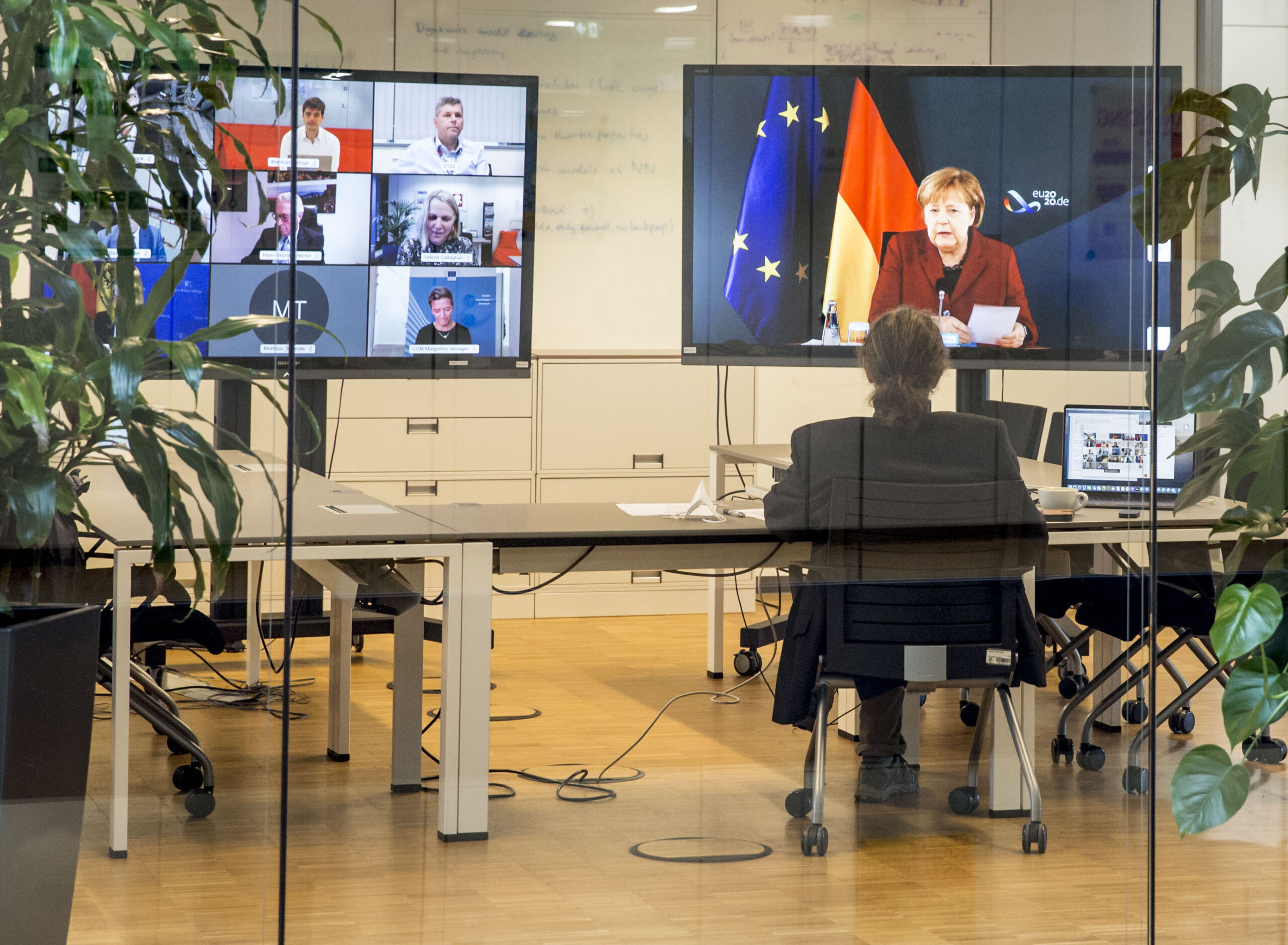
    Die Teilnehmenden der Videokonferenz sind:

    Startschuss des „AI Breakthrough Hub“

    • Dr. Angela Merkel
      Bundeskanzlerin
    • Winfried Kretschmann
      Ministerpräsident
    • Margrethe Vestager
      Exekutiv-Vizepräsidentin der EU-Kommission und Kommissarin für Digitales und Wettbewerb
    • Prof. Dr. Matthias Bethge
      Direktor des Kompetenzzentrums Tuebingen.AI, Professor an der Universität Tübingen
    • Dr. Michael Black
      Direktor am Max-Planck-Institut für Intelligente Systeme, Sprecher Cyber Valley
    • Prof. Dr. Bernhard Schölkopf
      Direktor am Max-Planck-Institut für Intelligente Systeme, Co-Direktor des Kompetenzzentrums Tuebingen.AI
    • Dr. Katherine Kuchenbecker
      Geschäftsführende Direktorin des Max-Planck-Instituts für Intelligente Systeme
    • Dr. Michael Bolle
      CTO/CDO Bosch GmbH

    Panel I: „Excellence in Research and Talent“

    • Anja Karliczek
      Bundesministerin für Bildung und Forschung
    • Theresia Bauer
      Landesministerin für Wissenschaft, Forschung und Kunst
    • Prof. Dr. Martin Stratmann
      Präsident der Max-Planck-Gesellschaft
    • Dr. h.c. Hans-Werner Hector
      Gründer der der Hector Stiftung
    • Prof. Dr. Bernd Engler
      Rektor der Universität Tübingen

    Panel II: „Excellence in Transfer and Venture“

    • Alex Diehl
      Senior Advisor Cyber Valley
    • Prof. Dr. Matthias Bethge
      Direktor des Kompetenzzentrums Tuebingen.AI
    • Dr. Raquel Urtasun
      ATG Uber, Chief Scientist, Vector Institute Toronto
    • Dr. Ulrich Quay
      Managing Director BMW iVentures, Mountain View
    • Naureen Mahmood
      CEO, Co-Founder Meshcapade GmbH
    • Dr. Benedikt Battke
      Partner Grazia

    Weitere Links

  • NeurIPS 2020

    NeurIPS 2020

    Monday, 7. December, 21:00-21:30 CET

    Katja Schwarz 

    Katja Schwarz is a PhD Student at Tuebingen University and scholar at the International Max Planck Research School (IMPRS) for Intelligent Systems (IS). She started her PhD in 2019 and is supervised by Prof. Andreas Geiger. Katja works at the intersection of Machine Learning, Deep Learning and Computer Vision. Currently, she is particularly interested in geometric scene understanding and 3D generative models.

    REGISTRATION

    Tuesday, 8. December, 21:00-21:30 CET

    Junhyung Park

    Junhyung Park has been a PhD student in the Empirical Inference Department at the Max Planck Institute for Intelligent Systems since November 2019. His work focuses primarily on reproducing kernel Hilbert space embeddings and causal inference. Outside work, he plays football and the piano, and also enjoys reading, traveling, and learning new languages.

    REGISTRATION

    Wednesday, 9. December, 21:00-21:30 CET

    Yiyi Liao

    Yiyi Liao is a postdoctoral researcher in the Autonomous Vision Group, which is affiliated with the University of Tübingen and the Max Planck Institute for Intelligent Systems. Her research interests include 3D scene understanding, reconstruction, and 3D-aware generative models.

    REGISTRATION

    Thursday, 10. December, 21:00-21:30 CET

    Fabian Sinz

    Fabian Sinz's research interests lie in the combination of machine learning and neuroscience. In 2018, he was appointed leader of the newly established independent Cyber Valley Neuronal Intelligence Research Group at the University of Tübingen. He is also currently an Adjunct Assistant Professor at the Baylor College of Medicine’s Center for Neuroscience and Artificial Intelligence in Houston, Texas.

    REGISTRATION

    Friday, 11. December, 21:00-21:30 CET

    Wieland Brendel 

    Wieland Brendel is a team lead at the University of Tübingen. His research focuses on robust and interpretable machine vision algorithms and the theory of representation learning. He studied theoretical physics and completed a PhD in computational neuroscience. Later, he switched to machine learning at the start of his postdoc. In addition to his position at the university, Wieland co-founded Layer7 AI in 2018, and was recently named one of Germany’s “Top 40 under 40” by Capital Magazin.

    REGISTRATION

  • AIxIA: AI Conference 2020

    AIxIA: AI Conference 2020

    This year’s conference will be held online and focusses on the application of Artificial Intelligence for the benefit of the environment!
    Climate Change is the biggest challenge of this century. We believe that Artificial Intelligence is a powerful technology that can contribute to a greener world, while at the same time driving economic growth for the benefit of humanity. For this we will present keynotes and talks that centre around this topic.

    The AIxIA keynotes, talks, discussions and state-of-the art use cases will cover two topics:

    AI & Industries

    From predicting malfunctions of machines and finding root causes to next-level process automation for production lines – AI technology has led to major improvements in manufacturing. Besides, we see that close human-robot collaboration is in advance. AI can reinforce the collaboration by “humanizing” the robot behavior. At the conference, we will look into how these innovations massively boost business success AND can have a positive environmental impact – the reduction of waste and energy usage are just two examples.
    Another aspect that will be covered is AI within the food industry. According to forecasts, humanity will need around 70 percent more food by 2050, than we produce today. AI solutions can help farmers to grow food more efficiently and at the same time in a more environmentally friendly way.


    AI & Sustainability

    Sustainability is a hot topic. An industry-wide shift is occurring which leads companies to include environmental sustainability goals in their corporate strategies. Companies must be aware of their footprint and what they can do to reduce it. The AI use cases presented in this session focus on these issues with a focus on energy, water, and resources.

    Find out more here: https://aixia.eu/

  • Cyber Valley Tech Clinic

    Cyber Valley Tech Clinic

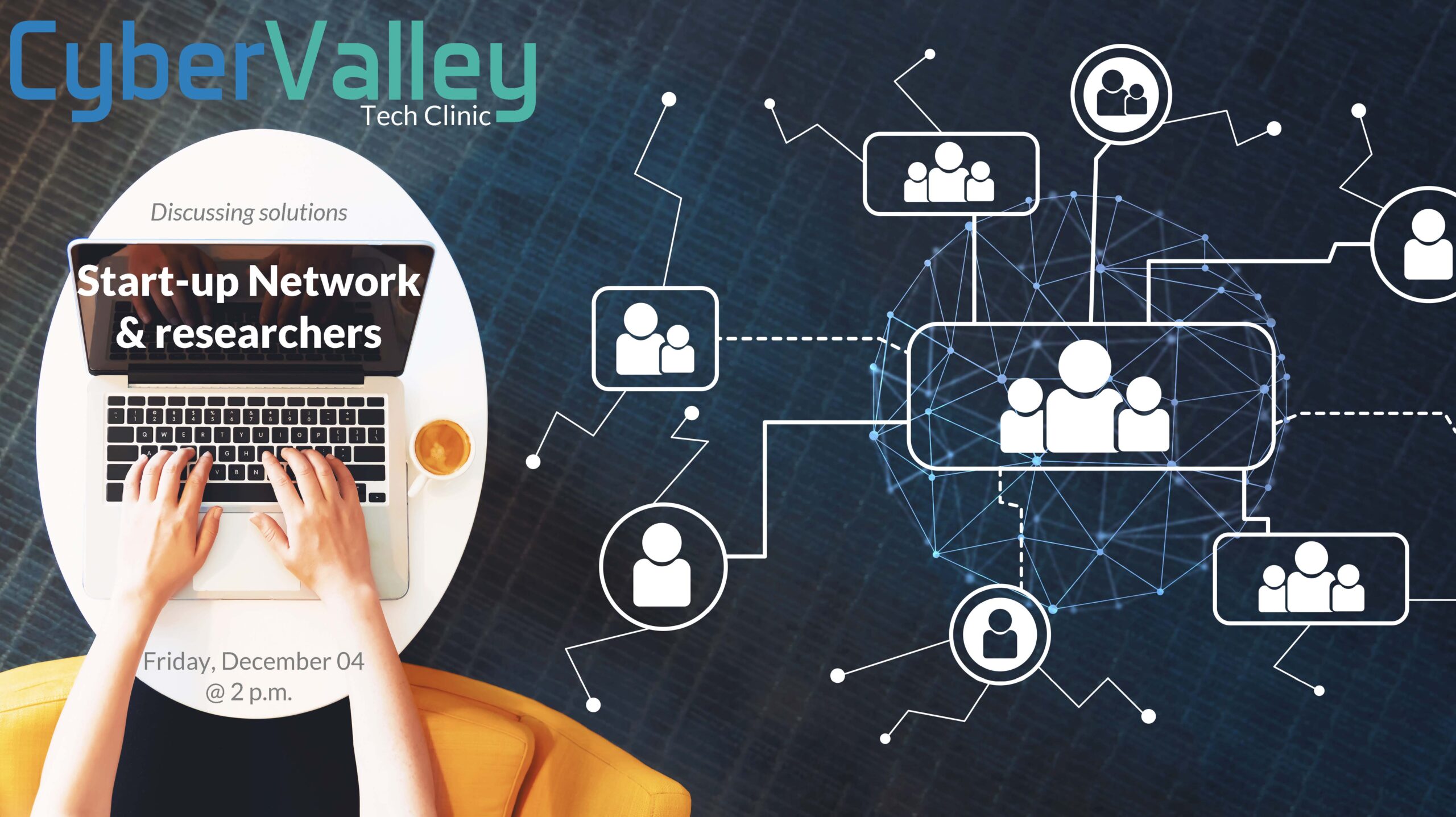
    On Friday, December 4th a computer vision problem regarding “6d Pose Estimation of Boxes and Trailers in Logistics” will be discussed. 

  • Virtual AI Roadshow: USA – Baden-Württemberg – Canada

    Virtual AI Roadshow: USA – Baden-Württemberg – Canada

    Join the virtual AI Roadshow, starting on November 17 – November 19, 2020 and discuss with experts from Pittsburgh/USA as well as Ontario and Québec/Canada. What to expect: Three days of networking, interesting info sessions, and keynotes.

    Which Topics will be discussed ?

    • AI and Ethics
    • AI and Autonomous Driving
    • AI and Healthcare
    • AI and Robotics

    Why participate?

    • As a company – get information on how to implement AI solutions in your company and find qualified contacts during effective one-to one meetings
    • As a university – find new international counterparts and to discuss new technology and innovative solutions
    • As a start-up – pitch your idea and business solution

    How can you benefit from this event?

    • Publish and showcase your products, projects, services or business needs or research results to event participants
    • Initiate and arrange promising pre-scheduled 1:1 meetings at the event
    • Generate fresh leads and meet new contacts in a time and cost-efficient way
    • Stay one step ahead of your competitors by being seen and visibly present at the event

    Learn more about the program and the speakers of the event here.

  • Mobility & AI

    Mobility & AI

    Schedule

    • Welcome and Introduction – Michael Black  |  Cyber Valley Spokesperson
    • Keynote – Michael Halbherr  |  Co-Founder HERE and Technology Investor
    • Textual Explanations for Self-Driving Vehicles – Zeynep Akata  |  Uni Tübingen
    • Scientific Perspective on Mobility & AI – Andreas Geiger  |  Uni Tübingen / MPI IS
    • Investment – Tobias Jahn  |  BMW i Ventures
    • Companies & Start-ups
      • Kai Przybysz-Herz  |  NAiSE GmbH
      • Martynas Gudonavicius und Jurgis Pašukonis  |  Trafi
      • Philipp Gneiting  |  STARTUP AUTOBAHN / Mercedes Benz AG
    • Discussion

    Registration

    Please register here


  • Seeding & Early Funding Opportunities

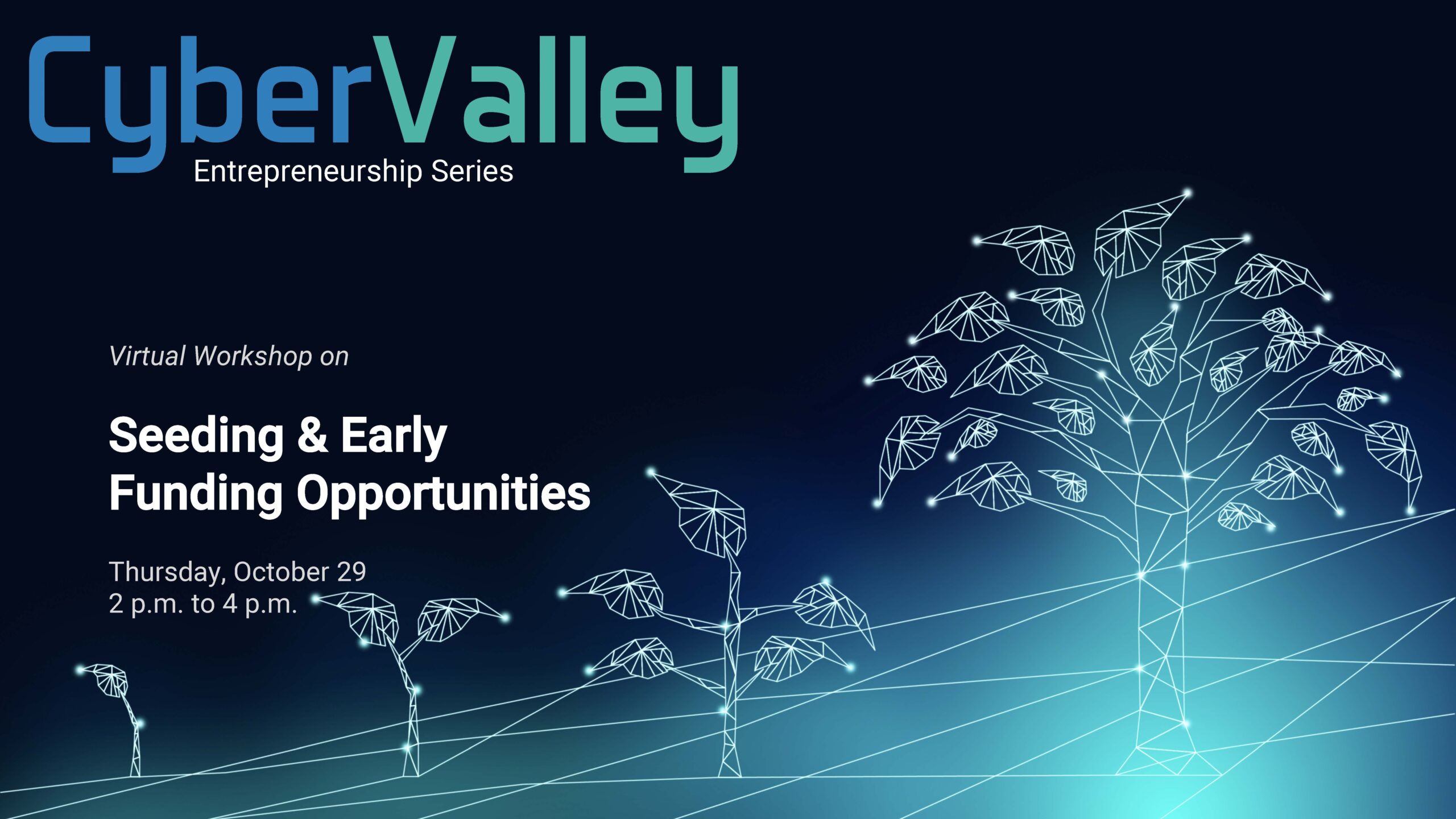
    Seeding & Early Funding Opportunities

    Schedule

    • Welcome and Introduction
    • Overview Early Funding Possibilities
    • Parallel Sessions
      • Univeristy of Tübingen
      • University of Stuttgart
      • Max Planck Innovation
    • Experiences and Programs from the region and Q&A
    • Closing Remarks

    Details below | Please register here.


    Welcome and Introduction

    Alex Diehl and Julia Schmaus

    Senior Advisor Cyber Valley 

    Innovation Manager

    Overview Early Funding Possibilities

    Tobias Dürr

    Innovation Manager

    Parallel Sessions

    University of Tübingen

    Sandra Gässler and Daniel Heblik


    University of Stuttgart

    Jordi Mauri


    Max Planck Innovation

    Florian Kirschenhofer

    Early Funding Opportunities, experiences and programs from the region

    Fraunhofer IPA

    Philipp Topic


    bwcon

    Timothy Earnshaw


    High-Tech Gründerfonds

    Gernot Berger


    Computomics GmbH

    Sebastian Schultheiss

    Closing and final Q&A

    Alex Diehl and Tobias Dürr

    Senior Advisor Cyber Valley 

    Innovation Manager

  • „Science meets Fiction“ – Künstliche Intelligenz im Film „Exit“

    Unmittelbar vor der Erstausstrahlung des Films am Mittwoch, 28. Oktober 2020, 20:35 Uhr in der ARD diskutieren wir gemeinsam mit den Machern von „Exit“ und mit KI-Forschenden, welche Folgen sogenannte Künstliche Intelligenzen für unsere Gesellschaft in Zukunft haben, und wie technologischer Fortschritt in einer gesellschaftlich wünschenswerten Weise gestaltet werden kann.

    Teilnehmerinnen und Teilnehmer: 

    • Katharina Dufner (SWR-Redakteurin)

    • Prof. Dr. Marco Huber (Leiter des Cyber Valley KI-Fortschrittszentrums „Lernende Systeme“, Fraunhofer IPA, Universität Stuttgart)

    • Prof. Dr. Ulrike von Luxburg (Professorin für Theorie des Maschinellen Lernens an der Universität Tübingen; Sprecherin des Exzellenzclusters “Maschinelles Lernen: Neue Perspektiven für die Wissenschaft”)

    • Sebastian Marka (Regisseur)

    • Erol Yesilkaya (Drehbuchautor)

    Moderation: Mirko Drotschmann (MrWissen2go)

    Anmeldung

    Sie können teilnehmen und mit-chatten im Zoom-Webinar (bitte hier anmelden) oder ohne Anmeldung den Live-Stream auf dem YouTube-Kanal des SWR anschauen. 

    Film

    Der Film "Exit" ist bereits jetzt in der ARD-Mediathek erhältlich.

  • AI & Health

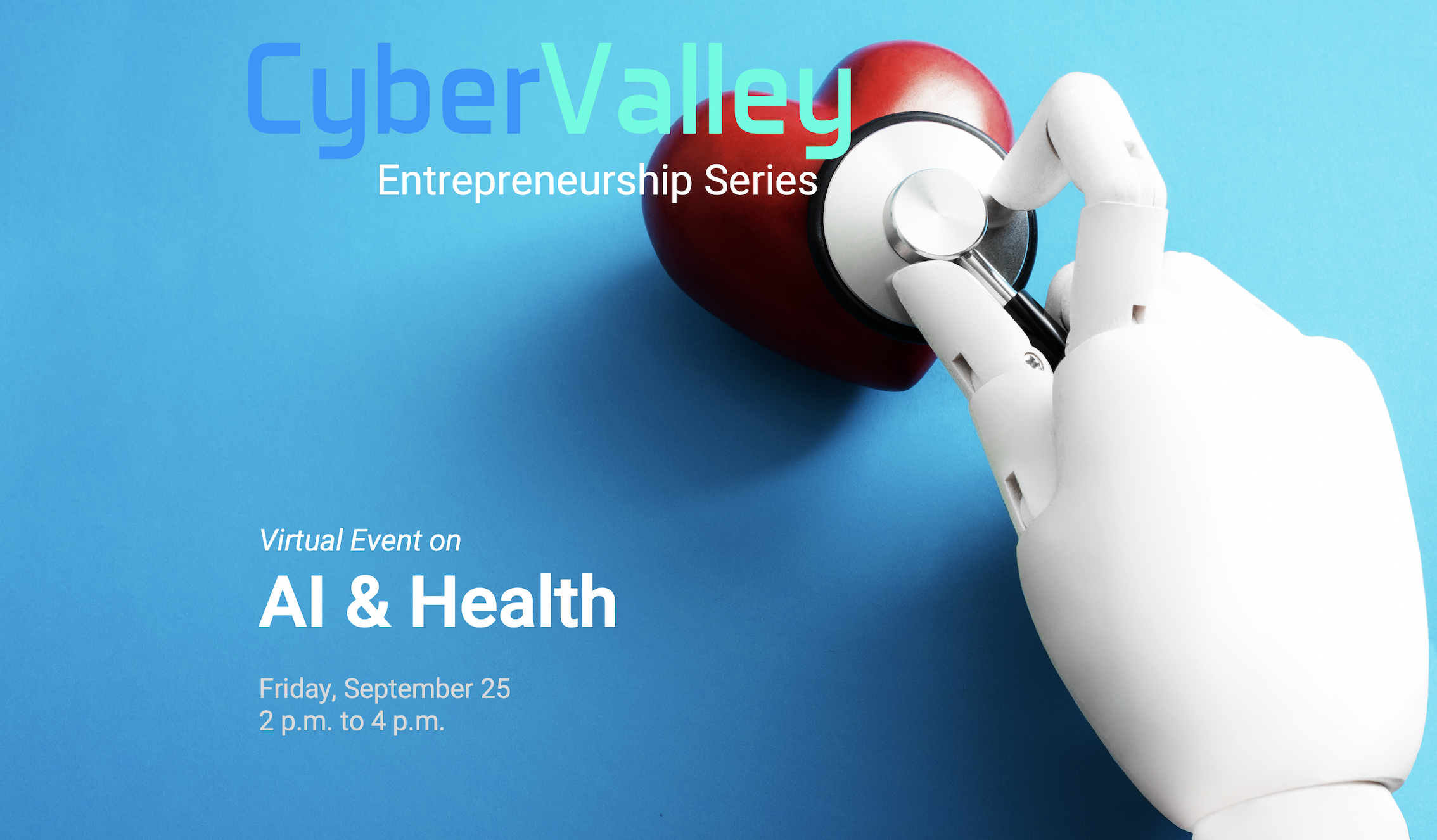
    AI & Health

    Schedule

    • Opening remarks
    • Start-Ups
    • Investors
    • Discussion
    • Closing Remarks
    Opening

    Alex Diehl

    Senior Advisor Cyber Valley

    Start-Ups

    Computomics GmbH (Start-Up, Tübingen)

    Sebastian Schultheiss

    "Computomics’ data analysis experts offer custom services for next-gen sequencing projects – from crop science to metagenomics."


    AIRAmed GmbH (Start-Up, Tübingen)

    Christiane Lindig & Tobias Lindig

    "Artificial intelligence makes neuroradiology measurable, Individual and objective."


    Curedatis (Early Stage Start-Up, Stuttgart)

    Robert Radloff

    "Current methods for evidence generation and synthesis do not scale to meet the demands, imposed by the exponentional growth of the evidence base."


    eye2you GmbH (Start-Up, Tübingen)

    Jörn-Philipp Lies

    "We want to make retinal eye care more accessible to everybody by leveraging the power of cutting-edge AI with the ubiquity of smartphones."


    Grazia Equity GmbH (Investor, Stuttgart)

    Benedikt Battke

    "Capital for entrepreneurs."


    Apollo Health Ventures (Investor, Hamburg)

    Victor Bustos

    "Apollo Health Ventures develops interventions with the potential to prevent or reverse age-related diseases and extend healthy human lifespan."

    Discussion

    Wieland Brendel

    Machine learning researcher at the University of Tübingen & Co-Founder of Layer7 AI


    Alexander Brem

    Chaired Professor of Entrepreneurship in Technology and Digitization, 
    endowed by the Daimler Fund in the Stifterverband, at the University of Stuttgart

    -Moderator-

    Closing

    Alex Diehl

    Senior Advisor Cyber Valley

  • Scientific Symposium

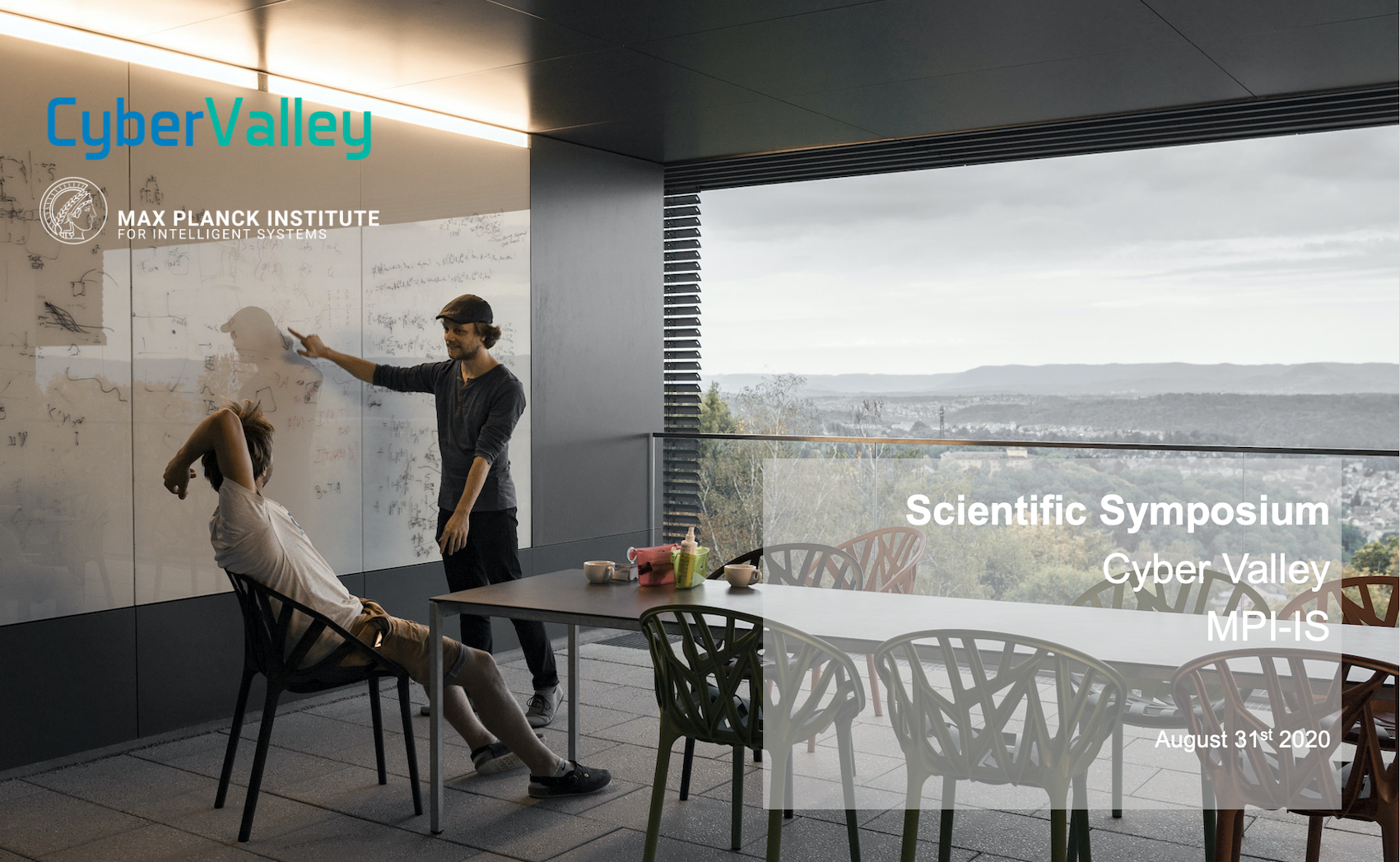
    Scientific Symposium


    Schedule (CEST)

    __________________________________________

    8:55 am – 9:00 am    Opening remarks

    9:00 am – 11:00 am    Presentations | Part One

    11:00 am – 2:00 pm    – Break –

    2:00 pm – 4:00 pm    Presentations | Part Two 

    __________________________________________


    Justus Thies

    Technical University of Munich, Germany

    Talk: Monday, August 31, 2020 – 9:00-9:30 am

    Neural Rendering and Representation Learning for 3D Holograms of Humans

    Communicating via text messages, audio-, or video-calls is a part of our modern society. As a next evolution step, we already see early implementations of virtual 3D telepresence systems and personalized avatars. Capturing natural motions and expressions as well as the photorealistic reproduction of images under free views are challenging. With the rise of deep learning methods and, especially, neural rendering, we see immense progress to succeed in these challenges. In this talk, I will give an overview of my previous and ongoing research about image synthesis of humans, the underlying representation of appearance, geometry, and motion to allow for explicit and implicit control over the synthesis process. Specifically, I will talk about my work on facial reenactment and neural rendering. 


    Jochen Müller

    Harvard University, Cambridge, USA

    Wyss Institute for Biologically Inspired Engineering

    Talk: Monday, August 31, 2020 – 9:30-10:00 am

    A computational approach to the creation of digital matter

    Human creativity, combined with bioinspiration and modern, computational tools is now able to derive the most captivating designs, elevating both structural appearance and functionality to unprecedented levels. The physical realization of these designs, however, remains a bottleneck. On the other end, the grand challenge in manufacturing is to create a process that is economical, fast, repeatable, and that enables the desired design freedom in both geometric complexity and choice of materials. Digital Fabrication and, in particular, Additive Manufacturing (AM) has emerged as a potent alternative to conventional manufacturing and is considered by many the holy grail. Despite this hype, however, AM still lacks behind the expectations and is often not able to handle the required complexity, which significantly limits progress in major research fields.

    In my talk, I will address both the digital design of novel materials and structures with outstanding properties, and the fabrication thereof. First, I will present recent research that shows how the mutual exclusivity between stiffness and toughness can be overcome in mechanical metamaterials and how we can integrate (multi-)functionality, such as actuation and sensing, on a materials-level. Second, I will demonstrate AM-based solutions specifically tailored to these design paradigms that cannot be fabricated in any other way. Third, I will address the general limitations of AM and show how they can be (partially) overcome, with the ultimate goal of solving the grand challenge. Finally, I will outline potential next steps and provide a perspective on how the proposed, data-driven design approaches can dictate the future direction of the whole field.


    Christian Rupprecht

    University of Oxford, UK

    Talk: Monday, August 31, 2020 – 10:00-10:30 am

    Minimally Supervised Learning

    We know that deep learning works exceptionally well with copious amounts of annotated training examples. Collecting this data is often tedious, expensive and sometimes even infeasible. This talk explores what we can learn from a reduced amount of annotated data and how including physical priors about the world can substitute manual supervision. We will show how incorporating explicit knowledge about the world in the model can lead to more interpretable predictions and better generalization.  


    Mateusz Malinowski

    DeepMind, London, UK

    Talk: Monday, August 31, 2020 – 10:30-11:00  am

    no image

    Towards Scalable Visual Reasoning

    With deep learning and large-scale datasets, we have seen a seismic shift in computer vision, where more traditional problems such as image recognition on ImageNet are one-by-one tackled with many successes. However, can we build and investigate architectures that go beyond simple classification?

    In the first part of the talk, I will talk about my work on visual question answering. In this line of research, we ask machines various questions about the visual scene. Within that paradigm, we can test the "reasoning" capabilities beyond the typical classification. During the talk, I will also shortly mention related works on grounding language into percepts and actions as well as building a symbolic proof system using deep learning.

    In the second part of the talk, I will briefly introduce my recent work on more scalable and biologically plausible training on temporal input streams such as videos. The underlying hypothesis is that we can exploit various redundancies in such signals to approximate the standard backpropagation algorithm accordingly.


    Seyed-Moohsen Moosavi-Dezfooli

    Institute for Machine Learning, ETH Zurich, Switzerland

    Talk: Monday, August 31, 2020 – 2:00-2:30 pm

    Geometric aspects of adversial robustness of deep networks

    Despite showing impressive classification performance on many challenging benchmarks, generally in well-controlled settings, deep networks are intriguingly vulnerable to adversarial perturbations. It is indeed relatively easy to design noise that can change the estimated label of the classifier. The decision boundaries learned by state-of-the-art image classifiers are known to lie close to data samples. That is precisely why they exhibit such a poor performance under l_p-norm adversarial perturbations. The study of this high-dimensional phenomenon is proven to be a challenging yet extremely crucial task; it will eventually bring important benefits in safety-critical applications of machine learning such as self-driving cars, autonomous robots, and medical imaging.

    In this talk, I will present some geometric insight about deep networks' decision boundaries and how their geometry contributes to the l_p-norm robustness properties of such classifiers. Furthermore, I will demonstrate how these observations can be exploited to design efficient methods to evaluate and improve the robustness of state-of-the-art image classifiers. In particular, I will show how controlling curvature of the decision boundary can be critical to improve l_p adversarial robustness, and how, by exploiting curvature, computationally efficient algorithms can be derived to measure robustness properties.


    Rebekka Burkholz

    Harvard T.H. Chan School of Public Health, Boston, USA

    Talk: Monday, August 31, 2020 – 2:30-3:00 pm

    Cascade Processes in Machine Learning

    Cascade processes have been proven useful in modeling such diverse phenomena as epidemic spreading, signaling in biological networks, information propagation in social media, financial systemic risk, and the reorganization of international trade networks. In this talk, we will focus on two model classes, load redistribution and spreading models, and use them as means to an end to improve and develop machine learning algorithms. We will leverage the fact that load redistribution models correspond one-to-one to the evaluation of deep neural networks. We will derive successful initialization strategies and speed up model training based on analytic insights for random graph ensembles. We will further discuss how we can utilize these improvements for the inference of gene regulatory networks.


    Antonio Vergari

    University of California, Los Angeles, USA

    Talk: Monday, August 31, 2020 – 3:00-3:30 pm

    From Simple Inference to Complex Probabilistic Reasoning

    Probabilistic reasoning is generally considered to be the framework-of-choice to enable and support decision making under uncertainty in real-world scenarios. Ideally, we would like a probabilistic ML system that is deployed in the wild to be able to i) allow humans (or other AI agents) to pose arbitrary and articulated queries, that is questions about states of the world; ii) to provide guarantees on their results; iii) to deal with complex, heterogeneous and potentially structured data and, moreover iv) to support chaining several inference steps together. In this talk, I will argue that the above desiderata are still unmet in the current landscape of probabilistic ML. Even the most prominent paradigm nowadays, deep generative modeling, is able to provide only a shallow, simplistic, form of inference and struggles when dealing with complex queries or data. I will then delineate how my past and current research aimed at closing this gap. Specifically, I will touch some recent works investigating principled frameworks within dealing with complex tasks such as reasoning about the behavior of classifiers or dealing with algebraic constraints over heterogeneous data can be done elegantly and efficiently. Lastly I will talk about some future research perspectives: extending these complex probabilistic reasoning routines to interactive and relational settings while allowing for approximations with guarantees.


    Roberto Calandra

    Facebook AI Research, USA

    Talk: Monday, August 31, 2020 – 3:30-4:00 pm

    Towards Embodied Intelligence

    The creation of intelligent embodied artificial agents has long been a dream for roboticists and artificial intelligence researchers alike. In this talk, I will argue for several key advances that I believe are necessary before we can achieve this dream, and in particular two of these key research areas: multi-modal sensing, and data-efficient learning for fast adaptation. Regarding multi-modal sensing, I will discuss the importance of using alternative sensor modalities in addition to vision, and will present my recent research on using touch sensing to allow robots to perceive, understand, and interact with the world around them. About data-efficient learning, I will discuss the use of model-based reinforcement learning — which explicitly creates models of the world — and present some of my recent works to understand and overcome the limitations of current approaches