Network Role: Partner

  • Cyber Valley begrüßt synthavo im Start-up Network

    Cyber Valley begrüßt synthavo im Start-up Network


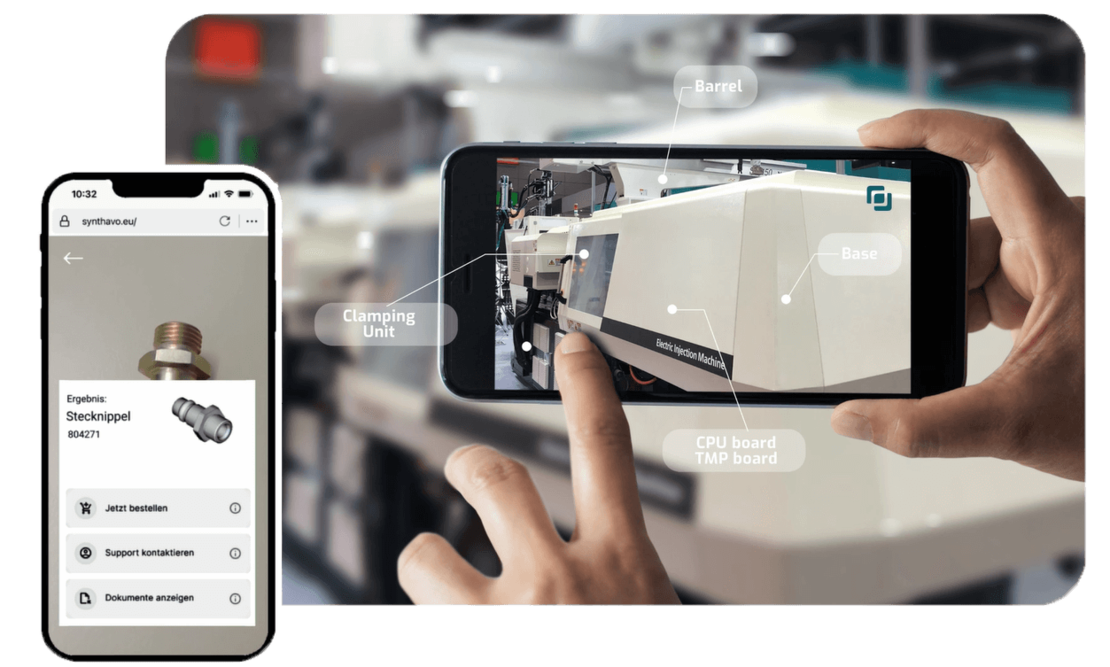
    The Stuttgart-based start-up synthavo has introduced a Software-as-a-Service (SaaS) solution that uses Artificial Intelligence to identify defective spare parts within a machine or solution, with a single photo taken from a smartphone. The solution will then order the required replacement parts with just one click.  

    Visual recognition for mechanical engineering 

    For the first time, synthavo enables the automated visual recognition of spare parts in mechanical and plant engineering by using CAD data. With just one click, spare parts are not only recognized, but they are then easily ordered. This process increases efficiency and reduces error costs by up to 21%.  

    Service technicians can also receive and collect images of the damage to increase product sustainability, all in one interface. The use of an external application is not necessary.   
    synthavo SaaS solution

    The SaaS solution increases the profitability in service and after sales for machinery and equipment manufacturers.  Image: synthavo

    Start-up Network 

    “We look forward to sharing our expertise and benefiting from the large network in Cyber Valley. To stay at the cutting edge, knowledge sharing, and research is essential,” says Sebastian Stöcklmeier, CEO synthavo. The Cyber Valley Start-up Network was founded in 2019 and currently holds 43 members.  

    About Cyber Valley  

    Cyber Valley is Europe's leading center for excellence in advanced AI and robotics. Cyber Valley creates a vibrant ecosystem that enables seamless collaboration and rapid exchange between academia, business, and society. As an ambassador for entrepreneurship, Cyber Valley's mission is to strengthen the research, development, and application of intelligent systems, providing a platform for collaboration, resource sharing, and advancement of modern AI and robotics. With a focus on the ethical and societal aspects of AI, Cyber Valley fosters dialogue between society and AI researchers and strives for a future in which the full potential of intelligent systems is used for the benefit of society.  

    About the Cyber Valley Start-up Network

    The Cyber Valley Start-up Network fosters a community of entrepreneurs. Its members are invited to attend newly created Cyber Valley networking events such as talks, meet-ups, and tech brunches on a regular basis. They are listed on the Cyber Valley website and can use the network’s logo in their communication materials. Network members are required to have a connection to Cyber Valley, for instance by being headquartered in the state of Baden-Württemberg, or by having members or alumni of Cyber Valley partner institutions among their founders. Their activities must be related to the field of intelligent systems. Membership in the Cyber Valley Start-up Network is reviewed once a year to ensure that these requirements continue to be met. Founded in November 2019, the Cyber Valley Start-up Network currently has 43 members.  

    About synthavo 

    synthavo enables the mechanical engineering service to gain market share in the strategically relevant area through visual spare parts recognition, to raise massive efficiency potentials and to decisively counteract the shortage of skilled workers. With synthavo's AI, anyone who can operate a cell phone can identify and order a desired spare part in less than two seconds. 

  • Cyber Valley Start-up Network wächst weiter

    Cyber Valley Start-up Network wächst weiter

    What does Visual Abstract do?

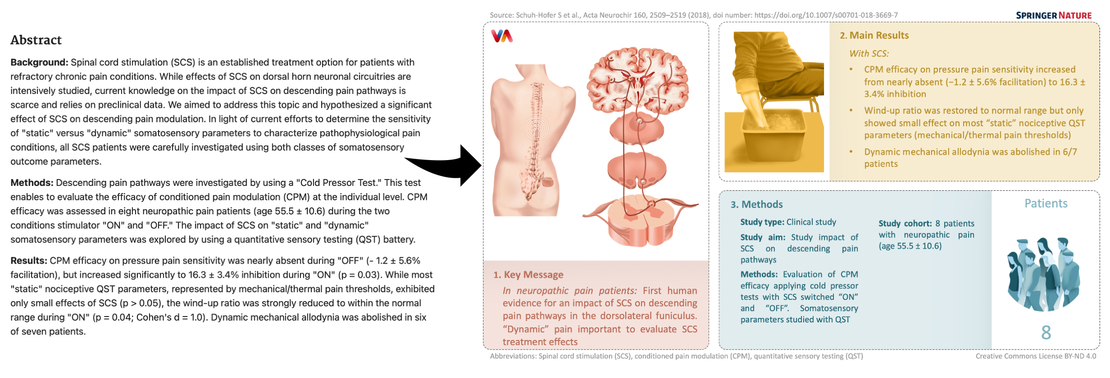
    The start-up uses texts of scientific publications and transforms them into clearer graphics with the use of artificial intelligence (AI). 

    Visual Abstract AI

    Visual Abstract to Paper: Spinal cord stimulation modulates descending pain inhibition and temporal summation of pricking pain in patients with neuropathic pain (Schuh-Hofer et al., 2018). Image: Visual Abstract

    The start-up's goal is to make science accessible to everyone. On the one hand, the graphics support researchers and students in easily and quickly absorbing newly published research results. In this way, the start-up wants to stem the flood of information to which researchers are exposed. On the other hand, the public benefits when scientific results are presented in a visually clearer way and are more easily accessible to interested parties.

    “Industry and researchers face the challenge of adequately communicating their often complex research findings,” says Saribek Karapetyan, CEO of Visual Abstract. “Our graphical abstracts are easy to read, easy to understand, and easy to memorize – and quickly available to customers thanks to our AI-powered automated production process.”

    Cyber Valley Start-up Network

    The Mannheim-based startup is part of the Cyber Valley Start-up Network. “As an AI startup from #TheLänd, it is a must and an honor for us to be part of the ecosystem of Europe's largest AI research consortium,” says Karapetyan. Founded in November 2019, the Cyber Valley Start-up Network now has 43 members.

  • Forschungsprojekt zur künstlichen Intelligenz für den nachhaltigen Straßenbau gestartet

    Forschungsprojekt zur künstlichen Intelligenz für den nachhaltigen Straßenbau gestartet

    Road construction causes around 400 million tonnes of CO2 emissions globally every year. This corresponds to about 7.5 per cent of the maximum annual amount that may be emitted worldwide in order to still achieve the climate target of 1.5 degrees Celsius global warming. Even on medium-sized construction sites with 2,500 tonnes of asphalt to be laid, about 4,000 trees need a whole year to compensate for the CO2 emissions of about 50 tonnes. In the KInaStra research project, CO2 emissions in asphalt road construction are to be analysed transparently using digital technologies and reduced by AI-based optimisation algorithms, without any negative impact on quality, costs and time.

    The project results should help construction companies to carry out road construction projects more sustainably through CO2-optimised planning and process control. KInaStra thus creates the prerequisites for efficiently meeting the sustainability requirements of the coming years, including those of public clients. At the same time, the project strengthens economic sustainability as resources become scarcer and more expensive.

    The goal of the project team from practice and science is the development of intelligent, data-driven real-time control procedures by means of machine learning. The results will be digital tools for CO2 reporting and decision support. Sensors and interfaces will be used to collect data across the entire asphalt supply chain. In the cloud, this data will then be analysed in real time using AI processes. This will make it possible to derive recommendations for action for the personnel carrying out the construction work.

    Project participants

    Smart Site Solutions GmbH is launching the research project together with Reif Bauunternehmung GmbH & Co. KG, Makadamlabor Schwaben GmbH and the University of Hohenheim. Cyber Valley supports the KInaStra project consortium as an associated partner. Other associated partners are Bauwirtschaft Baden-Württemberg e.V., Bundesanstalt für Straßenwesen, Deutscher Asphaltverband e.V. and infraTest Digital Solutions GmbH. The KInaStra project is part of the innovation funding programme "InvestBw – Digitalisation and Artificial Intelligence" and is funded by the Baden-Württemberg Ministry of Economics, Labour and Tourism on the basis of a decision by the Baden-Württemberg state government.

    Contact

    Dr. Marcus Müller
    Smart Site Solutions GmbH, Zugäckerstrasse 42, 72622 Nürtingen
    +49 (0) 7022 2081847
    marcus.mueller@smartsitesolutions.de
     

  • Ausstellung: Cyber and the City

    Ausstellung: Cyber and the City


    The Exhibition

    Twelve students of Empirical Cultural Studies and 20 students of the Master's programme Machine Learning have developed and produced this exhibition together with the Stadtmuseum within three semesters. The exhibition clarifies the facts and developments and provides space for debates about the use and misuse of the new technologies. Hands-on stations show visitors how machine learning works and how it can be used. Protagonists from the AI location Tübingen, which is part of Cyber Valley, from science, politics and business have their say, as do the critics and protagonists of the protests. With her work "Humano[i]de", the artist Sabine Bloch has created a photographic-artistic commentary on the topic especially for this exhibition, which is presented in a cabinet room.

    Cyber and the City. Artificial Intelligence Moves Tübingen
    February 11 to October 22, 2023
    Wednesday to Sunday 11:00–17:00.
    City Museum Tübingen, Kornhausstraße 10
    Free admission
    www.tuebingen.de/stadtmuseum

    Opening

    All interested people are cordially invited to the opening of the exhibition on Friday, February 10, from 18:00 CET at Tübingen Stadtmuseum, Kornhausstraße 10. The opening will be held in German.

    Speakers:

    • Boris Palmer, Lord Mayor of the University City of Tübingen,
    • Prof. Dr. Karla Pollmann, Rector of the University of Tübingen,
    • Students from the Ludwig Uhland Institute for Empirical Cultural Studies and the Master's programme in Machine Learning, and
    • Prof. Dr. Thomas Thiemeyer and Prof. Dr. Ulrike von Luxburg, representing the team of curators.

    The speeches will take place outside in front of the Stadtmuseum (in case of bad weather inside).

    Invitation to the press conference

    We cordially invite media representatives to a tour of the exhibition on Friday, 10 February, 11:00 CET, at the Stadtmuseum, Kornhausstraße 10. Museum director Wiebke Ratzeburg, curators Prof. Dr. Thomas Thiemeyer and Guido Szymanska and students from the project group will be present.

    Contact for further information

    Claudia Salden
    Universitätsstadt Tübingen
    +49 (0)7071 204-1500
    presse@tuebingen.de

    Antje Karbe
    Universität Tübingen
    +49 (0)7071 29-76789
    antje.karbe@uni-tuebingen.de

  • Masterclass: Numerik des maschinellen Lernens

    Masterclass: Numerik des maschinellen Lernens

    A new course is available on the YouTube channel “Tübingen Machine Learning”. The lecture series explains the view of probabilistic numerics, which assumes that computation itself is an inference process.

    Materials:

    • To the slides (github). All slides come with embedded, time-stamped links to these youtube videos (click on the icon on the bottom right of each slide).
    • To the playlist (youtube). Videos are uploaded in semantic groups over the course of January and February 2023.

    The introductory lecture of the course will be given by Philipp Hennig, Cyber Valley co-spokesperson and professor of machine learning methods at the Tübingen AI Center of the University of Tübingen. The course on machine learning numerics will be taught in the winter semester 2022/23 as part of the master's program in Machine Learning.

    Freely accessible learning and teaching videos

    The new series of lectures is one of several available for free on the YouTube channel “Tübingen Machine Learning” which is the result of a collaboration between the cluster's faculty and the Tübingen AI Center. “We started this during Corona, and have since built up a broad audience” says Philipp Hennig. For those interested in learning about machine learning without prior knowledge, he recommends the course series “Introduction to Machine Learning” by Dmitry Kobak. Those who want to stay up to date on current research can watch the three-minute “Research Spotlight Videos” that researchers publish on new scientific papers. The channel, which has more than 25,000 subscribers, is an example of OER practice in action in the Cyber Valley ecosystem. OER stands for Open Educational Resources, which are freely accessible learning and teaching materials that enable people around the world to further their education in the field of machine learning. 

    To the overview of the lecture series 

  • Neu dabei: Optocycle und Swarm Logistics

    Neu dabei: Optocycle und Swarm Logistics

    “To have now integrated 38 young companies into the Cyber Valley ecosystem in three years shows the dynamism and growth potential inherent in AI applications in this country,” says Rebecca C. Reisch, Managing Director of Cyber Valley GmbH. “Our mission has been for six years: We want to promote the start-up culture in science. We are pursuing that with vigor.”

    Optocycle develops AI-based systems for the optical classification of construction waste and mixed construction waste. The technology of the Tübingen-based start-up enables optimal material use of the demolition material – entirely in the spirit of the circular economy. “We are aware that our mission can only be achieved through cooperation and exchange,” says Optocycle CEO Max-Frederik Gerken. „Thus, we love to interact with like-minded pioneers within Cyber Valley – an initiative with a powerful network of outstanding potential to integrate AI and cutting-edge technology for sustainability and a green future.”

    Swarm Logistics is a Stuttgart-based deep tech software technology company specialized in the development of Fleet Control Systems for manned and unmanned ground vehicles to fully automate the coordination & orchestration of heterogeneous fleets with trucks, cars, autonomous vehicles, AGVs & delivery robots in open environments for an adaptable and resilient supply chain. “Our goal is to create the Machine Economy in logistics, bring automated collaboration to the transportation sector, increase the utilization of vehicles and reduce costs by up to 35 percent,” explains Damir Đulović, CEO & co-founder of Swarm Logistics.