News Category: Research Fund

  • Visualization tools for learning to play a musical instrument

    Visualization tools for learning to play a musical instrument

    Michael Sedlmair, Frank Heyen, and their research team have completed their research project “InstruData—Data-driven Musical Instrument Education”. The project was funded by the Cyber Valley Research Fund and was carried out between 2022 and 2025 at the University of Stuttgart. Its aim was to develop a music education tool to support musicians by providing them with automatically generated visual feedback so they can check for mistakes when practicing independently.  

    Learning to play an instrument requires dedication, hard work, and plenty of independent practice. Not everyone has access to a teacher, and even with one, a musician cannot expect to receive constant and appropriate feedback when practicing their instrument. To address this problem, this research project developed a collection of data-driven techniques and tools that use data taken from a musician’s practice session to provide visual feedback. The resulting Visual Analytics web-tool enables musicians to detect errors and improve their style.

    The visualization tools& helped make practicing more efficient. The project designed two methods that automatically assign colors to parts of the sheet music to make its structure easier to see, so that it is easier for the musician to see repeats and changes. Moreover, the visualization tools can show in real time how consistently the musician is playing, for example, a specific rhythm over multiple repetitions.

    The research group also wanted to produce a practice support tool that did not take time away from actually practicing. Consequently, they designed a way to control the software running on a computer or similar device directly through the instrument. Using the electric guitar as a preliminary case, the group developed an on-screen menu that follows the grid-like guitar fretboard, so that the musician can use the guitar as a controller. This set-up did not require any modification of the guitar or additional hardware.

    With some refinement and user-experience engineering, the tools developed by this project could be turned into smartphone or web apps that support musicians when practicing independently. The researchers do not conceive of the visualization tools developed by this project as replacing traditional music education, but rather as a support for musicians when practicing independently. In this respect, this project aligns with Cyber Valley’s mission to translate cutting-edge research into real-world applications for a better future.

    This project produced the following peer-reviewed publications:  

    • Simeon Rau, Frank Heyen, Stefan Wagner, & Michael Sedlmair (2022). Visualization for AI-Assisted Composing. In Proceedings of the 23rd International Society for Music Information Retrieval Conference (ISMIR). https://doi.org/10.5281/zenodo.7316618 (open access) 
    • Lucchas R Skreinig, Denis Kalkofen, Ana Stanescu, Peter Mohr, Frank Heyen, Shohei Mori, Michael Sedlmair, Dieter Schmalstieg, & Alexander Plopski (2023). guitARhero: Interactive Augmented Reality Guitar Tutorials. In IEEE Transactions on Visualization and Computer Graphics (TVCG). https://doi.org/10.1109/TVCG.2023.3320266 (open access) 
    • Frank Heyen, Quynh Quang Ngo, & Michael Sedlmair (2023). Visual Overviews for Sheet Music Structure. In the 24th International Society for Music Information Retrieval Conference (ISMIR). https://doi.org/10.5281/zenodo.10265383 (open access) 
    • Simeon Rau, Frank Heyen, Benedikt Brachtel & Michael Sedlmair (2025). MAICO: A Visualization Design Study on AI-Assisted Music Composition. In IEEE Transactions on Visualization and Computer Graphics (TVCG). https://doi.org/10.1109/TVCG.2025.3539779 
    • Frank Heyen, Marius Labudda, Michael Sedlmair, & Andreas Fender (2025). GuitarPie: Using the Fretboard of an Electric Guitar for Audio-Based Pie Menu Interaction. In Proceedings of the 38th Annual ACM Symposium on User Interface Software and Technology (UIST). https://doi.org/10.1145/3746059.3747799 (open access) 
    • Frank Heyen, Michael Gleicher, Michael Sedlmair (2026). Make the Unhearable Visible: Exploring Visualization for Musical Instrument Practice. In IEEE Transactions on Visualization and Computer Graphics (TVCG). https://doi.org/10.1109/TVCG.2026.3658216 

    About the Cyber Valley Research Fund 

    The Cyber Valley Research Fund was established to support Cyber Valley research groups undertake basic research in the fields of artificial intelligence and robotics. The fund totaled five million euros, including contributions from six of Cyber Valley’s founding corporate partners: Amazon, BMW, Bosch, IAV, Mercedes-Benz, Porsche, and ZF. It supported 20 research projects, the first of which began in 2020, and the final of which will conclude in 2026. 

  • Replicating the complexity of human movement

    Replicating the complexity of human movement

    Daniel Häufle, Georg Martius, and Pierre Schumacher have completed their project “Learning efficient control of non-linear muscle-driven systems: Morphological computation as guiding principle”. The project was funded by the Cyber Valley Research Fund and was carried out between 2021 and 2024 at the University of Tübingen. Its aim was to test whether morphological computation can improve how computer models of the human body learn to replicate its movements.

    Morphological computation (MC) is the process by which the body moves and interacts with the world without relying on the brain to calculate the exact forces that need to be applied by each muscle and joint. For example, the brain only needs to give the simple instruction “close your hand”, while low-level reflex arcs, in-built neural architectures, and muscle properties automatically coordinate the exact forces, timing, and adjustments needed to successfully perform the movement.

    The researchers first developed a new learning approach that allows computer models of the human body with many muscles to learn complex movements more effectively. They found that having many muscles makes learning harder, but by guiding the learning process more carefully, they were able to produce stable, human-like movements such as walking, even across uneven terrain. Building on this, they showed that adding simple, muscle-like properties makes movements more robust and natural, both in simulation and on real robots. Remarkably, a walking pattern learned in simulation worked on a real robot without extra training.

    The project demonstrated that morphological computation can advance computer models of the human body. The research represents the first step towards bringing the full diversity of human movement to artificial systems and robotics. With potentially broad applications across various industries, such as healthcare, rehabilitation, prosthetics, and advanced manufacturing, it aligns with Cyber Valley’s mission to translate cutting-edge research into real-world applications for a better future.

    This project produced the following peer-reviewed publications: 

    About the Cyber Valley Research Fund

    The Cyber Valley Research Fund was established to support Cyber Valley research groups undertake basic research in the fields of artificial intelligence and robotics. The fund totaled five million euros, including contributions from six of Cyber Valley’s founding corporate partners: Amazon, BMW, Bosch, IAV, Mercedes-Benz, Porsche, and ZF. It supported 20 research projects, the first of which began in 2020, and the final of which will conclude in 2026.


  • Quantifying uncertainty in scientific theories

    Quantifying uncertainty in scientific theories

    Paul Christian Bürkner and his research group have successfully completed their project “Meta-uncertainty in Bayesian model comparison” at the Cluster of Excellence SimTech at the University of Stuttgart. The project addressed a significant problem faced by scientists: the uncertainty that arises when theorizing about complex phenomena.

    This uncertainty must be accounted for when drawing scientific conclusions. Scientists can do this by translating scientific theories into statistical models and then investigating how well their predictions match real-world data. To compare uncertainty from different models and to understand which model is more likely to be true—or at least closer to the truth—scientists can use Bayesian model comparison (BMC).

    These probabilities of uncertainty that BMC provides are uncertain themselves, however. This is called meta-uncertainty (uncertainty over uncertainties). Meta-uncertainty affects the conclusions that can be drawn from model comparisons and the conclusions we can draw about the scientific theories they are based on.

    To address this problem, this project developed and evaluated methods for quantifying meta-uncertainty in BMC. Bürkner’s research team built upon mathematical theory of meta-uncertainty to utilize extensive model simulations as an additional information source, enabling them to quantify implicit yet important assumptions of BMC. The team also significantly improved the efficiency of their new methods by coupling them with neural network approaches, greatly accelerating the model evaluations that were previously possible.

    The project’s main achievement was the development and evaluation of methods for quantifying meta-uncertainty in BMC. Their research and corresponding software are freely and openly available. Companies can use them to improve their prediction models and uncertainty qualification, thereby adapting cutting-edge research for real-world applications. The project was funded by the Cyber Valley Research Fund and was carried out between 2021 and 2024.


    This project produced the following peer-reviewed publications: 

    Schmitt M., Pratz V., Köthe U., Bürkner P. C., and Radev S. T. (2024). Consistency Models for Scalable and Fast Simulation-Based Inference. Proceedings of the Conference on Neural Information Processing Systems (NeurIPS). Available on ArXiv.

    Schmitt M., Ivanova D. R., Habermann D., Köthe U., Bürkner P. C., and Radev S. T. (2024). Leveraging Self-Consistency for Data-Efficient Amortized Bayesian Inference. Proceedings of the International Conference on Machine Learning (ICML).

    Elsemüller L., Olischläger H., Schmitt M., Bürkner P. C., Köthe U., and Radev S. T. (2024). Sensitivity-Aware Amortized Bayesian Inference. Transactions in Machine Learning Research.

    Schmitt M., Li C., Vehtari A., Acerbi L., Bürkner P. C., and Radev S. T. (2024). Amortized Bayesian Workflow (Extended Abstract). NeurIPS Workshop on Bayesian Decision-Making and Uncertainty.

    Radev S. T., Schmitt M., Pratz V., Picchini U., Köthe U., and Bürkner P. C. (2023). JANA: Jointly Amortized Neural Approximation of Complex Bayesian Models. Uncertainty in Artificial Intelligence (UAI) Conference Proceedings.

    Schmitt M., Radev S. T., and Bürkner P. C. (2023). Meta-Uncertainty in Bayesian Model Comparison. Artificial Intelligence and Statistics (AISTATS) Conference Proceedings.

    Schmitt M., Bürkner P. C., Köthe U., and Radev S. T. (2023). Detecting Model Misspecification in Amortized Bayesian Inference with Neural Networks. Proceedings of the German Conference on Pattern Recognition (GCPR).

    Radev S. T., Schmitt M., Schumacher L., Elsemüller L., Pratz V., Schälte Y., Köthe U., and Bürkner P. C. (2023). BayesFlow: Amortized Bayesian Workflows With Neural Networks. Journal of Open Source Software.

    About the Cyber Valley Research Fund

    The Cyber Valley Research Fund was established to support Cyber Valley research groups undertake basic research in the fields of artificial intelligence and robotics. The fund totaled five million euros, including contributions from six of Cyber Valley’s founding corporate partners: Amazon, BMW, Bosch, IAV, Mercedes-Benz, Porsche, and ZF. It supported 20 research projects, the first of which began in 2020, and the final of which will conclude in 2026.

  • Improving the efficiency of training deep learning models

    Improving the efficiency of training deep learning models

    Frank Schneider and his research group have successfully completed their project “Resource-efficient autonomous training algorithms for deep learning” at the University of Tübingen. The project developed more resource-efficient and autonomous training algorithms for neural networks that have the potential to reduce training costs and improve model performance. Their findings are publicly available to both academic and industry labs, offering the potential for this research to be transferred into real-world applications.

    The project was funded by the Cyber Valley Research Fund and was carried out between 2022 and 2024. It aimed to design training methods that could automatically adapt its hyperparameters (such as the learning rate) during the training phase of deep neural networks, reducing the reliance on user-defined or well-tuned hyperparameters. This would bring about a decrease in computational demands and energy consumption, making deep learning more accessible to researchers outside of the few top academic or industry labs.

    An important outcome of the project was the development of the “AlgoPerf: Training Algorithms” benchmark: the first community-standard specifically designed to reliably measure the speeding up of neural network training resulting from algorithmic improvements. AlgoPerf was developed as an open collaboration within the MLCOmmons non-profit consortium, consisting of over 20 researchers from academia and industry, and led by two co-chairs: George Dahl (Google DeepMind) and Frank Schneider (University of Tübingen).

    The project’s main achievement was to advance the evaluation standard for training methods, particularly those that do not require user-defined hyperparameters. All findings from this research project are publicly available, so that its algorithms and benchmark findings can be adopted by industry, potentially reducing training costs and improving model performance.

    This project produced the following peer-reviewed publications: 

    Tatzel, L., Hennig, P., & Schneider, F. (2022). Late-Phase Second-Order Training.  NeurIPS 2022 Workshop: Has it Trained Yet?. [open access]

    Eschenhagen, R., Immer, A., Turner, R., Schneider, F., & Hennig, P.

    (2023). Kronecker-Factored Approximate Curvature for Modern Neural Network

    Architectures. Advances in Neural Information Processing Systems 36 (NeurIPS). [open access]

    Kasimbeg, P., Schneider, F., Eschenhagen, R., Bae, J. et al. (2025). Accelerating neural network training: An analysis of the AlgoPerf competition. International

    Conference on Learning Representations (ICLR). [open access]

    Fernandez, A., Schneider, F., Mahsereci, M., & Hennig, P. (2025) Connecting Parameter Magnitudes and Hessian Eigenspaces at Scale using Sketched Methods. Transactions on Machine Learning Research (TMLR). [open access]


    About the Cyber Valley Research Fund

    The Cyber Valley Research Fund was established to support Cyber Valley research groups undertake basic research in the fields of artificial intelligence and robotics. The fund totaled five million euros, including contributions from six of Cyber Valley’s founding corporate partners: Amazon, BMW, Bosch, IAV, Mercedes-Benz, Porsche, and ZF. It supported 20 research projects, the first of which began in 2020, and the final of which will conclude in 2026.

  • Teaching AI to see like humans

    Teaching AI to see like humans

    Fabian Sinz’s research group has successfully completed the project “Mechanisms of representation transfer” at the Institute for Bioinformatics and Medical Informatics at the University of Tübingen. The project drew on brain activity data to improve how AI models understand images. This could improve the reliability and adaptability of computer vision systems, which are used in fields as diverse as autonomous vehicles, medical imaging, and robotics.

    The project was funded by the Cyber Valley Research Fund and was carried out between 2019 and 2024. It addressed one of the main challenges in computer vision research: While current AI systems are proficient in classifying objects and segmenting images, they are less effective when images are distorted. Humans, by contrast, are highly adept at processing visual information from vastly different contexts. Our brains can process and understand both familiar landscapes and entirely new environments; we can interpret both photographs and abstract paintings, even though they have drastically different characteristics.

    Because we do not yet fully understand what exact features humans extract when processing visual stimuli, directly incorporating human-like visual processing strategies into artificial intelligence systems has proven challenging. Consequently, this research project took an alternative approach to improving how their AI model interprets visual data: Instead of teaching it to replicate how humans process visual stimuli, they developed a method that used data from how the brain reacts to images to guide the model’s behavior. In other words, they taught their model how to process visual data more like humans by learning from how the brain responds to images, rather than trying to copy how the brain works.

    The researchers found that models trained with brain activity data alongside standard computer vision tasks demonstrated an improved ability to process visual distortions, even though they were not explicitly trained for this. These models tended to focus on parts of the images that humans find important, indicating that they were learning to process visual stimuli more like humans. Although this project was primarily concerned with basic research, its findings have potential applications in numerous fields where reliable computer vision is essential, such as autonomous driving, robotics, and medical imaging, demonstrating how AI and robotics research has the potential to help create a more sustainable future for all.

    This project produced the following peer-reviewed publications: 

    Nix, A., Shrinivasan, S., Walker, E. Y., and Sinz, F. H. (2022). Can Functional Transfer Methods Capture Simple Inductive Biases? In International Conference on Artificial Intelligence and Statistics (AISTATS).

    Pierzchlewicz, P. A., Willeke, K. F., Nix, A. F., Elumalai, P., Restivo, K., Shinn, T., Nealley, C., Rodriguez, G., Patel, S., Franke, K., Tolias, A. S., and Sinz, F. H. (2023). Energy Guided Diffusion for Generating Neurally Exciting Images. In Advances in Neural Information Processing Systems (NeurIPS).

    Safarani, S., Nix, A., Willeke, K., Cadena, S. A., Restivo, K., Denfield, G., Tolias, A. S., and Sinz, F. H. (2021). Towards robust vision by multi-task learning on monkey visual cortex. In Advances in Neural Information Processing Systems (NeurIPS).

    Nix, A., Burg, M., Sinz F., Leading by example: Guiding knowledge transfer with adversarial data augmentation. NeurIPS 2022 Workshop SyntheticData4ML.

    About the Cyber Valley Research Fund

    The Cyber Valley Research Fund was established to support Cyber Valley research groups undertake basic research in the fields of artificial intelligence and robotics. The fund totaled five million euros, including contributions from six of Cyber Valley’s founding corporate partners: Amazon, BMW, Bosch, IAV, Mercedes-Benz, Porsche, and ZF. It supported 20 research projects, the first of which began in 2020, and the final of which will conclude in 2026.

  • Building with bamboo for a low-carbon future

    Building with bamboo for a low-carbon future

    Nicolas Kubail Kalousdian and Achim Menges have successfully completed their project “Task and Motion Planning for Collaborative Robotic Construction with Deformable Materials”. The project created a robotic system capable of constructing buildings with bamboo. By using this natural and sustainable material, this robotic system enables more sustainable and low-carbon building practices, demonstrating how AI and robotics research can solve real-world problems. 

    The project was funded by the Cyber Valley Research Fund and was carried out between 2021 and 2024 at the Institute of Computational Design and Construction (ICD), University of Stuttgart. It addressed the challenges of using robotic manipulation when constructing with non-standardized, flexible materials like bamboo.

    The project’s key achievements included:

    Robotic system development

    The project designed and implemented a custom mobile robotic system optimized for handling bamboo. To ensure effective manipulation of this material, the research team designed the robot’s kinematics and control strategies in response to its flexible and anisotropic structure.

    Task and motion planning (TAMP)

    The research team developed a hybrid approach using Reinforcement Learning and Logic-Geometric Programming. Reinforcement Learning was used for dynamic adaptation in bending tasks, while Logic-Geometric Programming was applied for structured, multi-step planning of construction sequences. This approach meant the robotic system could combine adaptability and precision.

    Simulation and learning framework

    To model bamboo’s mechanical behavior, the project developed a high-fidelity simulation environment to train the robotic system’s Reinforcement Learning policies, before being used in the real world. The researchers improved this transfer from simulation to reality by using Domain Randomization and Curriculum Learning techniques, so that the robotic system could work reliably with real bamboo.

    Experimental validation

    In both simulated and real-world experiments, the robotic system successfully demonstrated reaching, transporting, and assembling bamboo elements. The researchers also tested cooperation between multiple robots, showing the potential for large-scale autonomous construction.

    Architectural scale demonstrator

    The project culminated in the development of a full-scale robotic demonstrator that could execute key construction tasks. Although some mechanical and electrical components required further refinement, the demonstrator proved the feasibility of robotic bamboo construction.

    By contributing to the advancement of robotic construction methodologies, the outcome of this research project enabled robots to work with natural, renewable materials in a scalable and adaptive manner. In doing so, it provides a pathway to more sustainable, low-carbon building practices, fulfilling the Cyber Valley mission of turning AI and robotics research into a sustainable future for everyone.

    This project produced the following peer-reviewed publications: 

    N. K. Kalousdian et al., “Learning Robotic Manipulation of Natural Materials With Variable Properties for Construction Tasks”. In: IEEE Robotics and Automation Letters, Vol. 7, No. 2, April 2022, pp. 5749-5756. DOI: 10.1109/LRA.2022.3159288.

    About the Cyber Valley Research Fund

    The Cyber Valley Research Fund was established to support Cyber Valley research groups undertake basic research in the fields of artificial intelligence and robotics. The fund totaled five million euros, including contributions from six of Cyber Valley’s founding corporate partners: Amazon, BMW, Bosch, IAV, Mercedes-Benz, Porsche, and ZF. It supported 20 research projects, the first of which began in 2020, and the final of which will conclude in 2026.

  • The Cyber Valley Research Fund Symposium 2025

    The Cyber Valley Research Fund Symposium 2025

    Cyber Valley Research Fund Projects 

    The symposium began with a presentation by Dmitry Kobak (Hertie Institute for AI in Brain Health, University of Tübingen) on “Contrastive Learning for Dimensionality Reduction and Visualization of Transcriptomic Data.” He highlighted a new method for visualizing image data using self-supervised learning that combines contrastive learning with neighbor embedding to create clear 2D visualizations. 

    Tian Qiu (Professor at the Dresden University of Technology and Head of Smart Technologies for Tumor Therapy, German Cancer Research Center Dresden) gave the next presentation: “The Cyber-Physical Twin of Human Organs”. His research created digital and physical replicas of human organs that combine the benefits of physical and digital models, which make it easier to collect, analyze, and model difficult-to-obtain medical data. 

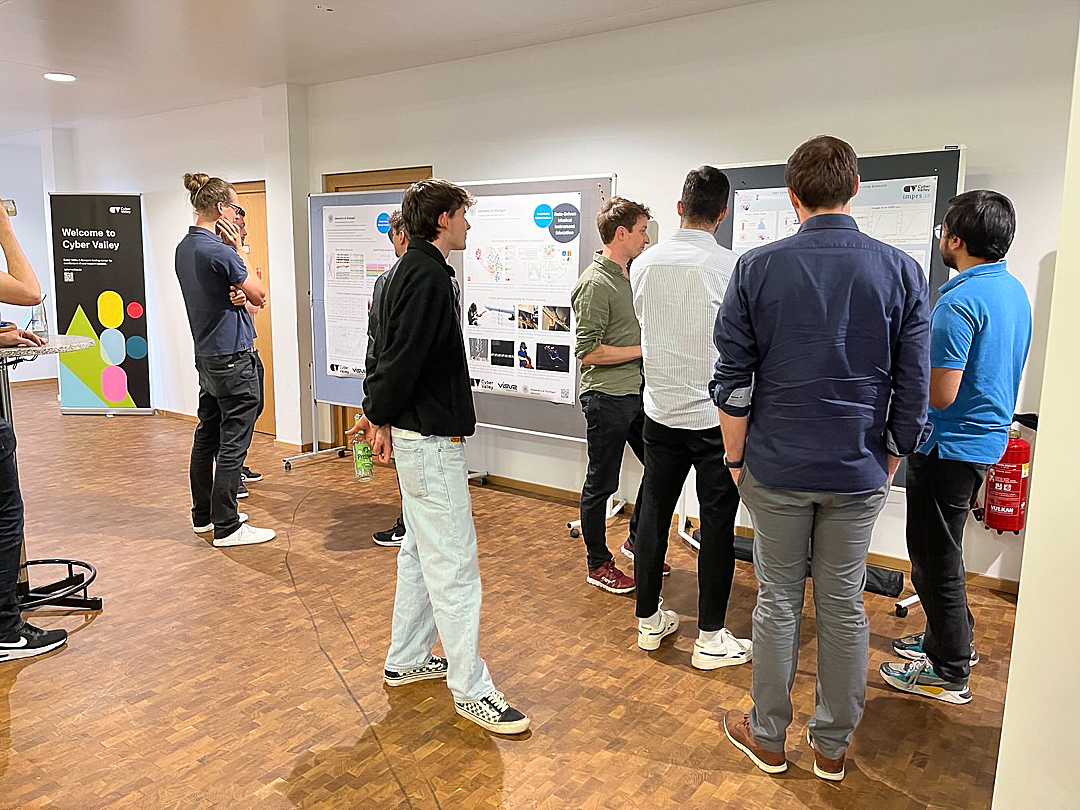
    Poster session at the Cyber Valley Research Fund Symposium. Photo: Cyber Valley

    Fabian Sinz (Professor of Machine Learning, University of Göttingen) presented the third Cyber Valley Research Fund project: “Mechanisms of Representation Transfer”. Sinz discussed the transference of strong visual processing skills between artificial neural networks and biological ones. 

    Fraunhofer covers robotics and GenAI 

    The Cyber Valley Research Fund also welcomed two talks from Fraunhofer IPA and Fraunhofer IAO. Werner Kraus (Head of Robot and Assistive Systems and Leader of the AI Innovation Center, Fraunhofer IPA) presented a review of the European Robotics Forum that took place in March 2025 in Stuttgart – the first time the conference has happened in Germany. Chandan Kumar (Team Leader of Interaction Design and Technologies at Fraunhofer Institute for Industrial Engineering IAO) then gave insights on “Smart Innovation with LLM-Powered Agents”. 

    Cyber Valley Research Fund Projects – (Flight) Robotics 

    Two projects led by Aamir Ahmad (Tenure-track Professor of Flight Robotics and Deputy Director of Research at the Institute of Flight Mechanics and Controls, University of Stuttgart, and Research Group Leader at the Max Planck Institute for Intelligent Systems) came next. Ahmad’s first project “WildCap – Autonomous Animal Motion Capture for Wildlife Conservation” developed autonomous flying robots that monitor wild animals using onboard sensors and wireless communication. He highlighted that AI methods enable them to detect, track, and interpret behavior, and how they adapt based on monitoring accuracy. 

    Christian Gall (Research Associate at the University of Stuttgart’s Institute of Flight Mechanics and Controls) is part of Ahmad’s research group and led the second project “Decision Making for Environmental Energy Exploitation with Small Aircraft”. Gall introduced a learning approach that permits aircraft to autonomously detect and exploit thermal updrafts. 

    Cyber Valley Research Fund Industry Partners 

    Four representatives from Cyber Valley’s industry partners shared their research in the first afternoon session. Mohsen Kaboli (Head of AI, Robotics and Cognitive Vehicle Research at BMW Group, and Professor of Embodied AI, Robotics, and Tactile Intelligence at the Eindhoven University of Technology) spoke about “Embodied Interactive Visuo-Tactile Perception and Learning for Robotic Grasp and Manipulation”. Maximilian Rabus (Product Manager and Data Strategist at Porsche AG) subsequently presented on “Data Fuels Performance: Insights into Porsche’s Data-Driven Development”, followed by Alexander Joos (Senior Vice President of Digital Solutions Powertrain at IAV GmbH) on “The Modern Development in the Age of AI”. 

    Cyber Valley Research Projects from Clusters of Excellence 

    The afternoon continued with a talk from Paul-Christian Bürkner (Professor of Computational Statistics at TU Dortmund University) on “Meta-uncertainty in Bayesian model comparison”. He highlighted the methods to quantify meta-uncertainty – the uncertainty over model probabilities in Bayesian model comparison – using theory and simulations to better understand the limits of scientific inference. 

    Next, Nicolas Kubail-Kalousdian (Institute of Computational Design and Construction, University of Stuttgart) gave his talk “Task and Motion Planning for Collaborative Robotic Construction with Irregular Materials”. His research developed a robotic construction system that combines reinforcement learning and logic-geometric programming to autonomously build with irregular, renewable materials like bamboo. The system showcases a sustainable, adaptive approach to low-carbon construction using mobile robots and intelligent material handling. 

    Cyber Valley Research Fund Projects – Specific research areas 

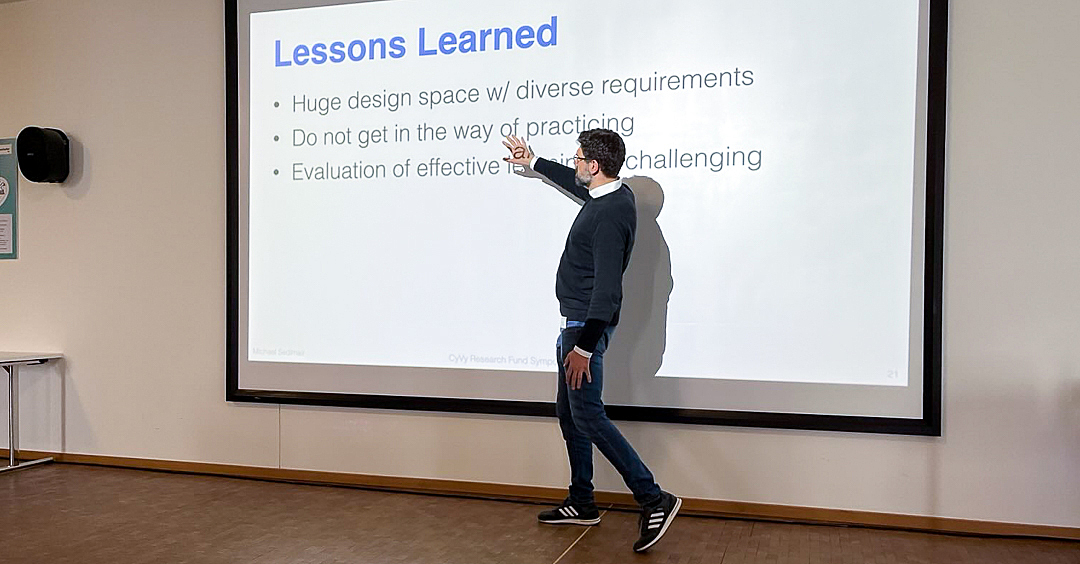
    In the symposium’s concluding session, Michael Sedlmair (Professor for Augmented Reality and Virtual Reality, University of Stuttgart) began by exploring how AI can support musical creativity. In “InstruData – Data-Driven Musical Instrument Education” he discussed how his research project used AI to augment creative processes through human-centered design. 

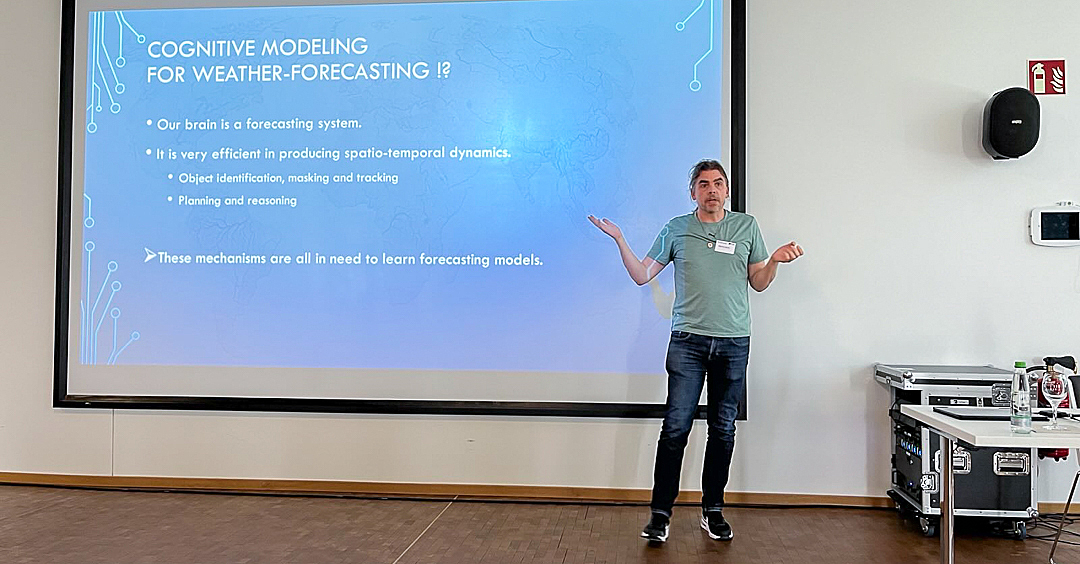
    Next, Martin Butz (Professor in Cognitive Modeling, University of Tübingen) discussed spatiotemporal forecasting models in “Neural Generative Weather Forecasting”. This project developed deep-learning models for forecasting spatiotemporal phenomena, ranging from local precipitation to global weather patterns. It utilized physics-informed, modular architectures and tailored data structures to improve prediction accuracy across diverse environmental scenarios. 

    In the final presentation, Falk Lieder (Assistant Professor of Psychology and Director of the Rational Altruism Lab, University of California Los Angeles) explained how his research has improved human decision-making. His project, “A Scalable Machine Learning Approach to Improving Human Decision Making”, developed computational tools which optimize decision-making strategies that outperform human intuition in areas like education, health, and finance. By integrating these strategies into educational software, they improved the quality of users’ decisions, resulting in smarter, more informed choices in real-world scenarios. 

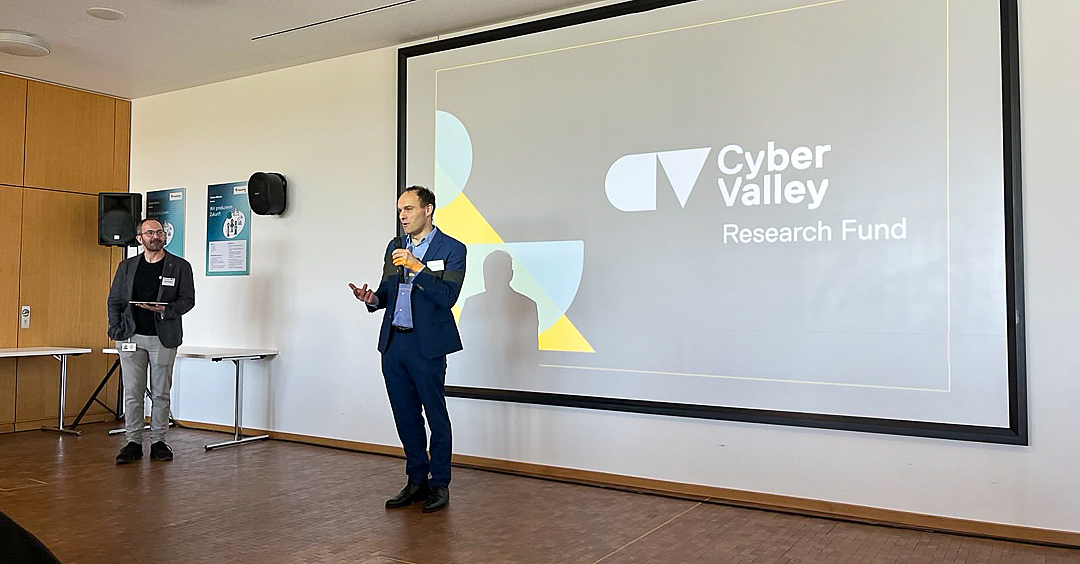
    The Cyber Valley Research Fund Symposium demonstrated the research excellence in AI and modern robotics generated through the support of Cyber Valley’s founding industry partners. The day was rounded off by a lively networking session, which included discussions on open research questions and future collaborations.