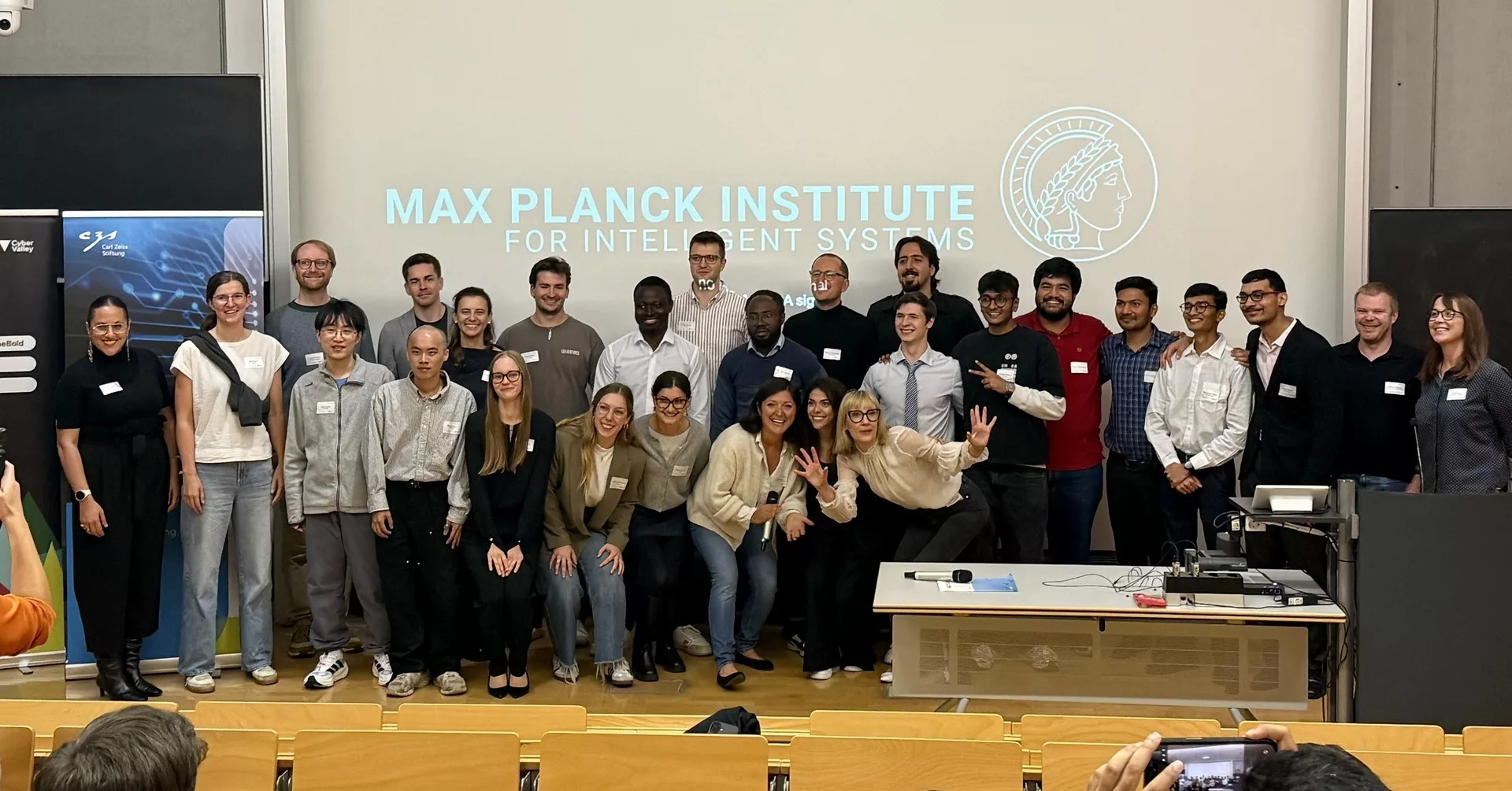
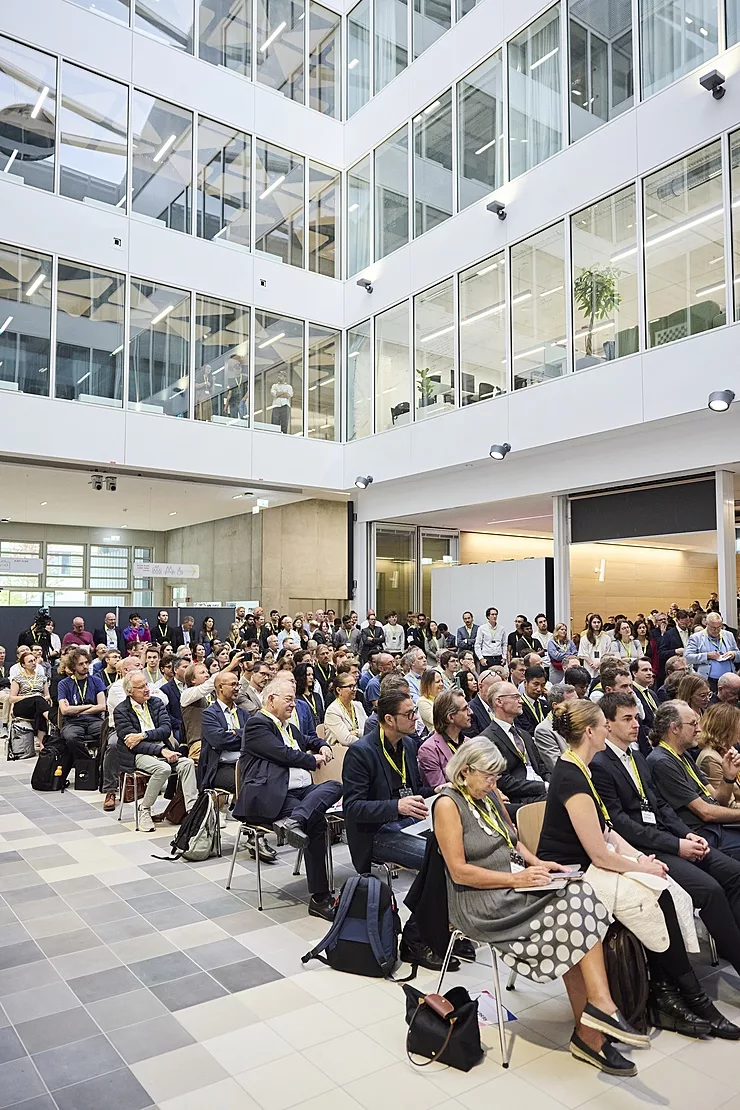
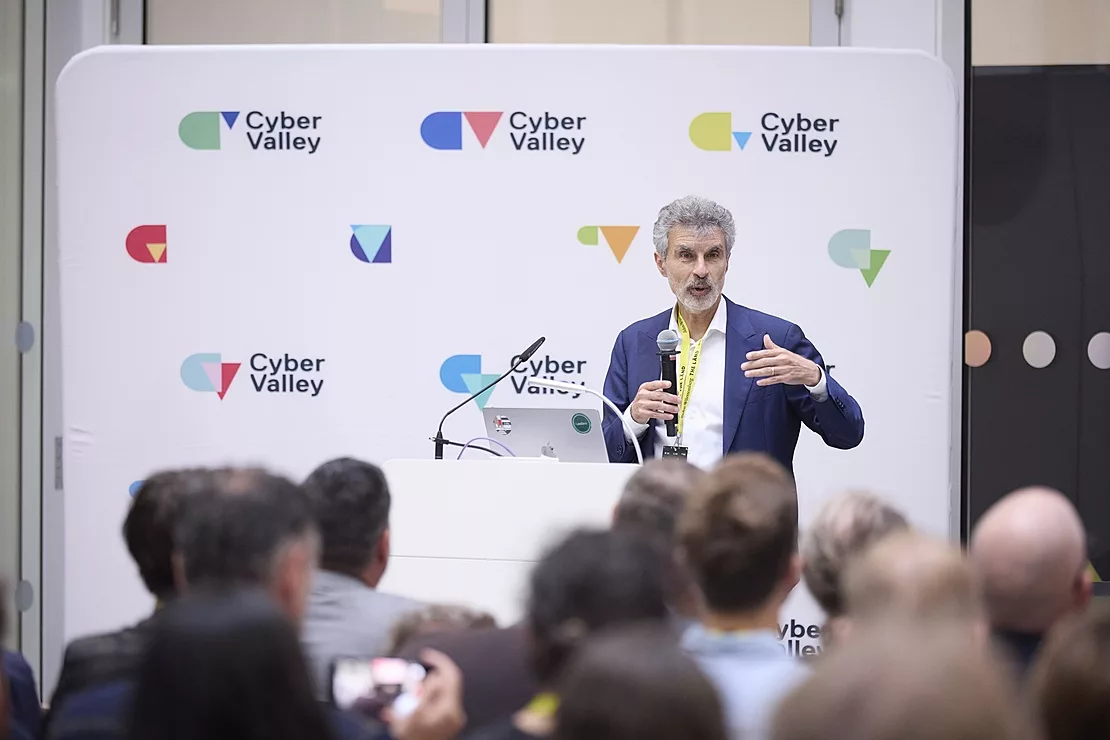
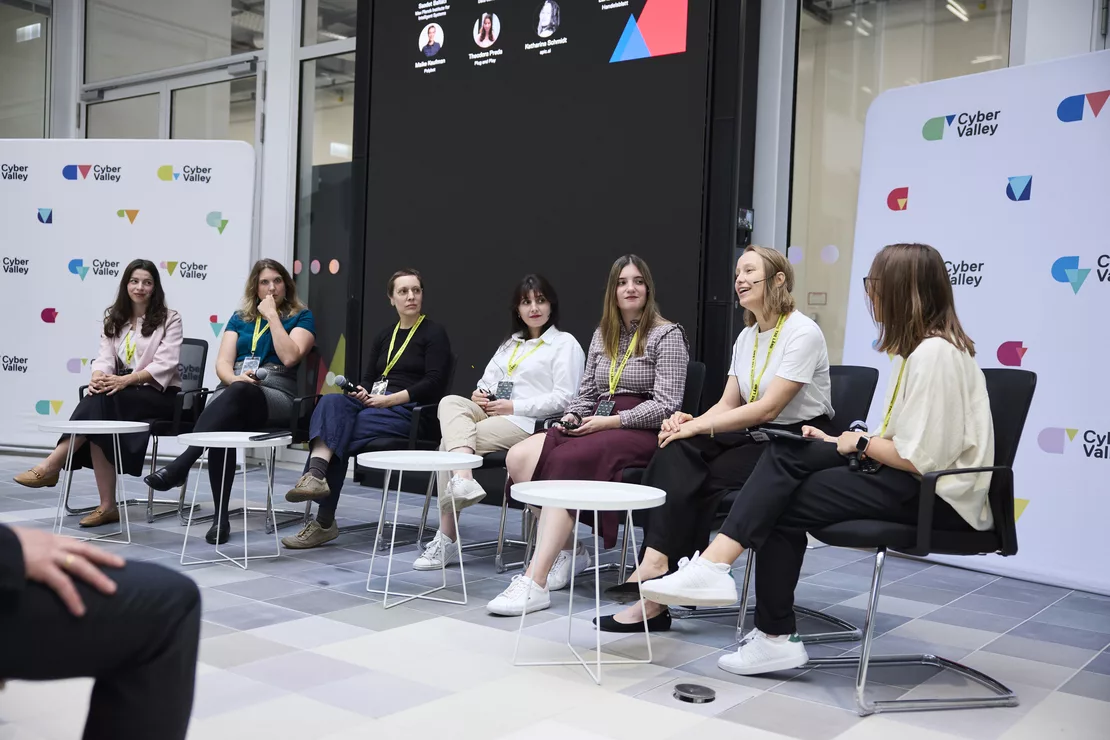
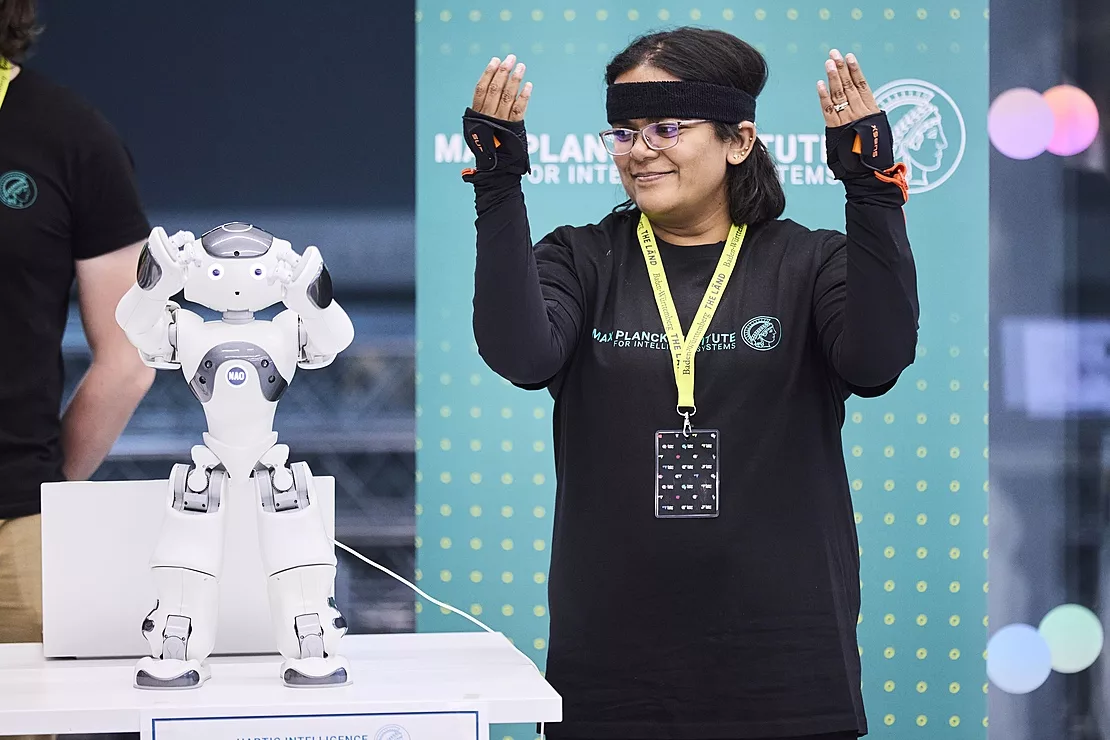
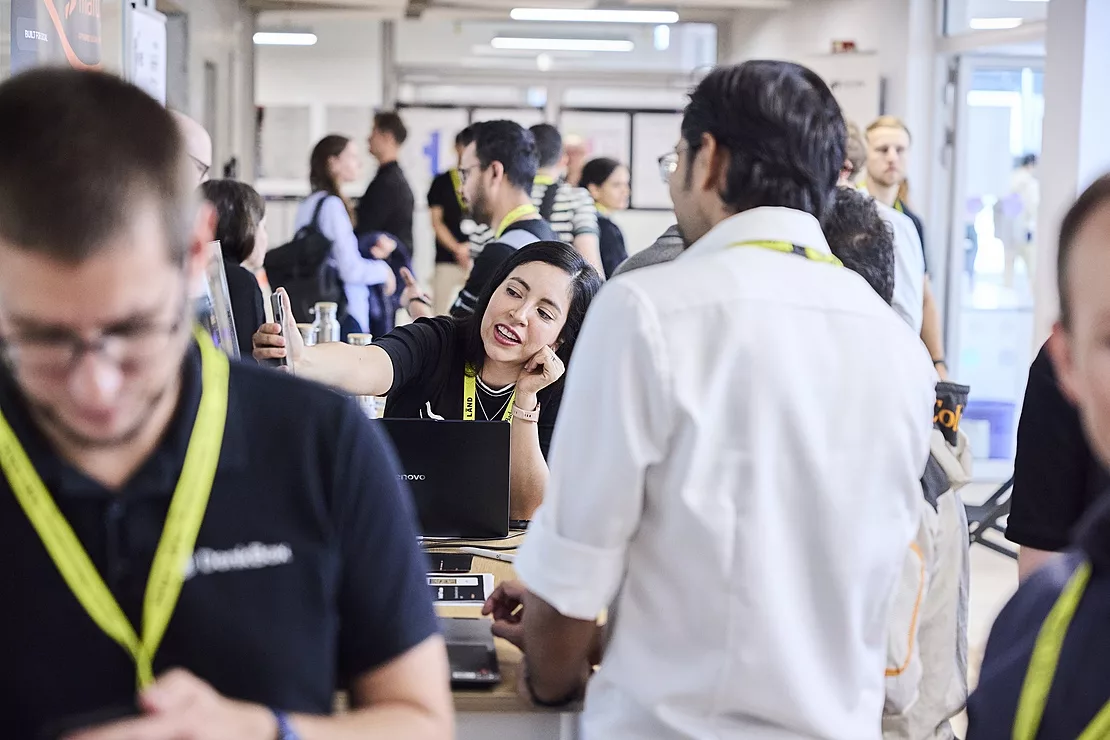
The Batch #9 of the Cyber Valley AI Incubator concluded successfully with its Demo Day on October 16, where seven emerging AI ventures presented their innovations to an audience of founders, investors, researchers, and members of the AI community. Made possible through the generous funding of the Carl Zeiss Foundation (CSZ), organized by the Max Planck Institute for Intelligent Systems (MPI-IS) and the International Max Planck Research School for Intelligent Systems (IMPRS-IS), the Cyber Valley AI Incubator continues to foster research-driven AI entrepreneurship by helping innovators transform cutting-edge ideas into start-up ventures.
Hosted at the MPI-IS in Stuttgart, Demo Day marked the culmination of two weeks of intensive workshops exploring customer needs, business models, funding, prototyping, and pitching. The event opened with welcome remarks from Christoph Keplinger and Leila Masri of the Max Planck Institute for Intelligent Systems (MPI-IS), who reflected on the achievements of batch 9 and the growing impact of the AI Incubator. Lukas Findeisen of the Carl-Zeiss-Stiftung, the program’s principal sponsor, highlighted the foundation’s continued commitment to advancing innovation and research-driven entrepreneurship.
A highlight of the evening was the keynote address by Theodora Preda, partner at Plug and Play, who shared insights into the investor mindset and investing dynamics, offering perspectives on how investors assess opportunities, and what founders should understand when approaching the investment landscape.
The spotlight then turned to the batch 9 teams, who presented their final venture pitches before an expert jury consisting of:
Christoph Keplinger (Director, Max Planck Institute for Intelligent Systems)
Daisy De Souza Paiva (Senior Program Manager, ZEISS Ventures)
Maximilian Worms (Analyst, LEA Ventures)
With all seven teams demonstrating an exceptionally high standard, selecting the winners proved challenging.
The following ventures were recognized for their outstanding achievements:
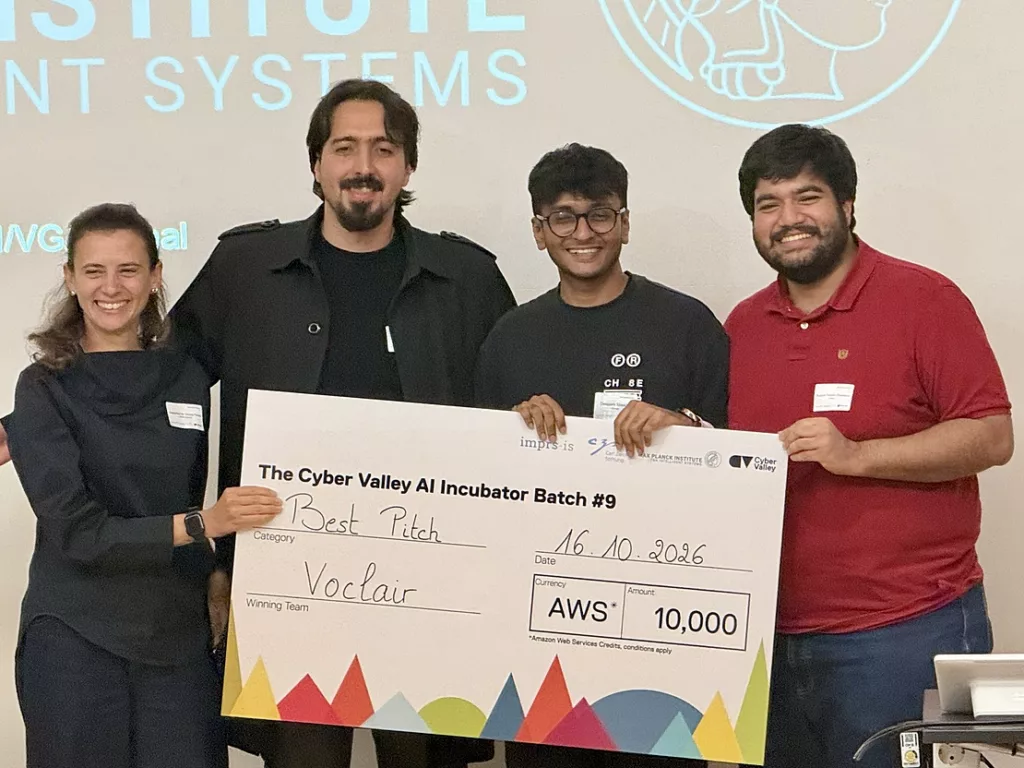
Best Pitch Award: Voclair, founded by Rustom Firdosh Bhesania, Mehryar Lessani, Deepam Maurya
Jury member Daisy De Souza Paiva, Founders Mehryar Lessani, Deepam Maurya, Rustom Firdosh Bhesania (from left to right). Copyright: Cyber Valley GmbH
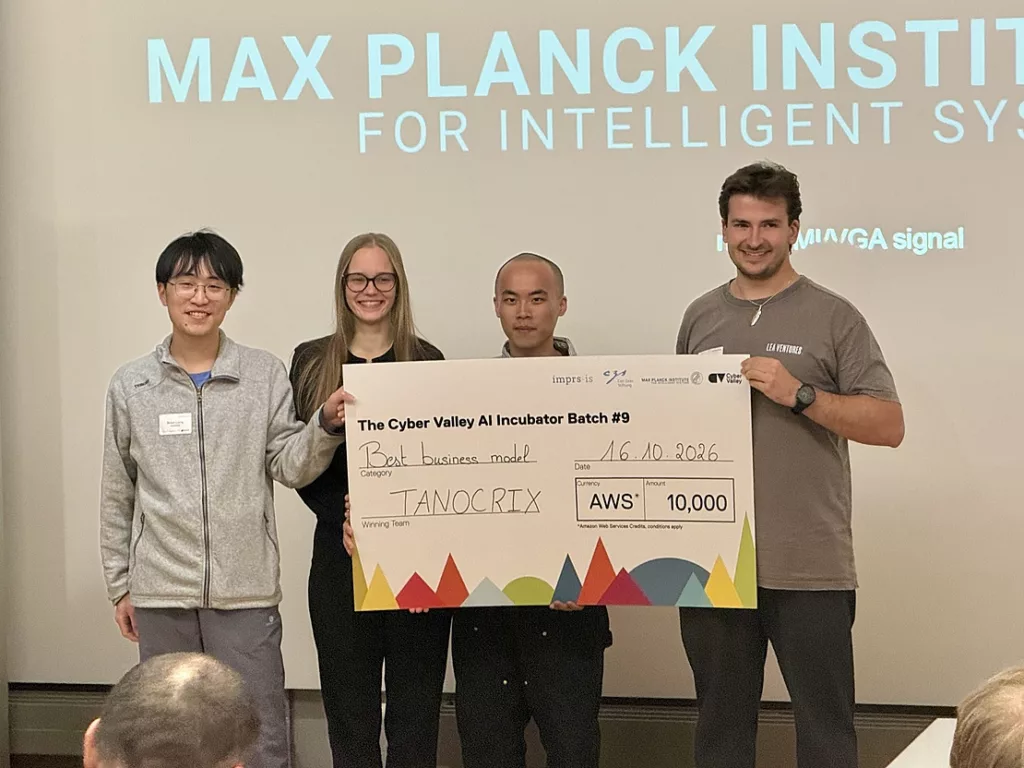
Best Business Model Award: TANOCRIX, founded by Marta Kriukova, Bolun Liang, Wei-Bo Tang
Founders Bolun Liang, Marta Kriukova, Wei-Bo Tang, jury member Maximilian Worms (from left to right). Copyright: Cyber Valley GmbH
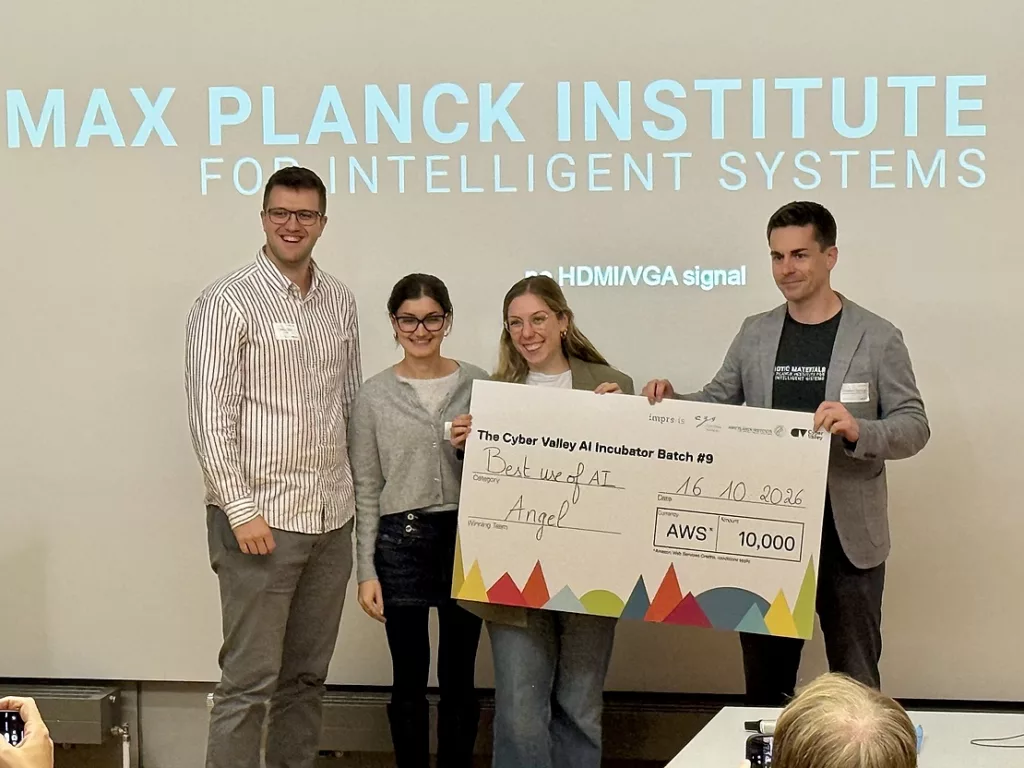
Best use of AI Award: Angel, founded by Melis Ilayda Bal, Stefano Esposito, Michela Petriconi, Marko Zaric
Founders Marko Zaric, Melis Ilayda Bal, Michela Petriconi, jury member Christoph Keplinger (from left to right) Copyright: Cyber Valley GmbH
Each winning team received $10,000 in AWS Credits, generously provided by Amazon, to support the continued development and scaling of their AI solutions.
The evening concluded with a networking reception, providing participants, mentors, investors, and guests with the opportunity to celebrate the achievements of Batch 9 and strengthen connections across the Cyber Valley innovation ecosystem.
About the Cyber Valley AI Incubator
Organized by the International Max Planck Research School for Intelligent Systems (IMPRS-IS) and the Max Planck Institute for Intelligent Systems (MPI-IS), the Cyber Valley AI Incubator continues to play a key role in supporting research-driven entrepreneurship within the Cyber Valley ecosystem. The program is made possible through the generous support of the Carl Zeiss Foundation, whose commitment to advancing innovation and scientific entrepreneurship enables researchers and innovators to bring their AI ideas closer to real-world application.
The Cyber Valley AI Incubator is designed to help researchers, engineers, and aspiring entrepreneurs bridge the gap between scientific discovery and startup creation. Open to participants from fields including artificial intelligence, robotics, computer vision, machine learning, biomedical technology, and data science, the program combines entrepreneurial education with mentorship from experienced founders, investors, and innovation experts.
The Cyber Valley Innovation Campus brings top scientists to Baden-Württemberg to advance AI and robotics research. These scientists are paving the way for the application of their research for the benefit of people, industry, and society.
Frank Allgöwer recognized for outstanding scientific contributions
The European Control Association (EUCA) and the Asian Control Association (ACA) have welcomed Frank Allgöwer as a fellow, recognizing his outstanding contributions to the field of systems and control engineering. Allgöwer is the first European to become a fellow at the ACA, which is one of the highest honors bestowed by the Asian control engineering community. Read more.
Jakob Macke and Kashyap Chitta join the ELLIS Institute Tübingen
Jakob Macke and Kashyap Chitta have joined the ELLIS Institute Tübingen, both as Principal Investigators and Hector Endowed Fellows.
Macke is already an established figure in the Tübingen machine learning and computational neuroscience ecosystem and will shape the Institute’s research direction. Read more.
Chitta is an expert in autonomous systems and physical AI, and will lead a new research group: the Physical AI Lab. The group focuses on understanding how machines interact with the physical world. Read more.
Andrea Iannelli awarded ERC Starting Grant
The European Research Council (ERC) is providing EUR 1.65 million in funding for Andrea Iannelli’s research project on autonomous systems that can adapt to complex tasks and changing environments while in operation. Gaining a Starting Grant is considered a highly prestigious achievement for early-career researchers in Europe. Read more.
Marcel Binz joins the Max Planck Institute for Biological Cybernetics
Marcel Binz has begun his research on a unified theory of human cognition using computational models at the Max Planck Institute for Biological Cybernetics. These models aim to simulate, predict, and explain human behavior in diverse situations.
Binz’s research examines the central building blocks of human cognition by addressing three challenges: 1) the technical challenge of building such models in the first place; 2) the scientific challenge of using these models to understand human cognition; 3) the applied challenge of translating this into real-world applications. Read more.
AI Incubator alumni SKAI receives EXIST Startup Grant
SKAI participated in the Cyber Valley AI Incubator in 2024 to develop a company that applies AI for the cosmetics industry. With the support of the EXIST Startup Grant, the team will be able to focus on developing SKAI and preparing for its launch in the coming months. Read more (German).
Ontic Labs and Feyer selected for SPRIND’s Next Frontier AI Challenge
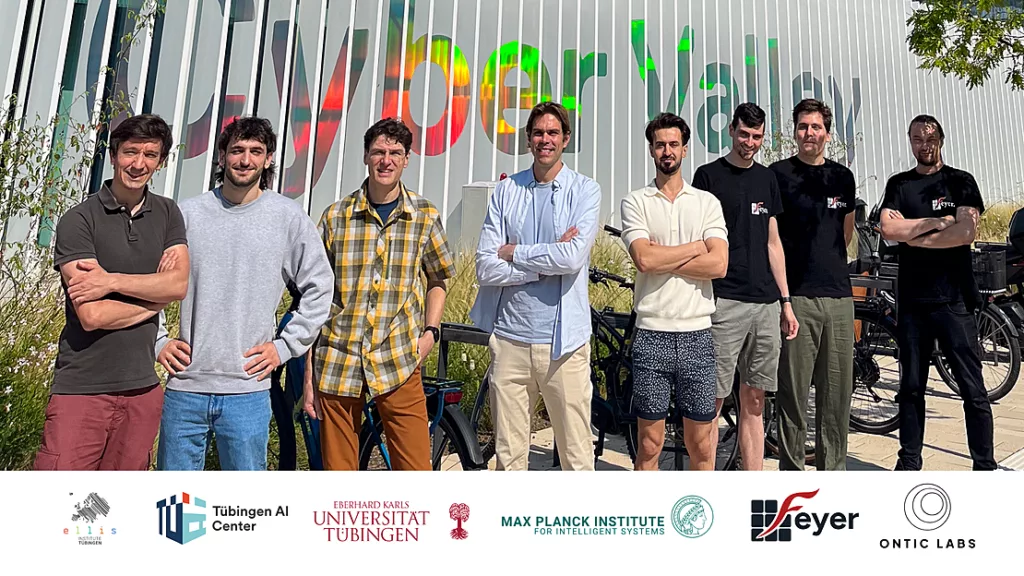
Ontic Labs and Feyer were selected for the first stage of the German Federal Agency for Breakthrough Innovation’s (SPRIND) Next Frontier AI Challenge. The two start-ups are both spin-outs from institutions from the Cyber Valley Innovation Campus, including the ELLIS Institute Tübingen, Max Planck Institute for Intelligent Systems, Tübingen AI Center, and the University of Tübingen. Each team will receive €3 million to develop technologies that go beyond today’s AI models. Read more.
Makysm Andriushchenko has co-founded the start-up Exponential Security Labs. Andriushchenko is a Principal Investigator at the ELLIS Institute Tübingen and leads the AI Safety and Alignment group.
The Tübingen-based start-up aims to improve the security and reliability of AI agents. Its work is based on decades of basic research in adversarial robustness and AI safety, showcasing how AI research can be applied to solve real-world problems. Read more.
EIT awards funding for the C-VENTURE project
The University of Tübingen has successfully applied for funding from the EIT (European Institute of Innovation and Technology) Higher Education Initiative together with five partner universities and innovation partners. The funding will support the C-VENTURE Project, of which the Tübingen Startup Center is a part. The Project will connect the fragmented initiatives that support entrepreneurship and knowledge transfer from thet different universities into a cohesive system. Read more (German).
There was a lot happening at Cyber Valley last month. Here’s a quick roundup of our highlights from September. Find out how Cyber Valley’s mission to translate excellent research into real-world applications for a better future for everyone came to life.
Celebrating ten years of the Cyber Valley Innovation Campus: Cyber Valley Day 2026
On September 9, more than 850 guests came to Tübingen to celebrate a very special milestone: ten years of the Cyber Valley Innovation Campus. Researchers, start-ups, investors, policymakers, partners from industry and society, as well as many other guests gathered for a day full of inspiring talks, surprising keynotes, a research exhibition, start-up presentations, investor sessions, and networking.
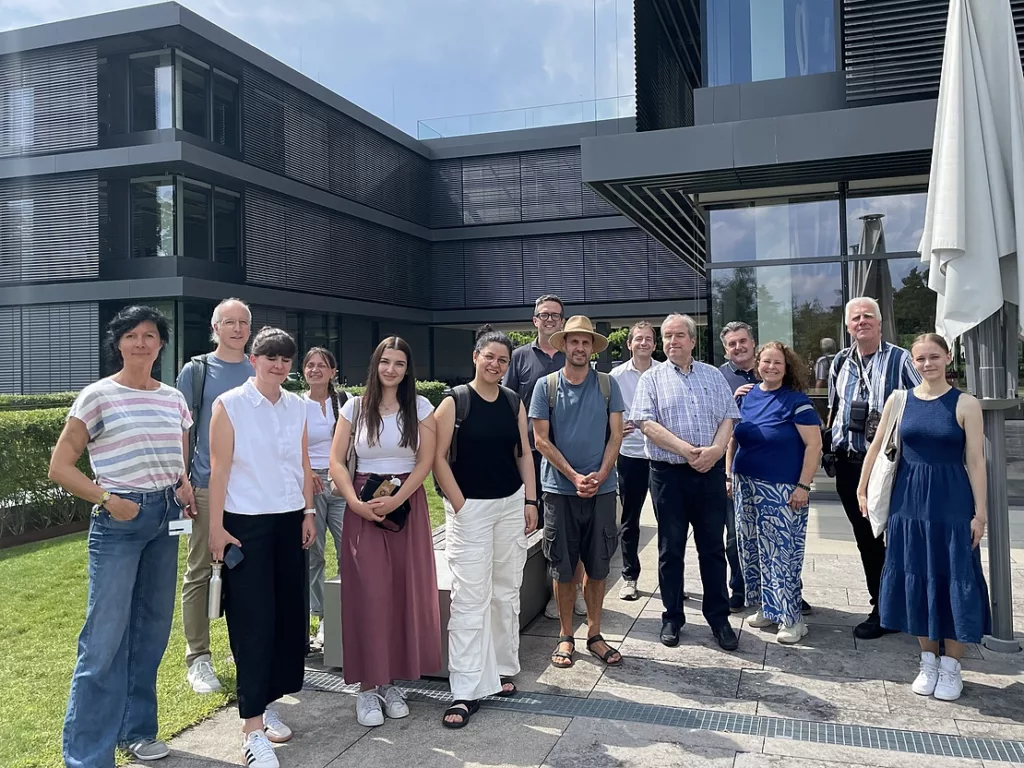
Welcoming Tech Fellowship journalists from Publix Berlin
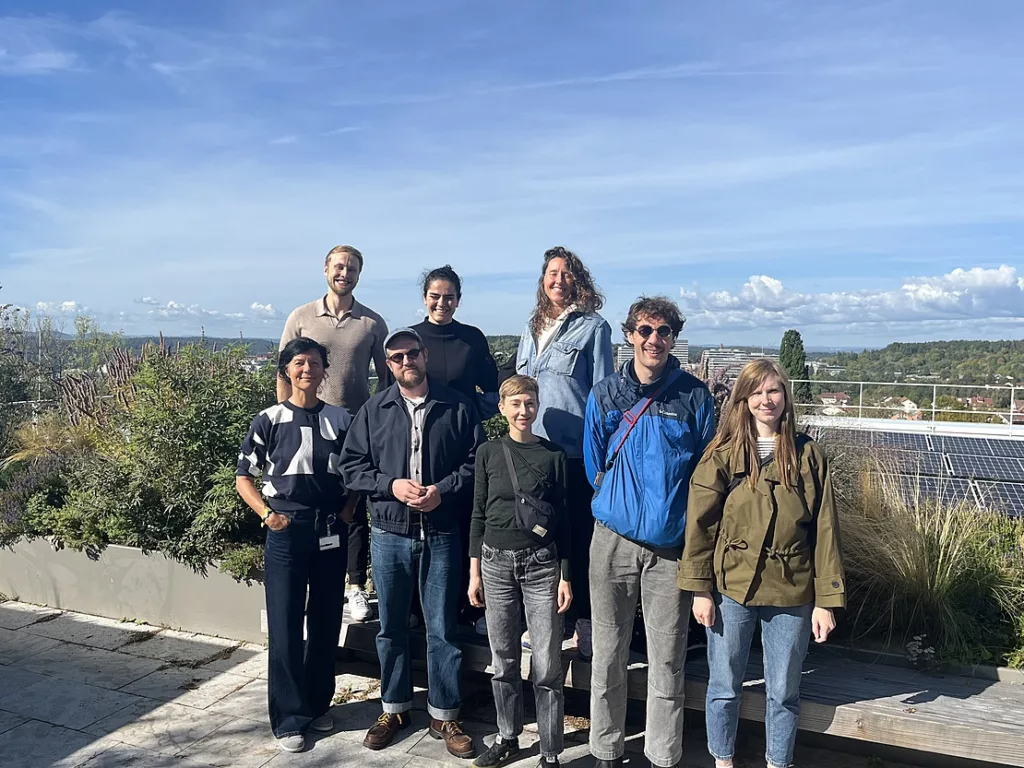
On September 17, we welcomed participants of the Tech Journalism Fellowship from „Publix Berlin – Haus für Journalismus und Öffentlichkeit“ in Tübingen. The group included Fatemeh Khodadadian, Bastian Hosan, Sonja Peteranderl, Jonathan Kemper, and Carina Schroeder, accompanied by Dr. Eva von Grafenstein.
This year’s fellowship focuses on the topic of “Ethical AI” and brings together journalists from Tagesspiegel Background, DER SPIEGEL, Deutschlandfunk, heise, WIRED, and DIE ZEIT for a year of exploring and reporting on artificial intelligence.
As part of a week-long visit to Baden-Württemberg to learn about the region’s AI ecosystem, the fellows gained insights into research activities and technology transfer across our Innovation Campus. Our discussions also addressed current developments, open questions, and challenges in AI and robotics.
Copyright: Cyber Valley
Visit of Rotary Club Rottenburg in Tübingen
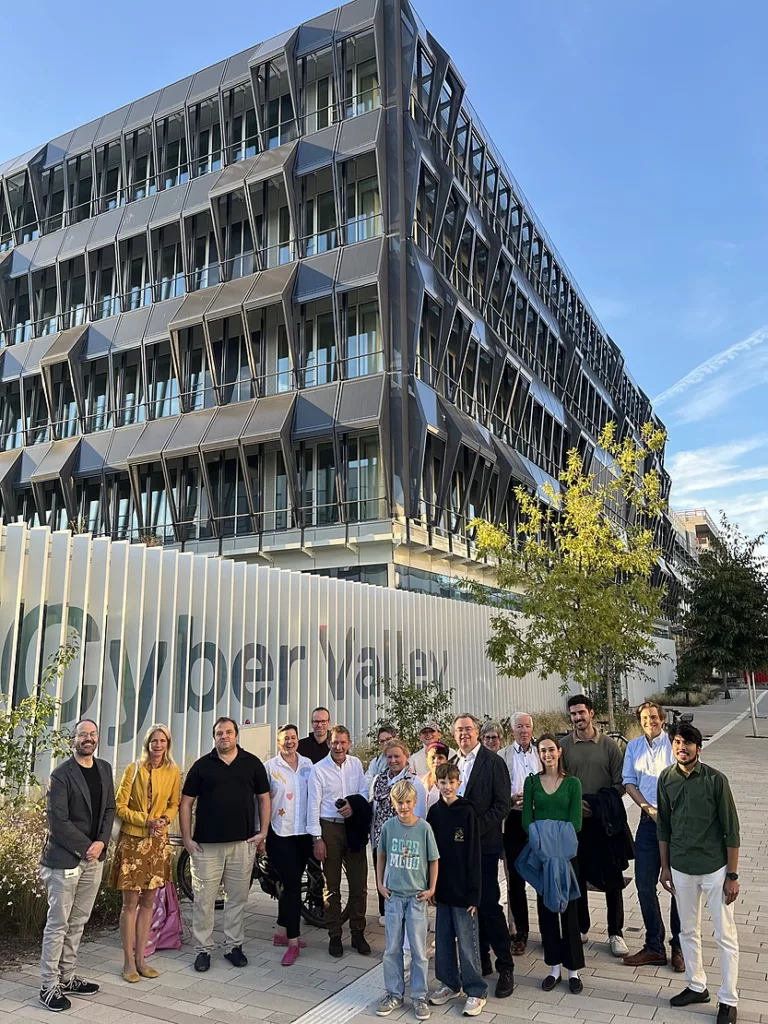
On September 23, members of the Rotary Club Rottenburg visited our campus in Tübingen for an introduction to our ecosystem and our activities at the intersection of AI, research, and innovation.
CEO Florian Mayer guided the visitors through the building, offering insights into the history of the campus. Silke Dutz introduced the Innovation Campus, its mission, and its role in advancing AI research and technology in the region.
The visit was organised by Benjamin Jetter and Melanie Jetter in collaboration with the Rotary Club Rottenburg and provided an opportunity to learn more about Cyber Valley and engage in discussions about the region’s innovation landscape.
Copyright: Cyber Valley
Co-Hosting event with Marketing Club Neckar-Alb
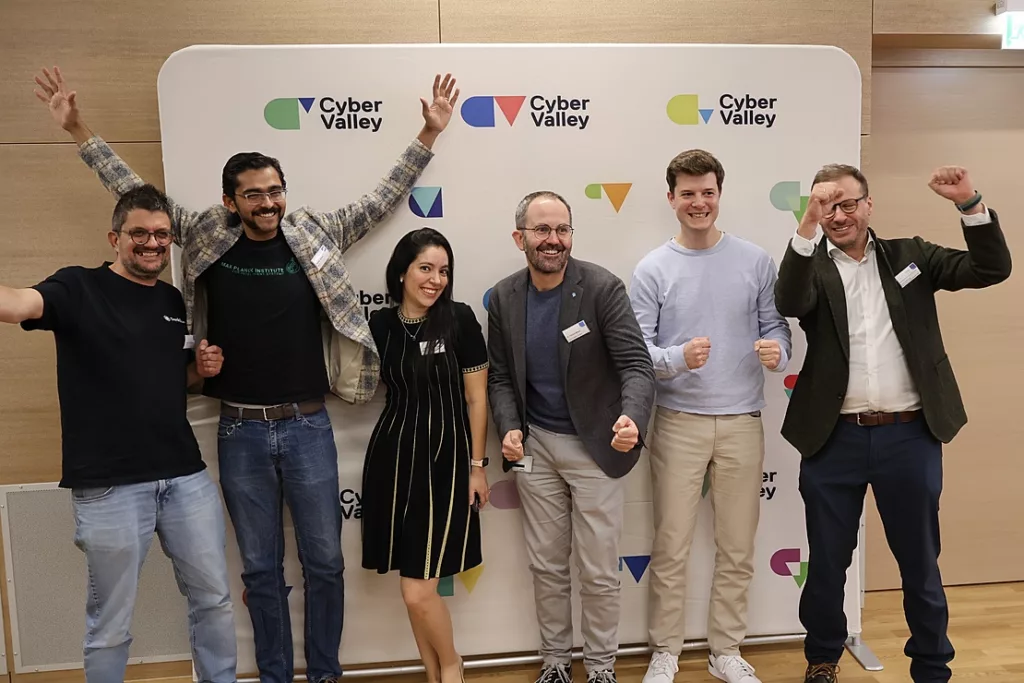
On September 24, Cyber Valley and the Marketing Club Neckar-Alb e.V. co-hosted an evening dedicated to startups, technology, and knowledge transfer in Tübingen. Moderated by Christoph Koppensteiner, the event opened with a conversation with our CEO Florian Mayer followed by presentations from four startups from our Start-up Network. The Start-ups introduced their businesses, technologies, and current activities:
Maddox AI, represented by Cornelius Widmaier
Spotium, represented by Patrick Duffner, who stepped in for Lisa Raab and Nico Raab
DenkBox GmbH, represented by Hannes Planatscher
MaiTY, represented by Partha Ghosh and Valentina Rodríguez Pasmiño
A subsequent panel discussion explored emerging technologies, new applications, and the opportunities and challenges AI presents for businesses and society. The evening concluded with networking over food and drinks, providing participants with further opportunities to exchange ideas and establish connections.
Copyright: Cyber Valley
Open Lab Day at KI-Fortschrittszentrum Stuttgart
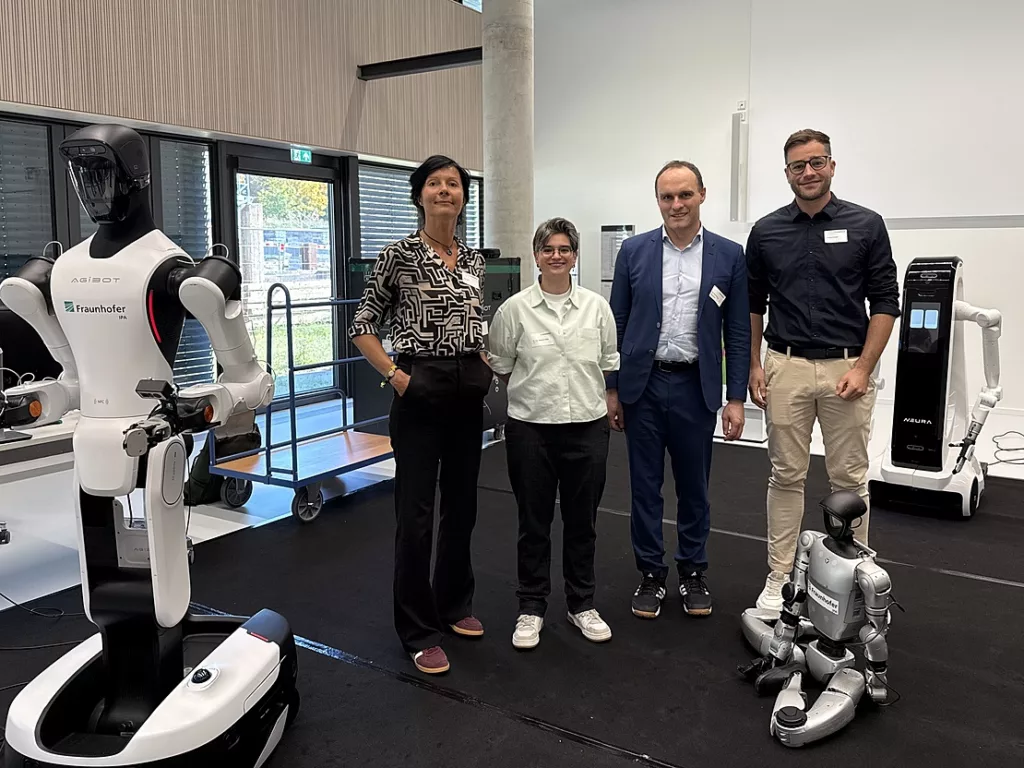
On September 30, we participated in the Open Lab Day of the KI-Fortschrittszentrum in Stuttgart. Organised by Fraunhofer IAO, Fraunhofer IPA, and the Institute of Human Factors and Technology Management (IAT) at the University of Stuttgart, the event welcomed more than 120 participants from industry and research.
The programme focused on the practical application of AI and robotics, addressing both technological possibilities and regulatory considerations. As a partner of the KI-Fortschrittszentrum, we contributed to the event with a welcome adress and an introduction to our ecosystem and role in advancing AI research and innovation. Participants gained insights into a range of current topics, including generative and agentic AI, humanoid robotics, AI compliance, and the EU AI Act. Guided tours of the Reallabor provided hands-on insights into practical applications, featuring demonstrations of AI-based quality inspection, service assistants, humanoid robots, intelligent process control, and AI-supported document processing.
The event offered a great opportunity for exchange between companies, researchers, and robotics experts, showing the wide range of innovative technologies, research activities, and practical applications developed across our Innovation Campus.
Europe needs a breakthrough in robotics. That’s why SPRIND, the German Federal Agency for Breakthrough Innovation, has launched the Next Frontier Robotics Challenge.
Without breakthroughs of our own, we risk critical dependencies. That‘s why SPRIND is launching Next Frontier Robotics – a €90m challenge to build a modular, interoperable European robotics ecosystem for complex physical work such as in logistics, maintenance, and construction. We have the experience and the best talent in mechanical engineering, precision mechanics, automation, precision manufacturing, and computer science to shape the next era of robotics from Europe – and keep safety and sovereignty in European hands.
The goal
Develop full-stack robot platforms that handle complex physical tasks in real environments or novel robotic hardware components with breakthrough capabilities.
What’s in it for you
Up to €7.2 million in non-dilutive funding per team across 4 stages (36 months total) – with potential follow-on funding for the most successful
Venture development support, coaching, and direct access to potential customers, investors, and industry partners
Join a community of world-class teams working at the forefront of robotics
Who should apply
Visionary innovators from all domains: individuals, startups, research institutions and established companies located in the EU, EFTA or UK. You should ideally already be incorporated, or have a clear plan to get there. You can appply via two tracks:
Track 1 Integrated Platforms challenges teams to develop full-stack robotic systems that orchestrate hardware, software and AI to master real-world use-cases autonomously.
Track 2 Hardware Components focuses on modular hardware components such as gripping systems, artificial skin or tactile sensors that deliver a radical performance leap over the state of the art.
To introduce the SPRIND challenge as well as the team behind the scenes and to answer any open questions, SPRIND is hosting Roadshows in Tübingen (Cyber Valley), Munich (TUM), Zurich (ETH).
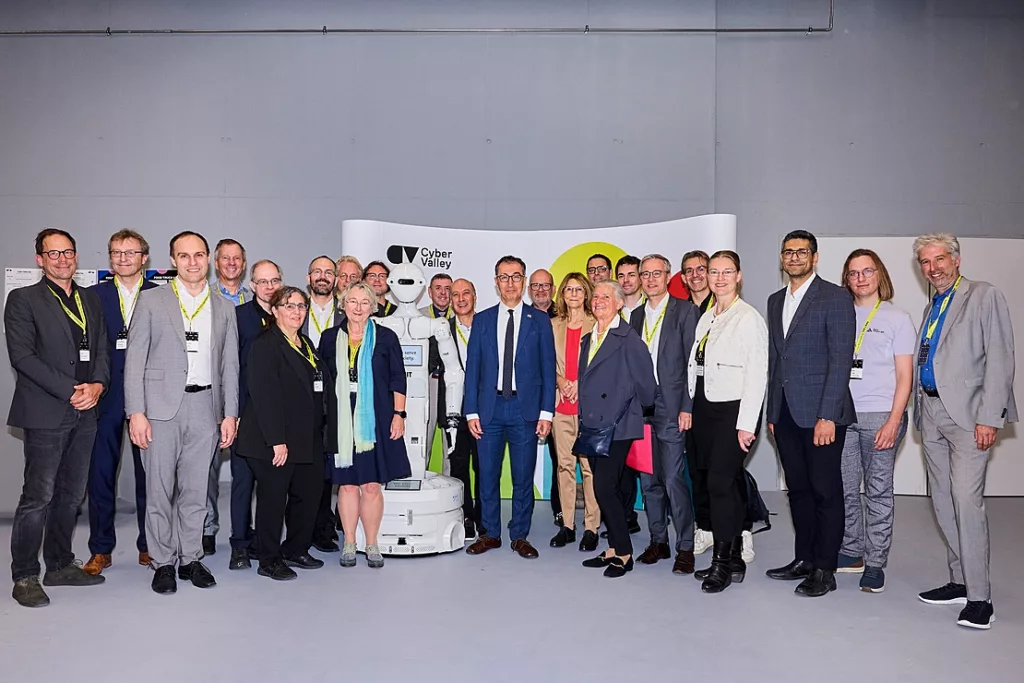
On September 9, more than 850 guests came to Tübingen to celebrate a very special milestone: ten years of the Cyber Valley Innovation Campus. Researchers, start-ups, investors, policymakers, partners from industry and society, as well as many other guests gathered for a day full of inspiring talks, surprising keynotes, a research exhibition, start-up presentations, investor sessions, and networking.
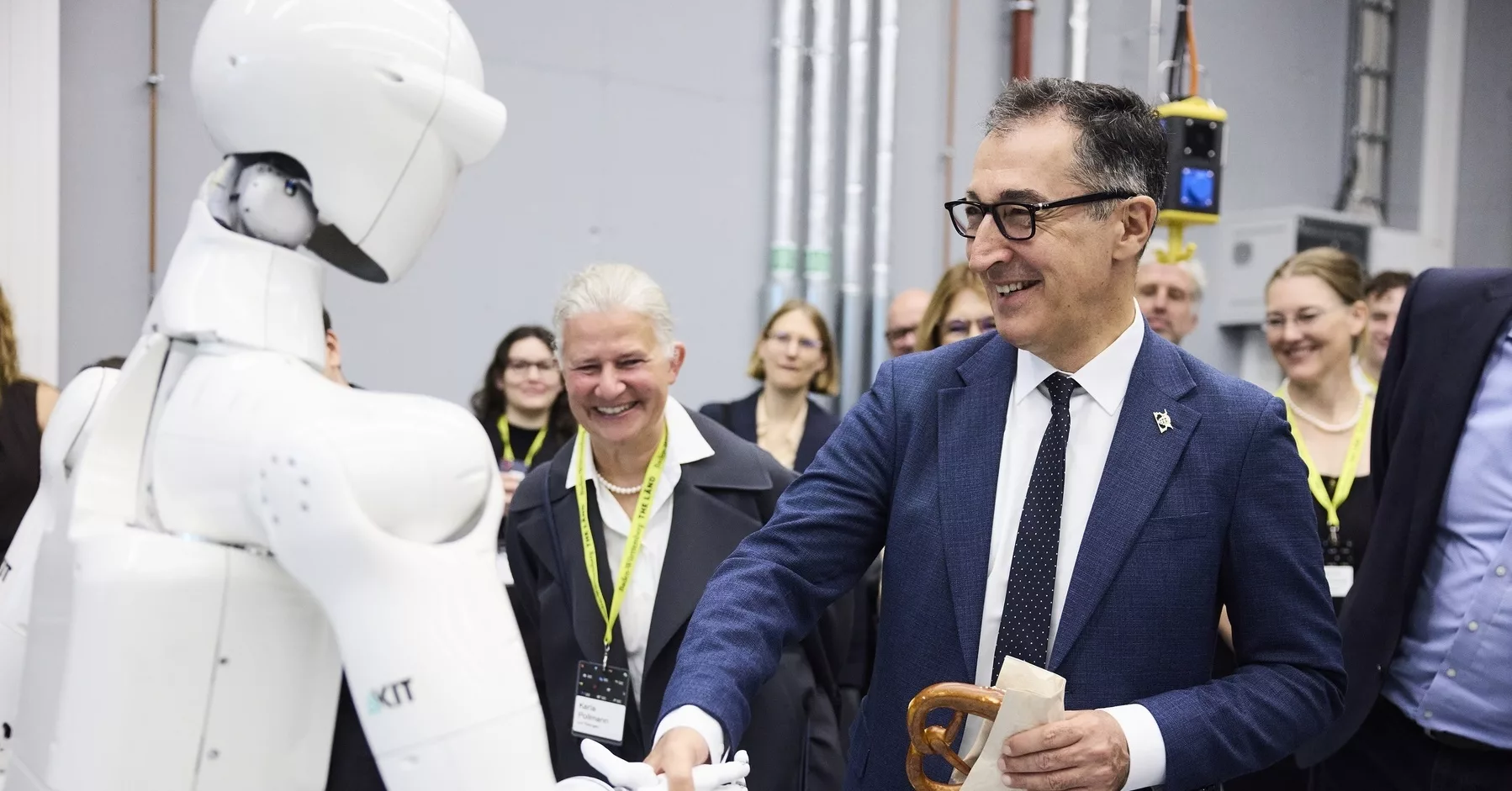
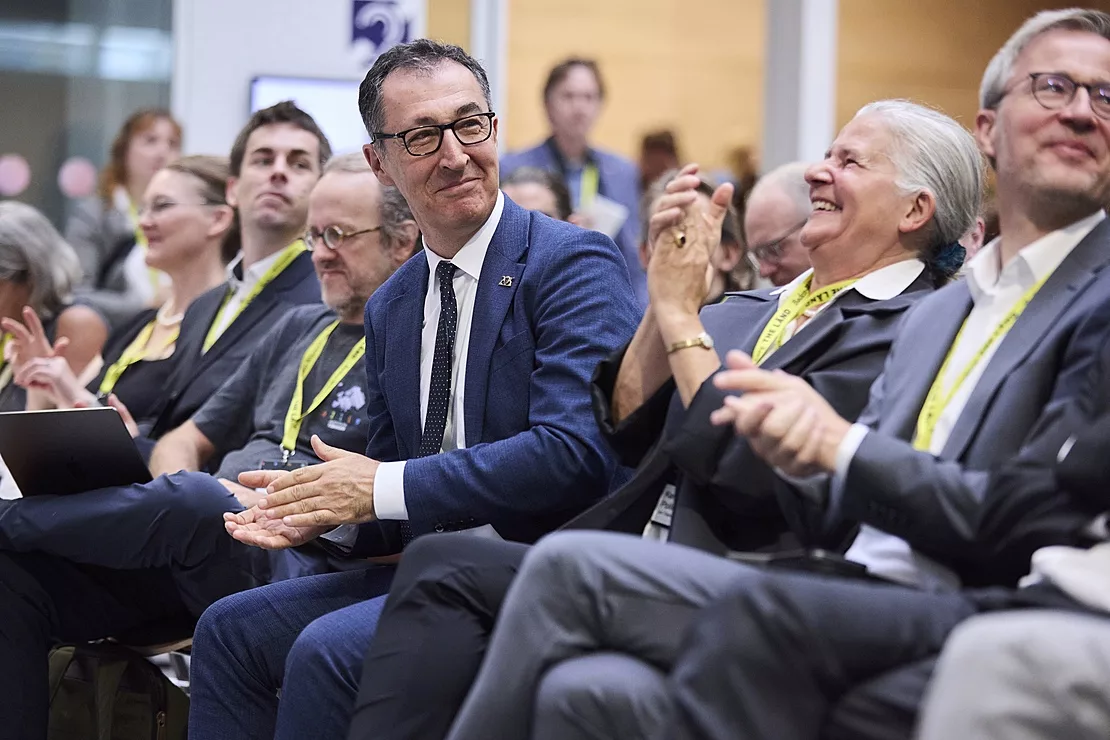
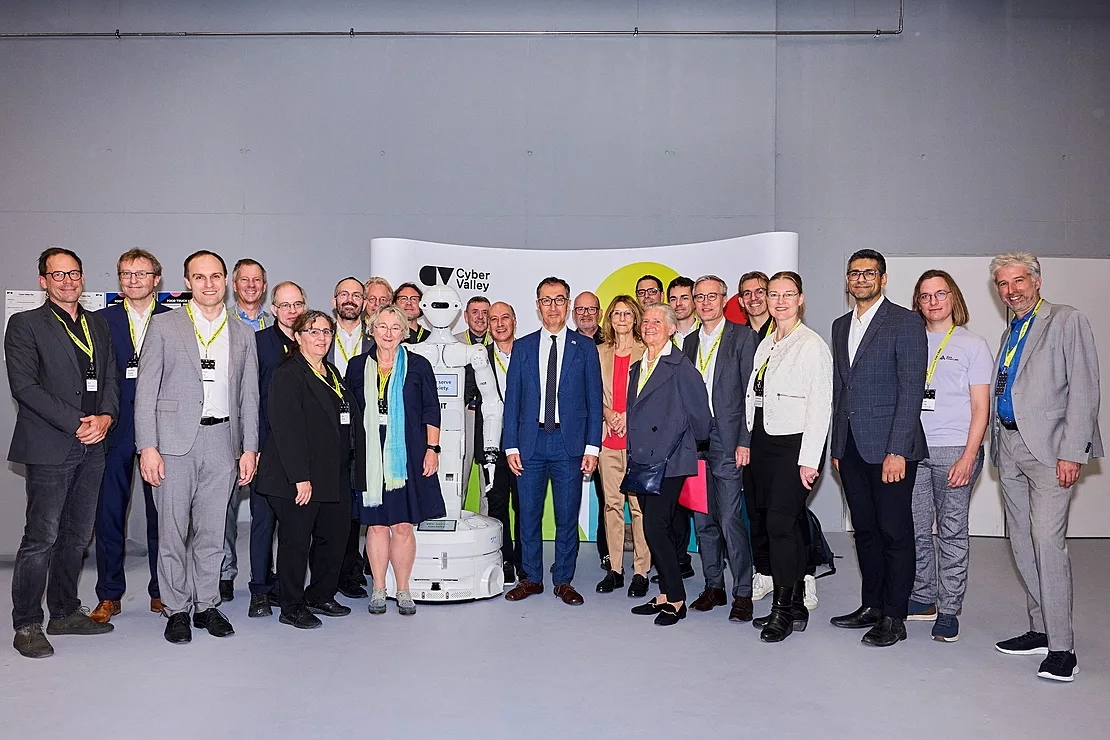
Cyber Valley Day opened with welcome addresses from leading representatives from politics, science, and our Innovation Campus: Moritz Hardt, Director at the Max Planck Institute for Intelligent Systems; Cem Özdemir, Minister President of Baden-Württemberg; Boris Palmer, Lord Mayor of Tübingen; Karla Pollmann, President of the University of Tübingen; Simone Schwanitz, Secretary General of the Max Planck Society; and Florian Mayer, Managing Director of Cyber Valley GmbH, welcomed guests to the anniversary celebration.
Hosted by Linda Behringer, press officer at the Max Planck Institute for Intelligent Systems, the main stage program brought together voices from across the international AI and innovation landscape.
A keynote by Manuela Veloso, Herbert A. Simon University Professor Emerita at Carnegie Mellon University, provided one of the early highlights of the day. Throughout the program, the Cyber Valley Voices sessions on the main stage featured leading researchers from across our Innovation Campus, including Bernhard Schölkopf from the ELLIS Institute Tübingen, Matthias Bethge from the Tübingen AI Center at the University of Tübingen, Tamim Asfour from the Karlsruhe Institute of Technology, Katherine J. Kuchenbecker from the Max Planck Institute for Intelligent Systems, Steffen Staab from the University of Stuttgart, and Werner Kraus from Fraunhofer IPA.
In the Auditorium, C. David Remy and Philipp Rothemund from the University of Stuttgart, as well as Chandan Kumar from Fraunhofer IAO, shared insights into their research. The afternoon continued with a keynote by Alex Smola, CEO and co-founder of Boson AI, as well as a talk by Rafael Laguna de la Vera from the Federal Agency for Disruptive Innovation (SPRIN-D).
One of the biggest highlights of the day was our surprise keynote speaker: Yoshua Bengio, one of the pioneers of modern artificial intelligence. He has become one of the most prominent voices discussing the societal implications of AI, discussing questions regarding safety, and he calls for a responsible development of AI. Having Yoshua Bengio join us for our anniversary was very special!
From excellent scientific ideas to real-world applications and impact
The panel discussion “Building what’s next: How bold ideas move from research to impact” brought together researchers, founders, and innovation experts to discuss how ambitious ideas can move beyond research and into society and industry. Moderated by Larissa Holzki from Handelsblatt, the discussion featured Saadet Baltaci and Antonia Georgopoulou from the Max Planck Institute for Intelligent Systems, Aline Defranceski from Data Coffee, Maike Kaufman from Polybot, Theodora Preda from Plug and Play, and Katharina Schmidt from apic.ai.
The Cyber Valley Start-up Voices session offered further perspectives on innovation and entrepreneurship, with contributions from Prashanth Halady of Bosch, Mario Krenn of Feyer, and Jonas Müller of Black Forest Labs.
Research from our Innovation Campus
The exhibition with more than 40 exhibitors on the ground floor brought together academic partners, research projects, and organizations from across our Innovation Campus, including the Max Planck Institute for Intelligent Systems, the Haptic Intelligence Department, Max Planck Foundation, the IMPRS-IS, the University of Stuttgart (IntCDC, IRIS, MLIP, KI-SIR), the University of Tübingen (ML Cluster, Tübingen AI Center), Bionic Intelligence Tübingen Stuttgart (BITS), ELLIS Institute Tübingen, Hertie Institute for AI in Brain Health, ARENA2036, BWKI, Cyber Valley GmbH and PAB, High Performance Humanoid Technologies Lab (H²T) from KIT, KE:SAI, Oktonex, Polybot, Prior Labs, and more!
On the sixth floor, the Start-up Basecamp put entrepreneurship and emerging innovation at the center of the conversation. Start-ups and initiatives including Bergsonne Labs, Denkbox, NUVUS, Computomics, Feyer, MaiTY, Istari AI, TextVerstehen, Tanocrix, Data Coffee, Yugen Space, IntegraSkin, MIRA vision, the Startup Center Tübingen, and the Tübingen AI Center presented their work and connected with researchers, investors, and other members of the ecosystem.
An investor “Ask Me Anything” session also gave researchers and future founders the opportunity to gain practical insights into early-stage investment and entrepreneurship. Representatives from Capnamic, Fly Ventures, AI Fund, and Mätch VC shared their perspectives on what investors look for and what researchers should consider when exploring the path from research to start-up. During more than 40 1:1 sessions with investors, researchers and prospective founders had the opportunity to discuss their individual ideas, receive tailored feedback, and explore potential pathways toward funding and venture creation.
The final highlight of the day was grubel, which announced its launch during Cyber Valley Day. Founded by Moritz Hardt, Reinhard Heckel, Vedant Nanda and Navid Rekabsaz, grubel is building AI systems specialized to individual legal matters. Its vision: every matter should be able to build its own AI by combining data curation, adaptation, and evaluation to create specialized systems that can deliver high performance while keeping sensitive data under the customer’s control. We’re excited to see this research-driven venture take its next step and look forward to following its journey!
Ten years ago, a group of visionary partners laid the foundation for Cyber Valley. Today, it has grown into a vibrant ecosystem connecting excellent research, entrepreneurship, industry, and society. Thank you to everyone who joined us and helped make this celebration a very memorable day!
The Cyber Valley Start-up Network is expanding, admitting three new members: Feyer, Ontic Labs, and oneAI. These start-ups are using bold ideas and groundbreaking technologies to shape the future of AI and robotics in Baden-Württemberg.
Feyer is building a European frontier AI lab for automated physical invention. The team develops AI systems designed to explore complex physical design spaces and create new technological solutions, with potential applications across areas such as photonics, precision instrumentation, and quantum technologies.
The company emerged from the research group of Mario Krenn, Professor at the Cluster of Excellence “Machine Learning: New Perspectives for Science” at the University of Tübingen. The founding team consists of Jonathan Klimesch, Sören Arlt, and Mario Krenn and has already reached an exciting milestone: Feyer was selected as one of ten teams for the first stage of SPRIND’s Next Frontier AI Challenge, together with Ontic Labs.
Ontic Labs is building a foundation model for physical intelligence, giving machines a working understanding of how the physical world behaves.
The Tübingen-based startup develops physics-aware world models that enable machines and robots to perceive, predict, and act in complex real-world environments. Its approach brings states, actions, and sensor data into a shared representation, allowing physical properties such as contact, forces, and object coherence to emerge from training rather than being manually programmed. The goal: a single world model that can transfer across robots, embodiments, tasks, and environments.
Founded by Omid Taheri, Mikel Zhobro, Georg Martius, Wieland Brendel, and Gerard Pons-Moll, Ontic Labs brings together expertise from the Max Planck Institute for Intelligent Systems, the University of Tübingen, the Tübingen AI Center, and the ELLIS Institute Tübingen. The team was also selected as one of ten teams in SPRIND’s Next Frontier AI Challenge.
SPRIND’s Next Frontier AI Challenge
The two start-ups from Tübingen are among just ten teams across Europe that have been selected and will receive €3 million to develop technologies beyond today’s AI models. Of the three selected teams from Germany, two originate from the Cyber Valley ecosystem in Baden-Württemberg as spin-outs from several of Cyber Valley’s academic partners, including the ELLIS Institute Tübingen, Max Planck Institute for Intelligent Systems, Tübingen AI Center, and the University of Tübingen. Their success highlights the growing momentum with which AI research is being translated into innovative companies and how excellent AI research from Baden-Württemberg is playing a key role in the European race for frontier AI models.
As AI adoption accelerates across organizations, questions around governance, security, compliance, and control are becoming increasingly important. oneAI is addressing exactly this challenge: enabling companies and public organizations to use AI securely, transparently, and in compliance with regulatory requirements.
The start-up is a spin-out from relyon AG, already part of the Cyber Valley Corporate Network, demonstrating Baden-Württemberg’s powerful research-to-innovation pipeline. Mirko Tochtermann, Founder & CTO of oneAI, shared his perspective on secure AI adoption and governance at one of our latest Cyber Valley IMPULSE events.
The research-to-market journeys of these start-ups highlight how transferring academic expertise into application leads to tangible impact, powering industry and driving Europe’s sustainable future. Cyber Valley is delighted to welcome these three start-ups to its community!
The Cyber Valley Start-up Network
The Cyber Valley Start-up Network brings together more than 100 innovative AI and robotics start-ups across Baden-Württemberg, forming a strong and growing entrepreneurial community within one of Europe’s leading AI and robotics ecosystems. The network spans a broad range of applications and industries, from foundational AI technologies to applied and industry-specific solutions. Connected through their close ties to Cyber Valley, members benefit from access to world-class research, industry partners, investors, and public stakeholders, jointly strengthening the region’s AI and robotics ecosystem.
Computomics GmbH, a member of the Cyber Valley Start-up Network since 2020, has raised EUR 6.3 million in new equity in a Series B financing round led by Convent Capital Agri Food Fund, which invested EUR 5 million. Existing investors including High-Tech Gründerfonds, MBG Baden-Württemberg and Amathaon Capital participated, alongside founders and scientific advisors. The proceeds will be used to scale commercial delivery of the company’s climate-smart breeding platform.
Computomics was founded in 2012 as a spin-off of the Max Planck Institute for Biology in Tübingen. Its team comprises leading experts in machine learning, plant breeding, and bioinformatics.
Computomics builds machine learning models that predict how a given genotype will perform under a given set of conditions, combining genomic data with environmental data such as temperature, rainfall and soil, and with field measurements. Breeders use the predictions to answer questions that trial data alone cannot answer in time: which candidates hold up under hotter and drier conditions, which are stable across environments rather than strong in one, and where a variety should be placed. Its ×SeedScore® platform runs those predictions at the scale of a commercial breeding program. Customers include commercial breeders working in field crops, forages, vegetables and specialty crops.
„Breeders have never lacked ambition about climate resilience. What they have lacked is a way to see it before the field tells them, which takes years they no longer have,“ said Dr. Sebastian J. Schultheiss, co-founder and Chief Executive Officer of Computomics. „This financing is about getting that capability into far more breeding programs, faster.“
On September 9, 2026, we are celebrating our ten-year anniversary at the Cyber Valley building in Tübingen.
The event shines a spotlight on the scientific backbone of our ecosystem, the Cyber Valley Innovation Campus, while bringing together the people, ideas, and organizations that make Cyber Valley what it is today. Throughout the day, you can look forward to inspiring talks from leading researchers and innovators, an exhibition showcasing cutting-edge research projects, and plenty of opportunities to connect across disciplines and organizations.
The exhibition will highlight the diversity of the Cyber Valley community and offer a space for participants to discover new projects, exchange ideas, and start conversations with researchers, entrepreneurs, and partners from across the ecosystem. Start-ups from the Cyber Valley network will present their work and connect with visitors, while dedicated networking opportunities and an investor program will help foster new collaborations and future ventures.
Beyond the stage program, the anniversary celebration is designed as a meeting point for the entire community. Our shared goal is to strengthen Cyber Valley, create new connections, and further grow the sense of community that has shaped the ecosystem over the past decade. We are all Cyber Valley, and this celebration is something we create together.
Join us to network with distinguished guests from science, politics, industry, and society, enjoy the exhibition and start-up showcase, and end the day with refreshments from a food truck food court.
With contributions from:
Max Planck Institute for Intelligent Systems (MPI-IS)
ELLIS Institute Tübingen
University of Tübingen
University of Stuttgart
Fraunhofer IPA and IAO
Karlsruhe Institute of Technology (KIT)
Start-ups from the Cyber Valley ecosystem
Welcome speeches from Cem Özdemir (Minister President of Baden-Württemberg), Boris Palmer (Mayor of Tübingen), Simone Schwanitz (Secretary General of the Max Planck Society), and Karla Pollmann (President of the University of Tübingen)
Inputs from Bernhard Schölkopf (MPI-IS and ELLIS), Katherine J. Kuchenbecker (MPI-IS), Matthias Bethge (Tübingen AI Center), Werner Kraus (Fraunhofer IPA), Tamim Asfour (KIT), Steffen Staab (University of Stuttgart), Rafael Laguna de la Vera (SPRIN-D), David Remy (University of Stuttgart), Naureen Mahmood (Epic Games), Mario Krenn (Feyer), Jonas Müller (Black Forest Labs), Manuela Veloso (JPMorganChase AI Resarch).
…and many more!
Agenda
10:00-12:30 | Inputs from key players from the Cyber Valley ecosystem 12:30-13:30 | Lunch 13:30-17:00 | Inputs from key players from the Cyber Valley ecosystem, exhibition, networking opportunities, and start-up presentations 17:30-20:00 | Networking and complimentary refreshments at the food truck food court
When registering, please indicate whether you will be staying for networking and refreshments from 17:30.
Please note that a shuttle bus from KIT to Tübingen is planned. Further details and timings will be communicated closer to the event.
We look forward to celebrating this special anniversary with you.
There was a lot happening at Cyber Valley last month. Here’s a quick roundup of our highlights—find out how Cyber Valley’s mission to translate excellent research into real-world applications for a better future for everyone came to life.
Lindau Nobel Laureate Meeting at Lake Constance
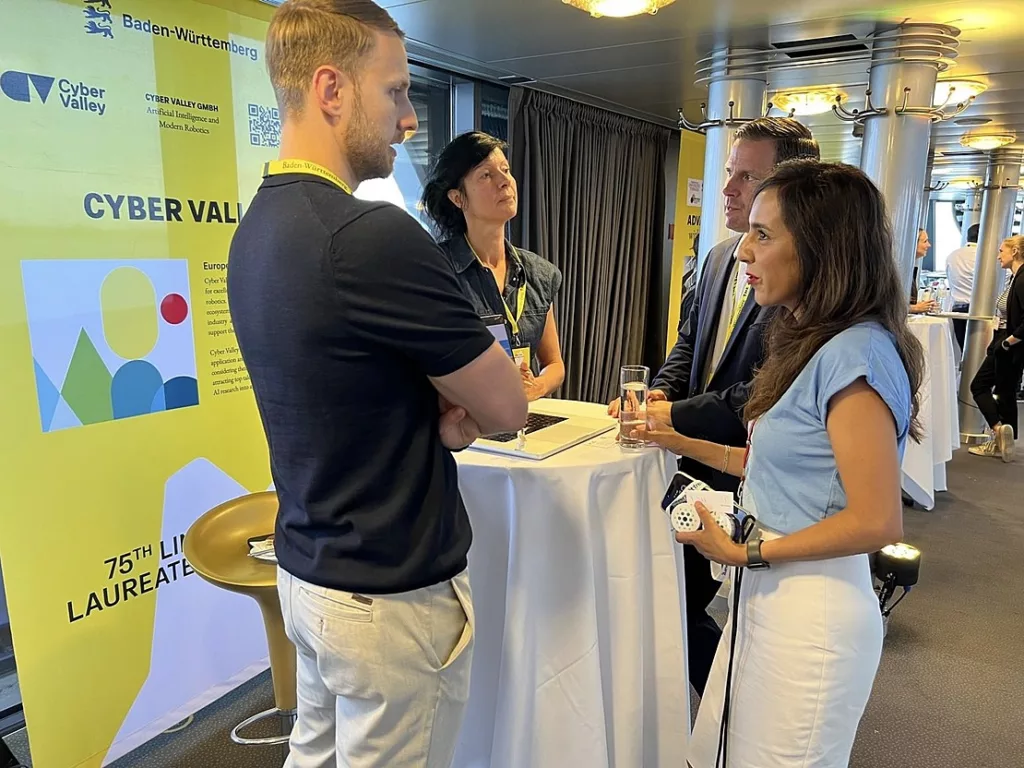
On July 3, we took part in the 75th Lindau Nobel Laureate Meeting, where around 75 Nobel laureates and several hundred young scientists from around the world gathered for a boat trip across Lake Constance to the island of Mainau.
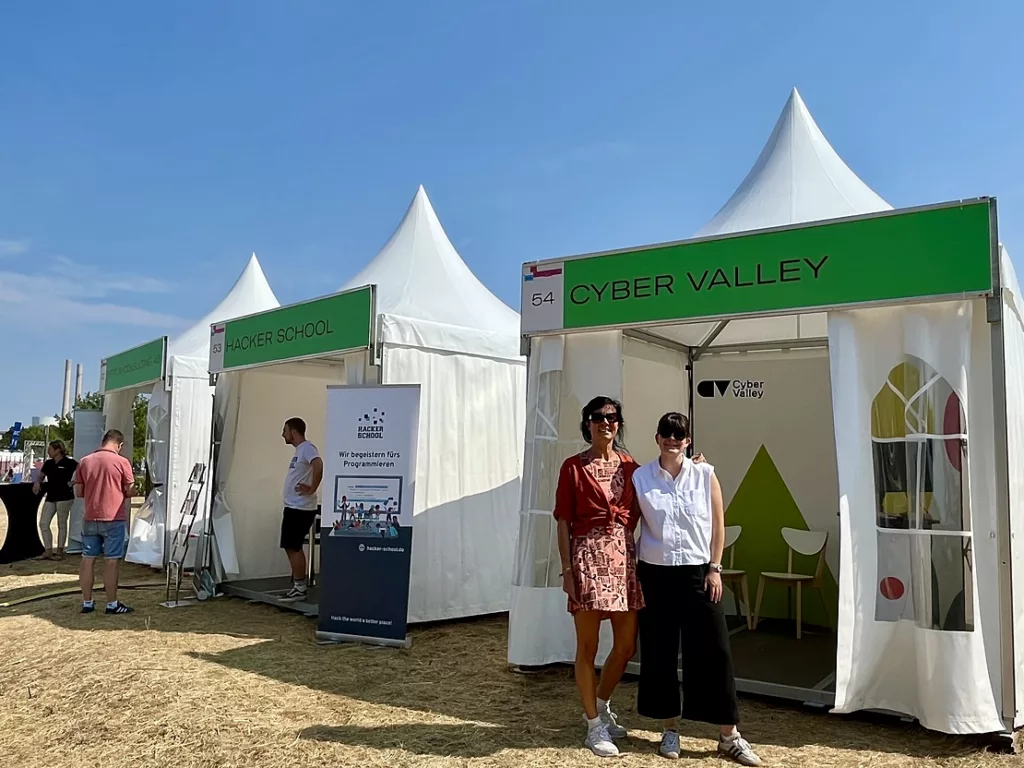
Invited to introduce the Cyber Valley in a three-minute pitch, we presented our mission to translate excellent AI research into practical applications. We also welcomed participants at the Cyber Valley booth and discussed career opportunities with young researchers.
The day concluded with a high-ranking panel discussion, „How to Rebuild Trust in Science?“ on the island of Mainau with Nobel Laureate of 2011 Saul Perlmutter, Nobel Laureate of 2013 Randy W. Schekman, Nobel Laureate of 2018 Donna Strickland, and others. The discussion explored how in an age of misinformation and polarization, education can rebuild trust in science. The panel explored the foundations of credibility, curiosity, and critical thinking in a rapidly changing world.
Photo: Cyber Valley
International researchers in Tübingen
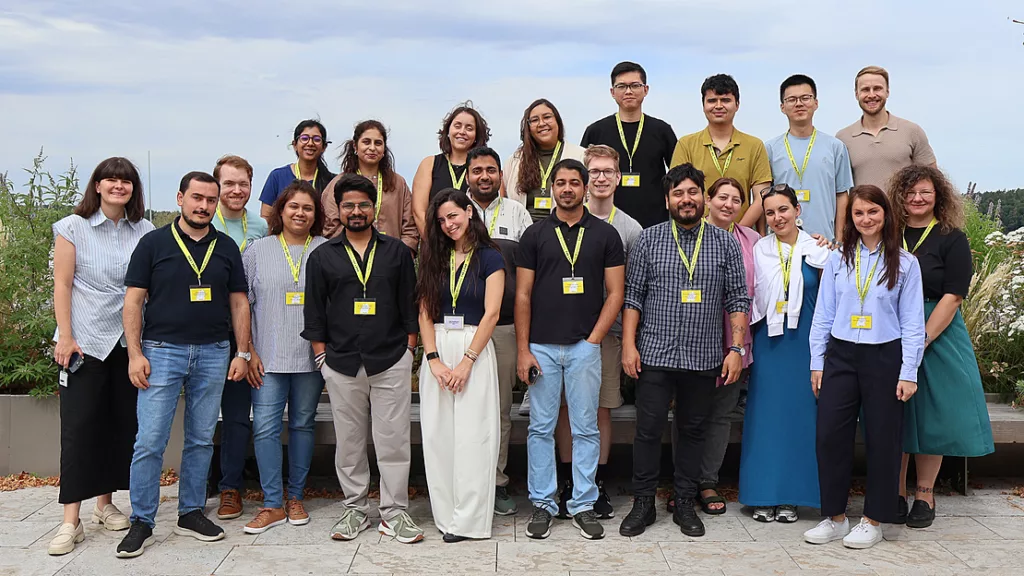
One week later, it was a pleasure to welcome a group of early-career researchers to Tübingen on July 7 after the Lindau Nobel Laureate Meetings.
During their stop at Cyber Valley, around 18 international PhD and postdoc researchers explored AI research and career opportunities in Baden-Württemberg. The visit included exchange with our network, lab tours, and insights from academia and start-ups.
The program included talks by Anand Waghmare (Yugen Space), Colin Dumont (Tübingen AI Center), and Ivan De Araujo (Max Planck Institute for Biological Cybernetics), as well as a lab visit to the Max Planck Institute for Biology.
Such exchanges demonstrate the importance of collaboration for the Cyber Valley mission: turning AI and robotics research into a more sustainable future for all.
Photo: Cyber Valley
Cyber Valley Impulse on agriculture, sustainability, and the environment
On July 8, the Cyber Valley Impulse on agriculture, sustainability, and the environment, co-hosted with Zukunftsstiftung Remstal, took place in Weinstadt. Experts from research and industry came together to exchange ideas and explore real-world applications. The event considered the applications of intelligent systems in agriculture, landscape management, and sustainability. With advances in AI, machine learning, and robotics, new forms of agricultural and landscape-care automation are becoming increasingly realistic, opening up questions about which tasks robots should take on first, what kinds of farming systems and landscapes we want to create, and how research, industry, and practice can contribute to this transformation.
Thanks to all our speakers and start-ups for sharing their insights and driving the conversation forward: Wieland Brendel (ELLIS Institute Tübingen, Max-Planck-Institut für Intelligente Systeme), Paul Hofmann (ELLIS Institute Tübingen, Max-Planck-Institut für Intelligente Systeme), Peter Ohlhausen (Fakultät NXT Nachhaltigkeit und Technologie – Hochschule Reutlingen), Zoe Rühlmann (SAM-DIMENSION), Christian Dreischer (Computomics), Johannes Schwegler (Zukunftsstiftung Remstal, TREEO)), Martin Kiefel and Sebastian Blaes(polybot), and Andy Clifton (enerlace).
Photo: Cyber Valley
Cyber Valley AI Incubator Batch #8: Demo Day
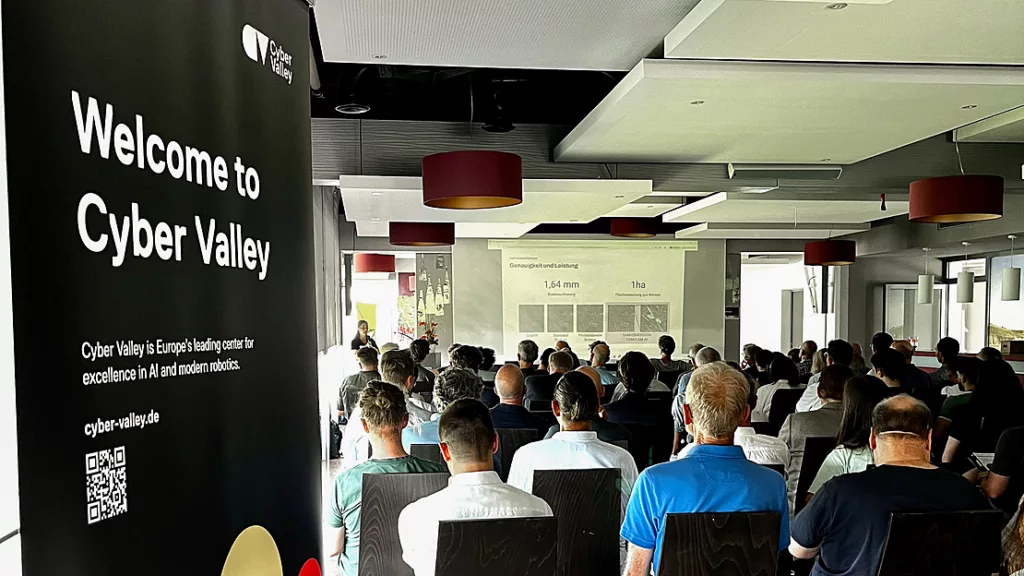
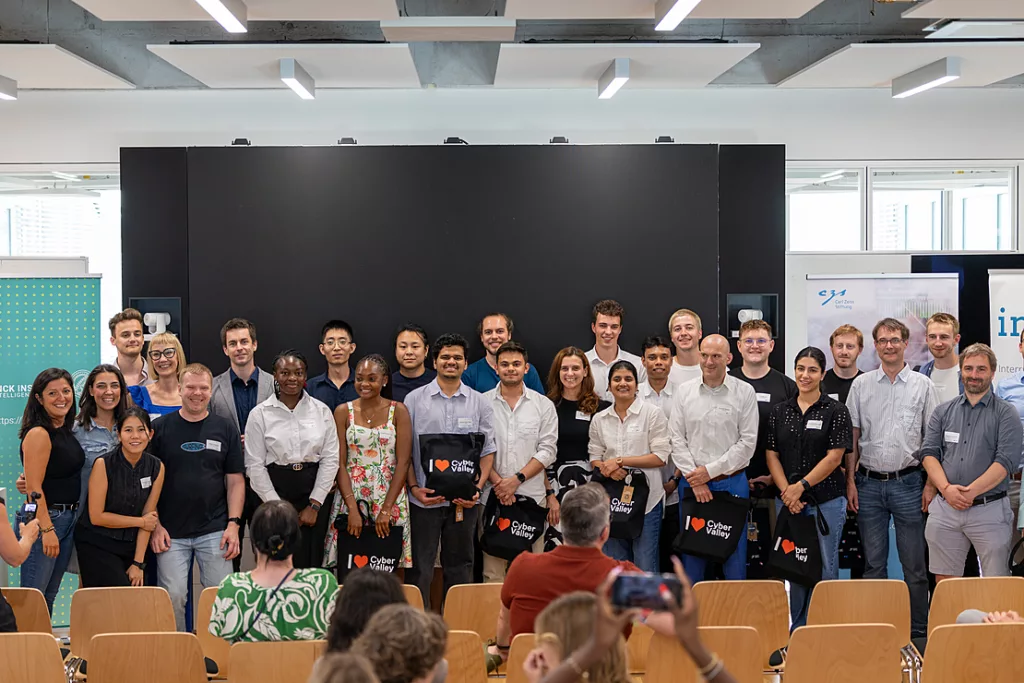
The Demo Day of the Cyber Valley AI Incubator, hosted at Cyber Valley in Tübingen, brought together a full auditorium of founders, investors, researchers, industry leaders, and AI enthusiasts to celebrate the next generation of AI start-ups on July 10.
The event opened with remarks from Christoph Keplinger and Leila Masri (Max-Planck-Institut für Intelligente Systeme), who reflected on the remarkable journey of Batch #8. We also welcomed Phil-Alan Gaertig, PhD from the Carl-Zeiss-Stiftung, whose continued support makes this program possible. The keynote, Axel Sauer from Black Forest Labs, introduced the company’s work and shared valuable insights into the development of AI models and the future of visual intelligence.
The spotlight then turned to the seven AI Incubator teams, who pitched their ideas before an outstanding jury consisting of: Daisy Paiva (ZEISS Ventures), Franziska Ivens (Silicon Allee at Fraunhofer Heinrich Hertz Institute HHI), and Christoph Keplinger (Max-Planck-Institut für Intelligente Systeme).
Selecting the winners was no easy task, as every team demonstrated impressive innovation, technical excellence, and entrepreneurial potential.
Congratulations to our award winners!
Audience and presentation award:
Sehnsora: Mohammed Raihan Soniwala, Shweta K. Yograj Yadav, and Abhishek Vijay P.
Best business model award:
CoGraph: Magnus T. Hornstein and Bela Thraen.
Use of AI award:
OptiGrocer: Ifeoma Veronica Nwabufo and Ornela Megne.
Thanks to all founders, mentors, trainers, jury members, speakers, partners, and guests who made this journey so memorable. We can’t wait to see where these start-ups go next. Congratulations to all teams for an outstanding Demo Day!
The Cyber Valley AI Incubator empowers scientists and entrepreneurs with promising AI ideas to begin their entrepreneurial journey. Over several weeks, participants receive hands-on training, mentoring, and access to leading experts, founders, and investors. Each full-day session focuses on a specific topic — from team building and market analysis to prototyping, business models, and pitching — equipping participants with actionable insights and a growing network.
The Cyber Valley AI Incubator is funded by the Carl-Zeiss-Stiftung and organized by the Max Planck Institute for Intelligent Systems.
Photo: MPI-IS
Campus Tour in Tübingen
It was a pleasure to welcome so many interested guests to our Campus Tour in Tübingen on July 16!
As part of our new Cyber Valley Innovation Campus Tours series, participants get an exclusive behind-the-scenes look at Europe’s largest center for excellence in AI and robotics. In addition to an introductory presentation, guests can join a guided tour of the Campus in Tübingen and learn more about the people, research, and innovation driving the ecosystem.
At Cyber Valley, our mission is to translate AI and robotics research into real-world solutions that benefit people, industry, and society. Engaging with the public and opening our doors to the community is an important part of that mission.
Photo: Cyber Valley
Ontic Labs and Feyer selected for SPRIND’s Next Frontier AI Challenge
Ontic Labs and Feyer have been selected for the first stage of the German Federal Agency for Breakthrough Innovation’s (SPRIND) Next Frontier AI Challenge. The two start-ups are among just ten teams across Europe that have been selected and will receive €3 million to develop technologies beyond today’s AI models.
On July 25 and 26, we had a great time at the KI Festival by IPAI Foundation in Heilbronn!
During the weekend, we had the pleasure of joining the KI Festival with our own booth. It was a great opportunity to connect with the Heilbronn community, engage with a curious public, and meet inspiring innovators and companies while sharing more about the Cyber Valley ecosystem. A big thank you to everyone who stopped by our booth and took the time to chat with us!
We are grateful to the IPAI Foundation for bringing together such a great community and creating a great space for exchange around AI and innovation.
We’re looking forward to future collaborations with IPAI and to continuing to strengthen the AI ecosystem together!
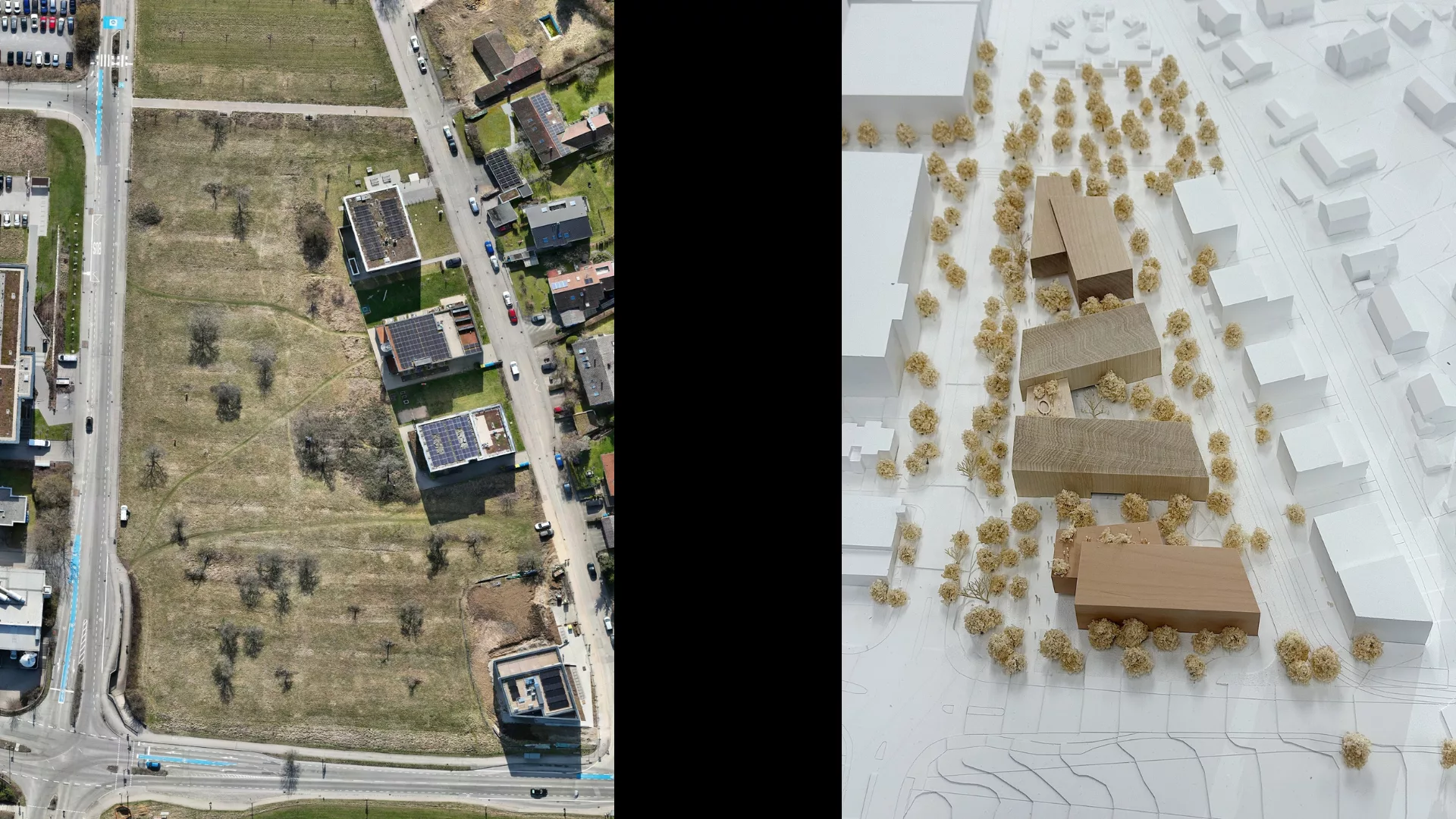
Tübingen is gaining a new flagship project in its science and research landscape: With the construction of the “Cyber Valley Start-up Campus” in Tübingen at the “Obere Viehweide” Science and Technology Park, a forward-looking hub is being created with a focus on startups in the field of artificial intelligence (AI). It is now clear what the buildings of the Tübingen-Reutlingen Technology Park (TTR) will look like in the future: The architectural firm 121 Architekten GmbH Florian Danner & Suleiman Mukarker, Tübingen, together with Machleidt GmbH, Berlin, and freiraumconcept Landschaftsarchitekten PartGmbB, Rottenburg a. N., have won first prize in the architectural competition. The jury reached this decision at its meeting on Friday, July 24, 2026.
New space for over 1,000 workstations
The planned spaces are designed to accommodate over 1,000 workstations, allowing for highly flexible use. The site is part of a dynamically growing innovation ecosystem featuring companies in the fields of medicine, biotechnology, and AI research, as well as university institutions, Cyber Valley GmbH, the ELLIS Institute, the Tübingen AI Center, and the Max Planck Institutes.