Event Year: 2021

  • It’s not the same river

    It’s not the same river

    Der Exzellenzcluster „Integrative Computational Design and Construction for Architecture“ (IntCDC) an der Universität Stuttgart veranstaltet die IntCDC Constructive Conversations, bei denen renommierte nationale und internationale Wissenschaftler und Industrieexperten zu aktuellen Themen und Herausforderungen im Bereich IntCDC sprechen.

    Die kommende IntCDC Constructive Conversations Session wird mit Aviad Almagor, Division Vice President, Emerging Technologies bei Trimble, stattfinden. Aviad Almagor hat sich auf einen sehr frustrierenden, aber auch sehr lohnenden Bereich spezialisiert – die Einführung und Umsetzung neuer Technologien in Unternehmensmärkten – kein Job für schwache Nerven. Seine Rolle erfordert flexible Hartnäckigkeit, sachkundige Ignoranz, Akrobatik und geistige Beweglichkeit. Aviad hat einen Master-Abschluss der Universität Cambridge, einen MBA-Abschluss der Heriot-Watt University, Schottland, und einen B.Arch-Abschluss des Israeli Institute of Technology.

    Aviad Almagor – Division Vice President, Emerging Technologies at Trimble

    Foto: Aviad Almagor – Division Vice President, Emerging Technologies, Trimble

    Die Veranstaltung findet digital über WebEx und in englischer Sprache statt. Um an der Veranstaltung teilzunehmen, klicken Sie hier.


  • Unternehmerinnen-Frühstück

    Was ist Cyber Valley? Warum ist KI für alle, insbesondere Gründer:innen relevant? Oliwia Gust (Event Manager für Cyber Valley, Max-Planck-Institut Tübingen) und Julia Schmaus (Innovation Manager für Cyber Valley) geben mit ihrem Impuls einen Einblick in diese für viele noch immer neue, unbekannte Welt.

    Das Event findet via Zoom am Mittwoch, 27.10.2021 von 8:00 – 9:00 Uhr statt. Weitere Informationen und Anmeldung zu diesem Event finden Sie hier.

    Dieses Event wird organisiert von OIC Open Innovation Campus Westspitze (Ulrike Landmann, Kontaktstelle Frau und Beruf &
    Marlies Mittler, ubf-Unternehmensberatung und Open Innovation Campus).

  • Intelligente Systeme in der Bildung

    Intelligente Systeme in der Bildung

    Künstliche Intelligenz begleitet unseren Alltag, ist Bestandteil technischer Innovationen und auch Teil unserer Bildungswelt. Aus der Verbindung pädagogischer Theorien mit psychologischen Methoden und Algorithmen aus der künstlichen Intelligenz entsteht ein großes Potenzial, Lernende wirksam und nachhaltig zu unterstützen. In der Vorlesung stellt Jun.-Prof. Maria Wirzberger, Institut für Erziehungswissenschaft, am Beispiel ausgewählter Forschungsprojekte ihrer Abteilung vor, wie dies gelingen kann und mit welchen kritischen Fragen wir uns dabei auseinandersetzen müssen.

    Das Event wird digital via WebEx abgehalten. Um dem Event beizutreten, klicken Sie hier.


    Diese Veranstaltung ist Teil der Ringvorlesung „Intelligente Systeme für eine zukunftsfähige Gesellschaft – Wirtschafts-, sozial-, erziehungs- und rechtswissenschaftliche Perspektiven“ der Fakultät Wirtschafts- und Sozialwissenschaften der Universität Stuttgart. Weitere Veranstaltungen dieser Reihe finden Sie hier.

  • KI-Sprechstunde

    KI-Sprechstunde

    Am 18. Oktober stellt sich von 19:30 bis 20:30 Uhr Prof. Dr. Ulrike von Luxburg (Expertin für Methoden des maschinellen Lernens) den Fragen der Bürger:innen.


    Registrierung

    Diese Ausgabe der KI-Sprechstunde ist eine Kooperation mit der vhs Tübingen. Bitte registrieren Sie sich hier. Die Sitzung wird in deutscher Sprache via Zoom abgehalten.


    Kontakt

    Patrick Klügel – Public Engagement Manager
    Mobile: + 49 151 74238237
    E-mail: patrick.kluegel@cyber-valley.de


  • Start-up Support & Funding

    Start-up Support & Funding

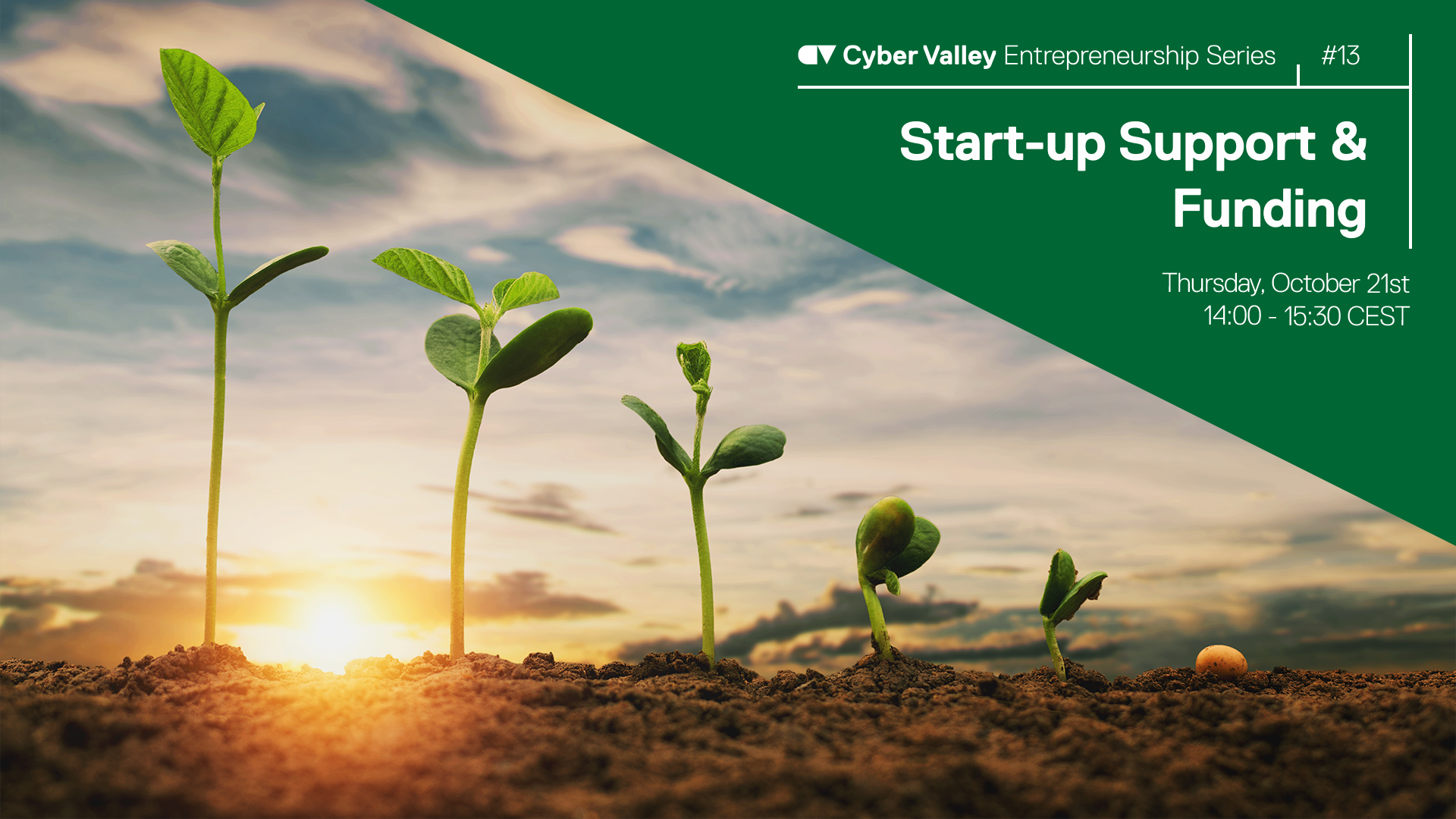
    Wissenschaftler:innen, Gründer:innen, Studierende und alle, die sich für das Thema “Start-up Support & Funding” interessieren, sind am Donnerstag, 21. Oktober von 14.00 bis 15.30 Uhr herzlich eingeladen.


    Sprecher:innen

    Florian Kirschenhofer
    Senior Start-up & Portfolio Manager, Max-Planck-Innovation GmbH

    Sandra Gäßler
    Management & Startup Consulting, Startup Center Universität Tübingen

    Marcel Werle
    Startup-Coach, Universität Stuttgart

    Eric Heintze & Sophia Hess
    Academic Lead & Data Analyst, Gründermotor


    Registrierung

    Bitte hier registrieren. Das Event findet via Zoom und in Englischer Sprache statt.


    Kontakt

    Oliwia Gust – Cyber Valley Event Manager
    Telefon: +49 7071 601 1554
    Mobil: +49 151 4075 6302 
    E-Mail: oliwia.gust@cyber-valley.de

  • NoBIAS Summer School 2021

    Die Liste der Referent:innen umfasst:

    • Krishna Gummadi,
    • Ricardo Baeza-Yates,
    • Alexandra Olteanu,
    • Stephanie Law,
    • Mathias Niepert,
    • Hinrich Schuetze,
    • Katharina Kinder-Kurlanda
    • und Annette Zimmermann.

    Termin: 20.–22. September 2021, ab 9:30 Uhr CEST.

    Die Anmeldung ist kostenlos. Sie können sich für eine, zwei oder alle drei Sitzungen anmelden. Einzelheiten zur Anmeldung, den detaillierten Zeitplan sowie Informationen zu den Abstracts und den Referent:innen finden Sie unter https://nobias-project.eu/index.php/nobias-summer-school/.

  • Research Forum

    Research Forum

    Aufgrund der COVID-19-Beschränkungen wird der Workshop online (Zoom) abgehalten. Wenn Sie teilnehmen möchten, registrieren Sie sich bitte hier.


    Schedule
    14:00 Welcome
    14:05 – 14:15

    Prof. Achim Menges

    Institute for Computational Design and Construction, University of Stuttgart, IntCDC

    Title: Introduction to IntCDC

    Abstract: The vision of the Cluster of Excellence Integrative Computational Design and Construction for Architecture (IntCDC) is to harness the full potential of digital technologies in order to rethink design, fabrication and construction based on integration and interdisciplinarity, with the goal of enabling game-changing innovation in the building sector as it can only occur through highly integrative fundamental research in an interdisciplinary, large-scale research undertaking.

    14:15 – 14:35

    Prof. Dr.-Ing Cristina Tarín

    Institute for System Dynamics, University of Stuttgart, IntCDC

    Title: Co-Design for Architecture, Engineering and Construction using Bipartite Graphs

    Abstract: The architecture, engineering and construction (AEC) industry consists of several players from different domains. They usually work in a sequential process, which is slow, costly and problems are identified in late stages. Co-design helps to identify and predict problems in early stages throughout different domains such that the design, engineering, manufacturing and construction process can be improved. We present an approach to enable co-design using bipartite graphs, which are capable to integrate expert knowledge, physical models and machine learning models from different domains. The different models form a computational network, which allows e.g. the architect to automatically analyze the feasibility of manufacturing a design.

    14:35 – 14:55

    Prof. Dr.-Ing. Peter Middendorf

    Institute of Aircraft Design, University of Stuttgart, IntCDC

    Title: Data-driven approaches for fiber composites technologies and simulation

    Abstract: Fibre composites for lightweight and wide-span architecture applications are one research area within IntCDC. The technology focus is laid here on freeform winding using collaborative robotics and the respective winding path is generated in a co-design approach. Whilst this is a collaborative effort from a group of IntCDC PIs, there is also a growing activity of supporting data-driven approaches at the Institute of Aircraft Design to make use of various sensor data along the process chain of a composite structure and thus to overcome limitations of classical modelling and simulation techniques.

    14:55 – 15:15

    Tenure-Track Prof. Dr. Thomas Wortmann

    Chair for Computing in Architecture, Institute for Computational Design and Construction, University of Stuttgart, IntCDC

    Title: AI for AEC

    Abstract: Tenure-Track Prof. Wortmann will present examples of the rich opportunities to apply AI in the Architecture, Engineering and Construction (AEC) sector, including architectural design optimization, modelling design and construction processes, predicting wind flow around buildings, predicting the behavior of heterogenous materials, and adaptive robotic control. Ultimately, these applications contribute to a reimagining of how our built environment is planned and constructed, which is an urgent need in light of the impending climate catastrophe.

    15:15 – 15:35

    Dr. Nicole Ludwig

    Machine Learning in Sustainable Energy Systems, Cluster of Excellence Machine Learning: New Perspectives for Science, University of Tübingen

    Title: Forecasting Sustainable Energy under Uncertain Weather

    Abstract: The increasing share of sustainable energy generation in the electricity system comes with significant challenges. One of the main challenges is the volatility of sustainable energy generation, due to their dependency on the weather. To efficiently integrate sustainable energy into the grid, the expected electricity supply and demand have to be forecast accurately. In this talk I will introduce the challenges we face when forecasting weather-dependent energy supply and demand and how probabilistic machine learning can help alleviate some of these challenges.

    15:35 – 15:55

    Dr. Bedartha Goswami

    Machine Learning in Climate Science, Cluster of Excellence Machine Learning: New Perspectives for Science, University of Tübingen

    Title: Uncovering hidden structure in climate data

    Abstract: The last decades have witnessed an unprecedented increase in data related to climatic processes all around the globe, which contain till yet undiscovered mechanisms of how the climate functions and how it is currently changing. We present the idea of "climate networks," which allow us to reveal non-trivial patterns in databases of climate data, and reveal potentially new climatic mechanisms and connections that have not been studied till date. We will look at how climate networks are estimated, what they can do for us, and three examples of how they are used in practice. Towards the end, we will also talk briefly about other projects that are ongoing in the "Machine Learning for Climate Science" research group, in the hope that we find common interests for cross-pollination of ideas and efforts.

    15:55 – 16:15

    Prof. Dr. Thomas Scholten

    Chair of Soil Science and Geomorphology, Department of Geosciences, University of Tübingen

    Title: Machine Learning in Soil Science

    Abstract: Soils are the most important basis for our nutrition. Their quality determines the food security of the world. Machine learning methods help to determine the underlying soil properties and to predict their spatial distribution on Earth. The presentation will explain the underlying theoretical approach of state factors and address the concept of relevant range of scales for multi-scale contextual spatial modeling of soil properties. Further, I will show results from my research of different parts of the world and demonstrate the potential of data-driven models for geo- and environmental science.

    16:15 – 16:30 Wrap-up