Location: Stuttgart

  • Cyber Valley AI Incubator Batch #9 culminates in Demo Day

    Cyber Valley AI Incubator Batch #9 culminates in Demo Day

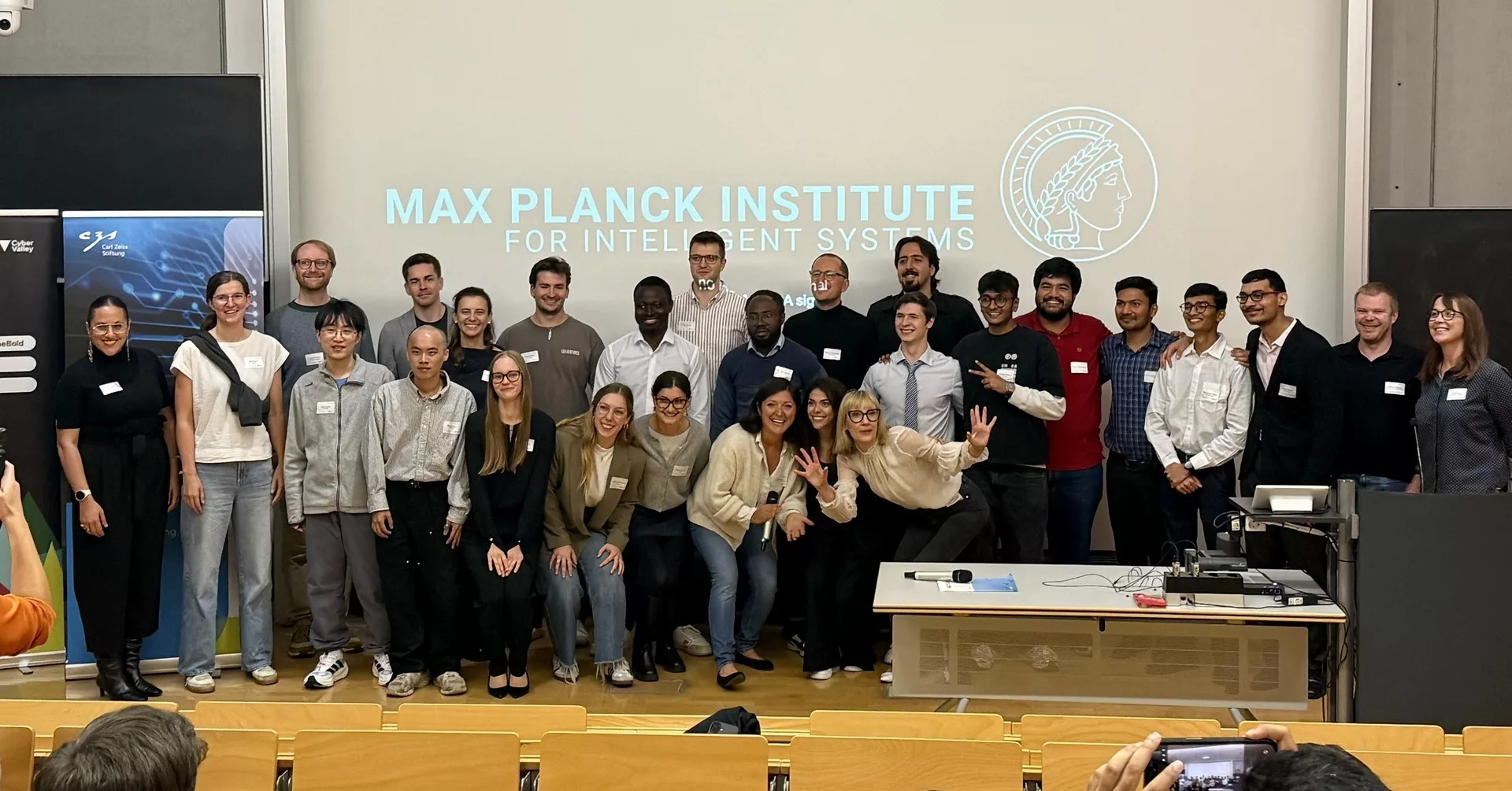
    The Batch #9 of the Cyber Valley AI Incubator concluded successfully with its Demo Day on October 16, where seven emerging AI ventures presented their innovations to an audience of founders, investors, researchers, and members of the AI community. Made possible through the generous funding of the Carl Zeiss Foundation (CSZ), organized by the Max Planck Institute for Intelligent Systems (MPI-IS) and the International Max Planck Research School for Intelligent Systems (IMPRS-IS), the Cyber Valley AI Incubator continues to foster research-driven AI entrepreneurship by helping innovators transform cutting-edge ideas into start-up ventures. 

    Hosted at the MPI-IS in Stuttgart, Demo Day marked the culmination of two weeks of intensive workshops exploring customer needs, business models, funding, prototyping, and pitching. The event opened with welcome remarks from Christoph Keplinger and Leila Masri of the Max Planck Institute for Intelligent Systems (MPI-IS), who reflected on the achievements of batch 9 and the growing impact of the AI Incubator. Lukas Findeisen of the Carl-Zeiss-Stiftung, the program’s principal sponsor, highlighted the foundation’s continued commitment to advancing innovation and research-driven entrepreneurship. 

    A highlight of the evening was the keynote address by Theodora Preda, partner at Plug and Play, who shared insights into the investor mindset and investing dynamics, offering perspectives on how investors assess opportunities, and what founders should understand when approaching the investment landscape.  

    The spotlight then turned to the batch 9 teams, who presented their final venture pitches before an expert jury consisting of: 

    • Christoph Keplinger (Director, Max Planck Institute for Intelligent Systems) 
    • Daisy De Souza Paiva (Senior Program Manager, ZEISS Ventures) 
    • Maximilian Worms (Analyst, LEA Ventures) 

    With all seven teams demonstrating an exceptionally high standard, selecting the winners proved challenging. 

    The following ventures were recognized for their outstanding achievements: 

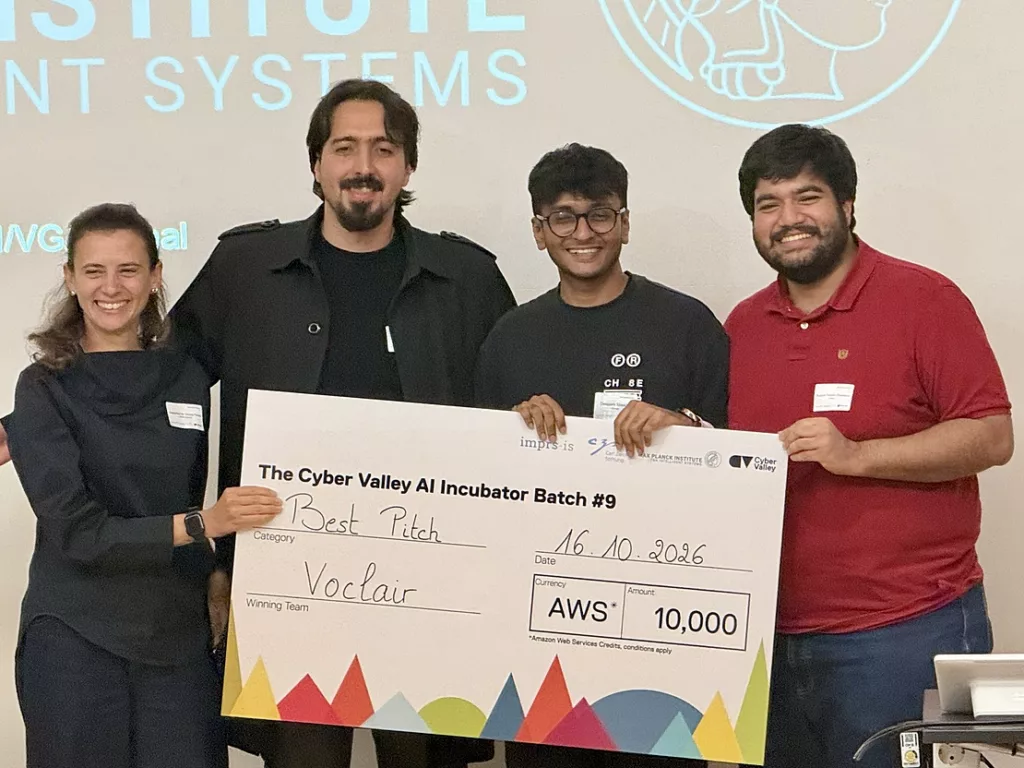
    Best Pitch Award: Voclair, founded by Rustom Firdosh Bhesania, Mehryar Lessani, Deepam Maurya
    AI Incubator Demo Day: Best Pitch Award
    Jury member Daisy De Souza Paiva, Founders Mehryar Lessani, Deepam Maurya, Rustom Firdosh Bhesania (from left to right). Copyright: Cyber Valley GmbH

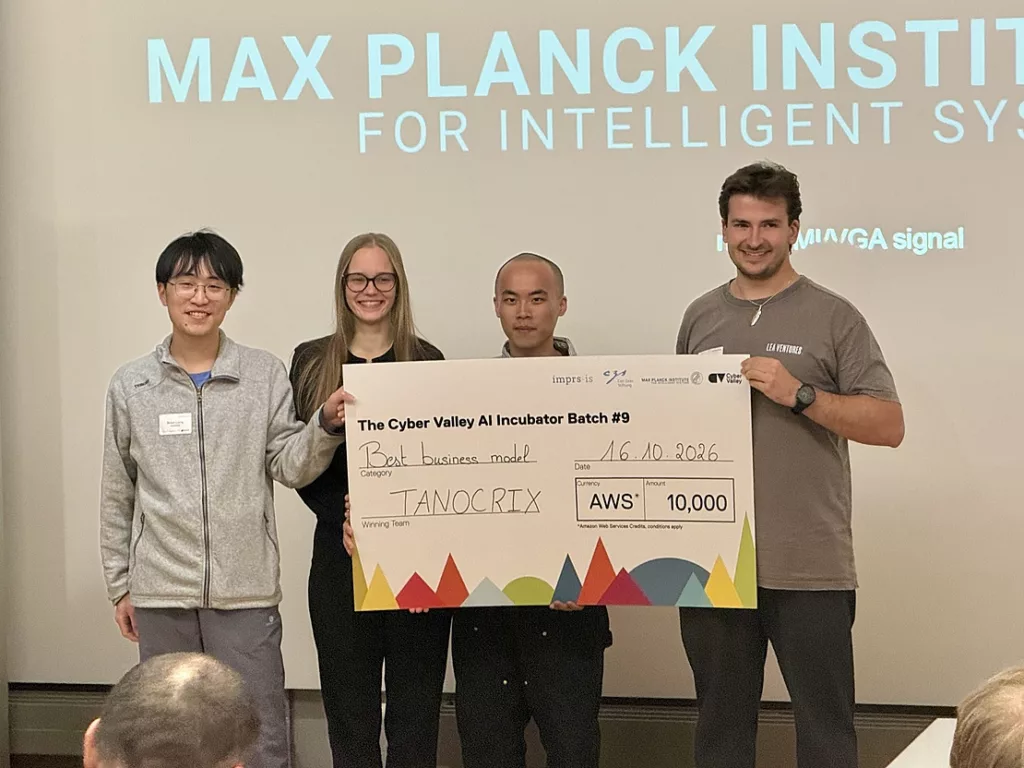
    Best Business Model Award: TANOCRIX, founded by Marta Kriukova, Bolun Liang, Wei-Bo Tang 
    Cyber Valley AI Incubator Demo Day, Best Business Model Award
    Founders Bolun Liang, Marta Kriukova, Wei-Bo Tang, jury member Maximilian Worms (from left to right). Copyright: Cyber Valley GmbH

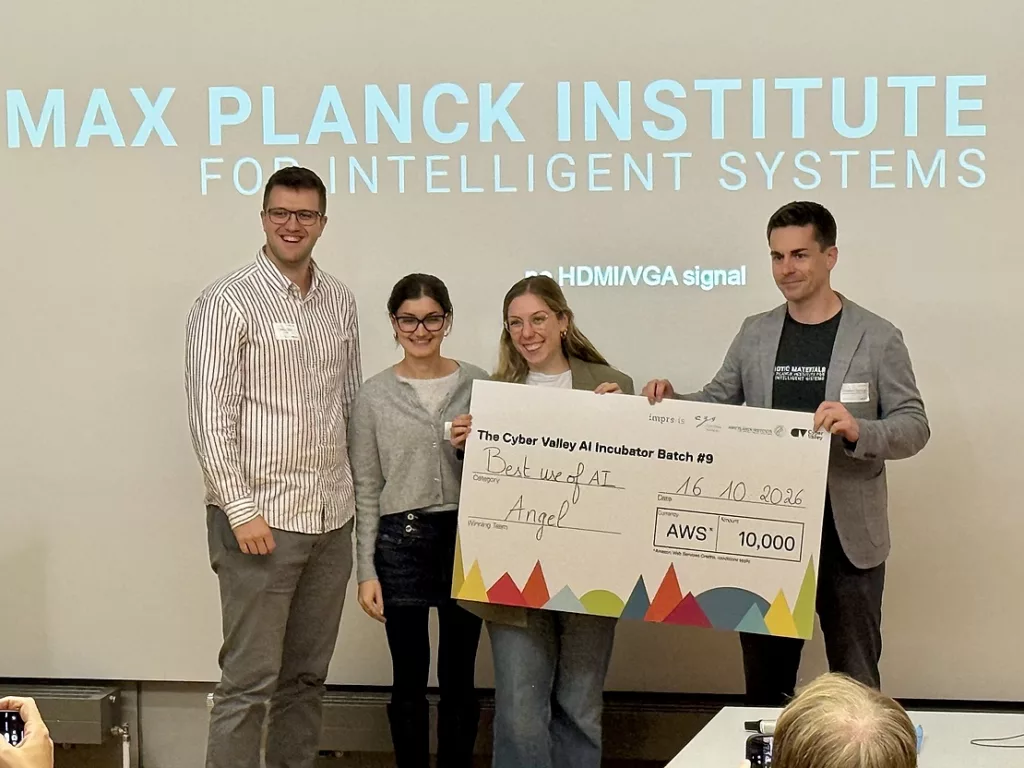
    Best use of AI Award: Angel, founded by Melis Ilayda Bal, Stefano Esposito, Michela Petriconi, Marko Zaric
    Cyber Valley AI Incubator Demo Day, Best use of AI Award
    Founders Marko Zaric, Melis Ilayda Bal, Michela Petriconi, jury member Christoph Keplinger (from left to right) Copyright: Cyber Valley GmbH

    Each winning team received $10,000 in AWS Credits, generously provided by Amazon, to support the continued development and scaling of their AI solutions. 

    The evening concluded with a networking reception, providing participants, mentors, investors, and guests with the opportunity to celebrate the achievements of Batch 9 and strengthen connections across the Cyber Valley innovation ecosystem.

    About the Cyber Valley AI Incubator 

    Organized by the International Max Planck Research School for Intelligent Systems (IMPRS-IS) and the Max Planck Institute for Intelligent Systems (MPI-IS), the Cyber Valley AI Incubator continues to play a key role in supporting research-driven entrepreneurship within the Cyber Valley ecosystem. The program is made possible through the generous support of the Carl Zeiss Foundation, whose commitment to advancing innovation and scientific entrepreneurship enables researchers and innovators to bring their AI ideas closer to real-world application. 

    The Cyber Valley AI Incubator is designed to help researchers, engineers, and aspiring entrepreneurs bridge the gap between scientific discovery and startup creation. Open to participants from fields including artificial intelligence, robotics, computer vision, machine learning, biomedical technology, and data science, the program combines entrepreneurial education with mentorship from experienced founders, investors, and innovation experts.


  • Computomics raises EUR 6.3 Mio to scale climate-smart plant breeding

    Computomics raises EUR 6.3 Mio to scale climate-smart plant breeding

    Computomics GmbH, a member of the Cyber Valley Start-up Network since 2020, has raised EUR 6.3 million in new equity in a Series B financing round led by Convent Capital Agri Food Fund, which invested EUR 5 million. Existing investors including High-Tech Gründerfonds, MBG Baden-Württemberg and Amathaon Capital participated, alongside founders and scientific advisors. The proceeds will be used to scale commercial delivery of the company’s climate-smart breeding platform. 

    Computomics was founded in 2012 as a spin-off of the Max Planck Institute for Biology in Tübingen. Its team comprises leading experts in machine learning, plant breeding, and bioinformatics.  

    Computomics builds machine learning models that predict how a given genotype will perform under a given set of conditions, combining genomic data with environmental data such as temperature, rainfall and soil, and with field measurements. Breeders use the predictions to answer questions that trial data alone cannot answer in time: which candidates hold up under hotter and drier conditions, which are stable across environments rather than strong in one, and where a variety should be placed. Its ×SeedScore® platform runs those predictions at the scale of a commercial breeding program. Customers include commercial breeders working in field crops, forages, vegetables and specialty crops. 

    “Breeders have never lacked ambition about climate resilience. What they have lacked is a way to see it before the field tells them, which takes years they no longer have,” said Dr. Sebastian J. Schultheiss, co-founder and Chief Executive Officer of Computomics. “This financing is about getting that capability into far more breeding programs, faster.” 

    Read the full article here: https://www.computomics.com/news-reader/eur-6.3-million-raised.html  

  • Visualization tools for learning to play a musical instrument

    Visualization tools for learning to play a musical instrument

    Michael Sedlmair, Frank Heyen, and their research team have completed their research project “InstruData—Data-driven Musical Instrument Education”. The project was funded by the Cyber Valley Research Fund and was carried out between 2022 and 2025 at the University of Stuttgart. Its aim was to develop a music education tool to support musicians by providing them with automatically generated visual feedback so they can check for mistakes when practicing independently.  

    Learning to play an instrument requires dedication, hard work, and plenty of independent practice. Not everyone has access to a teacher, and even with one, a musician cannot expect to receive constant and appropriate feedback when practicing their instrument. To address this problem, this research project developed a collection of data-driven techniques and tools that use data taken from a musician’s practice session to provide visual feedback. The resulting Visual Analytics web-tool enables musicians to detect errors and improve their style.

    The visualization tools& helped make practicing more efficient. The project designed two methods that automatically assign colors to parts of the sheet music to make its structure easier to see, so that it is easier for the musician to see repeats and changes. Moreover, the visualization tools can show in real time how consistently the musician is playing, for example, a specific rhythm over multiple repetitions.

    The research group also wanted to produce a practice support tool that did not take time away from actually practicing. Consequently, they designed a way to control the software running on a computer or similar device directly through the instrument. Using the electric guitar as a preliminary case, the group developed an on-screen menu that follows the grid-like guitar fretboard, so that the musician can use the guitar as a controller. This set-up did not require any modification of the guitar or additional hardware.

    With some refinement and user-experience engineering, the tools developed by this project could be turned into smartphone or web apps that support musicians when practicing independently. The researchers do not conceive of the visualization tools developed by this project as replacing traditional music education, but rather as a support for musicians when practicing independently. In this respect, this project aligns with Cyber Valley’s mission to translate cutting-edge research into real-world applications for a better future.

    This project produced the following peer-reviewed publications:  

    • Simeon Rau, Frank Heyen, Stefan Wagner, & Michael Sedlmair (2022). Visualization for AI-Assisted Composing. In Proceedings of the 23rd International Society for Music Information Retrieval Conference (ISMIR). https://doi.org/10.5281/zenodo.7316618 (open access) 
    • Lucchas R Skreinig, Denis Kalkofen, Ana Stanescu, Peter Mohr, Frank Heyen, Shohei Mori, Michael Sedlmair, Dieter Schmalstieg, & Alexander Plopski (2023). guitARhero: Interactive Augmented Reality Guitar Tutorials. In IEEE Transactions on Visualization and Computer Graphics (TVCG). https://doi.org/10.1109/TVCG.2023.3320266 (open access) 
    • Frank Heyen, Quynh Quang Ngo, & Michael Sedlmair (2023). Visual Overviews for Sheet Music Structure. In the 24th International Society for Music Information Retrieval Conference (ISMIR). https://doi.org/10.5281/zenodo.10265383 (open access) 
    • Simeon Rau, Frank Heyen, Benedikt Brachtel & Michael Sedlmair (2025). MAICO: A Visualization Design Study on AI-Assisted Music Composition. In IEEE Transactions on Visualization and Computer Graphics (TVCG). https://doi.org/10.1109/TVCG.2025.3539779 
    • Frank Heyen, Marius Labudda, Michael Sedlmair, & Andreas Fender (2025). GuitarPie: Using the Fretboard of an Electric Guitar for Audio-Based Pie Menu Interaction. In Proceedings of the 38th Annual ACM Symposium on User Interface Software and Technology (UIST). https://doi.org/10.1145/3746059.3747799 (open access) 
    • Frank Heyen, Michael Gleicher, Michael Sedlmair (2026). Make the Unhearable Visible: Exploring Visualization for Musical Instrument Practice. In IEEE Transactions on Visualization and Computer Graphics (TVCG). https://doi.org/10.1109/TVCG.2026.3658216 

    About the Cyber Valley Research Fund 

    The Cyber Valley Research Fund was established to support Cyber Valley research groups undertake basic research in the fields of artificial intelligence and robotics. The fund totaled five million euros, including contributions from six of Cyber Valley’s founding corporate partners: Amazon, BMW, Bosch, IAV, Mercedes-Benz, Porsche, and ZF. It supported 20 research projects, the first of which began in 2020, and the final of which will conclude in 2026.