Network Role: Partner

  • Research project on artificial intelligence for sustainable road construction launched

    Research project on artificial intelligence for sustainable road construction launched

    Road construction causes around 400 million tonnes of CO2 emissions globally every year. This corresponds to about 7.5 per cent of the maximum annual amount that may be emitted worldwide in order to still achieve the climate target of 1.5 degrees Celsius global warming. Even on medium-sized construction sites with 2,500 tonnes of asphalt to be laid, about 4,000 trees need a whole year to compensate for the CO2 emissions of about 50 tonnes. In the KInaStra research project, CO2 emissions in asphalt road construction are to be analysed transparently using digital technologies and reduced by AI-based optimisation algorithms, without any negative impact on quality, costs and time.

    The project results should help construction companies to carry out road construction projects more sustainably through CO2-optimised planning and process control. KInaStra thus creates the prerequisites for efficiently meeting the sustainability requirements of the coming years, including those of public clients. At the same time, the project strengthens economic sustainability as resources become scarcer and more expensive.

    The goal of the project team from practice and science is the development of intelligent, data-driven real-time control procedures by means of machine learning. The results will be digital tools for CO2 reporting and decision support. Sensors and interfaces will be used to collect data across the entire asphalt supply chain. In the cloud, this data will then be analysed in real time using AI processes. This will make it possible to derive recommendations for action for the personnel carrying out the construction work.

    Project participants

    Smart Site Solutions GmbH is launching the research project together with Reif Bauunternehmung GmbH & Co. KG, Makadamlabor Schwaben GmbH and the University of Hohenheim. Cyber Valley supports the KInaStra project consortium as an associated partner. Other associated partners are Bauwirtschaft Baden-Württemberg e.V., Bundesanstalt für Straßenwesen, Deutscher Asphaltverband e.V. and infraTest Digital Solutions GmbH. The KInaStra project is part of the innovation funding programme "InvestBw – Digitalisation and Artificial Intelligence" and is funded by the Baden-Württemberg Ministry of Economics, Labour and Tourism on the basis of a decision by the Baden-Württemberg state government.

    Contact

    Dr. Marcus Müller
    Smart Site Solutions GmbH, Zugäckerstrasse 42, 72622 Nürtingen
    +49 (0) 7022 2081847
    marcus.mueller@smartsitesolutions.de

     

  • Master class: The Numerics of Machine Learning

    Master class: The Numerics of Machine Learning

    A new course is available on the YouTube channel “Tübingen Machine Learning”. The lecture series explains the view of probabilistic numerics, which assumes that computation itself is an inference process.

    Materials:

    • To the slides (github). All slides come with embedded, time-stamped links to these youtube videos (click on the icon on the bottom right of each slide).
    • To the playlist (youtube). Videos are uploaded in semantic groups over the course of January and February 2023.

    The introductory lecture of the course will be given by Philipp Hennig, Cyber Valley co-spokesperson and professor of machine learning methods at the Tübingen AI Center of the University of Tübingen. The course on machine learning numerics will be taught in the winter semester 2022/23 as part of the master's program in Machine Learning.

    Freely accessible learning and teaching videos

    The new series of lectures is one of several available for free on the YouTube channel “Tübingen Machine Learning” which is the result of a collaboration between the cluster's faculty and the Tübingen AI Center. “We started this during Corona, and have since built up a broad audience” says Philipp Hennig. For those interested in learning about machine learning without prior knowledge, he recommends the course series “Introduction to Machine Learning” by Dmitry Kobak. Those who want to stay up to date on current research can watch the three-minute “Research Spotlight Videos” that researchers publish on new scientific papers. The channel, which has more than 25,000 subscribers, is an example of OER practice in action in the Cyber Valley ecosystem. OER stands for Open Educational Resources, which are freely accessible learning and teaching materials that enable people around the world to further their education in the field of machine learning. 

    To the overview of the lecture series 

  • New additions: Optocycle and Swarm Logistics

    New additions: Optocycle and Swarm Logistics

    “To have now integrated 38 young companies into the Cyber Valley ecosystem in three years shows the dynamism and growth potential inherent in AI applications in this country,” says Rebecca C. Reisch, Managing Director of Cyber Valley GmbH. “Our mission has been for six years: We want to promote the start-up culture in science. We are pursuing that with vigor.”

    Optocycle develops AI-based systems for the optical classification of construction waste and mixed construction waste. The technology of the Tübingen-based start-up enables optimal material use of the demolition material – entirely in the spirit of the circular economy. “We are aware that our mission can only be achieved through cooperation and exchange,” says Optocycle CEO Max-Frederik Gerken. „Thus, we love to interact with like-minded pioneers within Cyber Valley – an initiative with a powerful network of outstanding potential to integrate AI and cutting-edge technology for sustainability and a green future.”

    Swarm Logistics is a Stuttgart-based deep tech software technology company specialized in the development of Fleet Control Systems for manned and unmanned ground vehicles to fully automate the coordination & orchestration of heterogeneous fleets with trucks, cars, autonomous vehicles, AGVs & delivery robots in open environments for an adaptable and resilient supply chain. “Our goal is to create the Machine Economy in logistics, bring automated collaboration to the transportation sector, increase the utilization of vehicles and reduce costs by up to 35 percent,” explains Damir Đulović, CEO & co-founder of Swarm Logistics.

  • 1.5 million euros for micro-medical robots 

    1.5 million euros for micro-medical robots 

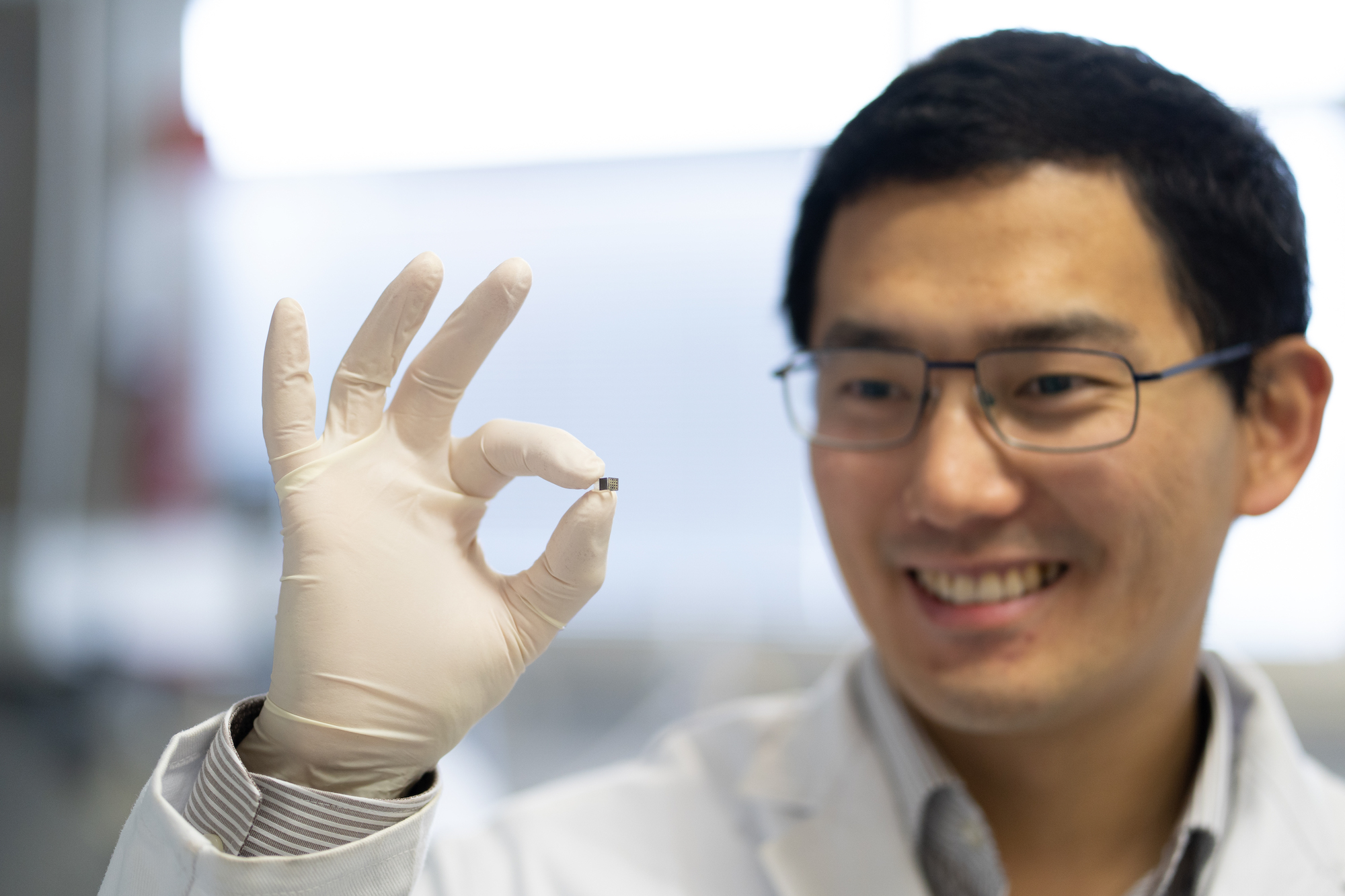
    How could drugs be used in the body in a more targeted way in the future? Biomedicine could provide an answer. Dr. Tian Qiu is researching tiny robots that travel through the human body. Tian Qiu and his team already succeeded in steering nanorobots through the dense tissue of an eyeball for minimally invasive drug delivery, which had never been achieved before.

    In the “VIBEBOT” project, Qiu and his team are taking this approach further: They are going to build the first micro-sized robot that can actively propel and wirelessly sense in deep biological tissues. For the project, Qui was inspired by nature: “We know that worms, for example, can penetrate human skin to infect humans. Why can't we build a similar-sized robotic system that can penetrate soft tissue to treat disease?” Research on this holds enormous potential for future minimally invasive medicine, “such as targeted drug delivery for tumor therapy,” Qiu said.

    Tian Qiu has been Cyber Valley research group leader for “Biomedical Microsystems” since 2019. The group is based at the Institute of Physical Chemistry at the University of Stuttgart. Previously, he studied mechanical and biomedical engineering at Tsinghua University in Beijing, which is considered China's leading technical university. He came to Europe in 2012, earning a PhD in biotechnology and bioengineering at Switzerland's Ecole Polytechnique Fédérale de Lausanne (EPFL) and conducting research at the Max Planck Institute for Intelligent Systems (MPI-IS).

    With the ERC Starting Grants, the European Research Council supports outstanding young scientists for innovative projects in basic research. The ERC evaluates the applications exclusively according to the criterion of scientific excellence. The research project “VIBEBOT” will receive funding of 1.5 million euros; the funding will run for five years. With the new grant, the University of Stuttgart is home to twelve active ERC grants, including six ERC Starting Grants (overview of scientists at the University of Stuttgart who have been awarded an ERC Grant). Two other Cyber Valley researchers were also awarded ERC Grants, an ERC Starting Grant and an ERC Consolidation Grant.

    _______________
    Further information
    From researcher to founder
    Scope of Cyber Valley research expanded to include intelligent biomedical microsystems

  • Almost 20 million for Tübingen AI Center

    Almost 20 million for Tübingen AI Center

    “I am very pleased that with the financial support of the federal government we can offer highly attractive working conditions in order to be at the forefront of the competition for the best AI specialists in the world. The permanent funding will make it possible to pursue a long-term research strategy, train excellent scientists in the field of artificial intelligence and bring AI technology ‘made in The Länd’ to our companies. To this end, Cyber Valley now receives another important building block,” said Science Minister Theresia Bauer in Stuttgart on Friday (July 1).

    In 2018, the German government laid the foundation for the establishment and expansion of AI lighthouses with international appeal with its AI strategy. Together with the German Research Center for Artificial Intelligence (DFKI), the five new AI centers in Baden-Württemberg, Bavaria, Berlin, North Rhine-Westphalia and Saxony form an integral part of Germany’s AI research landscape and pursue the common goal of establishing a European and internationally competitive research network that will sustainably strengthen Germany as a leading location for research, teaching and technology transfer.

    The Tübingen AI Competence Center is integrated into the Cyber Valley ecosystem as part of the University of Tübingen and the Max Planck Institute for Intelligent Systems. It has its origins in the machine learning funding program initiated by the BMBF in 2018.

    Under the motto “Machine Learning in the World,” Tübingen scientists pursue a broad range of research questions, from fundamental new methods for machine learning and causal inference to the integration of intelligent systems into the broader socio-technical environment. In doing so, the Tübingen AI Center pays close attention to societal impact, on the one hand through research, and on the other hand through target group specific offerings. In addition, the center is committed to providing targeted support and attractive positions for young scientists at all stages of their scientific careers.