News Category: Corporate Network

  • Cyber Valley AI Incubator Batch #9 culminates in Demo Day

    Cyber Valley AI Incubator Batch #9 culminates in Demo Day

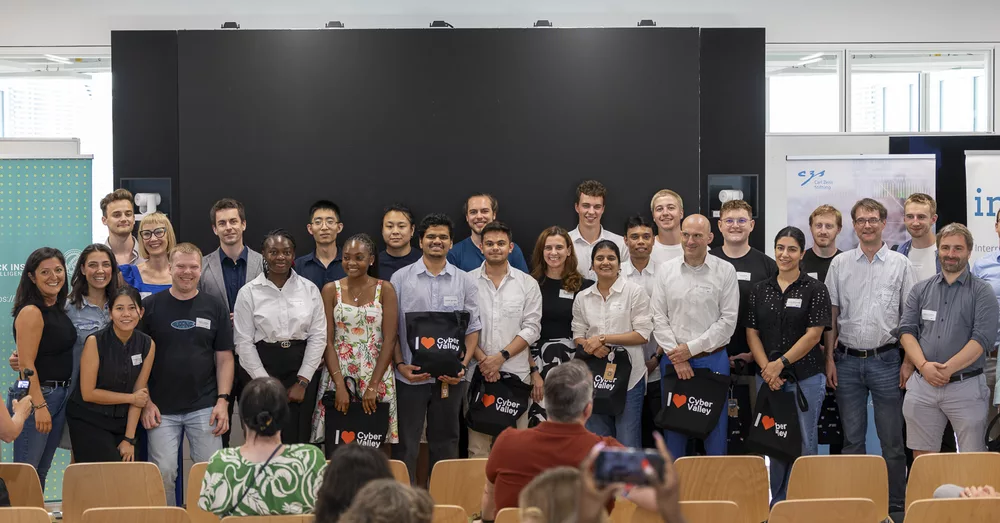
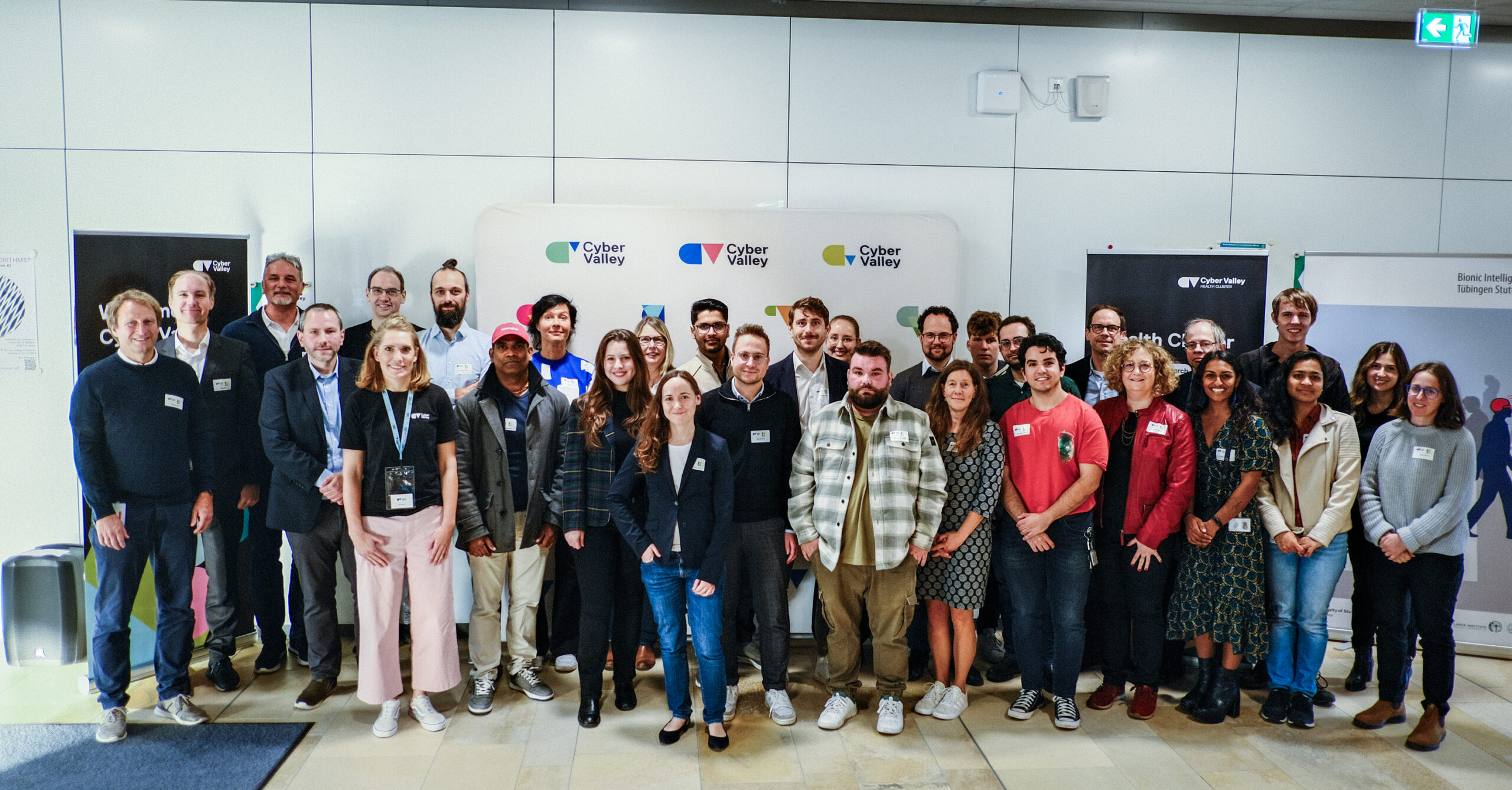
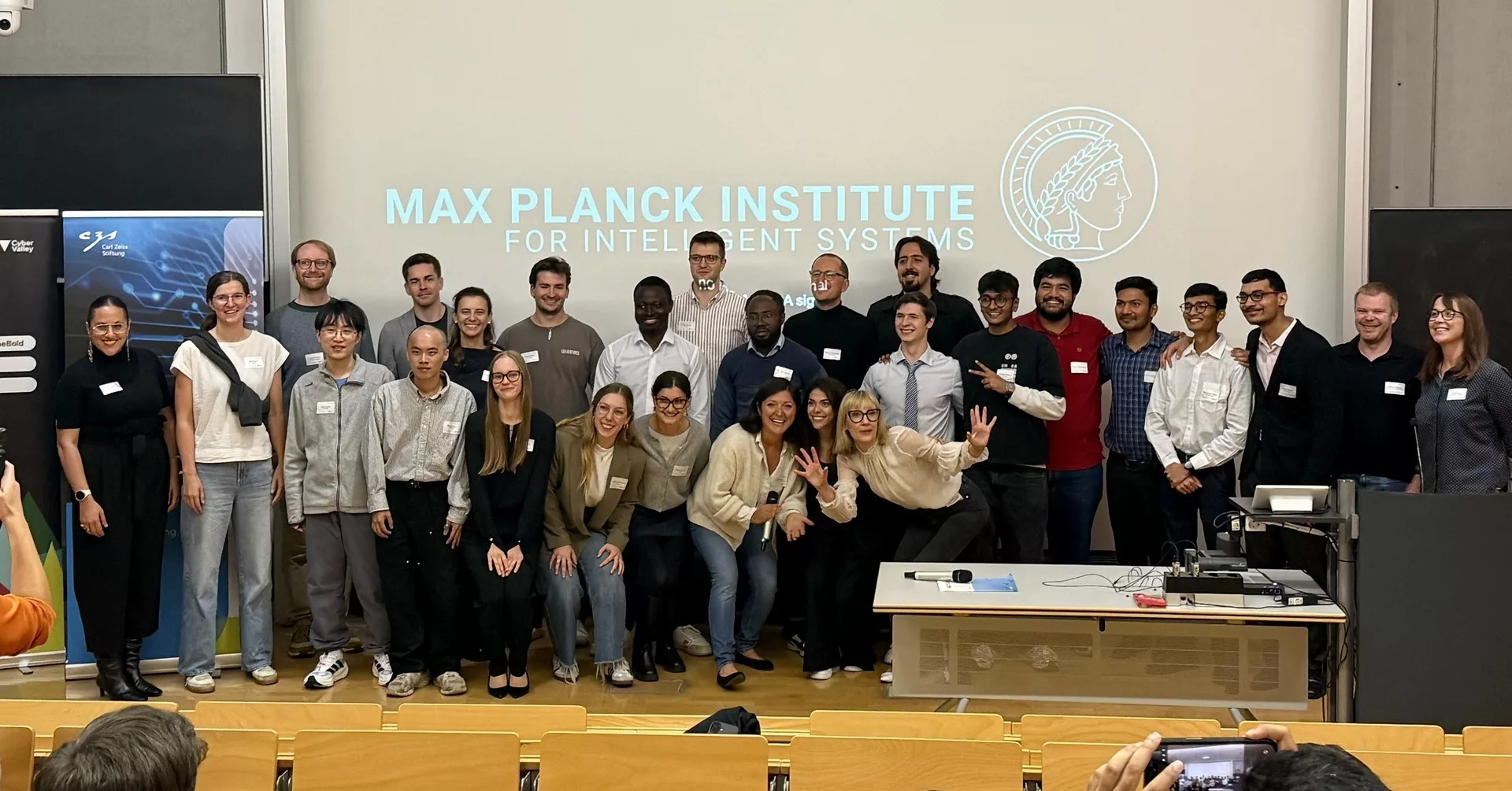
    The Batch #9 of the Cyber Valley AI Incubator concluded successfully with its Demo Day on October 16, where seven emerging AI ventures presented their innovations to an audience of founders, investors, researchers, and members of the AI community. Made possible through the generous funding of the Carl Zeiss Foundation (CSZ), organized by the Max Planck Institute for Intelligent Systems (MPI-IS) and the International Max Planck Research School for Intelligent Systems (IMPRS-IS), the Cyber Valley AI Incubator continues to foster research-driven AI entrepreneurship by helping innovators transform cutting-edge ideas into start-up ventures. 

    Hosted at the MPI-IS in Stuttgart, Demo Day marked the culmination of two weeks of intensive workshops exploring customer needs, business models, funding, prototyping, and pitching. The event opened with welcome remarks from Christoph Keplinger and Leila Masri of the Max Planck Institute for Intelligent Systems (MPI-IS), who reflected on the achievements of batch 9 and the growing impact of the AI Incubator. Lukas Findeisen of the Carl-Zeiss-Stiftung, the program’s principal sponsor, highlighted the foundation’s continued commitment to advancing innovation and research-driven entrepreneurship. 

    A highlight of the evening was the keynote address by Theodora Preda, partner at Plug and Play, who shared insights into the investor mindset and investing dynamics, offering perspectives on how investors assess opportunities, and what founders should understand when approaching the investment landscape.  

    The spotlight then turned to the batch 9 teams, who presented their final venture pitches before an expert jury consisting of: 

    • Christoph Keplinger (Director, Max Planck Institute for Intelligent Systems) 
    • Daisy De Souza Paiva (Senior Program Manager, ZEISS Ventures) 
    • Maximilian Worms (Analyst, LEA Ventures) 

    With all seven teams demonstrating an exceptionally high standard, selecting the winners proved challenging. 

    The following ventures were recognized for their outstanding achievements: 

    Best Pitch Award: Voclair, founded by Rustom Firdosh Bhesania, Mehryar Lessani, Deepam Maurya
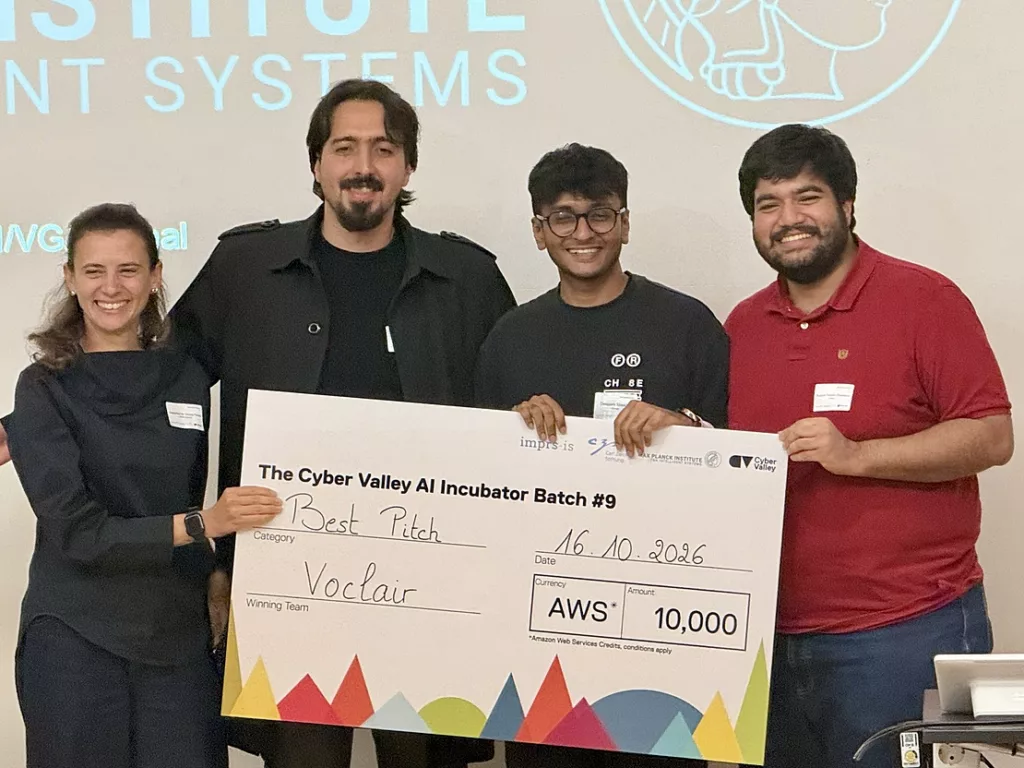
    AI Incubator Demo Day: Best Pitch Award
    Jury member Daisy De Souza Paiva, Founders Mehryar Lessani, Deepam Maurya, Rustom Firdosh Bhesania (from left to right). Copyright: Cyber Valley GmbH

    Best Business Model Award: TANOCRIX, founded by Marta Kriukova, Bolun Liang, Wei-Bo Tang 
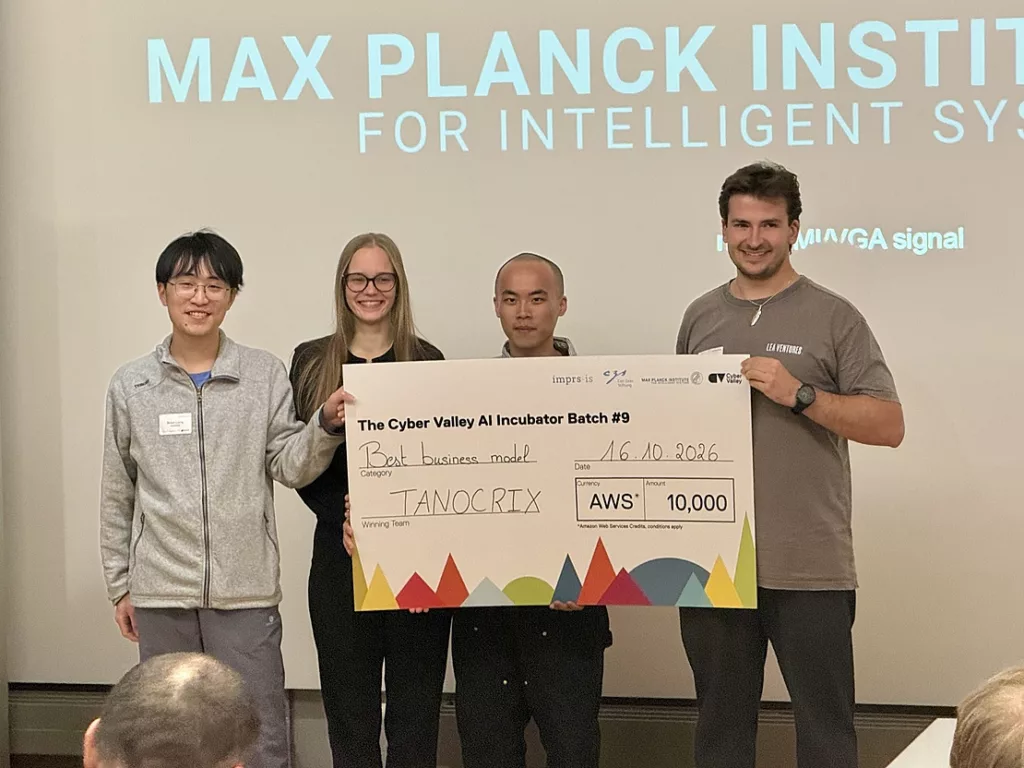
    Cyber Valley AI Incubator Demo Day, Best Business Model Award
    Founders Bolun Liang, Marta Kriukova, Wei-Bo Tang, jury member Maximilian Worms (from left to right). Copyright: Cyber Valley GmbH

    Best use of AI Award: Angel, founded by Melis Ilayda Bal, Stefano Esposito, Michela Petriconi, Marko Zaric
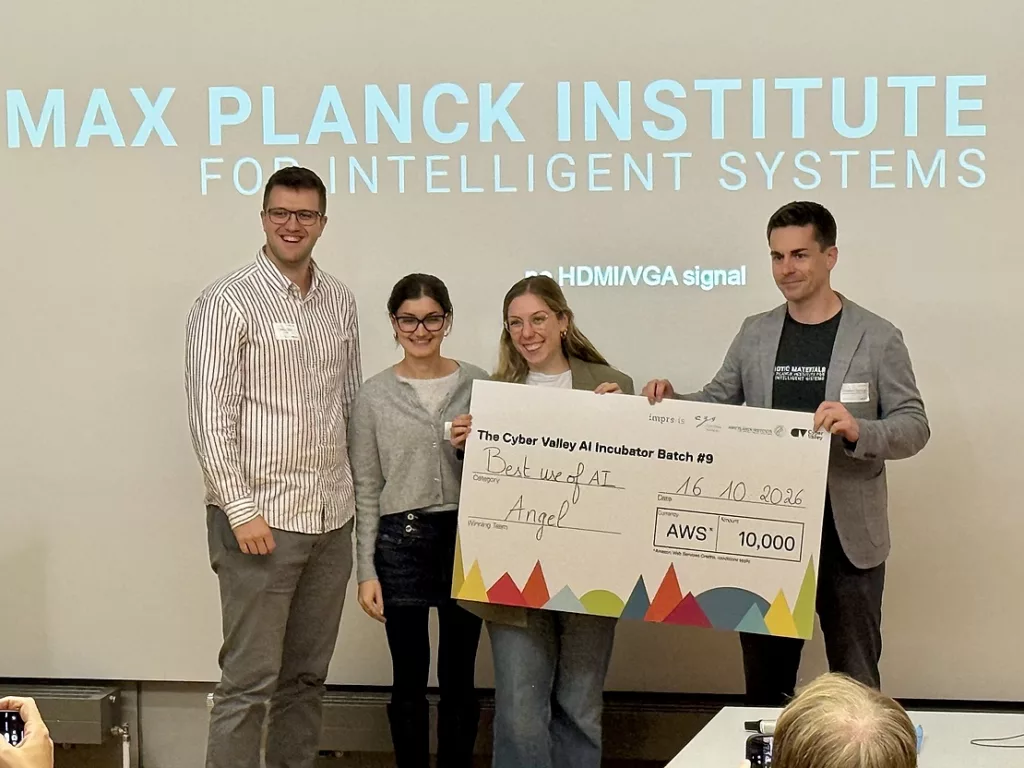
    Cyber Valley AI Incubator Demo Day, Best use of AI Award
    Founders Marko Zaric, Melis Ilayda Bal, Michela Petriconi, jury member Christoph Keplinger (from left to right) Copyright: Cyber Valley GmbH

    Each winning team received $10,000 in AWS Credits, generously provided by Amazon, to support the continued development and scaling of their AI solutions. 

    The evening concluded with a networking reception, providing participants, mentors, investors, and guests with the opportunity to celebrate the achievements of Batch 9 and strengthen connections across the Cyber Valley innovation ecosystem.

    About the Cyber Valley AI Incubator 

    Organized by the International Max Planck Research School for Intelligent Systems (IMPRS-IS) and the Max Planck Institute for Intelligent Systems (MPI-IS), the Cyber Valley AI Incubator continues to play a key role in supporting research-driven entrepreneurship within the Cyber Valley ecosystem. The program is made possible through the generous support of the Carl Zeiss Foundation, whose commitment to advancing innovation and scientific entrepreneurship enables researchers and innovators to bring their AI ideas closer to real-world application. 

    The Cyber Valley AI Incubator is designed to help researchers, engineers, and aspiring entrepreneurs bridge the gap between scientific discovery and startup creation. Open to participants from fields including artificial intelligence, robotics, computer vision, machine learning, biomedical technology, and data science, the program combines entrepreneurial education with mentorship from experienced founders, investors, and innovation experts.

  • Success stories from the Cyber Valley Innovation Campus: July–September 2026

    Success stories from the Cyber Valley Innovation Campus: July–September 2026

    The Cyber Valley Innovation Campus brings top scientists to Baden-Württemberg to advance AI and robotics research. These scientists are paving the way for the application of their research for the benefit of people, industry, and society.

    Members of the Cyber Valley Innovation Campus include the Max Planck Institute for Intelligent Systems (MPI-IS), Universities of Tübingen and Stuttgart, Fraunhofer IAO and IPA, ELLIS Institute Tübingen, and Karlsruhe Institute for Technology (KIT). As leading research institutions, they have announced the following exciting developments between July and September 2026.

    Frank Allgöwer recognized for outstanding scientific contributions

    The European Control Association (EUCA) and the Asian Control Association (ACA) have welcomed Frank Allgöwer as a fellow, recognizing his outstanding contributions to the field of systems and control engineering. Allgöwer is the first European to become a fellow at the ACA, which is one of the highest honors bestowed by the Asian control engineering community. Read more.

    Jakob Macke and Kashyap Chitta join the ELLIS Institute Tübingen

    Jakob Macke and Kashyap Chitta have joined the ELLIS Institute Tübingen, both as Principal Investigators and Hector Endowed Fellows.

    Macke is already an established figure in the Tübingen machine learning and computational neuroscience ecosystem and will shape the Institute’s research direction. Read more.

    Chitta is an expert in autonomous systems and physical AI, and will lead a new research group: the Physical AI Lab. The group focuses on understanding how machines interact with the physical world. Read more.

    Andrea Iannelli awarded ERC Starting Grant

    The European Research Council (ERC) is providing EUR 1.65 million in funding for Andrea Iannelli’s research project on autonomous systems that can adapt to complex tasks and changing environments while in operation. Gaining a Starting Grant is considered a highly prestigious achievement for early-career researchers in Europe. Read more.

    Marcel Binz joins the Max Planck Institute for Biological Cybernetics

    Marcel Binz has begun his research on a unified theory of human cognition using computational models at the Max Planck Institute for Biological Cybernetics. These models aim to simulate, predict, and explain human behavior in diverse situations.

    Binz’s research examines the central building blocks of human cognition by addressing three challenges: 1) the technical challenge of building such models in the first place; 2) the scientific challenge of using these models to understand human cognition; 3) the applied challenge of translating this into real-world applications. Read more.

    AI Incubator alumni SKAI receives EXIST Startup Grant

    SKAI participated in the Cyber Valley AI Incubator in 2024 to develop a company that applies AI for the cosmetics industry. With the support of the EXIST Startup Grant, the team will be able to focus on developing SKAI and preparing for its launch in the coming months. Read more (German).

    Ontic Labs and Feyer selected for SPRIND’s Next Frontier AI Challenge

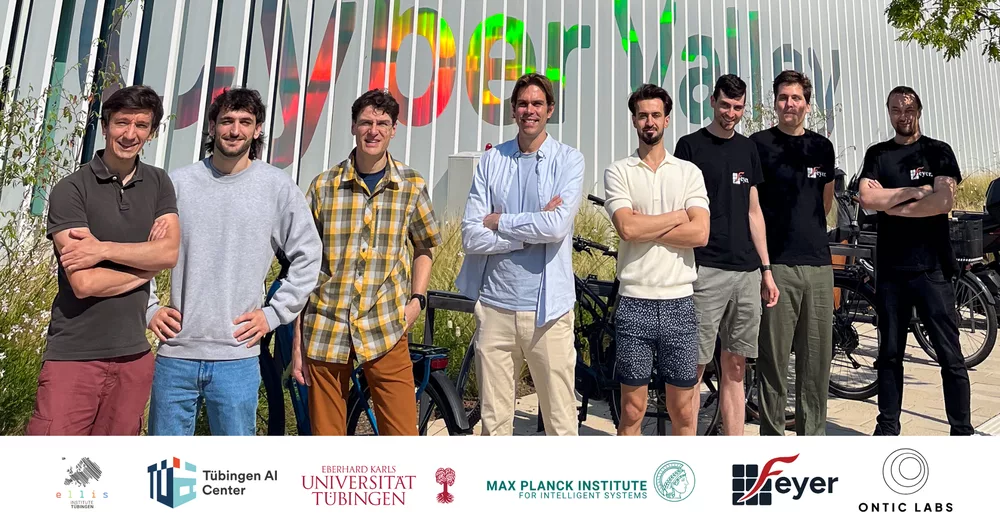
    Ontic Labs and Feyer were selected for the first stage of the German Federal Agency for Breakthrough Innovation’s (SPRIND) Next Frontier AI Challenge. The two start-ups are both spin-outs from institutions from the Cyber Valley Innovation Campus, including the ELLIS Institute Tübingen, Max Planck Institute for Intelligent Systems, Tübingen AI Center, and the University of Tübingen. Each team will receive €3 million to develop technologies that go beyond today’s AI models. Read more. 

    Makysm Andriushchenko co-founds Exponential Security Labs

    Makysm Andriushchenko has co-founded the start-up Exponential Security Labs. Andriushchenko is a Principal Investigator at the ELLIS Institute Tübingen and leads the AI Safety and Alignment group.

    The Tübingen-based start-up aims to improve the security and reliability of AI agents. Its work is based on decades of basic research in adversarial robustness and AI safety, showcasing how AI research can be applied to solve real-world problems. Read more.

    EIT awards funding for the C-VENTURE project

    The University of Tübingen has successfully applied for funding from the EIT (European Institute of Innovation and Technology) Higher Education Initiative together with five partner universities and innovation partners. The funding will support the C-VENTURE Project, of which the Tübingen Startup Center is a part. The Project will connect the fragmented initiatives that support entrepreneurship and knowledge transfer from thet different universities into a cohesive system. Read more (German). 

    Stay up to date with the latest news and success stories from Cyber Valley by registering for our email newsletter.

  • Cyber Valley Day 2026

    Cyber Valley Day 2026

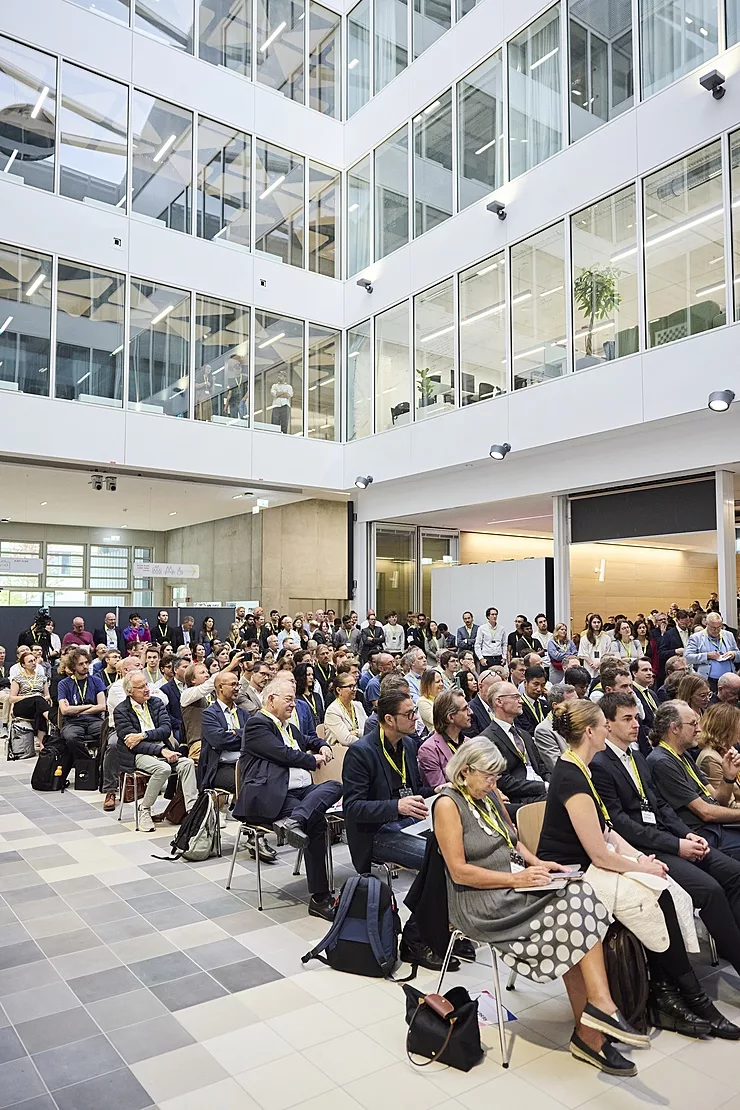
    On September 9, more than 850 guests came to Tübingen to celebrate a very special milestone: ten years of the Cyber Valley Innovation Campus. Researchers, start-ups, investors, policymakers, partners from industry and society, as well as many other guests gathered for a day full of inspiring talks, surprising keynotes, a research exhibition, start-up presentations, investor sessions, and networking.

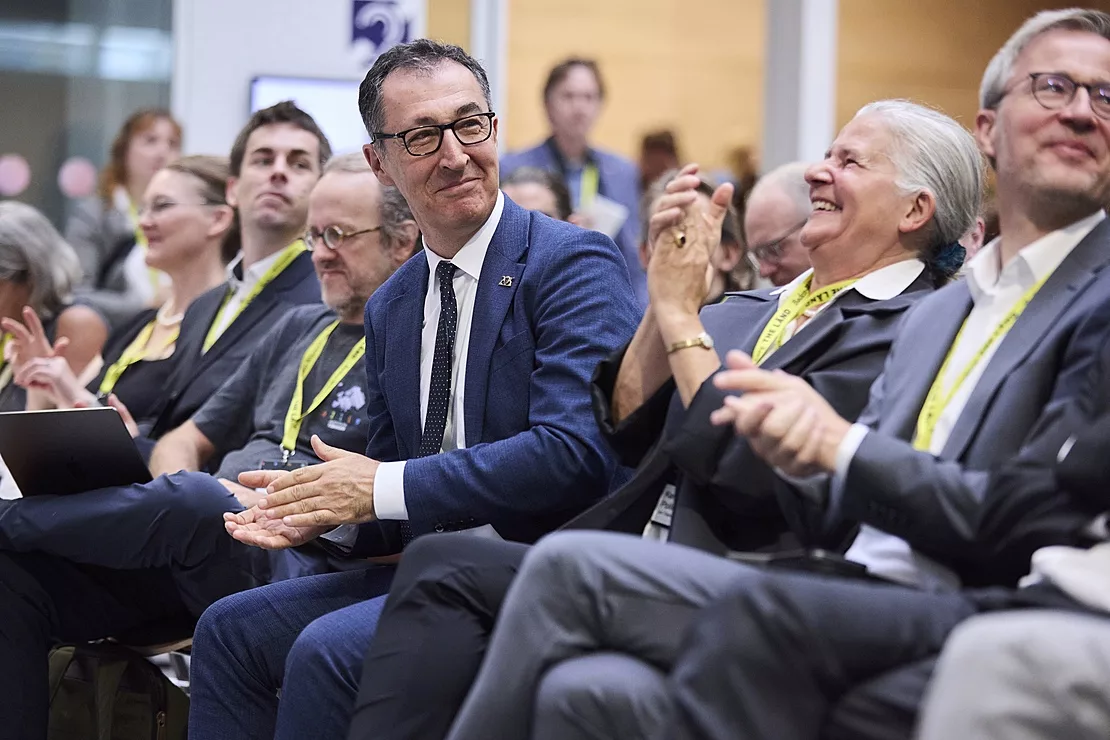
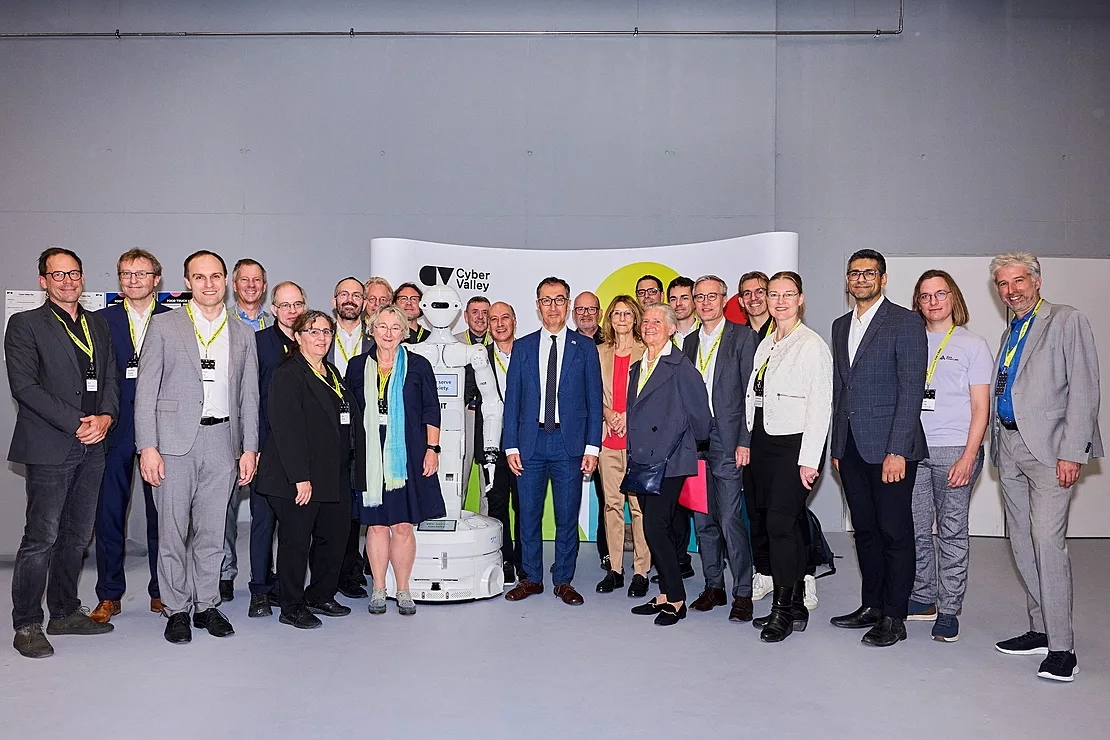
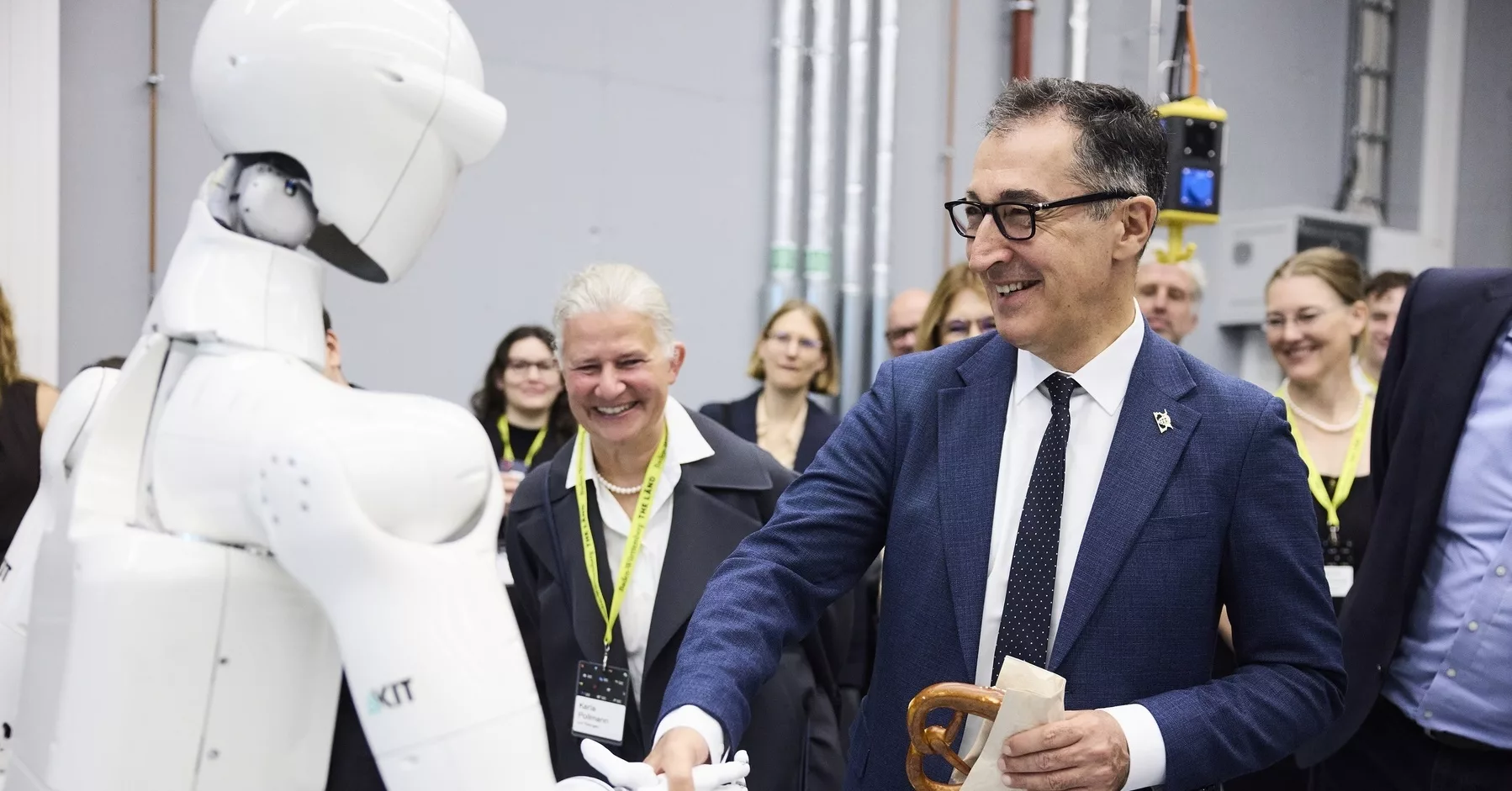
    Cyber Valley Day opened with welcome addresses from leading representatives from politics, science, and our Innovation Campus: Moritz Hardt, Director at the Max Planck Institute for Intelligent Systems; Cem Özdemir, Minister President of Baden-Württemberg; Boris Palmer, Lord Mayor of Tübingen; Karla Pollmann, President of the University of Tübingen; Simone Schwanitz, Secretary General of the Max Planck Society; and Florian Mayer, Managing Director of Cyber Valley GmbH, welcomed guests to the anniversary celebration.

    Cem Özdemir_Minister President
    © Christian Borth

    Scientific program at the main stage

    Hosted by Linda Behringer, press officer at the Max Planck Institute for Intelligent Systems, the main stage program brought together voices from across the international AI and innovation landscape.

    A keynote by Manuela Veloso, Herbert A. Simon University Professor Emerita at Carnegie Mellon University, provided one of the early highlights of the day. Throughout the program, the Cyber Valley Voices sessions on the main stage featured leading researchers from across our Innovation Campus, including Bernhard Schölkopf from the ELLIS Institute Tübingen, Matthias Bethge from the Tübingen AI Center at the University of Tübingen, Tamim Asfour from the Karlsruhe Institute of Technology, Katherine J. Kuchenbecker from the Max Planck Institute for Intelligent Systems, Steffen Staab from the University of Stuttgart, and Werner Kraus from Fraunhofer IPA.

    In the Auditorium, C. David Remy and Philipp Rothemund from the University of Stuttgart, as well as Chandan Kumar from Fraunhofer IAO, shared insights into their research. The afternoon continued with a keynote by Alex Smola, CEO and co-founder of Boson AI, as well as a talk by Rafael Laguna de la Vera from the Federal Agency for Disruptive Innovation (SPRIN-D).

    © Christian Borth

    Surprise keynote speaker

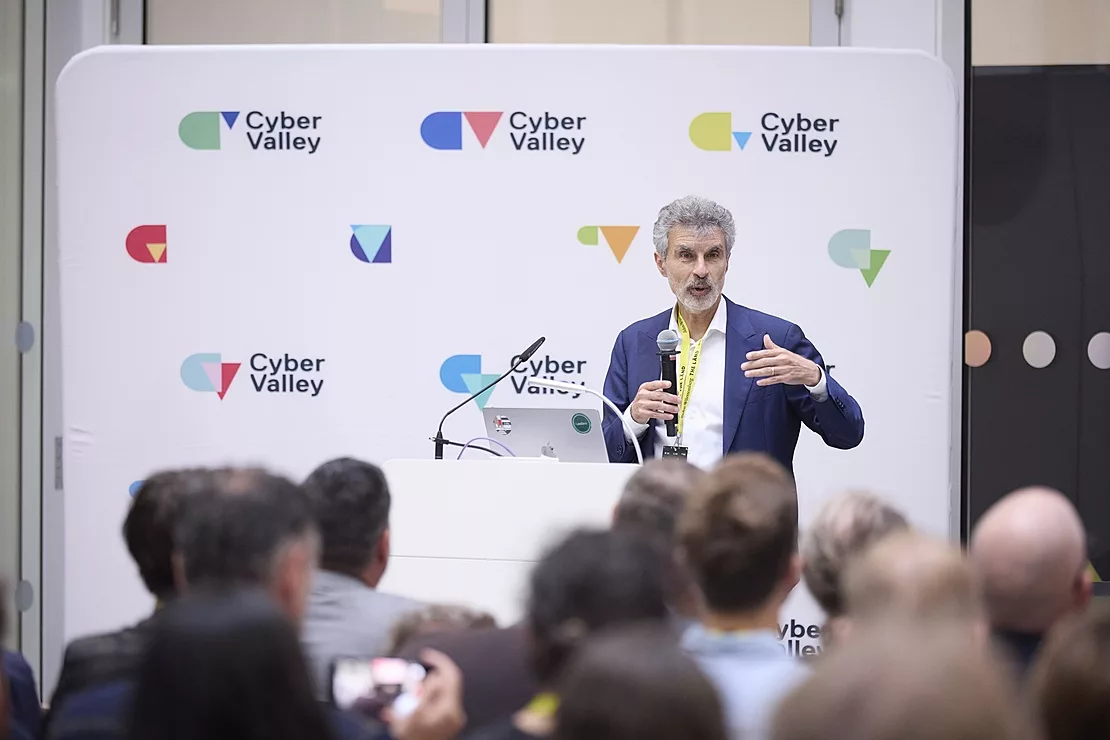
    One of the biggest highlights of the day was our surprise keynote speaker: Yoshua Bengio, one of the pioneers of modern artificial intelligence. He has become one of the most prominent voices discussing the societal implications of AI, discussing questions regarding safety, and he calls for a responsible development of AI. Having Yoshua Bengio join us for our anniversary was very special!

    Cyber Valley Day 10 Year Anniversary
    © Christian Borth

    From excellent scientific ideas to real-world applications and impact

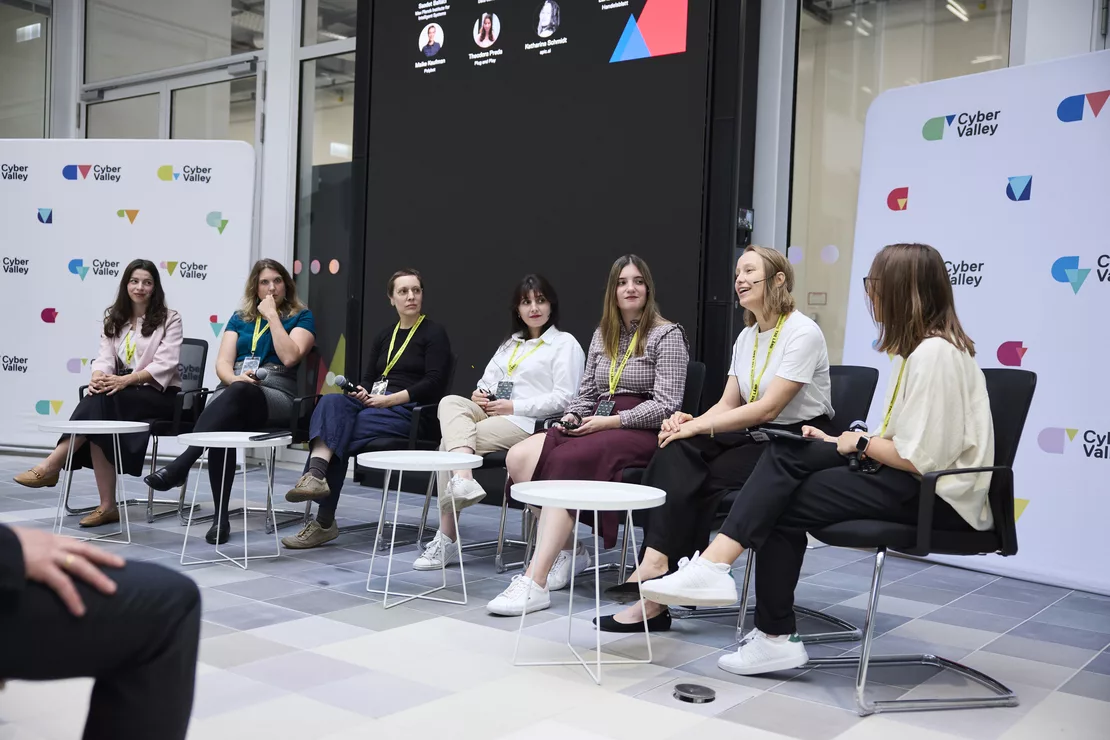
    The panel discussion “Building what’s next: How bold ideas move from research to impact” brought together researchers, founders, and innovation experts to discuss how ambitious ideas can move beyond research and into society and industry. Moderated by Larissa Holzki from Handelsblatt, the discussion featured Saadet Baltaci and Antonia Georgopoulou from the Max Planck Institute for Intelligent Systems, Aline Defranceski from Data Coffee, Maike Kaufman from Polybot, Theodora Preda from Plug and Play, and Katharina Schmidt from apic.ai.

    © Christian Borth

    The Cyber Valley Start-up Voices session offered further perspectives on innovation and entrepreneurship, with contributions from Prashanth Halady of Bosch, Mario Krenn of Feyer, and Jonas Müller of Black Forest Labs.

    Research from our Innovation Campus

    The exhibition with more than 40 exhibitors on the ground floor brought together academic partners, research projects, and organizations from across our Innovation Campus, including the Max Planck Institute for Intelligent Systems, the Haptic Intelligence Department, Max Planck Foundation, the IMPRS-IS, the University of Stuttgart (IntCDC, IRIS, MLIP, KI-SIR), the University of Tübingen (ML Cluster, Tübingen AI Center), Bionic Intelligence Tübingen Stuttgart (BITS), ELLIS Institute Tübingen, Hertie Institute for AI in Brain Health, ARENA2036, BWKI, Cyber Valley GmbH and PAB, High Performance Humanoid Technologies Lab (H²T) from KIT, KE:SAI, Oktonex, Polybot, Prior Labs, and more!

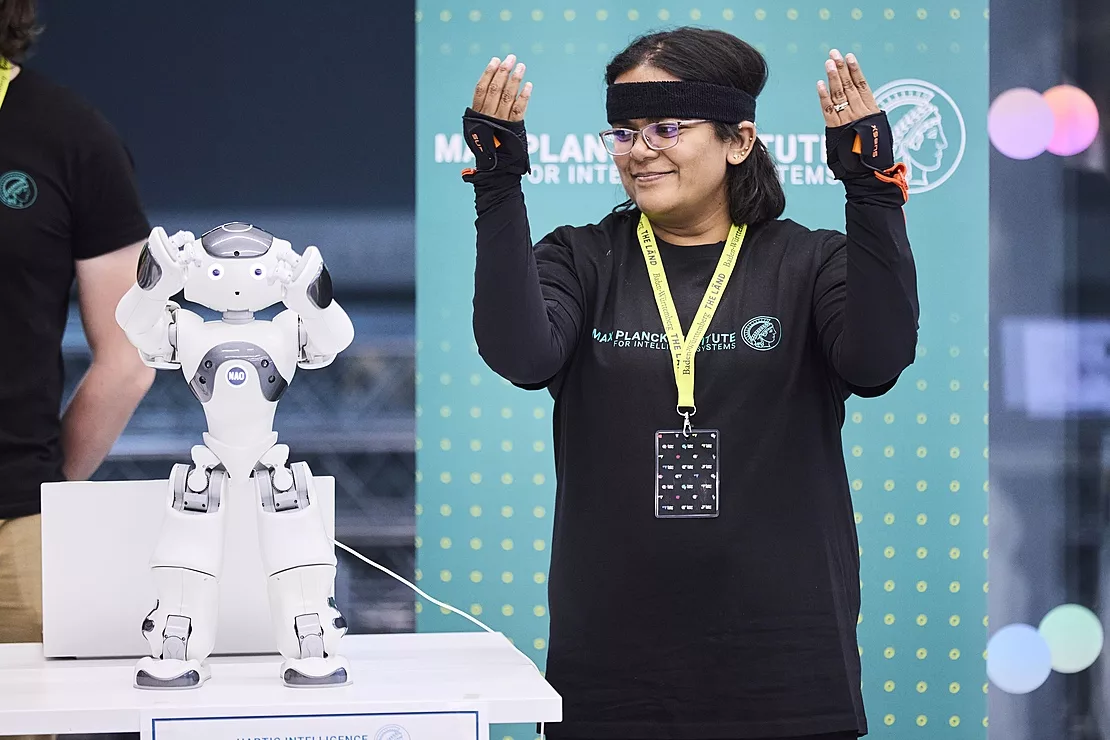
    Robot at Cyber Valley Day
    © Christian Borth

    A stage for the next generation of founders

    On the sixth floor, the Start-up Basecamp put entrepreneurship and emerging innovation at the center of the conversation.
    Start-ups and initiatives including Bergsonne Labs, Denkbox, NUVUS, Computomics, Feyer, MaiTY, Istari AI, TextVerstehen, Tanocrix, Data Coffee, Yugen Space, IntegraSkin, MIRA vision, the Startup Center Tübingen, and the Tübingen AI Center presented their work and connected with researchers, investors, and other members of the ecosystem.

    An investor “Ask Me Anything” session also gave researchers and future founders the opportunity to gain practical insights into early-stage investment and entrepreneurship. Representatives from Capnamic, Fly Ventures, AI Fund, and Mätch VC shared their perspectives on what investors look for and what researchers should consider when exploring the path from research to start-up.
    During more than 40 1:1 sessions with investors, researchers and prospective founders had the opportunity to discuss their individual ideas, receive tailored feedback, and explore potential pathways toward funding and venture creation.

    Cyber Valley Day start-ups
    © Christian Borth

    Special announcement

    The final highlight of the day was grubel, which announced its launch during Cyber Valley Day. Founded by Moritz Hardt, Reinhard Heckel, Vedant Nanda and Navid Rekabsaz, grubel is building AI systems specialized to individual legal matters. Its vision: every matter should be able to build its own AI by combining data curation, adaptation, and evaluation to create specialized systems that can deliver high performance while keeping sensitive data under the customer’s control. We’re excited to see this research-driven venture take its next step and look forward to following its journey! 

    © Christian Borth

    Looking ahead

    Ten years ago, a group of visionary partners laid the foundation for Cyber Valley. Today, it has grown into a vibrant ecosystem connecting excellent research, entrepreneurship, industry, and society. Thank you to everyone who joined us and helped make this celebration a very memorable day!

  • Three start-ups join the Cyber Valley Start-up Network

    Three start-ups join the Cyber Valley Start-up Network

    The Cyber Valley Start-up Network is expanding, admitting three new members: Feyer, Ontic Labs, and oneAI. These start-ups are using bold ideas and groundbreaking technologies to shape the future of AI and robotics in Baden-Württemberg.

    Feyer

    Feyer is building a European frontier AI lab for automated physical invention. The team develops AI systems designed to explore complex physical design spaces and create new technological solutions, with potential applications across areas such as photonics, precision instrumentation, and quantum technologies.

    The company emerged from the research group of Mario Krenn, Professor at the Cluster of Excellence “Machine Learning: New Perspectives for Science” at the University of Tübingen. The founding team consists of Jonathan Klimesch, Sören Arlt, and Mario Krenn and has already reached an exciting milestone: Feyer was selected as one of ten teams for the first stage of SPRIND’s Next Frontier AI Challenge, together with Ontic Labs.

    Ontic Labs

    Ontic Labs is building a foundation model for physical intelligence, giving machines a working understanding of how the physical world behaves.

    The Tübingen-based startup develops physics-aware world models that enable machines and robots to perceive, predict, and act in complex real-world environments. Its approach brings states, actions, and sensor data into a shared representation, allowing physical properties such as contact, forces, and object coherence to emerge from training rather than being manually programmed. The goal: a single world model that can transfer across robots, embodiments, tasks, and environments.

    Founded by Omid Taheri, Mikel Zhobro, Georg Martius, Wieland Brendel, and Gerard Pons-Moll, Ontic Labs brings together expertise from the Max Planck Institute for Intelligent Systems, the University of Tübingen, the Tübingen AI Center, and the ELLIS Institute Tübingen. The team was also selected as one of ten teams in SPRIND’s Next Frontier AI Challenge.

    SPRIND’s Next Frontier AI Challenge

    The two start-ups from Tübingen are among just ten teams across Europe that have been selected and will receive €3 million to develop technologies beyond today’s AI models. Of the three selected teams from Germany, two originate from the Cyber Valley ecosystem in Baden-Württemberg as spin-outs from several of Cyber Valley’s academic partners, including the ELLIS Institute Tübingen, Max Planck Institute for Intelligent Systems, Tübingen AI Center, and the University of Tübingen. Their success highlights the growing momentum with which AI research is being translated into innovative companies and how excellent AI research from Baden-Württemberg is playing a key role in the European race for frontier AI models.

    Read more about the success story here:
    https://cyber-valley.de/en/news/two-cyber-valley-start-ups-selected-to-shape-europe-s-frontier-ai-future

    oneAI

    As AI adoption accelerates across organizations, questions around governance, security, compliance, and control are becoming increasingly important. oneAI is addressing exactly this challenge: enabling companies and public organizations to use AI securely, transparently, and in compliance with regulatory requirements.

    The start-up is a spin-out from relyon AG, already part of the Cyber Valley Corporate Network, demonstrating Baden-Württemberg’s powerful research-to-innovation pipeline. Mirko Tochtermann, Founder & CTO of oneAI, shared his perspective on secure AI adoption and governance at one of our latest Cyber Valley IMPULSE events.

    The research-to-market journeys of these start-ups highlight how transferring academic expertise into application leads to tangible impact, powering industry and driving Europe’s sustainable future. Cyber Valley is delighted to welcome these three start-ups to its community!

    The Cyber Valley Start-up Network

    The Cyber Valley Start-up Network brings together more than 100 innovative AI and robotics start-ups across Baden-Württemberg, forming a strong and growing entrepreneurial community within one of Europe’s leading AI and robotics ecosystems. The network spans a broad range of applications and industries, from foundational AI technologies to applied and industry-specific solutions. Connected through their close ties to Cyber Valley, members benefit from access to world-class research, industry partners, investors, and public stakeholders, jointly strengthening the region’s AI and robotics ecosystem.

  • Cyber Valley AI Incubator announces batch #8 winners

    Cyber Valley AI Incubator announces batch #8 winners

    The Cyber Valley AI Incubator batch 8 has successfully concluded with its Demo Day, where seven emerging AI ventures presented their innovations to an audience of founders, investors, researchers, industry leaders, and members of the wider AI community. Made possible through the generous support of the Carl Zeiss Foundation (CSZ), the program continues to foster research-driven AI entrepreneurship by helping innovators transform cutting-edge ideas into startup ventures.

    Photo: A. Posada @MPI-IS

    The event opened with welcome remarks from Christoph Keplinger and Leila Masri of the Max Planck Institute for Intelligent Systems (MPI-IS), who reflected on the achievements of batch 8 and the growing impact of the AI Incubator. Phil-Alan Gärtig of the Carl-Zeiss-Stiftung, the program’s principal sponsor, highlighted the foundation’s continued commitment to advancing innovation and research-driven entrepreneurship.

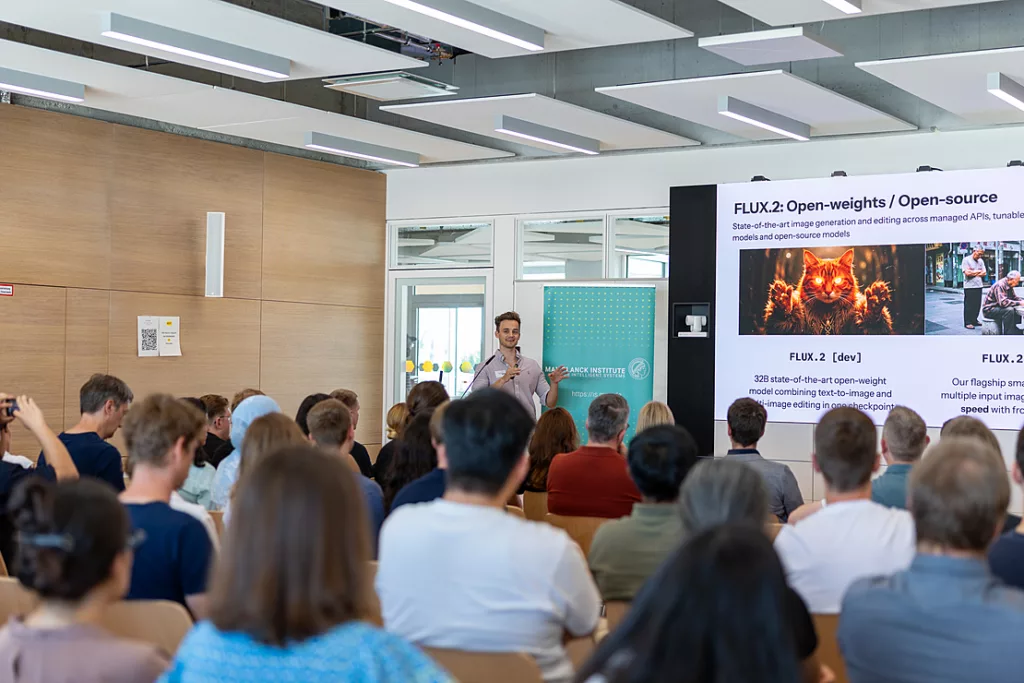
    In his keynote, “Towards Visual Intelligence: From Image Generation to Physical AI,” Axel Sauer explored the evolution of generative AI and the development of increasingly capable AI models. Drawing on the work of Black Forest Labs, he shared perspectives on the rapid progress of AI technologies and their potential to shape the future of visual intelligence and embodied AI systems.

    Photo: A. Posada @MPI-IS

    The spotlight then turned to the batch 8 teams, who presented their final venture pitches before an expert jury consisting of:

    • Daisy Paiva (ZEISS Ventures)
    • Franziska Ivens (Silicon Allee Venture Lab at Fraunhofer Heinrich Hertz Institute)
    • Christoph Keplinger (Max Planck Institute for Intelligent Systems)

    With an exceptionally high standard across all seven teams, selecting the winners proved to be a challenging task.
     

    Read the full press release on the Max Planck Institute for Intelligent System’s website. 

  • From Cyber Valley to Europe’s AI frontier

    From Cyber Valley to Europe’s AI frontier

    Ontic Labs and Feyer.ai have been selected for the first stage of the German Federal Agency for Breakthrough Innovation’s (SPRIND) Next Frontier AI Challenge. The two start-ups are among just ten teams across Europe that have been selected and will receive €3 million to develop technologies beyond today’s AI models. 

    Ontic Labs and Feyer.ai have been selected for the first stage of the German Federal Agency for Breakthrough Innovation’s (SPRIND) Next Frontier AI Challenge. The two start-ups are among just ten teams across Europe that have been selected and will receive €3 million to develop technologies beyond today’s AI models. 

    Of the three selected teams from Germany, two originate from the Cyber Valley ecosystem in Baden-Württemberg as spin-outs from several of Cyber Valley’s academic partners, including the ELLIS Institute Tübingen, Max Planck Institute for Intelligent Systems, Tübingen AI Center, and the University of Tübingen. Their success highlights the growing momentum with which AI research is being translated into innovative companies and how excellent AI research from Baden-Württemberg is playing a key role in the European race for frontier AI models.

    The Next Frontier AI Challenge is aimed at European teams developing fundamental AI technologies with exceptionally high innovation potential. The goal is to promote new approaches that go beyond the current state of the art and can have a long-term economic and societal impact.

    “Ontic Labs and Feyer.ai are excellent examples of what the Cyber Valley ecosystem is designed to achieve: turning outstanding research into technologies with societal and economic relevance,” said Florian K. Mayer, Managing Director of Cyber Valley GmbH. “Their success reflects the strength of the innovation pipeline in Baden-Württemberg, where leading researchers, entrepreneurs, and partners work together to transform scientific advances into new ventures and applications.”

    Ontic Labs: Building AI for Physical Intelligence

    Ontic Labs is developing a foundation model for physical intelligence. The company aims to enable machines to understand the physical dynamics of their environment rather than only recognizing visual patterns. This could allow robots to predict future states, reason about physical interactions, and operate more effectively in complex real-world settings.

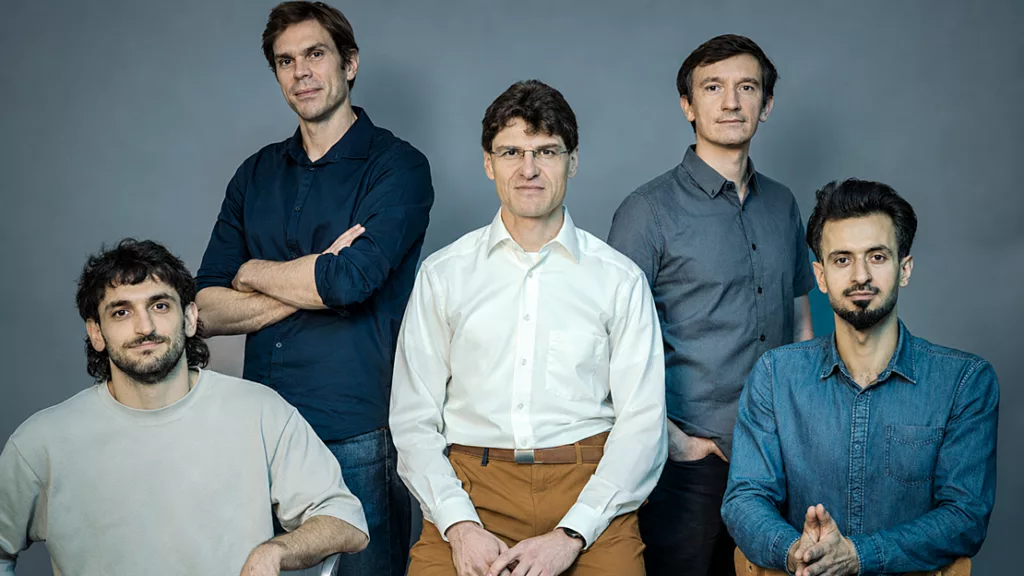
    The company brings together researchers from the Max Planck Institute for Intelligent Systems, the University of Tübingen’s Cluster of Excellence Machine Learning: New Perspectives for Science, the Tübingen AI Center, and the ELLIS Institute Tübingen. Ontic Labs was founded by Omid Taheri, Mikel Zhobro, Wieland Brendel, Georg Martius, and Gerard Pons-Moll.

    Ontic Labs team. Photo: SPRIND

    Feyer.ai: AI for Industrial Hardware Innovation

    Feyer.ai develops AI systems that autonomously design new industrial hardware. Its approach combines modern AI methods with physics-based simulations to generate and evaluate technical solutions. By applying AI-driven invention to industrial challenges, Feyer.ai aims to accelerate the development of new technologies across fields including photonics, quantum technologies, microscopy, semiconductor manufacturing, and energy systems.

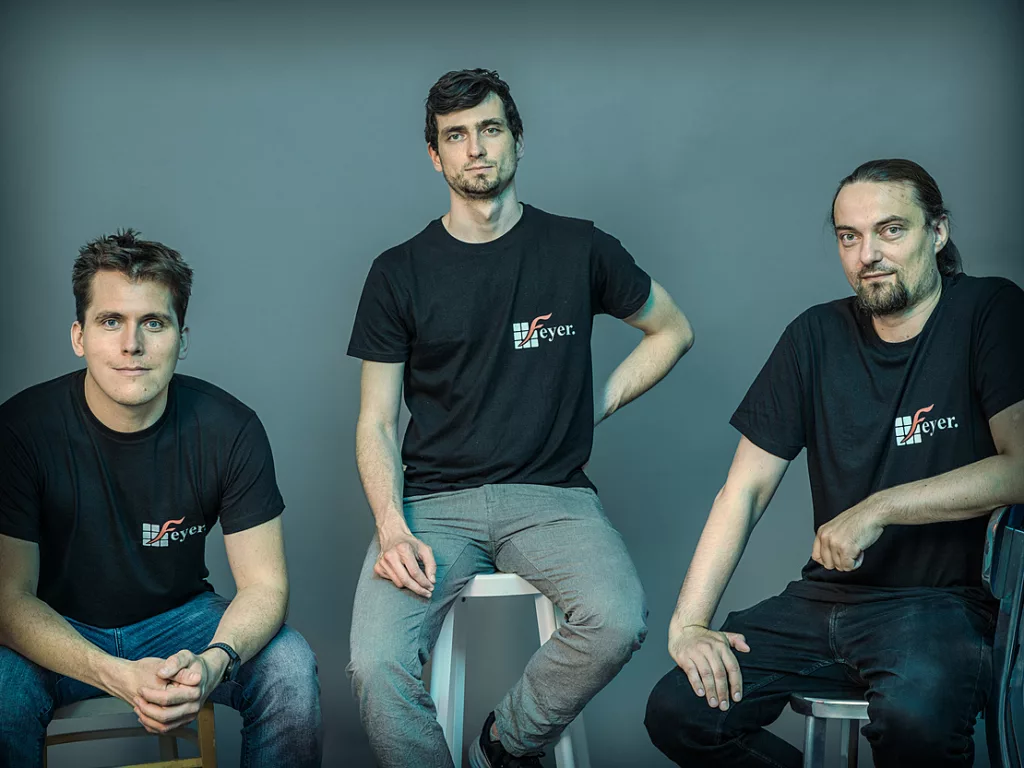
    The company emerged from the research group of Mario Krenn, Professor at the Cluster of Excellence Machine Learning: New Perspectives for Science at the University of Tübingen. The founding team consists of Jonathan Klimesch, Sören Arlt, and Mario Krenn.

    Feyer team. Photo: SPRIND

    The selection of Ontic Labs and Feyer.ai reflects the strength of the Cyber Valley ecosystem, which connects leading AI research with entrepreneurship and start-up support. Both companies build on research conducted at institutions that are central to Baden-Württemberg’s AI landscape and demonstrate how advances in AI research are being translated into to real-world impact, powering industry, and driving Europe’s sustainable future.

    Read SPRIND’s press release here.

    Read the press release from the University of Tübingen (in German) here.

  • Another milestone for AI from the Stuttgart region

    Another milestone for AI from the Stuttgart region

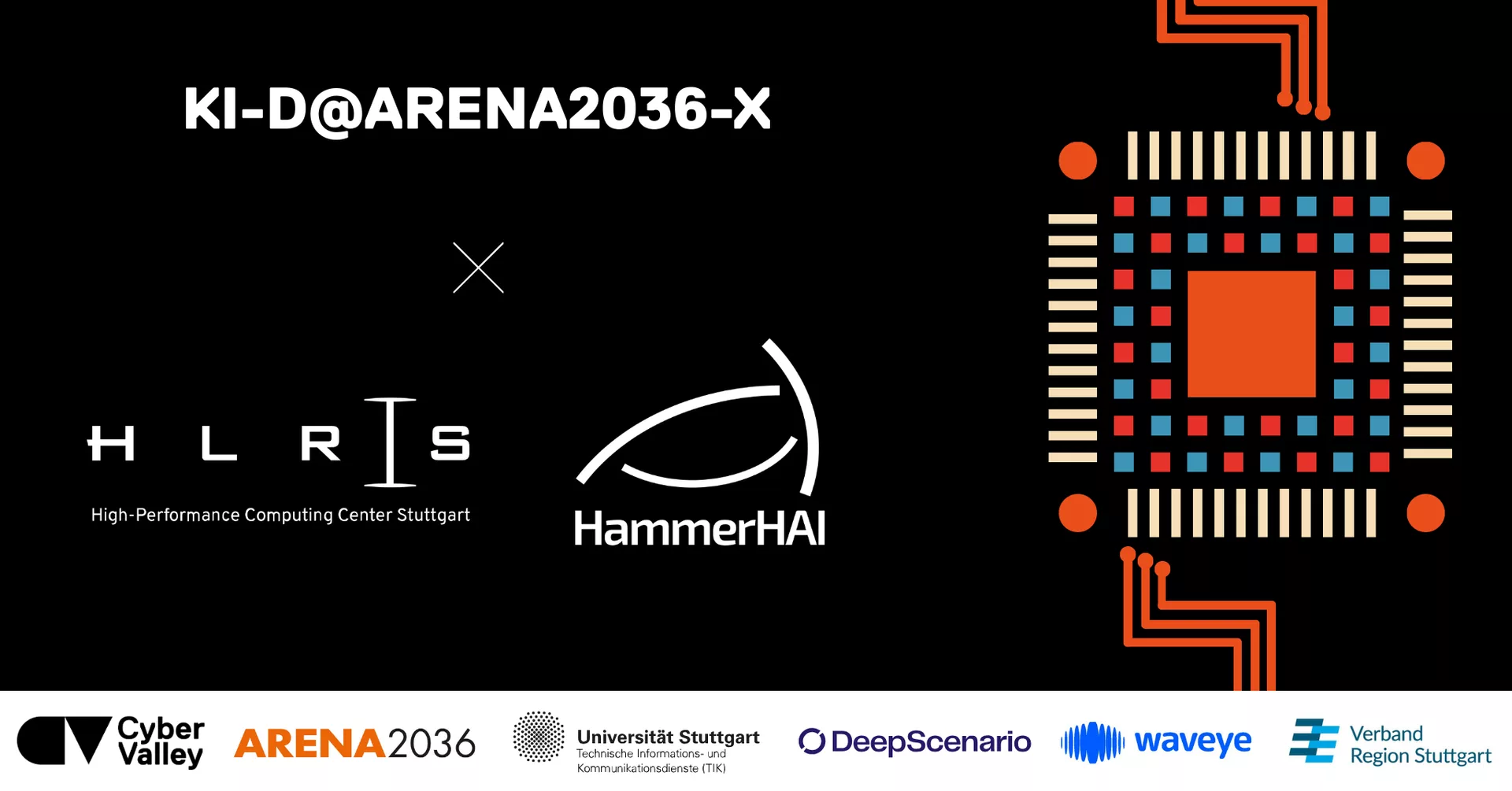
    The future of Artificial Intelligence (AI) is taking an important step forward in the heart of Baden-Württemberg: the High-Performance Computing Center Stuttgart (HLRS) is joining the ‘KI-D@ARENA2036-X” program as a new partner, contributing its expertise and computing capacity. 

    The program is jointly driven by ARENA2036, Cyber Valley GmbH, DeepScenario, waveye, and the Technical Information and Communication Services of the University of Stuttgart (TIK).

    With HLRS joining the initiative, the program gains an important new partner. This collaboration provides access to the infrastructure project HammerHAI. Starting in mid-year, extensive AI computing resources will be available across the entire development chain—from smaller systems directly integrated into machines or devices to powerful high-performance computing systems. This will make it possible to train and deploy very large and complex AI models.

    Infrastructure designed to accelerate AI development

    As part of the initiative, the partners are building an open IT and data infrastructure, including access to a data space for the sovereign exchange of data. The goal is to provide companies with easy access to powerful resources for AI applications—from the initial idea to practical deployment within companies. At the center of this effort is the networking of AI systems and data. Companies will be able to use the provided infrastructure without having to build large technical systems themselves. Access will be offered at competitive costs. Start-ups as well as small and medium-sized enterprises (SMEs) will particularly benefit, strengthening their innovative capacity and competitiveness.

    This will create a scalable, transparent, and collaboratively designed system in Baden-Württemberg. Instead of a black-box approach, the project deliberately focuses on an open infrastructure.

    This infrastructure is built on three key components:

    Integrating own hardware

    Companies can integrate their own computing hardware, allowing them to flexibly expand available computing capacity and address individual requirements.

    Shared data space

    A scalable, collaborative data space with marketplaces enables different organizations to work together on datasets, AI models, and concrete use cases.

    High-performance computing with HammerHAI

    Powerful high-performance computing resources enable the training and deployment of particularly large AI models.


    A program that accelerates companies

    Participating companies in the ‘KI-D@ARENA2036-X’ program benefit from practical access to powerful AI infrastructure and a strong innovation network.

    The program offers, among other things:

    • the opportunity to test and implement new ideas and proof-of-concepts without high upfront investments
    • access to powerful high-performance IT without having to operate their own data center
    • professional exchange with other AI developers facing similar technological challenges
    • a real-world testing environment at ARENA2036 that brings together requirements from different industries

    This means the program not only supports companies in their projects—it actively accelerates the development and implementation of new AI applications.

    Voices from the project team

    Prof. Dr. Peter Middendorf, Rector of the University of Stuttgart:

    “The IT and data infrastructure of ‘KI-D@ARENA2036-X’ is another important building block in our innovation ecosystem. The University of Stuttgart contributes to the success of this project through its Technical Information and Communication Services and as a partner of ARENA2036. I am therefore particularly pleased that the High-Performance Computing Center Stuttgart (HLRS) is now joining as another strong partner. With its powerful computing infrastructure, HLRS will support companies and start-ups in testing and optimizing state-of-the-art AI applications.”

    Dr. Alexander Lahl, Regional Director of the Verband Region Stuttgart:

    “Together with the HammerHAI infrastructure project, an important nucleus for AI development is emerging in the region. Start-ups and especially small and medium-sized enterprises will benefit greatly from this initiative. Through our support, we are significantly strengthening the Stuttgart Region as a location for AI applications and data infrastructures. At the same time, this project highlights the importance of collaboration across research, industry, and regional partners.”

    Michael Kaiser, Managing Director of Wirtschaftsförderung Region Stuttgart GmbH (WRS):

    “The collaboration between ‘KI-D@ARENA2036-X’ and HLRS and its European AI Factory HammerHAI is another important building block for the AI ecosystem of the Stuttgart Region. It enables companies to train and use very large AI models using efficient high-performance computers—without having to operate their own data center. This opens up new opportunities in AI development and application, especially for small and medium-sized companies.”

    Angelina Jukic, Program Manager at Cyber Valley GmbH:

    “Our goal within the KI-D@ARENA2036-X program is to create a highly connected ecosystem that brings together research, start-ups, and industry. This will make the development and training of AI models more efficient. HammerHAI is one of Germany’s leading AI computing infrastructures and works together with ARENA2036 on forward-looking solutions.”


    Project status and outlook

    Following the successful establishment of the basic infrastructure during the first year of the project, the program will enable operational access to the available computing and data resources in 2026.

    About the KI-D@ARENA2036-X program

    The KI-D@ARENA2036-X program is jointly implemented by ARENA2036, Cyber Valley GmbH, DeepScenario, waveye, and the Technical Information and Communication Services (TIK) of the University of Stuttgart. The goal is to build a collaborative infrastructure that accelerates AI innovation in Baden-Württemberg while ensuring security, transparency, and long-term economic sustainability.

    The program is funded by the Verband Region Stuttgart within the Co-Financing Program for Artificial Intelligence from 2024 to 2027 with a total of €685,000.

    Presscontact:

    Silke Dutz

    Public Outreach Manager      

    Email: silke.dutz@cyber-valley.de   

  • Cyber Valley unites AI and robotics expertise for the healthcare sector

    Cyber Valley unites AI and robotics expertise for the healthcare sector

    Stuttgart, October 28, 2024 – The Cyber Valley Health Cluster officially launched last Thursday with a public kickoff event in Tübingen. This initiative launched by Cyber Valley aims to unite the forces of science, industry, and start-ups to improve people’s long-term health through artificial intelligence and modern robotics. 

    Collaboration between research and industry for AI-driven health technologies 

    The Cyber Valley Health Cluster aims to integrate research, practice, and technology. It promotes joint projects between AI experts, scientists, and companies to develop innovative solutions for current and future challenges in the healthcare sector. The Health Cluster emphasizes interdisciplinary knowledge exchange, enabling new approaches and solutions that go beyond individual technological advances.  

    Rebecca C. Reisch, Managing Director of Cyber Valley GmbH, highlights the importance of this collaboration: “The Cyber Valley Health Cluster is more than an academic endeavor; it’s a collaborative alliance that encourages exchange between industry, start-ups, and research. The Health Cluster is where AI-based solutions can be developed to address the most pressing challenges in modern medicine and beyond.”

    Strong Cyber Valley Partners and Friends are already on board  

    The Cyber Valley Health Cluster is backed by strong partnerships. Among the already confirmed Cyber Valley Partners are well-known players such as Boehringer Ingelheim, ZEISS, the University of Tübingen, the University of Stuttgart, and the Max Planck Institute for Intelligent Systems (MPI-IS). These partners are investing significantly in the Cyber Valley Community and are playing a central role in the further development of the Health Cluster. 

    In addition, the Cyber Valley Health Cluster is supported by numerous committed Cyber Valley Friends who enrich the network with their expertise and connections. These include Immatics, Cegat, Ovesco, BIOPRO Baden-Württemberg, BioRegio STERN Management, as well as the Medical Innovations Incubator, and the start-ups Osora and Cerebri.  Further candidates are already under consideration.  

    Reisch emphasizes the role of the Cyber Valley Community: “Together with our Partners and Friends, we are creating an environment that drives the development of technologies that are not only groundbreaking but also practical and ethical. Because only by working together do we have the chance to establish Baden-Württemberg and the whole of Germany at the forefront of global AI health innovations.” 

    Long-term goal: a lasting healthcare alliance 

    The Cyber Valley Health Cluster supports start-ups and innovation projects to create real value by generating new jobs and health solutions. Health Cluster participants moreover benefit from extensive connections and new networking opportunities that enable the development of pioneering healthcare solutions and rapid knowledge transfer between research and industry. 

    The long-term goal of the Cyber Valley Health Cluster is to create a lasting and active community, pooling health expertise to enable interdisciplinary teams to tackle global health challenges. Further events and interaction formats are planned for the Cyber Valley Health Cluster in the coming months. 

    About Cyber Valley 

    Cyber Valley is Europe’s largest and leading center for excellence in artificial intelligence and modern robotics. Its mission and public mandate are to advocate for the research, development, application, and acceptance of technologies and methods in the field of intelligent systems. Cyber Valley encourages entrepreneurship by uniting scientific excellence with innovation and technology transfer. In addition, Cyber Valley facilitates critical reflection on the ethical and social implications of AI through public engagement. Cyber Valley envisions a future in which the full potential of intelligent systems is leveraged for the greater good of the world. 

    Media Contact: 

    Laura Neusser 
    Public Outreach Manager 
    Cyber Valley GmbH 
    laura.neusser@cyber-valley.de