User Group: Start-up

  • Cyber Valley Start-up Network welcomes two new members

    Cyber Valley Start-up Network welcomes two new members

    The Cyber Valley Start-Up Network continues to grow: at the end of February, two start-ups were added to the Network, bringing the current total to ten members. 

    Located in Stuttgart, 43IT is a software development start-up that works in the fields of computer vision, object recognition, and neural networks. More specifically, the company specializes in the analysis of volumetric image data. 

    With eye2you, the Start-Up Network now counts a MedTech start-up among its members. Based in Tübingen and Seoul, the company's mission is to make eye care more widely accessible by applying cutting-edge AI in combination with smartphones. In so doing, eye2you aims to help detect retinal disease at an early stage, which can prevent loss of vision. 

    More information on the Cyber Valley Start-Up Network can be found here: https://www.cyber-valley.de/cyber-valley-start-up-network

  • Cyber Valley Start-Up Network is expanding

    Cyber Valley Start-Up Network is expanding

    The Cyber Valley Start-Up Network is pleased to be welcoming a new member to its ranks. With the addition of Colugo, the network now counts a strategic consultancy that specializes in assessing AI-related potential and opportunities for businesses in the Tübingen region. The start-up also offers workshops and training courses that aim to support businesses in gaining the understanding of AI they need to apply it in their respective fields.

    The Cyber Valley Start-Up Network was recently established with the aim of promoting technology transfer and entrepreneurship in the broad field of AI in the Stuttgart-Tübingen region. The network currently counts eight members and plans to keep expanding in the New Year. 

  • Cyber Valley launches Start-Up Network

    Cyber Valley launches Start-Up Network

    Stuttgart/Tübingen. Cyber Valley on Monday announced the launch its new Start-up Network as a platform for exchange between AI start-ups within the Cyber Valley ecosystem.

    “By promoting dialog among experts in the field of intelligent systems, we are building a strong community of entrepreneurs in the Stuttgart-Tübingen region,” said Michael Black, Cyber Valley spokesperson and Director at the Max Planck Institute for Intelligent Systems in Tübingen. “With the Start-Up Network, we have taken an important step toward promoting tech transfer, which is one of the Cyber Valley initiative’s central goals.”  

    As members of the network, start-ups are invited to attend Cyber Valley networking events such as talks, meet-ups, and tech brunches on a regular basis. Network members’ activities must be related to the field of intelligent systems. Moreover, the start-ups are required to be connected with Cyber Valley, either by being headquartered in the Stuttgart-Tübingen region, or by having members or alumni of Cyber Valley partner institutions among their founders. Membership in the Cyber Valley Start-Up Network is reviewed once a year to ensure that these requirements continue to be met. 

    Cyber Valley invites interested start-ups that match these criteria to apply for membership to the Start-Up Network. “We want to help the start-up community in the region grow and are building this network to create a breeding ground for new ideas and innovation,” says Michael Black. 

    The Cyber Valley Start-Up Network counts seven initial members:

    • Deep Art: A joint venture between scientists at the University of Tübingen, École polytechnique fédérale de Lausanne (Switzerland), Université catholique de Louvain (Belgium), and the University of Freiburg, Deep Art applies an algorithm that allows everyone to create pictures in different artistic styles in just a few clicks.
    • Layer 7 AI. Founded by scientists at the University of Tübingen, the consultancy specializes in taking the latest breakthroughs in machine learning and turning them into scaleable products. 
    • Meshcapade was founded by two alumni of the Max Planck Institute for Intelligent Systems in Tübingen. The company aims to make animating, simulating, and recognizing human bodies effortless, and to bring realistic virtual humans into simulation and 3D environments.
    • Predictive Cueing is a Tübingen start-up offering motion cueing software that enables urban driving in a simulator. Its founder is an alumnus of the Max Planck Institute for Biological Cybernetics in Tübingen. 
    • Reasonal is developing a new generation of machine learning algorithms to bring meaning, clarity, and civility to online conversations. It was co-founded by scientists from the Max Planck Institute for Intelligent Systems in Tübingen and from the Max Planck Institute for Software Systems in Kaiserslautern.
    • Sagacity is a Tübingen-based start-up that seeks to improve customer and employee engagement with machine learning and artificial intelligence solutions.
    • Scatterblogs offers AI solutions for analysts, decision-makers, and journalists. Founded by alumni of the University of Stuttgart, the start-up’s solutions enable users to detect important events through social media such as Twitter and Facebook in real time and to identify relevant content.

    Start-ups interested in joining the Cyber Valley Start-Up Network are invited to contact the Cyber Valley management office at: contact@cyber-valley.de

  • Fraunhofer Gesellschaft joins Cyber Valley

    Fraunhofer Gesellschaft joins Cyber Valley

    Stuttgart – The Fraunhofer Institute for Manufacturing Engineering and Automation IPA and the Fraunhofer Institute for Industrial Engineering IAO have joined Cyber Valley, further strengthening Europe’s largest research consortium in the field of artificial intelligence (AI). The tie-up demonstrates once again that Baden-Württemberg is the AI hotspot in Europe, on a par with some of the world’s leading centers, for instance in North America.
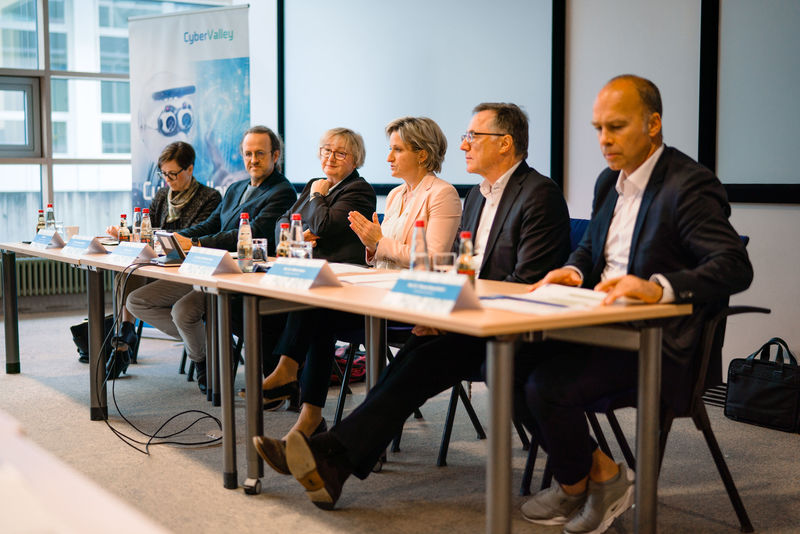
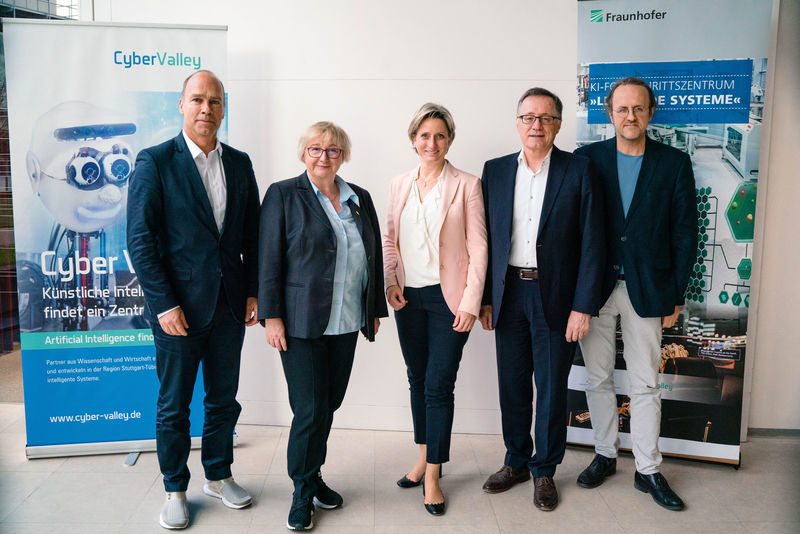
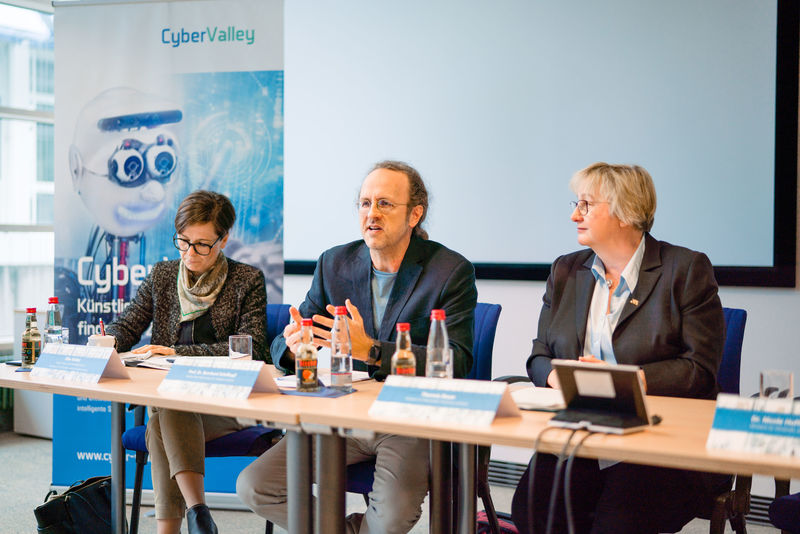
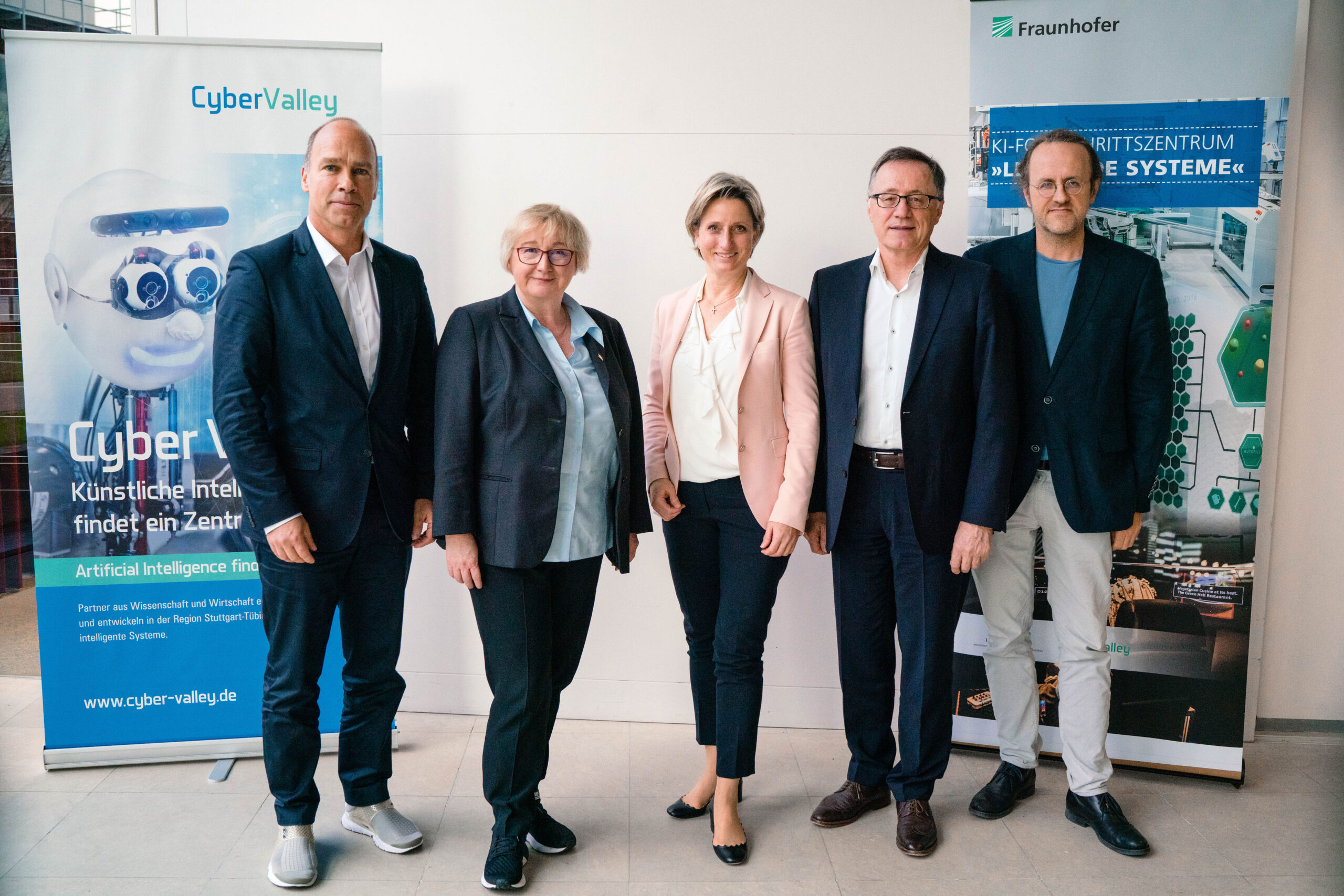
    From left to right: Silke Walter, press spokesperson Ministry of Economy, Prof. Bernhard Schölkopf, Baden-Württembergs Science Minister Theresia Bauer, Minister of Economy Dr. Hoffmeister-Kraut, and from Fraunhofer Prof. Wilhelm Bauer und Prof. Thomas Bauernhansl.

    “Artificial intelligence is a key driver of innovation and economic growth and holds enormous economic potential for our small and medium-sized enterprises,” said Baden-Württemberg's Minister of Economic Affairs, Labour and Housing Dr. Nicole Hoffmeister-Kraut. “We need more 'AI made in Baden-Württemberg' and we need to bring the results of our cutting-edge research even better and faster into the practical application of our companies. To this end, we must make massive progress in the research, development, and commercialisation of artificially intelligent systems.

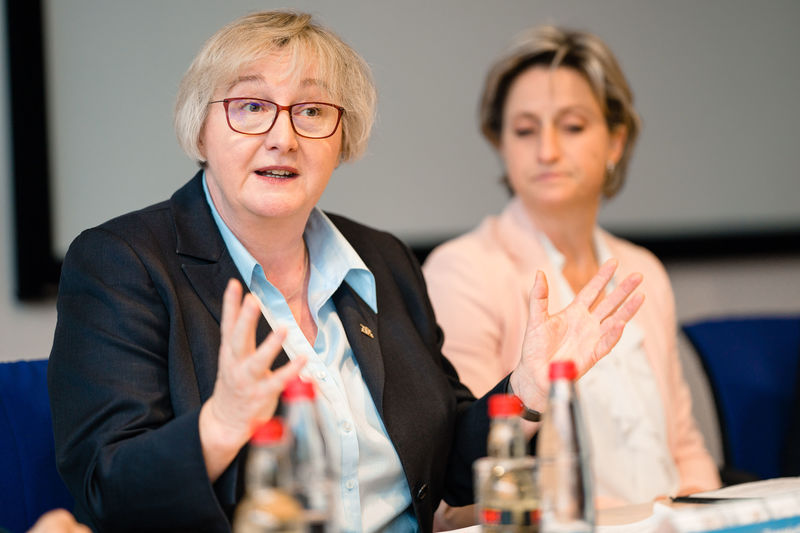
    Baden-Württemberg's Science Minister Theresia Bauer added: “An internationally visible AI hotspot is created here. We warmly welcome the Fraunhofer-Gesellschaft to the ever-growing circle! The Cyber Valley research network is developing very dynamically and is attracting more and more scientists, young talents from all across the world, companies, and foundations. The boom has created the need to establish reliable management structures for the Cyber Valley network in order to effectively manage the growing organizational tasks.”

    "With their application-oriented focus, the Fraunhofer Institutes ideally complement the research of the Max Planck Institute for Intelligent Systems and the Universities of Tübingen and Stuttgart," said Professor Martin Stratmann, President of the Max Planck Society. "Fraunhofer’s engagement makes it easier to bridge the gap to the industrial partners within Cyber Valley: in this way, findings from basic research can be applied more quickly."
     
    Professor Reimund Neugebauer, President of the Fraunhofer-Gesellschaft, emphasized: "Artificial intelligence is one of the central digital issues of the future and will change our lives from the ground up. For the international economy and industrial value chains, it means a fundamental structural change. By joining Cyber Valley, together with our partners we will advance research and transfer from science to the market in order to fully exploit the potential of this key technology and strengthen Germany as a location for international competition.”

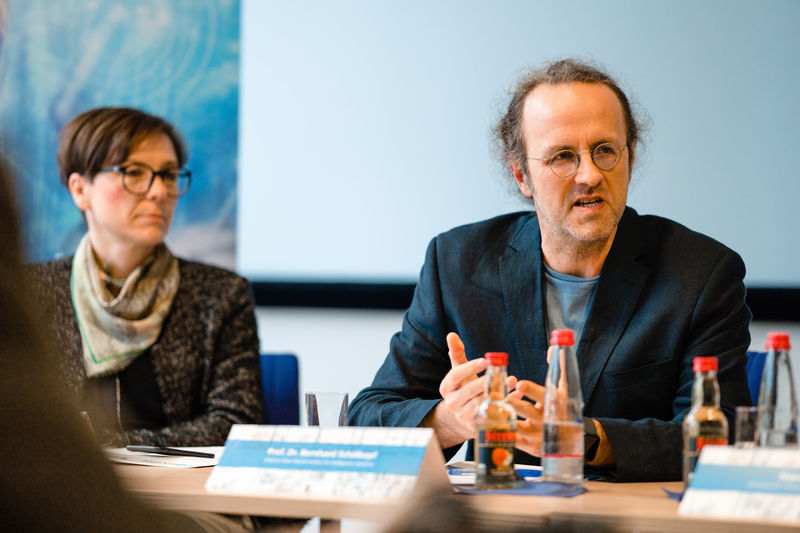
    "We very much welcome the Fraunhofer Gesellschaft’s participation, as it will help us apply the methods of modern AI, especially in small and medium-sized enterprises," said Professor Bernhard Schölkopf, Director at the Max Planck Institute for Intelligent Systems and co-founder of Cyber Valley.

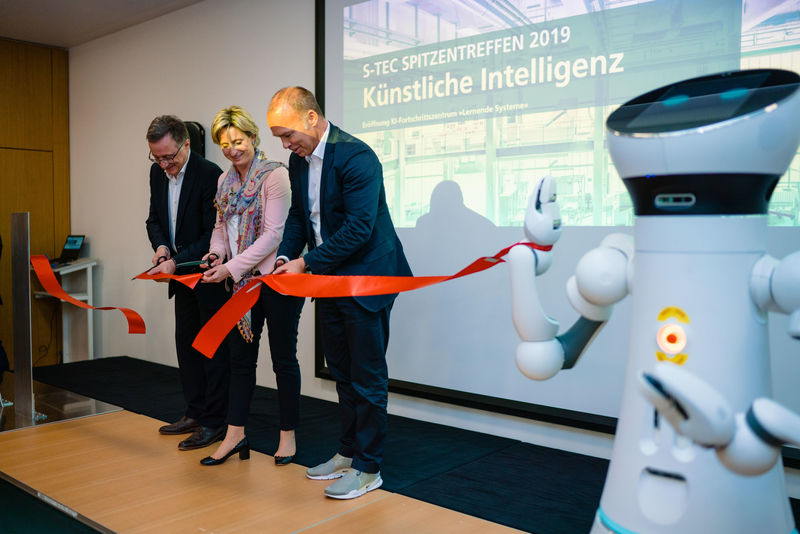
    Baden-Württemberg’s Ministry of Economic Affairs and the Fraunhofer Gesellschaft are co-financing the AI innovation center Learning Systems (KI-Fortschrittszentrum “Lernende Systeme”), which was incorporated into the Cyber Valley research consortium from October 1, 2019. The center is a laboratory with an initial team of 20 researchers and planned funding of ten million euros until the end of 2022.

    Central point of contact for application-oriented AI research

    For companies in Baden-Württemberg, the AI innovation center is a central point of contact for application-oriented research on artificial intelligence. The center explores applied research projects relevant to the manufacturing and service industries. It also acts as an interface between industry and the fundamental research conducted within the Cyber Valley consortium (the Universities of Tübingen and Stuttgart, the Max Planck Institute for Intelligent Systems, and several industry partners). The aim is to enable technology transfer to industry beyond the existing partners.

    As another component, joint research labs will be set up in which fundamental researchers will cooperate with more application-focused scientists at IPA or IAO. The projects will not be initiated by companies, but rather based on assessments of what the market needs. These joint research labs may thus bear the greatest potential for future start-ups.

    Direct cooperation with industry is a central focus of the AI innovation center. Feasibility studies and the development of prototypes of AI applications are partly financed by the innovation center’s budget. To establish strategic partnerships, industrial companies have the opportunity to operate and finance Enterprise Labs. At these labs, one or more researchers within the innovation center can give their full attention to the respective company’s specific needs. In all its activities, the AI innovation center Learning Systems aims to implement human-centered AI that people trust and accept. The full potential of AI can only be realized once people interact and work closely with new technology. To realize human-centered AI, research activities focus on topics such as explainability, privacy, safety, and the robustness of AI technologies.

    Benefit to industry and society

    With Cyber Valley, partners from science, business, and society are building a unique research ecosystem in the Stuttgart-Tübingen region. Supported by the state of Baden-Württemberg, Cyber Valley promotes an active exchange between science and industry. The initiative also focuses on training the best minds in the field of AI and creating a breeding ground for start-ups. The aim is to combine cutting-edge research with entrepreneurial spirit to promote spin-offs and technology transfer.

    The cooperation of the two Fraunhofer institutes and Cyber Valley is thus a major source of potential for all parties involved. Fraunhofer Gesellschaft has a 70-year history of excellence in business-oriented research. Its 72 institutes work closely with small and medium-sized enterprises, commonly referred to as the “German Mittelstand”, as well as with larger local and international enterprises. This expertise in realizing projects in close cooperation with industry is of immense value to Cyber Valley. With its proven track record of many successful start-ups, Fraunhofer Gesellschaft joining Cyber Valley will further enhance the research consortium's innovative and entrepreneurial strength. Fraunhofer Gesellschaft actively supports researchers who want to start their own companies based on the intellectual property they have developed while working with Fraunhofer. The mission of bringing technological pro-gress to companies and society is firmly anchored in the Fraunhofer mission statement.

    www.fraunhofer.de | www.iao.fraunhofer.de | www.ipa.fraunhofer.de

    Cyber Valley is Europe's largest research cooperation in the field of artificial intelligence with partners from politics, science, business, and society. The partnership strengthens research and teaching in the fields of machine learning, computer vision, and robotics as well as the links between these fields. Partners are the Max Planck Institute for Intelligent Systems, the University of Stuttgart, the University of Tübingen, the State of Baden-Württemberg and seven industrial partners: Amazon, the BMW Group, IAV GmbH, Daimler AG, Porsche AG, Robert Bosch GmbH and ZF Friedrichshafen AG. Cyber Valley is also supported by the Christian Bürkert Foundation, the Gips-Schüle Foundation, the Vector Foundation, and the Carl Zeiss Foundation.

    www.cyber-valley.de
  • Bosch is expanding its involvement in Cyber Valley

    Bosch is expanding its involvement in Cyber Valley

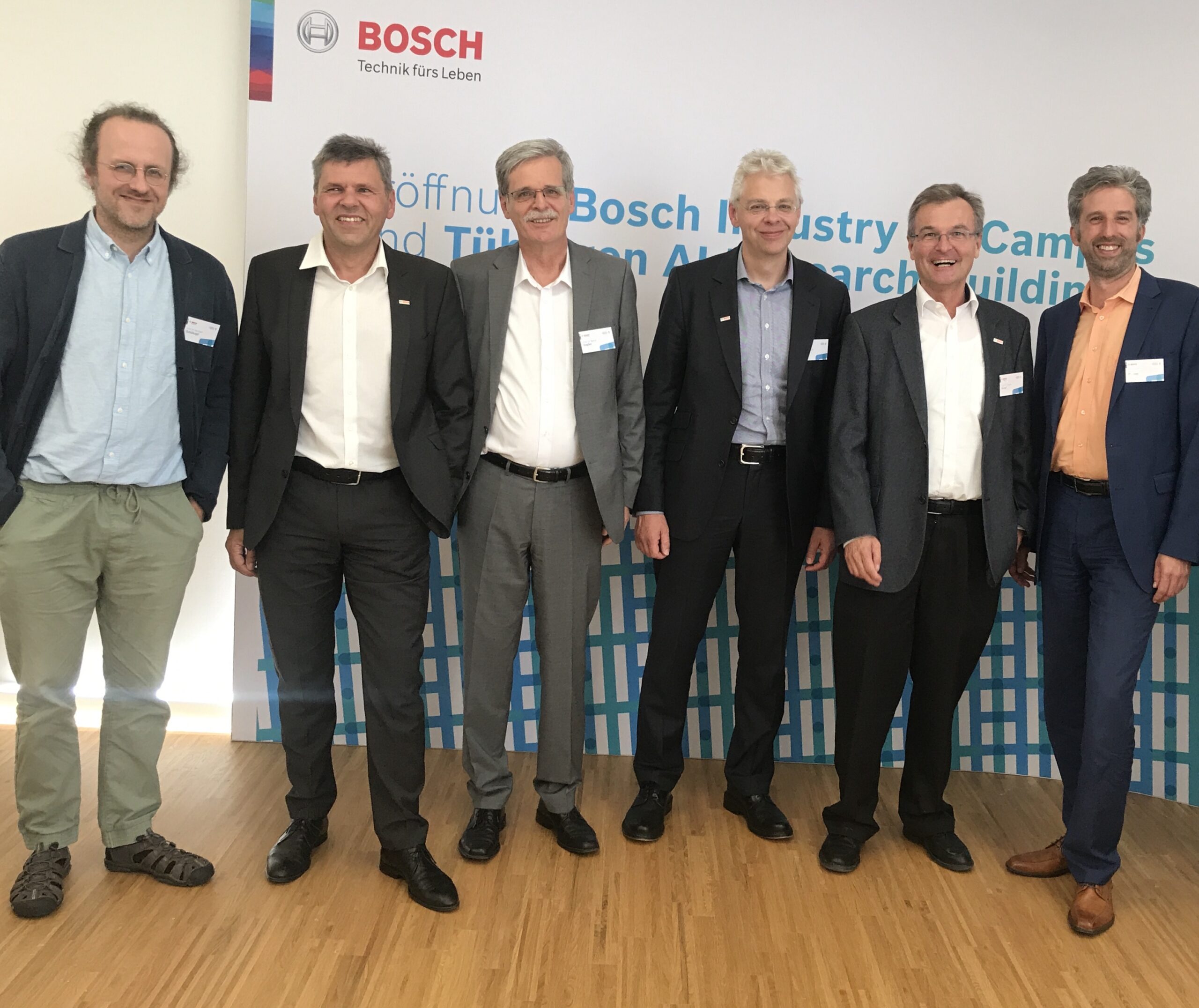
    Stuttgart/Tübingen − Bosch plans to ramp up its activities in the emerging technology of artificial intelligence (AI): in Tübingen in Germany’s Cyber Valley, the supplier of technology and services intends to invest some 35 million euros in a new “Bosch AI Campus.” Bosch is currently in talks with the city of Tübingen to negotiate the purchase of a rough 12,000 square-meter plot on which to build the campus. The move into the new research complex is planned for the end of 2022. Roughly 700 experts will work on applied AI there. “Bosch aims to be among the global leaders in industrial AI research,” said Bosch CDO/CTO Dr. Michael Bolle. “The new Bosch AI Campus will bring us a step closer to achieving this goal.”

    Space for startups and in-depth exchange

    The Bosch AI Campus in Tübingen will be situated close to the research facilities of the Max Planck Institute for Intelligent Systems and the University of Tübingen’s AI research building. Besides laboratories and offices, the campus will offer spaces in which startups and external AI research groups can take up temporary residence. Freely accessible areas on the first floor of the campus will serve to foster exchange among Cyber Valley experts. Other parts of the facility will also be open to the public. “In the new building, experts from the Bosch Center for Artificial Intelligence (BCAI) will work on projects together with experts from other Bosch divisions and from startups. The campus structure will do a lot to foster an exchange of ideas,” Bolle said.

    Bosch is a founding member of Cyber Valley, which was established in 2016. This joint research venture brings together partners from industry, academia, and politics to drive forward AI research in the German state of Baden-Württemberg. The idea is to quickly transfer research findings into real-world industrial applications. “Excellence clusters like Cyber Valley are important, as they make Germany even more attractive to top AI experts and strengthen our position in international competition,” Bolle continued. “The Bosch AI Campus also enhances Baden-Württemberg’s international appeal as an AI hub.”

    From research to practical application

    Bosch is researching artificial intelligence that is safe, robust, and explainable. Its investment in the new AI campus is yet another step by the company to strengthen AI research in Cyber Valley. Last year, Professor Matthias Hein was appointed to a Bosch-endowed chair at the University of Tübingen. The company sponsors two Industry on Campus professorships, which allow the university to integrate practical industrial expertise into its research and teaching.

    These professorships focus on the issues that arise when preparing for industrial applications. One example is predictive diagnostics, which makes it possible to predict machine breakdowns long before a fault actually occurs. Well-timed maintenance can avoid protracted machine downtimes. Predictive diagnostics is an example of machine learning, which is the focus of the research conducted at the BCAI. Currently, the BCAI has some 200 associates at a total of six locations in Germany, the United States, India, and Israel.

    Contact person for press inquiries:

  • Target Partners Tech Brunch on July 10, 2019

    Target Partners Tech Brunch on July 10, 2019

    Cyber Valley and Max Planck Innovation are hosting an informal "TechBrunch" in Tübingen with Target Partners, one of the most renowned German venture capital funds. Find our more about the event and how to register at: https://www.targetpartners.de/news/techbrunch-tuebingen-2019

  • Go-ahead for Cyber Valley

    Go-ahead for Cyber Valley

    "Cyber Valley will be a place where the technological foundations for our digital future will be laid", says Martin Stratmann. "We not only want to be a magnet and a talent factory for the best junior scientists, we also want to create space for dialogue with people. After all, the digital future affects us all."

    In Cyber Valley, the Max Planck Institute for Intelligent Systems, the State of Baden-Württemberg, the universities of Stuttgart and Tübingen, together with Bosch, Daimler, Porsche, BMW, ZF Friedrichshafen and Facebook are working together to boost research and development in artificial intelligence. The result is one of the largest research partnerships in Europe in the area of artificial intelligence. The State will invest more than EUR 50 million in the initiative in the coming years.

    A cycle of perception, understanding, action and learning

    The intelligent systems that will be researched and developed in Cyber Valley will be capable of completing the cycle of perception, understanding, action and learning. This ability, which humans and animals master as a matter of course, is vital in being able to act independently in complex and dynamic environments. The aim of the research cluster is to learn from nature and to understand the underlying regulatory and control mechanisms of perception, action and learning and to reproduce them in artificial systems.

    "A distant vision for so long, this is now within our reach: artificial intelligence is on the way", says Minister-President Winfried Kretschmann. "We are convinced that the establishment of Cyber Valley here in Baden-Württemberg can lead to the development of a hub for scientific excellence involving the brightest minds of tomorrow in the area of artificial intelligence. Our goal is not only to build the best machines but also the cleverest machines."

    Cyber Valley is designed to be more than an international centre for researching intelligent systems: its aim is also to promote company startups in this area in order to move as quickly as possible from basic research to marketable applications. A key element of the project will be the training of up to 100 doctoral students.


    New Research Groups and professorships

    As a first step, nine and later five Cyber Valley Research Groups will be set up. These will be funded by the State, the core partners and a consortium of foundations in Baden-Württemberg. Ten professorships at the universities of Stuttgart and Tübingen will also lend additional weight to Cyber Valley in an international context: the universities will each host two professorships as 'bridging professors' with the Max Planck Institute for Intelligent Systems and thus will make a significant and long-term contribution to the initiative. The State will supplement these efforts by financing two additional professorships in each case. The companies are also committed to the establishment of a total of two Endowment Chairs in Stuttgart and Tübingen. In summer 2017, the Max Planck Institute for Intelligent Systems and the universities of Stuttgart and Tübingen will set up a joint graduate school (International Max Planck Research School – Intelligent Systems). In a second development phase, the State will use special funding to support a shared new building project that will be the physical centre of Cyber Valley.

    "Thanks to their various areas of research, the universities of Stuttgart and Tübingen form the ideal interface between humans and machines", says Theresia Bauer, Minister of Science, Research and the Arts. "The partnership with the Max Planck Institute is an excellent opportunity to light a beacon for science in the area of AI in Baden-Württemberg."