CV Tag: Awards

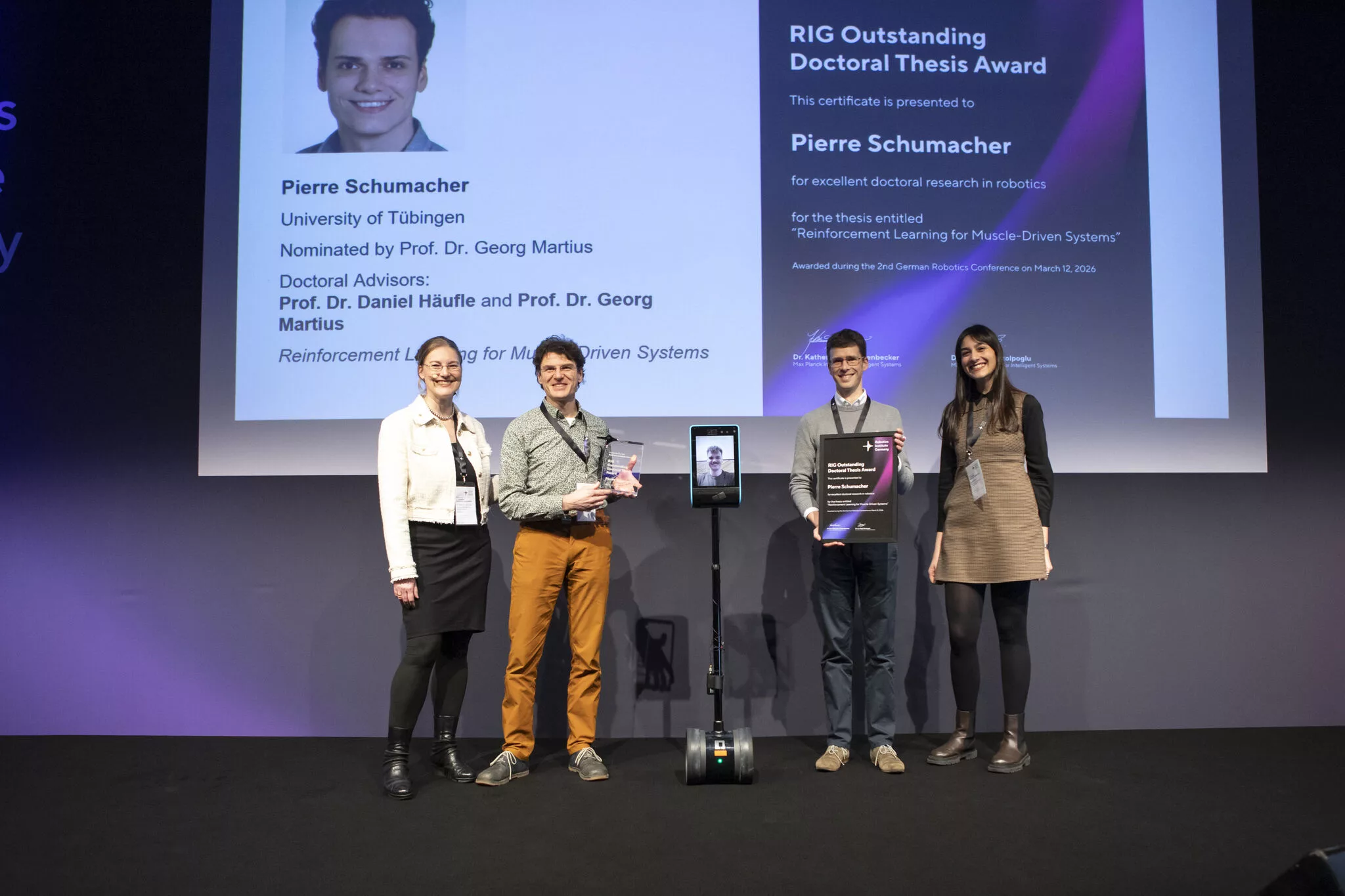
  • Pierre Schumacher receives RIG “Outstanding Doctoral Thesis Award” at the German Robotics Conference 2026

    Pierre Schumacher receives RIG “Outstanding Doctoral Thesis Award” at the German Robotics Conference 2026

    Pierre Schumacher has been selected as one of the two recipients of the “RIG Outstanding Doctoral Thesis Award”, recognizing exceptional doctoral research in robotics in Germany. The award was officially announced during the “RIG Heroes Award Night 2026” at the German Robotics Conference 2026, organized by the Robotics Institute Germany (RIG), in Cologne on March 12.

    Schumacher’s dissertation, “Reinforcement Learning for Muscle-Driven Systems,” was selected from 27 nominations submitted by 16 institutions across Germany. Following an extensive evaluation process, an international selection committee chose two equal awardees, citing Schumacher’s work for its “scientific depth, originality, and impact”.

    Pierre Schumacher conducted his doctoral research at the Max Planck Institute for Intelligent Systems in Tübingen under the supervision of Prof. Georg Martius (University of Tübingen) and Prof. Daniel Häufle (Hertie Institute for Clinical Brain Research) funded by the Cyber Valley Research grant “Learning effcient control of non-linear muscle-driven systems: Morphological computation as guiding principle”. His project was part of the Cluster of Excellence “Machine Learning: New Perspectives for Science” and the Center for Bionic Intelligence Tübingen Stuttgart (BITS). His dissertation, “Reinforcement Learning for Muscle-Driven Systems,” addresses challenges in controlling complex, highly overactuated robotic and biomechanical systems by developing new machine learning methods.

    A central contribution of the work is the development of DEP-RL, a reinforcement learning approach that improves exploration and learning in systems with many redundant actuators, such as musculoskeletal models. Using this method, Schumacher demonstrated efficient learning for tasks involving complex simulated bodies, including a human model with dozens of muscles and animal-inspired locomotion systems.

    Pierre’s research also explored how muscle-like actuation can improve learning performance and robustness in robotic systems. In collaborative studies, Schumacher and colleagues showed that musculoskeletal models can lead to more data-efficient and stable learning in anthropomorphic control tasks. More recent work demonstrated that reinforcement learning can produce natural and robust bipedal walking in musculoskeletal simulations without relying on motion-capture demonstrations.

    Schumacher began his academic path with a trinational bachelor’s degree in physics that took him to universities in France, Luxembourg, and Germany. After completing his B.Sc. in physics in Saarbrücken 2017, he shifted toward computational approaches and pursued a master’s degree at Goethe University Frankfurt in Frankfurt am Main. In 2021, he joined the Max Planck Institute for Intelligent Systems and the Hertie Institute for Clinical Brain Research in Tübingen with Prof. Georg Martius and Prof. Daniel Häufle for his PhD in Computer Science, which he completed in 2025.Schumacher’s expertise has also attracted industry attention: he joined MyoLab, a startup based in New York focusing on musculoskeletal control technologies, last year.

    The RIG Outstanding Doctoral Thesis Award highlights emerging researchers whose doctoral work significantly advances robotics research in Germany. Schumacher’s selection underscores the growing importance of combining machine learning, biomechanics, and embodied intelligence to enable the next generation of adaptive robotic systems.
  • Call for applications for the State Research Prize 2024

    Call for applications for the State Research Prize 2024

    Since 1989, the Ministry of Science, Research and the Arts, in cooperation with the Heidelberg Academy of Sciences and Humanities, has been awarding the Baden-Württemberg Research Prize. The research prize is endowed with 200,000 euros and is divided into two categories: a prize for fundamental research (100,000€) and a prize for applied research (100,000€). The two halves can be awarded in equal parts to one or more researchers.

    The State Research Prize stands as the most highly endowed research award among all the German states. It recognizes outstanding research by a scientist at universities or non-university research institutions in the state, regardless of discipline, within an international framework. 

    The prize for courageous scientific research is awarded together with the State Research Prize. The prize is endowed with 30,000€. The aim for this is to recognize excellent researchers at universities and non-university research institutions in Baden-Württemberg who have taken unusual paths and particular risks in their research. With this award, Baden-Württemberg recognizes the extent to which innovative science depends on researchers taking risks.

    Deadline: March 3, 2024.

    More Information (in GER)

  • Demo Day for Batch #3 of The AI Incubator

    Demo Day for Batch #3 of The AI Incubator

    Over a six-week-period, participants of The AI Incubator attended workshops and received extensive coaching to transform their AI ideas into successful start-ups. The AI Incubator is organized by Cyber Valley, Europe’s largest and leading research consortium in the field of artificial intelligence (AI) and modern robotics.

    At the Demo Day, participants from The AI Incubator will pitch their final projects before a carefully selected jury and an audience of researchers, investors, and entrepreneurs. Jury members include distinguished figures in the fields of AI and start-ups: Matthias Bethge (Director of the Tübingen AI Center), Michael Black (Managing Director of the Max Planck Institute of Intelligent Systems), Alexander Diehl (investor and Co-Founder of Architizer), Lukas Findeisen (Carl-Zeiss-Stiftung), Betty Mohler-Tesch (Principle Research Scientist at Amazon), Naureen Mahmood (Co-Founder of Meshapade), and Rebecca C. Reisch (CEO of Cyber Valley).

    Following the pitches, Ingmar Hörr, Co-Founder of Curevac, will share insights on transferring scientific research into commercial success. An award ceremony will then take place, during which the jury will present prizes to the top-performing teams. This will be followed by a concluding networking event.

    The Demo Day is open to the public, but spaces are limited, and attendance must be registered in advance. Please register here.


    Demo Day Schedule

    15:00: Welcome & Intro from Rebecca C. Reisch (CEO of Cyber Valley)
    15:30: Team pitches
    17:45: Inspirational talk from Ingmar Hörr (Co-Founder of Curevac): “Sciencepreneur – How to turn science into commercial value”
    18:00: Award ceremony
    18:30 onwards: Networking with food and beverages


    About The AI Incubator

    The AI Incubator is a six-week program of intensive workshops and idea development. The program encourages scientists, technologists, and business talent to found their own companies, fostering the next generation of AI start-ups. With topics like prototyping, product-market fit, business strategy, and funding opportunities, The AI Incubator equips participants with the right knowledge, tools, and skills to transfer their cutting-edge AI and robotics research into products and applications. The program also provides participants with access to a network of experts, mentors, founders, and investors who offer guidance and inspiration on their journey into the AI business world.
     
    The AI Incubator is organized by Cyber Valley and funded by the Carl-Zeiss-Stiftung.


    About Cyber Valley

    Cyber Valley is Europe’s largest and leading research consortium in the field of artificial intelligence (AI) and modern robotics. It has a mission and a public mandate to advocate for entrepreneurship, research, development, application, and acceptance of technologies and methods in the field of intelligent systems. The company envisions a future where the full potential of intelligent systems is leveraged for the greater good of the world. 
     
    The Cyber Valley Community brings together partners from science, industry, and society, along with AI researchers and entrepreneurs. The Cyber Valley GmbH is funded by the state of Baden-Württemberg and acts as the central organizer, service provider, and host for the community. While the GmbH operates from Stuttgart and Tübingen, Cyber Valley has a larger scope: As a national and European driving force, it attracts the best people from all over the world to create the future with AI.


    About the Carl-Zeiss-Stiftung

    The Carl-Zeiss-Stiftung’s mission is to create an open environment for scientific breakthroughs. As a partner of excellence in science, it supports basic research as well as applied sciences in the STEM subject areas (science, technology, and mathematics). Founded in 1889 by the physicist and mathematician Ernst Abbe, the Carl-Zeiss-Stiftung is one of the oldest and biggest private science funding institutions in Germany. It is the sole owner of Carl Zeiss AG and SCHOTT AG. Its projects are financed from the dividend distributions of the two foundation companies.

  • Leibniz Prize for Achim Menges

    Leibniz Prize for Achim Menges

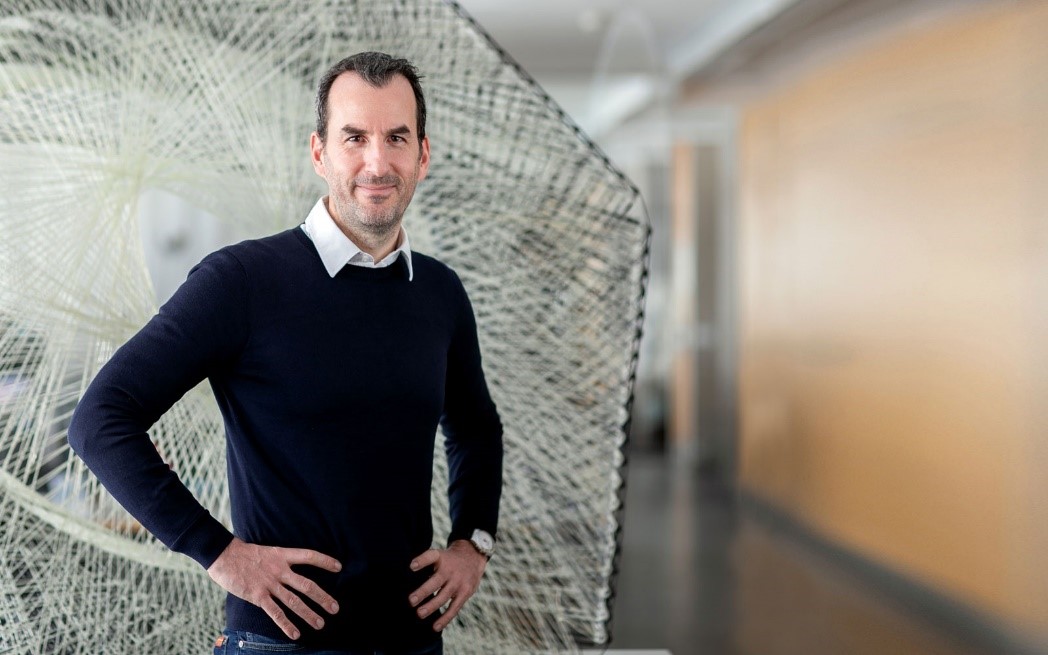
    “We warmly congratulate Professor Achim Menges on the prestigious Leibniz Prize and are quite proud to have such an outstanding pioneer of architecture at our university,” says Prof. Wolfram Ressel, Rectorate of the University of Stuttgart. “With his work, Achim Menges exemplifies our vision of ‘Intelligent Systems for a Sustainable Society’ in architecture and construction. He takes an interdisciplinary approach to researching novel and sustainable construction methods and has established numerous bridges to other departments. These are bundled in our Cluster of Excellence ‘Integrative Computational Design and Construction for Architecture’ (IntCDC). Without Achim Menges, IntCDC would not exist.”

    In recent years, Menges has made a name for himself through his research into sustainable building. He has also played a key role in shaping the Department of Architecture at the University of Stuttgart. His field of research is particularly relevant to society because there is considerable demand for new construction worldwide. The construction sector is also responsible for roughly half of the world’s waste and almost 40 percent of global energy- and process-related CO2 emissions, 11 percent of which are attributable to the production of building materials alone. Menges is researching novel and sustainable construction methods made possible by digital design methods and robotic manufacturing processes. The aim is to be able to build much faster with much less material as well as to see this as an opportunity for high-quality architecture that is worth living in.

    Menges’ open-ended and fundamental research has resulted in integrative design methods, innovative construction processes, and novel building systems that open up completely new possibilities for resource-efficient and sustainable architecture. Examples include robotically wound, long-span, and extremely material-efficient fiber structures, digitally manufactured lightweight wood building systems adaptable to various construction tasks, and adaptive 3D-printed facade elements that do not require any mechatronics or operating power.

    Architect, Institute Director and Spokesperson for the Cluster of Excellence

    Achim Menges, born in Mannheim in 1975, studied architecture at TU Darmstadt and at the Architectural Association in London. In 2008, he joined the University of Stuttgart as a professor. There, he founded the Institute for Computational Design (ICD) in 2009 and established what was then a unique and now globally visible research activity on digital design methods and robotic manufacturing processes for civil engineering. From 2009 to 2015, Menges was also a visiting professor at Harvard. In 2013, he co-founded the interdisciplinary master’s program Integrative Technologies and Architectural Design Research (ITECH) at the University of Stuttgart. Since 2019, Menges has been the spokesperson for the only cluster of excellence for architecture and civil engineering in Germany: “Integrative Computational Design and Construction for Architecture” (IntCDC) at the University of Stuttgart.

    About the Leibniz Prize

    The Gottfried Wilhelm Leibniz Prize is the most important research award in Germany. The aim of the Leibniz Program, which was established in 1985, is to improve the working conditions of outstanding scientists, to expand their research opportunities, and to relieve them of administrative workloads as well as to facilitate the employment of particularly qualified scientists. The award is endowed with up to EUR 2.5 million.

  • Andreas Geiger wins Longuet-Higgins prize

    “It is fantastic to see how KITTI has been driving research in computer vision over the last ten years as recognized by this award”, said Geiger. “When we started out, we were not sure if all the hard work would pay off eventually. It was a risky project that has continuously evolved with new benchmarks and data. It is still actively maintained by myself and many international collaborators that contributed time and dedication.”

    This is the second high-profile award for Geiger and his team – in October 2021, the researchers were honored with the Everingham Prize for KITTI. It’s also the second time in three years, that the Longuet-Higgins prize is awarded to a scientist from the Cyber Valley ecosystem: In 2020, Michael J. Black, Director at the Max Planck Institute for Intelligent Systems, won it along with his former students Deqing Sun and Stefan Roth for their paper “Secrets of optical flow estimation and their principles”.

    KITTI is among the world’s most popular datasets used in the development of self-driving cars and related machine vision applications. The dataset established new tasks and fostered new research in the area of perception for self-driving vehicles, in particular in stereo, flow, scene flow, monodepth, odometry, detection, tracking and semantic segmentation. The KITTI benchmark has over 24,500 registered users, has received more than 28,500 submissions since its inception and currently lists 1905 public entries in its various leaderboards. The KITTI benchmarks has led to various follow-up datasets, benchmarks and workshops in the computer vision community.

    The original paper “Are we ready for Autonomous Driving? The KITTI Vision Benchmark Suite” by Geiger, Lenz and Urtasun was published at CVPR in 2012. Now, ten years later, it is recognized by this award due to its significant impact on computer vision research in the past decade. The prize is named after theoretical chemist and cognitive scientist H. Christopher Longuet-Higgins. The award is presented by IEEE Pattern Analysis and Machine Intelligence (PAMI) Technical Committee at each year’s CVPR. Winners are decided by a committee appointed by the TCPAMI Awards Committee.

  • AI GameDev Preisverleihung

    AI GameDev Preisverleihung

    Die sieben Finalist:innen der AI GameDev wurden ausgewählt. Bei der Preisverleihung am 2. Dezember 2021 haben die Nominiterten die Möglichkeit, drei prestigeträchtige Preise mit nach Hause zu nehmen:

    Main Award

    powered by Square Enix für die innovativste KI-Lösung

    Scientific Award

    powered by Cyber Valley für die vielversprechenste wissenschaftliche Leistung

    Audience Award

    powered by IT-Farm und ausgewählt von euch


    Erfahre mehr über die Finalist:innen und die AI GameDev in unserer News und auf aigame.dev.


  • BWKI Preisverleihung

    BWKI Preisverleihung

    Die Preisverleihung wird ab 19:00 Uhr live auf YouTube übertragen. Alle Projekte der Finalist:innen werden vorgestellt – und die Zuschauer:innen haben die Möglichkeit, über die Gewinner:innen des Publikumspreises abzustimmen.

    Folgt dem BWKI auch auf Instagram und Twitter!