CV Tag: Max Planck Institute for Intelligent Systems

  • Research Engineer: Actuated Bio-Inspired Whisker-Sensor Systems

    The Max Planck Institute for Intelligent Systems (MPI-IS) conducts research to advance intelligent systems that perceive, learn, and interact. Through fundamental research across computational, physical, and social dimensions, they shape artificial intelligence and robotics to advance knowledge and benefit society.

    The Haptic Intelligence Department at the institute’s Stuttgart site is looking for a Research Engineer (m/f/d).

    Roles and responsibilities

    The Haptic Intelligence Department at the Max Planck Institute for Intelligent Systems (MPI-IS) seeks a research engineer to work on their Electrovibrissa project, where they are investigating actuated bio-inspired whisker-sensor systems. The successful candidate will carry out research on biomimetic tactile sensing by designing and maintaining the hardware and software components of their whisker-sensor setup. They will also be responsible for conducting data collection, analysis, and visualization, working closely with existing team members on this collaborative research project that also involves the Robotic Materials Department of MPI-IS.

    The position is preferably full-time for a period of 6 to 12 months. They also encourage applications from individuals who are interested in a part-time position (40% – 90%) for any duration in the specified range. Candidates must hold a bachelor’s degree.

    Specifically, the successful candidate will:

    • Design and develop hardware for robotic applications of instrumented bio-inspired whiskers that combine commercial sensors (e.g., microphones), custom electrohydraulic actuators, high-voltage amplifiers, and microcontrollers (e.g., Raspberry Pi, Arduino) (25%)
    • Design and develop software for whisker-sensor data acquisition, including data synchronization and integration of low-level control architectures (20%)
    • Develop algorithms for whisker-based object detection and identification of distinct object properties such as surface texture and material classification (20%)
    • Implement machine learning algorithms to evaluate and compare different bio-inspired whiskers with various sensors and different whisker actuation frequencies (15%)
    • Implement compelling real-time data visualizations of whisker-sensor outputs relevant to the robotic demonstrations (10%)
    • Present data and findings in an informative and engaging manner to facilitate understanding of actuated bio-inspired sensors (10%)

    Education and experience

    Applicants should have:

    • Bachelor’s degree in Computer Engineering, Electrical Engineering, Mechanical Engineering, Computer Science, Neuroscience, or related fields – required
    • Master’s degree in Computer Engineering, Electrical Engineering, Mechanical Engineering, Computer Science, Neuroscience, or related fields – preferred but not required
    • Patience and persistence when troubleshooting complex hardware and software systems, combined with a rigorous and systematic approach to experimental work and data analysis
    • Experience with machine learning techniques
    • Proficiency in Python, MATLAB, or similar programming languages
    • Experience with microcontrollers (e.g., Arduino, ESP boards)
    • Knowledge of software engineering practices, including object-oriented programming (OOP) and version control using Git
    • Ability to work independently and as part of a team
    • Eagerness to learn and explore new topics
    • Strong written and oral communication skills in English

    The offer

    The position will be located in Stuttgart at the Max Planck Institute for Intelligent Systems. You can expect an international environment with regular opportunities for further personal and professional growth. You will work closely with scientists, other engineers, administrative staff, and IT. You will enjoy an open, multicultural, and informal working environment.

    Salary and contract will be based on qualifications and previous professional experience according to the Public Service Wage Agreement (TVöD Bund) guidelines. All social benefits of public service apply. With them you receive a financial contribution to the job ticket (ÖPNV) and the possibility of mobile working.

    Application

    To apply, please submit a cover letter, your CV, and the contact details of two professional references. Please prepare these documents in English and upload them as one PDF file to the application portal.

    The position will be open until filled. Preference will be given to the applications received by November 1, 2026.

    The Max Planck Society is committed to increasing the number of individuals with disabilities in its workforce and therefore encourages applications from such qualified individuals. The Max Planck Society strives for gender equality and diversity. Furthermore, the Max Planck Society seeks to increase the number of women in its workforce in those areas where they are underrepresented and therefore explicitly encourages women to apply.

  • Three start-ups join the Cyber Valley Start-up Network

    Three start-ups join the Cyber Valley Start-up Network

    The Cyber Valley Start-up Network is expanding, admitting three new members: Feyer, Ontic Labs, and oneAI. These start-ups are using bold ideas and groundbreaking technologies to shape the future of AI and robotics in Baden-Württemberg.

    Feyer

    Feyer is building a European frontier AI lab for automated physical invention. The team develops AI systems designed to explore complex physical design spaces and create new technological solutions, with potential applications across areas such as photonics, precision instrumentation, and quantum technologies.

    The company emerged from the research group of Mario Krenn, Professor at the Cluster of Excellence “Machine Learning: New Perspectives for Science” at the University of Tübingen. The founding team consists of Jonathan Klimesch, Sören Arlt, and Mario Krenn and has already reached an exciting milestone: Feyer was selected as one of ten teams for the first stage of SPRIND’s Next Frontier AI Challenge, together with Ontic Labs.

    Ontic Labs

    Ontic Labs is building a foundation model for physical intelligence, giving machines a working understanding of how the physical world behaves.

    The Tübingen-based startup develops physics-aware world models that enable machines and robots to perceive, predict, and act in complex real-world environments. Its approach brings states, actions, and sensor data into a shared representation, allowing physical properties such as contact, forces, and object coherence to emerge from training rather than being manually programmed. The goal: a single world model that can transfer across robots, embodiments, tasks, and environments.

    Founded by Omid Taheri, Mikel Zhobro, Georg Martius, Wieland Brendel, and Gerard Pons-Moll, Ontic Labs brings together expertise from the Max Planck Institute for Intelligent Systems, the University of Tübingen, the Tübingen AI Center, and the ELLIS Institute Tübingen. The team was also selected as one of ten teams in SPRIND’s Next Frontier AI Challenge.

    SPRIND’s Next Frontier AI Challenge

    The two start-ups from Tübingen are among just ten teams across Europe that have been selected and will receive €3 million to develop technologies beyond today’s AI models. Of the three selected teams from Germany, two originate from the Cyber Valley ecosystem in Baden-Württemberg as spin-outs from several of Cyber Valley’s academic partners, including the ELLIS Institute Tübingen, Max Planck Institute for Intelligent Systems, Tübingen AI Center, and the University of Tübingen. Their success highlights the growing momentum with which AI research is being translated into innovative companies and how excellent AI research from Baden-Württemberg is playing a key role in the European race for frontier AI models.

    Read more about the success story here:
    https://cyber-valley.de/en/news/two-cyber-valley-start-ups-selected-to-shape-europe-s-frontier-ai-future

    oneAI

    As AI adoption accelerates across organizations, questions around governance, security, compliance, and control are becoming increasingly important. oneAI is addressing exactly this challenge: enabling companies and public organizations to use AI securely, transparently, and in compliance with regulatory requirements.

    The start-up is a spin-out from relyon AG, already part of the Cyber Valley Corporate Network, demonstrating Baden-Württemberg’s powerful research-to-innovation pipeline. Mirko Tochtermann, Founder & CTO of oneAI, shared his perspective on secure AI adoption and governance at one of our latest Cyber Valley IMPULSE events.

    The research-to-market journeys of these start-ups highlight how transferring academic expertise into application leads to tangible impact, powering industry and driving Europe’s sustainable future. Cyber Valley is delighted to welcome these three start-ups to its community!

    The Cyber Valley Start-up Network

    The Cyber Valley Start-up Network brings together more than 100 innovative AI and robotics start-ups across Baden-Württemberg, forming a strong and growing entrepreneurial community within one of Europe’s leading AI and robotics ecosystems. The network spans a broad range of applications and industries, from foundational AI technologies to applied and industry-specific solutions. Connected through their close ties to Cyber Valley, members benefit from access to world-class research, industry partners, investors, and public stakeholders, jointly strengthening the region’s AI and robotics ecosystem.

  • Pierre Schumacher receives RIG “Outstanding Doctoral Thesis Award” at the German Robotics Conference 2026

    Pierre Schumacher receives RIG “Outstanding Doctoral Thesis Award” at the German Robotics Conference 2026

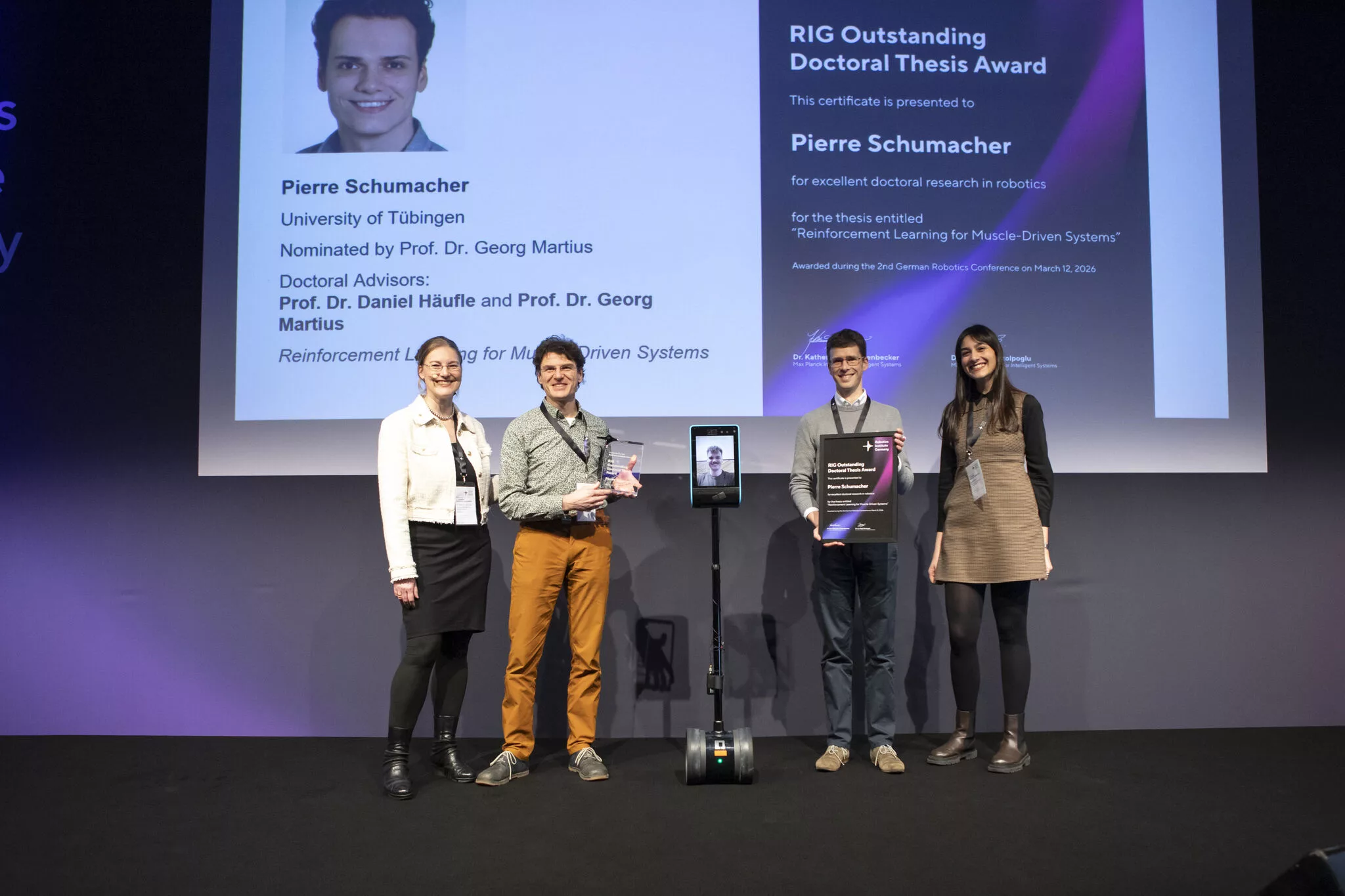
    Pierre Schumacher has been selected as one of the two recipients of the “RIG Outstanding Doctoral Thesis Award”, recognizing exceptional doctoral research in robotics in Germany. The award was officially announced during the “RIG Heroes Award Night 2026” at the German Robotics Conference 2026, organized by the Robotics Institute Germany (RIG), in Cologne on March 12.

    Schumacher’s dissertation, “Reinforcement Learning for Muscle-Driven Systems,” was selected from 27 nominations submitted by 16 institutions across Germany. Following an extensive evaluation process, an international selection committee chose two equal awardees, citing Schumacher’s work for its “scientific depth, originality, and impact”.

    Pierre Schumacher conducted his doctoral research at the Max Planck Institute for Intelligent Systems in Tübingen under the supervision of Prof. Georg Martius (University of Tübingen) and Prof. Daniel Häufle (Hertie Institute for Clinical Brain Research) funded by the Cyber Valley Research grant “Learning effcient control of non-linear muscle-driven systems: Morphological computation as guiding principle”. His project was part of the Cluster of Excellence “Machine Learning: New Perspectives for Science” and the Center for Bionic Intelligence Tübingen Stuttgart (BITS). His dissertation, “Reinforcement Learning for Muscle-Driven Systems,” addresses challenges in controlling complex, highly overactuated robotic and biomechanical systems by developing new machine learning methods.

    A central contribution of the work is the development of DEP-RL, a reinforcement learning approach that improves exploration and learning in systems with many redundant actuators, such as musculoskeletal models. Using this method, Schumacher demonstrated efficient learning for tasks involving complex simulated bodies, including a human model with dozens of muscles and animal-inspired locomotion systems.

    Pierre’s research also explored how muscle-like actuation can improve learning performance and robustness in robotic systems. In collaborative studies, Schumacher and colleagues showed that musculoskeletal models can lead to more data-efficient and stable learning in anthropomorphic control tasks. More recent work demonstrated that reinforcement learning can produce natural and robust bipedal walking in musculoskeletal simulations without relying on motion-capture demonstrations.

    Schumacher began his academic path with a trinational bachelor’s degree in physics that took him to universities in France, Luxembourg, and Germany. After completing his B.Sc. in physics in Saarbrücken 2017, he shifted toward computational approaches and pursued a master’s degree at Goethe University Frankfurt in Frankfurt am Main. In 2021, he joined the Max Planck Institute for Intelligent Systems and the Hertie Institute for Clinical Brain Research in Tübingen with Prof. Georg Martius and Prof. Daniel Häufle for his PhD in Computer Science, which he completed in 2025.Schumacher’s expertise has also attracted industry attention: he joined MyoLab, a startup based in New York focusing on musculoskeletal control technologies, last year.

    The RIG Outstanding Doctoral Thesis Award highlights emerging researchers whose doctoral work significantly advances robotics research in Germany. Schumacher’s selection underscores the growing importance of combining machine learning, biomechanics, and embodied intelligence to enable the next generation of adaptive robotic systems.

  • From perception to constrained decisions

    From perception to constrained decisions


    Georg Martius’ project, “Embedding combinatorial reasoning into learning control policies” addressed a practical gap in AI’s basic machinery: connecting data-driven neural networks with decision-making so they can adhere to clear structures, rules, and constraints. The project developed foundations for integrating combinatorial optimization into learning systems. It has potential applications wherever planning and resource allocation are central, such as in robotics and logistics. The project was funded by the Cyber Valley Research Fund and was carried out between 2021 and 2024. 

    Martius’ project addressed a key limitation of today’s machine-learning systems. While neural networks can learn powerful representations from data (for example, from images or sensor signals), many real-world decisions must also follow strict rules, such as budgets, capacities, safety limits, or “must/ must not” constraints. These rule-based decisions are often handled by specialized optimization software, but such tools are traditionally difficult to integrate into learning-based systems.

    Martius’ research created methods that make it easier to combine neural networks with combinatorial optimization components. This enables systems to learn from data while also drawing on proven optimization techniques to make decisions that respect constraints. Rather than replacing classical solvers, the project developed ways to use them as trainable building blocks inside larger learning pipelines.

    The project also explored “neuro-algorithmic” approaches to decision-making and control, investigating how structured algorithms can improve generalization to new problems compared with purely data-driven approaches.

    Overall, the project provides a foundation for building AI systems that connect perception with constraint-aware decision modules. This is an important step toward robust solutions in areas such as robotics, planning, logistics, and resource allocation.

    This project produced the following peer-reviewed publications:  

    Anselm Paulus, Michal Rolínek, Vít Musil, Brandon Amos, and Georg Martius. “CombOptNet: Fit the Right NP-Hard Problem by Learning Integer Programming Constraints”. In: Proceedings of the 38th International Conference on Machine Learning. Vol. 139. Proceedings of Machine Learning Research. PMLR, July 2021, pp. 8443–8453. url: https://proceedings.mlr.press/v139/paulus21a.html. 

    Marin Vlastelica, Michal Rolinek, and Georg Martius. “Neuro-algorithmic Policies Enable Fast Combinatorial Generalization”. In: Proceedings of the 2021 International Conference on Machine Learning (ICML). July 2021. url: https://proceedings.mlr.press/v139/vlastelica21a.html. 

    Marco Bagatella, Mirek Olšák, Michal Rolínek, and Georg Martius. “Planning from Pixels in Environments with Combinatorially Hard Search Spaces”. In: Advances in Information Processing Systems (NeurIPS 2021). 2021. url: https://openreview.net/forum?id=XgGUUaKgips. 

    Subham Sahoo, Anselm Paulus, Marin Vlastelica, Vít Musil, Volodymyr Kuleshov, and Georg Martius. “Backpropagation through Combinatorial Algorithms: Identity with Projection Works”. In: Proceedings of the Eleventh International Conference on Learning Representations. May 2023. url:  https://openreview.net/forum?id=JZMR727O29. 

    A. Paulus, G. Martius, and V. Musil. “LPGD: A General Framework for Backpropagation through Embedded Optimization Layers”. In: Proceedings of the 41st International Conference on Machine Learning (ICML). Vol. 235. Proceedings of Machine Learning Research. PMLR, July 2024, pp. 39989–40014. url: https://proceedings.mlr.press/v235/paulus24a.html. 

    Georg Martius is a Professor in the Department of Computer Science at the University of Tübingen.


    About the Cyber Valley Research Fund

    The Cyber Valley Research Fund was established to support Cyber Valley research groups undertake basic research in the fields of artificial intelligence and robotics. The fund totaled five million euros, including contributions from six of Cyber Valley’s founding corporate partners: Amazon, BMW, Bosch, IAV, Mercedes-Benz, Porsche, and ZF. It supported 20 research projects, the first of which began in 2020, and the final of which will conclude in 2026.

  • 2016: The foundation of an AI ecosystem

    2016: The foundation of an AI ecosystem

    In 2016, important actors from science, industry, and politics founded the Cyber Valley Consortium, which became the first Innovation Campus in Baden-Württemberg. Ten years on in 2026, we’re revisiting the most important milestones from the last decade. Each month, we’ll focus on a particular year since Cyber Valley’s beginning.

    This month, we’re returning to 2016 to look back at Cyber Valley’s foundation. Back then, the AI boom and the wholesale use of LLMs were still some years away. Actors from science, industry, and politics in Baden-Württemberg nevertheless knew that this technology would play an essential role in the state’s future.  

    Baden-Württemberg was already in an unrivalled position to create AI for the benefit of future society since it is home to several top AI research institutions: the Max Planck Institute for Intelligent Systems, the University of Stuttgart, the University of Tübingen, Fraunhofer-Gesellschaft, and Karlsruhe Institute of Technology (KIT). The next step was to apply their cutting-edge research to solving real-world problems.

    This was where Cyber Valley came in. In 2016, the Cyber Valley Consortium was founded with the mission of advocating for the research, development, application, and acceptance of AI and modern robotics. Cyber Valley was to unite excellent research with practical application to build the AI of tomorrow in Baden-Württemberg.

    At its founding, Cyber Valley Consortium consisted of the Max Planck Society (which includes the Max Planck Institute for Intelligent Systems, MPI-IS), the state of Baden-Württemberg, and the Universities of Stuttgart and Tübingen, alongside partners from industry: Amazon, BMW, Bosch, IAV, Mercedes-Benz Group, Porsche AG, and ZF Friedrichshafen. Other research institutions joined later, including Fraunhofer-Gesellschaft (in 2019), KIT, and ELLIS Institute Tübingen (both 2024).

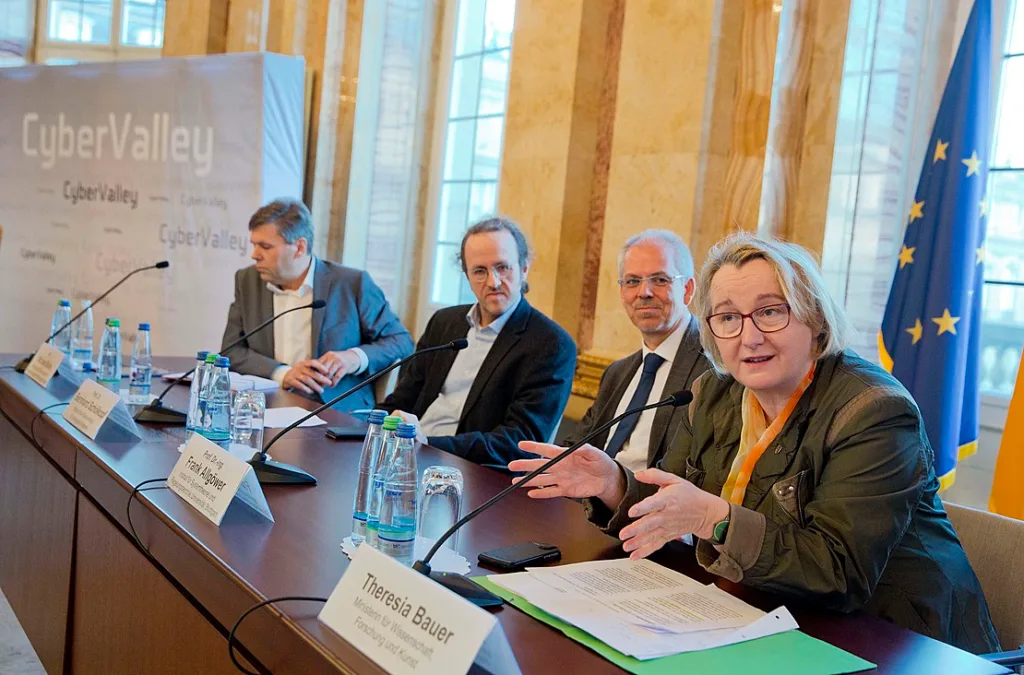
    Winfried Kretschmann, Minister-President of Baden-Württemberg, Theresia Bauer, who was then Minister of Science, Research and Art in Baden-Württemberg, and Martin Stratmann, who was then President of the Max Planck Society, launched the consortium on December 15, 2016, in Stuttgart’s Neues Schloss along with other participants from the consortium, including Bernhard Schölkopf(MPI-IS), Frank Allgöwer (University of Stuttgart) and Bernd Engler (University of Tübingen). The result was one of the largest research–industry partnerships for AI and modern robotics in Europe.

    Photo: MPI-IS / U. Regenscheit

    Theresia Bauer, Managing Director of the Baden-Württemberg-Stiftung, and Baden-Württemberg’s Minister of Science, Research and Art at the time of Cyber Valley’s founding:

    “At the time, I was thrilled by the great opportunity to bundle the excellent research landscape in the fields of AI and computer science in a condensed innovation ecosystem and make it more attractive for top international talent. When Cyber Valley was founded, I hoped that this concentration of cutting-edge research, the promotion of young talent, and responsible innovation would have what it takes to develop great appeal and grow rapidly. Today, you can see that we have succeeded in developing such a positive dynamic, which has a far-reaching impact on science, business, and the entire location.”

    Bernhard Schölkopf, Scientific Director of the ELLIS Institute Tübingen and Director of Empirical Inference at MPI-IS:

    “We started Cyber Valley with the belief that AI has the potential to change the world, and with the goal to do so in a positive way. This is now commonplace, but launching in 2016 gave us a head start and with a number of exciting start-ups, outstanding research institutions, and initiatives such as ELLIS and MP-AIX, we now have one of the most vibrant AI ecosystems in Europe.”

    Michael Black, Director of Perceiving Systems at MPI-IS:

    “The goal of Cyber Valley has always been to give Germany the chance to build a new high-growth economy around AI. In 2016, AI was not in the headlines, but we believed that we had the raw materials needed to succeed. Through the partnership of government, academia, and industry, we grew the AI faculty, attracted top researchers, built a top graduate program, trained hundreds of AI scientists, attracted investment, and helped launch a network of start-ups. These start-ups were always the goal and they hold the promise of a new Germany economy.” 

    Photo: MPI-IS / U. Regenscheit

    Peter Middendorf, Rector of the University of Stuttgart:

    “From the very beginning, the University of Stuttgart pursued the goal of pooling expertise in artificial intelligence and particularly in robotics, within and for the Stuttgart region. Together with the University of Tübingen, the Max Planck Institute for Intelligent Systems, and other partners, we have played a decisive role in shaping and advancing Cyber Valley. This strong network has given rise to excellent research, new professorships, and innovative projects, which we continue to actively drive forward – soon also in the new Cyber Valley building here in Stuttgart.” 

    Philipp Hennig, Director of Tübingen AI Center, University of Tübingen:

    “The world was a different place ten years ago, but even then it was clear that Europe, Germany, and Baden-Württemberg had to increase their efforts to stay relevant for AI. A decade later, I’m glad that we got the political mandate to get started then. The urgency of our tasks has only grown since then; but so have our opportunities.” 

    Bernhard Beckert, Dean of the KIT Department of Informatics:

    “When Cyber Valley was founded in 2016, we saw its potential to increase the visibility of AI research in Baden-Württemberg and to build a regional network that connects talent and accelerates scientific progress. Today, more than ever, this collaborative approach remains essential for supporting responsible AI development and for strengthening the region’s position within an increasingly complex international environment.”

    Matthias Tröndle, Head of the Scientific Coordination Office, MPI-IS:

    “When we founded Cyber Valley in 2016, we envisioned creating a bold innovation ecosystem focused on artificial intelligence at a time when its transformative impact was not yet widely recognized. By bringing together universities, non-university research institutions, industry, start-ups, foundations, and government in an unprecedented partnership, we broke new ground. The outstanding success of Cyber Valley has since made it a blueprint for subsequent innovation campuses.” 

    To celebrate Cyber Valley’s ten-year anniversary, we’ll be sharing a variety of content across our website and social media channels reflecting on milestones from the last decade. Stay tuned for the next instalments!

  • Cyber Valley continues to grow

    Cyber Valley continues to grow


    Antonia Georgopoulou started her Cyber Valley Max Planck Independent Research Group "Cyborg Robotics and Intelligent Sensing (CyRIS)" on October 15, 2025.

    Antonia’s research focuses on bio-inspired materials and structures, additive manufacturing and functional materials for soft and biohybrid robotic applications. Her work bridges materials science, robotics, and bioengineering to create adaptable and intelligent robotic platforms. Building on her work in electronic skin and multifunctional sensors, her group aims to develop robotic systems capable of adapting to complex, real-world environments.

    Antonia received her degree (M.Eng.) in Chemical Engineering with distinction from the University of Patras, Greece, in 2017. In 2019, she received her degree (M.S.) in Biomedical Engineering from ETH Zürich. She received her Ph.D. in Engineering Science at Vrije Universiteit Brussel with highest distinction in 2022 before joining the department of Advanced Materials and Surfaces at Empa, the Swiss Institute for Materials Science and Technology. In 2023, she was awarded the prestigious fellowship Women in Science (WINS) and joined the soft materials laboratory at EPFL and the NCCR Bio-Inspired Materials.

    https://is.mpg.de/cyris

    Philipp Müller started his Cyber Valley Max Planck Independent Research Group "Embodied Social Interaction" on November 1, 2025 at the MPI-IS Stuttgart.

    Philipp’s current research aims to establish the foundations for the next generation of embodied AI systems that can integrate seamlessly into human social life. He develops methods for analyzing and responding to complex, multimodal human behaviors – for instance, inferring user engagement, emotional expressions, and emotion regulation. Philipp combines theories and methodologies from psychology with multimodal artificial intelligence. He also applies his methods in psychiatric contexts, supporting clinical assessment and the evaluation of patient–therapist relationships

    Philipp received a Bachelor's degree in Psychology as well as Bachelor's and Master's degrees in Computer Science from Saarland University. After a research stay as a Visiting Student at Stanford University, he completed his Ph.D. at the Max Planck Institute for Informatics. He subsequently held research positions at the University of Stuttgart and most recently worked as a Senior Researcher at the German Research Center for Artificial Intelligence (DFKI) in Saarbrücken.

    https://is.mpg.de/esi

    Renate Sachse joined the MPI-IS Stuttgart on January 1, 2026 with her Independent Cyber Valley Research Group "Mechanics for Intelligent Structures".

    Renate Sachse’s research advances computational methods for designing intelligent structures that can actively shape, adapt, and respond to their environment. Her group develops high-fidelity simulation models to capture the complex, nonlinear deformation behavior of thin-walled, compliant, and soft robotic systems. A key focus is on engineering and programming nonlinear deformation patterns, as well as tailoring mechanical properties through geometry, material choice, and actuation. These methods aim to support the design of soft robotic and bioinspired structures that can achieve predictable, reliable and programmable motion.

    Renate has recently been a postdoctoral researcher at the Technical University of Munich and has completed a research stay at Harvard University. She received her Ph.D. in Civil Engineering from the University of Stuttgart in 2020 and has been recognized with multiple prestigious awards, including the Bertha Benz Prize 2022, the Dr. Wilhelmy-VDI Award, and the Klaus Tschira Boost Fund Fellowship.

    https://is.mpg.de/mis