CV Tag: Max Planck Institute for Intelligent Systems

  • Almost 70 AI spin-offs: Cyber Valley’s Start-up Network continues to grow 

    Almost 70 AI spin-offs: Cyber Valley’s Start-up Network continues to grow 

    Stuttgart, 14. Juni 2024 – A unique community for start-ups in the field of artificial intelligence (AI) has emerged around the Cyber Valley. The Cyber Valley Start-up Network supports founders in the state to transfer AI research into applications. The model is extremely successful: many of its 67 start-ups to date have raised millions from international investors. At Cyber Valley Days, which is taking placefrom June 19 to 21, start-ups from the network will introduce themselves and present current AI trends. June 21 marks the beginning of a new phase of the Cyber Valley. During a ceremonial event, the first ELLIS Institute in Europe will be opened by Minister President Winfried Kretschmann and Science Minister Petra Olschowski. 

    “Start-ups are generators and drivers of innovation. They bring AI applications into society – from healthcare to mobility and agriculture,” said Science Minister Petra Olschowski on June 14 in Stuttgart. “Our Cyber Valley innovation campus offers founders optimal conditions: every month, three to five new start-ups join the network – including start-ups by AI researchers, but also existing new companies. With their innovative strength, these entrepreneurs are further strengthening Baden-Württemberg as a center of research and business. As the Ministry of Science, we helped to initiate the founding of Cyber Valley; and we will continue to support our AI innovation campus to the best of our ability in the future.” 

    Baden-Württemberg as the location for AI start-ups 

    “Artificial intelligence is complex and extremely fast-paced in its application. Those who want to start a business can develop their ideas wherever they find the best conditions – including an international and thematically diverse environment, access to computing power, and start-up capital. In other words, where the future is already being created, such as at the excellent science locations in Baden-Württemberg,” said Rebecca C. Reisch, Managing Director of Cyber Valley GmbH.  
     
    As a supplement to the Cyber Valley Start-up Network, the AI Incubator supports those interested in setting up a business in the Cyber Valley innovation campus environment. Over the course of eight weeks, participants learn how to expand their business models and successfully launch them on the market supported by experienced entrepreneurs and start-up coaches. The fourth cohort of 25 founders is currently going through the program. The AI Incubator is funded by the Carl-Zeiss-Stiftung.  
     
    “AI will rapidly change the way we work, communicate, learn, or play – and Germany must be at the forefront of this change to maintain our quality of life. This change will be driven by innovative start-ups. Cyber Valley's mission is to create the basis for scientific breakthroughs and to support start-ups that will lead the AI future,” says Michael Black, spokesperson for Cyber Valley and Director at the Max Planck Institute for Intelligent Systems in Tübingen. 


    Millions invested in AI start-ups: three examples 

    Cyber Valley's AI start-ups are successful with investors:

    • In 2023, NEURA Robotics, a supplier of innovative cognitive robots, raised €65 million in two financing rounds.
    • The Esslingen-based start-up MARKT-PILOT developed a solution for dynamic and market-oriented spare parts pricing. To mark its fourth anniversary, the company announced one of the largest Series A financing rounds with 40 million euros.
    • Octomind, an AI-based end-to-end testing platform for development teams, recently received €4.8 million in seed capital. 


    Cyber Valley Days 2024: June 19 to 21 

    The network's almost 70 start-ups are active in a wide range of industries – including the healthcare sector, construction industry, in the field of mobility, and agriculture. This diversity will be highlighted at the Cyber Valley Days, a three-day event from June 19 to 21. The program focuses on entrepreneurship and scientific innovation in artificial intelligence and modern robotics. On Wednesday, June 19, start-ups and other members of the Cyber Valley Community will present in Stuttgart. Afterwards, the teams of the AI Incubator will pitch their AI business ideas to potential investors.   
     
    At the final on June 21, the new ELLIS Institute Tübingen of the European Laboratory for Learning and Intelligent Systems (ELLIS) will be opened in the presence of Minister President Winfried Kretschmann and Science Minister Petra Olschowski. This first ELLIS institute in Europe will further strengthen the Cyber Valley innovation campus as an internationally visible beacon for research into artificial intelligence. The world's most talented AI researchers will be able to advance their ideas and developments in an optimal environment. The opening of the ELLIS Institute also marks the beginning of the next phase of the Cyber Valley Innovation Campus. 
     
    Cyber Valley is the country's first innovation campus, located in the Stuttgart/Tübingen region. Cyber Valley was launched in 2016 as a joint initiative of the state, science, and industry. Its aim is to put Baden-Württemberg at the forefront of AI. The innovation campus combines excellent basic research and practical application. The scientific backbone is formed by three academic founding partners: the Universities of Stuttgart and Tübingen and the Max Planck Institute for Intelligent Systems. There are also other established partners from business and research. 


    Information about Cyber Valley Days:  

    cyber-valley.de/cyber-valley-days 

    Registration

    for the Start-up Expo on Wednesday, June 19, at the Max Planck Institute for Intelligent Systems, Stuttgart: shorturl.at/euuwd 
     
    Registration for media representatives for the ceremony and opening of ELLIS on Friday, June 21, via
    Rebecca Beiter, Director Communications & Society Cyber Valley GmbH
    0160/9448 1797
    Rebecca.beiter@cyber-valley.de 
     

    Further information 
     

    About Cyber Valley    

    Cyber Valley is Europe’s largest and leading center for excellence in artificial intelligence and modern robotics. Its mission and public mandate are to advocate for research, development, application, and acceptance of technologies and methods in the field of intelligent systems. Cyber Valley encourages entrepreneurship by uniting scientific excellence with innovation and technology transfer. In addition, Cyber Valley facilitates critical reflection on the ethical and social implications of AI through public engagement. Cyber Valley envisions a future in which the full potential of intelligent systems is leveraged for the greater good of the world.  


    About the Cyber Valley Start-up Network   

    The Cyber Valley Start-up Network builds and promotes a vibrant community of AI entrepreneurs. Members get access to exclusive events and a diverse network of AI researchers, investors, and other start-up founders. The prerequisite for membership is a connection to Cyber Valley, such as being members or alumni of the Cyber Valley Community, or a location in Baden-Württemberg. The business models must have intelligent systems at their core.
    Further information: cyber-valley.de/start-up-network.  
  • Cyber Valley Days: Day 2

    Cyber Valley Days: Day 2


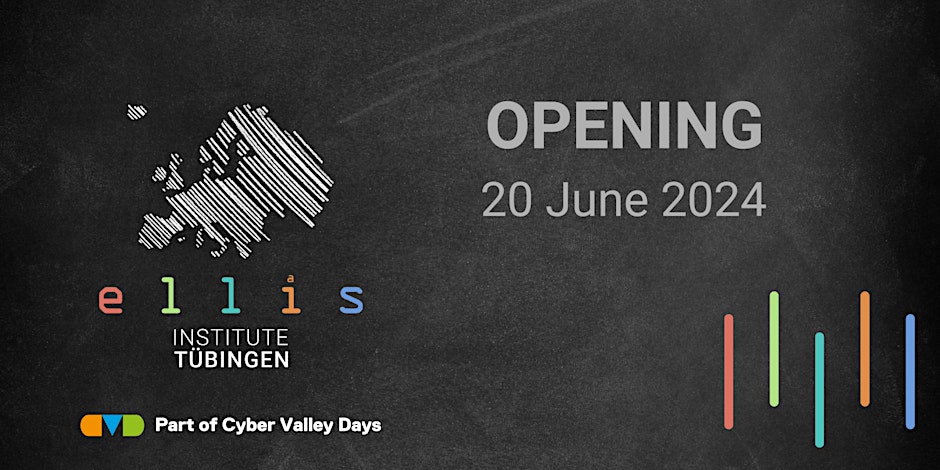
    ELLIS Institute Tübingen – Scientific Symposium & Opening Ceremony

    We are thrilled to invite you to the grand opening ceremony of the ELLIS Institute in Tübingen!

    Founded on the broader vision of the European Laboratory for Learning and Intelligent Systems (ELLIS), the ELLIS Institute Tübingen is the first ELLIS Institute in Europe, set to become a world-class center for outstanding and free research in machine learning and artificial intelligence.

    We look forward to welcoming you to an engaging program featuring scientific presentations, distinguished guests, and insight into the vision of the ELLIS Institute, as well as the future of AI in Tübingen and Europe.


    When

    20 June 2024 | 09:00–18:00


    What

    09:00 | Arrival & Registration

    09:15 | Scientific Symposium I

    12:00 | Lunch

    13:30 | Scientific Symposium II

    16:30 | ELLIS Institute Tübingen – Opening Ceremony

    18:00 | Apéro & CVD Meet-up (please register here for Apéro)


    Where

    MPI Tübingen

    Max-Planck-Ring 4

    72076 Tübingen


    Register to attend the ELLIS Institute Tübingen Symposium & Opening.

    ______________________________________________________


    By registering for this event, I grant permission to Cyber Valley GmbH and ELLIS Institute Tübingen gGmbH to use pictures, videos, and electronic media images in any promotional presentation within its community – offline and online, exclusively for non-profit-making purposes.

    During the Cyber Valley Days, pictures will be taken and videos will be recorded. These materials may be sent out to the media and used for internal and external communication purposes. These files will be stored in a secure location and only authorized staff will have access to them. They will be kept as long as they are relevant and after that time, they will be destroyed or archived.

    Further information on Cyber Valley data protection can be found at: https://cyber-valley.de/en/privacy-policy


  • Entrepreneurial Support for Scientists – Info Event

    Entrepreneurial Support for Scientists – Info Event

    Who to expect:

    Meet Cyber Valley:

    Discover Cyber Valley’s support for entrepreneurs and founders, from the Al Incubator program to our Proof of Concept and Innovation Fellowship grants.

    Introducing MAX!mize:

    Explore the opportunities to transform your research into a business with our comprehensive incubation program.

    Discover how we can support you in navigating the journey from laboratory innovation to successful startup launch.

    When and Where?

    April 10, 2024, 3:30 pm

    Max Planck Institute for Intelligent Systems

    Heisenbergstr. 3, 70569 Stuttgart

    Room Copper (2R04)

    April 11, 2024, 1:30 pm

    Max Planck Institute for Intelligent Systems

    Max-Planck-Ring 4, 72076 Tübingen

    Room NO.002 (Ground Floor)

    We are looking forward to seeing you!

  • Women in Science

    Women in Science

    Date

    Friday, March 22, 2024


    Time

    14:00


    Location

    Stuttgart, Heisenbergstr. 3, Copper Lecture Hall (2R04)

  • EuroEAP 2024 kommt nach Stuttgart!

    EuroEAP 2024 kommt nach Stuttgart!


    What is EuroEAP?

    The EuroEAP international conference, organized by the EuroEAP Society with a not-for-profit distinctive character and always held in Europe, primarily aims to share the latest advances and findings in this emerging field. It gathers experts from all over the world in a highly multidisciplinary event driven by scientific quality and industrial impact, with an organization that enables significant opportunities for one-to-one discussions in a friendly atmosphere. Today, the event expands its scope to the larger international and diverse research community of soft smart materials and soft transducers. The event is conceived as an exclusive forum for international experts and professionals seeking scientific quality, industrial impact, and opportunities for cooperation.


    When?

    June 11–13

    Important deadlines:

    • Hotel reservation (special rate): 10 APRIL 2024 (70 pre-booked rooms)
    • Early registration & abstract submission: 10 APRIL 2024
    • Deadline for registration: 10 MAY 2024


    Where?

    Max Planck Institute for Intelligent Systems 

    Heisenbergstrasse 3 | 70569 Stuttgart | Germany


    How to contribute and/or attend?

    Please have a look here: EuroEAP Platform


    Curious to see what awaits you there?

    Get exclusive insights in advance: The program 


    Tuesday, 11 June

    • A social dinner will be organized on Tuesday evening in the Stuttgart city center.
    • Transport from the MPI to the dinner and from the dinner to the hotel will be provided.
    • The cost to attend this event is covered by the conference registration fee.
    • More details will be released closer to the conference start.


    Wednesday, 12 June

    Castle tour:

    A castle tour for the participants of the conference will be organized on Wednesday. We will get a guided tour through Residenzschloss Ludwigsburg, one of the most beautiful baroque castles in Germany.
    The tour will start at 16:00.


    Social dinner:

    • Following the castle tour, there will be a social dinner at the restaurant Württemberger Hof (http://www.wuerttemberger-hof-ludwigsburg.de/), which is in walking distance from the castle.
    • The dinner will start at 19:00.
    • Transport from the MPI to Ludwigsburg and from the dinner to the hotel will be provided.
    • The cost to attend this event is covered by the conference registration fee.


    Accompanying persons

    • The castle tour and social dinners are open to accompanying people.
    • The participation fees for each accompanying person will be announced closer to the conference start.
    • The fees should be paid in cash at the conference desk (credit cards are NOT acceptable).
    • Attendees willing to join the castle tour and the social dinners should specify the option (including the number of accompanying persons) during the online registration to the conference.


    Thursday, 13 June

    SOFTWEAR Days:

    This year there is a satellite event to the EuroEAP 2024 conference: SOFTWEAR Days 2024. There will be an oral session also open to all EuroEAP participants, free of charge, on Thursday 13th of June in the afternoon at the same venue and room as the EuroEAP 2024. Oral presentations will be given by the SOFTWEAR PhD students presenting their research.

    A few slots have also been reserved for presentations by other PhD students outside SOFTWEAR. The topic of the presentation must be in the broad category of soft actuators for wearables. If you, as a non-SOFTWEAR student, want to give an oral presentation (15 mins incl. questions), please contact edwin.jager@liu.se.

    SOFTWEAR is a Marie Skłodowska-Curie Actions Doctoral Network in the emerging and rapidly growing field of wearables, with a unique focus on soft actuators for wearables and exoskeletons. The primary objective of SOFTWEAR is to train young researchers in the multidisciplinary science of soft actuators for integration in wearables and augmenting textiles. This will be achieved by merging chemistry, physics, mechanics, electronics, textile technology, design, human-technology interaction, and ethics in a truly interdisciplinary manner, while teaching essential skills in ethics, product development, IPR, and industrial realization, thus providing a unique added value to the careers of the researchers. For more information, see: https://softwear-dn.eu/


    EuroEAP Society Challenge:

    During the EuroEAP 2024, we’ll be having a challenge with € 400 worth of prizes. It is an open competition where teams of talented researchers can showcase a project of their choice and compete with colleagues in academia and industry. The final aim of the Challenge is to captivate and inspire the imagination of experts and the public alike with the possibilities that soft smart materials and soft transducers empower. More information on the challenge web page:
    http://www.euroeap.eu/index.php/euroeap-society-challenge-home.


    Deadlines

    • Enrolment: 23 APRIL 2024
    • Final submission: 23 MAY 2024


    Cyber Valley is looking forward to this event happening within the Cyber Valley community and welcomes our international guests!

  • Bionic Intelligence in Cyber Valley

    Bionic Intelligence in Cyber Valley

    The new Center for Bionic Intelligence Tübingen Stuttgart (BITS) aims to optimize the interaction between humans and technical systems in a fundamentally new way.

    Scientists from the University of Stuttgart, the University of Tübingen, the Max Planck Institute for Intelligent Systems and the Max Planck Institute for Biological Cybernetics are conducting research on intelligent bionic systems that will aid understanding and treatment of certain diseases of the central nervous system. Diagnoses will become more accurate, treatments more efficient and the illnesses more tolerable. Those affected by such disorders already use orthoses or communication aids. However, these systems cannot fully adapt themselves to the needs of the patient or the environment in order to fully compensate limitations or restore failed bodily functions. In interdisciplinary projects, BITS members develop individually tailored medical aids.

    Bionic systems can be found almost everywhere in everyday life: A Velcro fastener on a backpack is inspired by the burdock, suction cups are modeled on the form of an octopus tentacle. Both inventions are based on phenomena from the animal and plant world. Researchers at the University of Stuttgart, the University of Tübingen, the Max Planck Institute for Intelligent Systems and the Max Planck Institute for Biological Cybernetics are taking this one step further: Their vision is to optimize interaction between humans and technical systems so that, by using various signals and intelligent physical principles, the technical system is able to provide support when humans need it. The users are in control at all times.

    "We want to push the boundaries of what has been possible until now," says Professor Syn Schmitt, BITS spokesperson at the University of Stuttgart. "With bionic systems, such as novel robotic prostheses, we aim to create new intelligent diagnostic and treatment options that offer support in everyday life for patients with physical and neurological limitations."


    Diagnosis and treatment: Smart, flexible and ethical

    Technical assistance systems are already being used for therapeutic purposes, but they fall far short of the efficiency and flexibility that would be required to replace missing or impaired functions, or to support the diagnosis and treatment of complex mental disorders. The scientists of the newly founded BITS are jointly researching the development of bionic systems to adapt them to meet patients' individual needs, to compensate for impaired motor function in the everyday lives of those affected, and to support diagnostic and rehabilitation procedures. Social and ethical dimensions are considered from the very beginning.

    "The goal is to develop alternatives that work perfectly for individuals," adds Professor Martin Giese, BITS spokesperson at the University of Tübingen. "Forging efficient interactions between people and technology, requires not only optimal data and information processing, but also the exploitation of intelligent physical principles in people and the technical system." 

    The challenge here is to design technical components that interact with the nervous systems and muscular apparatus in a highly efficiently way and that adapt flexibly and individually to the patient's position. "To do this, we rely on functional materials that respond to different body-specific stimuli," adds Professor Sabine Ludwigs, also a BITS spokesperson at the University of Stuttgart.


    Interdisciplinary collaboration: From biomedicine to robotics and computer science

    The key to success is interdisciplinary cooperation between experts from different fields, such as biomedicine, neuromechanics, materials science, soft and biorobotics, physics, electrical engineering, social science, ethics, neuroscience, and computer science. "Each and every member of our team is an expert in their field," says Schmitt. "We try to transfer all this knowledge into workable solutions that allow people to interact with technical systems on multiple levels. We believe that affected individuals will benefit from such systems, and that science will gain a better understanding of humans."

    The research work within BITS encompasses everything from robotic orthoses that function as an everyday aid for people with muscle tremors, for example, to wearable sensors to improve diagnostics for obsessive-compulsive disorders, to so-called in-body micro- and nano-robots that can transport drugs specifically to the brain or enable new forms of brain stimulation. "At BITS, we want to build on previous successes and strengthen our collaborations to permanently establish intelligent systems in medicine, treatment and rehabilitation," emphasizes Giese. 


    About Cyber Valley

    Cyber Valley is Europe’s largest and leading research consortium in the field of artificial intelligence (AI) and modern robotics. It has a mission and a public mandate to advocate for entrepreneurship, research, development, application, and acceptance of technologies and methods in the field of intelligent systems. The company envisions a future where the full potential of intelligent systems is leveraged for the greater good of the world. 
    The Cyber Valley Community brings together partners from science, industry, and society, along with AI researchers and entrepreneurs. The Cyber Valley GmbH is funded by the state of Baden-Württemberg and acts as the central organizer, service provider, and host for the community. While the GmbH operates from Stuttgart and Tübingen, Cyber Valley has a larger scope: As a national and European driving force, it attracts the best people from all over the world to create the future with AI.


    About the Center for Bionic Intelligence Tübingen Stuttgart

    At the interdisciplinary research center BITS, approximately 50 scientists have been engaged in various projects since May 2023. BITS members bring together wide-ranging expertise from a variety of disciplines, including biomedicine, neuromechanics, materials science, soft and biorobotics, physics, electrical engineering, social science, ethics, neuroscience and computer science. The research work is intended to contribute to the technical implementation of bionic systems and help to establish these in the medical sector. This will significantly reduce the ever-increasing social burden of mental and neurological disorders, as well as individual suffering. To this end, BITS combines the complementary expertise of the Universities of Stuttgart and Tübingen and the Max Planck Institutes for Intelligent Systems and Biological Cybernetics. BITS is part of Cyber Valley, Europe's largest research consortium in robotics and artificial intelligence.

    Expert Contact

    • Prof. Dr. Syn Schmitt, University of Stuttgart, Institute for Modelling and Simulation of Biomechanical Systems
    • Prof. Sabine Ludwigs, University of Stuttgart, Institute of Polymer Chemistry
    • Prof. Martin Giese, University of Tübingen, Section for Computational Sensomotorics

    About Cyber Valley

    Cyber Valley is Europe’s largest and leading research consortium in the field of artificial intelligence (AI) and modern robotics. Cyber Valley has a public mandate: As advocates for entrepreneurship, research, development, application, and acceptance of technologies and methods in the field of intelligent systems are at the forefront. The company envisions a future where the full potential of intelligent systems is leveraged for the greater good of the world.