CV Tag: Tübingen AI Center

  • Three start-ups join the Cyber Valley Start-up Network

    Three start-ups join the Cyber Valley Start-up Network

    The Cyber Valley Start-up Network is expanding, admitting three new members: Feyer, Ontic Labs, and oneAI. These start-ups are using bold ideas and groundbreaking technologies to shape the future of AI and robotics in Baden-Württemberg.

    Feyer

    Feyer is building a European frontier AI lab for automated physical invention. The team develops AI systems designed to explore complex physical design spaces and create new technological solutions, with potential applications across areas such as photonics, precision instrumentation, and quantum technologies.

    The company emerged from the research group of Mario Krenn, Professor at the Cluster of Excellence “Machine Learning: New Perspectives for Science” at the University of Tübingen. The founding team consists of Jonathan Klimesch, Sören Arlt, and Mario Krenn and has already reached an exciting milestone: Feyer was selected as one of ten teams for the first stage of SPRIND’s Next Frontier AI Challenge, together with Ontic Labs.

    Ontic Labs

    Ontic Labs is building a foundation model for physical intelligence, giving machines a working understanding of how the physical world behaves.

    The Tübingen-based startup develops physics-aware world models that enable machines and robots to perceive, predict, and act in complex real-world environments. Its approach brings states, actions, and sensor data into a shared representation, allowing physical properties such as contact, forces, and object coherence to emerge from training rather than being manually programmed. The goal: a single world model that can transfer across robots, embodiments, tasks, and environments.

    Founded by Omid Taheri, Mikel Zhobro, Georg Martius, Wieland Brendel, and Gerard Pons-Moll, Ontic Labs brings together expertise from the Max Planck Institute for Intelligent Systems, the University of Tübingen, the Tübingen AI Center, and the ELLIS Institute Tübingen. The team was also selected as one of ten teams in SPRIND’s Next Frontier AI Challenge.

    SPRIND’s Next Frontier AI Challenge

    The two start-ups from Tübingen are among just ten teams across Europe that have been selected and will receive €3 million to develop technologies beyond today’s AI models. Of the three selected teams from Germany, two originate from the Cyber Valley ecosystem in Baden-Württemberg as spin-outs from several of Cyber Valley’s academic partners, including the ELLIS Institute Tübingen, Max Planck Institute for Intelligent Systems, Tübingen AI Center, and the University of Tübingen. Their success highlights the growing momentum with which AI research is being translated into innovative companies and how excellent AI research from Baden-Württemberg is playing a key role in the European race for frontier AI models.

    Read more about the success story here:
    https://cyber-valley.de/en/news/two-cyber-valley-start-ups-selected-to-shape-europe-s-frontier-ai-future

    oneAI

    As AI adoption accelerates across organizations, questions around governance, security, compliance, and control are becoming increasingly important. oneAI is addressing exactly this challenge: enabling companies and public organizations to use AI securely, transparently, and in compliance with regulatory requirements.

    The start-up is a spin-out from relyon AG, already part of the Cyber Valley Corporate Network, demonstrating Baden-Württemberg’s powerful research-to-innovation pipeline. Mirko Tochtermann, Founder & CTO of oneAI, shared his perspective on secure AI adoption and governance at one of our latest Cyber Valley IMPULSE events.

    The research-to-market journeys of these start-ups highlight how transferring academic expertise into application leads to tangible impact, powering industry and driving Europe’s sustainable future. Cyber Valley is delighted to welcome these three start-ups to its community!

    The Cyber Valley Start-up Network

    The Cyber Valley Start-up Network brings together more than 100 innovative AI and robotics start-ups across Baden-Württemberg, forming a strong and growing entrepreneurial community within one of Europe’s leading AI and robotics ecosystems. The network spans a broad range of applications and industries, from foundational AI technologies to applied and industry-specific solutions. Connected through their close ties to Cyber Valley, members benefit from access to world-class research, industry partners, investors, and public stakeholders, jointly strengthening the region’s AI and robotics ecosystem.


  • Two Full Professorships: Machine Learning and Intelligent Systems

    The Tübingen AI Center invites applications for two tenured full professorships (W3) in Machine Learning and Intelligent Systems, to start as soon as possible. The successful candidates will be appointed at the University of Tübingen. The positions provide generous, permanent core funding (e.g. for PhD students or postdocs) and substantially reduced teaching responsibilities.

    They are a federal competence center for AI education and research. Their research pushes the boundaries in numerous aspects of intelligence, including algorithms and models for machine learning, autonomous, causal, and agentic intelligence, as well as interaction with humans, markets, and society at large. Their core mission is to educate and empower the next generation of researchers to build the technological foundations of a competitive, sustainable, sovereign European society – through excellence in teaching, active technology transfer and societal action. They invite applications in all areas of machine learning, artificial intelligence, and related disciplines.

     The Tübingen AI Center is a joint research hub between the University of Tübingen and the Max Planck Institute for Intelligent Systems, situated in Tübingen’s rapidly growing science and technology campus. The center is home to seventeen full professors and will grow steadily over the next five years, with a commitment to increasing the diversity of the team. They maintain close links to ELLIS, a Europe-wide research network in machine learning, and the ELLIS Institute Tübingen, as well as to the Cyber Valley initiative that connects researchers with startups and industry in the area. 

    They seek internationally renowned candidates who pursue compelling long-term research agendas that complement and extend their expertise. Your application should explicitly articulate how you intend to contribute to their mission. They offer competitive budgets and compensation packages, with permanent funds allocated for research staff.

    Candidates will be evaluated based on their potential for further growth in scientific excellence, considering past scientific contributions as well as the novelty, creativity, and uniqueness of their research vision.

     Required qualifications include a PhD or equivalent degree with exceptional expertise in machine learning as well as postdoctoral qualifications and teaching experience equivalent to the requirements of a full professorship. Teaching and research are conducted in English.

    The University of Tübingen is committed to equity and diversity and actively promotes equal opportunities. Female academics, in particular, are explicitly invited to apply, as are candidates from outside Germany. Applications from equally qualified candidates with disabilities will be given preference.

    For more information on professorships, the hiring process, and the German academic system, please click here.

    Location: The center is located near Stuttgart in the historic university town of Tübingen, a beautiful location in southwest Germany close to a large natural preserve. Major cities such as Zurich, Munich and Frankfurt can be reached within a few hours by public transport. Stuttgart airport, with many direct flights to major international cities, is just half an hour away.

  • VC Ask-Me-Anything: Insights for Future Founders & Researchers

    VC Ask-Me-Anything: Insights for Future Founders & Researchers

    This event is aimed especially at PhD Students, researchers, and aspiring founders in Tübingen who would like to gain first-hand insights into how venture capitalists think and build early connections without the pressure of pitching.

    The event is jointly organized by the Tübingen AI Center and Cyber Valley GmbH. 

    Participants

    Meet Representatives from:

    What to expect

    • Insights into how venture capitalists evaluate early-stage companies

    • Practical advice on fundraising, market trends, and early start-up decisions

    • An open Q&A in an informal setting

    • Networking over pizza and drinks after the session


    The panel will be moderated by Professor Peter Gehler focused on tech transfer at Tübingen AI Center.

  • Tübingen Conference for AI and Law

    Tübingen Conference for AI and Law

    Keynote speakers


    Other Confirmed Speakers


    When?

    November 5–6
    Day 1: 9:00–19:00
    Day 2: 9:00–16:15


    Where?

    The conference will take place in Tübingen, a picturesque university town in southwest Germany. 

    Day 1: Alte Aula, in the historic town center, next to the Stiftskirche, University of Tübingen

    Day 2: Maria-von-Linden Straße 1: a brand-new building on the Tübingen AI research campus

  • 18th European Workshop on Reinforcement Learning (EWRL 2025)

    18th European Workshop on Reinforcement Learning (EWRL 2025)


    What?

    The 2025 edition of EWRL will be an exciting event for researchers worldwide, both for the presentation of top-quality papers, but also as a forum for ample discussion of open problems and future research directions.

    Past editions of EWRL can be found here.

    Reinforcement learning is an active field of research which deals with the problem of sequential decision making in unknown (and often) stochastic and/or partially observable environments. Recently there has been a wealth of impressive empirical results, including those coupling Deep Learning function approximators with Reinforcement Learning algorithms, as well as significant theoretical advances. Both types of advances are of major importance and the conference aims to create a forum to discuss such interesting results, their applications, consequences, and research perspectives. 


    When?

    September 17th–19th, 2025


    Where?

    EWRL18 will be located in the historical University of Tübingen, Germany. Tübingen is a lovely, vibrant university town in southern Germany, known for its rich history and scenic streets. Check out tourist information here!


    Call for papers

    The organizing committee invites submissions to the 18th European Workshop on Reinforcement Learning (EWRL 2025). There will be no proceedings for EWRL 2025. Papers may be submitted to one of two tracks:

    Regular track: unpublished work. Papers submitted to this track are unpublished, though they may be concurrently under review at another venue. These papers will be subjected to the full review process.

    Fast track: published work. Papers that are already accepted at one of the venues listed below may be submitted to this track. They will not receive new reviews, but will be checked for relevance to the topics of interest to EWRL.
    Submissions are handled through OpenReview. Submitted papers will be reviewed by the program committee in a double-blind procedure. Final decisions will be taken by the program chairs based on the reviews. There will be no author/reviewer discussion phase. Only accepted papers will be publicly released, while rejected or withdrawn manuscripts will be kept confidential.

    Submitted papers should follow the EWRL template linked below. There is a limit of 9 pages, excluding references and appendix. Authors of accepted papers will be allowed an additional page to prepare the camera-ready version. There is no page limit for the fast track. All accepted papers will be presented as posters.

    For any questions, please contact the organizers at ewrl2025@gmail.com.


    Fast track instructions

    For submission to the fast track, the selection committee will consider papers accepted at the following venues: NeurIPS, ICML, ICLR, RLC, AAAI, IJCAI, AISTATS, COLT, UAI, ALT, ICRA, IROS, CoRL, RAL, TMLR, JMLR, ECAI. If you want to submit a paper that was accepted at a different archival venue and you believe that this venue should be included in the list above, please let the conference organizers know. In the submission process, you will be required to provide a link to the online proceedings page showing your accepted article. If your paper is accepted but not yet published online, please send the acceptance confirmation to ewrl2025@gmail.com.


    Info

    Paper submission opens: April 23rd
    Paper deadline: May 30th June 3rd (11:59pm AOE)
    Notification of acceptance: July 31st July 16th
    Page limit – doesn’t apply to fast track: 9 pages excluding references and appendix (+1 page for final version)
    Paper format: Download
    Paper submissions: via Openreview


    Call for Contributed Talks

    In an effort to bring novel and diverse viewpoints to EWRL this year’s workshop has a special call for contributed talks. Early-career researchers are invited to submit proposals for an invited talk at EWRL 2025. Accepted authors will be given a 15-minute time slot for their presentation at the workshop.

    The content of talks should relate to or be on topics in the area of reinforcement learning. If your talk is on a paper you submitted to the main track of EWRL, you can reference it in your proposal.


    Submission guidelines

    Submit one pdf document (see template here) including:

    Abstract of your talk: 1-2 pages. This should include a preliminary title and abstract, a short description of the content, and a brief description of the anticipated outcome of your talk (e.g. increase awareness of an open problem, presenting new/emerging results, call-to-action etc.)
    A brief CV (see template) indicating your current and past positions, and a short list of related contributions to the topic of your talk. Do not include any metrics such as: Number of papers, citations, impact factors etc. (See also the section Special Review Criteria below)


    Special Review Criteria

    The speaker/author must be an early-career researcher: You are currently enrolled in a PhD program, or are a postdoctoral researcher who has received their PhD within the last three years (Researchers at Assistant Professor level are eligible if they started their position at most three years ago).
    For the evaluation of your submission, the selection committee will adhere to the principles laid out in the San Francisco Declaration on Research Assessment: They will review your submission based on its (scientific) content, and not on reputation or publication metrics.


    Info

    Talk submission deadline: June 15th
    Notification of acceptance: July 9th July 17th
    Talk submissions: via Openreview

  • Tübingen AI Talk Series with Prof Niklas Boers

    Tübingen AI Talk Series with Prof Niklas Boers


    The Earth’s climate is a highly complex system and as such many processes and phenomena cannot be resolved in terms of fundamental physical equations, either because they are unknown or because they would be to costly to explicitly include in numerical simulations. While there is a long history of complementary, data-driven modelling approaches, recent developments in deep learning promise substantial advances.

    Here Prof. Boers presents some recent results on machine learning approaches to address several challenges in nonlinear Earth system dynamics, including the prediction of climate phenomena such as monsoon onsets or ENSO, hybrid modelling combining process-based with deep learning model components, as well as bias correction and downscaling of Earth system models with generative machine learning models.


    About Prof. Niklas Boers:

    Niklas Boers is professor of Earth system modelling at the Technical University of Munich, leads the Future Lab on Artificial Intelligence at the Potsdam Institute for Climate Impact Research, and is Honorary Professor of Mathematics at the University of Exeter. He obtained his PhD from Humboldt University Berlin and spent several years at the ENS Paris and Imperial College London. As a physicist and mathematician by training, he studies theoretical climate dynamics with a combination of physical and data-driven approaches. In his research he develops methods rooted in dynamical system theory, complexity, science, and machine learning and applies them to different problems of nonlinear dynamics, with a focus on modelling and predicting extreme events and abrupt transitions in the Earth system.


    Date and Time: 25.01.2024 at 11 a.m. sharp
    Location: MvL6 Lecture Hall


    1-on-1 Meetings and Dinner:

    Niklas Boers is available for 1-on-1 meetings during the day; sign up here.
    If you're interested in joining for dinner, please indicate your preference in the same form.


  • Startup BW Summit 2022

    Startup BW Summit 2022

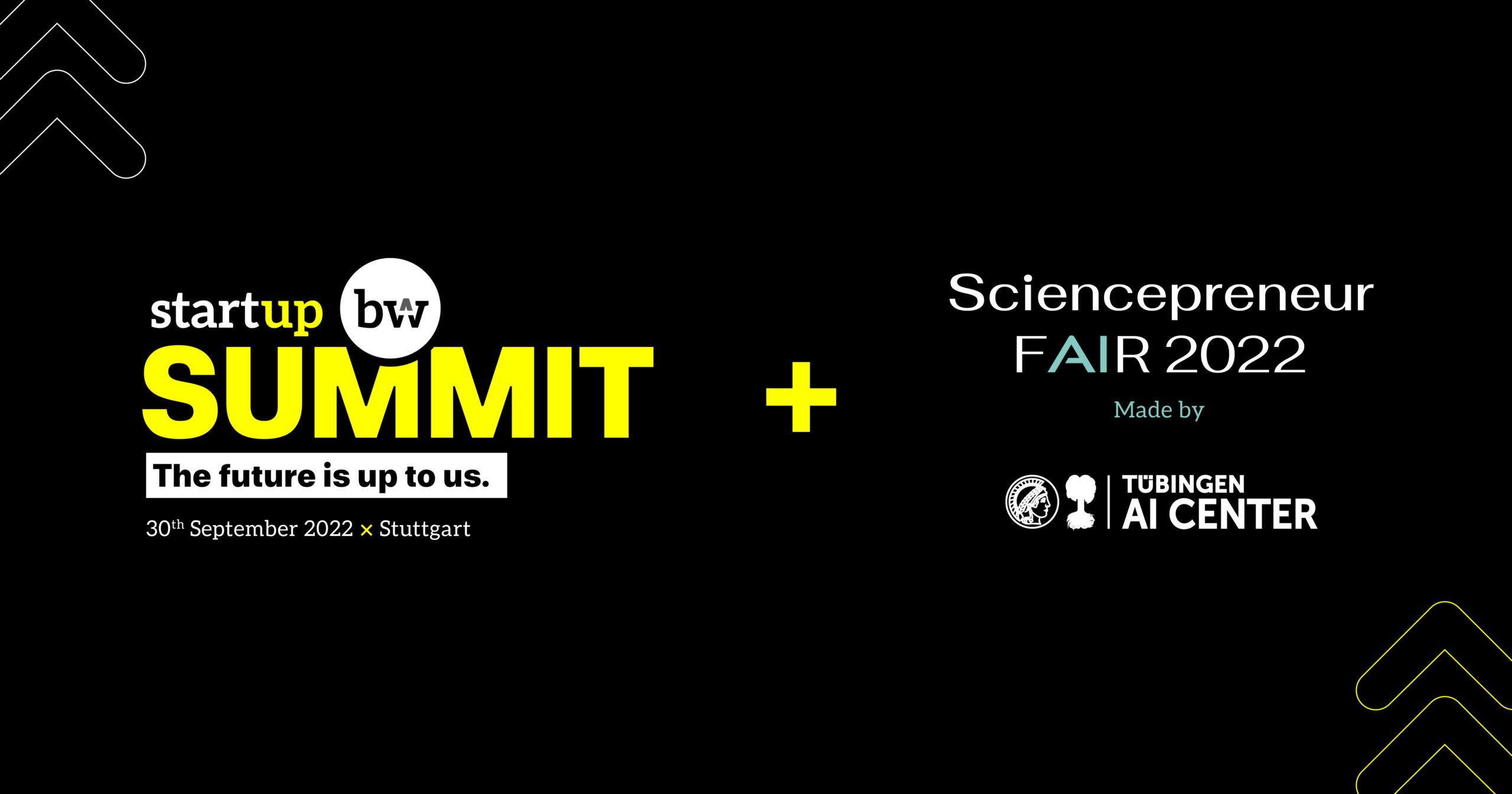
    Am 30. September findet auf der Messe Stuttgart der Startup BW Summit statt, eine Messe auf der sich Start-ups, Investoren und Partner aus Deutschland und ganz Europa vernetzen und austauschen können.

    Auch Cyber Valley wird mit einem Stand beim Startup BW Summit vertreten sein. Außerdem sind verschiedene Start-ups aus dem Cyber Valley Netzwerk dabei, u.a. Aleph Alpha, eye2you, BAUTA, DeepCare, GaussML, MARKT-PILOT.

    Ein weiterer Teil der Ein-Tages-Messe ist die „Sciencepreneur Fair 2022“, die vom Tübingen AI Center veranstaltet wird. Dort sind mehrere Personen aus dem Cyber Valley Ökosystem als Speaker bei Round Tables und Talks dabei, u.a. Marco Huber, Matthias Bethge und Alexander Diehl.

    Veranstaltungsort: Messe Stuttgart Halle 4 (Mahle Halle) und ICS

    Zur kostenfreien Anmeldung

    Weitere Infos zum Startup BW Summit

    Weitere Infos zu Sciencepreneur Fair 2022