CV Tag: University of Stuttgart

  • Doctoral researcher/ PhD student: Agentic AI

    The Institute for Artificial Intelligence, Analytic Computing group, at the University of Stuttgart invites applications for a full-time position as a doctoral researcher/PhD student for three years working on knowledge graphs for use in agentic AI.

    What will you contribute?

    You will undertake foundational research on using knowledge graphs as part of Agentic AI.

    You will advise and tutor bachelor’s, master’s, and PhD students in the computer and data science programs of the department on topics related to your research.

    What is your profile?

    You have a master’s degree in computer science or a related discipline. You enjoy interacting and collaborating with other team members. You are forward-thinking, you seek confirmation by applying your research ideas not only to toy problems, but also to real-world problems. You have experience in logical representations as well as foundation models. You are willing to go from problem analysis in real-world applications to method development, data collection, and formal and empirical evaluation. You enjoy precise analytical thinking and apply scientific rigor in your research practice and writing, and you intend to publish successfully in relevant conferences and/or journals.

    What do they offer?

    They provide a friendly yet challenging interdisciplinary research environment and support your academic career in successfully extending your academic profile through cutting-edge publications. The Institute for Artificial Intelligence is part of Cyber Valley, the largest and most prestigious research center for AI in Europe. Through the International Max Planck Research School for Intelligent Systems, the ELLIS Unit Stuttgart, and the ELLIS Network as a whole, they offer excellent opportunities for collaboration from local to international levels. The salary amounts to German TV-L E13, which starts at approx. 60,000 Euro per year (before taxation), depending on your experience.

    How to apply?

    Applications should be submitted via the International Max Planck Research School for Intelligent Systems application portal. Submit your application with the required documents and indicate Prof. Staab as your targeted PhD advisor. In particular, documents will have to include:

    1. a motivational/cover letter that highlights why you are the right fit for this specific position,
    2. a curriculum vitae,
    3. scans of all your original final transcripts and diploma certificates from each university degree (Bachelor, Master, Doctorate). Please include translations into English or German. Translations done by the applicant themselves will be accepted. The group has more than 10 nationalities, and they can likely confirm the accuracy of your translation internally,
    4. Letters of recommendation (if possible).

    Email applications (whether exclusively or in parallel) will be considered a malus.

    Women who apply will be given preferential consideration in areas in which they are underrepresented, provided they have the same aptitude, qualifications, and professional performance. Severely disabled applicants with equal qualifications will be given priority.

    More questions?

    Please visit their website to learn more about their research.

    Personal inquiries can be directed to Prof. Staab.
  • Doctoral Researcher/ PhD student: Knowledge Graphs

    The Institute for Artificial Intelligence, Analytic Computing group, at the University of Stuttgart invites applications for a full-time position as a doctoral researcher/PhD student for three years working on Causal Representation and Queries in Deterministic and Probabilistic Knowledge Graphs.

    What will you contribute?

    You will undertake foundational research on representing probabilistic and causal dependencies in knowledge graphs that can be used in engineering applications for answering complex queries.

    You will advise and tutor bachelor’s, master’s, and PhD students in the computer and data science programs of the department on topics related to your research.

    What is your profile?

    You have a master’s degree in computer science or a related discipline. You enjoy interacting and collaborating with other team members. You are forward-thinking; you seek confirmation by applying your research ideas not only to toy problems, but also to real-world problems. You have experience in logical representations as well as data and knowledge engineering. You are willing to go from problem analysis in real-world applications to method development, data collection, and formal and empirical evaluation. You enjoy precise analytical thinking and apply scientific rigor in your research practice and writing, and you intend to publish successfully in relevant conferences and/or journals.

    What do they offer?

    They provide a friendly yet challenging interdisciplinary research environment and support your academic career in successfully extending your academic profile through cutting-edge publications. The Institute for Artificial Intelligence is part of Cyber Valley, the largest and most prestigious research center for AI in Europe. Through the International Max Planck Research School for Intelligent Systems, the ELLIS Unit Stuttgart, and the ELLIS Network as a whole, they offer excellent opportunities for collaboration from local to international levels. The salary amounts to German TV-L E13, which starts at approx. 60,000 Euro per year (before taxation), depending on your experience.

    How to apply?

    Applications should be submitted via the International Max Planck Research School for Intelligent Systems application portal. Submit your application with the required documents and indicate Prof. Staab as your targeted PhD advisor. In particular, documents will have to include:

    1. a motivational/cover letter that highlights why you are the right fit for this specific position,
    2. a curriculum vitae,
    3. scans of all your original final transcripts and diploma certificates from each university degree (Bachelor, Master, Doctorate). Please include translations into English or German. Translations done by the applicant themselves will be accepted. The group has more than 10 nationalities, and they can likely confirm the accuracy of your translation internally.
    4. Letters of recommendation (if possible).

    Email applications (whether exclusively or in parallel) will be considered a malus.

    Women who apply will be given preferential consideration in areas in which they are underrepresented, provided they have the same aptitude, qualifications, and professional performance. Severely disabled applicants with equal qualifications will be given priority.

    More questions?

    Please visit their website to learn more about their research.

    Personal inquiries can be directed to Prof. Staab.

  • Meta-Uncertainty in Bayesian Model Comparison

    Overview

    Scientific theories are often translated into statistical models and tested by comparing their predictions with real-world data. Bayesian model comparison can then estimate how much support each model receives.

    Led by Paul-Christian Bürkner at the University of Stuttgart’s SimTech Cluster of Excellence, this project addressed a further problem: the probabilities produced by Bayesian model comparison are themselves uncertain. This is known as meta-uncertainty, or uncertainty about uncertainty. The project ran from 2021 to 2024.

    Key results

    • Developed and evaluated methods for quantifying meta-uncertainty in Bayesian model comparison.
    • Used extensive model simulations as an additional source of information. These simulations help reveal hidden assumptions about how well the models represent possible real-world processes.
    • Distinguished between a “closed-world” setting, in which the true model is assumed to be among the models being compared, and an “open-world” setting, in which all candidate models may be incomplete or inaccurate.
    • Developed neural-network methods for amortized Bayesian inference. These methods perform much of the computational work in advance, making it faster to evaluate complex models on new data.
    • Created methods for detecting model misspecification—situations in which a model’s assumptions do not adequately describe the data.
    • Produced open-source software and workflows, including JANA and BayesFlow, to make simulation-based Bayesian analysis more efficient and accessible.

    Why it matters

    Bayesian model comparison can show which theories are better supported by available evidence, but its results depend on assumptions about the data, the models, and the possible alternatives. Quantifying meta-uncertainty makes these limitations more transparent.

    The project therefore contributes to more careful and reliable scientific inference. Its methods could improve prediction models in fields such as biology, medicine, climate science, and engineering, particularly when models are complex or computationally expensive.

    The results do not identify which theory is objectively true. Rather, they help researchers assess how reliable their model comparisons are and how much confidence they should place in the conclusions drawn from them.

    This project produced the following peer-reviewed publications: 

    • Schmitt M., Pratz V., Köthe U., Bürkner P. C., and Radev S. T. (2024). Consistency Models for Scalable and Fast Simulation-Based Inference. Proceedings of the Conference on Neural Information Processing Systems (NeurIPS). Available on ArXiv.
  • 2016: The foundation of an AI ecosystem

    2016: The foundation of an AI ecosystem

    In 2016, important actors from science, industry, and politics founded the Cyber Valley Consortium, which became the first Innovation Campus in Baden-Württemberg. Ten years on in 2026, we’re revisiting the most important milestones from the last decade. Each month, we’ll focus on a particular year since Cyber Valley’s beginning.

    This month, we’re returning to 2016 to look back at Cyber Valley’s foundation. Back then, the AI boom and the wholesale use of LLMs were still some years away. Actors from science, industry, and politics in Baden-Württemberg nevertheless knew that this technology would play an essential role in the state’s future.  

    Baden-Württemberg was already in an unrivalled position to create AI for the benefit of future society since it is home to several top AI research institutions: the Max Planck Institute for Intelligent Systems, the University of Stuttgart, the University of Tübingen, Fraunhofer-Gesellschaft, and Karlsruhe Institute of Technology (KIT). The next step was to apply their cutting-edge research to solving real-world problems.

    This was where Cyber Valley came in. In 2016, the Cyber Valley Consortium was founded with the mission of advocating for the research, development, application, and acceptance of AI and modern robotics. Cyber Valley was to unite excellent research with practical application to build the AI of tomorrow in Baden-Württemberg.

    At its founding, Cyber Valley Consortium consisted of the Max Planck Society (which includes the Max Planck Institute for Intelligent Systems, MPI-IS), the state of Baden-Württemberg, and the Universities of Stuttgart and Tübingen, alongside partners from industry: Amazon, BMW, Bosch, IAV, Mercedes-Benz Group, Porsche AG, and ZF Friedrichshafen. Other research institutions joined later, including Fraunhofer-Gesellschaft (in 2019), KIT, and ELLIS Institute Tübingen (both 2024).

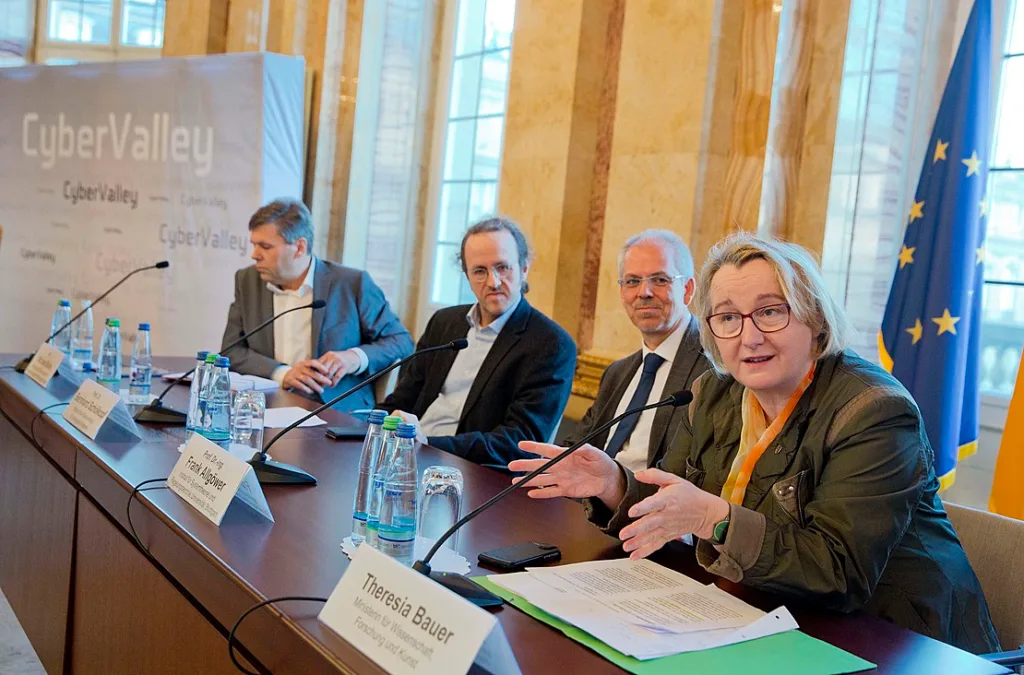
    Winfried Kretschmann, Minister-President of Baden-Württemberg, Theresia Bauer, who was then Minister of Science, Research and Art in Baden-Württemberg, and Martin Stratmann, who was then President of the Max Planck Society, launched the consortium on December 15, 2016, in Stuttgart’s Neues Schloss along with other participants from the consortium, including Bernhard Schölkopf(MPI-IS), Frank Allgöwer (University of Stuttgart) and Bernd Engler (University of Tübingen). The result was one of the largest research–industry partnerships for AI and modern robotics in Europe.

    Photo: MPI-IS / U. Regenscheit

    Theresia Bauer, Managing Director of the Baden-Württemberg-Stiftung, and Baden-Württemberg’s Minister of Science, Research and Art at the time of Cyber Valley’s founding:

    “At the time, I was thrilled by the great opportunity to bundle the excellent research landscape in the fields of AI and computer science in a condensed innovation ecosystem and make it more attractive for top international talent. When Cyber Valley was founded, I hoped that this concentration of cutting-edge research, the promotion of young talent, and responsible innovation would have what it takes to develop great appeal and grow rapidly. Today, you can see that we have succeeded in developing such a positive dynamic, which has a far-reaching impact on science, business, and the entire location.”

    Bernhard Schölkopf, Scientific Director of the ELLIS Institute Tübingen and Director of Empirical Inference at MPI-IS:

    “We started Cyber Valley with the belief that AI has the potential to change the world, and with the goal to do so in a positive way. This is now commonplace, but launching in 2016 gave us a head start and with a number of exciting start-ups, outstanding research institutions, and initiatives such as ELLIS and MP-AIX, we now have one of the most vibrant AI ecosystems in Europe.”

    Michael Black, Director of Perceiving Systems at MPI-IS:

    “The goal of Cyber Valley has always been to give Germany the chance to build a new high-growth economy around AI. In 2016, AI was not in the headlines, but we believed that we had the raw materials needed to succeed. Through the partnership of government, academia, and industry, we grew the AI faculty, attracted top researchers, built a top graduate program, trained hundreds of AI scientists, attracted investment, and helped launch a network of start-ups. These start-ups were always the goal and they hold the promise of a new Germany economy.” 

    Photo: MPI-IS / U. Regenscheit

    Peter Middendorf, Rector of the University of Stuttgart:

    “From the very beginning, the University of Stuttgart pursued the goal of pooling expertise in artificial intelligence and particularly in robotics, within and for the Stuttgart region. Together with the University of Tübingen, the Max Planck Institute for Intelligent Systems, and other partners, we have played a decisive role in shaping and advancing Cyber Valley. This strong network has given rise to excellent research, new professorships, and innovative projects, which we continue to actively drive forward – soon also in the new Cyber Valley building here in Stuttgart.” 

    Philipp Hennig, Director of Tübingen AI Center, University of Tübingen:

    “The world was a different place ten years ago, but even then it was clear that Europe, Germany, and Baden-Württemberg had to increase their efforts to stay relevant for AI. A decade later, I’m glad that we got the political mandate to get started then. The urgency of our tasks has only grown since then; but so have our opportunities.” 

    Bernhard Beckert, Dean of the KIT Department of Informatics:

    “When Cyber Valley was founded in 2016, we saw its potential to increase the visibility of AI research in Baden-Württemberg and to build a regional network that connects talent and accelerates scientific progress. Today, more than ever, this collaborative approach remains essential for supporting responsible AI development and for strengthening the region’s position within an increasingly complex international environment.”

    Matthias Tröndle, Head of the Scientific Coordination Office, MPI-IS:

    “When we founded Cyber Valley in 2016, we envisioned creating a bold innovation ecosystem focused on artificial intelligence at a time when its transformative impact was not yet widely recognized. By bringing together universities, non-university research institutions, industry, start-ups, foundations, and government in an unprecedented partnership, we broke new ground. The outstanding success of Cyber Valley has since made it a blueprint for subsequent innovation campuses.” 

    To celebrate Cyber Valley’s ten-year anniversary, we’ll be sharing a variety of content across our website and social media channels reflecting on milestones from the last decade. Stay tuned for the next instalments!

  • How to start up at the University of Stuttgart?

    How to start up at the University of Stuttgart?

     Many aspiring founders are unsure where to start or which support services can help them turn an idea into a business. This event aims to change that.

    Together with the Institute for Entrepreneurship (ENI), TTI Technologie-Transfer-Initative GmbH, the University’s transfer center TRACES, NXTGN, and a guest startup, participants get to explore how innovative ideas can grow into successful ventures at the University of Stuttgart.


    Participants will:

    • Learn about the university’s startup support programs and initiatives

    • Meet the people driving entrepreneurship in Stuttgart

    • Hear first-hand experiences from founders

    As a special guest, Michael Ilewicz, co-founder of Ecalia, will share his story of building a Stuttgart-based startup developing next-generation compressor-expander technology.

    This event is open to students, doctoral candidates, researchers, and anyone curious about entrepreneurship. No business idea or prior experience is needed – just curiosity and an open mind.

    Snacks and drinks will be available in a relaxed, informal atmosphere.


    Interested? 

    No registration is required for this event. Just drop by!


    Contact

    For any questions regarding the event, please contact Mia Zsohár (mia.zsohar@eni.uni-stuttgart.de).

    You already have an idea you would like to get started with? Get in touch with startupcoaching@traces.uni-stuttgart.de for a first touchpoint.

  • ELLIS Distinguished Lecture Series: Jens Kober

    ELLIS Distinguished Lecture Series: Jens Kober

    About the talk:

    The acquisition and self-improvement of novel motor skills is among the most important problems in robotics. Complexity arises from interactions with their environment and humans, dealing with high-dimensional input data, non-linear dynamics in general and contacts in particular, multiple reference frames, and variability in objects, environments, tasks, and human behavior. A human teacher is always involved in the learning process, either directly (providing data) or indirectly (designing the optimization criterion), which raises the question: How to best make use of the interactions with the human teacher to render the learning process efficient and effective? In this talk I’ll argue that there are tremendous benefits in having a human teacher intermittently interact with a robot also while it is learning. I will discuss various methods we have developed in the fields of supervised learning, imitation learning, reinforcement learning, and interactive learning. All these concepts will be illustrated with benchmark tasks and real robot experiments ranging from fun (ball-in-a-cup) to more applied (retail environments).

    About Jens Kober:

    Jens Kober is an associate professor at the TU Delft, Netherlands and an ELLIS Fellow. He worked as a postdoctoral scholar jointly at the CoR-Lab, Bielefeld University, Germany and at the Honda Research Institute Europe, Germany. He graduated in 2012 with a PhD Degree in Engineering from TU Darmstadt and the MPI for Intelligent Systems. For his research he received the annually awarded Georges Giralt PhD Award for the best PhD thesis in robotics in Europe, the 2018 IEEE RAS Early Academic Career Award, the 2022 RSS Early Career Award, and has received an ERC Starting grant. His research interests include motor skill learning, (deep) reinforcement learning, imitation learning, interactive learning, and machine learning for control.

    When?

    March 5, 2025, 09:45 CET

    Where?

    Universitätsstraße 32, Room 101, Campus Vaihingen of the University of Stuttgart

    The talk will be followed by an informal reception during which finger food and drinks will be provided.

    Professor Kober will also be available for meetings. If you are interested in scheduling a meeting, please email ellis-office@uni-stuttgart.de.