CV Tag: University of Tübingen

  • Cyber Valley Research Forum (virtual)

    Cyber Valley Research Forum (virtual)

    At this edition of the event, we will focus on the University of Stuttgart's Cyber Valley groups as well as on a recently established group at the University of Tübingen. In addition, our partners from Fraunhofer IPA and IAO will present the AI Innovation Center "Learning Systems" and their AI-related areas of research.

    Due to COVID-19 restrictions, the workshop will be held online (Zoom). If you would like to participate, please register here.


    Schedule
    13:30 Welcome
    13:30 – 13:40 AI Innovation Center “Learning Systems”
    https://www.ki-fortschrittszentrum.de
    13:40 – 14:00

    Dr. Tian Qiu

    Biomedical Microsystems, Institute of Physical Chemistry, University of Stuttgart

    Title: Augmented Reality Organ Phantom for the Generation of Biomedical Data

    Abstract:
    Biomedical data of the human body is complex and difficult to acquire for safety, ethical, legal, and technical reasons.  Building a realistic organ phantom based on rapid prototyping and augmented reality technologies is one of our group's research focuses. The phantom system represents the anatomy and the material properties of real organs. Moreover, the model can sense what it experiences and generate a large amount of data, which is not even possible with a real organ. The data will offer unique opportunities to train surgeons and optimize surgeries, and to develop new medical instruments and life protection systems.

    14:00 – 14:20

    Prof. Dr. Michael Sedlmair

    Virtual Reality and Augmented Reality, Visualization Research Center (VISUS), University of Stuttgart

    Title: VR/AR research at VISUS

    Abstract:
    I will introduce several examples of current Virtual/Augmented Reality (VR/AR) projects from the Visualization Research Center (VISUS) at the University of Stuttgart. Much of our work focuses on how data visualization can be meaningfully combined with VR/AR. Also referred to as Immersive Analytics, this combination is a popular topic. However, many things can go wrong. We will look at some of these pitfalls, identify ways of overcoming them, and outline scenarios that could have a truly significant and lasting effect.

    14:20 – 14:40

    Prof. Dr. Jakob Macke

    Machine Learning in Science, Cluster of Excellence "Machine Learning", University of Tübingen

    Title: Simulation-based inference: Bridging the gap between machine learning and scientific modelling

    Abstract:
    Many fields of science and engineering make extensive use of complex simulations that describe the structure and dynamics of the process being investigated. These models are derived from knowledge of the underlying mechanisms and are of critical importance for scientific hypothesis-building. However, linking such complex models to high-dimensional empirical data can be challenging. My group develops computational tools that aim to bridge the gap between data-driven machine learning and theory-driven, scientific modelling, with a focus on applications in the life sciences. In this talk, I will focus on our recent work on using neural conditional density estimators to perform Bayesian inference on simulation-based models. I will demonstrate the efficiency and flexibility of this approach and highlight applications to dynamical models of biological systems and source-reconstruction in biological imaging.

    14:40 – 15:00

    Prof. Dr. Alexander Brem

    Entrepreneurship in Technology and Digitization, Institute of Entrepreneurship in Technology and Science, University of Stuttgart

    Title: How AI-driven applications enhance Innovation and Entrepreneurship

    Abstract:
    Artificial intelligence (AI) is changing how entrepreneurs and companies innovate. Startups and established companies are developing a wide range of AI-driven applications, addressing different tasks along the innovation process. These tasks include, just to mention a few, the detection of emerging technologies and trends, the identification of customer needs or lead users, the generation of user feedback from emotional facial recognition, or the automated creation of new product designs.
    In light of such rapid developments, we offer an overview on how AI is being current used in creativity, innovation, and entrepreneurship. We describe how technology and management researchers in these fields are studying the applications and impact of AI. Finally, we outline the current research areas (still emerging) and suggest areas for further management research using AI and research on AI’s impact on innovation and entrepreneurship processes.

    15:00 – 15:25

    Fraunhofer Institute for Manufacturing Engineering and Automation (IPA)

    Dependable AI built on Explainability, Verification and Uncertainty Quantification
    (Nina Schaaf, Xinyang Wu, Marcel Albus)

    Computer Vision for Quality Control and Robotics
    (Bernd Meese, Johannes Stoll)

    Cognitive Robotics: Deep Learning for Robotic Grasping and Assembly
    (Marius Moosmann, Arik Lämmle)

    15:25 – 15:50

    Fraunhofer Institute for Industrial Engineering (IAO)

    X-tended Reality@Fraunhofer IAO – Labs and Usecases in the field of Building Construction
    (Alexandros Giannakidis, Günter Wenzel)

    AI-based solutions for text documents analysis
    (Maximilien Kintz)

    Applied Neuroscience and Neuroadaptive Technology
    (Katharina Lingelbach, Mathias Vukelic)

    Variable and adaptive driving behaviour and vehicle interior: Robust, safe and fun with AI
    (Frederik Diederichs, Mathias Vukelic, Matthias Bues)

    15:50 – 16:00 Wrap-up
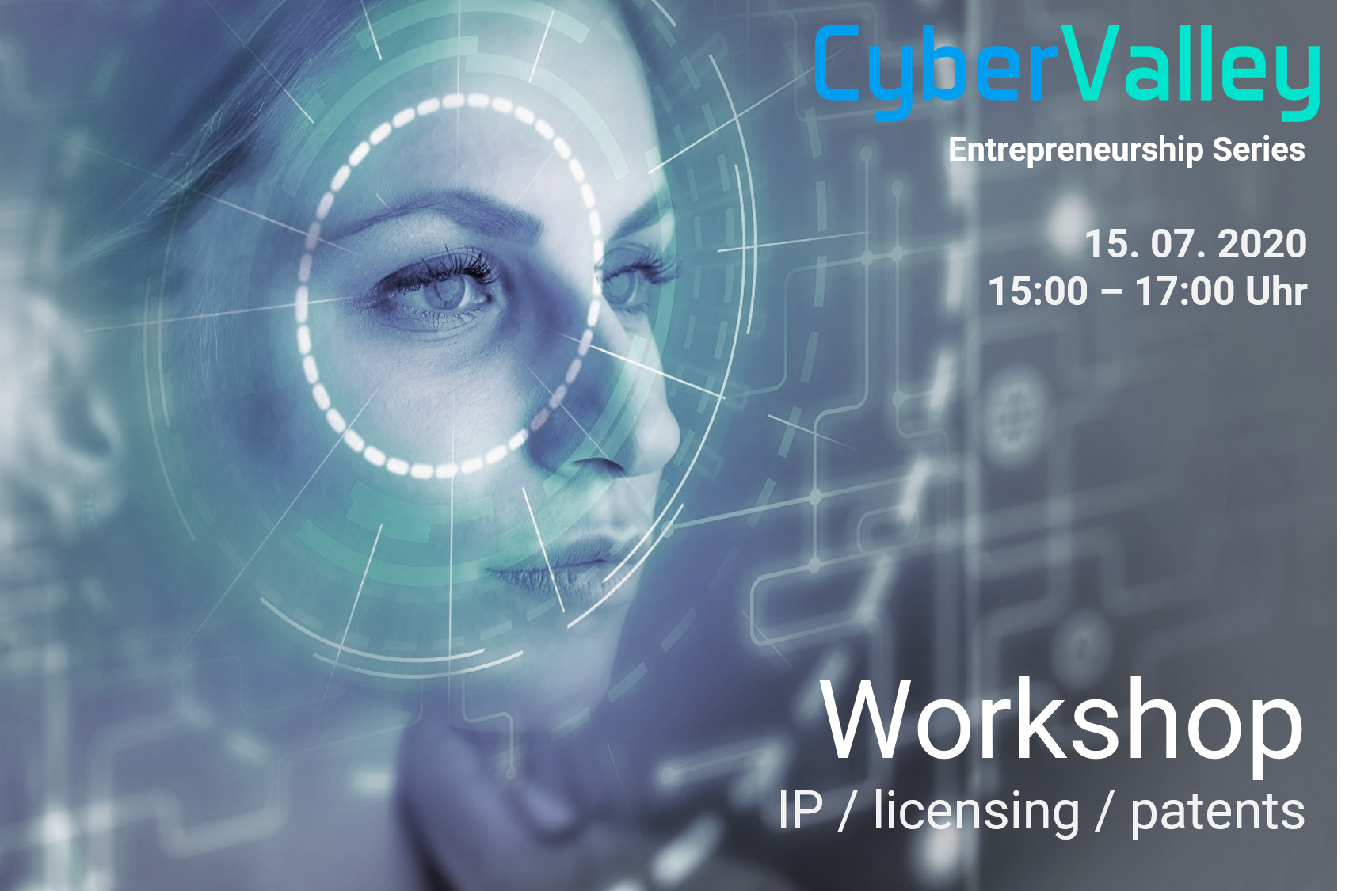
  • Workshop

    Workshop

    Due to COVID-19 restrictions, the workshop will be virtual (Zoom). If you would like to participate, please register here.
     
    Drawing on an example, our experts will describe a new technology's route to market as well as the relevant legal regulations. They will address a range of topics, including: invention, ownership, know-how, software, open source license, patent law, earnings, and many others.
    While the event is virtual, participants will be invited to interact with the experts and discuss concrete questions and challenges.
     
    Our experts have extensive experience in the relevant fields and look forward to sharing their profound knowledge. They are located at the technology transfer departments of the Universities of Stuttgart and Tübingen, Max Planck Innovation GmbH, the legal department of the Max Planck Society, and an external guest from the law firm Boehmert & Boehmert. We also have a founder with us, who can report from her own experience regarding the practical implementation.
     
    Our experts:
    Universities:
    Dr. Rolf Hecker, Head of Technology Transfer & Start-ups, University of Tübingen
    Dr. Ralf Kaun, Head of Knowledge and Technology Transfer, University of Stuttgart
     
    Max Planck Innovation:
    Dr. Bernd Ctortecka, Senior Patent- & License Manager
    Dr. Wolfgang Tröger, Senior Patent- & License Manager
    Dr. Andreas Vogler, Patent- & License Manager
    Dr. Florian Kirschenhofer, Senior Start-up & Portfolio Manager
    Simone Bund, Ass. jur. Patent- & License Manager
     
    Max Planck Society Legal Department:
    Sabine Krabichler, Shareholdings, Cooperations, Technology Transfer
    Maximillian Funk, IT Law and Data Protection Law
     
    Boehmert & Boehmert:
    Dr. Matthias Hofman, German Patent Attorney, European Patent and Trade Mark Attorney (external guest)
     
    Meshcapade (Cyber Valley Start-up Network Member):
    Naureen Mahmood, CEO
     
    Cyber Valley:
    Alexander Diehl, Senior Advisor
    Professor Alexander Brem, Entrepreneurship in Technology and Digitization
    Tobias Dürr, Innovation Manager


  • Chancen und Risiken der Künstlichen Intelligenz

    Chancen und Risiken der Künstlichen Intelligenz

    EINLADUNG zu "Chancen und Risiken der Künstlichen Intelligenz" mit der Vorsitzenden der Enquete-Kommission KI im Bundestag, Daniela Kolbe MdB, am Donnerstag, den 6. Februar 2020

    Welche Chancen bietet Künstliche Intelligenz für unser zukünftiges Leben und Zusammenleben? Welchen Einfluss hat sie auf unsere Wirtschaft und unsere Arbeitswelt? Und welche Risiken gehen von ihr aus?

    Der Bundestag hat mit der Enquete-Kommission "Künstliche Intelligenz – Gesellschaftliche Verantwortung und wirtschaftliche, soziale und ökologische Potenziale" eine der zentralen Debatten unserer Zeit aufgegriffen. Wir freuen uns sehr, dass wir die Vorsitzende dieser Enquete-Kommission, die SPD-Bundestagsabgeordnete Daniela Kolbe, für eine öffentliche Diskussion in Tübingen gewinnen konnten.

    Wir möchten Sie hierzu herzlich am 6. Februar um 18.30 Uhr in die Universität Tübingen, Hörsaal 24 im Kupferbau einladen.

    Mit ihr diskutieren:
    – Tanja-Silvana Grzesch, Erste Bevollmächtigte der IG Metall Reutlingen-Tübingen
    – Prof. Dr. Ulrike von Luxburg, Vertreterin des Cyber Valleys Tübingen
    – Dr. Bernd Villhauer, Geschäftsführer des Weltethos-Instituts


  • Forscher*innen aus dem Cyber Valley bei den französischen Filmtagen

    Forscher*innen aus dem Cyber Valley bei den französischen Filmtagen

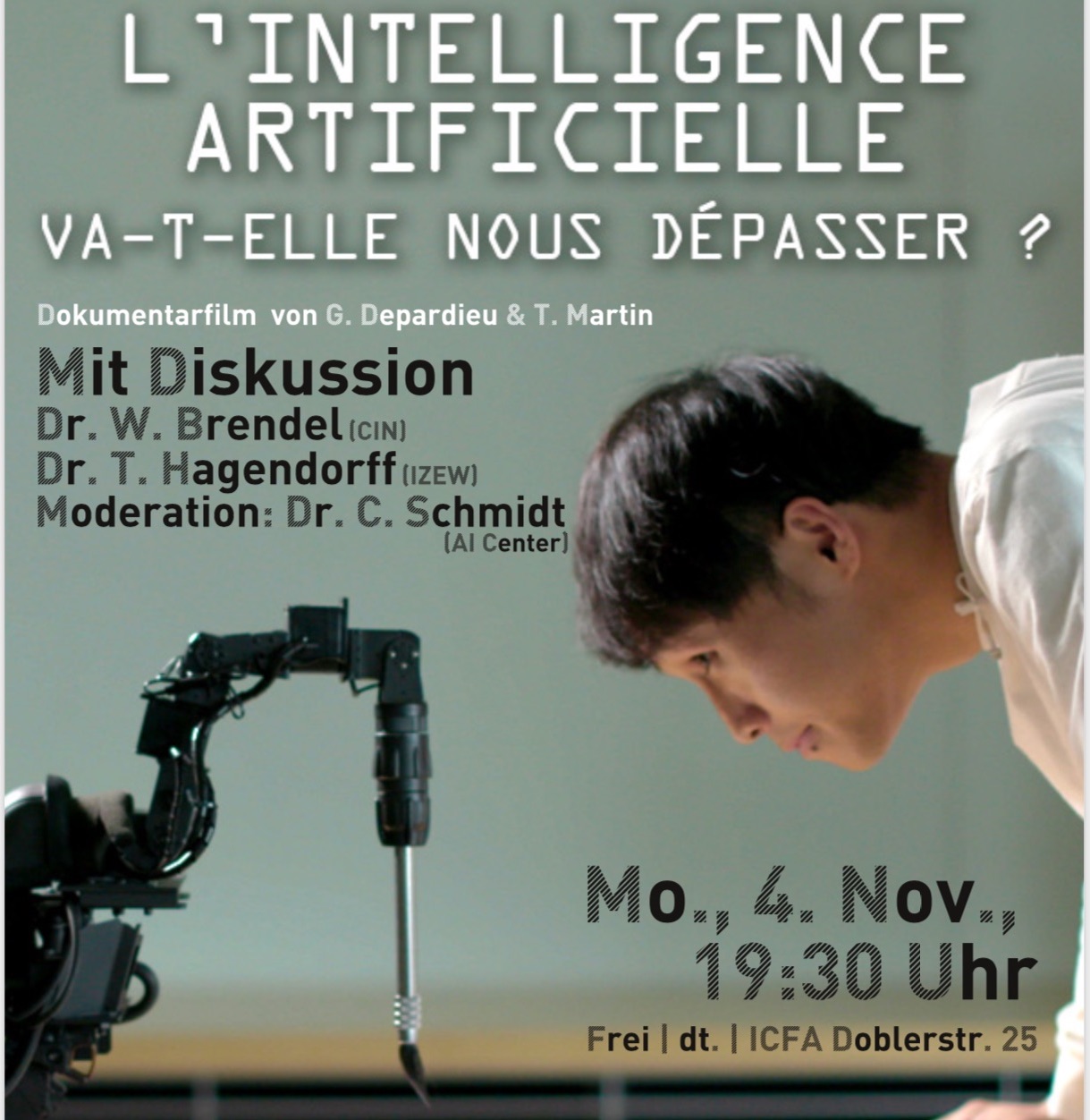
    Am 04. November lädt das Deutsch-Französische Kulturinstitut Tübingen e.V. zu einer Vorführung des ARTE Dokumentarfilms "KI: Schlauer als wir?" ein. Nach dem Film werden Wissenschaftler*innen der Universität Tübingen ihre Forschung im Bereich KI vorstellen. Im Anschluss diskutieren sie über wissenschaftliche und ethische Themen und beantworten die Fragen des Publikums.


    Referenten: 

    Wieland Brendel, Experte für Maschinelles Lernen am Center for Integrative Neuroscience der Universität Tübingen


    Thilo Hagendorff, Medien- und Technikethiker im Exzellenz-Cluster "Machine Learning: New Perspectives for Science" der Universität Tübingen


    Moderatorin: 

    Caroline Schmidt, Koordinatorin, Bundeswettbewerb künstliche Intelligenz und IT4Kids an der Universität Tübingen 


    Sprache: Deutsch


    Eintritt: frei 


    Ort: ICFA, Doblerstr. 25 in Tübingen


  • AI Research in Cyber Valley: Talks on Science and Society

    AI Research in Cyber Valley: Talks on Science and Society

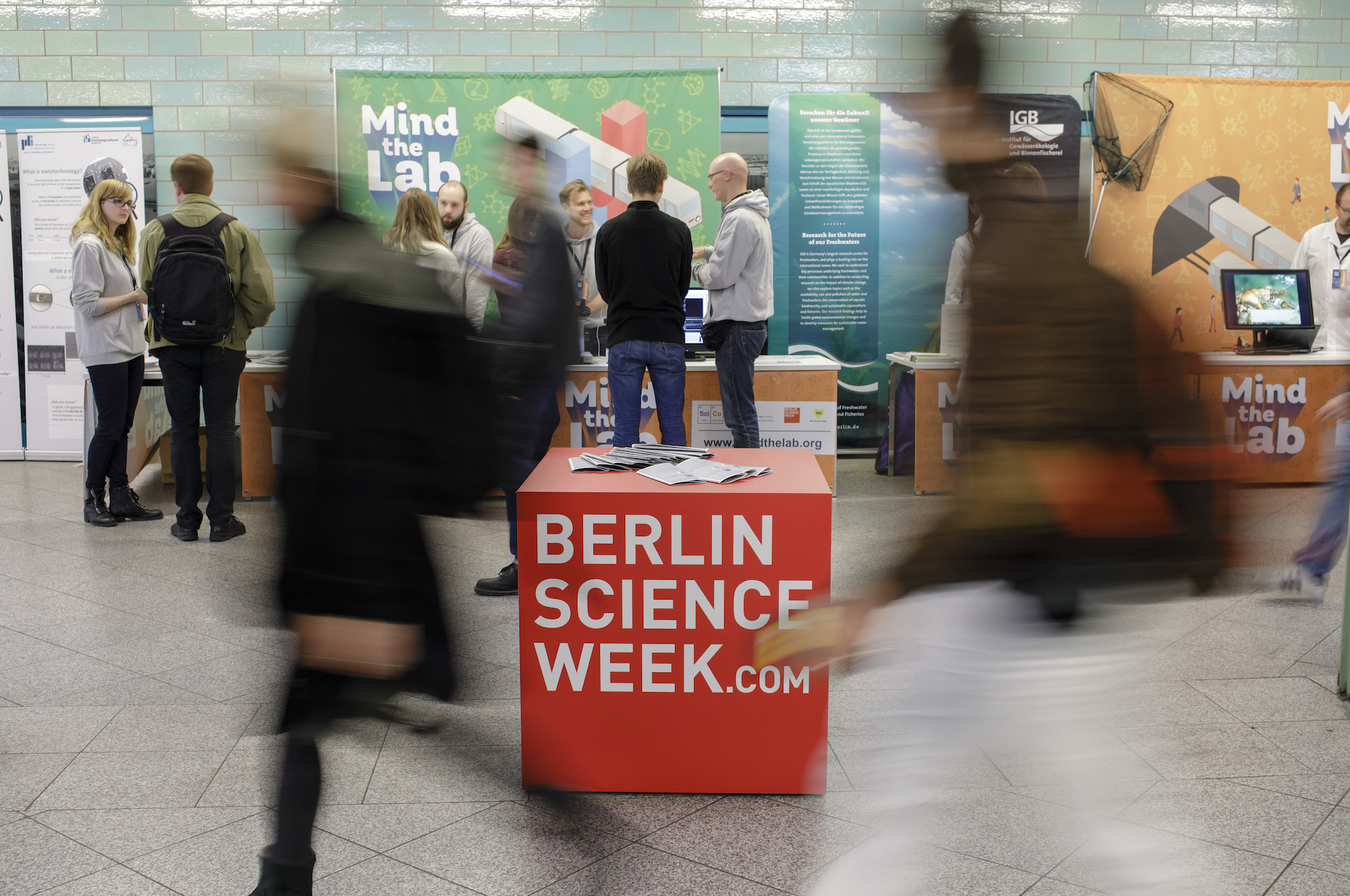
    Tübingen/Stuttgart: On November 6, 2019, Cyber Valley will be hosting an afternoon of public lectures at Berlin Science Week, where scientists from the research consortium’s partner institutions will present their research in the field of artificial intelligence (AI). At the "AI Research in Cyber Valley: Talks on Science and Society" event, scientists from the Max Planck Institute for Intelligent Systems, the University of Tübingen, and the University of Stuttgart will discuss topics ranging from nanorobots for surgery and brain-computer interfaces, to fairness in machine learning and the ethics of AI. The researchers aim to illustrate the interdisciplinary nature of the field, while at the same time addressing how AI will change society.

    Event: "AI research in Cyber Valley: Talks on Science and Society"

    Date: November 6, 2019

    Time: 4:00 p.m. – 7:30 p.m.

    Location: Berlin Museum of Natural History, New Lecture Hall, Invalidenstrasse 43, 10115 Berlin

    Language: English

    Admission: Free

    Speakers:

    Tian Qiu

    Tian Qiu was recently appointed leader of the new Cyber Valley Biomedical Systems Research Group at the University of Stuttgart. Prior to this, he completed his post-doctoral work at the Max Planck Institute for Intelligent Systems in Stuttgart. His research focuses on creating new devices and microsystems for biomedical applications. The aim is to integrate actuation, sensing, and computation to advance minimally invasive medical procedures.

    Talk: Nanorobots Inside Us – How Nanotechnology could Change Surgery

    Fabian Sinz

    Fabian Sinz is an award-winning scientist whose research interests lie in the combination of machine learning, computational neuroscience, and neural data. In 2018, he was appointed leader of the newly established independent Cyber Valley Neuronal Intelligence Research Group at the University of Tübingen. He is also currently an Adjunct Assistant Professor at the Baylor College of Medicine’s Center for Neuroscience and Artificial Intelligence in Houston, Texas.

    Talk: Real inception – Gaining Insights into the Brain by Controlling Real Neurons with AI

    Matthias Hohmann

    Matthias Hohmann is a PhD student in the Empirical Inference Department at the Max Planck Institute for Intelligent Systems in Tübingen. His research focuses on making participation in neuroscience more accessible, especially for people with rare diseases. The goal is to improve quality of life, support caregivers, and break down barriers in basic research. For his current project, he developed an app that makes participation in large-scale neuroscientific studies from home possible, without expert supervision.

    Talk: From the Lab into the Wild: A Platform for At-Home Participation in Neuroscientific Studies

    Caterina De Bacco

    Caterina De Bacco leads the Cyber Valley Physics for Inference and Optimization Research Group at the Max Planck Institute for Intelligent Systems in Tübingen. In her research, she develops models and algorithms based on the principles of statistical physics. The aim is to understand, optimize, and predict relations between the properties of complex large-scale interacting systems. Before joining MPI-IS, she was a postdoc at Columbia University’s Data Science Institute in New York.

    Talk: Physics for Inference and Optimization

    Isabel Valera

    Isabel Valera leads the Probabilistic Learning Research Group at the Max Planck Institute for Intelligent Systems in Tübingen. Her research focuses on the development of machine learning methods that are flexible, robust, and fair. She obtained her PhD in 2014 in Multimedia and Communications from the University Carlos III in Madrid, and then worked at the MPI for Software Systems as a postdoctoral fellow, and at the University of Cambridge as an associated researcher.

    Talk: Fairness in Artificial Intelligence: Challenges and Recent Advances

    Thilo Hagendorff

    Thilo Hagendorff is a media and technology ethicist. He received his doctorate in sociology in 2013 and has since been a research associate at the University of Tübingen’s International Center for Ethics in the Sciences and Humanities (IZEW). In 2019, he began working for the "Machine Learning: New Perspectives for Science" Excellence Cluster. He is also a lecturer at the University of Tübingen and at the University of Potsdam’s Hasso Plattner Institute.

    Talk: A Comprehensive Overview of AI Ethics