User Group: Promovierende

  • Next Frontier AI Roadshow at Cyber Valley

    Next Frontier AI Roadshow at Cyber Valley

    SPRIND is coming to Cyber Valley as part of its Next Frontier AI roadshow—Europe’s most radical initiative for genuine technological independence in AI. Sign up for a chance to learn more about frontier AI, the challenge and to connect with like-minded individuals.

    ​SPRIND is creating the conditions for Europe to discover and define the next frontier in AI—not by catching up, but by leaping forward with entirely new paradigms. Through massive funding (initially €125 million, non-dilutive), radical technological freedom, and a foundation of European values, SPRIND is establishing the environment to build three new Frontier AI Labs for research and deployment in Europe.

    As a leading center of excellence in AI research and robotics, Cyber Valley is proud to host this stop of the roadshow, bringing together top talent from academia, startups, and industry in our ecosystem.

    ​This isn’t your typical tech conference. No auditorium marathons. No sitting through panels while secretly checking your phone. This is an open, interactive ecosystem designed to go deep into what frontier AI actually means, to hear from Europe’s AI leaders, and know more about the initiative and the challenge.

    ​It’s designed to turn curiosity into clear intent, and strangers into potential co-founders.

    ​Who should attend–and why

    Top AI talent and promising juniors. Researchers with radical ideas. Engineers ready to build. Anyone who believes Europe can set the standard, not just keep up.

    Doors open at 14:00. Program starts at 14:45.

    Come if

    • ​You’re already certain you’re applying and want to meet potential co-founders and sharpen your thesis
    • ​You’re on the fence and need to see whether this is actually for you
    • ​You have a team but need more people to fill key roles
    • ​You’re flying solo with a strong idea and need to find your first collaborator
    • ​You work at a big lab and wonder „could I do this myself?“
    • ​You’re a professor, investor or run an AI network with access to the right people and teams

    What’s on the agenda

    Inputs on the Initiative, to shake up assumptions about where the next S-curve actually is.

    Open Q&A on the fundamentals of frontier AI, the labs we want you to build, and how the €125M → €1B funding path works. Ask us anything.

    Networking and the opportunity for 1:1 time with the Next Frontier AI team. Questions about your application, your idea, the fine print? We’re excited to talk. 

    Pressure-test your frontier thesis. Not a pitch. Not a spotlight. Just an open table for real feedback on your thinking.

    ​Food and drinks throughout – Continuous, distributed, designed to keep conversations going. No forced breaks. Standing, grazing, talking.

  • Der letzte Monat im Cyber Valley

    Der letzte Monat im Cyber Valley

    Letzten Monat war bei Cyber Valley einiges los. Hier gibt’s eine kleine Übersicht unserer Highlights:

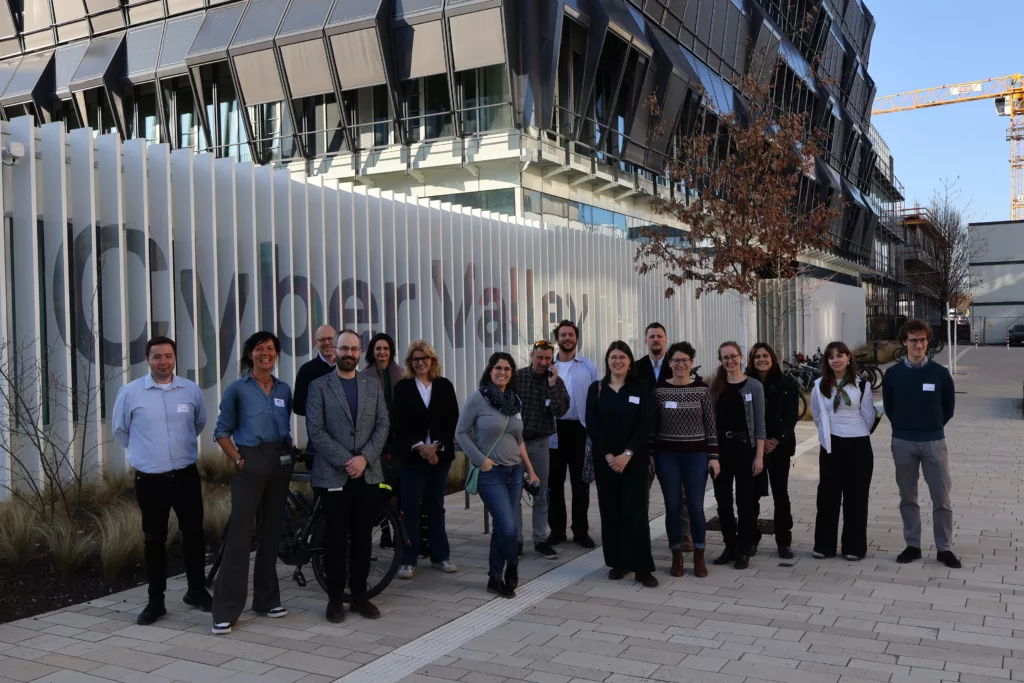
    Am 4. März besuchten Journalistinnen und Journalisten aus Europa das Cyber Valley in Tübingen. Das Programm, organisiert in Zusammenarbeit mit dem Deutsch-Französischen Institut Ludwigsburg, bot einen Überblick über Forschung, Innovation und Zusammenarbeit auf unserem Innovationscampus. Der Nachmittag begann mit Beiträgen von Florian K. Mayer (CEO der Cyber Valley GmbH), Tobias Leismann (Managing Director am ELLIS Institute Tübingen) und Philipp Hennig (Direktor am Tübingen AI Center). Christoph Koch, ehemaliger „Journalist in Residence“, gab Einblicke in das Journalist-in-Residence-Programm. Anschließend folgten Pitches aus dem Cyber Valley Start-up Network von Laura Neusser (Chief Communication Officer bei Optocycle) und Anand Waghmare (CEO & Co-Founder von Yugen Space). Abgerundet wurde der Nachmittag durch Laborbesuche bei Tsvetelina Alexiadis und Michael Muehlebach am Max-Planck-Institut für Intelligente Systeme sowie bei Martin Kiefel, Co-Founder von polybot.

    Image: Cyber Valley GmbH

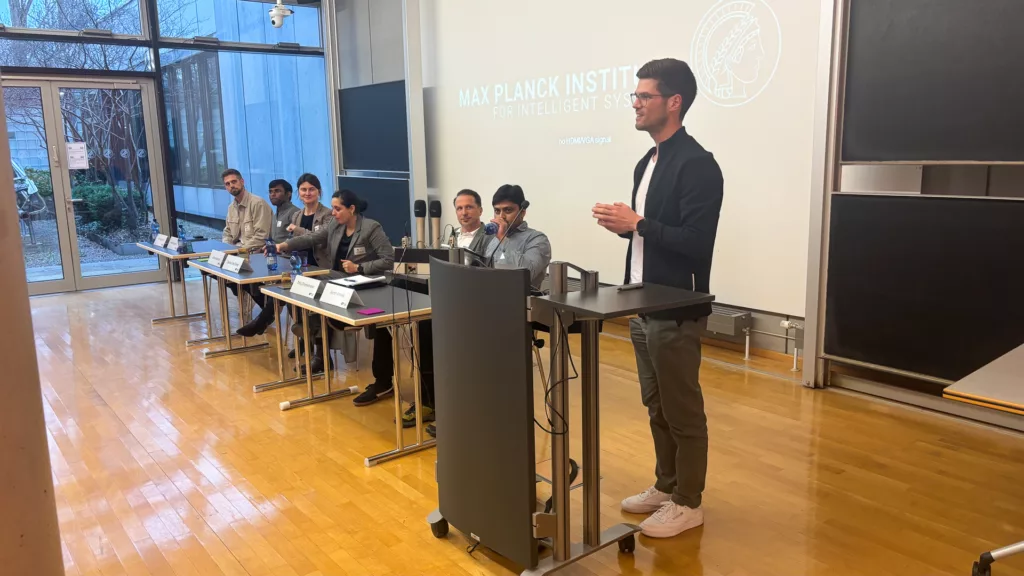
    Am 17. März startete die neue Veranstaltungsreihe „Cyber Valley Impulse“ mit dem Schwerpunkt „Mobility and Aerospace“. Forschende, Start-ups, Unternehmen und Investoren trafen sich am Max-Planck-Institut für Intelligente Systeme in Stuttgart, um über bildbasierte Wahrnehmung für Flugroboter, KI in Luft- und Raumfahrtsystemen, autonomes Fahren und neue Finanzierungsmöglichkeiten im Bereich Mobilitätstechnologien zu diskutieren. Zu den Referenten und Referentinnen gehörten: Aamir Ahmad (Universität Stuttgart), Thilo Zimmermann (InnovationsCampus Mobilität der Zukunft), Zamira Daw Perez (Institut für Flugzeugsysteme), Ulrike Weinrich (FKFS Forschungsinstitut für Kraftfahrzeugtechnik und Antriebssysteme), Anand Waghmare (Yugen Space) und Frederik Boenke (NUVUS).

    Image: Cyber Valley GmbH

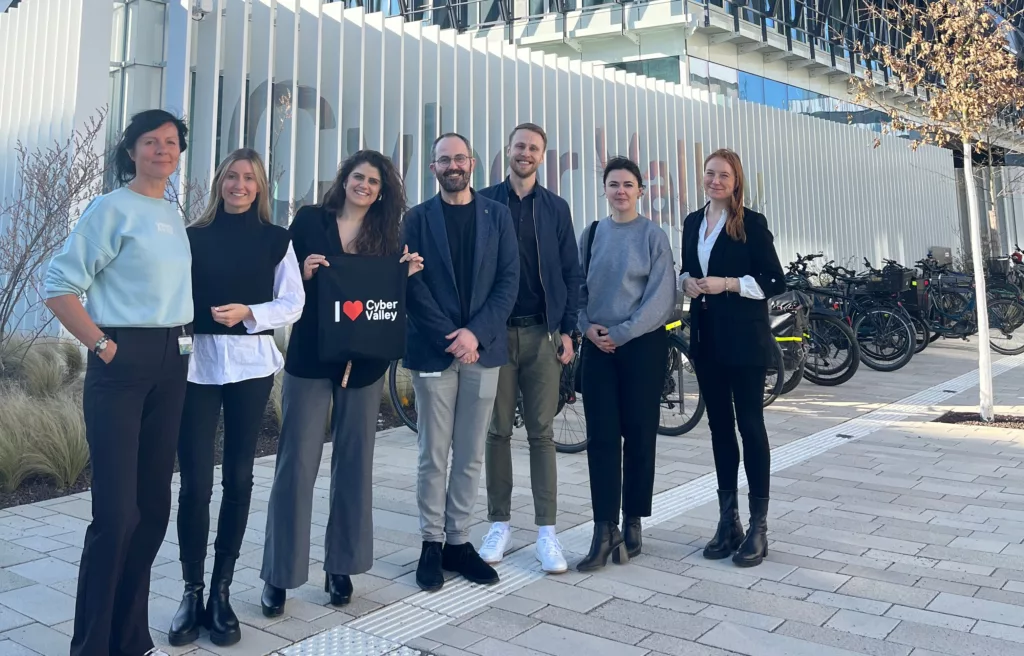
    Am 19. März konnten wir Vertreterinnen von IPAI und der IPAI Foundation im Cyber Valley in Tübingen zu einem spannenden Austausch über zukünftige Kooperationsmöglichkeiten begrüßen: Jana Strattner, Tamara Pyter und Sofia Willhauk– drei treibende Kräfte hinter der Mission von IPAI, ein lebendiges Ökosystem für angewandte künstliche Intelligenz aufzubauen.

    Indem wir unsere Stärken bündeln und zusammenarbeiten, können wir noch größeren Mehrwert für das gesamte Ökosystem in Baden-Württemberg schaffen – im Sinne eines verantwortungsvollen Ansatzes, der auch die sozialen und ethischen Auswirkungen von KI berücksichtigt. Der Austausch machte unsere gemeinsamen Ziele deutlich: den Transfer von KI-Forschung in Anwendungen zu beschleunigen, Netzwerke zu stärken und sinnvolle Kooperationen über Regionen hinweg aufzubauen. Durch diese Zusammenarbeit wollen wir Brücken zwischen Forschung, Gesellschaft und Industrie schlagen, um gemeinsam ein lebendiges Ökosystem für angewandte KI in Baden-Württemberg zu gestalten.

    Image: Cyber Valley GmbH

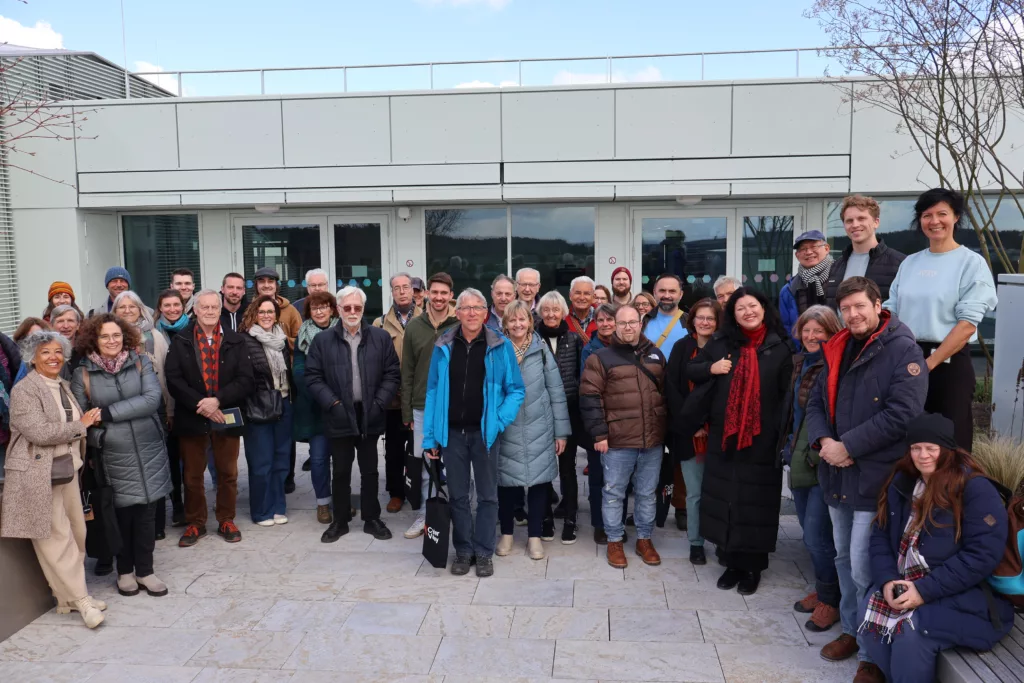
    Am 27. März besuchten Vertreterinnen und Vertreter der Tourismus und Stadtmarketing Tübingen GmbH das Cyber Valley in Tübingen. Die Tübinger Stadtführerinnen und Stadtführer sowie Stocherkahn-Fahrer und -Fahrerinnen erhielten zunächst eine Einführung in den Innovationscampus, bevor sie zu einer geführten Tour über den Campus in Tübingen starteten.

    Unsere Mission ist es, Forschung zu KI und Robotik in reale Lösungen zu überführen, die Menschen, Industrie und Gesellschaft zugutekommen. Ein wichtiger Teil davon ist der Austausch mit der Öffentlichkeit. Deshalb freuen wir uns, unsere kommenden Campus Tours in Tübingen anzukündigen, bei denen alle Interessierten den Campus erkunden und mehr über die hier stattfindende Forschung erfahren können. Die Termine werden bald bekannt gegeben.

    Image: Cyber Valley GmbH

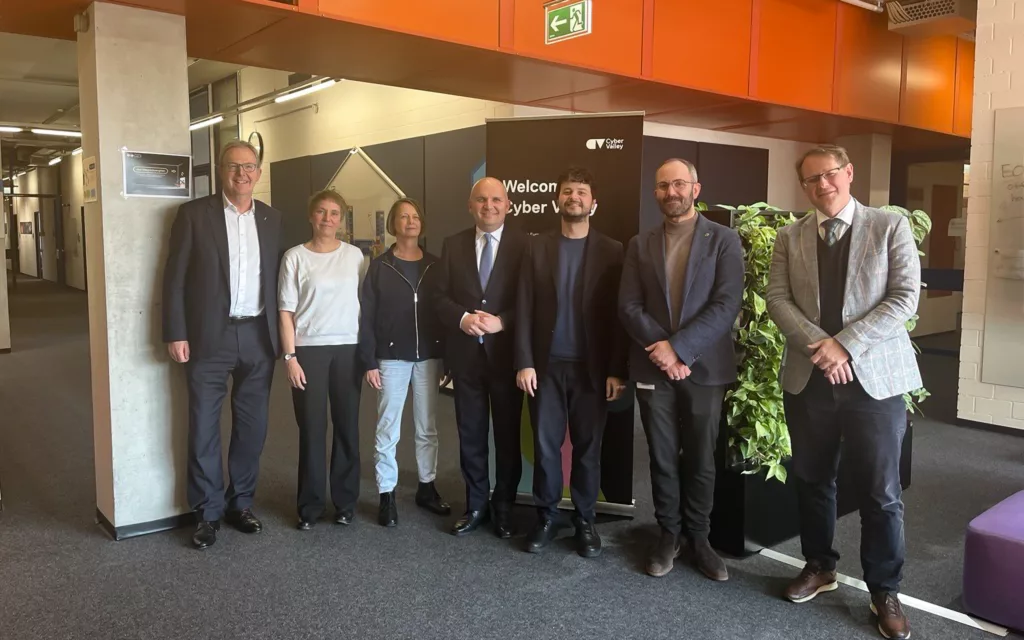
    Am 30. März hießen wir die Mitglieder des Europäisches Parlamentes Ilhan Kyuchyuk, Axel Voss, Brando Benifei und Anze Erbeznik im Cyber Valley in Stuttgart zu einem Austausch über die sich entwickelnde KI-Landschaft in Europa willkommen. Gemeinsam mit Regina Ammicht Quinn und Jessica Heesen vom Internationalen Zentrum für Ethik in den Wissenschaften der Eberhard Karls Universität Tübingen sowie Florian K. Mayer, CEO der Cyber Valley GmbH, diskutierten sie zentrale Entwicklungen, die das europäische KI-Ökosystem prägen. Themen waren unter anderem die europäische KI-Gesetzgebung und der EU Artificial Intelligence Act, die ethischen Implikationen von KI, digitale Autonomie sowie neue Fragen rund um unser digitales Nachleben.

    Image: Cyber Valley GmbH
  • Soft-Sensing Interfaces with Multifunctional Smart Materials

    Overview

    Led by Ardian Jusufi, this project investigated how biology and biomechanics can inform the design of soft robotic systems. Its goal was to develop flexible, stretchable, and potentially biocompatible materials that can sense deformation, pressure, and movement while adapting to complex surfaces.

    The research combined soft sensors, hydrogel actuators, and bio-inspired robot designs. It also used robophysical models—simplified physical robots that allow researchers to test how biological bodies move and interact with their environment. The project concluded in February 2023.

    Key results

    • Developed flexible and stretchable sensors for measuring strain, pressure, curvature, and body deformation.
    • Improved pressure sensing in situations where the sensor itself is stretched, addressing the trade-off between sensitivity, robustness, and durability.
    • Created multilayer hydrogel actuators with improved strength, stretchability, and fluidic performance.
    • Integrated soft sensors into bio-inspired robots, including an underwater robotic fish, to measure body movement and provide feedback during locomotion.
    • Used soft robotic fish and animal-inspired robots to study swimming, obstacle traversal, tail movements, mass distribution, and landing stability.
    • Demonstrated that soft sensors can measure body undulation and support closed-loop control, allowing a robotic fish to respond to changing flow conditions.
    • Used biorobotic models to test biological hypotheses, including how squirrels use their tails to reorient themselves during falls and how geckos use their tails to stabilise crash landings.

    Why it matters

    Soft robots can deform, absorb impacts, and adapt to their surroundings more easily than rigid machines. Sensors that stretch and move with a robot are therefore essential for reliable control and for measuring the robot’s interaction with its environment.

    This research contributes to more adaptable soft robots, wearable and skin-like sensors, underwater systems, and bio-inspired machines. It also shows how soft robotics can function as a scientific tool: robotic models make it possible to measure forces and movements that are difficult to study directly in living animals.

    Publications and output

    • Souri H, Banerjee H, Jusufi A, Radacsi N, Stokes A, Park I, Sitti M, Amjadi M. Advanced Int. Sys. 2 (8) 2000039. Wearable and Stretchable Strain Sensors: Materials, Sensing Mechanisms, and Applications. 2020. Advanced Intelligent Systems, Volume: 2, Issue: 8, 2020. DOI: https://doi.org/10.1002/aisy.202000039
    • Banerjee H, Kalairaj MS, Ren H, and Jusufi A*. Advanced Engineering Materials. Strong, Ultrastretchable Hydrogel-Based Multilayered Soft Actuator Composites Enhancing Biologically Inspired Pumping Systems. [Cover inside] Adv. Eng. Mater 2021, 23, 2100121. 
    • Wright B, Vogt D, Wood R, Jusufi A*. IEEE International Conference on Soft Robotics (RoboSoft). Soft Sensors for Curvature Estimation under Water in a Soft Robotic Fish. COEX, Seoul, Korea, 2019.
    • Siddall R, Fukushima T, Bardhi D, Perteshoni B, Morina A, Hasimja E, Dujaka Y, Haziri G, Martin L, Banerjee H, Jusufi A*. Advanced Robotics 35 (7). Compliance, Mass Distribution and Contact Forces in Cursorial and Scansorial Locomotion with Biorobotic Physical Models. 2021. https://www.tandfonline.com/doi/full/10.1080/01691864.2021.1887760.
    • Fukushima Toshihiko, Robert Siddall,Fabian Schwab, Severine Toussaint, Greg Byrnes, John Nyakatura, and Ardian Jusufi. Inertial tail effects during righting of squirrels in unexpected falls: From behavior to robotics. Integrative and Comparative Biology, icab 023, 2021.
    • Lin Yu-Hsiang, Siddall R, Schwab F, Fukushima T, Banerjee H, Youngjoon Baek, Daniel Vogt, Yong-Lae Park, and Jusufi A. Modeling and control of a soft robotic fish with integrated soft sensing. Advanced Intelligent Systems, 2000244, 2021.
    • Fabian Schwab, Elias T Lunsford, Taehwa Hong, Fabian Wiesemüller, Kovac M, Park YL, Akanyeti O, Liao J C, and Jusufi A. Body caudal undulation measured by soft sensors and emulated by soft artificial muscles. Integrative and Comparative Biology, 2021.
    • Fabian Schwab, Fabian Wiesemüller, Claudio Mucignat, Yong-Lae Park, Ivan Lunati,Mirko Kovac, and Ardian Jusufi. Undulatory swimming performance explored with a biorobotic fish and measured by soft sensors and particle image velocimetry. Frontiers in Robotics and AI, page 387, 2021.
    • Robert Siddall, Greg Byrnes, Rob J. Full and Ardian Jusufi, Tails stabilize landing of gliding geckos crashing head-first into tree trunks‘, Communications Biology, 2021. 

  • Ein weiterer Meilenstein für KI aus der Region Stuttgart

    Ein weiterer Meilenstein für KI aus der Region Stuttgart

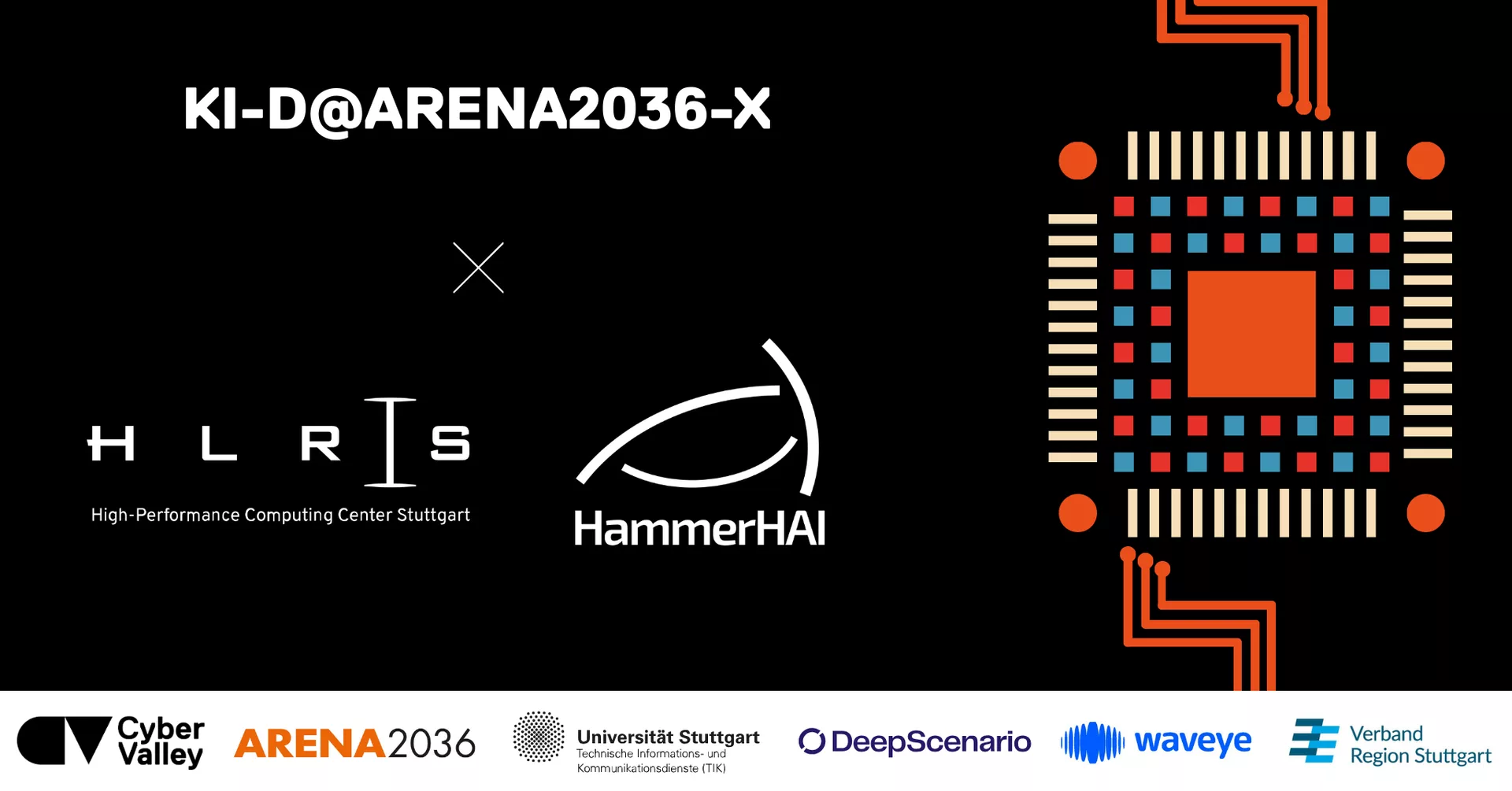
    Die Zukunft der künstlichen Intelligenz (KI) macht im Herzen von Baden-Württemberg einen wichtigen Schritt nach vorn. Das Höchstleistungsrechenzentrum Stuttgart (HLRS) wird als neuer Partner das Programm ‚KI-D@ARENA2036-X‘ mit seinem Wissen und Rechenkapazitäten unterstützen.

    Das Programm wird gemeinsam von ARENA2036, Cyber Valley GmbH, DeepScenario, waveye sowie den Technischen Informations- und Kommunikationsdiensten der Universität Stuttgart (TIK) umgesetzt.

    Mit dem HLRS kommt ein bedeutender Partner hinzu. Dadurch erhält das Programm Zugang zum Infrastrukturprojekt HammerHAI. Ab Mitte des Jahres können damit umfangreiche KI-Rechenressourcen entlang der gesamten Entwicklungskette genutzt werden – von kleineren Systemen direkt an Maschinen oder Geräten bis hin zu leistungsstarken Hochleistungsrechnern. Dadurch wird es möglich, auch sehr große und komplexe KI-Modelle zu trainieren und einzusetzen.

    Eine Infrastruktur, die KI-Entwicklung beschleunigt

    Im Rahmen der Initiative bauen die Partner eine offene IT- und Dateninfrastruktur einschließlich des Zugangs zu einem Datenraum für den souveränen Austausch von Daten auf. Ziel ist es, Unternehmen einen einfachen Zugang zu leistungsfähigen Ressourcen für KI-Anwendungen zu ermöglichen – von der ersten Idee bis zur praktischen Anwendung im Unternehmen. Dabei steht ein Modell im Mittelpunkt: die Vernetzung von KI-Systemen und Daten. Unternehmen können die bereitgestellte Infrastruktur nutzen, ohne selbst große technische Systeme aufbauen zu müssen. Die Nutzung soll zu wettbewerbsfähigen Kosten möglich sein. Besonders profitieren davon Start-ups sowie kleine und mittlere Unternehmen (KMU), deren Innovationsfähigkeit und Wettbewerbsstärke dadurch gestärkt werden.

    In Baden-Württemberg entsteht so ein skalierbares, transparentes und kooperativ gestaltetes System. Statt einer Blackbox setzt das Projekt bewusst auf eine offene Infrastruktur.

    Diese basiert auf drei zentralen Bausteinen:

    Eigene Hardware einbringen:

    Unternehmen können eigene Rechenhardware integrieren und damit die verfügbaren Rechenkapazitäten flexibel erweitern und individuelle Anforderungen abbilden.

    Gemeinsamer Datenraum:

    Ein skalierbarer, kollaborativer Datenraum mit Marktplätzen ermöglicht es verschiedenen Organisationen, gemeinsam an Datensätzen, KI-Modellen und konkreten Anwendungsfällen zu arbeiten.

    Hochleistungsrechnen mit HammerHAI:

    Leistungsstarke Hochleistungsrechen-Ressourcen ermöglichen das Training und den Einsatz besonders großer KI-Modelle.


    Ein Programm, das Unternehmen schneller voranbringt

    Teilnehmende Unternehmen des ‚KI-D@ARENA2036-X‘-Programmes profitieren von einem praxisnahen Zugang zu leistungsfähiger KI-Infrastruktur und einem starken Innovationsnetzwerk.

    Das Programm bietet unter anderem:

    • die Möglichkeit, neue Ideen und Proof-of-Concepts ohne hohe Anfangsinvestitionen zu testen und umzusetzen,
    • den Zugang zu leistungsstarker Hochleistungs-IT, ohne selbst ein eigenes Rechenzentrum betreiben zu müssen,
    • den fachlichen Austausch mit anderen KI-Entwickler:innen, die vor vergleichbaren technologischen Herausforderungen stehen,
    • sowie eine reale Testumgebung in der ARENA2036, die Anforderungen aus unterschiedlichen Branchen bündelt.

    Damit unterstützt das Programm Unternehmen nicht nur bei ihren Projekten – es beschleunigt aktiv die Entwicklung und Umsetzung neuer KI-Anwendungen.

    Stimmen aus dem Projektteam:

    Prof. Dr. Peter Middendorf, Rektor der Universität Stuttgart:

    „Die IT- und Dateninfrastruktur der ‚KI-D@ARENA2036-X‘ ist ein weiterer wichtiger Baustein unseres Innovationsökosystems. Die Universität Stuttgart trägt mit ihren Technischen Informations- und Kommunikationsdiensten und als Partner der ARENA2036 zum Erfolg dieses Projektes bei. Umso mehr freue ich mich, dass jetzt mit dem Höchstleistungsrechenzentrum Stuttgart HLRS ein weiterer starker Partner hinzukommt, der mit seiner leistungsfähigen Recheninfrastruktur Unternehmen und Start-ups bei der Erprobung und Optimierung modernster KI-Anwendungen unterstützt.“

    Dr. Alexander Lahl, Regionaldirektor des Verband Region Stuttgart:

    „Gemeinsam mit dem Infrastrukturprojekt HammerHAI entsteht ein bedeutender Nukleus, der von großem Nutzen für Start-ups und insbesondere kleinen und mittleren Unternehmen sein wird. Wir stärken damit den Standort Region Stuttgart bei KI-Anwendungen und Datenraumkapazitäten enorm, durch unsere Förderung von Innovationszentren sichern wir die Transparenz solcher Leistungen und damit die Wettbewerbsfähigkeit der Unternehmen der Region. Und es macht auch deutlich: die Stärke der Region Stuttgart ist das Miteinander.“

    Michael Kaiser, Geschäftsführer der Wirtschaftsförderung Region Stuttgart GmbH (WRS):

    „Die Zusammenarbeit der ‚KI-D@ARENA2036-X‘ mit dem HLRS und dessen europäischer AI Factory HammerHAI ist ein weiterer wichtiger Baustein für das KI-Ökosystem der Region Stuttgart. Damit ist es für Unternehmen möglich, dank effizienter Hochleistungsrechner sehr große KI-Modelle zu trainieren und zu nutzen – und das ohne eigenes Rechenzentrum. Gerade für kleine und mittelgroße Firmen entstehen dadurch neue Chancen in der KI-Entwicklung und -Anwendung.“

    Angelina Jukic, Programm Managerin bei der Cyber Valley GmbH:

    „Unser Ziel im ‚KI-D@ARENA2036-X‘-Programm ist es, ein stark vernetztes Ökosystem zu schaffen, das Forschung, Start-ups und Industrie näher zusammenbringt und die Entwicklung sowie das Training von KI-Modellen effizienter gestaltet. HammerHAI zählt dabei zu den führenden AI Factories Deutschlands und arbeitet gemeinsam mit ARENA2036 an zukunftsweisenden Lösungen.“


    Projektstand und Ausblick:

    Nach dem erfolgreichen Aufbau der grundlegenden Infrastruktur im ersten Projektjahr wird das Programm im Jahr 2026 den operativen Zugang zu den verfügbaren Rechen- und Datenressourcen ermöglichen.

    Über das ‚KI-D@ARENA2036-X‘-Programm:

    Das Programm ‚KI-D@ARENA2036-X‘ wird gemeinsam von ARENA2036, Cyber Valley GmbH, DeepScenario, waveye sowie den Technischen Informations- und Kommunikationsdiensten (TIK) der Universität Stuttgart umgesetzt. Ziel ist der Aufbau einer kollaborativen Infrastruktur, die KI-Innovationen in Baden-Württemberg schneller, sicherer und wirtschaftlich nachhaltig voranbringt.

    Das Programm wird vom Verband Region Stuttgart im Rahmen seines Kofinanzierungsprogramms für Künstliche Intelligenz als Förderprojekt von 2024 bis 2027 mit insgesamt 685.000 Euro gefördert.

    Pressekontakt:

    Silke Dutz

    Public Outreach Manager

    Email: silke.dutz@cyber-valley.de

  • Pierre Schumacher receives RIG “Outstanding Doctoral Thesis Award” at the German Robotics Conference 2026

    Pierre Schumacher receives RIG “Outstanding Doctoral Thesis Award” at the German Robotics Conference 2026

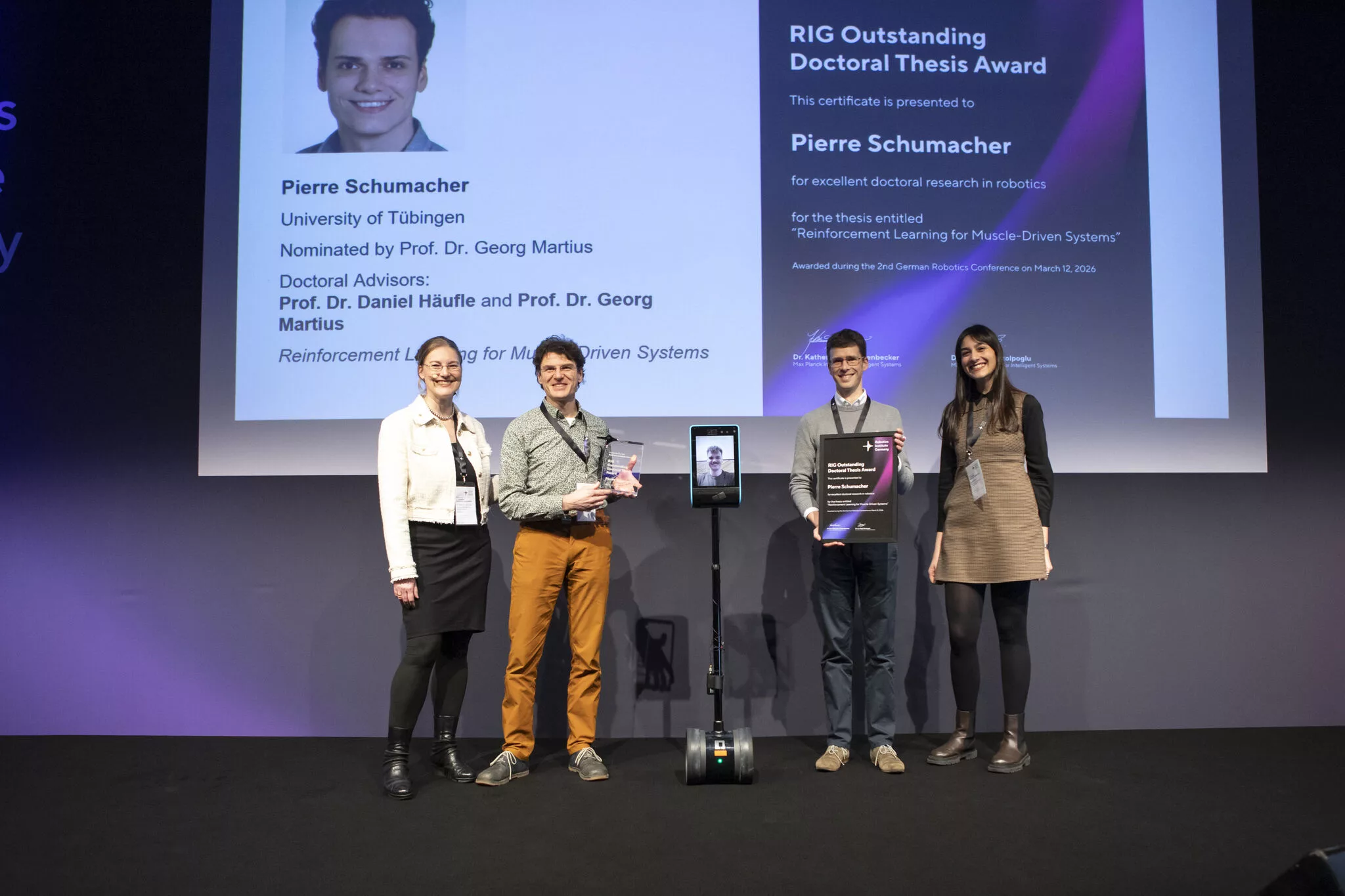
    Pierre Schumacher has been selected as one of the two recipients of the „RIG Outstanding Doctoral Thesis Award“, recognizing exceptional doctoral research in robotics in Germany. The award was officially announced during the „RIG Heroes Award Night 2026“ at the German Robotics Conference 2026, organized by the Robotics Institute Germany (RIG), in Cologne on March 12.

    Schumacher’s dissertation, “Reinforcement Learning for Muscle-Driven Systems,” was selected from 27 nominations submitted by 16 institutions across Germany. Following an extensive evaluation process, an international selection committee chose two equal awardees, citing Schumacher’s work for its “scientific depth, originality, and impact”.

    Pierre Schumacher conducted his doctoral research at the Max Planck Institute for Intelligent Systems in Tübingen under the supervision of Prof. Georg Martius (University of Tübingen) and Prof. Daniel Häufle (Hertie Institute for Clinical Brain Research) funded by the Cyber Valley Research grant “Learning effcient control of non-linear muscle-driven systems: Morphological computation as guiding principle”. His project was part of the Cluster of Excellence “Machine Learning: New Perspectives for Science” and the Center for Bionic Intelligence Tübingen Stuttgart (BITS). His dissertation, “Reinforcement Learning for Muscle-Driven Systems,” addresses challenges in controlling complex, highly overactuated robotic and biomechanical systems by developing new machine learning methods.

    A central contribution of the work is the development of DEP-RL, a reinforcement learning approach that improves exploration and learning in systems with many redundant actuators, such as musculoskeletal models. Using this method, Schumacher demonstrated efficient learning for tasks involving complex simulated bodies, including a human model with dozens of muscles and animal-inspired locomotion systems.

    Pierre’s research also explored how muscle-like actuation can improve learning performance and robustness in robotic systems. In collaborative studies, Schumacher and colleagues showed that musculoskeletal models can lead to more data-efficient and stable learning in anthropomorphic control tasks. More recent work demonstrated that reinforcement learning can produce natural and robust bipedal walking in musculoskeletal simulations without relying on motion-capture demonstrations.

    Schumacher began his academic path with a trinational bachelor’s degree in physics that took him to universities in France, Luxembourg, and Germany. After completing his B.Sc. in physics in Saarbrücken 2017, he shifted toward computational approaches and pursued a master’s degree at Goethe University Frankfurt in Frankfurt am Main. In 2021, he joined the Max Planck Institute for Intelligent Systems and the Hertie Institute for Clinical Brain Research in Tübingen with Prof. Georg Martius and Prof. Daniel Häufle for his PhD in Computer Science, which he completed in 2025.Schumacher’s expertise has also attracted industry attention: he joined MyoLab, a startup based in New York focusing on musculoskeletal control technologies, last year.

    The RIG Outstanding Doctoral Thesis Award highlights emerging researchers whose doctoral work significantly advances robotics research in Germany. Schumacher’s selection underscores the growing importance of combining machine learning, biomechanics, and embodied intelligence to enable the next generation of adaptive robotic systems.

  • 2018: Building a network of excellent scientists—interview with Caterina De Bacco

    2018: Building a network of excellent scientists—interview with Caterina De Bacco


    In 2016, important actors from science, industry, and politics founded the Cyber Valley Consortium, which became the first Innovation Campus in Baden-Württemberg. Ten years on in 2026, we’re revisiting the most important milestones from the last decade. Each month, we’ll focus on a particular year since Cyber Valley’s beginning. 

    This month, we’re looking back to 2018, when the first Cyber Valley Research Groups were established. One of these research groups was led by Caterina De Bacco: between 2018 and 2024, she led the Physics for Inference and Optimization group at the Max Planck Institute for Intelligent Systems before becoming an Associate Professor at Delft University of Technology.

    In the following interview, she explains how Cyber Valley’s network of scientists and innovators provided a thriving environment for her research, and how her research could be used for managing traffic in transportation networks.

    What were your research group’s main aims and outcomes?

    In my group, we were combining expertise from physics, mathematics, and statistics to effectively model complex systems; systems made of many individual elements that interact in complex ways, often referred to as networks. Our research approach aimed at developing mathematically rigorous models to learn patterns from network data or to optimize the design of these systems. We studied applications like clustering, anomaly detection, or optimal transport on networks, spanning various domains, in particular, the social sciences and engineering.

    How did your research address real-world challenges, and what kind of applications or long-term benefits could it have?

    Learning patterns from network data has applications in a variety of domains, as network data is ubiquitous. One of the challenges is to perform these inferences efficiently. Hence, special focus is given to the development of interpretable and principled models that are also computationally efficient, so that practitioners such as social scientists and engineers can use them without needing large resources, making these tools accessible to a wider audience. All the models we developed have a corresponding open-source implementation of the codes available online. With our models, practitioners can detect hidden clusters of similar nodes from network data or estimate the likelihood that certain observations are anomalous.

    In addition, our research on optimal transport has natural applications in managing traffic in transportation or communication networks. With our models, we can design optimal networks that can be used by network managers to assess the efficiency of existing transportation infrastructures.

    Cyber Valley is a network of leading research institutions, industry partners, and start-ups working in AI and robotics. How did being part of this network shape your research, skills, or career path?

    The exposure to this diverse network of experts was beneficial for the creative process of stimulating ideas, ideation. You have the feeling that there is always something cutting-edge going on around you, and you are among the first ones to know. There are not that many ecosystems connecting research and technology at this high level, so being immersed in it gives you valuable stimuli and ideas.


    The Cyber Valley Research Fund was also an important support for advancing our research (I obtained two grants from it). With little administrative burden and a smooth application and reporting process, I could focus mainly on the research itself, in contrast to other mainstream funding opportunities, where you end up spending much more time on non-research-related activities. As a result, our research thrived during these years, with an even higher level of productivity than we originally planned.

    How did your experience as a Cyber Valley Research Group Leader prepare you for your next career step?

    The opportunity to combine freedom and resources was unique and extremely valuable. This allowed me to grow in several aspects that are important for an academic career beyond pure research, for example, managerial responsibilities. Being able to independently manage a budget and to make key decisions (such as recruiting, deciding how to contribute to teaching) gives you a sense of responsibility and agency that makes you grow significantly faster compared to other young academics who are not as independent. As scientists, we are required to take on different roles (managers, mentors, supervisors, teachers, accountants, fundraisers) that we must learn on the job, as we are usually only trained in the science itself. To be able to effectively learn all these skills, I needed to be given the opportunity. The independence and support I got from Cyber Valley were key in this respect.

    As a result, I could start my next career step (as an Associate Professor at Delft University of Technology) with a significant advantage in terms of experience, compared to my peers. Needless to say, being a Cyber Valley Group Leader played a big role in increasing my chances of finding the right job for my next career step.

    To celebrate Cyber Valley’s ten-year anniversary, we’ll be sharing a variety of content across our website and social media channels reflecting on milestones from the last decade. Stay tuned for the next installments!

  • From perception to constrained decisions

    From perception to constrained decisions


    Georg Martius’ project, “Embedding combinatorial reasoning into learning control policies” addressed a practical gap in AI’s basic machinery: connecting data-driven neural networks with decision-making so they can adhere to clear structures, rules, and constraints. The project developed foundations for integrating combinatorial optimization into learning systems. It has potential applications wherever planning and resource allocation are central, such as in robotics and logistics. The project was funded by the Cyber Valley Research Fund and was carried out between 2021 and 2024.

    Martius’ project addressed a key limitation of today’s machine-learning systems. While neural networks can learn powerful representations from data (for example, from images or sensor signals), many real-world decisions must also follow strict rules, such as budgets, capacities, safety limits, or “must/ must not” constraints. These rule-based decisions are often handled by specialized optimization software, but such tools are traditionally difficult to integrate into learning-based systems.

    Martius’ research created methods that make it easier to combine neural networks with combinatorial optimization components. This enables systems to learn from data while also drawing on proven optimization techniques to make decisions that respect constraints. Rather than replacing classical solvers, the project developed ways to use them as trainable building blocks inside larger learning pipelines.

    The project also explored “neuro-algorithmic” approaches to decision-making and control, investigating how structured algorithms can improve generalization to new problems compared with purely data-driven approaches.

    Overall, the project provides a foundation for building AI systems that connect perception with constraint-aware decision modules. This is an important step toward robust solutions in areas such as robotics, planning, logistics, and resource allocation.

    This project produced the following peer-reviewed publications:

    Anselm Paulus, Michal Rolínek, Vít Musil, Brandon Amos, and Georg Martius. “CombOptNet: Fit the Right NP-Hard Problem by Learning Integer Programming Constraints”. In: Proceedings of the 38th International Conference on Machine Learning. Vol. 139. Proceedings of Machine Learning Research. PMLR, July 2021, pp. 8443–8453. url: https://proceedings.mlr.press/v139/paulus21a.html.

    Marin Vlastelica, Michal Rolinek, and Georg Martius. “Neuro-algorithmic Policies Enable Fast Combinatorial Generalization”. In: Proceedings of the 2021 International Conference on Machine Learning (ICML). July 2021. url: https://proceedings.mlr.press/v139/vlastelica21a.html.

    Marco Bagatella, Mirek Olšák, Michal Rolínek, and Georg Martius. “Planning from Pixels in Environments with Combinatorially Hard Search Spaces”. In: Advances in Information Processing Systems (NeurIPS 2021). 2021. url: https://openreview.net/forum?id=XgGUUaKgips.

    Subham Sahoo, Anselm Paulus, Marin Vlastelica, Vít Musil, Volodymyr Kuleshov, and Georg Martius. “Backpropagation through Combinatorial Algorithms: Identity with Projection Works”. In: Proceedings of the Eleventh International Conference on Learning Representations. May 2023. url: https://openreview.net/forum?id=JZMR727O29.

    A. Paulus, G. Martius, and V. Musil. “LPGD: A General Framework for Backpropagation through Embedded Optimization Layers”. In: Proceedings of the 41st International Conference on Machine Learning (ICML). Vol. 235. Proceedings of Machine Learning Research. PMLR, July 2024, pp. 39989–40014. url: https://proceedings.mlr.press/v235/paulus24a.html.

    Georg Martius is a Professor in the Department of Computer Science at the University of Tübingen.


    About the Cyber Valley Research Fund

    The Cyber Valley Research Fund was established to support Cyber Valley research groups undertake basic research in the fields of artificial intelligence and robotics. The fund totaled five million euros, including contributions from six of Cyber Valley’s founding corporate partners: Amazon, BMW, Bosch, IAV, Mercedes-Benz, Porsche, and ZF. It supported 20 research projects, the first of which began in 2020, and the final of which will conclude in 2026.

  • Cyber Valley und UTokyo IPC küren Yugen Space zum Gewinner des „Valley and Sunrise” – Programms zur Markterschließung

    Cyber Valley und UTokyo IPC küren Yugen Space zum Gewinner des „Valley and Sunrise” – Programms zur Markterschließung

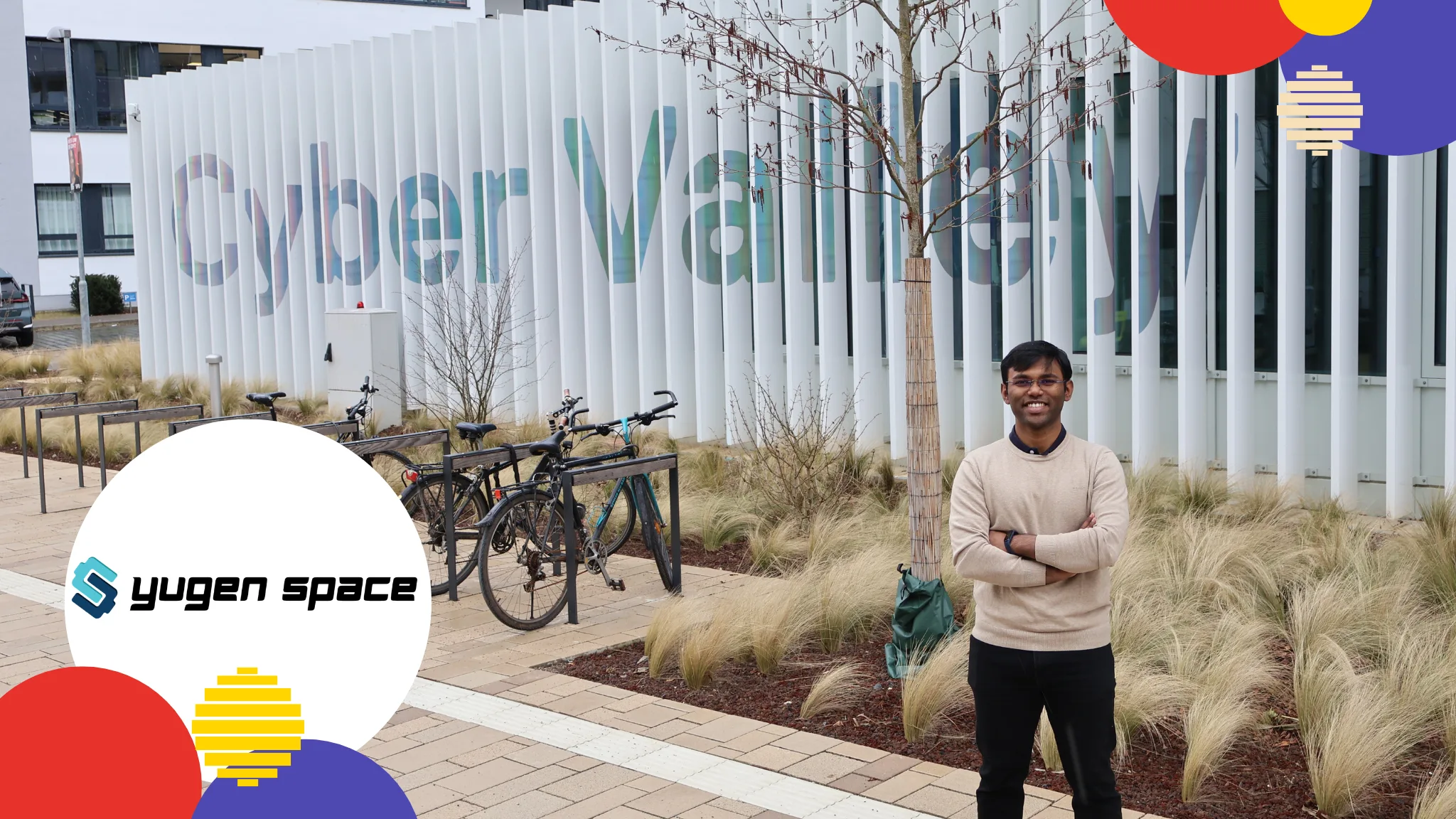
    STUTTGART / TÜBINGEN, TOKIO, 3. März 2026 – Cyber Valley GmbH und UTokyo Innovation Platform Co., Ltd. haben Yugen Space als Gewinner der ersten Ausgabe des Programmes „Valley and Sunrise” bekannt gegeben.

    Das Programm „Valley and Sunrise” unterstützt Start-ups aus den Bereichen KI und Robotik dabei, den japanischen Markt zu erschließen. Mit dem Ziel, internationales Wachstum zu fördern, bietet das Programm den Teilnehmenden praxisnahe Mentorenbetreuung, strategische Einblicke sowie Zugang zum Netzwerk von Branchenführern und Partnern von UTokyo IPC.

    „Wir haben Valley and Sunrise ins Leben gerufen, um talentierten Gründer:innen dabei zu helfen, ihre Wirkung zu beschleunigen”, sagte Angelina Jukic, Programmmanagerin von Valley and Sunrise bei der Cyber Valley GmbH. „Die Qualität der Bewerbungen war außergewöhnlich, und unsere Jury war beeindruckt davon, wie Yugen Space eine mutige Vision mit praktischer Umsetzung verband.”

    Yugen Space wurde aufgrund seines innovativen Ansatzes und seines starken Marktpotenzials aus einem hochkarätigen Bewerberfeld ausgewählt. Das Start-up wurde im Juni 2025 von Anand Waghmare (CEO) und Parikshit Joshi (CTO) gegründet und hat seinen Hauptsitz in Tübingen. Die Mission von Yugen Space ist es, eine intelligente Plattform für satellitengestützte Entscheidungen zu entwickeln.

    Yugen Space kombiniert Satellitenbilder mit Entscheidungen aus der realen Welt. Das Unternehmen integriert Satellitendaten aus verschiedenen Quellen, wendet wissenschaftliche Modelle und Modelle des maschinellen Lernens an und wandelt planetarische Signale in entscheidungsreife Informationen um. Nutzer:innen wählen einen Standort aus, stellen eine Frage und erhalten innerhalb weniger Minuten entscheidungsreife Erkenntnisse.

    Im Verlauf des Programms wird Yugen Space eng mit Mentor:innen und Branchenexpert:innen zusammenarbeiten, um seine Marktstrategie weiter zu schärfen und einen Fahrplan für die Skalierung seiner Produkte und Dienstleistungen zu entwickeln.

    Anand Waghmare, CEO von Yugen Space:

    „Die Auswahl für das Valley and Sunrise-Programm ist ein wichtiger Meilenstein für Yugen Space. Damit können wir zwei der weltweit fortschrittlichsten KI- und Deep-Tech-Ökosysteme miteinander verbinden: Cyber Valley hier in Deutschland und UTokyo IPC in Japan. Für uns ist dies eine wichtige Gelegenheit, unsere Mission der internationalen Demokratisierung planetarischer Intelligenz zu skalieren. Wir freuen uns darauf, mit japanischen Branchenführern zusammenzuarbeiten, um zu zeigen, wie unsere Produkte komplexe ökologische und industrielle Herausforderungen auf globaler Ebene lösen können.“

    Hideki Nagasaka, Partner und Direktor, 1stRound, UTokyo IPC:

    „Diese Auswahl ist ein bedeutender Meilenstein in der Zusammenarbeit, die wir über die Jahre hinweg zwischen Japan und Deutschland aufgebaut haben. Wir sind zuversichtlich, dass dieser Meilenstein ein wichtiger Schritt für Yugen Space sein wird, da das Unternehmen seine Geschäftsentwicklung mit klarem Blick auf die Expansion in den japanischen Markt vorantreibt. Mit dieser Initiative hoffen wir, nicht nur zum weiteren Wachstum der deutschen Innovationsgemeinschaft, einschließlich Cyber Valley, beizutragen, sondern auch die Beziehungen zwischen dem deutschen und dem japanischen Ökosystem weiter zu vertiefen. Wir bleiben weiterhin bestrebt, das japanisch-deutsche Netzwerk zu stärken und eine nachhaltige, langfristige Zusammenarbeit voranzutreiben.“

    Weitere Informationen über “Valley and Sunrise” finden Sie unter: https://cyber-valley.de/en/websites/cyber-valley/pages/valley-and-sunrise-program/

    Über UTokyo IPC

    UTokyo Innovation Platform Co., Ltd. (UTokyo IPC) ist eine Risikokapitalgesellschaft, die sich vollständig im Besitz der Universität Tokio befindet und 2016 gegründet wurde, um die globale industrielle Wettbewerbsfähigkeit Japans durch Investitionen in Start-ups und den Aufbau von Ökosystemen zu stärken. Als öffentlich-private Risikokapitalgesellschaft hat UTokyo IPC in mehr als 80 universitätsnahe Start-ups und Risikokapitalfonds in Japan und im Ausland investiert.
    Neben Investitionen betreibt UTokyo IPC das Startup-Building-Programm, das die Kommerzialisierung von Forschungsergebnissen unterstützt, 1stRound, Japans größten akademischen Accelerator, und DeepTech Dive, ein Programm zur Förderung von Deep-Tech-Talenten. Im Jahr 2024 startete UTokyo IPC den ASA-Fond im Rahmen einer Initiative der Stadtverwaltung von Tokio, um die globale Zusammenarbeit zu fördern und Japan als Zentrum für Deep-Tech-Innovationen zu etablieren.

    Über Cyber Valley

    Cyber Valley ist Europas führendes Zentrum für Exzellenz in künstlicher Intelligenz und moderner Robotik. Durch den Aufbau eines dynamischen Ökosystems sowie die Förderung reibungsloser Zusammenarbeit und eines schnellen Wissensaustauschs zwischen Wissenschaft, Wirtschaft und Gesellschaft gestalten wir eine Zukunft, in der das volle Potenzial intelligenter Systeme zum Wohle der Gesellschaft ausgeschöpft werden soll.

    Pressekontakt

    Silke Dutz, Cyber Valley GmbH: silke.dutz@cyber-valley.de

    Akiko Tsuchiya, UTokyo IPC: info2@utokyo-ipc.co.jp