User Group: Wissenschaftler:innen

  • Cyber Valley Research Fund Event

    Cyber Valley Research Fund Event

    Experts from industry and academia came together to discuss scientific advancement and to brainstorm future research paths. “The Cyber Valley Ecosystem continues to grow as a hotspot for innovation and research in AI and robotics”, Cyber Valley Scientific Coordinator Janell Lia-Breitmayer emphasized in her opening speech. This event lies at the heart of Cyber Valley, which originated from a collaboration between industry and academia to bring scientific excellence for the benefit of society. 

    Cyber Valley Research Fund Initiatives 

    The first cornerstone of the symposium was the presentation of five independent research initiatives that have thrived under the support of the Cyber Valley Research Fund. Prof. Dr. Jörg-Dieter Stückler, who heads the Embodied Vision Research Group, showed how the use of an adaptive dynamics model can improve the trajectory estimation and prediction of a robot. By optimizing its parameters in a self-supervised manner, the robot can adapt to variations in system dynamics and plan a more efficient path through unknown terrain. 

    In a second research project supervised by Stückler under the Cyber Valley iniative, the group combined extended Kalman filtering with a differentiable physics simulator to estimate trajectories of 3D objects. In addition to reconstructing an object’s shape and pose, the model is able to infer physical properties, such as velocity and friction, from RGB-D images. This information can be used to simulate physically plausible trajectories of sliding and colliding objects.

    Subsequently, two projects of the Physics for Inference and Optimization Research Group led by Caterina De Bacco were presented. PhD student Martina Contisciani discussed advancements in network reconstruction from data. By relaxing assumptions about the conditional independence of edges, she enhances the detection of communities and clusters. In addition, her probabilistic model is able to infer the reliability of nodes, which is particularly valuable in reconstructing networks from social sciences data, where conflicting reports from multiple individuals are common.

    Postdoctoral researcher Dr. Hadiseh Safdari continued the discourse by looking at anomaly detection within networks. To identify parts of the network that deviate from the norm, she and her colleagues use a probabilistic generative model that compares the observed network with synthetic data, generated based on assumptions about community membership and reciprocity. Safdari highlighted applications such as uncovering fake users on social media platforms and detecting fraudulent activities in financial transactions. 

    Prof. Dr. Georg Martius, leader of the Autonomous Learning Research Group, explored the fusion of combinatorial algorithms and machine learning. He presented a method that implements a backward pass for combinatorial solvers with linear objective functions, allowing them to be used as building blocks in deep learning pipelines. This novel approach exploits both the reliability and efficiency of discrete optimization and the flexibility of deep learning, resulting in architectures that can solve tasks beyond the capabilities of conventional neural networks.

    After the lunch break, Rebecca Beiter's presentation on public engagement for the industry resonated as a powerful call for a modern communication paradigm. Engaging with the public entails more than just information dissemination, she emphasized — it requires active and ongoing interaction with all relevant knowledge actors, including politicians, journalists, NGOs, start-ups, and educational institutions. Beiter underlined the evolution of public engagement, defining it as a field, a practice, and above all, an attitude: "It will change the culture in which you work!”.

    Cyber Valley Founding Partner Industry Research 

    In the final round of presentations, representatives from Porsche, Amazon, and Fraunhofer shared insights into industry research. Dr.-Ing Bruno Kistner, Head of Data-Driven Development at Porsche AG, highlighted Porsche's use of AI in customer-centric applications, exemplified by intelligent climate control among its smart products and services. He outlined Porsche's AI-driven optimization of production processes, ensuring quality and support to employees throughout the design and production phases.

    Amazon Applied Principal Scientist, Dr. Betty Mohler-Tesch, demonstrated how Amazon aims to enhance customer experience with innovation, such as virtual avatars and AI-powered personal shoppers. Stressing the importance of inclusivity, she remarked: “Fashion is for everyone – you can’t avoid putting clothes on in the morning”. Her research group aims to improve the generation of realistic three-dimensional human avatars. Their goal is to enable customers to digitally try on clothes and order custom-fit garments, thereby reducing stress and lowering return rates. 

    Fraunhofer IAO researcher Ravi Kanth Kosuru spoke about Fraunhofer’s research in applied neurocognitive systems. Aiming to promote human-machine partnership, the group employs neuro-technology, such as EEG systems, to measure cognitive and emotional states of users. Their work involves refining brain-computer interfaces to enable the interpretation of brain signals, data classification, and automatic error detection.

    In the final presentation, Fraunhofer IPA Researcher Tim Nickel presented model-free 3D bin packing as an innovative solution for the growing need for warehouse automation. Physically demanding yet mentally unstimulating, packaging is prone to error, making it ideal for automation. Nickel presented a robot system capable of densely packing arbitrarily shaped objects with ad hoc planning. Unlike static approaches, this method enables unexpected circumstance, such as rolling or shifting of objects, without collision.

    The evening was rounded off by a lively networking session, which included discussions on open research questions and potential future collaborations.

    For any questions regarding the Cyber Valley Research Fund, please contact: 

  • Engineering Intelligence – Cyber Valley at University of Stuttgart

    Engineering Intelligence – Cyber Valley at University of Stuttgart

    Cyber Valley ist Europas größte Forschungsallianz in den Bereichen Künstliche Intelligenz, Intelligente Systeme und Robotik. Als Mitgründerin prägt die Universität Stuttgart seit 2018 das Cyber Valley mit ihren besonderen Stärken in der Verbindung von Modellierung, Hardware und Künstlicher Intelligenz in integrierten cyber-physischen Systemen. Die Forschung in diesen Bereichen, beispielweise in der Intelligenten Robotik, bietet großes innovatives Potenzial. Gerade hier ist es möglich und wichtig, Grundlagenforschung mit Perspektiven der wirtschaftlichen Verwertung und der gesellschaftlichen Verantwortung zu verbinden.

    Die Veranstaltung „Engineering Intelligence – Cyber Valley at University of Stuttgart“ präsentiert Highlights und Aktivitäten am Standort Stuttgart am 29. und 30. November 2023 und fördert die weitere Vernetzung im Forschungsfeld der Intelligenten Systeme und der Künstlichen Intelligenz. An zwei Veranstaltungstagen erwartet die Teilnehmenden ein abwechslungsreiches Programm mit einer Vielzahl spannender Panels, Vorträge, Workshops, Poster Sessions und Ausstellungen, darunter:

      • Antrittsvorlesungen neuer Professorinnen und Professoren
          • Prof. Andrea Iannelli, Institut für Systemtheorie und Regelungstechnik – Mehr Informationen
      • Vorstellung des neuen Institutes für Künstliche Intelligenz (KI)
      • Einblicke in die Aktivitäten der Exzellenzcluster IntCDC und SimTech
      • Eröffnung des Transfercenters der Universität Stuttgart (TRACES)​​​​​​

    Registrierung

    Zur besseren Planung bitten wir Sie, sich bis spätestens 24. November über das Registrierungsformular für Ihre Teilnahme an der Veranstaltung „Engineering Intelligence – Cyber Valley at University of Stuttgart“ anzumelden.

    Hier gehts es zur Registrierung.

    Programm

    Hier geht es zum Programmheft.

    Ort und Anfahrt

    „Engineering Intelligence – Cyber Valley at University of Stuttgart“ findet am Campus Vaihingen der Universität Stuttgart statt, mit Veranstaltungen in Räumen des Gebäudes PWR 47 (Pfaffenwaldring 47) sowie dem frei[raum] (Pfaffenwaldring 45).

    Zur Entlastung der Umwelt sowie in Anbetracht der Parksituation bitten wie Sie, mit öffentlichen Verkehrsmitteln anzureisen.

    Ausgehend von Stuttgart-Mitte kann der Campus Vaihingen über die S-Bahn-Linien S1 (nach Vaihingen oder Herrenberg), S2 (nach Vaihingen oder Filderstadt) sowie S3 (nach Vaihingen oder Flughafen/Messe) erreicht werden. Ausstieg ist die Station „Universität“.

    Ausgehend vom Flughafen fahren die S-Bahn-Linien S2 (Schorndorf) und S3 (Backnang). Her ist ebenfalls „Universität“ die gewünschte Haltestelle.

    PWR 47 befindet sich direkt gegenüber dem Ausgang „Universitätszentrum“ der S-Bahn-Station, PWR 45 ist nur einen kurzen Fußweg entfernt:

    Lageplan Event

    Foto: OpenStreetMaps

  • Kyutai: Lernen Sie Europas eigenständiges KI-Forschungslabor kennen

    Kyutai: Lernen Sie Europas eigenständiges KI-Forschungslabor kennen

    Kyutai, das erste europäische Labor auf Privatinitiative wurde am 17. November 2023 in Station F in Paris auf Privatinitiative gegründet. Mit Freude möchten wir Bernhard Schölkopf gratulieren, der nun dem wissenschaftlichen Ausschuss von Kyutai angehört. Bernhard Schölkopf ist zudem Vorstandsmitglied von Cyber Valley sowie Präsident von ELLIS (European Laboratory for Learning and Intelligent Systems).

    Weitere Einzelheiten ist der nachstehenden Pressemitteilung in englischer Sprache zu entnehmen.

    Kyutai is a non-profit laboratory entirely dedicated to open research in artificial intelligence (AI). Its objective is to tackle the main challenges of modern AI, particularly by developing large multimodal models – using text but also sound, images, etc. – and by inventing new algorithms to enhance their capacities, reliability and efficiency.

    Kyutai has already brought on board a team of researchers and a scientific committee with outstanding academic and business backgrounds.

    Bernhard Schölkopf is known worldwide for his work in machine learning. After spending time working for corporations, he joined the Max Planck Institute for Intelligent Systems in Tübingen as a Director, where he headed the Empirical Inference department. He is also an Affiliated Professor at ETH Zürich and President of ELLIS (European Laboratory for Learning and Intelligent Systems). He has received numerous awards for his research work, including the Leibniz Prize in 2018 and the Royal Society Milner Prize in 2014.

    Resolutely committed to the democratization of AI, Kyutai is positioning itself as a leading player in AI open science. Its ambition is to share its advances with the entire AI ecosystem – the scien- tific community, developers, companies, society at large and decision-makers in democracies.

    Kyutai will also contribute to the training of future AI experts, by offering internships to students on Master’s programs and supervising PhD students and postdocs.

    Kyutai was founded jointly by the iliad Group, the CMA CGM Group and Schmidt Futures. Kyutai’s offices are based in Paris.

  • Finale: Demo Day for The AI Incubator

    Finale: Demo Day for The AI Incubator


    Bei dieser Veranstaltung werden die Teilnehmer des KI-Inkubatorprogramms ihre endgültigen Ideen einer Jury vorstellen. Die Veranstaltung findet in englischer Sprache statt. Weitere Informationen über das Programm auf Englisch sind unten.


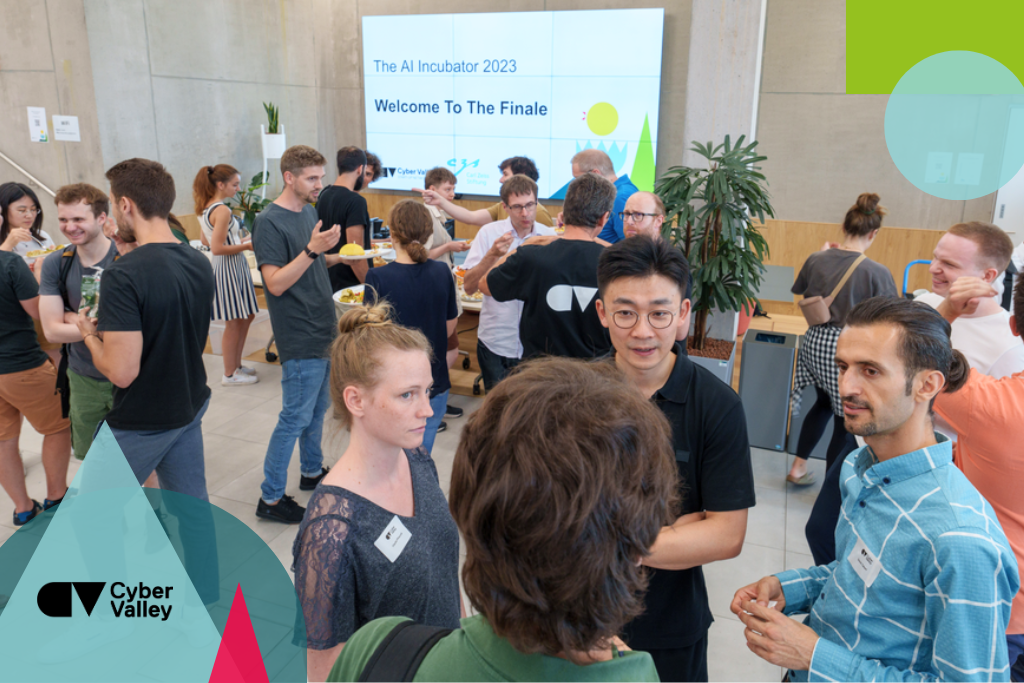
    Following six weeks of workshops and inspiring inputs, participants from Batch #3 of The AI Incubator will pitch their final ideas to a jury and a distinguished audience of investors, corporates, researchers, and entrepreneurs. The best teams will be awarded by the jury and have the chance to win attractive prices. Event attendees will have the chance to meet the teams during the concluding networking event with beverages and fingerfood.


    When? 

    November 23, 2023, 15:00-18:30 CEST


    Where? 

    Amazon Research & Development Center
    Friedrich-Miescher-Straße 4, 72076 Tübingen


    Jury

    Michael Black 
    Alex Diehl 
    Lukas Findeisen
    Naureen Mahmood
    Betty Mohler-Tesch
    Rebecca C. Reisch


    Special Guest Speaker

    Ingmar Hörr, Co-Founder CureVac


    Schedule

    15:00: Welcome & Intro from Rebecca C. Reisch (CEO of Cyber Valley)
    15:30: Team pitches
    17:45: Inspirational talk from Ingmar Hörr (Co-Founder of Curevac): “Sciencepreneur – How to turn science into commercial value”
    18:00: Award ceremony
    18:30 onwards: Networking with food and beverages


    Registration

    Registration is closed for this event. Please contact Paul-David Bittner if you have any questions. 


    The AI Incubator

    The AI Incubator is a six-week program for AI talents with brilliant ideas. The program encourages scientists, technologists, and business talent to found their own companies, fostering the next generation of AI start-ups.  The AI Incubator equips participants with the right knowledge, tools, and skills to transfer their cutting-edge AI and robotics research into products and applications.

    It covers topics such as, AI prototyping, product-market fit, business strategy, and funding. The program also provides participants with access to a network of experts, mentors, founders, and investors who offer guidance and inspiration on their journey into the AI business world.

    The AI Incubator is organized by Cyber Valley and funded by the Carl Zeiss Foundation. 

  • Cyber Valley forms a new partnership with ARENA2036

    Cyber Valley forms a new partnership with ARENA2036

    ARENA2036 is a research campus and innovation hub focused on shaping the future of mobility and production. Its location in Stuttgart ­– a focal point of the German automotive industry ­– offers a flexible factory space where partners from different professional backgrounds can collaborate under one roof. Here, scientists, engineers, and companies meet to create innovative solutions for not only the automotive and production industries but also other sectors.

    “ARENA2036 is committed to collaborating with leading experts in the field of artificial intelligence”, says Dr. Clemens Ackermann, Deputy Managing Director of ARENA2036. “The cooperation with Cyber Valley opens up additional opportunities for us in AI research and application. This helps us to rethink conventional production processes and develop intelligent, sustainable solutions for the mobility requirements of the future. With this powerful mix of AI know-how and our expertise in manufacturing and automotive, we are looking forward to an exciting time of innovation and transformation.”

    About Cyber Valley

    Cyber Valley is Europe’s largest research consortium in artificial intelligence (AI) and modern robotics. Cyber Valley has a public mandate to advocate for entrepreneurship, research, development, application, and acceptance of technologies and methods in the field of intelligent systems. The company envisions a future where the full potential of intelligent systems is leveraged for the greater good of the world.

    The Cyber Valley Community connects partners from science, industry, and society together, along with AI researchers and entrepreneurs. The Cyber Valley GmbH, funded by the state of Baden-Württemberg, acts as the central organizer, service provider, and host for this community. The GmbH is located in Stuttgart and Tübingen, but the Cyber Valley Community has a far wider reach: As a national and European driving force, we attract the best people from around the world to create the future with AI.

    About ARENA2036

    ARENA2036 stands for “Active Research Environment for the Next generation of Automobiles” and is the innovation platform for mobility and production of the future. The research campus is part of the funding initiative “Research Campus – Public-Private Partnership for Innovations” in Germany. ARENA2036 is supported by the Federal Ministry of Education and Research (BMBF) and is run as a registered association with over 50 members from science and industry. The innovation platform based in Stuttgart stands for cooperation under one roof between science and industry. ARENA2036 wants to contribute to actively shaping work, mobility, and production of the future in the context of digitalization. The partners are active in various disciplines – from the automotive industry, aerospace technology, textile, and materials research to industrial science.

  • The AI Incubator 2023 Batch #3: Q&A Session 3

    The AI Incubator 2023 Batch #3: Q&A Session 3

    Q&A Dates:

      • September 20, 17:30–19:30, CEST, in person at Cyber Valley Meet-up #07, register here.

    The AI Incubator 2023

    The Cyber Valley AI Incubator encourages scientists, technologists, and business talent to found their own businesses and be part of the next generation of AI start-ups.

    Our six-week program encourages researchers to consider how they can transfer their cutting-edge AI and robotics research into products and applications. Topics include:

      • Product-market-fit
      • Business strategy
      • Funding opportunities

    We want to equip participants with knowledge, tools, and skills while connecting them with a network of experts, mentors, investors, and other founders to inspire their AI start-up journey. At the program’s conclusion, every team will have the opportunity to pitch their idea to a jury.

    If you’re interested in taking part in The AI Incubator, join one of our Q&A sessions to ask us about the application process, the program, or anything else. You can find more information on the application process and all the dates here.

  • The AI Incubator 2023 Batch #3: Q&A Session 1

    The AI Incubator 2023 Batch #3: Q&A Session 1

    Q&A Dates:

      • September 20, 17:30–19:30, CEST, in person at Cyber Valley Meet-up #07, register here.

    The AI Incubator 2023

    The Cyber Valley AI Incubator encourages scientists, technologists, and business talent to found their own businesses and be part of the next generation of AI start-ups.

    Our six-week program encourages researchers to consider how they can transfer their cutting-edge AI and robotics research into products and applications. Topics include:

      • Product-market-fit
      • Business strategy
      • Funding opportunities

    We want to equip participants with knowledge, tools, and skills while connecting them with a network of experts, mentors, investors, and other founders to inspire their AI start-up journey. At the program’s conclusion, every team will have the opportunity to pitch their idea to a jury.

    If you’re interested in taking part in The AI Incubator, join one of our Q&A sessions to ask us about the application process, the program, or anything else. You can find more information on the application process and all the dates here.