Network Role: Sponsor

  • Another milestone for AI from the Stuttgart region

    Another milestone for AI from the Stuttgart region

    The future of Artificial Intelligence (AI) is taking an important step forward in the heart of Baden-Württemberg: the High-Performance Computing Center Stuttgart (HLRS) is joining the ‘KI-D@ARENA2036-X” program as a new partner, contributing its expertise and computing capacity. 

    The program is jointly driven by ARENA2036, Cyber Valley GmbH, DeepScenario, waveye, and the Technical Information and Communication Services of the University of Stuttgart (TIK).

    With HLRS joining the initiative, the program gains an important new partner. This collaboration provides access to the infrastructure project HammerHAI. Starting in mid-year, extensive AI computing resources will be available across the entire development chain—from smaller systems directly integrated into machines or devices to powerful high-performance computing systems. This will make it possible to train and deploy very large and complex AI models.

    Infrastructure designed to accelerate AI development

    As part of the initiative, the partners are building an open IT and data infrastructure, including access to a data space for the sovereign exchange of data. The goal is to provide companies with easy access to powerful resources for AI applications—from the initial idea to practical deployment within companies. At the center of this effort is the networking of AI systems and data. Companies will be able to use the provided infrastructure without having to build large technical systems themselves. Access will be offered at competitive costs. Start-ups as well as small and medium-sized enterprises (SMEs) will particularly benefit, strengthening their innovative capacity and competitiveness.

    This will create a scalable, transparent, and collaboratively designed system in Baden-Württemberg. Instead of a black-box approach, the project deliberately focuses on an open infrastructure.

    This infrastructure is built on three key components:

    Integrating own hardware

    Companies can integrate their own computing hardware, allowing them to flexibly expand available computing capacity and address individual requirements.

    Shared data space

    A scalable, collaborative data space with marketplaces enables different organizations to work together on datasets, AI models, and concrete use cases.

    High-performance computing with HammerHAI

    Powerful high-performance computing resources enable the training and deployment of particularly large AI models.


    A program that accelerates companies

    Participating companies in the ‘KI-D@ARENA2036-X’ program benefit from practical access to powerful AI infrastructure and a strong innovation network.

    The program offers, among other things:

    • the opportunity to test and implement new ideas and proof-of-concepts without high upfront investments
    • access to powerful high-performance IT without having to operate their own data center
    • professional exchange with other AI developers facing similar technological challenges
    • a real-world testing environment at ARENA2036 that brings together requirements from different industries

    This means the program not only supports companies in their projects—it actively accelerates the development and implementation of new AI applications.

    Voices from the project team

    Prof. Dr. Peter Middendorf, Rector of the University of Stuttgart:

    “The IT and data infrastructure of ‘KI-D@ARENA2036-X’ is another important building block in our innovation ecosystem. The University of Stuttgart contributes to the success of this project through its Technical Information and Communication Services and as a partner of ARENA2036. I am therefore particularly pleased that the High-Performance Computing Center Stuttgart (HLRS) is now joining as another strong partner. With its powerful computing infrastructure, HLRS will support companies and start-ups in testing and optimizing state-of-the-art AI applications.”

    Dr. Alexander Lahl, Regional Director of the Verband Region Stuttgart:

    “Together with the HammerHAI infrastructure project, an important nucleus for AI development is emerging in the region. Start-ups and especially small and medium-sized enterprises will benefit greatly from this initiative. Through our support, we are significantly strengthening the Stuttgart Region as a location for AI applications and data infrastructures. At the same time, this project highlights the importance of collaboration across research, industry, and regional partners.”

    Michael Kaiser, Managing Director of Wirtschaftsförderung Region Stuttgart GmbH (WRS):

    “The collaboration between ‘KI-D@ARENA2036-X’ and HLRS and its European AI Factory HammerHAI is another important building block for the AI ecosystem of the Stuttgart Region. It enables companies to train and use very large AI models using efficient high-performance computers—without having to operate their own data center. This opens up new opportunities in AI development and application, especially for small and medium-sized companies.”

    Angelina Jukic, Program Manager at Cyber Valley GmbH:

    “Our goal within the KI-D@ARENA2036-X program is to create a highly connected ecosystem that brings together research, start-ups, and industry. This will make the development and training of AI models more efficient. HammerHAI is one of Germany’s leading AI computing infrastructures and works together with ARENA2036 on forward-looking solutions.”


    Project status and outlook

    Following the successful establishment of the basic infrastructure during the first year of the project, the program will enable operational access to the available computing and data resources in 2026.

    About the KI-D@ARENA2036-X program

    The KI-D@ARENA2036-X program is jointly implemented by ARENA2036, Cyber Valley GmbH, DeepScenario, waveye, and the Technical Information and Communication Services (TIK) of the University of Stuttgart. The goal is to build a collaborative infrastructure that accelerates AI innovation in Baden-Württemberg while ensuring security, transparency, and long-term economic sustainability.

    The program is funded by the Verband Region Stuttgart within the Co-Financing Program for Artificial Intelligence from 2024 to 2027 with a total of €685,000.

    Presscontact:

    Silke Dutz

    Public Outreach Manager      

    Email: silke.dutz@cyber-valley.de   
  • 2016: The foundation of an AI ecosystem

    2016: The foundation of an AI ecosystem

    In 2016, important actors from science, industry, and politics founded the Cyber Valley Consortium, which became the first Innovation Campus in Baden-Württemberg. Ten years on in 2026, we’re revisiting the most important milestones from the last decade. Each month, we’ll focus on a particular year since Cyber Valley’s beginning.

    This month, we’re returning to 2016 to look back at Cyber Valley’s foundation. Back then, the AI boom and the wholesale use of LLMs were still some years away. Actors from science, industry, and politics in Baden-Württemberg nevertheless knew that this technology would play an essential role in the state’s future.  

    Baden-Württemberg was already in an unrivalled position to create AI for the benefit of future society since it is home to several top AI research institutions: the Max Planck Institute for Intelligent Systems, the University of Stuttgart, the University of Tübingen, Fraunhofer-Gesellschaft, and Karlsruhe Institute of Technology (KIT). The next step was to apply their cutting-edge research to solving real-world problems.

    This was where Cyber Valley came in. In 2016, the Cyber Valley Consortium was founded with the mission of advocating for the research, development, application, and acceptance of AI and modern robotics. Cyber Valley was to unite excellent research with practical application to build the AI of tomorrow in Baden-Württemberg.

    At its founding, Cyber Valley Consortium consisted of the Max Planck Society (which includes the Max Planck Institute for Intelligent Systems, MPI-IS), the state of Baden-Württemberg, and the Universities of Stuttgart and Tübingen, alongside partners from industry: Amazon, BMW, Bosch, IAV, Mercedes-Benz Group, Porsche AG, and ZF Friedrichshafen. Other research institutions joined later, including Fraunhofer-Gesellschaft (in 2019), KIT, and ELLIS Institute Tübingen (both 2024).

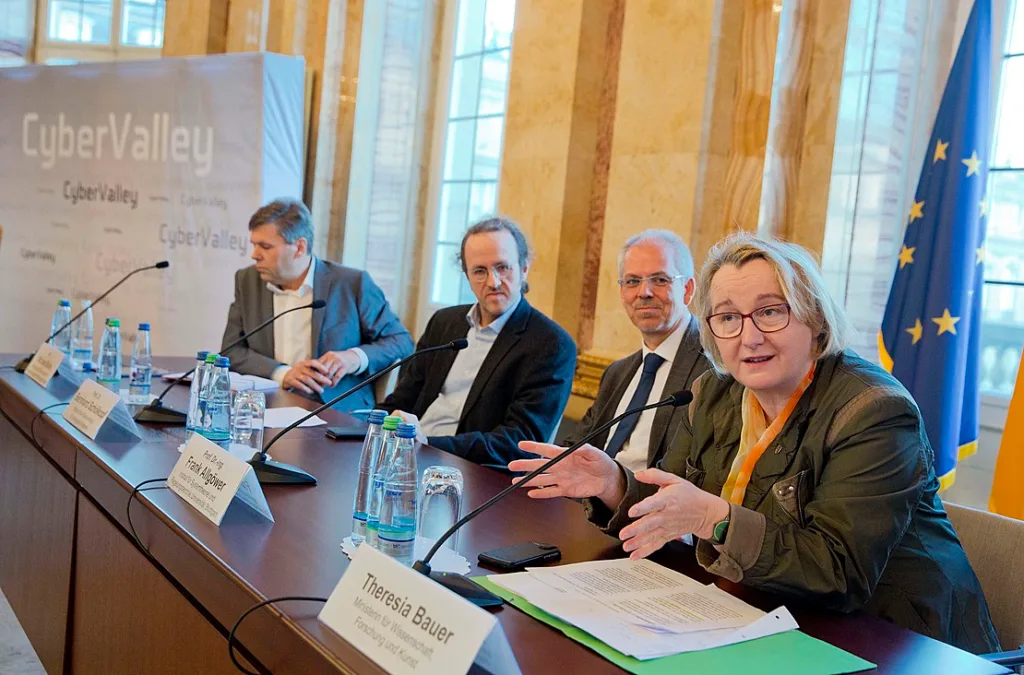
    Winfried Kretschmann, Minister-President of Baden-Württemberg, Theresia Bauer, who was then Minister of Science, Research and Art in Baden-Württemberg, and Martin Stratmann, who was then President of the Max Planck Society, launched the consortium on December 15, 2016, in Stuttgart’s Neues Schloss along with other participants from the consortium, including Bernhard Schölkopf(MPI-IS), Frank Allgöwer (University of Stuttgart) and Bernd Engler (University of Tübingen). The result was one of the largest research–industry partnerships for AI and modern robotics in Europe.

    Photo: MPI-IS / U. Regenscheit

    Theresia Bauer, Managing Director of the Baden-Württemberg-Stiftung, and Baden-Württemberg’s Minister of Science, Research and Art at the time of Cyber Valley’s founding:

    “At the time, I was thrilled by the great opportunity to bundle the excellent research landscape in the fields of AI and computer science in a condensed innovation ecosystem and make it more attractive for top international talent. When Cyber Valley was founded, I hoped that this concentration of cutting-edge research, the promotion of young talent, and responsible innovation would have what it takes to develop great appeal and grow rapidly. Today, you can see that we have succeeded in developing such a positive dynamic, which has a far-reaching impact on science, business, and the entire location.”

    Bernhard Schölkopf, Scientific Director of the ELLIS Institute Tübingen and Director of Empirical Inference at MPI-IS:

    “We started Cyber Valley with the belief that AI has the potential to change the world, and with the goal to do so in a positive way. This is now commonplace, but launching in 2016 gave us a head start and with a number of exciting start-ups, outstanding research institutions, and initiatives such as ELLIS and MP-AIX, we now have one of the most vibrant AI ecosystems in Europe.”

    Michael Black, Director of Perceiving Systems at MPI-IS:

    “The goal of Cyber Valley has always been to give Germany the chance to build a new high-growth economy around AI. In 2016, AI was not in the headlines, but we believed that we had the raw materials needed to succeed. Through the partnership of government, academia, and industry, we grew the AI faculty, attracted top researchers, built a top graduate program, trained hundreds of AI scientists, attracted investment, and helped launch a network of start-ups. These start-ups were always the goal and they hold the promise of a new Germany economy.” 

    Photo: MPI-IS / U. Regenscheit

    Peter Middendorf, Rector of the University of Stuttgart:

    “From the very beginning, the University of Stuttgart pursued the goal of pooling expertise in artificial intelligence and particularly in robotics, within and for the Stuttgart region. Together with the University of Tübingen, the Max Planck Institute for Intelligent Systems, and other partners, we have played a decisive role in shaping and advancing Cyber Valley. This strong network has given rise to excellent research, new professorships, and innovative projects, which we continue to actively drive forward – soon also in the new Cyber Valley building here in Stuttgart.” 

    Philipp Hennig, Director of Tübingen AI Center, University of Tübingen:

    “The world was a different place ten years ago, but even then it was clear that Europe, Germany, and Baden-Württemberg had to increase their efforts to stay relevant for AI. A decade later, I’m glad that we got the political mandate to get started then. The urgency of our tasks has only grown since then; but so have our opportunities.” 

    Bernhard Beckert, Dean of the KIT Department of Informatics:

    “When Cyber Valley was founded in 2016, we saw its potential to increase the visibility of AI research in Baden-Württemberg and to build a regional network that connects talent and accelerates scientific progress. Today, more than ever, this collaborative approach remains essential for supporting responsible AI development and for strengthening the region’s position within an increasingly complex international environment.”

    Matthias Tröndle, Head of the Scientific Coordination Office, MPI-IS:

    “When we founded Cyber Valley in 2016, we envisioned creating a bold innovation ecosystem focused on artificial intelligence at a time when its transformative impact was not yet widely recognized. By bringing together universities, non-university research institutions, industry, start-ups, foundations, and government in an unprecedented partnership, we broke new ground. The outstanding success of Cyber Valley has since made it a blueprint for subsequent innovation campuses.” 

    To celebrate Cyber Valley’s ten-year anniversary, we’ll be sharing a variety of content across our website and social media channels reflecting on milestones from the last decade. Stay tuned for the next instalments!

  • Mirelo AI: Shaping the Future of AI from Cyber Valley

    Mirelo AI: Shaping the Future of AI from Cyber Valley

    Carl Johann Simon-Gabriel’s career exemplifies the successful translation of cutting-edge research into entrepreneurial innovation. After completing his PhD under the supervision of Prof. Bernhard Schölkopf at the Max Planck Institute for Intelligent Systems in Tübingen, he spent several years working in leading technology companies in the United States before co-founding Mirelo AI.

    Mirelo AI develops generative AI models capable of producing high-quality, production-ready sound effects directly from video content. This technology addresses a largely untapped area of audiovisual production and offers substantial potential for applications in film, gaming, and advertising.

    Founded in 2023, since joining the Cyber Valley Startup Network in 2024, Mirelo AI has become a strong example of how scientific excellence, ambitious vision, and effective execution converge within the region’s AI ecosystem. The successful completion of this seed round underscores both the company’s potential and the international relevance of the Cyber Valley research and innovation environment.

    Image: Flügelmann

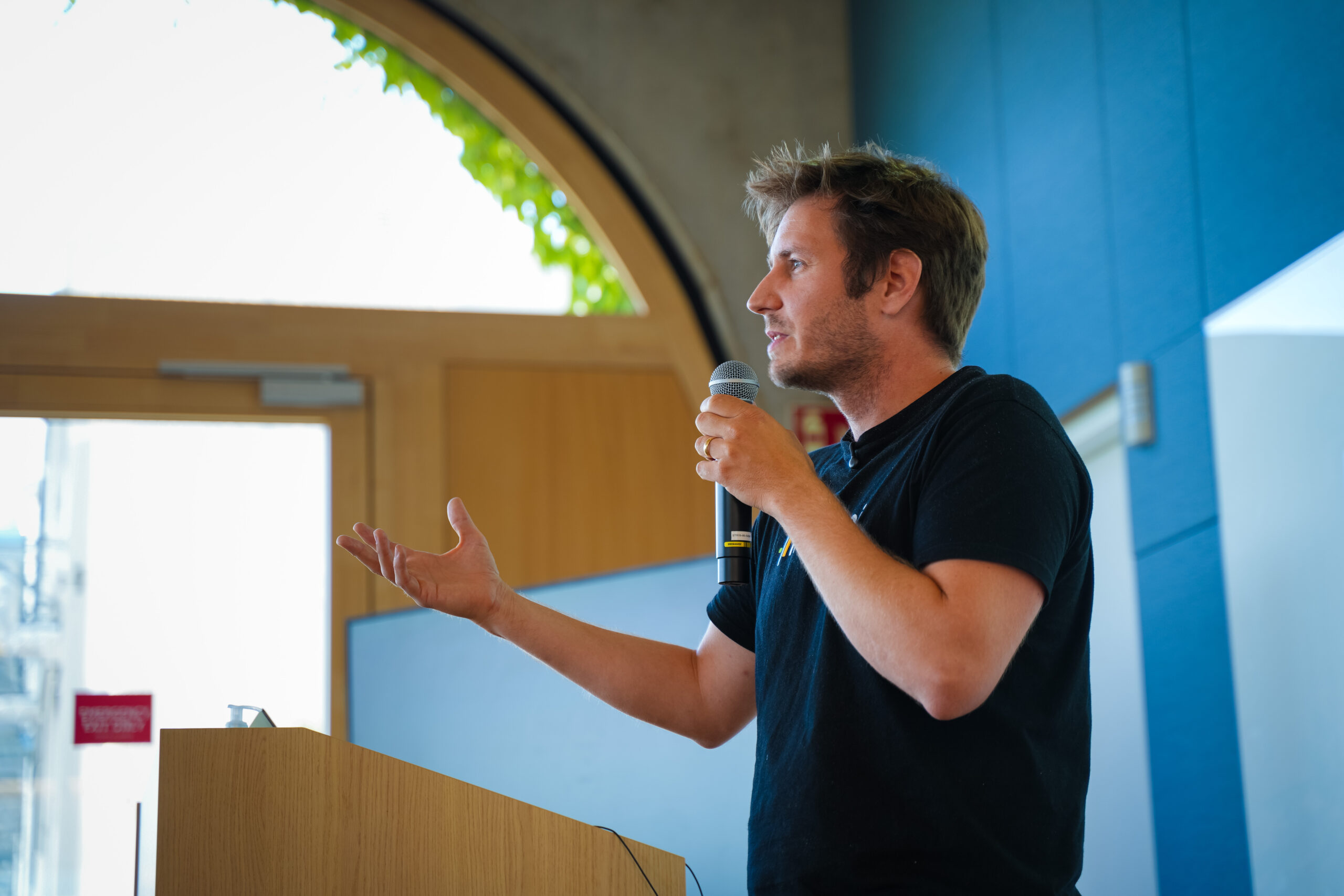
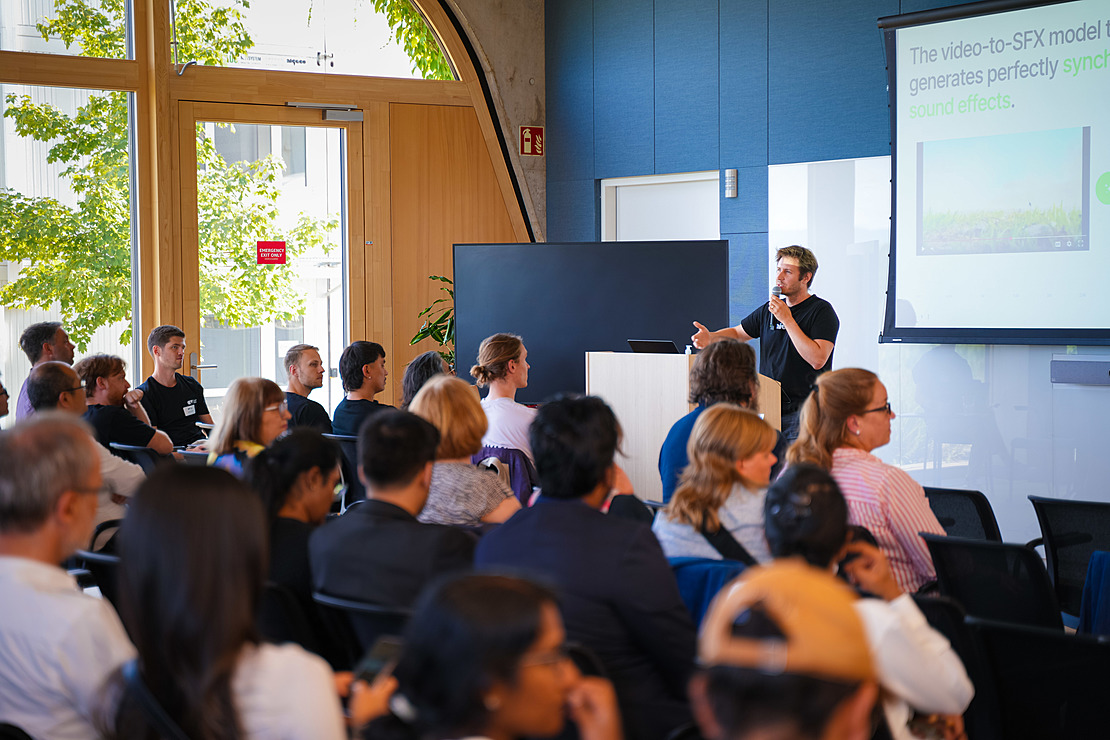
    At the Demo Day of the Cyber Valley AI Incubator (Batch #6), Carl Johann Simon-Gabriel participated as a keynote speaker, sharing insights from his entrepreneurial journey and inspiring the next generation of founders. Reflecting on his experience, he noted:

    “Cyber Valley is a great initiative for emerging AI startups, especially because it is rooted in Tübingen’s world-renowned AI research scene and its talent pool.”

    Mirelo AI is continuing to expand its team and is actively recruiting talent to develop next-generation generative AI models for audio and video. Open positions are available on the company’s website: Mirelo.ai

    Related Start-Ups

    • Mirelo AI

      Mirelo AI

  • Cyber Valley announces partnership with SPRIND

    Cyber Valley announces partnership with SPRIND

    SPRIND, the Federal Agency for Breakthrough Innovation, funds groundbreaking projects, alternative approaches, and spin-offs. Through this new partnership, Cyber Valley and SPRIND will foster creative solutions beyond conventional paths. 

    This partnership seeks to explore next-level AI technologies, venturing beyond popular concepts like Large Language Models (LLMs), Transformers, and Diffusion Models. It will focus on championing alternative approaches to AI, encouraging bold thinking, and exploring uncharted territories. This collaboration signals a significant step toward redefining the possibilities of artificial intelligence. 

    Leading the charge for this initiative is Mirko Holzer, Innovation Manager at SPRIND, “This partnership is all about pushing boundaries and bringing bold ideas to life. With Cyber Valley, we are creating the perfect launchpad for disruptive technologies that have the power to reshape science and society.”   

    Florian Mayer, COO of Cyber Valley, shares the enthusiasm, “It’s fantastic to see SPRIND committing significant resources and funding to such a vital area of innovation. We are thrilled to join forces and pave the way for the next wave of groundbreaking AI technologies.” 

    Alternative approaches 

    Through this collaboration, SPRIND and Cyber Valley are looking for innovators who are working on new and alternative approaches to artificial intelligence (AI), transformative artificial intelligence (TAI), and artificial general intelligence (AGI). The goal is to find alternative, bold, even speculative ideas that diverge from established AI pathways such as diffusion models, large-scale language models, and/or generally transformer-based architectures. 
     

    The partnership supports visionary AI methods, emphasizing:   

    • New Architectures: Energy-efficient designs inspired by biological systems, non-neural paradigms, quantum-inspired models, adaptive systems, and generative models simulating environments. 

    • New Learning Paradigms: Innovative methods like federated learning, causal learning, reinforcement learning, active learning, and synthetic data ecosystems to redefine how machines learn. 

    • New Hardware Approaches: Breakthroughs in neuromorphic, photonic, holographic, and biohybrid computing, as well as robotic systems with embodied cognition and sensory integration. 

    • Innovations outside the mainstream: Bold ideas such as meta-learning, swarm intelligence, digital organisms, evolutionary algorithms, and AI systems with emotional and self-aware intelligence. 

  • Cyber Valley celebrates the launch of ELLIS Institute Finland

    Cyber Valley celebrates the launch of ELLIS Institute Finland

    The new institute is part of the European Laboratory for Learning and Intelligent Systems (ELLIS) – a pan-European AI research network that is an important player in the Cyber Valley Community. It will position Finland as a key player in AI, attract international talent, and drive cutting-edge research. This announcement marks a major step towards achieving Cyber Valley’s vision of a closely connected, pan-European AI research network, strengthening Europe’s global standing in AI and machine learning.

    The Finnish Ministry of Education and Culture has pledged substantial financial backing, committing €10 million annually from 2025 to 2028, in addition to a launch-phase investment of €6 million. Further support comes from the Post Scriptum Foundation, established by Peter Sarlin, CEO and co-founder of Silo AI. Silo AI joined the Cyber Valley Community in June 2024 at Cyber Valley Days. The foundation has pledged an additional €10 million to fund up to 15 professorships at the ELLIS Institute Finland. 

    This ELLIS Institute, which will be based at Aalto University, is the second in the prestigious pan-European ELLIS network, following the establishment of the first institute in Tübingen, Germany, in 2023. Aalto University will lead the initiative in Finland, working collaboratively with other Finnish universities.

    The new institute will build on the achievements of the Finnish Center for Artificial Intelligence (FCAI), which currently hosts ELLIS Unit Helsinki—the Finnish node of ELLIS. Professor Samuel Kaski, director of FCAI and ELLIS Unit Helsinki, will play a central role in the development of ELLIS Institute Finland.

    This initiative underlines Finland’s commitment to becoming a major hub for AI research and innovation, leveraging its longstanding expertise to address both local and global challenges through AI-driven solutions.

    Cyber Valley is proud to support and collaborate with ELLIS Institute Finland. Together, we look forward to advancing European AI research, fostering collaborative innovation, and addressing global challenges through the power of intelligent systems. This marks a significant step in uniting Europe’s AI efforts, strengthening our shared goals and vision for a more connected, forward-thinking AI research ecosystem.