
Founded in 2023, the ELLIS Institute Tübingen has established itself as a leading center for foundational AI research, attracting top machine learning talent and providing state-of-the-art facilities in Tübingen, Germany. Its mission is to advance pioneering AI research while contributing to the broader ELLIS initiative. By combining fundamental scientific excellence with societal relevance, the Institute is shaping the future of AI in Europe and beyond by fostering innovation, interdisciplinary collaboration, and the development of the next generation of leaders in AI science.
Network Role: State
-

2018: The lecture hall occupation and its consequences—in dialog with society
In 2016, important actors from science, industry, and politics founded the Cyber Valley Consortium, which became the first Innovation Campus in Baden-Württemberg. Ten years on in 2026, we’re revisiting the most important milestones from the last decade. Each month, we’ll focus on a particular year since Cyber Valley’s beginning.
This month, we’re looking back to 2018, which marked an important moment for the exchange between AI research and society in Tübingen. From the end of November to the beginning of December, activists occupied a lecture hall in the Kupferbau (a university lecture hall in Tübingen) to demonstrate their concerns with Cyber Valley. They drew attention to the Innovation Campus’s collaboration with private companies and demanded greater public involvement in decision-making and transparency about its research.
The lecture hall occupation demonstrated the public’s interest in AI and the importance of open conversations about its impact on society. To increase dialog between researchers and the public, Cyber Valley launched several initiatives, including the Cyber Valley Public Advisory Board, the Cyber and the City exhibition at the Tübingen Stadtmuseum, the KI-Bürgerrat, as well as numerous public engagement activities from Cyber Valley GmbH.
Engaging the public in AI research: Philipp Hennig, Professor for the Methods of Machine Learning at the University of Tübingen
While the protests came as a surprise to many members of the Cyber Valley Community, they highlighted the importance of public engagement when building Baden-Württemberg’s future with AI. To ensure that the whole of society benefits from Cyber Valley’s research and collaboration with industry, the public needed to be involved in decision-making, as Philipp Hennig explains:
“On a late morning in 2018, I showed up for my lecture in the Kupferbau to find the building occupied. I walked up to the protest camp, interested to see what good cause the students were fighting for. It took a few bewildered moments before I realized that their banners had something to do with me. But I believe the protesters may also not have realized that there was a lecture in the building by and for the very people they were protesting against. At least, they seemed unprepared when I asked them to join me in the lecture hall so we could talk in front of my students.
Over the weeks that followed, I understood this mutual surprise was a metaphor for the situation in town. Students and the wider public did not know or understand what was happening on our nascent AI campus on the hill. And how could they? We had never made an effort to tell them. In our defense, it had not occurred to us that anyone would want to know. AI was still an emerging topic then. Many of us academics, myself included, thought of our work as a nerdy niche.
December 2018 and January 2019 would prove to be a very stressful time. But in hindsight, I am grateful for the experience. Many of my colleagues, from PhD students to professors, stepped up to speak publicly, often in antagonistic settings, about their work, and the often misunderstood administrative details of research funding. Perhaps the most interesting effect of the protests was what it did to Computer Science students. Most of them were initially indifferent. But as they found themselves forced to side with either their fellow students from other faculties or their own professors, many of them became increasingly engaged.
I learned that winter that explaining oneself—in public, and in person—is painful, but worth it. Seven years later, Tübingen may be more harmonious. But the question to our students has only become more pertinent: What kind of world do they want to build with AI?”

Photo: Friedhelm Albrecht/Universität Tübingen Founding the Cyber Valley Public Advisory Board: Regina Ammicht Quinn, Senior Professor at the International Center for Ethics in the Sciences and Humanities (IZEW) at the University of Tübingen
One of the outcomes from the protests was the establishment of the Cyber Valley Public Advisory Board (PAB)—an independent committee that critically questions the ethical and social implications of the research projects from the Cyber Valley Innovation Campus. Here, PAB spokesperson, Regina Ammicht Quinn, recounts her experiences of the protests and how they led to the PAB’s founding:
“I experienced the occupation of the Kupferbau as remarkably civilized and cooperative. There were notes everywhere about what was allowed and what was not, chess was played in the afternoon, and the atmosphere was generally characterized by politeness and mutual respect. For example, when I wanted to hold an event in the Kupferbau as part of my lecture series on the topic of “Discrimination by Algorithms”, the sleeping bags were unceremoniously put aside so that the lecture could take place. In my opinion, the protesters did not formulate any concrete demands. Rather, they articulated general concerns and fears about the social consequences of artificial intelligence—questions and uncertainties that, in my view, have lost none of their relevance to this day.
The occupation’s aim was to draw attention to problems: next to the main demand ‘Amazon not in Tübingen!’, came calls for greater transparency—especially regarding possible weapons research—and fears of the already difficult housing situation deteriorating further. There were no concrete problems that were easy for the university to solve. The students articulated general concerns and fears regarding AI’s social consequences—questions and uncertainties that, in my view, have lost none of their relevance to this day. Universities are also committed to society, so a lecture hall can sometimes be a place of protest.
The establishment of a Public Advisory Board in Cyber Valley was therefore a necessary and important step. The Public Advisory Board should create the space in which social perspectives, ethical questions, and public concerns about AI research are brought into discussion. The board’s initial responsibilities included reviewing project proposals and making recommendations. It did not expressly see itself as a moral control body. Rather, it saw its role in pointing out that digital research should be more interdisciplinary and that additional scientific perspectives are necessary to broaden horizons.”
Cyber and the City: Thomas Thiemeyer, Professor for empirical cultural studies at the University of Tübingen
The protests also gave an impetus to cultural researchers like Thomas Thiemeyer, who curated the Cyber and the City exhibition at the Tübingen Stadtmuseum. The exhibition ran from February 2023 to January 2024 and gave an overview of the developments and debates surrounding AI research in Tübingen. For Thiemeyer, it offered a space for the public to engage with this topic following the protests in 2018:
“The protests raised some of the big questions related to AI that were little discussed publicly in Germany at the time: Where will our city develop if the tech industry and AI research become central players? What does AI do to our society? How does it change our everyday lives? And which economic models (keyword: ‘surveillance capitalism’) do we support with new technologies? What does this mean for scientific research, whose independence from commercial interests and political expectations is important?
The protests were the reason why we, as cultural researchers, dealt with the topic and finally made an exhibition on it. The protests meant that the topic of AI in Tübingen and Stuttgart became a topic for the people of Tübingen, where fundamental questions of urban and social development were negotiated. Protests are always interesting for cultural studies because they force societies to reflect upon themselves and make corrections.
A continuing dialog with the public about AI research and application is important because new technologies always change people’s lives. These technologies affect all of us and are therefore a subject of political discussion. For these discussions to be conducted not only by a few experts, but by as many citizens as possible, information is a prerequisite.”
The events of 2018 highlighted the importance of open discussions about new technology. AI developments not only raise scientific and technological questions but also touch on societal expectations, hopes, and concerns. This is why it is crucial to create spaces for the exchange of different perspectives.
Public engagement is an important part of Cyber Valley’s activities. Various public engagement formats and initiatives promote continuous exchange between researchers and the public—from dialog events and exhibitions to participatory formats such as citizens’ dialogues and campus tours. The aim is to make AI understandable, include different perspectives, and consider the social dimensions of new technologies.
To celebrate Cyber Valley’s ten-year anniversary, we’ll be sharing a variety of content across our website and social media channels reflecting on milestones from the last decade. Stay tuned for the next installments!
-

2016: The foundation of an AI ecosystem
In 2016, important actors from science, industry, and politics founded the Cyber Valley Consortium, which became the first Innovation Campus in Baden-Württemberg. Ten years on in 2026, we’re revisiting the most important milestones from the last decade. Each month, we’ll focus on a particular year since Cyber Valley’s beginning.
This month, we’re returning to 2016 to look back at Cyber Valley’s foundation. Back then, the AI boom and the wholesale use of LLMs were still some years away. Actors from science, industry, and politics in Baden-Württemberg nevertheless knew that this technology would play an essential role in the state’s future.
Baden-Württemberg was already in an unrivalled position to create AI for the benefit of future society since it is home to several top AI research institutions: the Max Planck Institute for Intelligent Systems, the University of Stuttgart, the University of Tübingen, Fraunhofer-Gesellschaft, and Karlsruhe Institute of Technology (KIT). The next step was to apply their cutting-edge research to solving real-world problems.
This was where Cyber Valley came in. In 2016, the Cyber Valley Consortium was founded with the mission of advocating for the research, development, application, and acceptance of AI and modern robotics. Cyber Valley was to unite excellent research with practical application to build the AI of tomorrow in Baden-Württemberg.
At its founding, Cyber Valley Consortium consisted of the Max Planck Society (which includes the Max Planck Institute for Intelligent Systems, MPI-IS), the state of Baden-Württemberg, and the Universities of Stuttgart and Tübingen, alongside partners from industry: Amazon, BMW, Bosch, IAV, Mercedes-Benz Group, Porsche AG, and ZF Friedrichshafen. Other research institutions joined later, including Fraunhofer-Gesellschaft (in 2019), KIT, and ELLIS Institute Tübingen (both 2024).
Winfried Kretschmann, Minister-President of Baden-Württemberg, Theresia Bauer, who was then Minister of Science, Research and Art in Baden-Württemberg, and Martin Stratmann, who was then President of the Max Planck Society, launched the consortium on December 15, 2016, in Stuttgart’s Neues Schloss along with other participants from the consortium, including Bernhard Schölkopf(MPI-IS), Frank Allgöwer (University of Stuttgart) and Bernd Engler (University of Tübingen). The result was one of the largest research–industry partnerships for AI and modern robotics in Europe.

Photo: MPI-IS / U. Regenscheit Theresia Bauer, Managing Director of the Baden-Württemberg-Stiftung, and Baden-Württemberg’s Minister of Science, Research and Art at the time of Cyber Valley’s founding:
“At the time, I was thrilled by the great opportunity to bundle the excellent research landscape in the fields of AI and computer science in a condensed innovation ecosystem and make it more attractive for top international talent. When Cyber Valley was founded, I hoped that this concentration of cutting-edge research, the promotion of young talent, and responsible innovation would have what it takes to develop great appeal and grow rapidly. Today, you can see that we have succeeded in developing such a positive dynamic, which has a far-reaching impact on science, business, and the entire location.”
Bernhard Schölkopf, Scientific Director of the ELLIS Institute Tübingen and Director of Empirical Inference at MPI-IS:
“We started Cyber Valley with the belief that AI has the potential to change the world, and with the goal to do so in a positive way. This is now commonplace, but launching in 2016 gave us a head start and with a number of exciting start-ups, outstanding research institutions, and initiatives such as ELLIS and MP-AIX, we now have one of the most vibrant AI ecosystems in Europe.”
Michael Black, Director of Perceiving Systems at MPI-IS:
“The goal of Cyber Valley has always been to give Germany the chance to build a new high-growth economy around AI. In 2016, AI was not in the headlines, but we believed that we had the raw materials needed to succeed. Through the partnership of government, academia, and industry, we grew the AI faculty, attracted top researchers, built a top graduate program, trained hundreds of AI scientists, attracted investment, and helped launch a network of start-ups. These start-ups were always the goal and they hold the promise of a new Germany economy.”
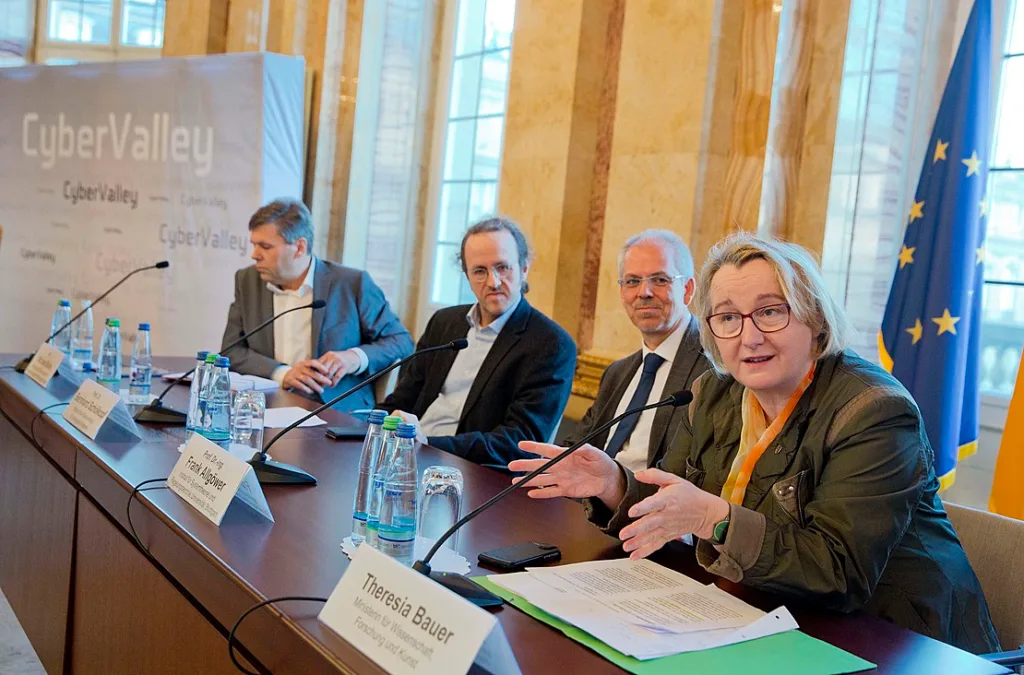
Photo: MPI-IS / U. Regenscheit Peter Middendorf, Rector of the University of Stuttgart:
“From the very beginning, the University of Stuttgart pursued the goal of pooling expertise in artificial intelligence and particularly in robotics, within and for the Stuttgart region. Together with the University of Tübingen, the Max Planck Institute for Intelligent Systems, and other partners, we have played a decisive role in shaping and advancing Cyber Valley. This strong network has given rise to excellent research, new professorships, and innovative projects, which we continue to actively drive forward – soon also in the new Cyber Valley building here in Stuttgart.”
Philipp Hennig, Director of Tübingen AI Center, University of Tübingen:
“The world was a different place ten years ago, but even then it was clear that Europe, Germany, and Baden-Württemberg had to increase their efforts to stay relevant for AI. A decade later, I’m glad that we got the political mandate to get started then. The urgency of our tasks has only grown since then; but so have our opportunities.”
Bernhard Beckert, Dean of the KIT Department of Informatics:
“When Cyber Valley was founded in 2016, we saw its potential to increase the visibility of AI research in Baden-Württemberg and to build a regional network that connects talent and accelerates scientific progress. Today, more than ever, this collaborative approach remains essential for supporting responsible AI development and for strengthening the region’s position within an increasingly complex international environment.”
Matthias Tröndle, Head of the Scientific Coordination Office, MPI-IS:
“When we founded Cyber Valley in 2016, we envisioned creating a bold innovation ecosystem focused on artificial intelligence at a time when its transformative impact was not yet widely recognized. By bringing together universities, non-university research institutions, industry, start-ups, foundations, and government in an unprecedented partnership, we broke new ground. The outstanding success of Cyber Valley has since made it a blueprint for subsequent innovation campuses.”
To celebrate Cyber Valley’s ten-year anniversary, we’ll be sharing a variety of content across our website and social media channels reflecting on milestones from the last decade. Stay tuned for the next instalments!
-

Max Planck Institute for Intelligent Systems
The Max Planck Institute for Intelligent Systems (MPI-IS) answers fundamental questions about intelligence and how to create intelligent behavior in machines and pioneer new solutions by combining research in hardware, software, and theory. With a strong commitment to interdisciplinary collaboration, MPI-IS seeks to advance the field by exploring how computational, physical, and social intelligence can work together to solve complex real-world problems. Research at the Institute is organized into six departments and numerous independent research groups, each with a different focus, led by a faculty of Directors, Group Leaders, and Max Planck Fellows.
-

KIT
The Karlsruhe Institute of Technology (KIT) is “The University in the Helmholtz Association.” As the only German university of excellence with a national large-scale research sector, the Institute offers students, researchers, and employees unique learning, teaching, and working conditions. The roots of the academic education institution extend all the way back to 1825. Today’s structure of KIT is the result of the merger of the Technical University of Karlsruhe and Karlsruhe Research Center in 2009.
-

University of Stuttgart
The University of Stuttgart is a leading, technologically oriented university with a global presence. The Stuttgart Way stands for the interdisciplinary integration of engineering, natural sciences, humanities, management, economics and social sciences on a foundation of top-flight disciplinary research.
Nestled in one of Europe’s most vibrant industrial regions, the University of Stuttgart blends science, economy, and society. From this fusion emerge variegated forms of interdisciplinary teamwork.
-

Fraunhofer
The Fraunhofer-Gesellschaft, headquartered in Germany, is a leading organization for applied research. It plays a pivotal role in innovation by focusing on cutting-edge technologies and transferring research results to industry in order to strengthen Germany as a business location and benefit society. Since its founding as a nonprofit in 1949, Fraunhofer has held a unique position in the German research and innovation ecosystem.
-

University of Tübingen
Innovative, interdisciplinary, international: these three words summarize what makes the University of Tübingen special. Excellent research and teaching are Tübingen’s answer to the challenges of the future in a globalized world. The University maintains exchanges with partners around the globe—both at institutions of higher education and at non-university research institutions. Networks and cooperation across faculty and subject boundaries are the pillars of the University’s successful strategy. This is reflected in the its good position in international rankings. In addition, it is one of the eleven German universities distinguished with the title of “excellent.”
-
Cem Özdemir visits Cyber Valley
Insights into AI research and political discussions
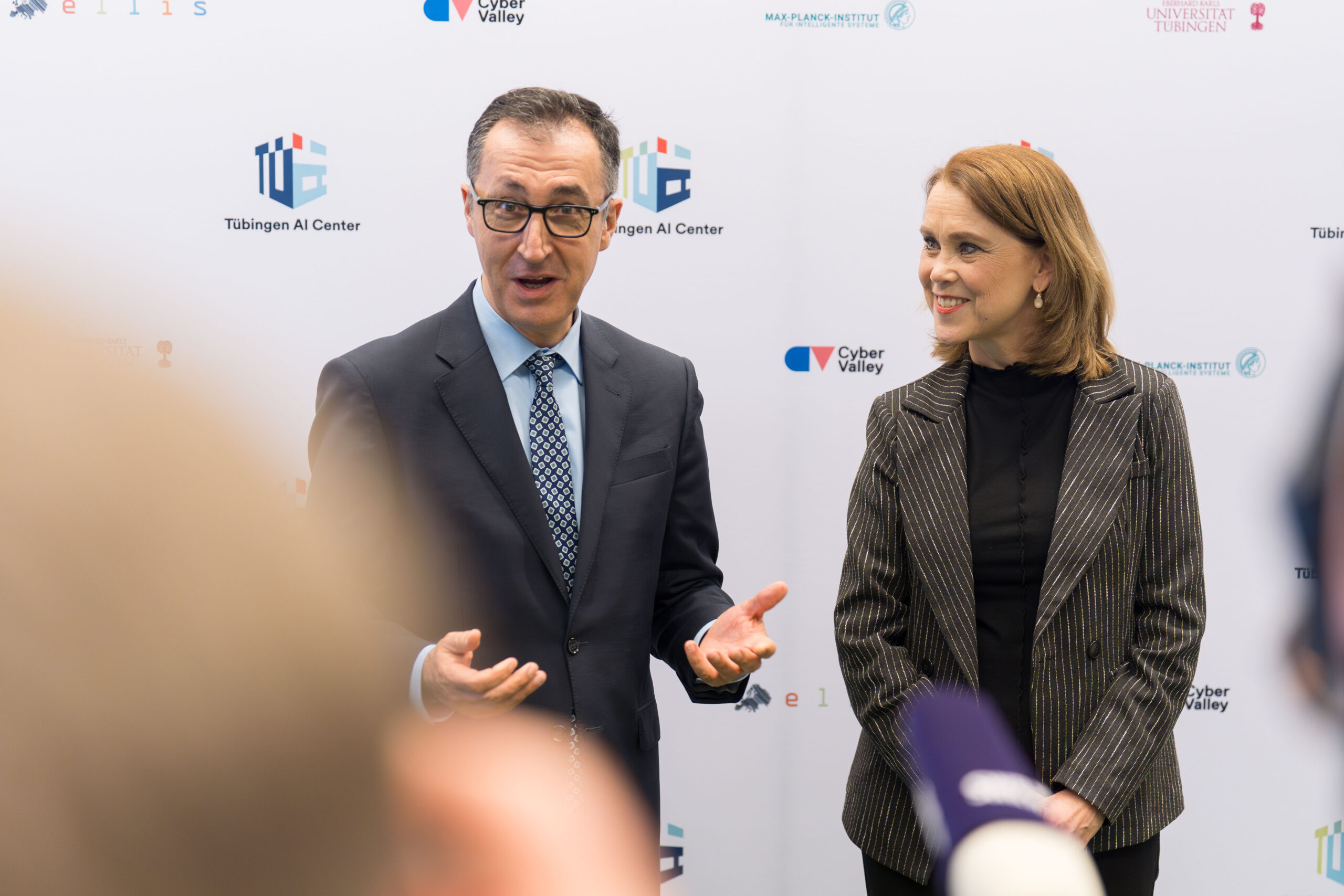
The visit began with a round of introductions in the MPI-IS building in Tübingen. In addition to keynote speeches by Prof. Matthias Bethge (Tübingen AI Center) and Prof. Bernhard Schölkopf (MPI-IS & ELLIS Tübingen), Cyber Valley, SPRIND and several AI start-ups also introduced themselves. Among them were the start-ups Maddox AI, Meshcapade and the Polybot project, which are part of the Cyber Valley Start-up Network. In short presentations, they gave an insight into their work before the participants exchanged views on various topics in a closed discussion. The focus was on discussing which specific measures are particularly important for Germany to keep up with the global competition for AI supremacy.
Lab tour and start-up presentations
A guided tour of the MPI-IS laboratories followed, giving participants exclusive insights into innovative projects and start-ups. Polybot presented its AI-supported robotics to transform agriculture. Educational initiatives were also discussed: “KI macht Schule” and the “Bundeswettbewerb KI” are committed to promoting AI skills and inspiring young talent. Black Forest Labs and Maddox AI gave further presentations on how they are developing AI for a wide range of applications.
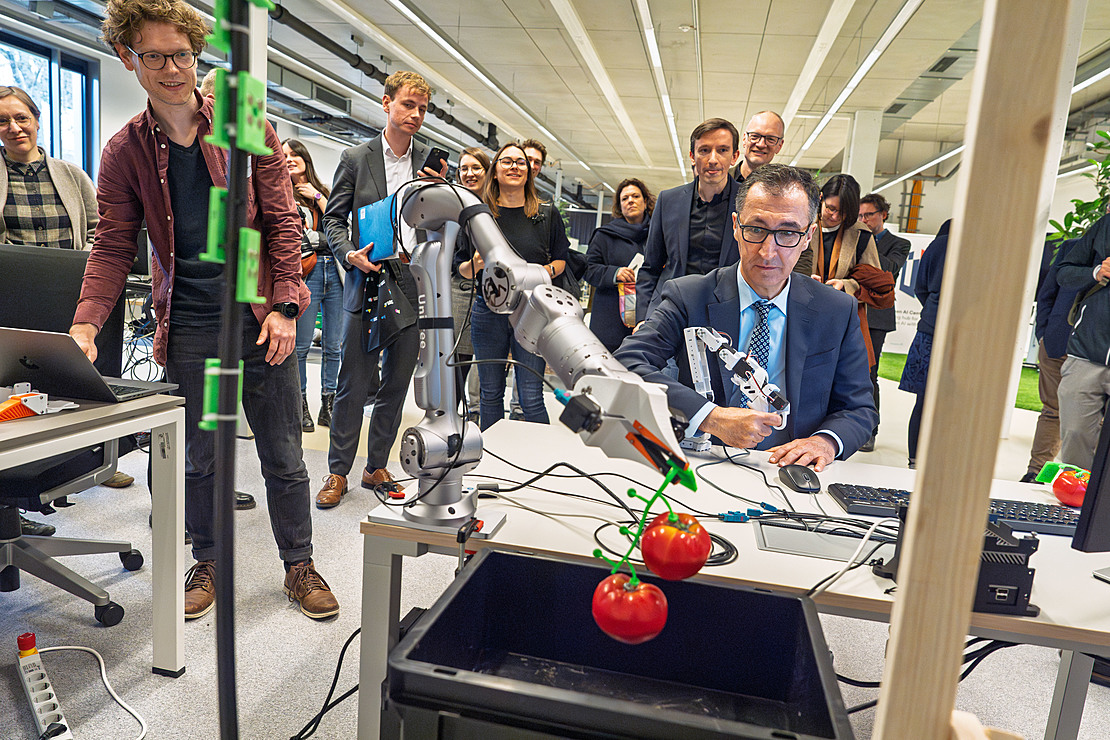
During the visit, Federal Minister Özdemir gave a statement on the importance of AI development and the political measures to promote the innovation landscape in Germany. The press was also present to report on the progress and developments in AI research. In conclusion, the Federal Minister was impressed: “Together with the partners in Cyber Valley, an outstanding AI ecosystem has developed here. We must continue to invest in such regional ecosystems in key technologies,” said Özdemir, summarizing his impressions.
Minister Petra Olschowski further states: “Today we have once again seen that the collaboration between Cyber Valley, universities, the Max Planck Institute, and the Tübingen AI Center in the field of AI is extremely important for the region. The initiatives not only remain in the area of academic basic research but also lead to successful spin-offs that collaborate with the industry.”
Cyber Valley & Tübingen AI Center: A perfect match
Cyber Valley connects cutting-edge research with industry, promoting technology transfer and the launch of innovative AI start-ups. The Tübingen AI Center is not only a central part of the Cyber Valley Community but is also active in the European ELLIS network and part of the newly founded ELIAS Alliance, which promotes socially valuable AI technologies from Europe. The visit underlined the political and economic importance of artificial intelligence for Germany and Europe.
We would like to thank everyone involved for the inspiring exchange! Further impressions and reports on the visit can be found on our social media channels.