User Group: Entrepreneur

  • Cyber Valley AI Incubator Batch #9 culminates in Demo Day

    Cyber Valley AI Incubator Batch #9 culminates in Demo Day

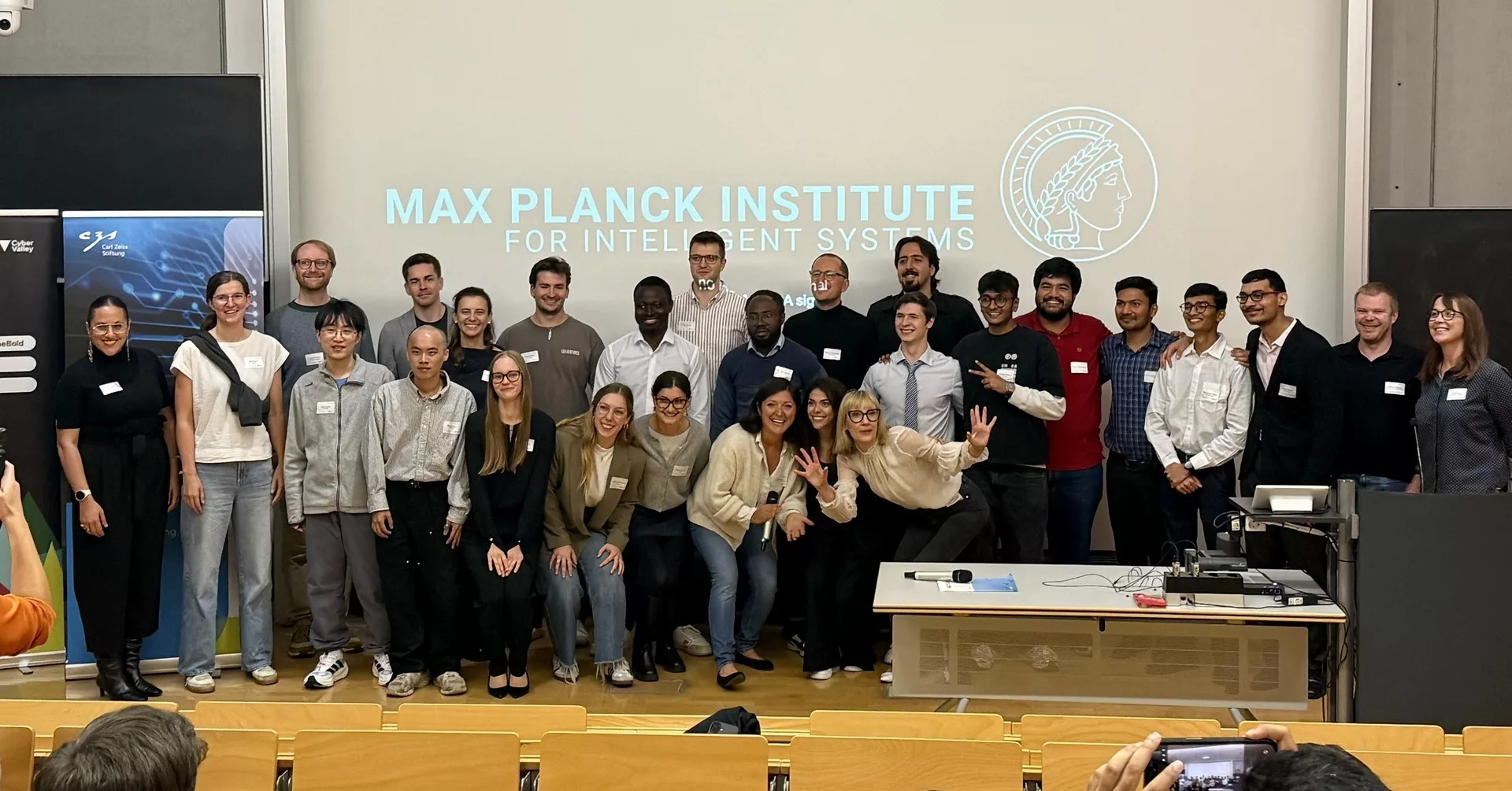
    The Batch #9 of the Cyber Valley AI Incubator concluded successfully with its Demo Day on October 16, where seven emerging AI ventures presented their innovations to an audience of founders, investors, researchers, and members of the AI community. Made possible through the generous funding of the Carl Zeiss Foundation (CSZ), organized by the Max Planck Institute for Intelligent Systems (MPI-IS) and the International Max Planck Research School for Intelligent Systems (IMPRS-IS), the Cyber Valley AI Incubator continues to foster research-driven AI entrepreneurship by helping innovators transform cutting-edge ideas into start-up ventures. 

    Hosted at the MPI-IS in Stuttgart, Demo Day marked the culmination of two weeks of intensive workshops exploring customer needs, business models, funding, prototyping, and pitching. The event opened with welcome remarks from Christoph Keplinger and Leila Masri of the Max Planck Institute for Intelligent Systems (MPI-IS), who reflected on the achievements of batch 9 and the growing impact of the AI Incubator. Lukas Findeisen of the Carl-Zeiss-Stiftung, the program’s principal sponsor, highlighted the foundation’s continued commitment to advancing innovation and research-driven entrepreneurship. 

    A highlight of the evening was the keynote address by Theodora Preda, partner at Plug and Play, who shared insights into the investor mindset and investing dynamics, offering perspectives on how investors assess opportunities, and what founders should understand when approaching the investment landscape.  

    The spotlight then turned to the batch 9 teams, who presented their final venture pitches before an expert jury consisting of: 

    • Christoph Keplinger (Director, Max Planck Institute for Intelligent Systems) 
    • Daisy De Souza Paiva (Senior Program Manager, ZEISS Ventures) 
    • Maximilian Worms (Analyst, LEA Ventures) 

    With all seven teams demonstrating an exceptionally high standard, selecting the winners proved challenging. 

    The following ventures were recognized for their outstanding achievements: 

    Best Pitch Award: Voclair, founded by Rustom Firdosh Bhesania, Mehryar Lessani, Deepam Maurya
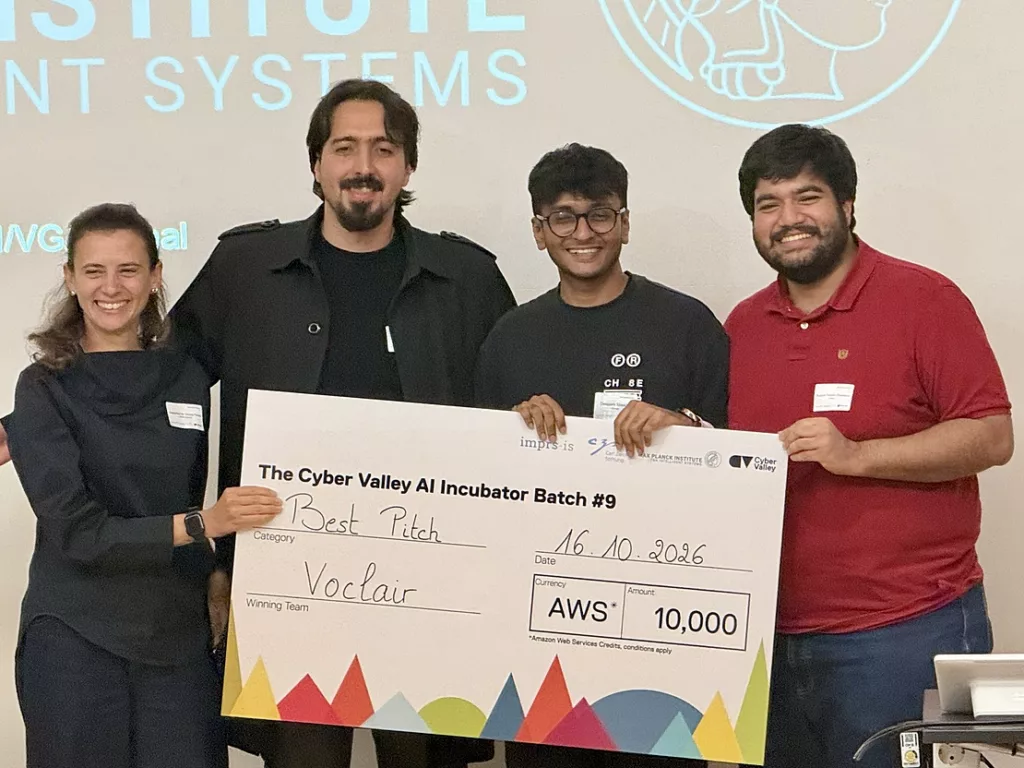
    AI Incubator Demo Day: Best Pitch Award
    Jury member Daisy De Souza Paiva, Founders Mehryar Lessani, Deepam Maurya, Rustom Firdosh Bhesania (from left to right). Copyright: Cyber Valley GmbH

    Best Business Model Award: TANOCRIX, founded by Marta Kriukova, Bolun Liang, Wei-Bo Tang 
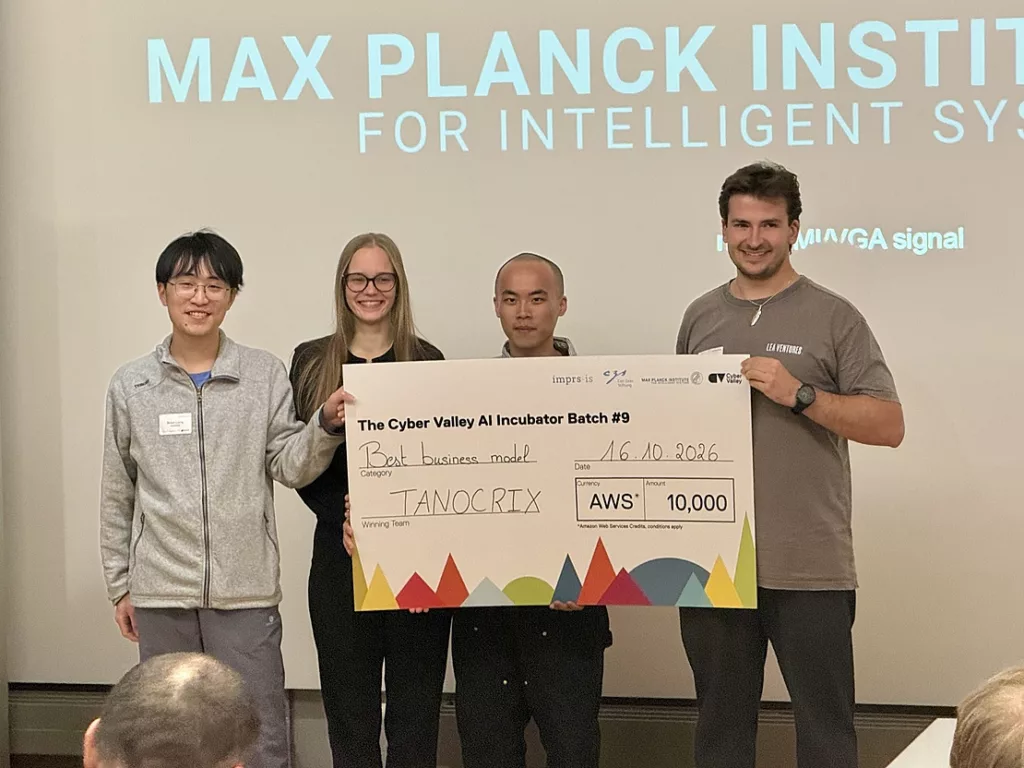
    Cyber Valley AI Incubator Demo Day, Best Business Model Award
    Founders Bolun Liang, Marta Kriukova, Wei-Bo Tang, jury member Maximilian Worms (from left to right). Copyright: Cyber Valley GmbH

    Best use of AI Award: Angel, founded by Melis Ilayda Bal, Stefano Esposito, Michela Petriconi, Marko Zaric
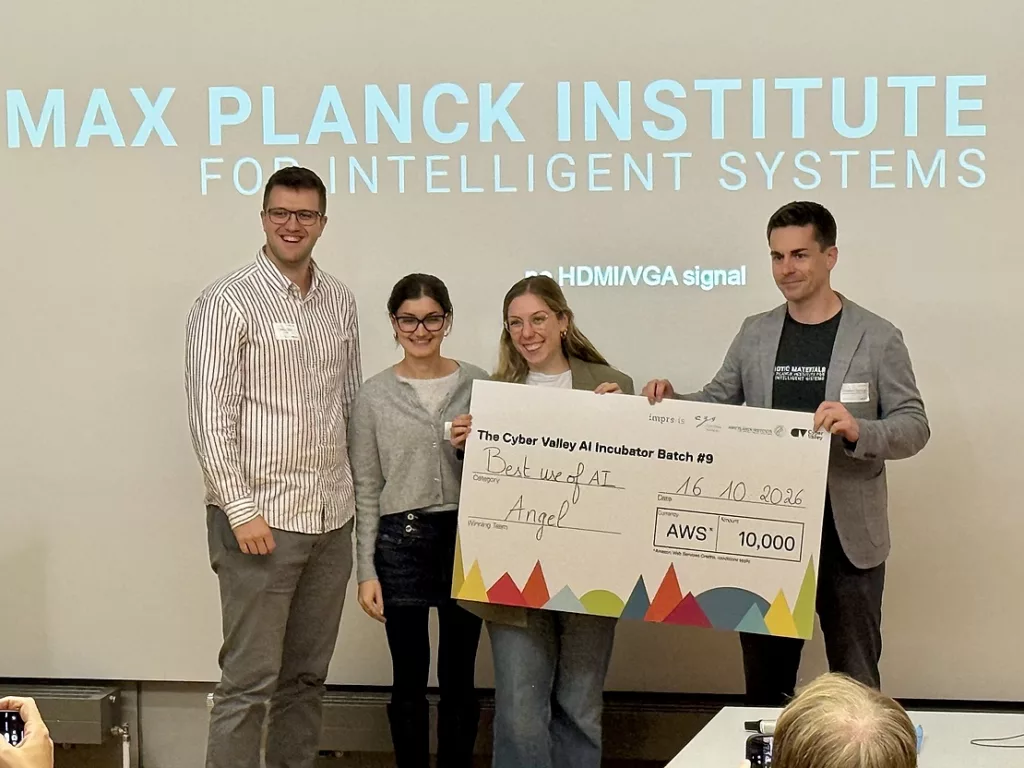
    Cyber Valley AI Incubator Demo Day, Best use of AI Award
    Founders Marko Zaric, Melis Ilayda Bal, Michela Petriconi, jury member Christoph Keplinger (from left to right) Copyright: Cyber Valley GmbH

    Each winning team received $10,000 in AWS Credits, generously provided by Amazon, to support the continued development and scaling of their AI solutions. 

    The evening concluded with a networking reception, providing participants, mentors, investors, and guests with the opportunity to celebrate the achievements of Batch 9 and strengthen connections across the Cyber Valley innovation ecosystem.

    About the Cyber Valley AI Incubator 

    Organized by the International Max Planck Research School for Intelligent Systems (IMPRS-IS) and the Max Planck Institute for Intelligent Systems (MPI-IS), the Cyber Valley AI Incubator continues to play a key role in supporting research-driven entrepreneurship within the Cyber Valley ecosystem. The program is made possible through the generous support of the Carl Zeiss Foundation, whose commitment to advancing innovation and scientific entrepreneurship enables researchers and innovators to bring their AI ideas closer to real-world application. 

    The Cyber Valley AI Incubator is designed to help researchers, engineers, and aspiring entrepreneurs bridge the gap between scientific discovery and startup creation. Open to participants from fields including artificial intelligence, robotics, computer vision, machine learning, biomedical technology, and data science, the program combines entrepreneurial education with mentorship from experienced founders, investors, and innovation experts.

  • Success stories from the Cyber Valley Innovation Campus: July–September 2026

    Success stories from the Cyber Valley Innovation Campus: July–September 2026

    The Cyber Valley Innovation Campus brings top scientists to Baden-Württemberg to advance AI and robotics research. These scientists are paving the way for the application of their research for the benefit of people, industry, and society.

    Members of the Cyber Valley Innovation Campus include the Max Planck Institute for Intelligent Systems (MPI-IS), Universities of Tübingen and Stuttgart, Fraunhofer IAO and IPA, ELLIS Institute Tübingen, and Karlsruhe Institute for Technology (KIT). As leading research institutions, they have announced the following exciting developments between July and September 2026.

    Frank Allgöwer recognized for outstanding scientific contributions

    The European Control Association (EUCA) and the Asian Control Association (ACA) have welcomed Frank Allgöwer as a fellow, recognizing his outstanding contributions to the field of systems and control engineering. Allgöwer is the first European to become a fellow at the ACA, which is one of the highest honors bestowed by the Asian control engineering community. Read more.

    Jakob Macke and Kashyap Chitta join the ELLIS Institute Tübingen

    Jakob Macke and Kashyap Chitta have joined the ELLIS Institute Tübingen, both as Principal Investigators and Hector Endowed Fellows.

    Macke is already an established figure in the Tübingen machine learning and computational neuroscience ecosystem and will shape the Institute’s research direction. Read more.

    Chitta is an expert in autonomous systems and physical AI, and will lead a new research group: the Physical AI Lab. The group focuses on understanding how machines interact with the physical world. Read more.

    Andrea Iannelli awarded ERC Starting Grant

    The European Research Council (ERC) is providing EUR 1.65 million in funding for Andrea Iannelli’s research project on autonomous systems that can adapt to complex tasks and changing environments while in operation. Gaining a Starting Grant is considered a highly prestigious achievement for early-career researchers in Europe. Read more.

    Marcel Binz joins the Max Planck Institute for Biological Cybernetics

    Marcel Binz has begun his research on a unified theory of human cognition using computational models at the Max Planck Institute for Biological Cybernetics. These models aim to simulate, predict, and explain human behavior in diverse situations.

    Binz’s research examines the central building blocks of human cognition by addressing three challenges: 1) the technical challenge of building such models in the first place; 2) the scientific challenge of using these models to understand human cognition; 3) the applied challenge of translating this into real-world applications. Read more.

    AI Incubator alumni SKAI receives EXIST Startup Grant

    SKAI participated in the Cyber Valley AI Incubator in 2024 to develop a company that applies AI for the cosmetics industry. With the support of the EXIST Startup Grant, the team will be able to focus on developing SKAI and preparing for its launch in the coming months. Read more (German).

    Ontic Labs and Feyer selected for SPRIND’s Next Frontier AI Challenge

    Ontic Labs and Feyer were selected for the first stage of the German Federal Agency for Breakthrough Innovation’s (SPRIND) Next Frontier AI Challenge. The two start-ups are both spin-outs from institutions from the Cyber Valley Innovation Campus, including the ELLIS Institute Tübingen, Max Planck Institute for Intelligent Systems, Tübingen AI Center, and the University of Tübingen. Each team will receive €3 million to develop technologies that go beyond today’s AI models. Read more. 

    Makysm Andriushchenko co-founds Exponential Security Labs

    Makysm Andriushchenko has co-founded the start-up Exponential Security Labs. Andriushchenko is a Principal Investigator at the ELLIS Institute Tübingen and leads the AI Safety and Alignment group.

    The Tübingen-based start-up aims to improve the security and reliability of AI agents. Its work is based on decades of basic research in adversarial robustness and AI safety, showcasing how AI research can be applied to solve real-world problems. Read more.

    EIT awards funding for the C-VENTURE project

    The University of Tübingen has successfully applied for funding from the EIT (European Institute of Innovation and Technology) Higher Education Initiative together with five partner universities and innovation partners. The funding will support the C-VENTURE Project, of which the Tübingen Startup Center is a part. The Project will connect the fragmented initiatives that support entrepreneurship and knowledge transfer from thet different universities into a cohesive system. Read more (German). 

    Stay up to date with the latest news and success stories from Cyber Valley by registering for our email newsletter.

  • Data Scientist

    Die Subsequent GmbH aus Konstanz am Bodensee bietet 3D-Skelettdatenerhebung sowie abgeleitete Analysen und Auswertungen aus einfachen Videoaufnahmen (wie z.B. Smartphoneaufnahmen). Dabei werden selbstentwickelte Deep-Learning Verfahren eingesetzt um Qualität, Echtzeitfähigkeit und domänenspezifische Anpassungen zu gewährleisten. Resultierende Daten werden durch zugeschnittene visuelle Analysen und Apps verständlich zugänglich gemacht. Zu den Kunden der Subsequent GmbH gehören – unter anderem – Sportvereine und -verbände sowie Unternehmen aus den Bereichen Home-Fitness, Einzelhandel, Automotive und Gesundheit.

    Subsequent wurde in den vergangenen Jahren mit mehreren renommierten Preisen ausgezeichnet, darunter der 1. Platz und die Auszeichnung als Digitales Start-Up des Jahres 2023 bundesweit (durch das Bundesministerium für Wirtschaft und Klimaschutz (BMWK)), dem Gewinn des Innovationspreis Baden-Württemberg, die Auszeichnung als KI-Champion Baden-Württemberg 2023 sowie dem Gewinn des KfW Award Gründen 2023 als Landespreissieger Baden-Württemberg.

    Was erwartet dich bei Subsequent? 

    • Dynamisches und erfolgreiches Start-Up im Bereich Computer Vision und Bewegungsanalyse
    • Transfer von Methoden aus der Forschung in spannende, innovative Produkte
    • Direkte Mitarbeit im Team und persönlicher Einbezug in den Entwicklungsprozess
    • Ständige Erprobung und Einsatz von neuen Technologien
    • Homeoffice an vorher festgelegten Tagen möglich
    • Schlanke Prozesse, einfache interne Strukturen

    Das sind deine Aufgaben:

    • Entwicklung von Verfahren zur Vor- bzw. Nachverarbeitung von Bewegungsdaten aus optischen Tracking-Systemen
    • Entwicklung neuartiger Analysen zur semantischen Auswertung von Bewegungsabläufen
    • Unterstützung bei der Realisierung von Produkten zur Bewegungsanalyse in Bereichen wie Gesundheit, Sport, Home-Fitness, und vielen mehr…

    Dein persönliches Profil:

    • Studium im Bereich Informatik, Medieninformatik, Wirtschaftsinformatik oder einer vergleichbaren technischen Studienrichtung
    • Grundkenntnisse in den Bereichen Statistik und Data Science sowie Erfahrung mit Methoden zur Datenauswertung
    • Gute Kenntnisse in Python, idealerweise Erfahrung mit numpy, scipy, pandas, etc.
    • Verhandlungssichere Deutsch- und gute Englischkenntnisse

    Initiativbewerbungen von Fachkräften aus verwandten Berufsfeldern, die nicht exakt auf das beschriebene Profil passen, aber Interesse an der automatischen Bewegungsanalyse mitbringen und sich für diese spannende Thematik begeistern können, sind jederzeit herzlich willkommen. Sie freuen sich über deine Nachricht an contact@subsequent.ai!

  • Computer Vision Engineer

    Die Subsequent GmbH aus Konstanz am Bodensee bietet 3D-Skelettdatenerhebung sowie abgeleitete Analysen und Auswertungen aus einfachen Videoaufnahmen (wie z.B. Smartphoneaufnahmen). Dabei werden selbstentwickelte Deep-Learning Verfahren eingesetzt um Qualität, Echtzeitfähigkeit und domänenspezifische Anpassungen zu gewährleisten. Resultierende Daten werden durch zugeschnittene visuelle Analysen und Apps verständlich zugänglich gemacht. Zu den Kunden der Subsequent GmbH gehören – unter anderem – Sportvereine und -verbände sowie Unternehmen aus den Bereichen Home-Fitness, Einzelhandel, Automotive und Gesundheit.

    Subsequent wurde in den vergangenen Jahren mit mehreren renommierten Preisen ausgezeichnet, darunter der 1. Platz und die Auszeichnung als Digitales Start-Up des Jahres 2023 bundesweit (durch das Bundesministerium für Wirtschaft und Klimaschutz (BMWK)), dem Gewinn des Innovationspreis Baden-Württemberg, die Auszeichnung als KI-Champion Baden-Württemberg 2023 sowie dem Gewinn des KfW Award Gründen 2023 als Landespreissieger Baden-Württemberg.

    Was erwartet dich bei Subsequent? 

    • Dynamisches und erfolgreiches Start-Up im Bereich Computer Vision und Bewegungsanalyse
    • Transfer von Methoden aus der Forschung in spannende, innovative Produkte
    • Direkte Mitarbeit im Team und persönlicher Einbezug in den Entwicklungsprozess
    • Ständige Erprobung und Einsatz von neuen Technologien
    • Homeoffice an vorher festgelegten Tagen möglich
    • Schlanke Prozesse, einfache interne Strukturen

    Das sind deine Aufgaben:

    • Evaluation von neuen Forschungsergebnissen im Bereich Machine Learning/Computer Vision
    • Weiterentwicklung von bestehenden Machine-Learning Modellen unter Verwendung von Pytorch und Python
    • Unterstützung bei der Implementierung von Computer Vision-Verfahren innerhalb der Subsequent-Cloud

    Dein persönliches Profil:

    • Studium im Bereich Informatik, Medieninformatik, Wirtschaftsinformatik oder einer vergleichbaren technischen Studienrichtung
    • Gute Kenntnisse in Python
    • Erfahrung mit modernen Deep-Learning Frameworks, idealerweise Tensorflow oder PyTorch
    • Idealerweise erste Erfahrungen mit fundamentalen Konzepten aus dem Bereich Computer Vision
    • Begeisterung für aktuellen Trends und Themen (Kubernetes, Deep Learning, Micro-Services, etc.)
    • Optional: Kenntnisse in C/C++
    • Optional: Erfahrung mit OpenCV
    • Verhandlungssichere Deutsch- und gute Englischkenntnisse

    Initiativbewerbungen von Fachkräften aus verwandten Berufsfeldern, die nicht exakt auf das beschriebene Profil passen, aber Interesse an der automatischen Bewegungsanalyse mitbringen und sich für diese spannende Thematik begeistern können, sind jederzeit herzlich willkommen. Sie freuen sich über deine Nachricht an contact@subsequent.ai!

  • Frontend Developer

    Die Subsequent GmbH aus Konstanz am Bodensee bietet 3D-Skelettdatenerhebung sowie abgeleitete Analysen und Auswertungen aus einfachen Videoaufnahmen (wie z.B. Smartphoneaufnahmen). Dabei werden selbstentwickelte Deep-Learning Verfahren eingesetzt um Qualität, Echtzeitfähigkeit und domänenspezifische Anpassungen zu gewährleisten. Resultierende Daten werden durch zugeschnittene visuelle Analysen und Apps verständlich zugänglich gemacht. Zu den Kunden der Subsequent GmbH gehören – unter anderem – Sportvereine und -verbände sowie Unternehmen aus den Bereichen Home-Fitness, Einzelhandel, Automotive und Gesundheit.

    Subsequent wurde in den vergangenen Jahren mit mehreren renommierten Preisen ausgezeichnet, darunter der 1. Platz und die Auszeichnung als Digitales Start-Up des Jahres 2023 bundesweit (durch das Bundesministerium für Wirtschaft und Klimaschutz (BMWK)), dem Gewinn des Innovationspreis Baden-Württemberg, die Auszeichnung als KI-Champion Baden-Württemberg 2023 sowie dem Gewinn des KfW Award Gründen 2023 als Landespreissieger Baden-Württemberg.

    Was erwartet dich bei Subsequent? 

    • Dynamisches und erfolgreiches Start-Up im Bereich Computer Vision und Bewegungsanalyse
    • Transfer von Methoden aus der Forschung in spannende, innovative Produkte
    • Direkte Mitarbeit im Team und persönlicher Einbezug in den Entwicklungsprozess
    • Ständige Erprobung und Einsatz von neuen Technologien
    • Homeoffice an vorher festgelegten Tagen möglich
    • Schlanke Prozesse, einfache interne Strukturen

    Das sind deine Aufgaben: 

    • Entwicklung von Single Page Applikationen für mobile Apps und Webanwendungen
    • Konzeption von wiederverwendbaren Komponenten
    • Weiterentwicklung existierender Webanwendungen und Projekte
    • Optimierung der User Experience und Designs

    Dein persönliches Profil:

    • Abgeschlossene Ausbildung oder Studium im Bereich Informatik, Medieninformatik, Kommunikationsdesign, Wirtschaftsinformatik oder einer vergleichbaren technischen Richtung
    • Sehr gute Kenntnisse der gängigen Webtechnologien (Javascript, HTML, CSS)
    • Gute Kenntnisse des Angular Web Frameworks, Erfahrung mit React Native ebenfalls von Vorteil.
    • Verhandlungssichere Deutsch- und gute Englischkenntnisse

    Initiativbewerbungen von Fachkräften aus verwandten Berufsfeldern, die nicht exakt auf das beschriebene Profil passen, aber Interesse an der automatischen Bewegungsanalyse mitbringen und sich für diese spannende Thematik begeistern können, sind jederzeit herzlich willkommen. Sie freuen sich über deine Nachricht an contact@subsequent.ai!

  • Cyber Valley AI Incubator: Batch 9 – Demo Day

    Cyber Valley AI Incubator: Batch 9 – Demo Day

    All the hard work of our teams culminates in Cyber Valley Batch 9 Demo Day, an evening celebrating innovation, entrepreneurship, and the future of AI and robotics. The event will feature a keynote by Theodora Preda, Partner at Plug and Play, sharing insights into the investor mindset and what founders should understand when navigating the investment landscape.

    What begins as a research idea can become the foundation for a new technology, a new company, or an entirely new approach to solving real-world problems. After intensive collaboration, expert-led workshops, and venture development, the teams of Cyber Valley AI Incubator Batch 9 will come together at the Max Planck Institute for Intelligent Systems (MPI-IS) in Stuttgart to present the innovations they have been developing throughout the program.

    The Demo Day brings together researchers, entrepreneurs, investors, industry representatives, and members of the wider innovation ecosystem to explore how advances in artificial intelligence and robotics can move beyond the laboratory and into practical applications. 

    Throughout the program, the teams have worked with experts across disciplines to develop their ideas and understand the challenges of building a technology-based venture. Workshops and mentoring have covered topics ranging from startup formation and investment strategy to legal considerations for AI, product development, and effective communication—helping participants consider not only what their technology can do, but also how it can create value beyond the research environment.

    A highlight of the evening will be a keynote by Theodora Preda, Partner at Plug and Play, who will share perspectives on the investor mindset and the dynamics of early-stage investing. Her talk will offer the participating founders insights into how investors evaluate opportunities and what researchers and entrepreneurs should consider when taking their ideas toward the investment landscape.

    The keynote will be followed by the final pitches from the Batch 9 teams, giving each venture the opportunity to present its technology and vision to an audience of investors, researchers, and industry experts. The evening will conclude with awards, networking, and a reception celebrating the achievements of the participating teams.

    What is the Cyber Valley AI Incubator?

    The Cyber Valley AI Incubator supports researchers and entrepreneurs in developing promising ideas in artificial intelligence and robotics into potential ventures. Made possible through the generous funding of the Carl Zeiss Foundation, the program has helped teams explore the path from scientific research to entrepreneurship, building a growing track record of ventures emerging from the Cyber Valley ecosystem. Over successive batches, participants have gone on to further develop their technologies, establish companies, attract investment, and contribute to the transfer of cutting-edge research into applications with potential impact beyond academia.

  • Founding team wanted for a new biotech company

    Dr. Christoph Ratzke is looking for a founding team to build a new startup. He is a microbiologist and biophysicist who leads the Systems Biology of Microbial Communities junior research group at the University of Tübingen’s Interfaculty Institute of Microbiology and Infection Medicine (IMIT) and the Cluster of Excellence “Controlling Microbes to Fight Infections” (CMFI).

    ML-designed microbial communities

    Most chemicals and materials are still made from fossil resources. Microbial communities can make them from waste instead, if we learn to design and control them. Ratzke wants to build a company around that: designing microbial communities rationally, with machine learning, to replace as much chemistry as possible with biology.

    Ratzke is preparing an application to a current challenge of SPRIND, Germany’s Federal Agency for Breakthrough Innovation, on this topic, which funds selected teams for up to three years.

    He is looking for members of the starting team with expertise in one or more of 

    • High-throughput experimental biology

    Building and manipulating microbial communities at large scale

    • Mass spectrometry

    MS-based metabolite analysis and data handling in high throughput

    • Machine learning

    Predicting and optimising microbial community function

    You would be part of a startup from day one, shape it from the start, and do science with a direct environmental impact. It also means uncertainty, pressure and fast change. These are positions in the company, not academic posts: the goal is a product and a business.

    More than a specific skill, Ratzke am looking for people who are proactive and motivated, work independently, communicate well and are good to have on a team. Ideally you have a PhD or postdoc experience.

    If the startup is selected in December, work would start in early 2027 in Tübingen.

    Interested, or know someone who might be? Write Ratzke a few lines about yourself and why this interests you, ideally by 25 October.

  • Computer Vision Engineer – Working Student

    DeepScenario is looking for a talented computer vision enthusiast to join their dedicated team of experts. You will work on a variety of computer vision topics and help the start-up to take their AI pipeline to the next level.

    Your responsibilities

    • Develop state-of-the-art computer vision algorithms for autonomous systems
    • Automate and optimize the performance of the AI pipeline
    • Support on customer deliveries
    • Work closely with the team to identify additional features and requirements

    Your qualifications

    • Currently enrolled in computer science, machine learning, or another related field
    • Practical experience in computer vision and machine learning
    • Excellent skills in Python
    • Knowledge of a cloud computing platform is a plus
    • Team player with passion to work in an intercultural environment
    • High degree of autonomy and excellent problem-solving skills

    Your benefits

    • Join their team of experts and be part of an investor-backed start-up
    • Take responsibility from day 1 and drive high-impact work
    • Gain access to a Germany-wide network of fitness and wellness facilities
    • Benefit from flexible working hours to accommodate your needs
    • Great team spirit in an agile environment with multiple company offsites per year

    Application

    Please send your application to jobs@deepscenario.com, including your CV, transcript of records, and work certificates.

  • Last month at Cyber Valley: September

    Last month at Cyber Valley: September

    There was a lot happening at Cyber Valley last month. Here’s a quick roundup of our highlights from September. Find out how Cyber Valley’s mission to translate excellent research into real-world applications for a better future for everyone came to life.

    Celebrating ten years of the Cyber Valley Innovation Campus: Cyber Valley Day 2026

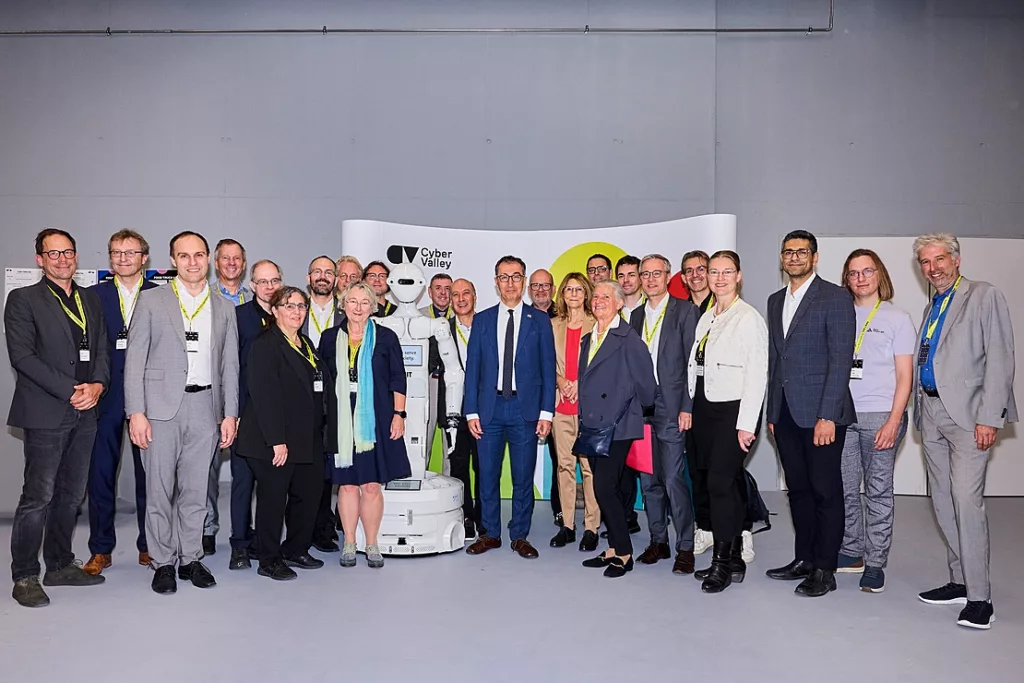
    On September 9, more than 850 guests came to Tübingen to celebrate a very special milestone: ten years of the Cyber Valley Innovation Campus. Researchers, start-ups, investors, policymakers, partners from industry and society, as well as many other guests gathered for a day full of inspiring talks, surprising keynotes, a research exhibition, start-up presentations, investor sessions, and networking.

    Read the full article about our anniversary event here.

    Cyber Valley Day
    Copyright: Christian Borth

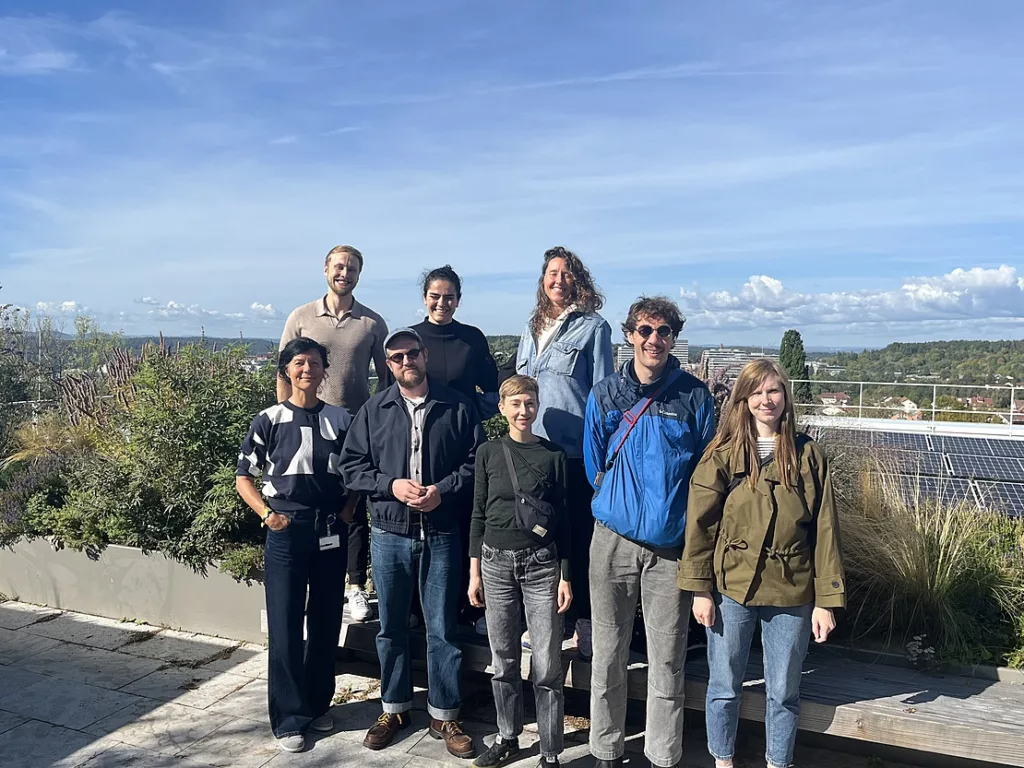
    Welcoming Tech Fellowship journalists from Publix Berlin

    On September 17, we welcomed participants of the Tech Journalism Fellowship from “Publix Berlin – Haus für Journalismus und Öffentlichkeit” in Tübingen. The group included Fatemeh Khodadadian, Bastian Hosan, Sonja Peteranderl, Jonathan Kemper, and Carina Schroeder, accompanied by Dr. Eva von Grafenstein.

    This year’s fellowship focuses on the topic of “Ethical AI” and brings together journalists from Tagesspiegel Background, DER SPIEGEL, Deutschlandfunk, heise, WIRED, and DIE ZEIT for a year of exploring and reporting on artificial intelligence.

    As part of a week-long visit to Baden-Württemberg to learn about the region’s AI ecosystem, the fellows gained insights into research activities and technology transfer across our Innovation Campus. Our discussions also addressed current developments, open questions, and challenges in AI and robotics.

    TECH_Journalists
    Copyright: Cyber Valley

    Visit of Rotary Club Rottenburg in Tübingen

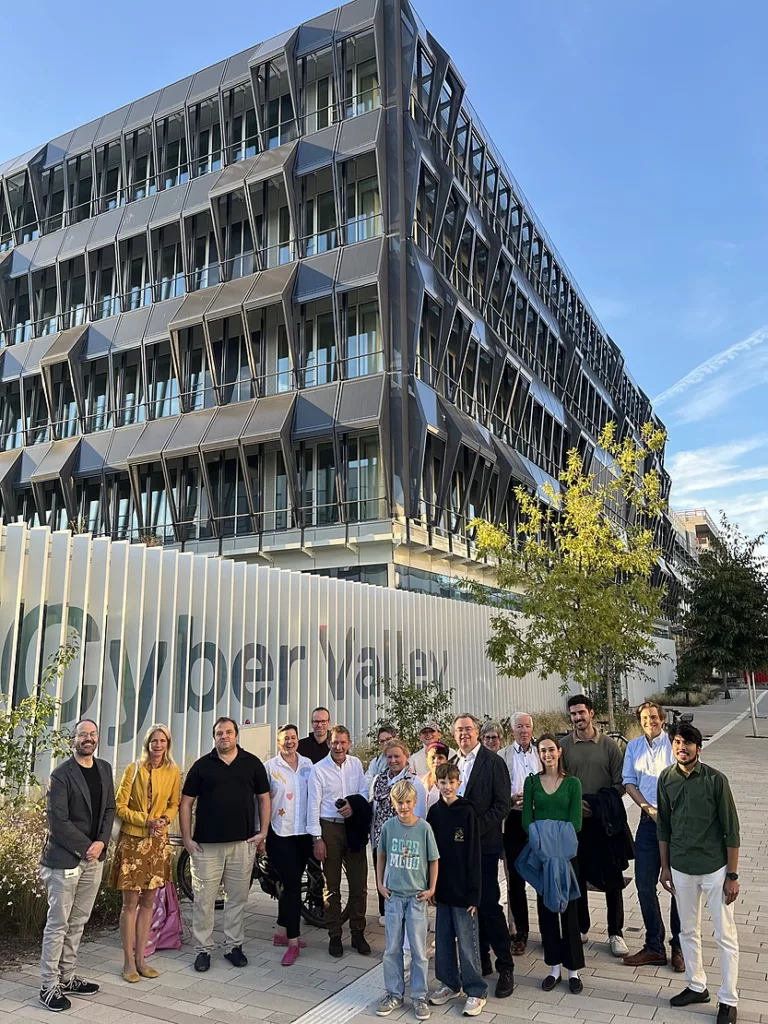
    On September 23, members of the Rotary Club Rottenburg visited our campus in Tübingen for an introduction to our ecosystem and our activities at the intersection of AI, research, and innovation.

    CEO Florian Mayer guided the visitors through the building, offering insights into the history of the campus. Silke Dutz introduced the Innovation Campus, its mission, and its role in advancing AI research and technology in the region.

    The visit was organised by Benjamin Jetter and Melanie Jetter in collaboration with the Rotary Club Rottenburg and provided an opportunity to learn more about Cyber Valley and engage in discussions about the region’s innovation landscape.

    RotaryClub Reutlingen
    Copyright: Cyber Valley

    Co-Hosting event with Marketing Club Neckar-Alb 

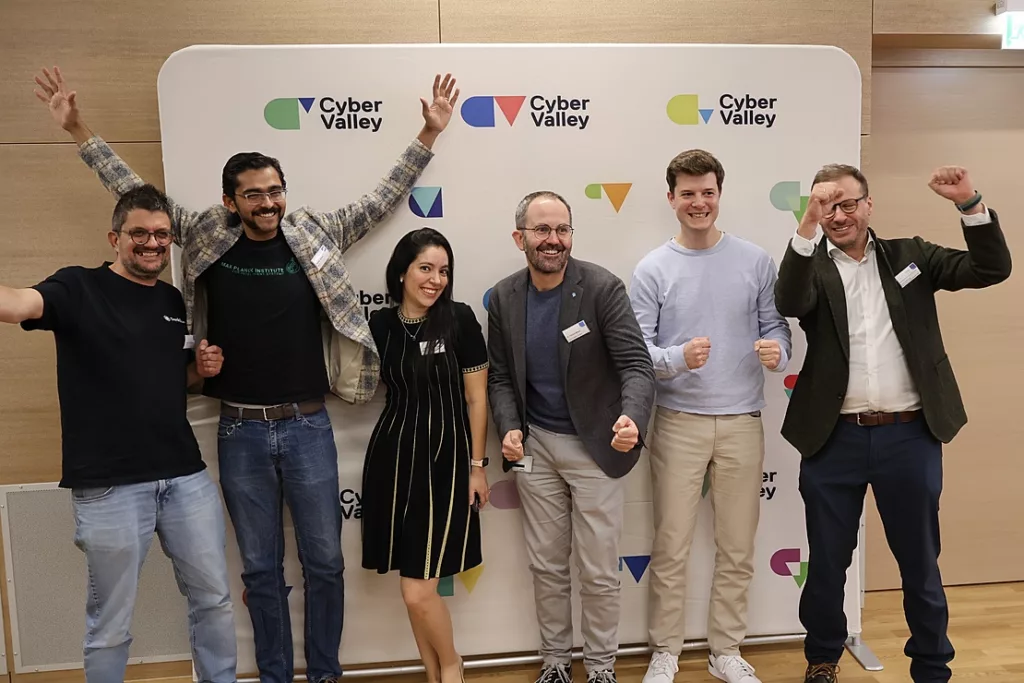
    On September 24, Cyber Valley and the Marketing Club Neckar-Alb e.V. co-hosted an evening dedicated to startups, technology, and knowledge transfer in Tübingen.
    Moderated by Christoph Koppensteiner, the event opened with a conversation with our CEO Florian Mayer followed by presentations from four startups from our Start-up Network. The Start-ups introduced their businesses, technologies, and current activities:

    • Maddox AI, represented by Cornelius Widmaier
    • Spotium, represented by Patrick Duffner, who stepped in for Lisa Raab and Nico Raab
    • DenkBox GmbH, represented by Hannes Planatscher
    • MaiTY, represented by Partha Ghosh and Valentina Rodríguez Pasmiño

    A subsequent panel discussion explored emerging technologies, new applications, and the opportunities and challenges AI presents for businesses and society. The evening concluded with networking over food and drinks, providing participants with further opportunities to exchange ideas and establish connections.

    Marketing Club Neckar-Alb e.V.
    Copyright: Cyber Valley

    Open Lab Day at KI-Fortschrittszentrum Stuttgart

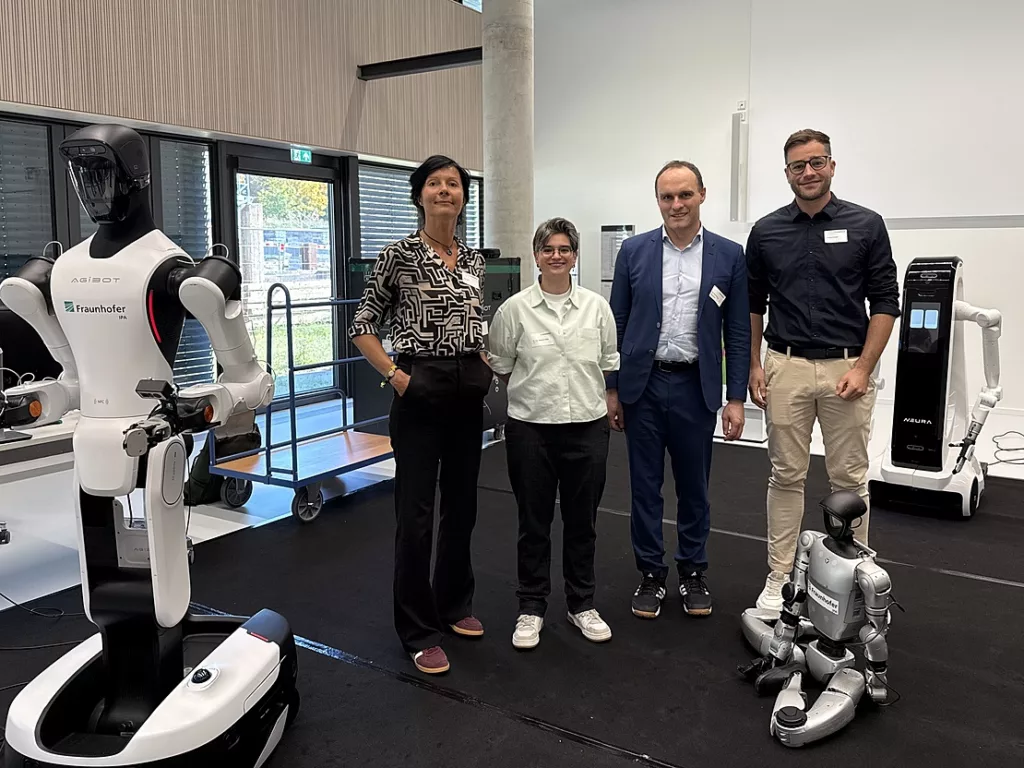
    On September 30, we participated in the Open Lab Day of the KI-Fortschrittszentrum in Stuttgart. Organised by Fraunhofer IAO, Fraunhofer IPA, and the Institute of Human Factors and Technology Management (IAT) at the University of Stuttgart, the event welcomed more than 120 participants from industry and research.

    The programme focused on the practical application of AI and robotics, addressing both technological possibilities and regulatory considerations. As a partner of the KI-Fortschrittszentrum, we contributed to the event with a welcome adress and an introduction to our ecosystem and role in advancing AI research and innovation.
    Participants gained insights into a range of current topics, including generative and agentic AI, humanoid robotics, AI compliance, and the EU AI Act. Guided tours of the Reallabor provided hands-on insights into practical applications, featuring demonstrations of AI-based quality inspection, service assistants, humanoid robots, intelligent process control, and AI-supported document processing.

    The event offered a great opportunity for exchange between companies, researchers, and robotics experts, showing the wide range of innovative technologies, research activities, and practical applications developed across our Innovation Campus.

    Open Lab Day of the KI-Fortschrittszentrum
    Copyright: Cyber Valley
  • Call for applications: SPRIND launches Next Frontier Robotics Challenge

    Call for applications: SPRIND launches Next Frontier Robotics Challenge

    Europe needs a breakthrough in robotics. That’s why SPRIND, the German Federal Agency for Breakthrough Innovation, has launched the Next Frontier Robotics Challenge.

    Without breakthroughs of our own, we risk critical dependencies. That‘s why SPRIND is launching Next Frontier Robotics – a €90m challenge to build a modular, interoperable European robotics ecosystem for complex physical work such as in logistics, maintenance, and construction. We have the experience and the best talent in mechanical engineering, precision mechanics, automation, precision manufacturing, and computer science to shape the next era of robotics from Europe – and keep safety and sovereignty in European hands.

    The goal

    Develop full-stack robot platforms that handle complex physical tasks in real environments or novel robotic hardware components with breakthrough capabilities.

    What’s in it for you

    • Up to €7.2 million in non-dilutive funding per team across 4 stages (36 months total) – with potential follow-on funding for the most successful
    • Venture development support, coaching, and direct access to potential customers, investors, and industry partners
    • Join a community of world-class teams working at the forefront of robotics

    Who should apply

    Visionary innovators from all domains: individuals, startups, research institutions and established companies located in the EU, EFTA or UK. You should ideally already be incorporated, or have a clear plan to get there. You can appply via two tracks: 

    Track 1 Integrated Platforms challenges teams to develop full-stack robotic systems that orchestrate hardware, software and AI to master real-world use-cases autonomously.

    Track 2 Hardware Components focuses on modular hardware components such as gripping systems, artificial skin or tactile sensors that deliver a radical performance leap over the state of the art.

    Interested? 

    The call is open until October 22, 2026.

    Apply now: https://www.sprind.org/en/actions/challenges/next-frontier-robotics

    To introduce the SPRIND challenge as well as the team behind the scenes and to answer any open questions,  SPRIND is hosting Roadshows in Tübingen (Cyber Valley), Munich (TUM),  Zurich (ETH).

    Learn more: https://luma.com/Next-Frontier-Robotics.