Stuttgart-Tübingen region plays leading role in AI research
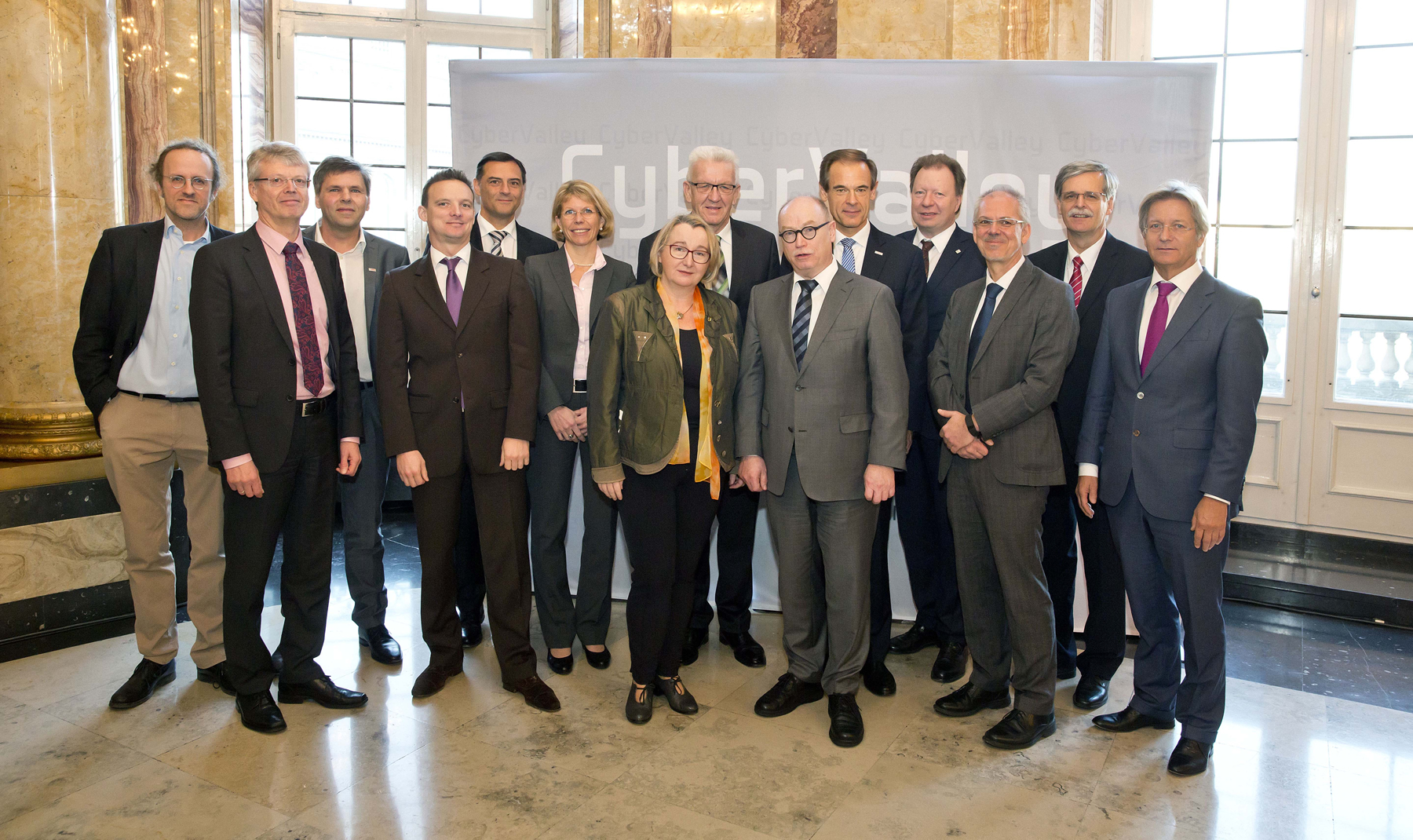
Theresia Bauer, Baden-Württemberg's Minister of Science, Research and the Arts is delighted by the rapid expansion of Cyber Valley. 'Advances in intelligent systems and machine learning are the driving force behind digitization. The Stuttgart-Tübingen region has already proven to be the hotspot for artificial intelligence nationwide. We make every effort to ensure Baden-Württemberg has a leading international position in this field. With the expansion of Cyber Valley, the state is investing in an internationally highly competitive infrastructure in the field of artificial intelligence, which is also geared towards the further connection of cross-border cooperation. This will enable us to develop competitive new applications, innovative products and digital services as well as secure our economic strength in the digitization process,' Bauer emphasizes.
'AI is the most competitive research area today and leaders want to run with the best“, Michael Black continues. “The success of Cyber Valley makes it very clear that the Stuttgart-Tübingen region is a leader in AI research, that the pace of innovation is increasing, and that this is the place to have a major societal and economic impact. Cyber Valley pulls together industry, universities, research institutions, and the government. The attention that Cyber Valley has attracted from all over the world has helped us attract and retain top talent in the field.'
'Cyber Valley increasingly receives national and international attention', Professor Bernd Engler, the President of the University of Tübingen, agrees. 'The academic background of the new research group leaders makes this more than clear. The fact that outstanding researchers from Harvard, Berkeley, ETH Zurich, Columbia University or Baylor College of Medicine have been brought to Stuttgart and Tübingen impressively underlines that Cyber Valley is determined to become a world leader in AI research'.
The ten independent research groups under the Cyber Valley umbrella include five groups at the Max Planck Institute for Intelligent Systems (MPI-IS) with its two locations in Stuttgart and Tübingen. Three other research groups are located at the University of Tübingen and two at the University of Stuttgart. The research groups at the University of Stuttgart will be announced in the course of this year.
Sebastian Trimpe is the first of the Cyber Valley group leaders to begin his research. Since February 1, the 36-year-old engineer, who received his doctorate from ETH Zurich, heads the ten-member Cyber Valley research group 'Intelligent Control Systems', which is based at the MPI-IS site in Stuttgart. His research investigates how machines can learn independently from data and at the same time be reliable, safe and efficient. 'My team and I want to understand the basic principles and develop algorithms that enable intelligent artificial systems to find their own way around the physical world.'
Ardian Jusufi and his 'Locomotion Biorobotics and Morphological Intelligence' group is also based at the Stuttgart of the MPI-IS. The 33-year-old holds a doctorate from the University of California at Berkeley. Upon graduating he moved to Cambridge and Harvard University for postdoctoral research on interdisciplinary motion science, soft robotics, and biologically-inspired engineering, and was most recently Assistant Professor at the University of Technology in Sydney, Australia.
Another new research group leader at the Max Planck Institute for Intelligent Systems in Tübingen is Jörg Stückler, who comes from the Technical University of Munich. His “Embodied Vision” group will develop autonomous intelligent systems that can independently learn and improve their perception and action skills during their interaction with the environment.
On July 1st, Caterina De Bacco and Falk Lieder will join the Cyber Valley. De Bacco is currently a postdoctoral researcher at the Data Science Institute at Columbia University and Falk Lieder a postdoc at the University of California, Berkeley. While De Bacco´s research focuses on optimizing data networks by developing algorithms derived from statistical physics principles, Lieder researches in the field of rationality enhancement. He focuses on how people think, decide, and effectively set goals. He transfers the knowledge gained from this to intelligent systems that help people make better decisions.
At the University of Tübingen, Mijung Park is the first Cyber Valley group leader. Most recently Park worked at the Department of Empirical Inference at the MPI-IS in Tübingen. There she concentrated on the development of machine learning algorithms for the protection of personal privacy. She will continue this research under the Cyber Valley umbrella with her group “Privacy-preserving Machine Learning“. Gabriele Schweikert will follow her in summer and Fabian Sinz in autumn.
'I am pleased with the prospect of setting up a group in the extremely dynamic environment of the Tübingen artificial intelligence community,'' says Schweikert, who in her research uses machine learning methods to better understand molecular processes in living cells. 'I love the interdisciplinary and varied offer. The combination of experienced researchers and well-established groups with extensive expertise in the field of machine learning on the one hand and new, young and enthusiastic group leaders on the other is very exciting'.
Research closely linked to the top tier of industry
Cyber Valley is one of Europe's largest research collaborations in the field of artificial intelligence. Supported by the State of Baden-Württemberg, new research groups and university chairs are being created in the fields of machine learning, robotics and computer vision. A new interdisciplinary Ph.D. program, the International Max Planck Research School for Intelligent Systems (IMPRS-IS), is also affiliated with Cyber Valley. The Max Planck Society, the universities of Stuttgart and Tübingen, the State of Baden-Württemberg and the industry partners Amazon, BMW AG, Daimler AG, IAV GmbH, Porsche AG, Robert Bosch GmbH, and ZF Friedrichshafen AG are involved in the research network.
Cyber Valley has already made a name for itself as a research hotspot. According to the 2018 annual report on Research, Innovation and Technological Performance in Germany by the Commission of Experts for Research and Innovation (EFI), there is no getting around Stuttgart and Tübingen when it comes to artificial intelligence. The report states that AI research in Germany concentrates on a few locations and scientists. 23.8 percent of the proceedings contributions considered in the period 2007 to 2016 come from the Tübingen/Stuttgart area, which makes the region by far the leading hub for AI research in Germany.
Breaking science out of its ivory tower
The Cyber Valley initiative facilitates the exchange between basic research at the Max Planck Institute for Intelligent Systems and the two universities, and the more applied research in the partnering companies. 'Cyber Valley is a long-term effort that will build a pool of well- trained talent for research and applications in AI together with a diversified economic foundation that includes both startups and established companies. The next key phase of Cyber Valley is to spark a startup culture around AI,' says Michael Black. Top research combined with entrepreneurship to create a breeding ground for start-ups is Cyber Valley's declared goal, Black says.
'Many of the research group leaders have already carried out research together with our industry partners,' explains Cyber Valley Coordinator Tamara Almeyda. 'What was initially a vision for the future, namely to conduct joint basic research, is now taking shape. We want to break down the barriers between industrial research and curiosity-driven basic research and facilitate a lively exchange. In many areas, basic research can be years away from possible application. The speed at which research in the field of artificial intelligence is developing, may accelerate this process enormously.' New formats will be developed to bring researchers from industry and academia together: 'Where are the connections between the group leaders and the researchers of our industrial partners? To find out, we want to create platforms to facilitate exchange. We want to make Cyber Valley a flagship for a successful research cooperation,' says Almeyda.
Max Planck Institute for Intelligent Systems
Dr. Sebastian Trimpe joined the MPI-IS at the end of 2013, initially as a scientist and later as a group leader at the Autonomous Motion Department in Tübingen. Since February 1, 2018, he leads the independent Cyber Valley research group 'Intelligent Control Systems'. His group has already grown to ten researchers and is based at the MPI-IS site in Stuttgart.
Trimpe has set himself high goals for the future: In his work he will investigate how machines can learn independently from data and at the same time be reliable, safe and efficient. His team wants to understand the fundamental principles and develop algorithms that enable intelligent artificial systems to act and learn autonomously in the physical world. In addition to his research at the MPI, Trimpe is also active in research and teaching at the University of Stuttgart.
Dr. Ardian Jusufi positions his research in the fields of both engineering and biology. He calls his group 'Locomotion Biorobotics and Morphological Intelligence'. There he integrates soft actuators and flexible sensors made of hyperelastic silicone elastomers (containing liquid metal) and embeds them for instance into a diving, soft robot fish. Their integration enables new skills in swimming and climbing robots to increase their ability to overcome obstacles. 'The biggest differences between biological systems and human-made devices are to be found in (1) their inherent robustness, and (2) in the resilience of materials, which are predominantly soft in nature.' In contrast to robots with mostly hard components, the musculoskeletal system of animals is capable of adapting to multiple dynamic perturbations. Life-like movement not only expands upon robot capability, it also enables original discovery in experimental biology. In this spirit, his group integrates comparative biomechanics with robotics and ‘smart’ materials.
Ardian Jusufi received his Ph.D. from the University of California at Berkeley, USA, with Professor Bob Full, where he worked at the CiBER Center on interdisciplinary motion science and bioinspired robotics. After graduating, he went to Cambridge University, UK, for a postdoctoral position at Queens' College. Jusufi then moved to Harvard University, USA, for a second postdoctoral position in Professor Rob Wood's Microrobotics Lab at the Wyss Institute for Biologically-Inspired Engineering. He was subsequently Assistant Professor at the University of Technology in Sydney, Australia. Since March 1, 2018, Jusufi heads a Cyber Valley research group at the MPI-IS in Stuttgart.
Dr. Jörg Stückler heads the Cyber Valley research group 'Embodied Vision' at the MPI-IS in Tübingen since April 1, 2018. His goal is to develop autonomous intelligent systems that can independently learn and improve their perception and action skills during their interaction with the environment. A main focus of his research are learning-based approaches to image and sensor data analysis. Stückler develops methods which enable robots to actively gain an understanding of their dynamic environment from sensor data and to use this understanding for complex tasks such as object handling or autonomous navigation. In addition to image data, he also uses other sensors such as tactile sensors for the artificial sense of touch during gripping or inertial sensors comparable to the human sense of balance
After studying Computer Science at the University of Freiburg, Stückler earned his Ph.D. in Robotics and Computer Vision at the University of Bonn. During his doctorate, he did research on robotic systems such as household robots and developed methods for image-based 3D perception. In 2014 he began his postdoctoral research at the Technical University of Munich (TUM) at what is now the Chair for Computer Vision and Artificial Intelligence. His research there focused on methods for visual 3D scene reconstruction, especially methods for visual localization and mapping with visual and inertial sensors. These were also developed for the visual navigation of drones. After one year at TUM, Stückler joined the Computer Vision Group at RWTH Aachen University. There he continued his research on visual scene understanding and 3D reconstruction for intelligent systems and also investigated the use of deep learning methods in these areas. Last winter semester he was deputy professor at the TUM Chair for Computer Vision and Artificial Intelligence and is now looking forward to the new challenge of leading a Cyber Valley research group.
Dr. Caterina De Bacco will begin her work as a Cyber Valley research group leader at the MPI-IS in Tübingen on July 1, 2018. She calls her group 'Interdisciplinary Physics for Inference and Optimization'. Her research is based on two pillars: First, on the development of theoretical models of inference and optimization of interacting systems with methods and ideas from statistical physics. Secondly, De Bacco focuses on application-oriented and interdisciplinary problems concerning cooperation with experts from other disciplines, in particular the social sciences.
De Bacco holds a Master degree in Theoretical Physics from the University of Padua in Italy. She then obtained her doctorate in statistical physics from the Université Paris-Sud. She continued her postdoctoral research at the Santa Fe Institute in New Mexico, USA. De Bacco is currently a postdoc at the Data Science Institute at Columbia University in New York.
Dr. Falk Lieder will also join the MPI-IS on July 1, 2018. He calls his Cyber Valley research group 'Rationality Enhancement'. His research focuses on how people think, decide, set themselves effective goals, are productive and achieve their goals. In order to uncover the underlying cognitive mechanisms in these thought processes, he builds computer models and tests them in behavioral experiments. He transfers the findings to intelligent systems that help people make better decisions – a kind of augmented cognition or extended perception for more effective goal setting and achievement. With his research, he hopes to create the scientific basis for technologies that can significantly improve human performance and productivity.
Lieder received his Ph.D. in May 2018 from Tom Griffith’s Computational Cognitive Science Lab at the University of California, Berkeley. Prior to that, he worked as a research assistant in Klaas Stephan’s Translational Neuromodeling Unit, obtained a Master degree in Neuronal Systems and Computer Science from ETH Zurich and completed two simultaneous Bachelor degrees in Cognitive Sciences and in Mathematics and Computer Science from the University of Osnabrück.
University of Tübingen
Since April 2018, Dr. Mijung Park has been working in equal parts as head of a research group at the University of Tübingen and at the Max Planck Institute for Intelligent Systems. At the MPI-IS she is doing research at the Department of Empirical Inference of Bernhard Schölkopf. 'Privacy-preserving Machine Learning' is the name of her group at the university. She develops algorithms to protect privacy when large data sets come to their own statistical conclusions. Her aim is to solve challenging statistical problems in the field of machine learning and privacy.
Mijung Park graduated from the University of Texas in Austin, USA, in 2013. Between 2014 and 2015 she was a postdoc at the University College in London. From 2016 to 2017 she was a postdoctoral researcher at the University of Amsterdam before moving to Tübingen.
Dr. Gabriele Schweikert will relocate to Tübingen this summer from the University of Edinburgh. Schweikert uses machine learning methods to better understand important molecular processes in living cells. She is particularly interested in epigenetic mechanisms: if all cells in a body have the same genetic code, what makes a liver cell a liver cell, or a white blood cell what it is? Understanding epigenetic processes is immensely promising for medical applications. For example, malfunctions of epigenetic mechanisms are increasingly recognized as one of the triggers of tumor development, e.g. in leukemia. By working on the development of machine learning techniques for computer-aided gene finding, Schweikert hopes to further advance this science. She has therefore named her Cyber Valley research group 'Computational Epigenomics'.
Dr. Fabian Sinz will head the “Neuronal Intelligence” group at the University of Tübingen in autumn. There he will focus on research on neuronal circuits in the brain – the building blocks of intelligent systems. Despite enormous advances in artificial intelligence, mammalian brains are still superior regarding their versatility, speed of learning, and robustness. A key objective of his AI research is to develop intelligent systems that are as flexible and capable as their biological counterparts. However, date scientists know very little about how computations in neuronal circuits give rise to biological intelligence. His group will use AI both as a testbed and a tool on large scale neuro-physiological and neuro-anatomical data to better understand the constituent principles of neuronal intelligence, and narrow the gap between AI and neuroscience. He is inspired by the idea that a deeper understanding of computational motifs in cortical circuits can help build the next generation of intelligent systems. Sinz plans to closely collaborate with experimental and computational neuroscientists to develop new tools and experimental paradigms to discover principles of biological intelligence.
Fabian Sinz studied bioinformatics and philosophy in Tübingen and worked with Bernhard Schölkopf and Carl Rasmussen at the MPI for Biological Cybernetics in Tübingen and with Vladimir Vapnik and Jason Weston at NEC Research in Princeton. He did his doctoral thesis with Matthias Bethge at the MPl for Biological Cybernetics. Towards the end of his doctoral thesis, Sinz decided that he wanted to be able to record his own neurophysiological data and joined Gilles Laurent's group at the MPI for Brain Research in Frankfurt, where he did research on turtles. He did his first postdoc in Jan Benda's laboratory, where he worked on the electrosensory system of weakly electric fish. For his second postdoc, he moved to the laboratory of Andreas Tolias at Baylor College of Medicine in Houston, where he is currently researching the visual system of mice and was recently promoted to Research Assistant Professor.