CV Tag: Machine Learning

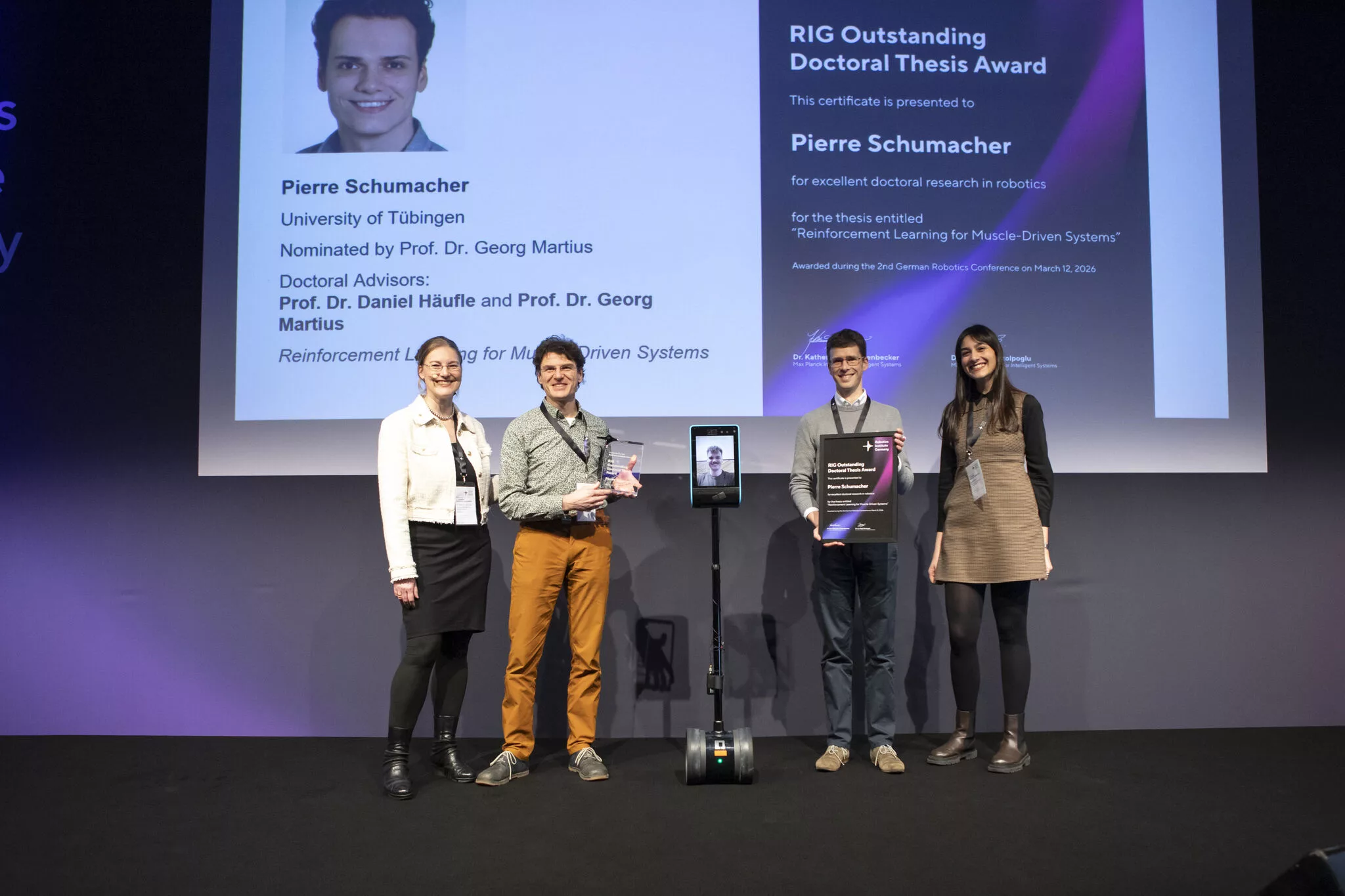
  • Pierre Schumacher receives RIG “Outstanding Doctoral Thesis Award” at the German Robotics Conference 2026

    Pierre Schumacher receives RIG “Outstanding Doctoral Thesis Award” at the German Robotics Conference 2026

    Pierre Schumacher has been selected as one of the two recipients of the “RIG Outstanding Doctoral Thesis Award”, recognizing exceptional doctoral research in robotics in Germany. The award was officially announced during the “RIG Heroes Award Night 2026” at the German Robotics Conference 2026, organized by the Robotics Institute Germany (RIG), in Cologne on March 12.

    Schumacher’s dissertation, “Reinforcement Learning for Muscle-Driven Systems,” was selected from 27 nominations submitted by 16 institutions across Germany. Following an extensive evaluation process, an international selection committee chose two equal awardees, citing Schumacher’s work for its “scientific depth, originality, and impact”.

    Pierre Schumacher conducted his doctoral research at the Max Planck Institute for Intelligent Systems in Tübingen under the supervision of Prof. Georg Martius (University of Tübingen) and Prof. Daniel Häufle (Hertie Institute for Clinical Brain Research) funded by the Cyber Valley Research grant “Learning effcient control of non-linear muscle-driven systems: Morphological computation as guiding principle”. His project was part of the Cluster of Excellence “Machine Learning: New Perspectives for Science” and the Center for Bionic Intelligence Tübingen Stuttgart (BITS). His dissertation, “Reinforcement Learning for Muscle-Driven Systems,” addresses challenges in controlling complex, highly overactuated robotic and biomechanical systems by developing new machine learning methods.

    A central contribution of the work is the development of DEP-RL, a reinforcement learning approach that improves exploration and learning in systems with many redundant actuators, such as musculoskeletal models. Using this method, Schumacher demonstrated efficient learning for tasks involving complex simulated bodies, including a human model with dozens of muscles and animal-inspired locomotion systems.

    Pierre’s research also explored how muscle-like actuation can improve learning performance and robustness in robotic systems. In collaborative studies, Schumacher and colleagues showed that musculoskeletal models can lead to more data-efficient and stable learning in anthropomorphic control tasks. More recent work demonstrated that reinforcement learning can produce natural and robust bipedal walking in musculoskeletal simulations without relying on motion-capture demonstrations.

    Schumacher began his academic path with a trinational bachelor’s degree in physics that took him to universities in France, Luxembourg, and Germany. After completing his B.Sc. in physics in Saarbrücken 2017, he shifted toward computational approaches and pursued a master’s degree at Goethe University Frankfurt in Frankfurt am Main. In 2021, he joined the Max Planck Institute for Intelligent Systems and the Hertie Institute for Clinical Brain Research in Tübingen with Prof. Georg Martius and Prof. Daniel Häufle for his PhD in Computer Science, which he completed in 2025.Schumacher’s expertise has also attracted industry attention: he joined MyoLab, a startup based in New York focusing on musculoskeletal control technologies, last year.

    The RIG Outstanding Doctoral Thesis Award highlights emerging researchers whose doctoral work significantly advances robotics research in Germany. Schumacher’s selection underscores the growing importance of combining machine learning, biomechanics, and embodied intelligence to enable the next generation of adaptive robotic systems.

  • From perception to constrained decisions

    From perception to constrained decisions


    Georg Martius’ project, “Embedding combinatorial reasoning into learning control policies” addressed a practical gap in AI’s basic machinery: connecting data-driven neural networks with decision-making so they can adhere to clear structures, rules, and constraints. The project developed foundations for integrating combinatorial optimization into learning systems. It has potential applications wherever planning and resource allocation are central, such as in robotics and logistics. The project was funded by the Cyber Valley Research Fund and was carried out between 2021 and 2024. 

    Martius’ project addressed a key limitation of today’s machine-learning systems. While neural networks can learn powerful representations from data (for example, from images or sensor signals), many real-world decisions must also follow strict rules, such as budgets, capacities, safety limits, or “must/ must not” constraints. These rule-based decisions are often handled by specialized optimization software, but such tools are traditionally difficult to integrate into learning-based systems.

    Martius’ research created methods that make it easier to combine neural networks with combinatorial optimization components. This enables systems to learn from data while also drawing on proven optimization techniques to make decisions that respect constraints. Rather than replacing classical solvers, the project developed ways to use them as trainable building blocks inside larger learning pipelines.

    The project also explored “neuro-algorithmic” approaches to decision-making and control, investigating how structured algorithms can improve generalization to new problems compared with purely data-driven approaches.

    Overall, the project provides a foundation for building AI systems that connect perception with constraint-aware decision modules. This is an important step toward robust solutions in areas such as robotics, planning, logistics, and resource allocation.

    This project produced the following peer-reviewed publications:  

    Anselm Paulus, Michal Rolínek, Vít Musil, Brandon Amos, and Georg Martius. “CombOptNet: Fit the Right NP-Hard Problem by Learning Integer Programming Constraints”. In: Proceedings of the 38th International Conference on Machine Learning. Vol. 139. Proceedings of Machine Learning Research. PMLR, July 2021, pp. 8443–8453. url: https://proceedings.mlr.press/v139/paulus21a.html. 

    Marin Vlastelica, Michal Rolinek, and Georg Martius. “Neuro-algorithmic Policies Enable Fast Combinatorial Generalization”. In: Proceedings of the 2021 International Conference on Machine Learning (ICML). July 2021. url: https://proceedings.mlr.press/v139/vlastelica21a.html. 

    Marco Bagatella, Mirek Olšák, Michal Rolínek, and Georg Martius. “Planning from Pixels in Environments with Combinatorially Hard Search Spaces”. In: Advances in Information Processing Systems (NeurIPS 2021). 2021. url: https://openreview.net/forum?id=XgGUUaKgips. 

    Subham Sahoo, Anselm Paulus, Marin Vlastelica, Vít Musil, Volodymyr Kuleshov, and Georg Martius. “Backpropagation through Combinatorial Algorithms: Identity with Projection Works”. In: Proceedings of the Eleventh International Conference on Learning Representations. May 2023. url:  https://openreview.net/forum?id=JZMR727O29. 

    A. Paulus, G. Martius, and V. Musil. “LPGD: A General Framework for Backpropagation through Embedded Optimization Layers”. In: Proceedings of the 41st International Conference on Machine Learning (ICML). Vol. 235. Proceedings of Machine Learning Research. PMLR, July 2024, pp. 39989–40014. url: https://proceedings.mlr.press/v235/paulus24a.html. 

    Georg Martius is a Professor in the Department of Computer Science at the University of Tübingen.


    About the Cyber Valley Research Fund

    The Cyber Valley Research Fund was established to support Cyber Valley research groups undertake basic research in the fields of artificial intelligence and robotics. The fund totaled five million euros, including contributions from six of Cyber Valley’s founding corporate partners: Amazon, BMW, Bosch, IAV, Mercedes-Benz, Porsche, and ZF. It supported 20 research projects, the first of which began in 2020, and the final of which will conclude in 2026.

  • Funded Doctoral Positions at the International Max Planck Research School for Intelligent Systems (IMPRS-IS)

    Funded Doctoral Positions at the International Max Planck Research School for Intelligent Systems (IMPRS-IS)

    The school is a key element of to accelerate basic research and commercial development in artificial intelligence and robotics. IMPRS-IS seeks students who want to earn a doctorate while contributing to world-leading research in areas such as:

    • Artificial Intelligence

    • Biomedical Technology

    • Computational Cognitive Science

    • Computer Vision and Graphics

    • Control Systems and Optimization

    • Data Science and Visualization

    • Haptics and Human-Computer Interaction

    • Machine Learning

    • Micro- and Nano-Robotics

    • Natural Language Processing

    • Neuroscience

    • Perceptual Inference

    • Robotics and Human-Robot Interaction

    • Soft Robotics and Materials

    Renowned faculty include Sahar Abdelnabi, Rediet Abebe, Amirreza Aghakhani, Aamir Ahmad, Buse Aktaş, Frank Allgöwer, Maksym Andriushchenko, Kai Arras, Robert Bamler, Philipp Berens, Matthias Bethge, Michael J. Black, Wieland Brendel, Andrés Bruhn, Andreas Bulling, Martin Butz, Manfred Claassen, Maximilian Dax, Katharina Eggensperger, Benedikt Ehinger, Carsten Eickhoff, Andreas Geiger, Jonas Geiping, Antonia Georgopoulou, Martin A. Giese, Thilo Hagendorff, Moritz Hardt, Florian Hartmann, Daniel Häufle, Matthias Hein, Philipp Hennig, Niels Henze, Christian Holm, Andrea Iannelli, Christoph Keplinger, Mario Krenn, Katherine J. Kuchenbecker, Hilde Kuehne, Anja Lauer, Hendrik Lensch, Anna Levina, Shiwei Liu, Nicole Ludwig, Sabine Ludwigs, Jakob Macke, Georg Martius, Kristof Meding, Celestine Mendler-Dünner, Michael Mühlebach, Philipp Müller, Sven Nahnsen, Mathias Niepert, Seong Joon Oh, Antonio Orvieto, Aniket Pal, Nico Pfeifer, Gerard Pons-Moll, Michael Pradel, C. David Remy, Kerstin Ritter, Philipp Rothemund, Konstantin Rusch, Renate Sachse, Samira Samadi, Harry Scells, Dieter Schmalstieg, Syn Schmitt, Bernhard Schölkopf, Sabine Schulte im Walde, Janneke Schwaner, Michael Sedlmair, Thomas Speck, Steffen Staab, Ingo Steinwart, Alexander Verl, Claire Vernade, Ulrike von Luxburg, Daniel Weiskopf, Felix Wichmann, Bob Williamson, Andreas Wortmann, Thomas Wortmann, and Charley Wu.

    Associated faculty include R. Harald Baayen, Franz Baumdicker, Peter Dayan, Jonathan Fiene, Volker Franz, Ksenia Keplinger, Miriam Klopotek, Kay Nieselt, Senya Polikovsky, Peter Pott, Gunther Richter, Cornelia Sindermann, Maria Wirzberger, Isabell Wochner, and Thomas Wolfers.

    About the program:

    Intelligent systems that can successfully perceive, act, and learn in complex environments hold great potential for aiding society. The school seeks doctoral students who are curious, creative, and passionate about research to join and help advance human knowledge about intelligent systems.

    • Admitted students can join the program starting in 2026.

    • You will be mentored by an internationally renowned faculty.

    • You will register as a university doctoral student and conduct research.

    • IMPRS-IS offers a wide variety of scientific seminars, workshops, and social activities.

    • All aspects of the program are in English.

    • Your doctoral degree will be conferred when you successfully complete your doctoral project.

    • Dedicated staff members will assist you throughout your time as a doctoral student.

    IMPRS-IS is an equal opportunity employer dedicated to excellence through diversity and does not discriminate on the basis of age, race, sex, disability, sexual orientation, national origin, religion, marital status, gender identity, or any other non-job-related criteria. They believe in the importance of a multicultural community of students, faculty, and staff who seek to advance our commitment to diversity and inclusion. IMPRS-IS strives to create and maintain working and learning environments that are inclusive, equitable, and welcoming.

    Admission will be competitive. If selected, you will receive funding via an employment contract, subject to the rules of the Max Planck Society and the two participating universities.

    Application deadline: 

    November 16, 2025 (End of Day, AoE)

    Selection interviews: 

    February 5–13, 2026

    Apply now: 

    https://imprs.is.mpg.de/application

    For more information, please visit https://imprs.is.mpg.de.

  • 18th European Workshop on Reinforcement Learning (EWRL 2025)

    18th European Workshop on Reinforcement Learning (EWRL 2025)


    What?

    The 2025 edition of EWRL will be an exciting event for researchers worldwide, both for the presentation of top-quality papers, but also as a forum for ample discussion of open problems and future research directions.

    Past editions of EWRL can be found here.

    Reinforcement learning is an active field of research which deals with the problem of sequential decision making in unknown (and often) stochastic and/or partially observable environments. Recently there has been a wealth of impressive empirical results, including those coupling Deep Learning function approximators with Reinforcement Learning algorithms, as well as significant theoretical advances. Both types of advances are of major importance and the conference aims to create a forum to discuss such interesting results, their applications, consequences, and research perspectives. 


    When?

    September 17th–19th, 2025


    Where?

    EWRL18 will be located in the historical University of Tübingen, Germany. Tübingen is a lovely, vibrant university town in southern Germany, known for its rich history and scenic streets. Check out tourist information here!


    Call for papers

    The organizing committee invites submissions to the 18th European Workshop on Reinforcement Learning (EWRL 2025). There will be no proceedings for EWRL 2025. Papers may be submitted to one of two tracks:

    Regular track: unpublished work. Papers submitted to this track are unpublished, though they may be concurrently under review at another venue. These papers will be subjected to the full review process.

    Fast track: published work. Papers that are already accepted at one of the venues listed below may be submitted to this track. They will not receive new reviews, but will be checked for relevance to the topics of interest to EWRL.
    Submissions are handled through OpenReview. Submitted papers will be reviewed by the program committee in a double-blind procedure. Final decisions will be taken by the program chairs based on the reviews. There will be no author/reviewer discussion phase. Only accepted papers will be publicly released, while rejected or withdrawn manuscripts will be kept confidential.

    Submitted papers should follow the EWRL template linked below. There is a limit of 9 pages, excluding references and appendix. Authors of accepted papers will be allowed an additional page to prepare the camera-ready version. There is no page limit for the fast track. All accepted papers will be presented as posters.

    For any questions, please contact the organizers at ewrl2025@gmail.com.


    Fast track instructions

    For submission to the fast track, the selection committee will consider papers accepted at the following venues: NeurIPS, ICML, ICLR, RLC, AAAI, IJCAI, AISTATS, COLT, UAI, ALT, ICRA, IROS, CoRL, RAL, TMLR, JMLR, ECAI. If you want to submit a paper that was accepted at a different archival venue and you believe that this venue should be included in the list above, please let the conference organizers know. In the submission process, you will be required to provide a link to the online proceedings page showing your accepted article. If your paper is accepted but not yet published online, please send the acceptance confirmation to ewrl2025@gmail.com.


    Info

    Paper submission opens: April 23rd
    Paper deadline: May 30th June 3rd (11:59pm AOE)
    Notification of acceptance: July 31st July 16th
    Page limit – doesn’t apply to fast track: 9 pages excluding references and appendix (+1 page for final version)
    Paper format: Download
    Paper submissions: via Openreview


    Call for Contributed Talks

    In an effort to bring novel and diverse viewpoints to EWRL this year’s workshop has a special call for contributed talks. Early-career researchers are invited to submit proposals for an invited talk at EWRL 2025. Accepted authors will be given a 15-minute time slot for their presentation at the workshop.

    The content of talks should relate to or be on topics in the area of reinforcement learning. If your talk is on a paper you submitted to the main track of EWRL, you can reference it in your proposal.


    Submission guidelines

    Submit one pdf document (see template here) including:

    Abstract of your talk: 1-2 pages. This should include a preliminary title and abstract, a short description of the content, and a brief description of the anticipated outcome of your talk (e.g. increase awareness of an open problem, presenting new/emerging results, call-to-action etc.)
    A brief CV (see template) indicating your current and past positions, and a short list of related contributions to the topic of your talk. Do not include any metrics such as: Number of papers, citations, impact factors etc. (See also the section Special Review Criteria below)


    Special Review Criteria

    The speaker/author must be an early-career researcher: You are currently enrolled in a PhD program, or are a postdoctoral researcher who has received their PhD within the last three years (Researchers at Assistant Professor level are eligible if they started their position at most three years ago).
    For the evaluation of your submission, the selection committee will adhere to the principles laid out in the San Francisco Declaration on Research Assessment: They will review your submission based on its (scientific) content, and not on reputation or publication metrics.


    Info

    Talk submission deadline: June 15th
    Notification of acceptance: July 9th July 17th
    Talk submissions: via Openreview

  • Tübingen AI Summer Poster Event 2025

    Tübingen AI Summer Poster Event 2025


    This event at the Tübingen AI Center will spotlight recent machine learning papers published in top-tier venues. You are invited to present your poster if your paper has been accepted at one of the following conferences since December 2024:

    NeurIPS, ICML, ICLR, JMLR, CVPR, ICCV, ECCV, IJCV, PAMI, RSS, CoRL, TRO, IJRR, Science Robotics, ACL, EMNLP, KDD, AAAI, IJCAI, COLT, UAI, AAMAS, AISTATS, TACL, SIGIR, WSDM, ACM Multimedia, SIGGRAPH, KDD, ACM FAccT

    Otherwise, join to mingle, exchange, and wrap up the day with drinks and snacks! 


    When?

    Friday, July 11
    14:00–18:00


    Where?

    Tübingen AI Research Building, ground floor coffee lounge
    Maria-von-Linden-Straße 6, 72076 Tübingen


    Register

    Register here if you'd like to attend or present a poster.

  • Symposium ML4QT: Machine Learning for Quantum Technologies

    Symposium ML4QT: Machine Learning for Quantum Technologies


    Leveraging AI to transform quatum advancements 

    Machine learning holds massive potential for transforming quantum technologies. The Symposium Machine Learning for Quantum Technologies (ML4QT) is aiming to explore these potenitals by connecting leading researchers, industry experts, and innovators to discuss how AI-powered quantum computing, machine learning for quantum hardware, and new research methodologies. 

    The event also marks the launch of the Applied Quantum AI Hub Heilbronn, fostering collaboration between academia and industry. 


    When? 

    July 7-8, 2025


    Where? 

    experimenta – Das Science Center
    Experimenta-Platz 
    74072 Heilbronn


    Want to contribute yourself? 

    Researchers are warmly invited to submit talks and posters on topics such as: 

    • Machine learning for quantum hardware & software 
    • Ai-driven optimization of quantum systems 
    • Quantum-enhanced research methodologies 

    Submissions are possible until April 18, 2025. You can submit your contributions, as well as pre-register for the event here. 


    Organizers & Partners

    ML4QT is organized by the quantum computing teams at Fraunhofer IAO and Fraunhofer IPA as well as the Institute for Quantum Computing (IQC) at the University of Waterloo. The symposium is generously funded by the Dieter Schwarz Foundation. 


    For more information on the event, please check out this website. 

  • Cyber Valley Research Fund improves human decision-making with AI

    Cyber Valley Research Fund improves human decision-making with AI

    From February 2020 to February 2024, Dr. Falk Lieder led a major project supported by the Research Fund, titled “A Scalable Machine Learning Approach to Improve Human Decision Making,”. The project aimed to prepare for a future where effective decision-making is crucial. 

    Good decision-making involves planning, gathering relevant information, and handling uncertainty. As automation transforms the workforce by taking over routine tasks, the demand for jobs requiring decision-making in complex and novel situations will rise. Future roles will emphasize critical thinking and adaptability. To prepare, society must focus on retraining workers and equipping the next generation with advanced decision-making skills. 

    Lieder’s project leveraged artificial intelligence to uncover optimal decision strategies that help individuals navigate complex challenges. The team also designed and tested interactive tutorials, allowing participants to learn and apply these strategies effectively. 

    They evaluated their approach on a series of more realistic decision problems, ranging from an abstract planning task without uncertainty, to planning under uncertainty, to a company choosing between alternative projects. In each case, the new AI methods found decision strategies that outperformed both human decision-making and strategies identified by previous techniques. 

    Their interactive tutorials improved decision-making by explaining the strategy in clear language, demonstrating it through examples, and offering hands-on practice with feedback. In all three applications, individuals who completed the AI-driven strategy tutorials made better decisions than those who practiced decision-making independently. 

    This project yielded the following peer-reviewed publications: 

    1.  Consul, S., Heindrich, L., Stojchewski, J., & Lieder, F. (2022), Improving Human Decision-Making by Discovering Efficient Strategies for Hierarchical Planning, Computational Brain & Behavior, 5(2), 185-216. https://doi.org/10.1007/s42113-022-00128-3 

    2. Callaway, F., Jain, Y. R., van Opheusden, B., Das, P., Iwama, G., Gul, S., Krueger, P.M., Becker, F., Griffiths, T. L., & Lieder, F. (2022). Leveraging Artificial Intelligence to Improve People's Planning Strategies. PNAS, 119 (12) e2117432119. https://doi.org/10.1073/pnas.2117432119 

    3.  Mehta, A., Jain, Y. R., Kemtur, A., Stojcheski, J., Consul, S., Tosic, M., & Lieder, F. (2022). Leveraging machine learning to automatically derive robust decision strategies from imperfect knowledge of the real world. Computational Brain & Behavior, 5(3), 343-377. https://doi.org/10.1007/s42113-022-00141-6 

    4.  Becker, F., Skirzynski, J., van Opheusden, B., & Lieder, F. (2022). Boosting human farsightedness with automatically discovered planning instructions. Computational Brain & Behavior, 5(4), 467–490. https://doi.org/10.1007/s42113-022-00149-y 

    5. Skirzynski, J., Jain, Y. R., & Lieder, F. (2024). Automatic discovery and description of human planning strategies. Behavior Research Methods, 56(3), 1065-1103. https://doi.org/10.3758/s13428-023-02062-z 

    6. Skirzyński, J., Becker, F., Lieder, F. (2021). Automatic Discovery of Interpretable Planning Strategies. Machine Learning, 110, pp. 2641–2683. https://doi.org/10.1007/s10994-021-05963-2

    7. Kemtur, A., Jain, Y. R., Mehta, A., Callaway, F., Consul, S., Stojcheski, J., & Lieder, F. (2020). Leveraging machine learning to automatically derive robust planning strategies from biased models of the environment. Proceedings of the 42nd Annual Meeting of the Cognitive Science Society. 

    Preprints of articles yet to be published: 

    1. Heindrich, L., Consul, C. & Lieder, F. (2024). Leveraging AI to improve human planning in large partially observable environments. arXiv Preprint. https://arxiv.org/abs/2302.02785 

    2.  Heindrich, L., & Lieder, F. (2024). Leveraging automatic strategy discovery to teach people how to select better projects. https://arxiv.org/abs/2406.04082 

    Dr. Falk Lieder is now an Assistant Professor of Psychology at UCLA and the Director of the Rational Altruism Lab. 

  • Maschinelles Lernen in der Wissenschaft

    Maschinelles Lernen in der Wissenschaft


    AI has been a hot topic, especially since the release of Chat GPT-3 in November 2022. But what role do AI and machine learning play in the natural sciences? Could they transform scientific research or are the current expectations set too high? Join the discussion as these questions are explored.


    What?

    A podium discussion will take place, moderated by TT-Prof. Pascal Friederich (Institute of Theoretical Informatics)

    Participants
    TT-Prof. Peer Nowack (Institute of Theoretical Informatics)
    TT-Prof. Benjamin Schäfer (Institute for Automation and Applied Informatics)
    Dr. Charlotte Debus (Scientific Computing Center)
     

    When?

    Date: Tuesday, September 10, 2024

    Time: 19:00–21:00


    Where?

    Triangel Karlsruhe 
    Kaiserstraße 93, 76133 Karlsruhe


    Find out more information about this event here.

  • Science Hub Research Symposium 2024

    Science Hub Research Symposium 2024


    This two-day event will bring research communities together to highlight the latest innovations and breakthroughs. Attendees can look forward to keynote speeches, lightning talks, breakout sessions, and networking opportunities.


    What?

    The event will cover a range of topics, including:

    • Haptic intelligence and the simulation of clothing pressure fields
    • Physically plausible object pose refinement in cluttered scenes and insights into what foundation models know about 3D humans
    • Advances in machine learning, such as root cause analysis at Amazon, thermodynamics-guided techniques to improve aluminum recycling, and making time series classification more understandable using multiple instance learning
    • Cutting-edge research in document-level relation extraction and entity linking, deep selective state-space models, and improving decision-making with machine learning

    Further program information can be found here.


    When and where?

    On September 16th, the event will take place at MPI-IS Tübingen.

    On September 17th, the event will take place at Amazon Entwicklungszentrum in Tübingen.


    Registration

    Please RSVP through the event website.