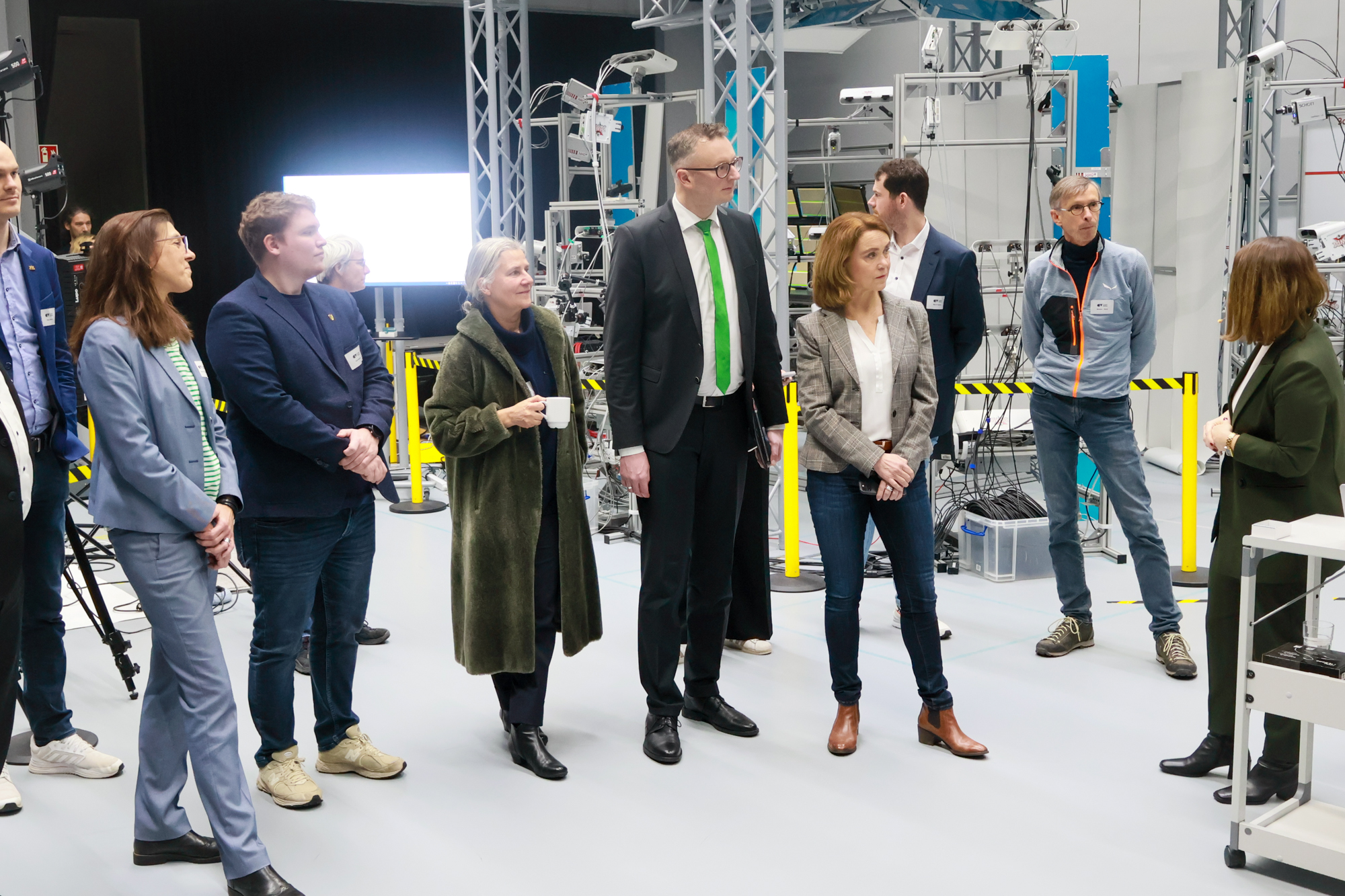
Tübingen, January 28, 2024 – What will our future look like with AI? Minister of Science and MdL Petra Olschowski, chairman of the State Parliamentary Group of the Greens in Baden-Württemberg Andreas Schwarz, and further guests were able to experience this future at Cyber Valley, Europe’s largest and leading center for excellence in artificial intelligence and modern robotics. The special guests toured Cyber Valley at the Max Planck Institute for Intelligent Systems (MPI-IS) in Tübingen on Friday, January 26, gaining valuable insights into the cutting-edge research underway in the field of AI, modern robotics, and intelligent systems. Cyber Valley presented select projects led by eminent scientists from the Cyber Valley Community, which included the founding members MPI-IS and the University of Tübingen.
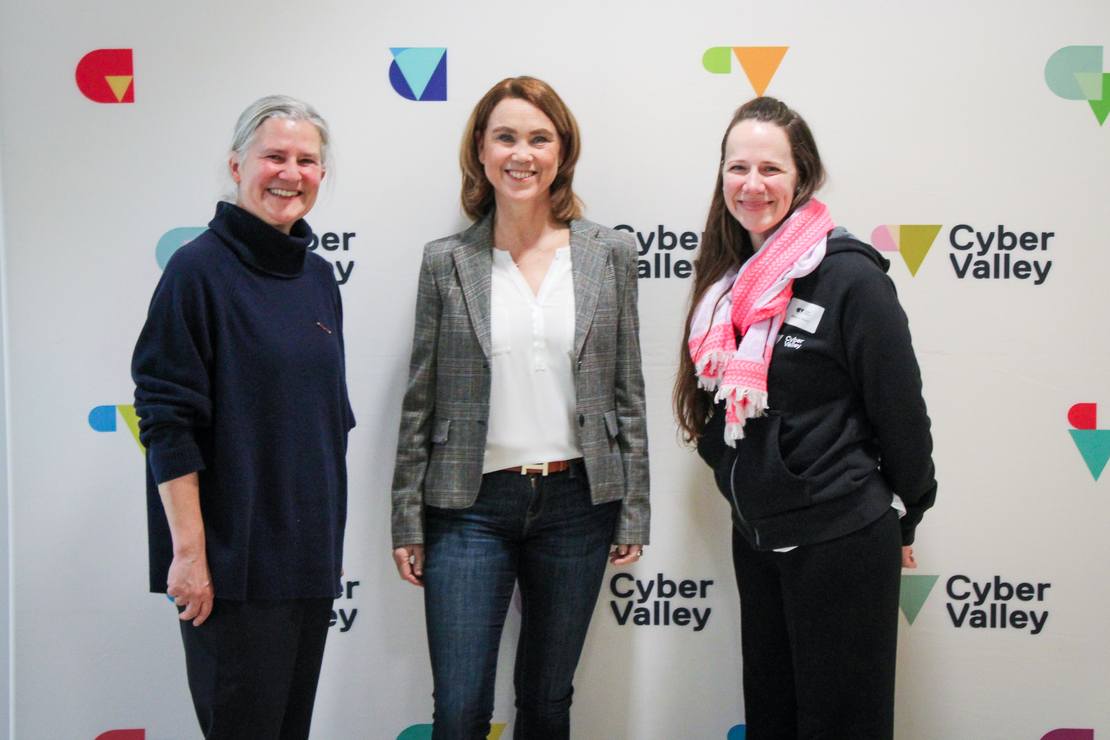
Rebecca C. Reisch, Cyber Valley Managing Director, provided an insightful overview underscoring the significance of the Cyber Valley Community. With the launch of ICAIN or the AI House Davos during the World Economic Forum, Cyber Valley is now leading the global conversation on AI. The Director of the Perceiving Systems Department at MPI-IS, Prof. Michael J. Black, emphasized: “Cyber Valley developed as a response to a changing world. With our excellence in AI, we have the opportunity to build a new economic foundation for the region. The strong partnership between the state government, industry, and academia has built this into one of the best locations for AI research worldwide.”
The Rector of the University of Tübingen, Prof. Dr. Karla Pollmann, commented on the overall visit: "I am impressed by the diversity of topics being researched in the Cyber Valley Community and at the University of Tübingen and the interdisciplinarity we showcased. We will further support Cyber Valley, so that we can grow even stronger together.
Measuring power and rethinking agriculture with AI
Prof. Michael J. Black provided an overview of the excellent research at MPI-IS as well as the current status of AI. "Of course, there are limits to current AI systems; for example, they may generate images of people with six fingers. But whenever you think that AI is not going to be able to do a specific task – forget that. It will. And the scale of investment in AI means that it will happen more quickly than people imagine." Furthermore, he emphasized the need for more German venture investment and lower costs for computing resources, so that start-ups can make the transfer from AI research to entrepreneurship.
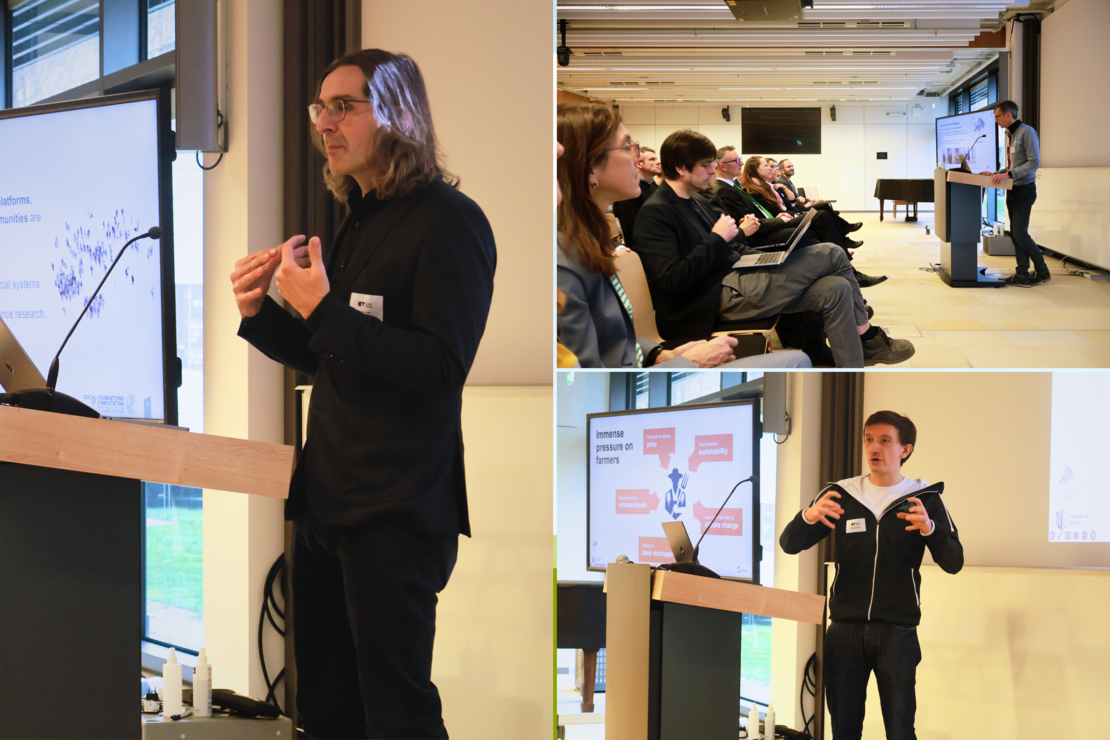
By explaining that “AI in the real world is not about observation, but prediction”, Prof. Moritz Hardt, Director of Social Foundations of Computation Department at MPI-IS, elaborated on how to measure the power of social media platforms and the impact of their algorithms. Dr. Wieland Brendel, Research Group Leader for Robust Machine Learning, highlighted his research and technology transfer initiatives, with a focus on the integration of artificial intelligence into agriculture. More specifically, he showcased the Polybot farming robot and its contribution to more sustainable and environmentally friendly farming practices.
Better together – Interdepartmental initiatives at the University of Tübingen
The University of Tübingen shared detailed insights into their artificial intelligence research and programs, emphasizing their profound societal impact. The Cluster of Excellence, as described by Prof. Dr. Ulrike von Luxburg, is immersed in outstanding research, contributing to a wide variety of applications for AI in science. She further commented; “Simulation of data is currently a major area of application for AI in science. In the social and legal context, the explainability of AI is a major topic of research here in Tübingen, which was also spurred on by the AI Act.”
Prof. Dr. Philipp Berens, Director of the Hertie Institute for AI in Brain Health, stressed the significance of artificial intelligence in the medical domain and its crucial role in handling tasks in fields where there is a shortage of medical professionals. As an example, he elaborated on the use of AI in screening eyes for potential diabetes cases.
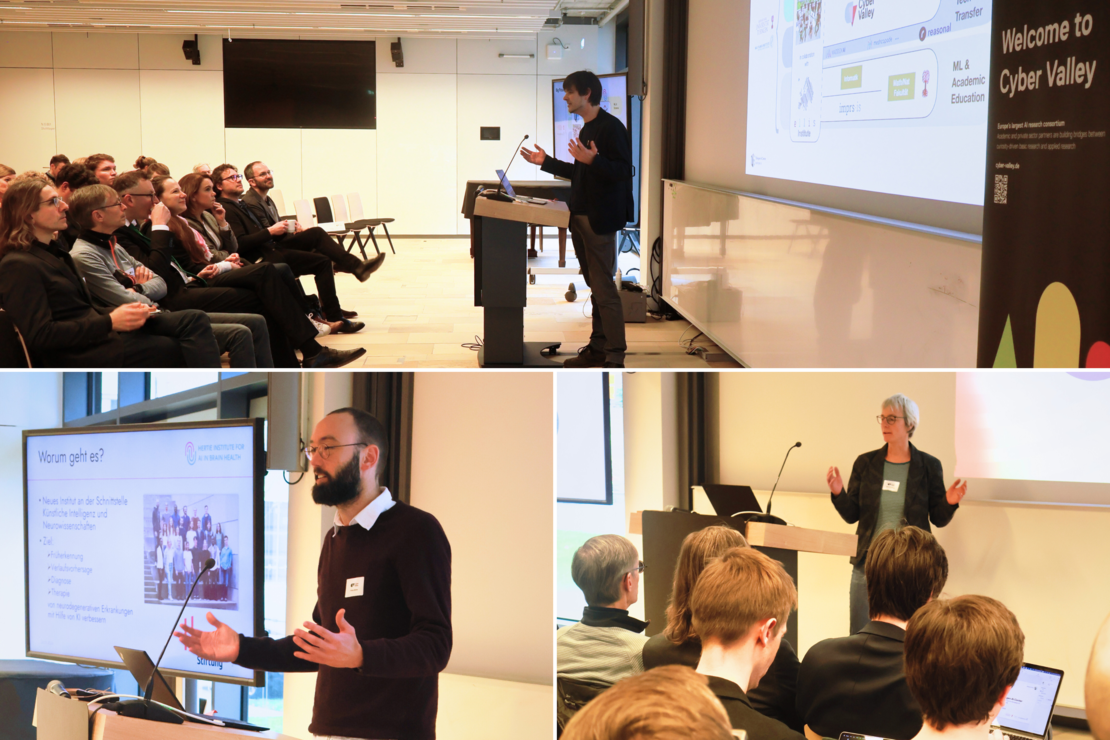
Furthermore, Prof, Dr. Matthias Bethge, Director of the Tübingen AI Center, emphasized the importance of excellent research for the future of technology: "Academia is a laboratory for the future. As researchers, we want to bring our ideas to life in order to make the world a better place. We need faster processes for the recruitment of excellent AI researchers and for spinning off start-ups and building up computing power."
Modern robotics in action – showcasing practical examples of the future
What does the future look like with AI? The visit continued with lab tours at the Tübingen site. Tsvetelina Alexiadis, who leads the Data Team of the Perceiving Systems Department, presented the Capture Hall. She demonstrated the advancement of computer vision research through the digitization of the human body. The equipment teaches computers to understand human poses and motion through images and videos. It can interpret how humans interact with each other and the environment by gathering data, including the motion, shape, and texture of the body, and much more. It offers computers a form of sight, to be used in various industries, including medicine, fashion, and entertainment.
A demonstration of the table tennis robot highlighted the dynamic essence of robotics movement and illustrated how a robot can acquire basic skills, such as playing table tennis. This demonstration left a lasting impression on the visitors. Dieter Büchler, Research Group Leader, and Ph.D. student Jan Schneider explained that through reinforcement learning, the robot has acquired successfully over time the ability to play table tennis, progressively refining its skills through the learning process.
Cyber Valley, the location for AI in Europe
Minister of Science and MdL Petra Olschowski expressed great satisfaction with her visit to Cyber Valley and the detailed overview of its associated projects, stating, "AI is shaping the world of tomorrow – impacting fields from manufacturing and engineering to medicine, along with our everyday lives. In Baden-Württemberg, we are leading the way. Excellent research and transfer into practice go hand in hand – that is the idea behind our Cyber Valley innovation campus. I am always impressed by what is created here. Today's visit for example showed the enormous potential in the field of intelligent robotics. At Cyber Valley, researchers together with industry partners are creating the future – which is not only important for our economy, but also for our prosperity and well-being. That is why the state government founded Cyber Valley in 2018 and why we are still supporting this innovation campus today as an investment in our future.”
About Cyber Valley
Cyber Valley is Europe’s largest and leading center for excellence in artificial intelligence and modern robotics. Its mission and public mandate are to advocate for research, development, application, and acceptance of technologies and methods in the field of intelligent systems. Cyber Valley encourages entrepreneurship by uniting scientific excellence with innovation and technology transfer. In addition, Cyber Valley facilitates critical reflection on the ethical and social implications of AI through public engagement. Cyber Valley envisions a future in which the full potential of intelligent systems is leveraged for the greater good of the world.
Press Contact