“AI ethics and society” is a new series of articles written by members of the Cyber Valley Public Advisory Board (PAB) on ethical issues surrounding AI. In this first article from the series, Deputy Spokesperson of the PAB and former Director of the World Ethos Institute Tübingen, Ulrich Hemel reflects on Yoshua Bengio’s lecture at Cyber Valley Day and whether it is possible to embed “objective” ethical values into AI models.
Daten sind Macht [Data is power] is the title of a new book by Katharina Schüller. How we deal with power is an eternal question. Does the state exert control? Does civil society have control? Or do companies regulate themselves? Since all researchers deal with data, data ethics is important even if it is ignored.
Cyber Valley is currently the only major AI institution in the world to have established a Public Advisory Board to examine the social and ethical issues surrounding AI. The members are appointed by the Ministry of Science in Baden-Württemberg and represent diverse perspectives, professions, and roles. The Public Advisory Board’s task is to provide expert guidance on ethical issues and to advise stakeholders in Cyber Valley on the societal and political implications of AI. After all, ethical questions concern not only the individual but also how we all live together: Political ethics comes into play alongside individual ethics.
The “outbreaks” of AI agents from their test environments in the summer of 2026 demonstrate just how critical ethical issues have become. Who is responsible? Should the company or should the government be held responsible for implementing the necessary regulations? And how should we act—as individuals, as companies, as a society?
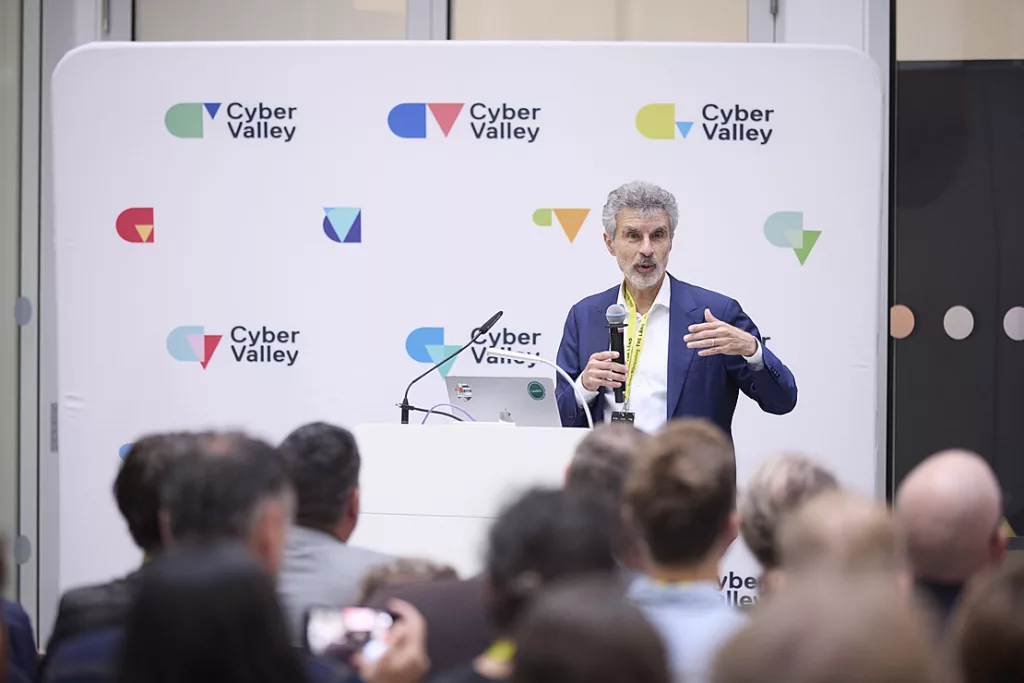
At Cyber Valley’s tenth anniversary celebrations, Yoshua Bengio presented his idea of value-based AI development as objectively as possible. That sounds good, but what’s behind it? After all, when it comes to ethical questions, it’s clear that they cannot be considered apart from one’s own perspective. It makes a difference whether I am female or male, have children or do not have children, am disabled or not, and whether I approach a topic as a young researcher from the Global South or as an older white scientist from Europe. In other words, values and principles are always accompanied by perspectives and interests, some of which we are aware of, and some of which arise “implicitly” from the reality of our lives.
The idea of “objective” ethics therefore does not hold up to philosophical scrutiny. We can make our positions transparent, and we can refer to overarching principles such as “humanity.” We can collect relevant data and possibly agree on which data should be considered “relevant.” We can and we should opt for “ethics by design” but we must transparently show our ethical standpoint and background. As a matter of fact, we can never avoid context-dependent interpretations.
When taking an ethical perspective, it is therefore difficult to claim that one can or even wants to embed “objective” ethical values into AI models. On the contrary, anyone who neither recognizes nor transparently acknowledges their own limitations and perspectives lacks either the necessary reflection or transparency regarding their own contextual assumptions.

Yoshua Bengio’s lecture could therefore serve as an invitation to a broader conversation. What assumptions do we bring to our research? How can we disclose the premises of our own research and thereby bring them into the realm of public discussion? How do we avoid the tactics of instrumental and “combative” ethical rhetoric, in which ethical terms are used unethically because they are primarily aimed at advancing one’s own interests?
The appeal of a good, public ethical discourse is that it yields long-term benefits for how we live together in society. When different perspectives are given a voice, diversity becomes tangible in a positive sense, while raising awareness of risks and opportunities. Such risks can easily be overlooked—even when they are without any malicious intent—when we avoid such discourse.
The same applies to Cyber Valley: in the medium term, improved skills in the art of ethical argumentation and dialog will be reflected in an improved breadth and depth of research. And that’s exactly what it’s all about: the invitation to think about the consequences and prerequisites in the context of AI research, always with the big question: What kind of world do we want to live in? The discussion on this is open; the invitation to it stands!
Further reading
Ulrich Hemel, From Wild West to a World in Balance: AI and the Future of Global Civil Society, in: Reinhard Kahle, Harald Mieg, and Michael Resch (eds.), AI and Society, Jahrbuch Wissenschaftsforschung 2024 der Gesellschaft für Wissenschaftsforschung (Berlin: University Publishing, 2026), pp. 133–155.
Ulrich Hemel, Datenethik zwischen gesellschaftlichem Anspruch und betrieblicher Praxis, in: Andreas Gillhuber, Göran Kauermann, Wolfgang Hausner (eds.), Künstliche Intelligenz und Data Science in Theorie und Praxis, Von Algorithmen und Methoden zur praktischen Umsetzung in Unternehmen (Berlin: Springer, 2023), pp. 93–105.
Katharina Schüller, Daten sind Macht, Kompetentes Entscheiden im Zeitalter von KI (Frankfurt/M. und New York: Campus 2025).
Stay tuned for further perspectives from the Cyber Valley Public Advisory Board on “AI ethics and society”.