CV Tag: Robotics

  • Cyber Valley Research Fund drives advancements in soft robotics

    Cyber Valley Research Fund drives advancements in soft robotics

    Dr. Ardian Jusufi and his team researched innovative materials that improve proprioception (the body’s ability to sense movement and position) in unpredictable and irregular environments. Insights from the project have deepened understanding of how the body moves and interacts with its environment. These advancements in soft active materials and sensors will revolutionize the fields of biomedical devices and soft robotics.  

    Some of the project’s key achievements include:  

    • Enhanced pumping system performance: The project team improved a hydrogel-encapsulated soft actuator pumping system. The system demonstrated improved competitive pressure and fluid velocity performance, offering potential insights for cardiovascular and renal applications. 

    • Addressing sensor challenges: The project addressed the inherent trade-offs of soft sensors. While offering greater flexibility and sensitivity, these sensors often lack robustness, repeatability, linearity, and durability. Various use cases were evaluated to balance these trade-offs effectively. 

    • Innovative manufacturing and materials: The team developed advanced manufacturing techniques and synthesized new materials responsive to environmental stimuli, such as hydrodynamic pressure. This was relevant for studying locomotion, like the undulatory swimming of fish, using fluidic actuators. 

    • System integration with mobile soft actuators: Soft sensors were integrated with mobile soft fluidic actuators in robots. This integration provided valuable insights into the neuromechanics of movement, particularly in aquatic environments. 

    • Electroactive polymer-driven pumping systems: The team aimed to reduce the tissue stress associated with traditional implanted pumps. Although current limitations related to in-body electricity use means that these systems are not yet feasible for in vivo applications, the research marks significant progress in understanding the biomechanics of movement. 

    This project yielded the following publications:  

    1. Souri H, Banerjee H, Jusufi A, Radacsi N, Stokes A, Park I, Sitti M, Amjadi M. Advanced Int. Sys. 2 (8) 2000039. Wearable and Stretchable Strain Sensors: Materials, Sensing Mechanisms, and Applications. 2020. Advanced Intelligent Systems, Volume: 2, Issue: 8, 2020. DOI: https://doi.org/10.1002/aisy.202000039 
    2. Banerjee H, Kalairaj MS, Ren H, and Jusufi A*. Advanced Engineering Materials. Strong, Ultrastretchable Hydrogel-Based Multilayered Soft Actuator Composites Enhancing Biologically Inspired Pumping Systems. [Cover inside] Adv. Eng. Mater 2021, 23, 2100121. 
    3. Wright B, Vogt D, Wood R, Jusufi A*. IEEE International Conference on Soft Robotics (RoboSoft). Soft Sensors for Curvature Estimation under Water in a Soft Robotic Fish. COEX, Seoul, Korea, 2019.
    4. Siddall R, Fukushima T, Bardhi D, Perteshoni B, Morina A, Hasimja E, Dujaka Y, Haziri G, Martin L, Banerjee H, Jusufi A*. Advanced Robotics 35 (7). Compliance, Mass Distribution and Contact Forces in Cursorial and Scansorial Locomotion with Biorobotic Physical Models. 2021. https://www.tandfonline.com/doi/full/10.1080/01691864.2021.1887760.
    5. Fukushima Toshihiko, Robert Siddall,Fabian Schwab, Severine Toussaint, Greg Byrnes, John Nyakatura, and Ardian Jusufi. Inertial tail effects during righting of squirrels in unexpected falls: From behavior to robotics. Integrative and Comparative Biology, icab 023, 2021.
    6. Lin Yu-Hsiang, Siddall R, Schwab F, Fukushima T, Banerjee H, Youngjoon Baek, Daniel Vogt, Yong-Lae Park, and Jusufi A. Modeling and control of a soft robotic fish with integrated soft sensing. Advanced Intelligent Systems, 2000244, 2021.
    7. Fabian Schwab, Elias T Lunsford, Taehwa Hong, Fabian Wiesemüller, Kovac M, Park YL, Akanyeti O, Liao J C, and Jusufi A. Body caudal undulation measured by soft sensors and emulated by soft artificial muscles. Integrative and Comparative Biology, 2021.
    8. Fabian Schwab, Fabian Wiesemüller, Claudio Mucignat, Yong-Lae Park, Ivan Lunati,Mirko Kovac, and Ardian Jusufi. Undulatory swimming performance explored with a biorobotic fish and measured by soft sensors and particle image velocimetry. Frontiers in Robotics and AI, page 387, 2021.
    9. Robert Siddall, Greg Byrnes, Rob J. Full and Ardian Jusufi, Tails stabilize landing of gliding geckos crashing head-first into tree trunks', Communications Biology, 2021. 

    This research project primarily aimed to expand knowledge of biomechanics through robophysical models, rather than immediate practical applications. It started in April 2020 and concluded in February 2023. Dr. Ardian Jusufi was formerly a Max Planck Research Group Leader at the MPI for Intelligent Systems (March 2018–January 2024). He is now Head of Soft Kinetic group in the Engineering Sciences Department of the Empa Swiss Federal Labs for Materials Science and Technology. 

  • Cyber Valley Research Fund advances robotic perception techniques

    Cyber Valley Research Fund advances robotic perception techniques

    Current autonomous systems still lack the capabilities of humans in scene perception and object manipulation tasks. Jörg Stückler and his team developed a method that combines differentiable physics and deep learning to estimate an object’s position, orientation, and velocity, while also simultaneously determining the friction between an object and its surface. The team also explored how understanding an object’s dynamics could improve control strategies, such as predicting how a robot’s actions will impact the object and guiding it to a desired location.  

    Their findings inspire new methods and approaches that adapt robotics object manipulation skills to the physical properties of objects. Although the research is still in its scientific development stage, it has the potential to revolutionize applications by enabling robots to manipulate objects more flexibly and adaptively.  

    This project yielded the following publications: 


    1. Kandukuri, R. K., Strecke, M., Stueckler, J. Physics-Based Rigid Body Object Tracking and Friction Filtering From RGB-D Videos. Accepted for International Conference on 3D Vision (3DV), 2024. Preprint arXiv:2309.15703. 

    2. EV-SynPhys and EV-RealPhys datasets accompanying at https://keeper.mpdl.mpg.de/d/5ec213b655b44e40a382/ 

    3. The 3DV 2024 paper was presented as poster presentation at the International Conference on 3D Vision 2024. Parts of the results reported in the paper have been also presented in a keynote given at the IEEE International Conference on Multi-Sensor Fusion and Integration / Symposium on Sensor and Data Fusion (MFI/SDF) in Bonn in November 2023. Parts of the project results have been presented at the Cyber Valley Research Fund symposium in November 2023. 

    This research project started in June 2020 and concluded in December 2023. Dr. Jörg Stückler is now a Professor of Computer Science at the University of Augsburg. 

  • Cyber Valley Research Fund’s self-supervised robot project

    Cyber Valley Research Fund’s self-supervised robot project

    Led by Prof. Dr. Jörg Stückler, Research Group Leader, and a dedicated team of researchers, the project, “Self-supervised learning of mobility affordances for vision-based navigation", has advanced the field of mobile robotics. They believe that mobile robots, whether in logistics or autonomous vehicles, should be able to properly adapt their navigation actions according to the surrounding environment. 

    The Cyber Valley Research Fund supported the project from March 2020 until its conclusion in October 2023. In this project, the team investigated novel approaches for adapting kinematic and dynamics models of wheeled mobile robots in a self-supervised way. The team’s goal was to develop modularized perception and motion control methods that allow dynamics models to learn through interaction with the environment. Stückler’s team created a method that uses camera images and inertial measurements to estimate the robot's motion.  

    They improved two types of robot platforms: one for indoor and one for outdoor use. Initially, they focused on a motion model for indoor wheeled robots controlled by setting target velocities. Then, they expanded this method to adjust parameters for a robot with car-like, steerable front wheels. Evaluating their online adaptation techniques showed better trajectory estimation and prediction accuracy compared to offline calibration or visual-inertial trajectory estimation without motion model information. 

    The Cyber Valley Research Fund, supported by six partners, has invested five million euros in fostering innovation and scientific excellence. Research groups were invited to submit project proposals, with ethical and societal considerations playing a crucial role in the evaluation process.   

    This project has yielded the following peer-reviewed publications: 

    • Li, H., Stueckler, J. Tracking 6-DoF Object Motion from Events and Frames. In Proc. of IEEE Int. Conf. on Robotics and Automation (ICRA), 2021. DOI: 10.1109/ICRA48506.2021.9561760 

    • Li, H., Stueckler, J. Visual-Inertial Odometry with Online Calibration of Velocity-Control Based Kinematic Motion Models. IEEE Robotics and Automation Letters (RA-L), 2022. DOI: 10.1109/LRA.2022.3169837 

    • Li, H., Stueckler, J. Online Calibration of a Single-Track Ground Vehicle Dynamics Model by Tight Fusion with Visual-Inertial Odometry. Accepted for IEEE International Conference on Robotics and Automation (2024). Preprint arXiv:2309.11148. 

    • Li, H., Stueckler, J. Observability Analysis of Visual-Inertial Odometry with Online Calibration of Velocity-Control Based Kinematic Motion Models abs/2204.06651, CoRR/arxiv, 2022 

  • NEURA Robotics joins the Cyber Valley Start-up Network

    NEURA Robotics joins the Cyber Valley Start-up Network

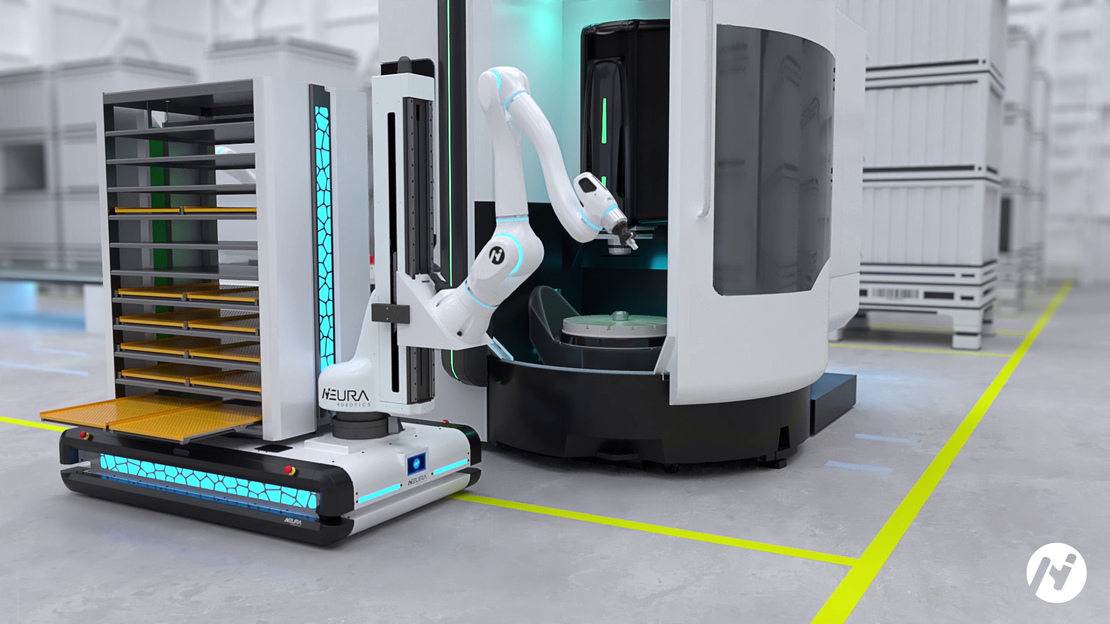
    NEURA Robotics was founded in 2019 in Metzingen near Stuttgart. The start-up builds robotics assistants to collaborate naturally with humans. Among its products is the world’s first commercially available cognitive robot MAiRA, which integrates AI and a Touchless Safe Human Detection sensor technology to perceive its surroundings and easily adapt to different environments. Its other products include:
     

    • LARA, a Lightweight Agile Robotic Assistant that combines a lightweight design with industrial performance.         
    • MAV, a Multi-Sensing Autonomous Vehicle that can autonomously move and load any type of good
    • MiPA, an intelligent, versatile robotic assistant designed to support people in various domains

    MAV MAIRA

    With these robotic assistants, NEURA Robotics has laid the groundwork for humans and robots to work hand-in-hand. By enabling seamless interaction with humans in existing environments, NEURA eliminates the need for complex and expensive safety systems. Their guiding principle, “we serve humanity”, underscores their commitment to creating attractive, safer, and more sociable workspaces.

    NEURA Robotics’ unique approach is to develop key components in-house, including AI, control software, sensors and mechanical parts. Under the leadership of founder David Reger, they have made remarkable advances in environmental perception, control engineering, materials science and artificial intelligence, and are on track to bring the first cognitive humanoid robot to market.

  • AI on the River

    AI on the River

    Our exclusive AI on the River event will bring together innovative minds in the fields of AI, robotics, and entrepreneurship for a truly memorable and inspiring evening.


    • Date: August 23, 2023
       
    • Time: 18:00 CET onwards
       
    • Location: Neckareinstieg Innenstadt, Tübingen


    What to expect:


    • Engaging discussions: Delve into thought-provoking conversations with fellow AI enthusiasts and founders. Share your insights, experiences, and ideas that will drive the future of AI and technology.
       
    • Scenic river experience: Relax and unwind on our Stocherkahn, a traditional boat perfect for experiencing the picturesque Neckar River. Enjoy the soothing breeze and breathtaking scenery as we float along the gentle waters.
       
    • Networking with peers: Forge meaningful connections with like-minded individuals in the AI start-up community. Discover potential collaborators, mentors, or friends as you navigate your entrepreneurial journey.
       
    • Refreshments and snacks: We'll provide a variety of light snacks and beverages, giving you the fuel you need for engaging conversations and networking with fellow AI start-up founders.


    To ensure an intimate and meaningful gathering, we’re keeping this event exclusive and small for the initial run, allowing us to test the format and foster valuable connections among all participants. To ensure we have sufficient supplies, we kindly ask that you register here by August 15th. 

    We look forward to seeing you there and enjoying an inspiring evening with you.