User Group: Promovierende

  • Geförderte Promotionsstellen an der IMPRS-IS

    Geförderte Promotionsstellen an der IMPRS-IS

    Das Max-Planck-Institut für Intelligente Systeme bietet in Zusammenarbeit mit den Universitäten Stuttgart und Tübingen ein interdisziplinäres Promotionsprogramm an, die International Max Planck Research School for Intelligent Systems (IMPRS-IS). Dieses Doktorand:innen-Programm wird im Frühjahr 2022 seine sechste Generation von Promotionsstudent:innen aufnehmen.

    Diese Schule ist ein Kernbestandteil von Cyber Valley, um die Grundlagenforschung und die kommerzielle Entwicklung in den Bereichen künstliche Intelligenz und Robotik zu beschleunigen. Die IMPRS-IS sucht Studendierende, die einen Doktortitel erwerben und gleichzeitig einen Beitrag zur weltweit führenden Forschung in folgenden Bereichen leisten möchten:

    • Biomedical Technology
    • Computational Cognitive Science
    • Computer Vision and Graphics
    • Control Systems and Optimization
    • Data Science
    • Haptics and Human-Computer Interaction
    • Machine Learning
    • Micro- and Nano-Robotics
    • Neuroscience
    • Perceptual Inference
    • Robotics and Human-Robot Interaction
    • Soft Robotics and Materials

    Sie können sich bis zum 1. November 2021, 23:59 Uhr MEZ, unter https://imprs.is.mpg.de/application bewerben. Die Finalist:innen werden zu Auswahlgesprächen eingeladen, die vom 18. bis 21. Januar 2022 online stattfinden.

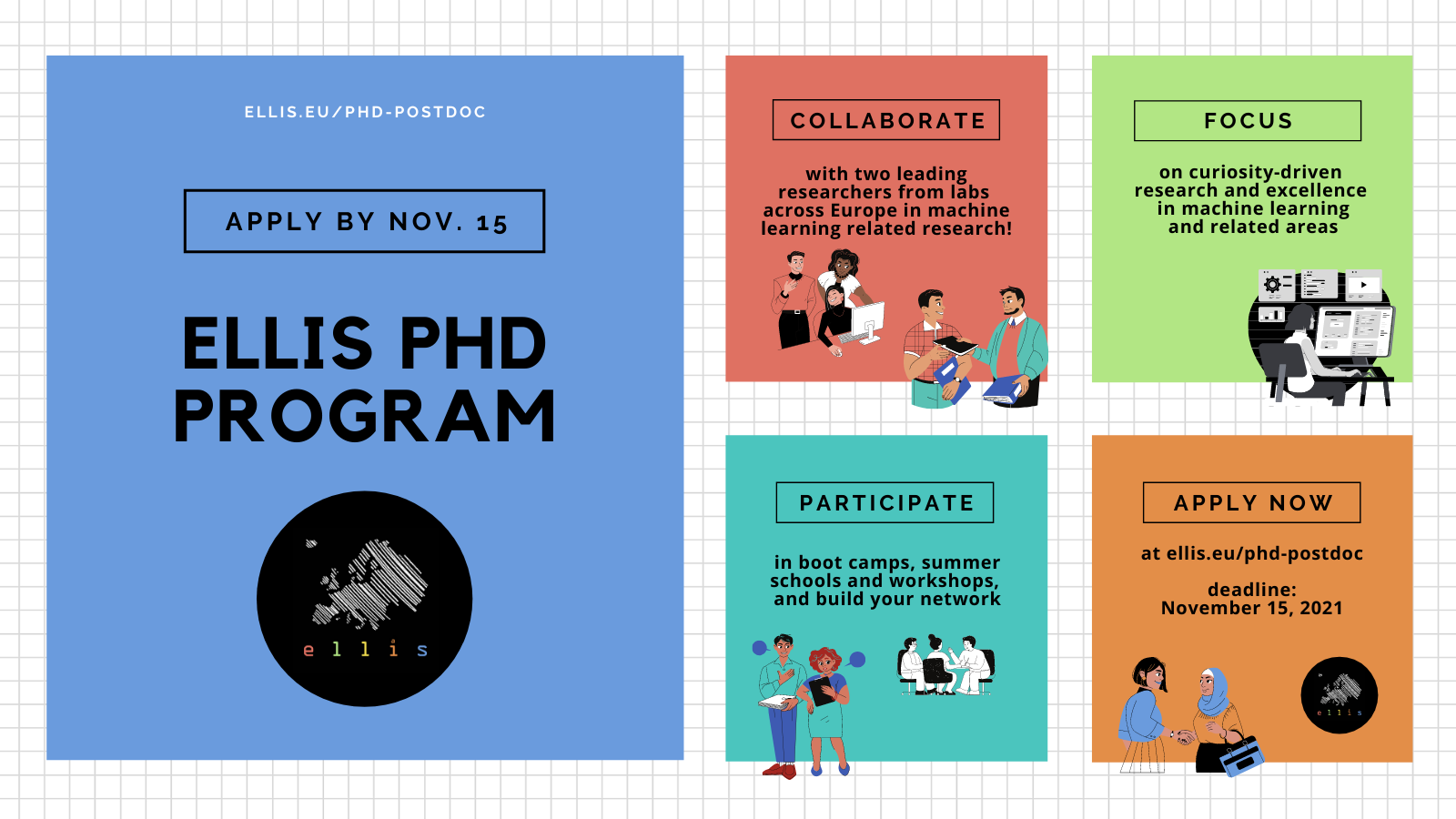
  • ELLIS-PhD-Programm: Aufruf zur Bewerbung

    ELLIS-PhD-Programm: Aufruf zur Bewerbung

    Das Programm bietet Doktorand:innen aus der ganzen Welt die einmalige Gelegenheit, von den Vorteilen des paneuropäischen Forschungsnetzes zu profitieren, und befindet sich nun in seiner zweiten zentralen Einstellungsrunde.

    Das ELLIS-PhD-Programm hat seine zweite Bewerbungsrunde gestartet. Als Schlüsselelement der ELLIS-Initiative besteht sein zentrales Ziel darin, die besten Talente auf dem Gebiet des maschinellen Lernens und verwandter Forschungsbereiche zu fördern und auszubilden, indem herausragende Studierende mit führenden akademischen und industriellen Forschenden in Europa zusammengebracht werden. Das Programm bietet auch eine Vielzahl von Vernetzungs- und Schulungsaktivitäten, darunter Sommerschulen und Workshops. Jede:r Doktorand:in wird von einem ELLIS-Fakultätsmitglied an einer der Partnerinstitutionen mitbetreut. Im Laufe ihres Studiums absolvieren sie außerdem einen obligatorischen mindestens sechsmonatigen Austausch mit einem Co-Betreuer bzw. einer Co-Betreuerin an einer anderen Einrichtung innerhalb des europäischen Netzwerks. Einer der Betreuer:innen kann auch aus der Industrie kommen. In diesem Fall arbeiten die Studierenden eng mit dem Partner bzw. der Partnerin aus der Privatwirtschaft zusammen und verbringen ihren Austausch mit Forschungsarbeiten in einem Industrielabor.

    Die Bewerbungsfrist endet am 15. November 2021. Interessierte Kandidat:innen sollten sich online über das ELLIS-Bewerbungsportal bewerben, das Anfang Oktober geöffnet wird. Ausführlichere Informationen über das Programm, spezifische Forschungsbereiche und das Bewerbungsverfahren finden Sie auf der ELLIS-Website.

  • Zweiter Workshop, Mental Effort

    Zweiter Workshop, Mental Effort

    Detaillierte Beschreibung des Workshops, der in englischer Sprache abgehalten wird:

    We can all feel exhausted after a day of work, even if we have spent it sitting at a desk. The intuitive concept of mental effort pervades virtually all domains of human information processing and has become an indispensable ingredient for general theories of cognition. However, inconsistent use of the term across cognitive sciences, including cognitive psychology, education, human-factors engineering and artificial intelligence, makes it one of the least well-defined theoretical constructs across fields.

    The purpose of our two-day workshop is to bridge this gap by (a) offering hands-on tutorials on different computational approaches used to model mental effort and by (b) fostering discussion about the operationalization of mental effort among scientists from different research communities and modeling backgrounds.

    Key questions of discussion will include (but are not limited to):

    ● What are the experimental phenomena that lay a foundation for theories of mental effort?

    ● What is the common ground in operationalizing mental effort across different domains of cognitive science?

    ● Which modeling approach(es) is (are) best suited to answer which questions regarding mental effort?

    The workshop is specifically designed to attract scholars with expertise in different modeling

    Call for abstracts and registration

    Are you working on a project or thesis related to mental effort and want to discuss your ideas?

    If so, we are inviting you to present a poster during our virtual poster session.

    Registration and Call for Submission Closes: July 15, 2021

  • So beliebt wie nie: IMPRS-IS erhält Rekordmenge an Bewerbungen

    So beliebt wie nie: IMPRS-IS erhält Rekordmenge an Bewerbungen

    Das Doktorandenprogramm der Forschungskooperation Cyber Valley übertrifft erneut alle Erwartungen.

    Stuttgart/Tübingen – Die erst vor drei Jahren ins Leben gerufene International Max Planck Research School for Intelligent Systems (IMPRS-IS) erfreut sich immer größerer Beliebtheit. Am Ende der jüngst abgeschlossenen Bewerbungsrunde für den fünften Jahrgang von Forschenden konnte das Doktorandenprogramm eine Rekordzahl an Bewerbungen verzeichnen: Von den 968 eingegangenen Bewerbungen haben es die besten 489 in die nächste Begutachtungsphase geschafft. Die Nachwuchsforschenden bewerben sich um voll finanzierte Doktorandenstellen, und würden im Frühjahr 2021 beginnen.

    Ausgewählte Bewerber/innen werden eng mit der Fakultät der IMPRS-IS zusammenarbeiten, bestehend aus Elitewissenschaftler/innen, die mit dem Max-Planck-Institut für Intelligente Systeme (MPI-IS), der Universität Stuttgart und der Universität Tübingen verbunden sind. Die Doktoranden möchten Teil der renommierten multidisziplinären Forschungslandschaft in Stuttgart und Tübingen werden.

    „Wir sind sehr stolz, dass wir erneut eine Rekordzahl an Bewerbungen erhalten haben“, sagt Dr. Leila Masri, die die IMPRS-IS seit ihrem Start Anfang 2017 koordiniert. „Besonders freuen wir uns über die Vielfalt: Studierende aus 55 Ländern haben sich beworben – und fast ein Drittel von ihnen ist weiblich!“

    Derzeit prüft ein Team von über 100 Dozentinnen und Dozenten die Bewerbungen. Im Anschluss daran werden die Mitglieder der Fakultät, assoziierte Fakultätsmitglieder und/oder ihre Vertreter/innen gebeten, vorläufige Gespräche mit den Bewerberinnen und Bewerbern zu führen. Schließlich werden die Spitzenkandidat/innen zur Teilnahme an einem Symposium zur Endauswahl eingeladen, das im Januar 2021 virtuell stattfinden wird.

    „Wir planen, dass unsere gesamte IMPRS-IS-Community an dem Symposium teilnimmt. Es wird eine einleitende Begrüßung geben, Keynotes, Bewerbergespräche und virtuelle Interviews“, sagt Masri. „Ich freue mich darauf, die vielen begabten Studierende virtuell zu treffen, von ihren aktuellen Forschungsprojekten zu hören und zu erfahren, woran sie in Zukunft arbeiten möchten, sollten sie Teil unserer Doktorandenschule werden.“

    Die International Max Planck Research School for Intelligent Systems vereint das MPI für Intelligente Systeme und die Universitäten Tübingen und Stuttgart. Zusammen bilden sie eine interdisziplinäre Graduiertenschule mit 34 international renommierten Fakultätsmitgliedern – allesamt Spitzenforscher/innen im Bereich computergestützte Kognitionswissenschaften, Computergrafik, Computer-Vision, Steuerungssysteme, Mensch-Computer-Interaktion, Maschinelles Lernen, Mikro- und Nanorobotik, Wahrnehmungsinferenz und Robotik. Das Doktorandenprogramm ist ein Schlüsselelement der Cyber Valley Forschungskooperation, die sich unter anderem zum Ziel gesetzt hat, den weltweit besten Nachwuchsforscher/innen im Bereich künstliche Intelligenz eine erstklassige Ausbildung zu bieten.

    Zurzeit promovieren 159 Vollzeit-Stipendiaten im Rahmen der IMPRS-IS und übertreffen damit bei weitem die anfängliche Vision, 100 Doktoranden im Laufe der ersten sechsjährigen Laufzeit des Stipendiums zu rekrutieren. Die IMPRS-IS ist eine der größten IMPRS-Doktorandenschulen der Max-Planck-Gesellschaft. Die hohen Rekrutierungszahlen spiegeln den Erfolg aller Fakultätsmitglieder bei der Einwerbung von Drittmitteln sowie ihr Geschick bei der Schaffung attraktiver Forschungsprojekte wider, die qualifizierte Bewerber anziehen.

    Die Gründung der IMPRS-IS wurde ermöglicht durch einen zentralen Förderzuschuss der Max-Planck-Gesellschaft an das MPI-IS für zunächst sechs Jahre sowie durch eine bedeutende Förderung des Landes Baden-Württemberg für die Promotion an den Universitäten Tübingen und Stuttgart. Die erste Generation mit 28 Doktorand/innen aus elf Ländern begann ihre Arbeit im Herbst 2017. Die in einem mehrstufigen Verfahren ausgewählten Wissenschaftler/innen haben jeweils einen Master-Abschluss in einem Forschungsgebiet mit Bezug zu intelligenten Systemen: Mathematik, Informatik, Maschinelles Lernen, Physik, Ingenieurwesen oder Robotik.

    Mehr Infos zur IMPRS-IS finden Sie unter: https://imprs.is.mpg.de

  • The Max Planck-ETH PhD program: Call for Applications

    The Max Planck-ETH PhD program: Call for Applications

    The Max Planck ETH Center for Learning Systems (CLS), a joint academic program between the Eidgenoessische Technische Hochschule (Zurich, Switzerland) and the Max Planck Society, primarily the Max Planck Institute for Intelligent Systems (Stuttgart / Tuebingen, Germany), is currently accepting applications for 2021.

    The highly competitive fellowship program aims to advance artificial intelligence by achieving a fundamental understanding of perception, learning, and adaption in complex systems through a platform for exchange in research and education. Applicants should have a strong interest in doing basic research in areas such as:

    • Machine learning and empirical inference of complex systems

    • Machine intelligence, including machine vision and natural language understanding

    • Perception-action cycle for autonomous systems

    • Robust model-based control for intelligent behavior

    • Robust perception in complex environments

    • Synthetic, bio-inspired, and bio-hybrid micro/nanoscale robotic systems

    • Haptic intelligence

    • Data-driven computational biology and medical informatics

    • Neurotechnology and emergent intelligence in nervous systems

    Ph.D. students are co-supervised by an advisor from each partner institution. All Ph.D. fellows will register as graduate students at ETH Zurich. Upon successful completion of their Ph.D. project, they will be granted a doctoral degree by ETH. The program offers a wide range of activities including retreats, workshops, and summer schools. Fellowships are remunerated through employment contracts with the Max Planck Society and ETH Zurich. The program language is English.

    Applicants must hold or expect to hold an excellent master's degree in a relevant subject and should be enthusiastic about spending time during at both CLS partner institutions over the course of their Ph.D. Good written and spoken English is essential. Anyone who meets our academic requirements is encouraged to apply, regardless of gender, nationality, or background.

    Please submit your application through our online application portal. Applications sent via email or postal services will not be considered. The application deadline is midnight (23:59 CET) on November 2, 2020.

    For further information about financial support, required documents, and our selection process please visit: https://learning-systems.org

  • ELLIS PhD Program: Call for Applications

    ELLIS PhD Program: Call for Applications

    The program supports excellent PhDs across Europe by giving them access to leading research through boot camps, summer schools and workshops of the ELLIS programs. Every PhD student is supervised by one ELLIS fellow/scholar and one ELLIS member from a different country and conducts a 1 year exchange at the other location.

  • Scientific Symposium

    Scientific Symposium


    Schedule (CEST)

    __________________________________________

    8:55 am – 9:00 am    Opening remarks

    9:00 am – 11:00 am    Presentations | Part One

    11:00 am – 2:00 pm    – Break –

    2:00 pm – 4:00 pm    Presentations | Part Two 

    __________________________________________


    Justus Thies

    Technical University of Munich, Germany

    Talk: Monday, August 31, 2020 – 9:00-9:30 am

    Neural Rendering and Representation Learning for 3D Holograms of Humans

    Communicating via text messages, audio-, or video-calls is a part of our modern society. As a next evolution step, we already see early implementations of virtual 3D telepresence systems and personalized avatars. Capturing natural motions and expressions as well as the photorealistic reproduction of images under free views are challenging. With the rise of deep learning methods and, especially, neural rendering, we see immense progress to succeed in these challenges. In this talk, I will give an overview of my previous and ongoing research about image synthesis of humans, the underlying representation of appearance, geometry, and motion to allow for explicit and implicit control over the synthesis process. Specifically, I will talk about my work on facial reenactment and neural rendering. 


    Jochen Müller

    Harvard University, Cambridge, USA

    Wyss Institute for Biologically Inspired Engineering

    Talk: Monday, August 31, 2020 – 9:30-10:00 am

    A computational approach to the creation of digital matter

    Human creativity, combined with bioinspiration and modern, computational tools is now able to derive the most captivating designs, elevating both structural appearance and functionality to unprecedented levels. The physical realization of these designs, however, remains a bottleneck. On the other end, the grand challenge in manufacturing is to create a process that is economical, fast, repeatable, and that enables the desired design freedom in both geometric complexity and choice of materials. Digital Fabrication and, in particular, Additive Manufacturing (AM) has emerged as a potent alternative to conventional manufacturing and is considered by many the holy grail. Despite this hype, however, AM still lacks behind the expectations and is often not able to handle the required complexity, which significantly limits progress in major research fields.

    In my talk, I will address both the digital design of novel materials and structures with outstanding properties, and the fabrication thereof. First, I will present recent research that shows how the mutual exclusivity between stiffness and toughness can be overcome in mechanical metamaterials and how we can integrate (multi-)functionality, such as actuation and sensing, on a materials-level. Second, I will demonstrate AM-based solutions specifically tailored to these design paradigms that cannot be fabricated in any other way. Third, I will address the general limitations of AM and show how they can be (partially) overcome, with the ultimate goal of solving the grand challenge. Finally, I will outline potential next steps and provide a perspective on how the proposed, data-driven design approaches can dictate the future direction of the whole field.


    Christian Rupprecht

    University of Oxford, UK

    Talk: Monday, August 31, 2020 – 10:00-10:30 am

    Minimally Supervised Learning

    We know that deep learning works exceptionally well with copious amounts of annotated training examples. Collecting this data is often tedious, expensive and sometimes even infeasible. This talk explores what we can learn from a reduced amount of annotated data and how including physical priors about the world can substitute manual supervision. We will show how incorporating explicit knowledge about the world in the model can lead to more interpretable predictions and better generalization.  


    Mateusz Malinowski

    DeepMind, London, UK

    Talk: Monday, August 31, 2020 – 10:30-11:00  am

    no image

    Towards Scalable Visual Reasoning

    With deep learning and large-scale datasets, we have seen a seismic shift in computer vision, where more traditional problems such as image recognition on ImageNet are one-by-one tackled with many successes. However, can we build and investigate architectures that go beyond simple classification?

    In the first part of the talk, I will talk about my work on visual question answering. In this line of research, we ask machines various questions about the visual scene. Within that paradigm, we can test the "reasoning" capabilities beyond the typical classification. During the talk, I will also shortly mention related works on grounding language into percepts and actions as well as building a symbolic proof system using deep learning.

    In the second part of the talk, I will briefly introduce my recent work on more scalable and biologically plausible training on temporal input streams such as videos. The underlying hypothesis is that we can exploit various redundancies in such signals to approximate the standard backpropagation algorithm accordingly.


    Seyed-Moohsen Moosavi-Dezfooli

    Institute for Machine Learning, ETH Zurich, Switzerland

    Talk: Monday, August 31, 2020 – 2:00-2:30 pm

    Geometric aspects of adversial robustness of deep networks

    Despite showing impressive classification performance on many challenging benchmarks, generally in well-controlled settings, deep networks are intriguingly vulnerable to adversarial perturbations. It is indeed relatively easy to design noise that can change the estimated label of the classifier. The decision boundaries learned by state-of-the-art image classifiers are known to lie close to data samples. That is precisely why they exhibit such a poor performance under l_p-norm adversarial perturbations. The study of this high-dimensional phenomenon is proven to be a challenging yet extremely crucial task; it will eventually bring important benefits in safety-critical applications of machine learning such as self-driving cars, autonomous robots, and medical imaging.

    In this talk, I will present some geometric insight about deep networks' decision boundaries and how their geometry contributes to the l_p-norm robustness properties of such classifiers. Furthermore, I will demonstrate how these observations can be exploited to design efficient methods to evaluate and improve the robustness of state-of-the-art image classifiers. In particular, I will show how controlling curvature of the decision boundary can be critical to improve l_p adversarial robustness, and how, by exploiting curvature, computationally efficient algorithms can be derived to measure robustness properties.


    Rebekka Burkholz

    Harvard T.H. Chan School of Public Health, Boston, USA

    Talk: Monday, August 31, 2020 – 2:30-3:00 pm

    Cascade Processes in Machine Learning

    Cascade processes have been proven useful in modeling such diverse phenomena as epidemic spreading, signaling in biological networks, information propagation in social media, financial systemic risk, and the reorganization of international trade networks. In this talk, we will focus on two model classes, load redistribution and spreading models, and use them as means to an end to improve and develop machine learning algorithms. We will leverage the fact that load redistribution models correspond one-to-one to the evaluation of deep neural networks. We will derive successful initialization strategies and speed up model training based on analytic insights for random graph ensembles. We will further discuss how we can utilize these improvements for the inference of gene regulatory networks.


    Antonio Vergari

    University of California, Los Angeles, USA

    Talk: Monday, August 31, 2020 – 3:00-3:30 pm

    From Simple Inference to Complex Probabilistic Reasoning

    Probabilistic reasoning is generally considered to be the framework-of-choice to enable and support decision making under uncertainty in real-world scenarios. Ideally, we would like a probabilistic ML system that is deployed in the wild to be able to i) allow humans (or other AI agents) to pose arbitrary and articulated queries, that is questions about states of the world; ii) to provide guarantees on their results; iii) to deal with complex, heterogeneous and potentially structured data and, moreover iv) to support chaining several inference steps together. In this talk, I will argue that the above desiderata are still unmet in the current landscape of probabilistic ML. Even the most prominent paradigm nowadays, deep generative modeling, is able to provide only a shallow, simplistic, form of inference and struggles when dealing with complex queries or data. I will then delineate how my past and current research aimed at closing this gap. Specifically, I will touch some recent works investigating principled frameworks within dealing with complex tasks such as reasoning about the behavior of classifiers or dealing with algebraic constraints over heterogeneous data can be done elegantly and efficiently. Lastly I will talk about some future research perspectives: extending these complex probabilistic reasoning routines to interactive and relational settings while allowing for approximations with guarantees.


    Roberto Calandra

    Facebook AI Research, USA

    Talk: Monday, August 31, 2020 – 3:30-4:00 pm

    Towards Embodied Intelligence

    The creation of intelligent embodied artificial agents has long been a dream for roboticists and artificial intelligence researchers alike. In this talk, I will argue for several key advances that I believe are necessary before we can achieve this dream, and in particular two of these key research areas: multi-modal sensing, and data-efficient learning for fast adaptation. Regarding multi-modal sensing, I will discuss the importance of using alternative sensor modalities in addition to vision, and will present my recent research on using touch sensing to allow robots to perceive, understand, and interact with the world around them. About data-efficient learning, I will discuss the use of model-based reinforcement learning — which explicitly creates models of the world — and present some of my recent works to understand and overcome the limitations of current approaches


  • Cyber Valley Research Forum (virtual)

    Cyber Valley Research Forum (virtual)

    At this edition of the event, we will focus on the University of Stuttgart's Cyber Valley groups as well as on a recently established group at the University of Tübingen. In addition, our partners from Fraunhofer IPA and IAO will present the AI Innovation Center "Learning Systems" and their AI-related areas of research.

    Due to COVID-19 restrictions, the workshop will be held online (Zoom). If you would like to participate, please register here.


    Schedule
    13:30 Welcome
    13:30 – 13:40 AI Innovation Center “Learning Systems”
    https://www.ki-fortschrittszentrum.de
    13:40 – 14:00

    Dr. Tian Qiu

    Biomedical Microsystems, Institute of Physical Chemistry, University of Stuttgart

    Title: Augmented Reality Organ Phantom for the Generation of Biomedical Data

    Abstract:
    Biomedical data of the human body is complex and difficult to acquire for safety, ethical, legal, and technical reasons.  Building a realistic organ phantom based on rapid prototyping and augmented reality technologies is one of our group's research focuses. The phantom system represents the anatomy and the material properties of real organs. Moreover, the model can sense what it experiences and generate a large amount of data, which is not even possible with a real organ. The data will offer unique opportunities to train surgeons and optimize surgeries, and to develop new medical instruments and life protection systems.

    14:00 – 14:20

    Prof. Dr. Michael Sedlmair

    Virtual Reality and Augmented Reality, Visualization Research Center (VISUS), University of Stuttgart

    Title: VR/AR research at VISUS

    Abstract:
    I will introduce several examples of current Virtual/Augmented Reality (VR/AR) projects from the Visualization Research Center (VISUS) at the University of Stuttgart. Much of our work focuses on how data visualization can be meaningfully combined with VR/AR. Also referred to as Immersive Analytics, this combination is a popular topic. However, many things can go wrong. We will look at some of these pitfalls, identify ways of overcoming them, and outline scenarios that could have a truly significant and lasting effect.

    14:20 – 14:40

    Prof. Dr. Jakob Macke

    Machine Learning in Science, Cluster of Excellence "Machine Learning", University of Tübingen

    Title: Simulation-based inference: Bridging the gap between machine learning and scientific modelling

    Abstract:
    Many fields of science and engineering make extensive use of complex simulations that describe the structure and dynamics of the process being investigated. These models are derived from knowledge of the underlying mechanisms and are of critical importance for scientific hypothesis-building. However, linking such complex models to high-dimensional empirical data can be challenging. My group develops computational tools that aim to bridge the gap between data-driven machine learning and theory-driven, scientific modelling, with a focus on applications in the life sciences. In this talk, I will focus on our recent work on using neural conditional density estimators to perform Bayesian inference on simulation-based models. I will demonstrate the efficiency and flexibility of this approach and highlight applications to dynamical models of biological systems and source-reconstruction in biological imaging.

    14:40 – 15:00

    Prof. Dr. Alexander Brem

    Entrepreneurship in Technology and Digitization, Institute of Entrepreneurship in Technology and Science, University of Stuttgart

    Title: How AI-driven applications enhance Innovation and Entrepreneurship

    Abstract:
    Artificial intelligence (AI) is changing how entrepreneurs and companies innovate. Startups and established companies are developing a wide range of AI-driven applications, addressing different tasks along the innovation process. These tasks include, just to mention a few, the detection of emerging technologies and trends, the identification of customer needs or lead users, the generation of user feedback from emotional facial recognition, or the automated creation of new product designs.
    In light of such rapid developments, we offer an overview on how AI is being current used in creativity, innovation, and entrepreneurship. We describe how technology and management researchers in these fields are studying the applications and impact of AI. Finally, we outline the current research areas (still emerging) and suggest areas for further management research using AI and research on AI’s impact on innovation and entrepreneurship processes.

    15:00 – 15:25

    Fraunhofer Institute for Manufacturing Engineering and Automation (IPA)

    Dependable AI built on Explainability, Verification and Uncertainty Quantification
    (Nina Schaaf, Xinyang Wu, Marcel Albus)

    Computer Vision for Quality Control and Robotics
    (Bernd Meese, Johannes Stoll)

    Cognitive Robotics: Deep Learning for Robotic Grasping and Assembly
    (Marius Moosmann, Arik Lämmle)

    15:25 – 15:50

    Fraunhofer Institute for Industrial Engineering (IAO)

    X-tended Reality@Fraunhofer IAO – Labs and Usecases in the field of Building Construction
    (Alexandros Giannakidis, Günter Wenzel)

    AI-based solutions for text documents analysis
    (Maximilien Kintz)

    Applied Neuroscience and Neuroadaptive Technology
    (Katharina Lingelbach, Mathias Vukelic)

    Variable and adaptive driving behaviour and vehicle interior: Robust, safe and fun with AI
    (Frederik Diederichs, Mathias Vukelic, Matthias Bues)

    15:50 – 16:00 Wrap-up
  • 2020 Intelligent Systems Summer Colloquium

    2020 Intelligent Systems Summer Colloquium

    MPI-IS cordially invites you to attend the 2020 Intelligent Systems Summer Colloquium

    Please see below for the schedule.

    The Max Planck Institute for Intelligent Systems is delighted to invite you to its annual scientific summer colloquium, formerly referred to as the Günter Petzow Colloquium.

    Date: Friday, July 24, 2020
    Virtual Meetup Time: 2:00 p.m.

    The event will commence at 2:00 pm that day and include four scientific presentations as well as a Ph.D. graduation ceremony. This year, it will be held virtually through a stable video-conferencing service. All current and former employees, friends of the institute, and the interested public are invited to this event.

    On the occasion of this year's summer colloquium, the Stuttgart site of the Max Planck Institute for Intelligent Systems will award the 15th annual Günter Petzow Prize to a young scientist from the institute for outstanding research in the field of materials science. Professor Günter Petzow was a Director at the Max Planck Institute for Metals Research in Stuttgart between 1973 and 1994. He is internationally renowned for his trend-setting research on multicomponent materials.

    The Günter Petzow Prize is funded by the Stifterverband für die Deutsche Wissenschaft and Volkswagen AG.

    Given his outstanding research success here at MPI-IS, the selection committee has chosen to bestow upon:

    Dr. Hakan Ceylan
    the
    2020 Günter Petzow Prize.

    Dr. Hakan Ceylan is a senior research scientist in the Physical Intelligence Department. He will be awarded this prize for his achievements in developing new design principles, materials, and manufacturing strategies that enable untethered soft robots as small as a single cell.

    Professor Metin Sitti will introduce Dr. Ceylan, who will then deliver a 25-minute presentation on his research.

    The final part of the colloquium will be a graduation ceremony for all of the MPI-IS Ph.D. students who completed their degree in the last year.

    Live transmission of the summer colloquium and the graduation ceremony will take place on the event website.


    Schedule

    14:00

    Opening by Katherine J. Kuchenbecker, Ph.D. (Managing Director)

    Max Planck Institute for Intelligent Systems, Stuttgart

    14:15

    Professor Syn Schmitt

    Morphological computation: from hopping robots to micro swimmers to human walking

    Institute for Modelling and Simulation of Biomechanical Systems, University of Stuttgart

    Abstract and speaker’s short biography >>

    Biological motion is fascinating. Especially locomotion plays a crucial part in the evolution of life. Highly evolved structures, like bones connected by joints and soft tissues and contracting proteins in a muscle-tendon unit, enable and prescribe the respective species' specific locomotion pattern. Most importantly, biological motion is autonomously learned, it is untethered as there is no external energy supply and typical for vertebrates, it's muscle-driven.

    This talk will focus on structures, which facilitate motion by their design and present criteria to measure to which extent a specific motion pattern is facilitated, i.e. morphological computation (MC). We will discuss, whether assessing MC helps in understanding how biology solves challenges, like non-linearity of materials, redundancy of actuators, delays of sensor signals and finally, learning motion.

    Syn Schmitt studied physics at the University of Stuttgart and graduated from the University of Tuebingen with a PhD in Theoretical Astrophysics (topic: muscle modelling / computational biophysics). In 2012, Schmitt was appointed as Juniorprofessor (assistant professor) at the University of Stuttgart. Since 2018, he is full professor of "Computational Biophysics and Biorobotics" at the University of Stuttgart and in 2019 he founded the Institute for Modelling and Simulation of Biomechanical Systems, together with his colleague Oliver Roehrle. Syn Schmitt is fellow of the Stuttgart Center for Simulation Science (SimTech) and a faculty member of the International Max Planck Research School for Intelligent Systems (IMPRS-IS). Recently, he was appointed as Adjunct Professor in the School of Mechanical, Medical and Process Engineering of the Queensland University of Technology in Brisbane, Australia. His research focuses on autonomous muscle-driven motion with special interests in design principles of the locomotion apparatus, non-linear dynamics of locomotion, motor control and morphological computation in biological and technical systems.

    14:45

    Peter Dayan, Ph.D.

    Model based and model free interactions: inference, influence and confidence

    Computational Neuroscience, Max Planck Institute for Biological Cybernetics, Tübingen

    Abstract and speaker’s short biography >>

    An influential reinforcement learning framework proposes that behaviour is jointly governed by model-free (MF) and model-based (MB) controllers. Whereas the former learns the values of actions directly from past encounters, the latter uses a cognitive map of the task to calculate them prospectively. Considerable attention has been paid to how these systems interact during choice, however, how they interact in more general facets of decision-making such as learning and confidence is unclear. Using variants of a simple task that lays out limpidly various aspects of the interaction, we show how MB information resolves uncertainty and focuses MF learning, and discuss unexpected facets of their joint contribution to confidence.

    Peter Dayan read Mathematics at Cambridge, studied for his PhD with David Willshaw in Edinburgh, and did postdocs with Terry Sejnowski at the Salk Institute and Geoff Hinton in Toronto. He was an assistant professor in the Department of Brain and Cognitive Sciences at MIT, and was a founding faculty member of the Gatsby Computational Neuroscience Unit at UCL, which he then ran for 15 years. He is currently a Director at the Max Planck Institute for Biological Cybernetics. His interests include affective decision making and neural reinforcement learning.

    15:15

    Professor Marco Hutter

    From legged robots to digital fabrication

    Institute of Robotics and Intelligent Systems (IRIS), ETH Zürich

    Abstract and speaker’s short biography >>

    Recent development in robotics, machine automation and intelligence has led to systems that are skilled and mature enough for real-world deployment. For example, quadrupedal robots have reached a level of mobility to navigate complex environments, which enables them to take over inspection or surveillance jobs in place like offshore industrial plants, in underground areas, or on construction sites. In this talk, I will present our research work with the quadruped ANYmal, mobile manipulators and automated construction machines, and explain some of the underlying technologies for locomotion control, manipulation, environment perception, and mission autonomy. I will show how these robots can learn and plan complex manoeuvres, how they can navigate through unknown environments and how they are able to conduct surveillance, inspection or construction tasks with super-human precision.

    Marco is an assistant professor for robotic systems at ETH Zurich, associate member of MPI-ETH Learning Center, and founder of ANYbotics AG. He studied mechanical engineering and completed his doctoral degree in robotics at ETH. Marco’s research interests are in the development of novel machines and actuation concepts together with the underlying control, planning, and learning algorithms for locomotion and manipulation. Marco is part of the National Centre of Competence in Research (NCCR) Robotics and NCCR Digital Fabrication and PI in various international projects (e.g. EU Thing) and challenges (e.g. DARPA SubT). His work has been recognized with a number of awards and prestigious grants such as the Branco Weiss Fellowship, ETH medal, IEEE/RAS Early Career Award or ERC Starting Grant.

    15:45
    Günter Petzow Prize Award Ceremony
    16:00

    Dr. Hakan Ceylan, Winner of the 2020 Günter Petzow Prize

    Cell-Size Robots for Minimally Invasive Medical Interventions and Targeted Delivery

    Physical Intelligence Department, Max Planck Institute for Intelligent Systems, Stuttgart

    Abstract and speaker’s short biography >>

    Untethered mobile robots the size of a human cell can make a disruptive impact in medicine. Their small size and wireless mobility can enable access and navigation in small, confined, hard-to-reach, and sensitive inner body sites, such as the central nervous system, the circulatory system, and the fetus. At these locations, such tiny machines can provide new ways of minimally invasive surgical interventions, remain inside for long durations as semi-implantable devices, and deliver targeted diagnosis and therapy with high precision and repeatability. To achieve these goals, however, there are many scientific and technical challenges to overcome. In this talk, I will present design, fabrication and control of cell-sized mobile robots for medical applications. I will demonstrate that the realization of coupled sensing, response and motion, the pillars of a robotic system, requires new materials and fabrication routes that can produce highly integrated systems that successfully interact with the environment. I will explore alternative power sources and design principles that would realistically sustain robotic operations at the microscopic size scales. I will demonstrate medical microrobots with the capabilities of moving around, sensing, responding to the local pathological information, and performing specific diagnostic and therapeutic tasks as orderly executed operations using their smart composite material architectures. Upon completing their functions, most of the microrobots I have developed are enzymatically degradable at the physiological conditions. Given the progress and the status of this emerging field, I will finally be providing a translational perspective on medical microrobotics research with an application-oriented, integrative design approach where powering, materials, fabrication, control, localization and medical functionalities need to be considered altogether at the same time. I will discuss the complexity of the challenges ahead and the potential directions to overcome them.

    Hakan Ceylan is a senior research scientist at Max Planck Institute for Intelligent Systems, Stuttgart, Germany, working on medical microrobots, bioinspired materials, molecular engineering, and intelligence at microscopic length scales. He received the BSc. degree in molecular biology and genetics (with high honor) and the Ph.D. degree in materials science and nanotechnology in 2010 and 2014, respectively, from Bilkent University, Ankara, Turkey. Dr. Ceylan was a post-doctoral researcher during 2014-2017 at Max Planck Institute for Intelligent Systems. He has been an associate member of Max Planck ETH Center for Learning Systems since 2015, the first joint institute of Max Planck Society and ETH Zurich. Dr. Ceylan’s inventions have resulted in one granted two pending patents and over twenty publications in the internationally renowned peer-reviewed journals. He has received several best paper, best talk and science-as-art awards as an extension of his research output. His studies have been publicized by Bayern2 radio, PC Magazine and a number of other printed and web-based German and international media. In 2019, PC Magazine featured Dr. Ceylan’s medical microrobot project among "5 amazing projects that will change the future of healthcare".

    16:30

    Ph.D. Graduation Ceremony

    We congratulate 15 young researchers who successfully defended their doctoral thesis during the past year

    Opening words from Professor Michael J. Black, Max Planck Institute for Intelligent Systems, Tübingen

    List of graduating Ph.D. students >>

    Six world-class universities are awarding doctoral degrees to this year’s batch of graduating students, who are affiliated either directly with MPI-IS or indirectly through our doctoral programs (Cam-Tue, CLS, CMU, and IMPRS-IS).

    University of Cambridge
    Matthias Bauer, Empirical Inference Department, Max Planck Institute for Intelligent Systems, Tübingen (Cam-Tue)
    Paul Rubenstein, Empirical Inference Department, Max Planck Institute for Intelligent Systems, Tübingen (Cam-Tue)

    Carnegie Mellon University
    Mehmet Berk Yigit, Physical Intelligence Department, Max Planck Institute for Intelligent Systems, Stuttgart
    Xiaoguang Dong, Physical Intelligence Department, Max Planck Institute for Intelligent Systems, Stuttgart

    Technical University of Darmstadt
    Dieter Büchler, Empirical Inference Department, Max Planck Institute for Intelligent Systems, Tübingen and Technical University of Darmstadt
    Sebastian Gomez-Gonzales, Empirical Inference Department, Max Planck Institute for Intelligent Systems, Tübingen and Technical University of Darmstadt

    University of Pennsylvania
    Siyao Hu, Haptic Intelligence Department, Max Planck Institute for Intelligent Systems, Stuttgart

    Eberhard Karls University Tübingen
    Anurag Ranjan, Perceiving Systems Department, Max Planck Institute for Intelligent Systems, Tübingen (CLS associate)
    Joel Janai, Autonomous Vision Group and Perceiving Systems Department, Max Planck Institute for Intelligent Systems, Tübingen
    Lars Mescheder, Autonomous Vision Group, Max Planck Institute for Intelligent Systems, Tübingen
    Matthias Kümmerer, Computational Neuroscience & Machine Learning Group, University of Tübingen (IMPRS-IS)
    Siyavash Haghiri, Theory of Machine Learning Group, University of Tübingen
    Steve Heim, Dynamic Locomotion Group, Max Planck Institute for Intelligent Systems, Stuttgart (CLS associate)

    ETH Zürich
    Ceren Yasa, Physical Intelligence Department, Max Planck Institute for Intelligent Systems, Stuttgart (CLS associate)
    Öncay Yasa, Physical Intelligence Department, Max Planck Institute for Intelligent Systems, Stuttgart

    17:30

    Closing by Katherine J. Kuchenbecker, Ph.D. (Managing Director)

    Max Planck Institute for Intelligent Systems, Stuttgart