User Group: Wissenschaftler:innen

  • Scientific Symposium

    Scientific Symposium


    Schedule (CEST)

    __________________________________________

    8:55 am – 9:00 am    Opening remarks

    9:00 am – 11:00 am    Presentations | Part One

    11:00 am – 2:00 pm    – Break –

    2:00 pm – 4:00 pm    Presentations | Part Two 

    __________________________________________


    Justus Thies

    Technical University of Munich, Germany

    Talk: Monday, August 31, 2020 – 9:00-9:30 am

    Neural Rendering and Representation Learning for 3D Holograms of Humans

    Communicating via text messages, audio-, or video-calls is a part of our modern society. As a next evolution step, we already see early implementations of virtual 3D telepresence systems and personalized avatars. Capturing natural motions and expressions as well as the photorealistic reproduction of images under free views are challenging. With the rise of deep learning methods and, especially, neural rendering, we see immense progress to succeed in these challenges. In this talk, I will give an overview of my previous and ongoing research about image synthesis of humans, the underlying representation of appearance, geometry, and motion to allow for explicit and implicit control over the synthesis process. Specifically, I will talk about my work on facial reenactment and neural rendering. 


    Jochen Müller

    Harvard University, Cambridge, USA

    Wyss Institute for Biologically Inspired Engineering

    Talk: Monday, August 31, 2020 – 9:30-10:00 am

    A computational approach to the creation of digital matter

    Human creativity, combined with bioinspiration and modern, computational tools is now able to derive the most captivating designs, elevating both structural appearance and functionality to unprecedented levels. The physical realization of these designs, however, remains a bottleneck. On the other end, the grand challenge in manufacturing is to create a process that is economical, fast, repeatable, and that enables the desired design freedom in both geometric complexity and choice of materials. Digital Fabrication and, in particular, Additive Manufacturing (AM) has emerged as a potent alternative to conventional manufacturing and is considered by many the holy grail. Despite this hype, however, AM still lacks behind the expectations and is often not able to handle the required complexity, which significantly limits progress in major research fields.

    In my talk, I will address both the digital design of novel materials and structures with outstanding properties, and the fabrication thereof. First, I will present recent research that shows how the mutual exclusivity between stiffness and toughness can be overcome in mechanical metamaterials and how we can integrate (multi-)functionality, such as actuation and sensing, on a materials-level. Second, I will demonstrate AM-based solutions specifically tailored to these design paradigms that cannot be fabricated in any other way. Third, I will address the general limitations of AM and show how they can be (partially) overcome, with the ultimate goal of solving the grand challenge. Finally, I will outline potential next steps and provide a perspective on how the proposed, data-driven design approaches can dictate the future direction of the whole field.


    Christian Rupprecht

    University of Oxford, UK

    Talk: Monday, August 31, 2020 – 10:00-10:30 am

    Minimally Supervised Learning

    We know that deep learning works exceptionally well with copious amounts of annotated training examples. Collecting this data is often tedious, expensive and sometimes even infeasible. This talk explores what we can learn from a reduced amount of annotated data and how including physical priors about the world can substitute manual supervision. We will show how incorporating explicit knowledge about the world in the model can lead to more interpretable predictions and better generalization.  


    Mateusz Malinowski

    DeepMind, London, UK

    Talk: Monday, August 31, 2020 – 10:30-11:00  am

    no image

    Towards Scalable Visual Reasoning

    With deep learning and large-scale datasets, we have seen a seismic shift in computer vision, where more traditional problems such as image recognition on ImageNet are one-by-one tackled with many successes. However, can we build and investigate architectures that go beyond simple classification?

    In the first part of the talk, I will talk about my work on visual question answering. In this line of research, we ask machines various questions about the visual scene. Within that paradigm, we can test the "reasoning" capabilities beyond the typical classification. During the talk, I will also shortly mention related works on grounding language into percepts and actions as well as building a symbolic proof system using deep learning.

    In the second part of the talk, I will briefly introduce my recent work on more scalable and biologically plausible training on temporal input streams such as videos. The underlying hypothesis is that we can exploit various redundancies in such signals to approximate the standard backpropagation algorithm accordingly.


    Seyed-Moohsen Moosavi-Dezfooli

    Institute for Machine Learning, ETH Zurich, Switzerland

    Talk: Monday, August 31, 2020 – 2:00-2:30 pm

    Geometric aspects of adversial robustness of deep networks

    Despite showing impressive classification performance on many challenging benchmarks, generally in well-controlled settings, deep networks are intriguingly vulnerable to adversarial perturbations. It is indeed relatively easy to design noise that can change the estimated label of the classifier. The decision boundaries learned by state-of-the-art image classifiers are known to lie close to data samples. That is precisely why they exhibit such a poor performance under l_p-norm adversarial perturbations. The study of this high-dimensional phenomenon is proven to be a challenging yet extremely crucial task; it will eventually bring important benefits in safety-critical applications of machine learning such as self-driving cars, autonomous robots, and medical imaging.

    In this talk, I will present some geometric insight about deep networks' decision boundaries and how their geometry contributes to the l_p-norm robustness properties of such classifiers. Furthermore, I will demonstrate how these observations can be exploited to design efficient methods to evaluate and improve the robustness of state-of-the-art image classifiers. In particular, I will show how controlling curvature of the decision boundary can be critical to improve l_p adversarial robustness, and how, by exploiting curvature, computationally efficient algorithms can be derived to measure robustness properties.


    Rebekka Burkholz

    Harvard T.H. Chan School of Public Health, Boston, USA

    Talk: Monday, August 31, 2020 – 2:30-3:00 pm

    Cascade Processes in Machine Learning

    Cascade processes have been proven useful in modeling such diverse phenomena as epidemic spreading, signaling in biological networks, information propagation in social media, financial systemic risk, and the reorganization of international trade networks. In this talk, we will focus on two model classes, load redistribution and spreading models, and use them as means to an end to improve and develop machine learning algorithms. We will leverage the fact that load redistribution models correspond one-to-one to the evaluation of deep neural networks. We will derive successful initialization strategies and speed up model training based on analytic insights for random graph ensembles. We will further discuss how we can utilize these improvements for the inference of gene regulatory networks.


    Antonio Vergari

    University of California, Los Angeles, USA

    Talk: Monday, August 31, 2020 – 3:00-3:30 pm

    From Simple Inference to Complex Probabilistic Reasoning

    Probabilistic reasoning is generally considered to be the framework-of-choice to enable and support decision making under uncertainty in real-world scenarios. Ideally, we would like a probabilistic ML system that is deployed in the wild to be able to i) allow humans (or other AI agents) to pose arbitrary and articulated queries, that is questions about states of the world; ii) to provide guarantees on their results; iii) to deal with complex, heterogeneous and potentially structured data and, moreover iv) to support chaining several inference steps together. In this talk, I will argue that the above desiderata are still unmet in the current landscape of probabilistic ML. Even the most prominent paradigm nowadays, deep generative modeling, is able to provide only a shallow, simplistic, form of inference and struggles when dealing with complex queries or data. I will then delineate how my past and current research aimed at closing this gap. Specifically, I will touch some recent works investigating principled frameworks within dealing with complex tasks such as reasoning about the behavior of classifiers or dealing with algebraic constraints over heterogeneous data can be done elegantly and efficiently. Lastly I will talk about some future research perspectives: extending these complex probabilistic reasoning routines to interactive and relational settings while allowing for approximations with guarantees.


    Roberto Calandra

    Facebook AI Research, USA

    Talk: Monday, August 31, 2020 – 3:30-4:00 pm

    Towards Embodied Intelligence

    The creation of intelligent embodied artificial agents has long been a dream for roboticists and artificial intelligence researchers alike. In this talk, I will argue for several key advances that I believe are necessary before we can achieve this dream, and in particular two of these key research areas: multi-modal sensing, and data-efficient learning for fast adaptation. Regarding multi-modal sensing, I will discuss the importance of using alternative sensor modalities in addition to vision, and will present my recent research on using touch sensing to allow robots to perceive, understand, and interact with the world around them. About data-efficient learning, I will discuss the use of model-based reinforcement learning — which explicitly creates models of the world — and present some of my recent works to understand and overcome the limitations of current approaches


  • From picking up a cube to writing with a pen – learning dexterous manipulation skills on real-world robotic systems

    From picking up a cube to writing with a pen – learning dexterous manipulation skills on real-world robotic systems

    Tübingen – On August 3, the Max Planck Institute for Intelligent Systems (MPI-IS) in Tübingen, Germany, will launch the first global real-world robotics manipulation challenge in the cloud. The robotics challenge aims to democratize research by giving researchers around the globe access to advanced robotic systems. Until now, this access has generally been limited to top academic and industrial labs in the US, Europe, and Japan.


    “We hope that this competition will lead to a more inclusive robotic learning community, foster exchange across academic and industry labs, and spark cooperation,” says Stefan Bauer, a research group leader in the Empirical Inference Department at the MPI-IS. “But we also want to create a benchmark to know what algorithm works best. We can collect much more data than what is possible in individual labs, as we have standardized tasks on a standardized platform.” Manuel Wüthrich, who is also part of the challenge’s organizing team, adds: “Since the robotic systems run around the clock, they generate enough data to actually use deep learning.”


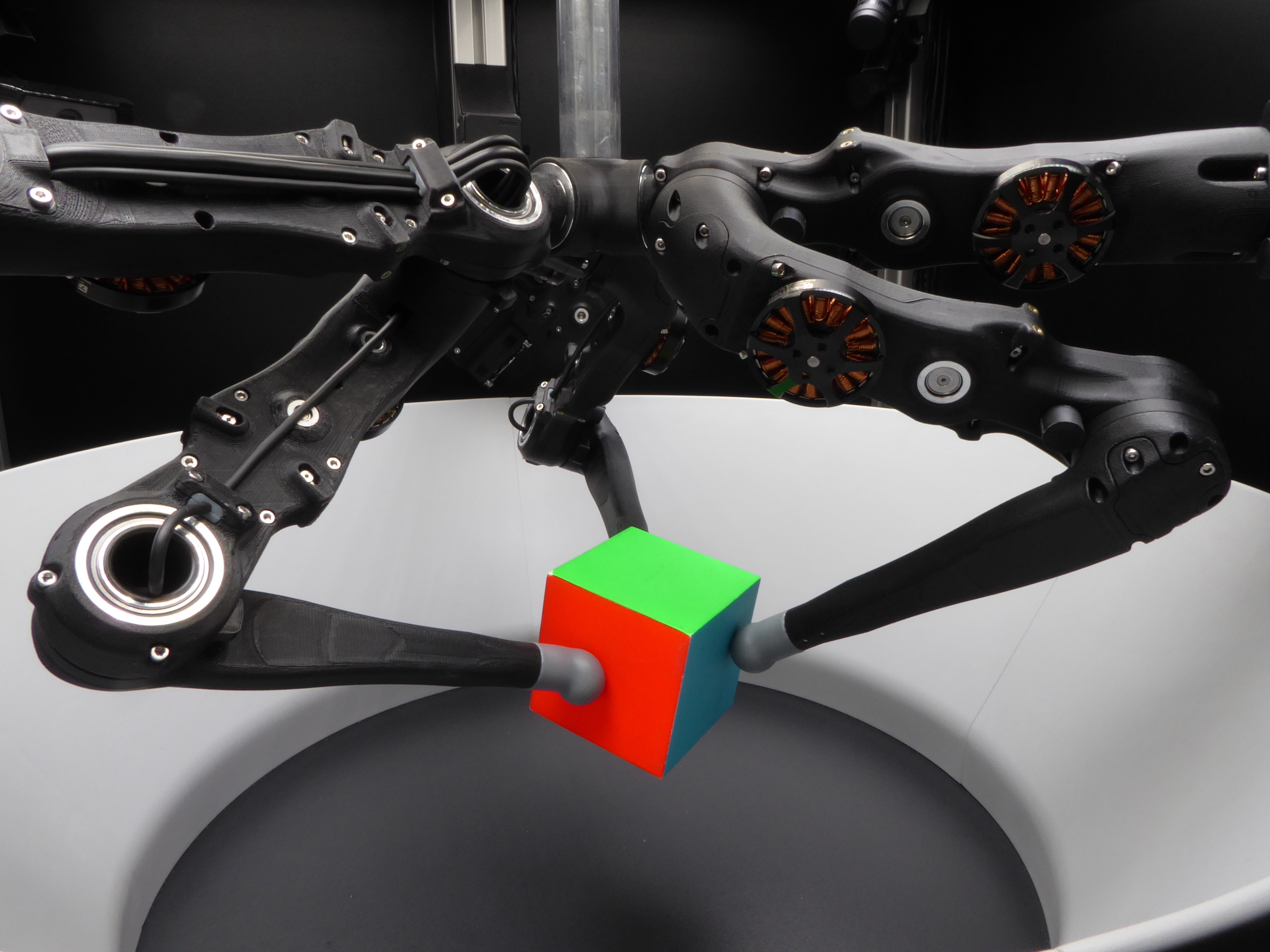
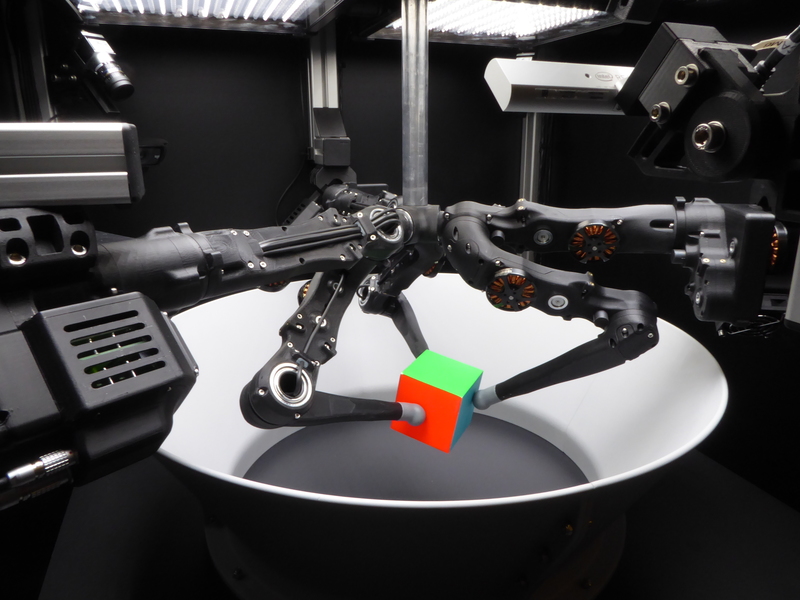
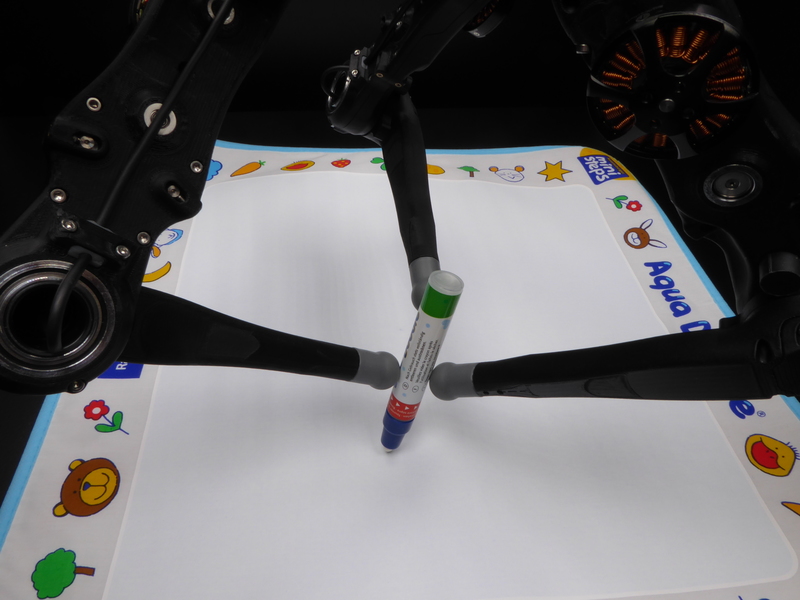
    The robotic platform resembles a hand with three fingers. It is surrounded by three cameras that provide images to measure the results. Several identical robotic platforms have been set up around the robotic lab at the MPI-IS in Tübingen to run the learning algorithms the participating teams submit. Participants can execute their algorithms remotely thanks to a convenient and simple interface. Each team will have a budget of more than 100 real robot hours on one of the high-performing robotic platforms, without any restrictions on the algorithms they execute.


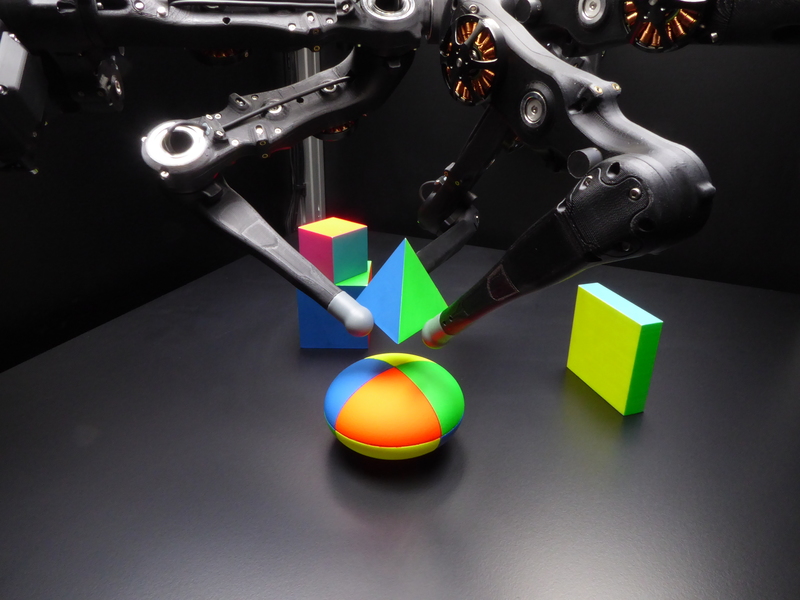
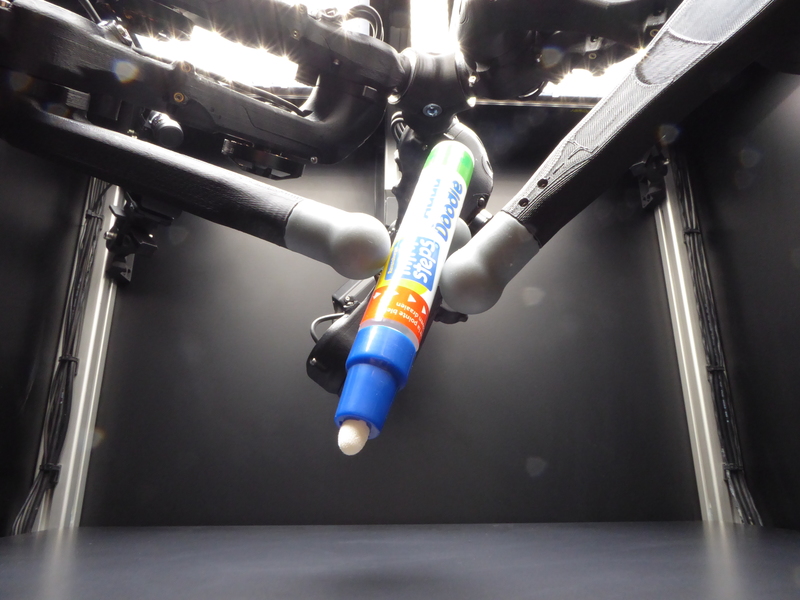
    The challenge comprises three stages. First, participants familiarize themselves with the overall setup and aim to solve a task in a physical simulator. Next, they solve simple real-world tasks: specifically, they are required to train the robot to pick up an object and perform in-hand manipulation with a cube. In the final stage, the robot has to pick up a pen and write a short phrase like “I won!”.


    To achieve these tasks, participants need to design advanced control or reinforcement learning algorithms. “We want to see the extent to which the teams are able to tune their algorithms to fulfill these very difficult tasks. Using a learning-based algorithm for writing with a pen can probably be considered a breakthrough in robotic manipulation,” says Wüthrich.


    “For the first time, we can benchmark all these algorithms on real robots, making them comparable,” says Bauer. “Before, this kind of benchmarking was done mainly in simulation. There is no noise or friction, and contacts are simplified, which makes very impressive results in simulation possible. However, these insights do not typically translate to real robots, in particular for tasks that involve contact and complex interactions with the environment.” Wüthrich adds: “Now, a relatively large number of people who previously didn’t have access to such an advanced robotic platform are able to participate. While some top-notch universities may have extraordinarily good and advanced robots, for most researchers, it is very difficult to gain access to real robotic systems. It is very costly in terms of time and money. Our goal is thus to give a greater number of people  access and an opportunity  to achieve impressive manipulation results.”


    The Real Robotic Challenge will run for 16 weeks. Ultimately, it will help advance the state of the art in dexterous manipulation, which has myriad applications. These include, for instance, construction, cleaning, patient and elder care, agriculture, and product assembly.


    Twitter: @robo_challenge #RoboChallenge

    https://real-robot-challenge.com/

    The robot hand lifts an object and twists it around.

    Several objects make this task more difficult.

    Grabbing a pen is one thing….

    ….but actually writing with it quite another.

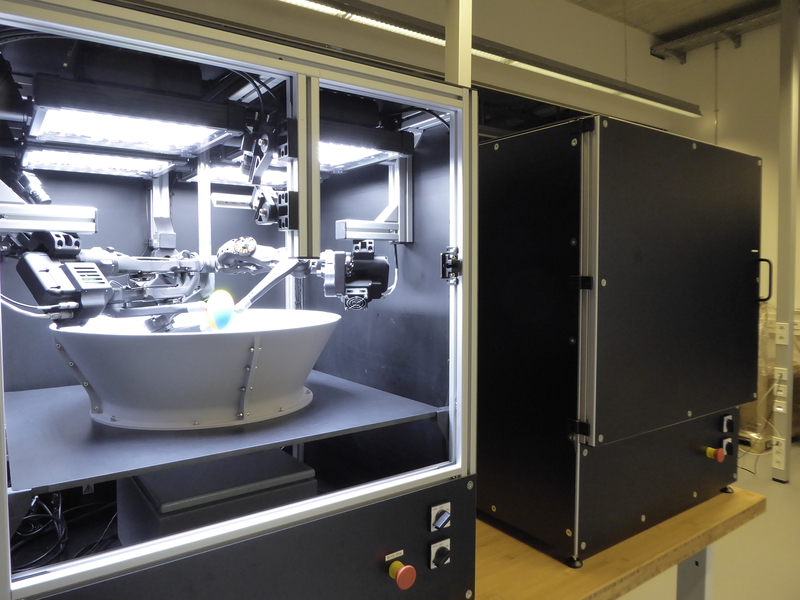
    Several completely identical setups are waiting for algorithms to run on them.

  • IMPRS-IS schickt neue Generation junger Wissenschaftler*innen in die Welt

    IMPRS-IS schickt neue Generation junger Wissenschaftler*innen in die Welt

    Nur drei Jahre nach der Gründung der interdisziplinären Doktorandenschule schließen sechs Ph.D.-Studenten ihre Doktorarbeit ab

    Tübingen/Stuttgart – Nur drei Jahre nach dem Start des interdisziplinären Doktorandenprogramms promovieren an der International Max Planck Research School for Intelligent Systems (IMPRS-IS) sechs Doktoranden. Ingrid Blaschzyk, Siyavash Haghiri, Steve Heim, Matthias Kümmerer, Brahyam Ponto und Alonso Marco Valle werden im Rahmen einer Feier im Anschluss an das Sommerkolloquium des Max-Planck-Instituts für Intelligente Systeme am Freitag, 24. Juli, geehrt.

    Die IMPRS-IS ist ein Schlüsselelement des Forschungskonsortiums Cyber Valley. Das interdisziplinäre Doktorandenprogramm konzentriert sich auf die erstklassige Ausbildung der weltweit besten Nachwuchsforscher*innen auf dem breiten Gebiet der intelligenten Systeme. Die Forschungsprojekte der Absolvent*innen umfassen eine Vielzahl von Themen in den Bereichen Computer Vision, Robotik und Maschinelles Lernen.

    „Diese ersten sechs IMPRS-IS-Absolventen haben einen Hintergrund, der von Mathematik und Informatik bis hin zu Physik und Ingenieurwesen reicht. Die schiere Breite ihrer Forschung zeigt deutlich die potenziellen Auswirkungen intelligenter Systeme auf die Gesellschaft. Ob sie sich nun für eine akademische Laufbahn entscheiden, den Sprung in die Industrie wagen oder ihre eigene Firma gründen, wir sind gespannt, wie diese jungen Wissenschaftler*innen die Zukunft beeinflussen werden“, sagt Katherine J. Kuchenbecker, Sprecherin der IMPRS-IS, Fakultätsmitglied der Schule und Direktorin der Abteilung für Haptische Intelligenz am Max-Planck-Institut für Intelligente Systeme.

    „Es hat mir wirklich Spaß gemacht, diese zukünftige Generation von Wissenschaftler*innen zu unterstützen und ihre Karriere mitzugestalten. Wir sind stolz auf das, was sie geworden sind, und wünschen ihnen alles Gute für die Zukunft“, sagt Leila Masri, die Koordinatorin der IMPRS-IS.
     
    An der Graduiertenschule sind das Max-Planck-Institut für Intelligente Systeme (MPI-IS), die Universität Tübingen und die Universität Stuttgart beteiligt. Insgesamt zählt das Programm 56 international renommierte Fakultätsmitglieder und assoziierte Lehrkräfte. Ihre Forschungsfelder decken alle drei Schlüsselbereiche intelligenter Systeme ab, die allgemein als Wahrnehmen, Handeln und Lernen bezeichnet werden. Der Ansatz, Forschungsmöglichkeiten an drei nahegelegenen Institutionen anzubieten, ist äußerst positiv aufgenommen worden, wobei die Doktorand*innen die einfache Interaktion zwischen Wissenschaftler*innen verschiedener Disziplinen lobten.“Ich habe es wirklich genossen, andere Wissenschaftler aus verschiedenen Forschungsbereichen zu treffen und zu sehen, woran sie arbeiten. Ich kam aus meiner Mathematik- und Stochastik-Blase heraus, um Maschinenbauingenieure und Robotiker zu treffen. Es war großartig, mit Wissenschaftlern aus vielen verschiedenen Disziplinen zu interagieren“, sagt Blaschzyk, dessen Forschungsprojekt sich auf die statistische Analyse von lokalisierten Support-Vektor-Maschinen (SVMs) konzentrierte.

    Die Schule bündelt vorhandene Stärken und baut Brücken zwischen den drei beteiligten Institutionen. „Bevor ich zur IMPRS-IS kam, war ich immer ein wenig enttäuscht, dass in Tübingen und Stuttgart so viel interessante KI-Forschung betrieben wird, allerdings in so vielen verschiedenen Instituten und Abteilungen, dass es sehr schwer war, zu wissen, welche Forschung wo tatsächlich betrieben wird, und formell und informell mit anderen Forschern in Kontakt zu treten. Die IMPRS-IS war für mich genau die zentrale Anlaufstelle, die ich gesucht habe“, sagt Kümmerer.

    Seit ihrer Gründung im Juli 2017 hat die IMPRS-IS eine hohe Sichtbarkeit in der wissenschaftlichen Community erlangt. Bis heute haben sich über 2.000 angehende Forschende aus aller Welt im Rahmen der jährlichen Rekrutierungssymposia um einen Platz in der Schule beworben; der nächste Bewerbungstermin ist der 2. November 2020. Derzeit promovieren 160 Doktoran*innen im Rahmen der IMPRS-IS. Diese Zahl übertrifft bei weitem die anfängliche Vision der Schule, bis zu 100 Doktorand*innen zwischen 2017 und 2023 zu rekrutieren. Gegenwärtig ist die IMPRS-IS eines der größten Promotionsprogramme der 65 derzeit vorhandenen innerhalb der Max-Planck-Gesellschaft (MPG).

    Neben der anfänglichen Finanzierung durch die Max-Planck-Gesellschaft erhält die IMPRS-IS auch erhebliche Mittel des Landes Baden-Württemberg für die Doktorandenausbildung an den Universitäten Tübingen und Stuttgart. Die Auswahl der Stipendiaten erfolgt in einem hart umkämpften mehrstufigen Verfahren mit einer Annahmequote zwischen fünf und acht Prozent. Je nach Hintergrund und Interessenlage hat jeder Stipendiat die Möglichkeit, entweder an der Universität Tübingen oder an der Universität Stuttgart zu promovieren.

    Hagihiri fasst die Auslosung der Schule treffend zusammen: „Ich habe mich bei der IMPRS-IS beworben wegen ihres ausgezeichneten akademischen Rufs, der weltweit renommierten Fakultät und wegen des fantastischen Führungsteams. Ich hab die vielen Gelegenheiten genossen, mit anderen zusammenzuarbeiten und in den Bootcamps und Workshops viel zu lernen“.

    Erfahren Sie mehr über die IMPRS-IS unter https://imprs.is.mpg.de

  • Female Leadership in Cyber Valley – Frauenwirtschaftstage 2020

    Female Leadership in Cyber Valley – Frauenwirtschaftstage 2020

    Agenda

    • Begrüßung
    • Einführung in das Cyber Valley-Projekt
    • Podiumsdiskussion mit weiblichen Führungskräften aus dem Cyber Valley-Ökosystem
    • Fragerunde
    • Netzwerken in Break-Out-Rooms
    • Schlussbemerkungen

    Teilnehmerinnen

    Prof. Dr. Zeynep Akata

    Professorin für Erklärbares Maschinelles Lernen, Exzellenzcluster „Maschinelles Lernen: Neue Perspektiven für die Wissenschaften“, Universität Tübingen

    Dr. Caterina De Bacco

    Cyber Valley Max Planck Forschungsgruppenleiterin, Physik für Inferenz und Optimierung, Max-Planck-Institut für Intelligente Systeme

    Dr. Katherine J. Kuchenbecker

    Geschäftsführende Direktorin und Direktorin der Abteilung für Haptische Intelligenz, Max-Planck-Institut für Intelligente Systeme

    Naureen Mahmood, M.Sc.

    Geschäftsführerin, Meshcapade GmbH, Tübingen

    Prof. Dr. Nicole Radde

    Professorin für Systemtheorie in der Systembiologie, Exzellenzcluster „SimTech“, Universität Stuttgart

    Jun.-Prof. Maria Wirzberger

    Juniorprofessorin für Lehren und Lernen mit intelligenten Systemen, Institut für Erziehungswissenschaft, Universität Stuttgart

    Registrierung

    Bitte melden Sie sich hier an – Teilnehmer*innen inklduiert männlich, weiblich und divers. Die Veranstaltung findet als Zoom-Konferenz und auf Englisch statt.

    Kontakt

    Oliwia Gust, Cyber Valley Event Manager
     +49 7071 6011554
     +49 151 40756302
    oliwia.gust@cyber-valley.de

    Organisation

    Cyber Valley in Kooperation mit dem Max-Planck-Institut für Intelligente Systeme sowie den Gleichstellungsbüros der Universitäten Stuttgart und Tübingen. Die Veranstaltung findet im Rahmen der Frauenwirtschaftstage 2020 statt.

  • Jakob Macke: neuer Professor für Maschinelles Lernen

    Jakob Macke: neuer Professor für Maschinelles Lernen

    Dr. Jakob Macke (geb. 1982) wurde zum Sommersemester 2020 auf die Professur für Maschinelles Lernen in der Wissenschaft an der Mathematisch-Naturwissenschaftlichen Fakultät der Universität Tübingen berufen. Diese Professur wurde im Exzellenzcluster „Maschinelles Lernen – Neue Perspektiven für die Wissenschaften“ eingerichtet.

    Macke studierte Mathematik an der Universität Oxford. Nach seinem Studium arbeitete er als Doktorand am Max-Planck-Institut für Biologische Kybernetik in Tübingen, als Postdoc an der Gatsby Unit des University College London und als Bernstein-Fellow am Max-Planck-Institut in Tübingen. Von 2015 bis 2018 war er Max-Planck Gruppenleiter am Forschungszentrum Caesar in Bonn, ab 2017 zudem Professor am Centre for Cognitive Science der Technischen Universität Darmstadt. Anschließend lehrte und forschte Macke von 2018 bis 2020 als Professor für Computational Neuroengineering an der Technischen Universität München. Von 2013 bis 2018 war er Mitglied der Jungen Akademie an der Deutschen Akademie der Naturforscher Leopoldina.

    Sein Ziel ist es, den wissenschaftlichen Erkenntnisprozess mit Hilfe von Maschinellem Lernen und Künstlicher Intelligenz zu beschleunigen: Er will Methoden entwickeln, die Wissenschaftlerinnen und Wissenschaftler dabei helfen, experimentelle Daten zu interpretieren und sie mit theoretischen Modellen in Einklang zu bringen. Macke arbeitet dabei mit Forschenden aus verschiedenen Disziplinen zusammen. Besonders interessiert er sich für Anwendungen in den Neurowissenschaften: Er will verstehen, wie neuronale Netze im Gehirn sensorische Informationen verarbeiten und intelligentes Verhalten steuern, und Methoden zur Diagnose und Therapie neuronaler Fehlfunktionen entwickeln.

    Weitere Informationen zu den Arbeitsgruppen des ML-Clusters an der Universität Tübingen gibt es hier.

  • Sebastian Trimpe zum ordentlichen Professor an die RWTH Aachen ernannt

    Sebastian Trimpe zum ordentlichen Professor an die RWTH Aachen ernannt

    Der Leiter der Cyber Valley-Forschungsgruppe übernimmt den Lehrstuhl „Data Science in Mechanical Engineering“

    Stuttgart – Sebastian Trimpe, Leiter der Cyber Valley Forschungsgruppe „Intelligent Control Systems“ am Max-Planck-Institut für Intelligente Systeme (MPI-IS) in Stuttgart, hat eine ordentliche Professur (W3) an der RWTH Aachen, der größten technischen Hochschule in Deutschland, übernommen. Die Professur trägt den Titel „Data Science in Mechanical Engineering“. Trimpe baut nun sukzessive das entsprechende Institut auf, das er auch leiten wird. Die kommenden zwölf Monate werden eine Übergangszeit für Trimpes Stuttgarter Forschungsgruppe sein. Trimpe wird in dieser Zeit weiter mit dem MPI-IS verbunden bleiben.

    „Die Leitung meiner Cyber Valley Forschungsgruppe war ein aufregendes Kapitel in meiner Karriere. 2013 kam ich ans MPI-IS und habe es seither sehr genossen, mit allen Forscherinnen und Forschern in Stuttgart und Tübingen eng zusammenzuarbeiten. Ich bin dankbar für die Möglichkeiten, die ich am Institut hatte, und besonders für all die großartigen Kolleginnen und Kollegen“, sagt Trimpe.

    „Sebastian Trimpes akademischer Erfolg ist genau das, was wir uns von Cyber Valley erhoffen“, sagt Michael J. Black, Direktor der Abteilung für Perzeptive Systeme am Max-Planck-Institut für Intelligente Systeme und Sprecher des Cyber Valley Forschungskonsortiums. „Die Positionen als unabhängige Gruppenleiter innerhalb des Cyber Valley Ökosystems geben jungen Wissenschaftlerinnen und Wissenschaftlern die Möglichkeit, ihre Karriere an der Spitze ihres Fachgebiets zu etablieren. Die Ausbildung und Unterstützung der nächsten Generation an Spitzenwissenschaftlern ist unser erklärtes Ziel. Ganz gleich, ob sie eine akademische Laufbahn einschlagen, in der Industrie arbeiten oder ihr eigenes Unternehmen gründen – dies stärkt Deutschlands Führungsposition in der Erforschung künstlicher intelligenter Systeme.“

    Cyber Valley ist Europas größtes Forschungskonsortium auf dem Gebiet der Künstlichen Intelligenz mit Partnern aus Politik, Wissenschaft, Wirtschaft und Gesellschaft. Die Partnerschaft stärkt Forschung und Lehre auf den Gebieten des maschinellen Lernens, des maschinellen Sehens und der Robotik sowie die Verbindungen zwischen diesen Wissenschaftsgebieten. Partner sind das Max-Planck-Institut für Intelligente Systeme, die Universität Stuttgart, die Universität Tübingen, die Fraunhofer Gesellschaft, das Land Baden-Württemberg sowie sieben Industriepartner.

    Trimpe und sein Team untersuchen, was er als „maschinelles Lernen für Maschinen“ bezeichnet: die grundlegende Frage, wie eine Maschine innerhalb bestimmter Grenzen zuverlässig, sicher und effizient aus Daten lernen kann. Konkret geht es in seiner Forschung darum, die Grundlagen zu verstehen, die es künstlich intelligenten Systemen wie Robotern und autonomen Fahrzeugen ermöglichen, in der physischen Welt autonom zu agieren und zu lernen. Um selbstlernende Systeme für die reale Welt zu entwickeln, verbindet Trimpe klassische Methoden der System- und Regelungstheorie mit maschinellem Lernen – zum Beispiel entwickelt er Algorithmen, die physikalisches Wissen über die Welt mit experimentellen Daten kombinieren.

    Lern- und Entscheidungsalgorithmen sind wesentlich für das Funktionieren des Kreislaufs von Wahrnehmen, Entscheiden und Handeln, der auch als Regelkreis bezeichnet wird. Vereinfacht ausgedrückt sind diese Algorithmen das „Gehirn“ eines technischen Systems. Sie stehen im Mittelpunkt von Trimpes Forschung. Mit Hilfe von Sensordaten nimmt die Maschine ihren eigenen Zustand und ihre Umgebung wahr. Auf der Grundlage dieser Daten entscheidet ein Algorithmus, was als nächstes geschehen soll. Die Maschine setzt dann Motoren und andere Aktuatoren ein, um zu handeln und ein gewünschtes Ziel zu erreichen. Dieser Zyklus findet kontinuierlich und oft viele Male pro Sekunde statt. Beispielsweise kann ein Auto automatisch den Abstand zum vorausfahrenden Fahrzeug einhalten, eine Klimaanlage ist in der Lage, eine bestimmte Temperatur einzuregeln, und ein Roboter in Trimpes Labor kann eine Stange selbstständig balancieren. Eine wichtige Forschungsfrage ist, wie solche Maschinen aus Erfahrung und Interaktion mit der Welt lernen können, um ihre Fähigkeiten zu erweitern oder ihre Leistung zu verbessern.

    Trimpe befasst sich auch mit der Kommunikation mehrerer intelligenter Systeme, die gemeinsam eine Aufgabe erfüllen sollen, wie zum Beispiel Gruppen von Robotern. Dies geschieht heute oft über drahtlose Netzwerke. Wenn Maschinen jedoch ständig miteinander kommunizieren, wird das Netzwerk schnell überlastet und wichtige Daten können nicht übertragen werden. Um dieses Problem zu lösen, entwickelt Trimpe intelligente Verfahren, die es jedem Subsystem erlauben, nur dann zu kommunizieren, wenn es etwas Relevantes zu sagen hat. Auf diese Weise ist es vielen Systemen möglich, gemeinsam zu agieren oder voneinander zu lernen, ohne dabei zu viele Ressourcen zu verbrauchen.

    Da Trimpes Forschung auf grundlegenden mathematischen Fragestellungen und deren Lösungen basiert, sind die Ergebnisse allgemein gültig und könnten in Zukunft möglicherweise auf viele verschiedene Systeme übertragen werden. Sein Team hat theoretische Ergebnisse in Laborexperimenten mit humanoiden Robotern und auf drahtlos vernetzten mechatronischen Systemen validiert. In gemeinsamen Projekten mit den Cyber Valley Partnern Bosch und IAV wurden einige der Algorithmen erfolgreich in der Industrie eingesetzt. Beispielsweise wurde der gleiche Algorithmus, den der Roboter Apollo verwendet um zu lernen wie man eine Stange ausbalanciert, auch bei einem Motor angewandt, der selbst lernt, wie man die Drosselklappe am besten steuert (Zusammenarbeit mit der IAV).

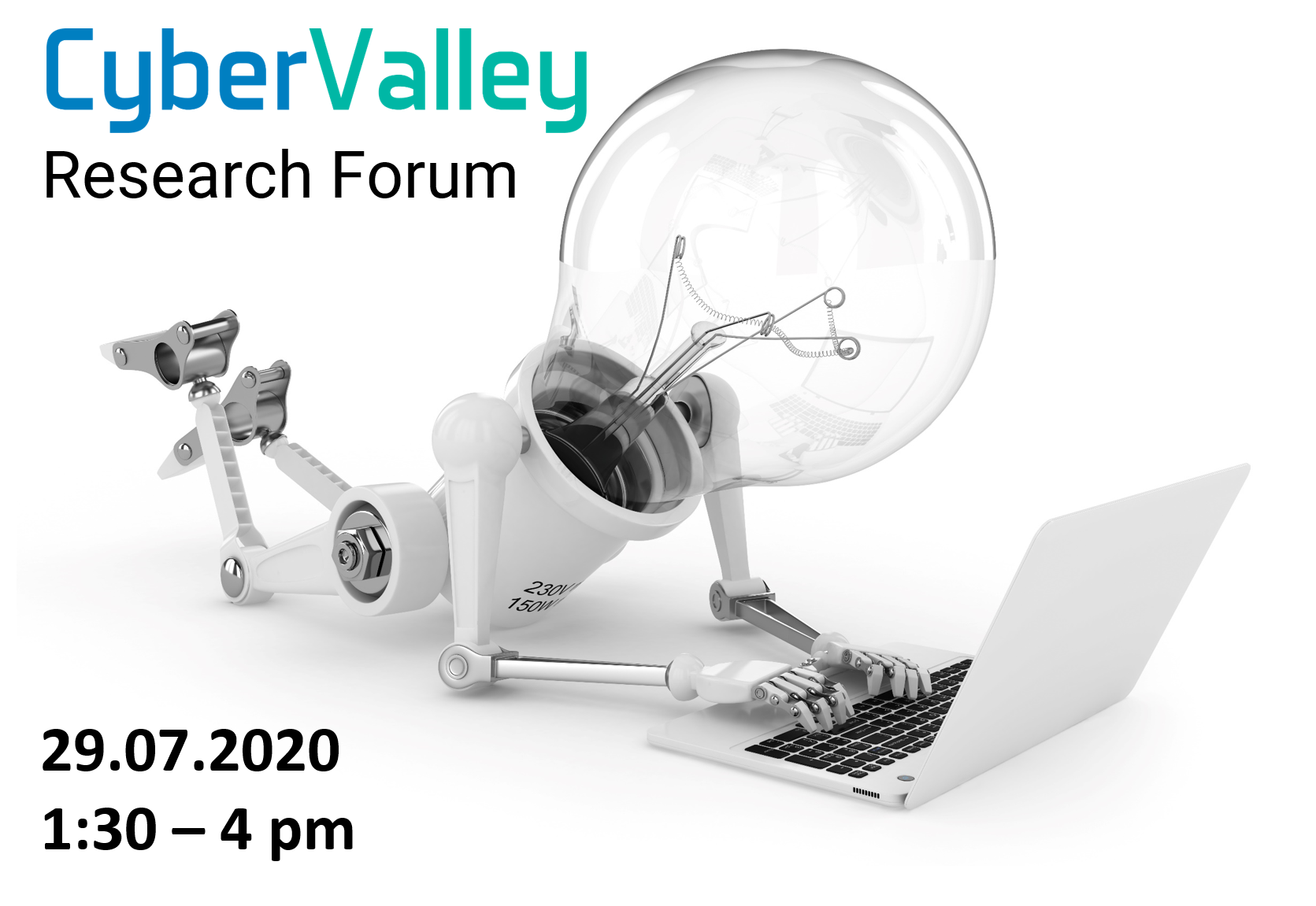
  • Cyber Valley Research Forum (virtual)

    Cyber Valley Research Forum (virtual)

    At this edition of the event, we will focus on the University of Stuttgart's Cyber Valley groups as well as on a recently established group at the University of Tübingen. In addition, our partners from Fraunhofer IPA and IAO will present the AI Innovation Center "Learning Systems" and their AI-related areas of research.

    Due to COVID-19 restrictions, the workshop will be held online (Zoom). If you would like to participate, please register here.


    Schedule
    13:30 Welcome
    13:30 – 13:40 AI Innovation Center “Learning Systems”
    https://www.ki-fortschrittszentrum.de
    13:40 – 14:00

    Dr. Tian Qiu

    Biomedical Microsystems, Institute of Physical Chemistry, University of Stuttgart

    Title: Augmented Reality Organ Phantom for the Generation of Biomedical Data

    Abstract:
    Biomedical data of the human body is complex and difficult to acquire for safety, ethical, legal, and technical reasons.  Building a realistic organ phantom based on rapid prototyping and augmented reality technologies is one of our group's research focuses. The phantom system represents the anatomy and the material properties of real organs. Moreover, the model can sense what it experiences and generate a large amount of data, which is not even possible with a real organ. The data will offer unique opportunities to train surgeons and optimize surgeries, and to develop new medical instruments and life protection systems.

    14:00 – 14:20

    Prof. Dr. Michael Sedlmair

    Virtual Reality and Augmented Reality, Visualization Research Center (VISUS), University of Stuttgart

    Title: VR/AR research at VISUS

    Abstract:
    I will introduce several examples of current Virtual/Augmented Reality (VR/AR) projects from the Visualization Research Center (VISUS) at the University of Stuttgart. Much of our work focuses on how data visualization can be meaningfully combined with VR/AR. Also referred to as Immersive Analytics, this combination is a popular topic. However, many things can go wrong. We will look at some of these pitfalls, identify ways of overcoming them, and outline scenarios that could have a truly significant and lasting effect.

    14:20 – 14:40

    Prof. Dr. Jakob Macke

    Machine Learning in Science, Cluster of Excellence "Machine Learning", University of Tübingen

    Title: Simulation-based inference: Bridging the gap between machine learning and scientific modelling

    Abstract:
    Many fields of science and engineering make extensive use of complex simulations that describe the structure and dynamics of the process being investigated. These models are derived from knowledge of the underlying mechanisms and are of critical importance for scientific hypothesis-building. However, linking such complex models to high-dimensional empirical data can be challenging. My group develops computational tools that aim to bridge the gap between data-driven machine learning and theory-driven, scientific modelling, with a focus on applications in the life sciences. In this talk, I will focus on our recent work on using neural conditional density estimators to perform Bayesian inference on simulation-based models. I will demonstrate the efficiency and flexibility of this approach and highlight applications to dynamical models of biological systems and source-reconstruction in biological imaging.

    14:40 – 15:00

    Prof. Dr. Alexander Brem

    Entrepreneurship in Technology and Digitization, Institute of Entrepreneurship in Technology and Science, University of Stuttgart

    Title: How AI-driven applications enhance Innovation and Entrepreneurship

    Abstract:
    Artificial intelligence (AI) is changing how entrepreneurs and companies innovate. Startups and established companies are developing a wide range of AI-driven applications, addressing different tasks along the innovation process. These tasks include, just to mention a few, the detection of emerging technologies and trends, the identification of customer needs or lead users, the generation of user feedback from emotional facial recognition, or the automated creation of new product designs.
    In light of such rapid developments, we offer an overview on how AI is being current used in creativity, innovation, and entrepreneurship. We describe how technology and management researchers in these fields are studying the applications and impact of AI. Finally, we outline the current research areas (still emerging) and suggest areas for further management research using AI and research on AI’s impact on innovation and entrepreneurship processes.

    15:00 – 15:25

    Fraunhofer Institute for Manufacturing Engineering and Automation (IPA)

    Dependable AI built on Explainability, Verification and Uncertainty Quantification
    (Nina Schaaf, Xinyang Wu, Marcel Albus)

    Computer Vision for Quality Control and Robotics
    (Bernd Meese, Johannes Stoll)

    Cognitive Robotics: Deep Learning for Robotic Grasping and Assembly
    (Marius Moosmann, Arik Lämmle)

    15:25 – 15:50

    Fraunhofer Institute for Industrial Engineering (IAO)

    X-tended Reality@Fraunhofer IAO – Labs and Usecases in the field of Building Construction
    (Alexandros Giannakidis, Günter Wenzel)

    AI-based solutions for text documents analysis
    (Maximilien Kintz)

    Applied Neuroscience and Neuroadaptive Technology
    (Katharina Lingelbach, Mathias Vukelic)

    Variable and adaptive driving behaviour and vehicle interior: Robust, safe and fun with AI
    (Frederik Diederichs, Mathias Vukelic, Matthias Bues)

    15:50 – 16:00 Wrap-up
  • 2020 Intelligent Systems Summer Colloquium

    2020 Intelligent Systems Summer Colloquium

    MPI-IS cordially invites you to attend the 2020 Intelligent Systems Summer Colloquium

    Please see below for the schedule.

    The Max Planck Institute for Intelligent Systems is delighted to invite you to its annual scientific summer colloquium, formerly referred to as the Günter Petzow Colloquium.

    Date: Friday, July 24, 2020
    Virtual Meetup Time: 2:00 p.m.

    The event will commence at 2:00 pm that day and include four scientific presentations as well as a Ph.D. graduation ceremony. This year, it will be held virtually through a stable video-conferencing service. All current and former employees, friends of the institute, and the interested public are invited to this event.

    On the occasion of this year's summer colloquium, the Stuttgart site of the Max Planck Institute for Intelligent Systems will award the 15th annual Günter Petzow Prize to a young scientist from the institute for outstanding research in the field of materials science. Professor Günter Petzow was a Director at the Max Planck Institute for Metals Research in Stuttgart between 1973 and 1994. He is internationally renowned for his trend-setting research on multicomponent materials.

    The Günter Petzow Prize is funded by the Stifterverband für die Deutsche Wissenschaft and Volkswagen AG.

    Given his outstanding research success here at MPI-IS, the selection committee has chosen to bestow upon:

    Dr. Hakan Ceylan
    the
    2020 Günter Petzow Prize.

    Dr. Hakan Ceylan is a senior research scientist in the Physical Intelligence Department. He will be awarded this prize for his achievements in developing new design principles, materials, and manufacturing strategies that enable untethered soft robots as small as a single cell.

    Professor Metin Sitti will introduce Dr. Ceylan, who will then deliver a 25-minute presentation on his research.

    The final part of the colloquium will be a graduation ceremony for all of the MPI-IS Ph.D. students who completed their degree in the last year.

    Live transmission of the summer colloquium and the graduation ceremony will take place on the event website.


    Schedule

    14:00

    Opening by Katherine J. Kuchenbecker, Ph.D. (Managing Director)

    Max Planck Institute for Intelligent Systems, Stuttgart

    14:15

    Professor Syn Schmitt

    Morphological computation: from hopping robots to micro swimmers to human walking

    Institute for Modelling and Simulation of Biomechanical Systems, University of Stuttgart

    Abstract and speaker’s short biography >>

    Biological motion is fascinating. Especially locomotion plays a crucial part in the evolution of life. Highly evolved structures, like bones connected by joints and soft tissues and contracting proteins in a muscle-tendon unit, enable and prescribe the respective species' specific locomotion pattern. Most importantly, biological motion is autonomously learned, it is untethered as there is no external energy supply and typical for vertebrates, it's muscle-driven.

    This talk will focus on structures, which facilitate motion by their design and present criteria to measure to which extent a specific motion pattern is facilitated, i.e. morphological computation (MC). We will discuss, whether assessing MC helps in understanding how biology solves challenges, like non-linearity of materials, redundancy of actuators, delays of sensor signals and finally, learning motion.

    Syn Schmitt studied physics at the University of Stuttgart and graduated from the University of Tuebingen with a PhD in Theoretical Astrophysics (topic: muscle modelling / computational biophysics). In 2012, Schmitt was appointed as Juniorprofessor (assistant professor) at the University of Stuttgart. Since 2018, he is full professor of "Computational Biophysics and Biorobotics" at the University of Stuttgart and in 2019 he founded the Institute for Modelling and Simulation of Biomechanical Systems, together with his colleague Oliver Roehrle. Syn Schmitt is fellow of the Stuttgart Center for Simulation Science (SimTech) and a faculty member of the International Max Planck Research School for Intelligent Systems (IMPRS-IS). Recently, he was appointed as Adjunct Professor in the School of Mechanical, Medical and Process Engineering of the Queensland University of Technology in Brisbane, Australia. His research focuses on autonomous muscle-driven motion with special interests in design principles of the locomotion apparatus, non-linear dynamics of locomotion, motor control and morphological computation in biological and technical systems.

    14:45

    Peter Dayan, Ph.D.

    Model based and model free interactions: inference, influence and confidence

    Computational Neuroscience, Max Planck Institute for Biological Cybernetics, Tübingen

    Abstract and speaker’s short biography >>

    An influential reinforcement learning framework proposes that behaviour is jointly governed by model-free (MF) and model-based (MB) controllers. Whereas the former learns the values of actions directly from past encounters, the latter uses a cognitive map of the task to calculate them prospectively. Considerable attention has been paid to how these systems interact during choice, however, how they interact in more general facets of decision-making such as learning and confidence is unclear. Using variants of a simple task that lays out limpidly various aspects of the interaction, we show how MB information resolves uncertainty and focuses MF learning, and discuss unexpected facets of their joint contribution to confidence.

    Peter Dayan read Mathematics at Cambridge, studied for his PhD with David Willshaw in Edinburgh, and did postdocs with Terry Sejnowski at the Salk Institute and Geoff Hinton in Toronto. He was an assistant professor in the Department of Brain and Cognitive Sciences at MIT, and was a founding faculty member of the Gatsby Computational Neuroscience Unit at UCL, which he then ran for 15 years. He is currently a Director at the Max Planck Institute for Biological Cybernetics. His interests include affective decision making and neural reinforcement learning.

    15:15

    Professor Marco Hutter

    From legged robots to digital fabrication

    Institute of Robotics and Intelligent Systems (IRIS), ETH Zürich

    Abstract and speaker’s short biography >>

    Recent development in robotics, machine automation and intelligence has led to systems that are skilled and mature enough for real-world deployment. For example, quadrupedal robots have reached a level of mobility to navigate complex environments, which enables them to take over inspection or surveillance jobs in place like offshore industrial plants, in underground areas, or on construction sites. In this talk, I will present our research work with the quadruped ANYmal, mobile manipulators and automated construction machines, and explain some of the underlying technologies for locomotion control, manipulation, environment perception, and mission autonomy. I will show how these robots can learn and plan complex manoeuvres, how they can navigate through unknown environments and how they are able to conduct surveillance, inspection or construction tasks with super-human precision.

    Marco is an assistant professor for robotic systems at ETH Zurich, associate member of MPI-ETH Learning Center, and founder of ANYbotics AG. He studied mechanical engineering and completed his doctoral degree in robotics at ETH. Marco’s research interests are in the development of novel machines and actuation concepts together with the underlying control, planning, and learning algorithms for locomotion and manipulation. Marco is part of the National Centre of Competence in Research (NCCR) Robotics and NCCR Digital Fabrication and PI in various international projects (e.g. EU Thing) and challenges (e.g. DARPA SubT). His work has been recognized with a number of awards and prestigious grants such as the Branco Weiss Fellowship, ETH medal, IEEE/RAS Early Career Award or ERC Starting Grant.

    15:45
    Günter Petzow Prize Award Ceremony
    16:00

    Dr. Hakan Ceylan, Winner of the 2020 Günter Petzow Prize

    Cell-Size Robots for Minimally Invasive Medical Interventions and Targeted Delivery

    Physical Intelligence Department, Max Planck Institute for Intelligent Systems, Stuttgart

    Abstract and speaker’s short biography >>

    Untethered mobile robots the size of a human cell can make a disruptive impact in medicine. Their small size and wireless mobility can enable access and navigation in small, confined, hard-to-reach, and sensitive inner body sites, such as the central nervous system, the circulatory system, and the fetus. At these locations, such tiny machines can provide new ways of minimally invasive surgical interventions, remain inside for long durations as semi-implantable devices, and deliver targeted diagnosis and therapy with high precision and repeatability. To achieve these goals, however, there are many scientific and technical challenges to overcome. In this talk, I will present design, fabrication and control of cell-sized mobile robots for medical applications. I will demonstrate that the realization of coupled sensing, response and motion, the pillars of a robotic system, requires new materials and fabrication routes that can produce highly integrated systems that successfully interact with the environment. I will explore alternative power sources and design principles that would realistically sustain robotic operations at the microscopic size scales. I will demonstrate medical microrobots with the capabilities of moving around, sensing, responding to the local pathological information, and performing specific diagnostic and therapeutic tasks as orderly executed operations using their smart composite material architectures. Upon completing their functions, most of the microrobots I have developed are enzymatically degradable at the physiological conditions. Given the progress and the status of this emerging field, I will finally be providing a translational perspective on medical microrobotics research with an application-oriented, integrative design approach where powering, materials, fabrication, control, localization and medical functionalities need to be considered altogether at the same time. I will discuss the complexity of the challenges ahead and the potential directions to overcome them.

    Hakan Ceylan is a senior research scientist at Max Planck Institute for Intelligent Systems, Stuttgart, Germany, working on medical microrobots, bioinspired materials, molecular engineering, and intelligence at microscopic length scales. He received the BSc. degree in molecular biology and genetics (with high honor) and the Ph.D. degree in materials science and nanotechnology in 2010 and 2014, respectively, from Bilkent University, Ankara, Turkey. Dr. Ceylan was a post-doctoral researcher during 2014-2017 at Max Planck Institute for Intelligent Systems. He has been an associate member of Max Planck ETH Center for Learning Systems since 2015, the first joint institute of Max Planck Society and ETH Zurich. Dr. Ceylan’s inventions have resulted in one granted two pending patents and over twenty publications in the internationally renowned peer-reviewed journals. He has received several best paper, best talk and science-as-art awards as an extension of his research output. His studies have been publicized by Bayern2 radio, PC Magazine and a number of other printed and web-based German and international media. In 2019, PC Magazine featured Dr. Ceylan’s medical microrobot project among "5 amazing projects that will change the future of healthcare".

    16:30

    Ph.D. Graduation Ceremony

    We congratulate 15 young researchers who successfully defended their doctoral thesis during the past year

    Opening words from Professor Michael J. Black, Max Planck Institute for Intelligent Systems, Tübingen

    List of graduating Ph.D. students >>

    Six world-class universities are awarding doctoral degrees to this year’s batch of graduating students, who are affiliated either directly with MPI-IS or indirectly through our doctoral programs (Cam-Tue, CLS, CMU, and IMPRS-IS).

    University of Cambridge
    Matthias Bauer, Empirical Inference Department, Max Planck Institute for Intelligent Systems, Tübingen (Cam-Tue)
    Paul Rubenstein, Empirical Inference Department, Max Planck Institute for Intelligent Systems, Tübingen (Cam-Tue)

    Carnegie Mellon University
    Mehmet Berk Yigit, Physical Intelligence Department, Max Planck Institute for Intelligent Systems, Stuttgart
    Xiaoguang Dong, Physical Intelligence Department, Max Planck Institute for Intelligent Systems, Stuttgart

    Technical University of Darmstadt
    Dieter Büchler, Empirical Inference Department, Max Planck Institute for Intelligent Systems, Tübingen and Technical University of Darmstadt
    Sebastian Gomez-Gonzales, Empirical Inference Department, Max Planck Institute for Intelligent Systems, Tübingen and Technical University of Darmstadt

    University of Pennsylvania
    Siyao Hu, Haptic Intelligence Department, Max Planck Institute for Intelligent Systems, Stuttgart

    Eberhard Karls University Tübingen
    Anurag Ranjan, Perceiving Systems Department, Max Planck Institute for Intelligent Systems, Tübingen (CLS associate)
    Joel Janai, Autonomous Vision Group and Perceiving Systems Department, Max Planck Institute for Intelligent Systems, Tübingen
    Lars Mescheder, Autonomous Vision Group, Max Planck Institute for Intelligent Systems, Tübingen
    Matthias Kümmerer, Computational Neuroscience & Machine Learning Group, University of Tübingen (IMPRS-IS)
    Siyavash Haghiri, Theory of Machine Learning Group, University of Tübingen
    Steve Heim, Dynamic Locomotion Group, Max Planck Institute for Intelligent Systems, Stuttgart (CLS associate)

    ETH Zürich
    Ceren Yasa, Physical Intelligence Department, Max Planck Institute for Intelligent Systems, Stuttgart (CLS associate)
    Öncay Yasa, Physical Intelligence Department, Max Planck Institute for Intelligent Systems, Stuttgart

    17:30

    Closing by Katherine J. Kuchenbecker, Ph.D. (Managing Director)

    Max Planck Institute for Intelligent Systems, Stuttgart

  • IAV entwickelt intelligentes Corona-Früherkennungssystem

    IAV entwickelt intelligentes Corona-Früherkennungssystem

    Der Berliner Engineering-Spezialist IAV und Cyber Valley Partner hat ein Konzept entwickelt, das mittels einer intelligenten Auswertung öffentlich verfügbarer Daten und Analyseergebnissen von Abwasserproben aus dem Kanalisationsnetz Informationen zur Ausbreitung von Covid-19 ableitet. Das ermöglicht eine deutlich frühere Erkennung sowie genauere Lokalisation von Infektionsherden. Der nächste Schritt ist der Test-Einsatz in einem Pilotprojekt.

    Dr. Matthias Pätsch, verantwortlich für das Business Development Wasserwirtschaft bei IAV: „Zwischen einer Infektion mit dem neuartigen Coronavirus, dem Auftreten erster Symptome, der Entnahme eines Abstriches, dem Vorliegen eines Testergebnisses und der Meldung an die zuständigen Ämter können leicht mehrere Wochen vergehen. Währenddessen kann sich das Virus unbemerkt weiterverbreiten. Im Abwasser ist die Erreger-RNA (Ribonukleinsäure) hingegen unmittelbar nachweisbar. Führen wir die Daten aus Abwasserproben mit öffentlichen Test- und Infektionsdaten zusammen und werten diese intergiert aus, können wir eine Infektionswelle früher erkennen und genauer lokalisieren als bislang möglich.“

    Das von IAV entwickelte Konzept eines Früherkennungssystems basiert auf zwei Entwicklungen: Einer bereits in der Praxis erprobten, intelligenten und cloudbasierten IoT-Plattform zur Datensynthese und -auswertung und einer KI-gestützten Methode zur intelligenten Positionierung von Vorrichtungen im Kanalisationssystem, die automatisiert Proben entnehmen können (sogenannte Probenehmer).

    IAV kooperiert bei diesem Projekt mit der Technischen Universität Berlin (Institut für Siedlungswasserwirtschaft) und der ORI Abwassertechnik GmbH, einem führenden Hersteller automatisierter Probenehmer mit Datenfernübertragung für Kanalsysteme. Die TU Berlin ist für die Entnahme und Analyse der Proben zuständig, während die ORI GmbH die Probenehmer und Messtechnik liefert. IAV wiederum stellt die IT-Umgebung, verantwortet die Datenanalyse und -auswertung und bildet damit die Klammer des gesamten Projekts.

    Matthias Kratzsch, Geschäftsführer Technik von IAV: „Das ist ein hervorragendes Beispiel dafür, wie wir bei IAV Datenmanagement- und KI-Know-how aus der Automotive-Entwicklung in neue Anwendungsfelder übertragen, mit exzellenten Partnern an unserer Seite weiterentwickeln und damit Mehrwert stiften.“

    Die IoT-Plattform von IAV erfasst – unter strikter Einhaltung der gesetzlichen Datenschutzvorschriften – die öffentlich verfügbaren Gesundheitsdaten von Ämtern und weiterer öffentlicher Institutionen sowie die Daten der vernetzten Probenehmer, wertet diese in Echtzeit aus und bildet das Ergebnis auf einer topografischen und individuell skalierbaren Karte ab.

    Um zu identifizieren, wo die Probenehmer in der Kanalisation positioniert werden sollten, untersucht und testet IAV die Nutzung einer künstlichen Intelligenz auf Basis eines sogenannten Bayesschen Netzes. Mit Hilfe initialer Probenahmen im Klärwerk und in der Kanalisation, historischer Daten früherer Infektionsausbreitungen sowie Daten über Infektionsherde aus Humantests kann die Wahrscheinlichkeit für positive Proben an einem bestimmten Punkt im Kanalsystem berechnet werden. Ziel ist es dann, in dem mitunter von tausenden Zu- und Abflüssen gespickten Kanalsystem weitergehende Proben an jenen Knotenpunkten zu nehmen, die eine hohe Trefferquote versprechen – und damit eine besonders hohe Aussagekraft für die Lokalisierung eines Infektionsgeschehens besitzen.

    Ein stark vereinfachtes Beispiel: In einem der Klärwerke Berlins wird in einer Abwasserprobe die Erreger-RNA gefunden. Damit ist klar, dass es in dem angeschlossenen Abwassernetz einen positiven Fall geben muss. Im nächsten Schritt werden die Probenehmer an den Hauptabwassersammler jenes Kiezes oder Stadtgebietes gebracht, der die statistisch größte Wahrscheinlichkeit für einen Treffer aufweist, etwa, weil in besagtem Kiez/Stadtviertel bei einer ersten Infektionswelle besonders viele Fälle registriert worden waren. Wird in der nun genommenen Probe die Erreger-RNA registriert, wird der Infektionsherd mit weiteren Proben an mittels KI ausgewählten Punkten im betroffenen Kiez/Stadtviertel eingegrenzt – wenn möglich bis auf ein Wohnviertel oder einen Wohnblock. Bleibt ein positiver Fund aus, lässt sich das entsprechende Stadtgebiet ausschließen und die Ressourcen können auf ein anderes Stadtgebiet fokussiert werden.

    Dr. Matthias Pätsch erklärt: „Die große Herausforderung besteht neben der Identifizierung der Viren-RNA darin, zu entscheiden, wo genau man sinnvollerweise nach der RNA suchen sollte. Ein Kanalnetz hat tausende Verzweigungen und in jeder variieren ständig die Strömungen. Mit der KI-gestützten Methode kommen wir schneller zu einem aussagekräftigen Ergebnis. So lässt sich wertvolle Zeit bei der Erkennung und Lokalisierung eines neu auftretenden Infektionsherdes einsparen.“

    Das Konzept des Früherkennungssystems befindet sich in der Umsetzungsphase. Ein nächster Schritt auf dem Weg zur kommerziellen Anwendung ist der Test-Einsatz in einem Pilotprojekt mit einer Stadt oder einem Landkreis.

    Über IAV:

    IAV ist mit mehr als 8.000 Mitarbeitern einer der weltweit führenden Engineering-Partner der Automobilindustrie. Das Unternehmen entwickelt seit über 35 Jahren innovative Konzepte und Technologien für zukünftige Fahrzeuge und setzte 2019 mehr als 1 Milliarde Euro um. Zu den Kunden zählen weltweit alle namhaften Automobilhersteller und Zulieferer. Neben Fahrzeug- und Antriebsentwicklung ist IAV bereits frühzeitig in die Elektromobilität und das autonome Fahren eingestiegen und ist heute einer der führenden Entwicklungsdienstleister auf diesen Gebieten. Neben den Entwicklungszentren in Berlin, Gifhorn und Chemnitz/Stollberg verfügt IAV über weitere Standorte u.a. in München, Sindelfingen und Ingolstadt sowie in Europa, Asien als auch in Nord- und Südamerika.

  • No one size fits all: Artificial Intelligence as Key Technology for Personalised Medicine

    No one size fits all: Artificial Intelligence as Key Technology for Personalised Medicine

    Artificial intelligence is one of the technologies that are key to Europe’s future. The areas of application are manifold, but not yet fully anchored in society. In the field of healthcare, the crucial role that data collection and analysis can play in the treatment of diseases has already been recognised. Personalised medicine is one out of many key applications of this modern data-driven approach to healthcare. Cross-disciplinary collaboration and a strong European network of AI hubs are needed to lever the full potential of AI.

    With the Cyber Valley, Baden-Württemberg has created a powerful hub for AI. Different universities and university hospitals, research institutes and industry are working closely together in an integrated approach, having established a globally recognised European network.

    We will discuss with our distinguished panellists the interfaces between AI and medicine, the cooperation between science and industry as well as the future funding instruments for health and AI planned by the European Commission.


    Programme

    01:30 p.m.


    Welcome

    Bodo Lehmann, Head of the Representation of the State of Baden-Württemberg to the European Union


                      Introduction

                   Dr. Julia Stamm, Founder and Director, Science Leads, Berlin


    01:35 p.m.


    Keynote speech

    Minister Theresia Bauer MdL, Ministry of Science, Research and Arts of the State of Baden-Württemberg


    afterwards


    Keynote speech

    Prof. Dr. Bernhard Schölkopf, Director, Max Planck Institute for Intelligent Systems, Co-Founder of the Cyber Valley and Member of the Board of ELLIS Society (European Laboratory for Learning and Intelligent Systems)


    01:45 p.m. 


    Panel discussion with

    Dr. Karim Berkouk, Deputy Head of Unit Combatting Diseases, DG Research and Innovation, European Commission

    Dr. Nuria Oliver, Chief Data Scientist, Data-Pop Alliance, Member of the Board of ELLIS Society (European Laboratory for Learning and Intelligent Systems) and ELLIS Unit Alicante

    Dr. Oliver Stegle, Head of Division, Computational Genomics and Systems Genetics, German Cancer Research Center Heidelberg and European Molecular Biology Laboratory Heidelberg

    Moderator: Dr. Julia Stamm, Founder and Director, Science Leads, Berlin


    afterwards


    Q&A with the audience


    02:45 p.m.


    Outlook

    Priorities in research and innovation under the German EU Council Presidency

    Michael Vorländer, Head of Unit Education and Research, Permanent Representation of Germany to the European Union


    02:55 p.m.


    Closing remarks

    Dr. Julia Stamm, Founder and Director, Science Leads, Berlin


    Please use this link for your registration.
    You will receive the link for the online stream in your registration confirmation by email.
    We look forward to your participation!
    Yours sincerely,
    Bodo Lehmann
    Head of the Representation of the State of Baden-Württemberg
    to the European Union
    Please see attached for information on our data protection policy according to the General Data Protection Regulation.
    Note:
    With your registration, you give permission to publish photos and videos that will be taken or recorded during the event and you agree with the storage of your personal data.