User Group: Corporate

  • Female Leadership in Cyber Valley – Frauenwirtschaftstage 2020

    Female Leadership in Cyber Valley – Frauenwirtschaftstage 2020

    Agenda

    • Begrüßung
    • Einführung in das Cyber Valley-Projekt
    • Podiumsdiskussion mit weiblichen Führungskräften aus dem Cyber Valley-Ökosystem
    • Fragerunde
    • Netzwerken in Break-Out-Rooms
    • Schlussbemerkungen

    Teilnehmerinnen

    Prof. Dr. Zeynep Akata

    Professorin für Erklärbares Maschinelles Lernen, Exzellenzcluster „Maschinelles Lernen: Neue Perspektiven für die Wissenschaften“, Universität Tübingen

    Dr. Caterina De Bacco

    Cyber Valley Max Planck Forschungsgruppenleiterin, Physik für Inferenz und Optimierung, Max-Planck-Institut für Intelligente Systeme

    Dr. Katherine J. Kuchenbecker

    Geschäftsführende Direktorin und Direktorin der Abteilung für Haptische Intelligenz, Max-Planck-Institut für Intelligente Systeme

    Naureen Mahmood, M.Sc.

    Geschäftsführerin, Meshcapade GmbH, Tübingen

    Prof. Dr. Nicole Radde

    Professorin für Systemtheorie in der Systembiologie, Exzellenzcluster „SimTech“, Universität Stuttgart

    Jun.-Prof. Maria Wirzberger

    Juniorprofessorin für Lehren und Lernen mit intelligenten Systemen, Institut für Erziehungswissenschaft, Universität Stuttgart

    Registrierung

    Bitte melden Sie sich hier an – Teilnehmer*innen inklduiert männlich, weiblich und divers. Die Veranstaltung findet als Zoom-Konferenz und auf Englisch statt.

    Kontakt

    Oliwia Gust, Cyber Valley Event Manager
     +49 7071 6011554
     +49 151 40756302
    oliwia.gust@cyber-valley.de

    Organisation

    Cyber Valley in Kooperation mit dem Max-Planck-Institut für Intelligente Systeme sowie den Gleichstellungsbüros der Universitäten Stuttgart und Tübingen. Die Veranstaltung findet im Rahmen der Frauenwirtschaftstage 2020 statt.

  • Bernhard Schölkopf holds keynote speech at online event “No one size fits all: Artificial Intelligence as Key Technology for Personalised Medicine”

    Bernhard Schölkopf holds keynote speech at online event “No one size fits all: Artificial Intelligence as Key Technology for Personalised Medicine”

    The Cyber Valley ecosystem is one such powerful AI hub. Different universities and university hospitals, research institutes and industry are working closely together in an integrated approach. All partners have contributed to integrating this thriving research center into a globally recognised European network, the European Laboratory for Learning and Intelligent Systems, also known as Ellis.

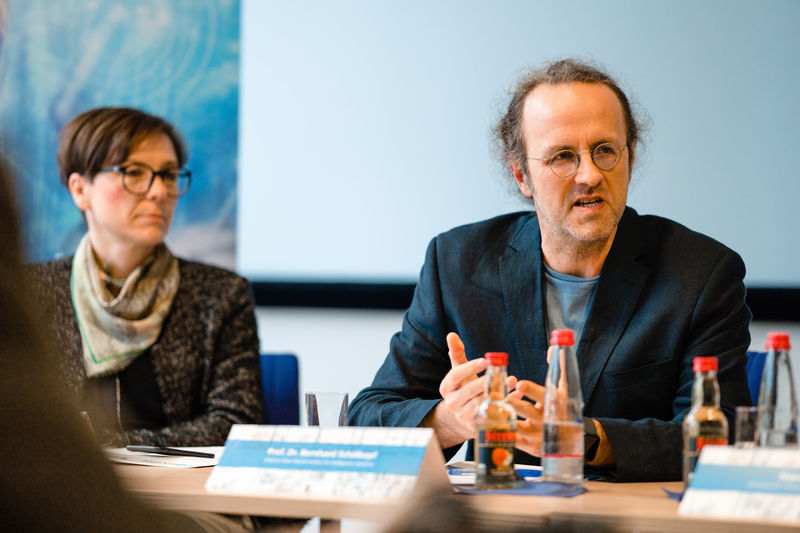
    Bernhard Schölkopf, Director of the Empirical Inference Department at the Max Planck Institute for Intelligent Systems, is the co-founder of Cyber Valley and of the Ellis Society. He held a keynote speech at an online event hosted by the Representation of the State of Baden-Württemberg to the European Union in Brussels. The event is among the first held after Germany took on the EU's rotating six-month presidency on July 1st. The panelists who contributed to the “No one size fits all: Artificial Intelligence as Key Technology for Personalised Medicine” event discussed the various interfaces between AI and medicine, the cooperation between science and industry as well as the future funding instruments for health and AI planned by the European Commission. Schölkopf particularly stressed the importance of creating an ideal research environment to help keep and attract the best AI talents from all over the world.

    The event was moderated by Dr. Julia Stamm, Founder and Director of Berlin based Science Leads. She was also joined by

    • Bodo Lehmann, Head of the Representation of the State of Baden-Württemberg to the European Union
    • Theresia Bauer, Minister of Science, Research and Arts of the State of Baden-Württemberg,
    • Dr. Karim Berkouk, Deputy Head of Unit Combatting Diseases, DG Research and Innovation, European Commission
    • Dr. Nuria Oliver, Chief Data Scientist, Data-Pop Alliance, Member of the Board of ELLIS Society (European Laboratory for Learning and Intelligent Systems) and ELLIS Unit Alicante
    • Dr. Oliver Stegle, Head of Division, Computational Genomics and Systems Genetics, German Cancer Research Center Heidelberg and European Molecular Biology Laboratory Heidelberg
  • Speaker Series: From an Idea to a Successful Startup

    Speaker Series: From an Idea to a Successful Startup

    In the second part of the series, the focus is on founder stories. Founders, investors, and University of Stuttgart Alumni join us to give you unique insights into an exciting world that is waiting for your entreprenuerial spirit!

    Meet the Speakers:

    • Jeff Burton – CEO, Woodside Creek Ventures
    • Konrad Wenzel – CEO and founder of nFrames


  • Cyber Valley partner institutions shine once again at leading international conferences

    Cyber Valley partner institutions shine once again at leading international conferences

    In the coming weeks, the Cyber Valley research consortium will make a strong showing on the global stage once again: scientists from the Max Planck Institute for Intelligent Systems (MPI-IS), the University of Tübingen, and the Bosch Center for Artificial Intelligence (BCAI) will be well represented at the upcoming International Conference on Machine Learning (ICML) and Conference on Computer Vision and Pattern Recognition (CVPR), two of the leading conferences in global artificial intelligence (AI) research. As a result of the COVID-19 pandemic, both conferences are being held virtually this year. CVPR is set to run from June 14-19, and ICML will follow from July 12-18.

    With a total of 27 papers accepted at both conferences – 15 at CVPR and 12 at ICML – the initiative has once again demonstrated that southwestern Germany is a European hotspot for research in the fields of machine learning, computer vision, and robotics.

    “Just like last year, our success at these two highly competitive conferences shows that Cyber Valley researchers are among the world’s very best,” says Michael Black, Speaker of the Cyber Valley Executive Board and Director at the Max Planck Institute for Intelligent Systems, where he heads the Perceiving Systems department. In recent years, submissions to both conferences have exploded, reflecting rapid growth in the field of AI. In 2020, ICML received 4,090 papers, around 600 more than the previous year. The increase in submissions at CVPR was even more dramatic: this year, 6,656 papers were submitted, compared with 5,165 in 2019. For 2020, acceptance rates for the two conferences stood at around 22 percent.

    Several of the papers from Cyber Valley institutions accepted at ICML and CVPR are the product of joint research between the University of Tübingen and MPI-IS or BCAI. “The Cyber Valley initiative has created a campus-like environment that provides researchers at the partner institutions with the infrastructure they need to collaborate and learn from each other. Our consistent success at international conferences shows that this approach pays off,” says Philipp Hennig, Professor for the Methods of Machine Learning at the University of Tübingen and Deputy Speaker of the Cyber Valley Executive Board.

    Since the Cyber Valley consortium was founded at the end of 2016, it has grown into a dynamic ecosystem in the Stuttgart/Tübingen region, with newly established professorships, research groups, industry research labs, doctoral programs, and Germany’s first international master’s program in machine learning. The initiative has attracted a growing number of talented young people from around the world, and has quickly built an international reputation as a top research location in the field of modern AI.

    A full list of papers and authors is available here.

  • Cyber Valley welcomes five new members to its Start-Up Network

    Cyber Valley welcomes five new members to its Start-Up Network

    “We are pleased to be welcoming these new members to the Cyber Valley Start-up community”, said Michael Black, Director of the Perceiving Systems Department at the Max Planck Institute for Intelligent Systems and Spokesperson of Cyber Valley. “These companies show that the AI ecosystem that we’ve built is thriving. Since it was launched less than a year ago, the Start-Up Network has gained significant momentum. The diversity of its members testifies to the broad scope of AI expertise in southwestern Germany and demonstrates the region’s strength as a tech hotspot.”

    AmbiGate is a Tübingen-based software company that specializes in human motion sensing. The spin-off of the University of Tübingen has developed software that – combined with 3D camera systems or common smartphone cameras – precisely analyses human motion to offer a solution for one of society’s most widespread health problems: back pain.

    Also based in Tübingen, Cytolytics has developed software that improves medical analyses and generates knowledge for research. Based on machine learning, the software speeds up flowcytometry analysis while at the same time ensuring more reliable results. Flowcytometry is used for routine diagnostics in hematology, infectiology and immunology, among others. Cytolytics is already collaborating with the Tübingen University Hospital.

    In Mojin Robotics, an already well-known player has joined the Cyber Valley start-up community. Its “Care-O-bot®4” robotics platform offers individual solutions in all kinds of customer service scenarios, such as retail, hotels, museums, hospitals, and airports. In 2015, Care-O-bot® won the prestigious RedDot Design Award with the distinction “best of the best” and in 2017, Mojin’s service robot Paul won at the retail technology awards europe (reta) in the category “Best Customer Experience”. The company, which is a spin-off of the Fraunhofer IPA Stuttgart and is based in Leinfelden-Echterdingen, is currently working on its next product: a mobile service robot for the logistics and manufacturing industry.

    plus10 has developed AI-based software tools to optimize automated manufacturing lines in the fields of consumer goods, medical devices and pharmaceutical production. For instance, its “Shannon®” virtual assistant system for machine operators helps increase productivity by delivering information about possible sources of error and identifying quick fixes. In addition, the “Darwin” software continuously learns about the behavior of automated stand-alone machines and provides feedback about technical improvements for each of machine. plus10 is also a Fraunhofer high-tech spin-off, operating from offices in Stuttgart and Augsburg.

    Tactai has developed software and hardware products that bring the natural sense of human touch to online digital interactons across a wide range of applications, among them touchscreens, VR devices, and haptic sensors. The company’s “Dynamic Haptics Platform” can be used for both commercial and medical applications. Tactai was cofounded by Katherine J. Kuchenbecker, Director of the Haptic Intelligence Department at the Max Planck Institute for Intelligent Systems in Stuttgart. The company is based in both Stuttgart and Boston, USA.

  • Cyber Valley Start-up Network welcomes two new members

    Cyber Valley Start-up Network welcomes two new members

    The Cyber Valley Start-Up Network continues to grow: at the end of February, two start-ups were added to the Network, bringing the current total to ten members. 

    Located in Stuttgart, 43IT is a software development start-up that works in the fields of computer vision, object recognition, and neural networks. More specifically, the company specializes in the analysis of volumetric image data. 

    With eye2you, the Start-Up Network now counts a MedTech start-up among its members. Based in Tübingen and Seoul, the company's mission is to make eye care more widely accessible by applying cutting-edge AI in combination with smartphones. In so doing, eye2you aims to help detect retinal disease at an early stage, which can prevent loss of vision. 

    More information on the Cyber Valley Start-Up Network can be found here: https://www.cyber-valley.de/cyber-valley-start-up-network

  • ABGESAGT! Hier bin ich Maschine, hier darf ich sein

    ABGESAGT! Hier bin ich Maschine, hier darf ich sein

    Daran gibt es keinen Zweifel: Intelligente Systeme werden uns immer mehr Entscheidungen abnehmen und un sere Kommunikation noch weiter verändern.  Doch wo liegen ihre Grenzen? Was müssen Unternehmer, Mitarbeiter und Kunden heute wissen, damit sie verantwortungsbewusst mit KI umgehen?

    Das ist unser Thema. Die Referenten kommen von Europas größtem Zukunftsinstitut 2bAhead und zählen zu den besten internationalen Experten auf dem Gebiet: Dan Jeffries, einer der versiertesten KI-Experten aus dem Silicon Valley, leitet das Programm „Practical AI-Ethics“ des Leipziger ThinkTanks und Jan Berger, CEO von 2bAhead. Durch jahrelange Forschungs- und Beratungstätigkeit erwarb er ein tiefes Verständnis der Finanz-, Mobilitäts-, Energie-, IT- und Nahrungsmittelwirtschaft und ist ein gefragter Sparringspartner für vielfältige Technologiethemen und eine werteorientierte Zukunftsstrategie.

    Tübingen wird zum größten KI-Standort Deutschlands und hat eine lange Tradition der Ethik. Der beste Ort, um mit Experten des größten Zukunftsinstituts Europas 2bAhead von Gabor Sven Janzsky, der Initiative „Responsible Communication“
    und dem Max-Planck-Institut im Cyber Valley ins Gespräch zu kommen.

    Sie erwartet ein inspirierender Abend, der mit der audiovisuellen Performance „Homo ex Data“ eine künstlerische Note erhält.

  • Cyber Valley Start-Up Network is expanding

    Cyber Valley Start-Up Network is expanding

    The Cyber Valley Start-Up Network is pleased to be welcoming a new member to its ranks. With the addition of Colugo, the network now counts a strategic consultancy that specializes in assessing AI-related potential and opportunities for businesses in the Tübingen region. The start-up also offers workshops and training courses that aim to support businesses in gaining the understanding of AI they need to apply it in their respective fields.

    The Cyber Valley Start-Up Network was recently established with the aim of promoting technology transfer and entrepreneurship in the broad field of AI in the Stuttgart-Tübingen region. The network currently counts eight members and plans to keep expanding in the New Year. 

  • Cyber Valley launches Start-Up Network

    Cyber Valley launches Start-Up Network

    Stuttgart/Tübingen. Cyber Valley on Monday announced the launch its new Start-up Network as a platform for exchange between AI start-ups within the Cyber Valley ecosystem.

    “By promoting dialog among experts in the field of intelligent systems, we are building a strong community of entrepreneurs in the Stuttgart-Tübingen region,” said Michael Black, Cyber Valley spokesperson and Director at the Max Planck Institute for Intelligent Systems in Tübingen. “With the Start-Up Network, we have taken an important step toward promoting tech transfer, which is one of the Cyber Valley initiative’s central goals.”  

    As members of the network, start-ups are invited to attend Cyber Valley networking events such as talks, meet-ups, and tech brunches on a regular basis. Network members’ activities must be related to the field of intelligent systems. Moreover, the start-ups are required to be connected with Cyber Valley, either by being headquartered in the Stuttgart-Tübingen region, or by having members or alumni of Cyber Valley partner institutions among their founders. Membership in the Cyber Valley Start-Up Network is reviewed once a year to ensure that these requirements continue to be met. 

    Cyber Valley invites interested start-ups that match these criteria to apply for membership to the Start-Up Network. “We want to help the start-up community in the region grow and are building this network to create a breeding ground for new ideas and innovation,” says Michael Black. 

    The Cyber Valley Start-Up Network counts seven initial members:

    • Deep Art: A joint venture between scientists at the University of Tübingen, École polytechnique fédérale de Lausanne (Switzerland), Université catholique de Louvain (Belgium), and the University of Freiburg, Deep Art applies an algorithm that allows everyone to create pictures in different artistic styles in just a few clicks.
    • Layer 7 AI. Founded by scientists at the University of Tübingen, the consultancy specializes in taking the latest breakthroughs in machine learning and turning them into scaleable products. 
    • Meshcapade was founded by two alumni of the Max Planck Institute for Intelligent Systems in Tübingen. The company aims to make animating, simulating, and recognizing human bodies effortless, and to bring realistic virtual humans into simulation and 3D environments.
    • Predictive Cueing is a Tübingen start-up offering motion cueing software that enables urban driving in a simulator. Its founder is an alumnus of the Max Planck Institute for Biological Cybernetics in Tübingen. 
    • Reasonal is developing a new generation of machine learning algorithms to bring meaning, clarity, and civility to online conversations. It was co-founded by scientists from the Max Planck Institute for Intelligent Systems in Tübingen and from the Max Planck Institute for Software Systems in Kaiserslautern.
    • Sagacity is a Tübingen-based start-up that seeks to improve customer and employee engagement with machine learning and artificial intelligence solutions.
    • Scatterblogs offers AI solutions for analysts, decision-makers, and journalists. Founded by alumni of the University of Stuttgart, the start-up’s solutions enable users to detect important events through social media such as Twitter and Facebook in real time and to identify relevant content.

    Start-ups interested in joining the Cyber Valley Start-Up Network are invited to contact the Cyber Valley management office at: contact@cyber-valley.de

  • Fraunhofer Gesellschaft joins Cyber Valley

    Fraunhofer Gesellschaft joins Cyber Valley

    Stuttgart – The Fraunhofer Institute for Manufacturing Engineering and Automation IPA and the Fraunhofer Institute for Industrial Engineering IAO have joined Cyber Valley, further strengthening Europe’s largest research consortium in the field of artificial intelligence (AI). The tie-up demonstrates once again that Baden-Württemberg is the AI hotspot in Europe, on a par with some of the world’s leading centers, for instance in North America.
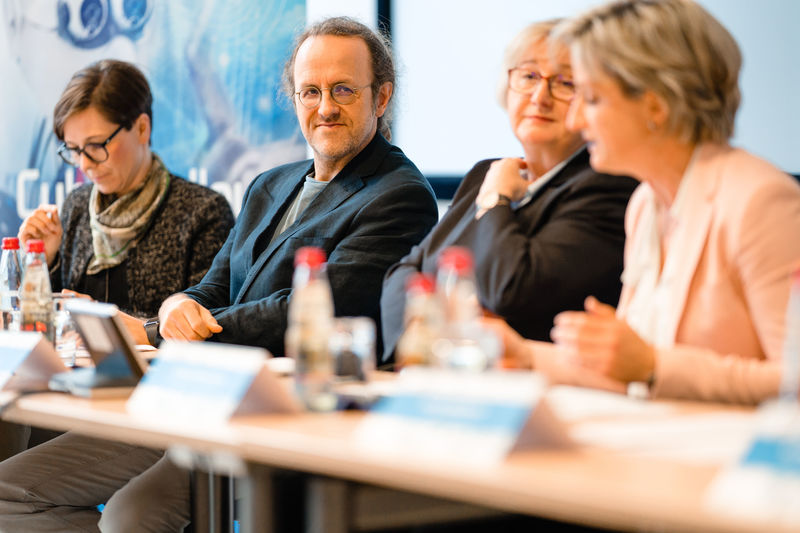
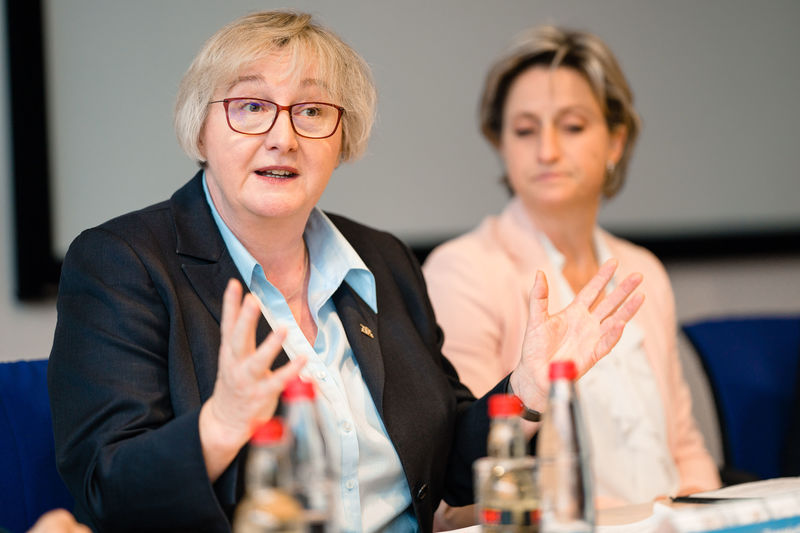
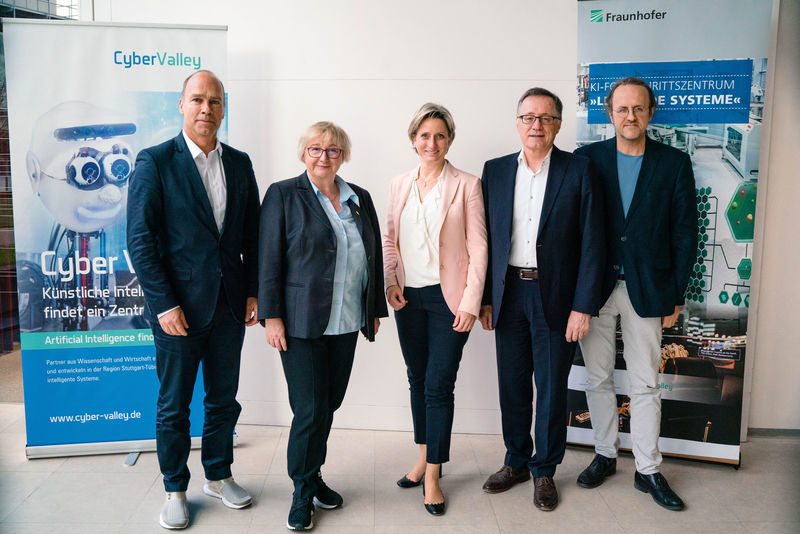
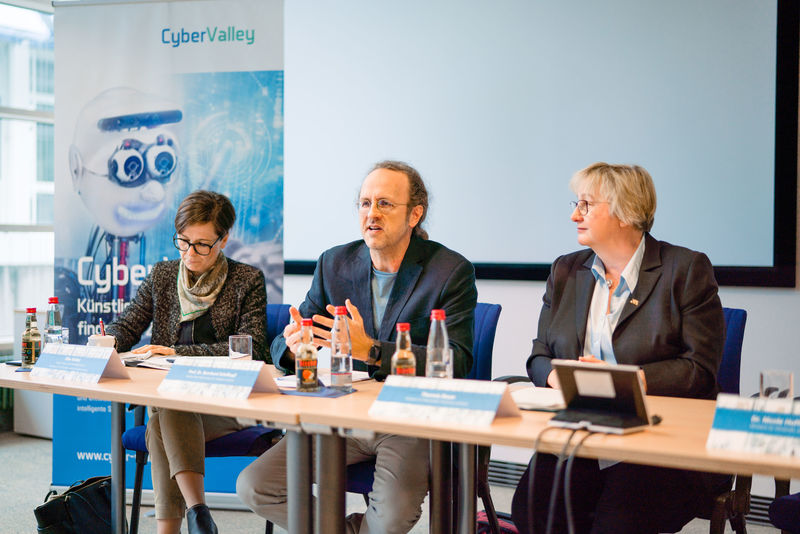
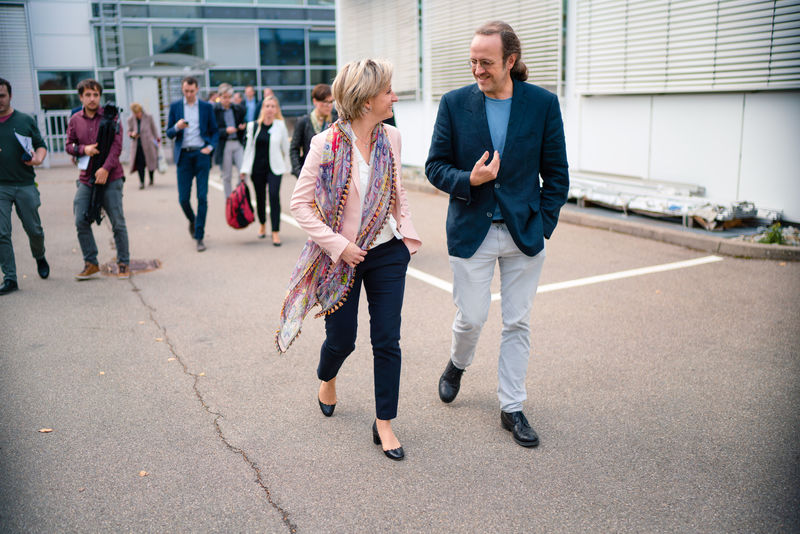
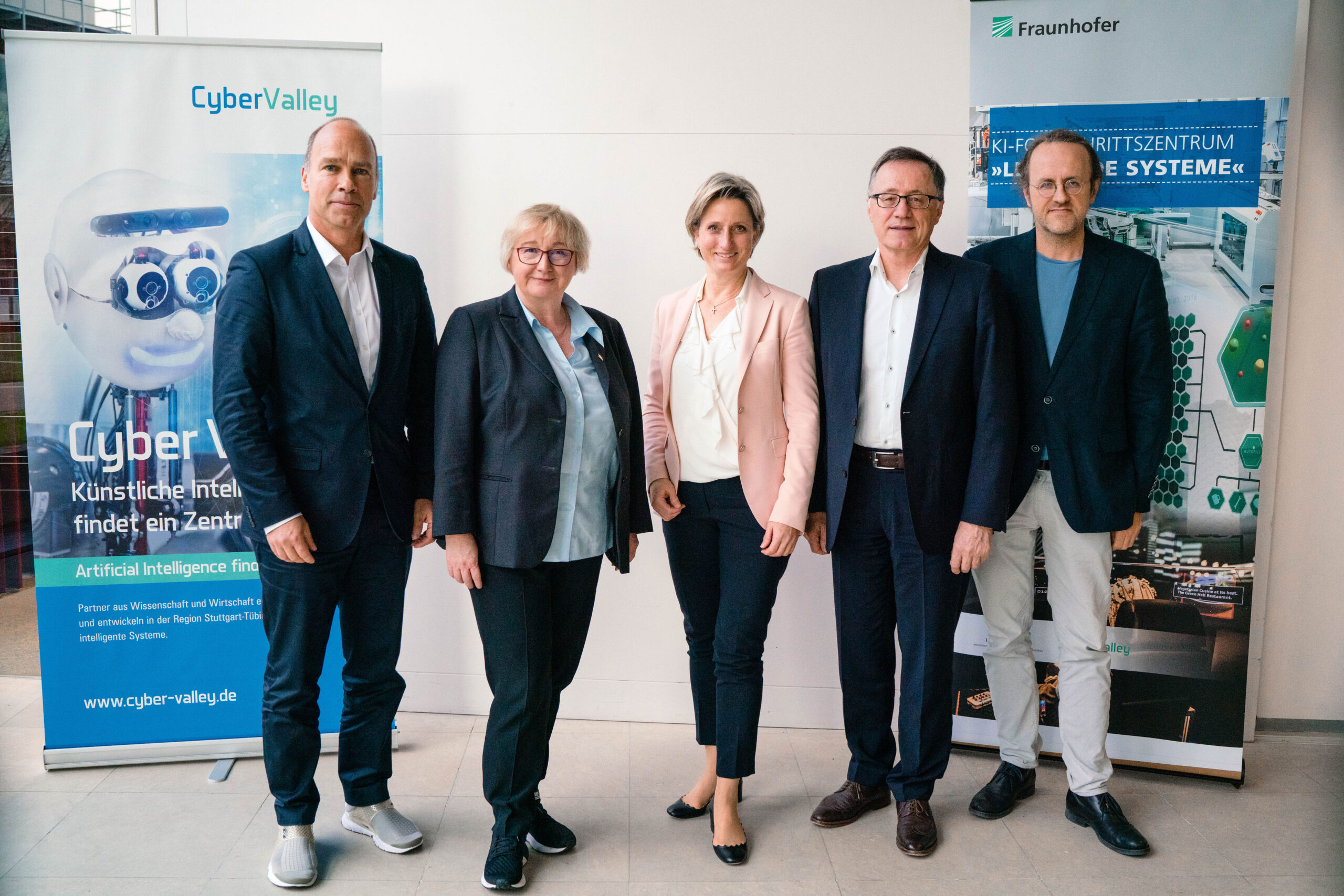
    From left to right: Silke Walter, press spokesperson Ministry of Economy, Prof. Bernhard Schölkopf, Baden-Württembergs Science Minister Theresia Bauer, Minister of Economy Dr. Hoffmeister-Kraut, and from Fraunhofer Prof. Wilhelm Bauer und Prof. Thomas Bauernhansl.

    “Artificial intelligence is a key driver of innovation and economic growth and holds enormous economic potential for our small and medium-sized enterprises,” said Baden-Württemberg's Minister of Economic Affairs, Labour and Housing Dr. Nicole Hoffmeister-Kraut. “We need more 'AI made in Baden-Württemberg' and we need to bring the results of our cutting-edge research even better and faster into the practical application of our companies. To this end, we must make massive progress in the research, development, and commercialisation of artificially intelligent systems.

    Baden-Württemberg's Science Minister Theresia Bauer added: “An internationally visible AI hotspot is created here. We warmly welcome the Fraunhofer-Gesellschaft to the ever-growing circle! The Cyber Valley research network is developing very dynamically and is attracting more and more scientists, young talents from all across the world, companies, and foundations. The boom has created the need to establish reliable management structures for the Cyber Valley network in order to effectively manage the growing organizational tasks.”

    "With their application-oriented focus, the Fraunhofer Institutes ideally complement the research of the Max Planck Institute for Intelligent Systems and the Universities of Tübingen and Stuttgart," said Professor Martin Stratmann, President of the Max Planck Society. "Fraunhofer’s engagement makes it easier to bridge the gap to the industrial partners within Cyber Valley: in this way, findings from basic research can be applied more quickly."
     
    Professor Reimund Neugebauer, President of the Fraunhofer-Gesellschaft, emphasized: "Artificial intelligence is one of the central digital issues of the future and will change our lives from the ground up. For the international economy and industrial value chains, it means a fundamental structural change. By joining Cyber Valley, together with our partners we will advance research and transfer from science to the market in order to fully exploit the potential of this key technology and strengthen Germany as a location for international competition.”

    "We very much welcome the Fraunhofer Gesellschaft’s participation, as it will help us apply the methods of modern AI, especially in small and medium-sized enterprises," said Professor Bernhard Schölkopf, Director at the Max Planck Institute for Intelligent Systems and co-founder of Cyber Valley.

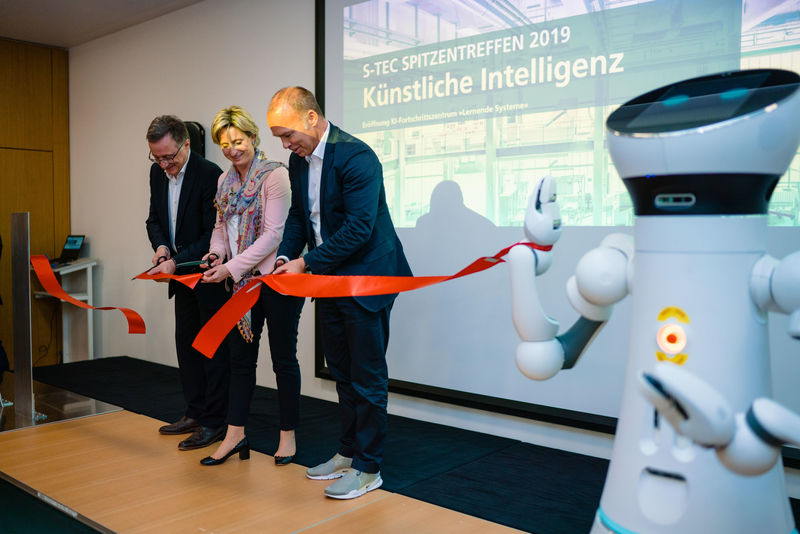
    Baden-Württemberg’s Ministry of Economic Affairs and the Fraunhofer Gesellschaft are co-financing the AI innovation center Learning Systems (KI-Fortschrittszentrum “Lernende Systeme”), which was incorporated into the Cyber Valley research consortium from October 1, 2019. The center is a laboratory with an initial team of 20 researchers and planned funding of ten million euros until the end of 2022.

    Central point of contact for application-oriented AI research

    For companies in Baden-Württemberg, the AI innovation center is a central point of contact for application-oriented research on artificial intelligence. The center explores applied research projects relevant to the manufacturing and service industries. It also acts as an interface between industry and the fundamental research conducted within the Cyber Valley consortium (the Universities of Tübingen and Stuttgart, the Max Planck Institute for Intelligent Systems, and several industry partners). The aim is to enable technology transfer to industry beyond the existing partners.

    As another component, joint research labs will be set up in which fundamental researchers will cooperate with more application-focused scientists at IPA or IAO. The projects will not be initiated by companies, but rather based on assessments of what the market needs. These joint research labs may thus bear the greatest potential for future start-ups.

    Direct cooperation with industry is a central focus of the AI innovation center. Feasibility studies and the development of prototypes of AI applications are partly financed by the innovation center’s budget. To establish strategic partnerships, industrial companies have the opportunity to operate and finance Enterprise Labs. At these labs, one or more researchers within the innovation center can give their full attention to the respective company’s specific needs. In all its activities, the AI innovation center Learning Systems aims to implement human-centered AI that people trust and accept. The full potential of AI can only be realized once people interact and work closely with new technology. To realize human-centered AI, research activities focus on topics such as explainability, privacy, safety, and the robustness of AI technologies.

    Benefit to industry and society

    With Cyber Valley, partners from science, business, and society are building a unique research ecosystem in the Stuttgart-Tübingen region. Supported by the state of Baden-Württemberg, Cyber Valley promotes an active exchange between science and industry. The initiative also focuses on training the best minds in the field of AI and creating a breeding ground for start-ups. The aim is to combine cutting-edge research with entrepreneurial spirit to promote spin-offs and technology transfer.

    The cooperation of the two Fraunhofer institutes and Cyber Valley is thus a major source of potential for all parties involved. Fraunhofer Gesellschaft has a 70-year history of excellence in business-oriented research. Its 72 institutes work closely with small and medium-sized enterprises, commonly referred to as the “German Mittelstand”, as well as with larger local and international enterprises. This expertise in realizing projects in close cooperation with industry is of immense value to Cyber Valley. With its proven track record of many successful start-ups, Fraunhofer Gesellschaft joining Cyber Valley will further enhance the research consortium's innovative and entrepreneurial strength. Fraunhofer Gesellschaft actively supports researchers who want to start their own companies based on the intellectual property they have developed while working with Fraunhofer. The mission of bringing technological pro-gress to companies and society is firmly anchored in the Fraunhofer mission statement.

    www.fraunhofer.de | www.iao.fraunhofer.de | www.ipa.fraunhofer.de

    Cyber Valley is Europe's largest research cooperation in the field of artificial intelligence with partners from politics, science, business, and society. The partnership strengthens research and teaching in the fields of machine learning, computer vision, and robotics as well as the links between these fields. Partners are the Max Planck Institute for Intelligent Systems, the University of Stuttgart, the University of Tübingen, the State of Baden-Württemberg and seven industrial partners: Amazon, the BMW Group, IAV GmbH, Daimler AG, Porsche AG, Robert Bosch GmbH and ZF Friedrichshafen AG. Cyber Valley is also supported by the Christian Bürkert Foundation, the Gips-Schüle Foundation, the Vector Foundation, and the Carl Zeiss Foundation.

    www.cyber-valley.de