User Group: Corporate

  • Color patch could throw self-driving vehicles off track

    Color patch could throw self-driving vehicles off track

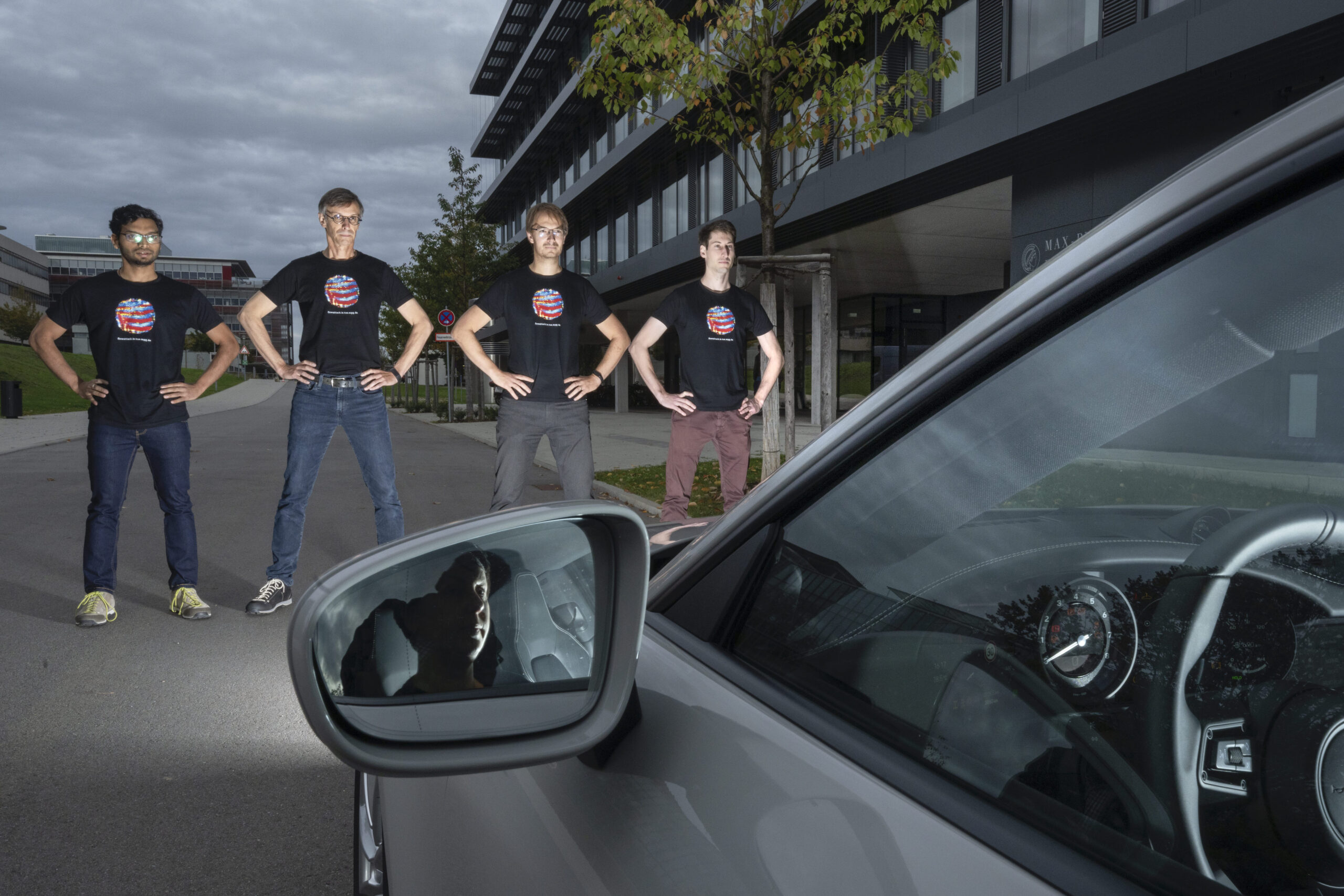
    Tübingen – A color patch printed on a t-shirt, or as a bumper sticker, or displayed on a grocery bag could be a problem for autonomous cars; a small pattern that creates so much noise it could become safety critical. “It took us three, maybe four hours to create the pattern – that’s all,” says Anurag Ranjan, a Ph.D. student in the Perceiving Systems department at the Max Planck Institute for Intelligent Systems (MPI-IS) in Tübingen. He is the lead author of the publication “Attacking Optical Flow”, a research collaboration of the Perceiving Systems department and the Autonomous Vision group at the MPI-IS and the University of Tübingen. The paper is accessible on arXiv and due to be presented at the leading international computer vision conference, the International Conference on Computer Vision ICCV, which kicks off on October 27 in Seoul.

    The risk of affecting any cars on the road is extremely low but, in the interest of caution, the researchers informed the major car manufacturers that are deploying self-driving technology about the risk several months ago to give them time to react if needed.

    In their research work, Anurag Ranjan and his colleagues Joel Janai, Andreas Geiger and Michael J. Black challenge the robustness of several different optical flow systems. Such systems are used in self-driving cars, in robotics, medicine, video gaming, or navigation to name a few. Optical flow describes the motion in a scene captured by the onboard cameras. Recent advances in machine learning have produced faster and better methods for computing this motion, but this new research shows that such methods are vulnerable to “attack”, simply by placing a printed pattern in the scene. Even if the pattern is not moving, it causes the algorithm to think that large parts of the scene are moving in the wrong direction.

    Previously, researchers showed that such patches could confuse neural networks trained to classify objects such as stop signs. This new work is the first to show that “regression” problems are also vulnerable to simple attacks. In such problems the computer estimates a continuous value such as depth or speed. The vulnerability of optical flow methods to attack suggests that other problems like stereo are similarly vulnerable. However, when used in safety-critical applications like autonomous cars, such systems need to be “robust” to such attacks.

    Even a small patch generates a large effect

    Ranjan and his team took on the task in March last year. On their journey, it took them by surprise how small the patch can be to wreak havoc. Even at a size tinier than 1% of the overall image, the system could be attacked, making severe errors in its estimates affecting half the image region. It gets worse the bigger the patch. “This is a concerning threat, as in many cases, the flow system completely erased the movement of objects in the entire scene”, Ranjan says and points to a video showing the attacked system. It is up to everyone's imagination what damage a paralyzed flow system of a self-driving car can cause on a road at high speed.

    How each self-driving car operates is a well-kept secret among manufacturers, hence the computer vision research community can only guess. “Optical flow gives information about the world and how objects are moving so it may be a component of existing systems” says co-author Michael J. Black, Director of the Perceiving Systems department. “This work shows the makers of self-driving technology that there is a new possible threat and enable them to train their systems to be robust to such attacks.”

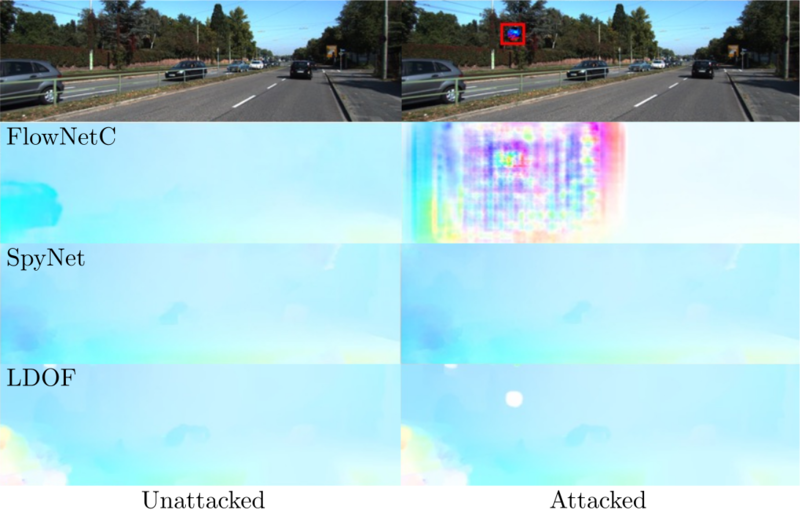
    The first column shows the optical flow results using an encoder-decoder architecture FlowNetC, a spatial pyramid architecture SpyNet and classical method LDOF. In the second column, a small circular patch is added to both frames at the same location and orientation (highlighted by the red box for illustration purpose). SpyNet and LDOF are barely affected by the patch. In contrast, FlowNetC is strongly affected, even in regions far away from the patch.

    Maybe as important as the attack is that it teaches the researchers how to make better optical flow algorithms using a “zero flow” test. “If we show the system two input images that are identical with no motion between them, the optical flow and the neural network should produce zero flow. But this is often not the case, even without any attack. We can use this to “debug” what the network is doing wrong,” says Ranjan. He and his team hope their research will help raise awareness, that car companies take such attacks seriously, and create their systems in such a way that they are less vulnerable.


    Press Contact:
    Linda Behringer
    Max Planck Institut for Intelligent Systems, Stuttgart, germany
    T: +49 711 689 3552
    M: +49 151 2300 1111
    linda.behringer@is.mpg.de


    About us

    At the Max Planck Institute for Intelligent Systems we aim to understand the principles of Perception, Action and Learning in Intelligent Systems.

    The Max Planck Institute for Intelligent Systems is located in two cities: Stuttgart and Tübingen. Research at the Stuttgart site covers small-scale robotics, self-organization, haptic perception, bio-inspired systems, medical robotics, and physical intelligence. The Tübingen site focuses on machine learning, computer vision, robotics, control, and the theory of intelligence.

    www.is.mpg.de

    The Perceiving Systems department combines computer vision, machine learning, and computer graphics to train computers to understand humans and their behavior in images and video. The team’s unique approach begins with learning compact parametric models of 3D human shape and motion. We use these to extract and analyze human behavior in the context of 3D scenes. The department has approximately 45 staff and students and additional affiliated researchers. It operates unique 4D scanning facilities that produce highly accurate and detailed 3D meshes of the body, face, hands, and feet at 60 frames per second. The department also employs wearable motion capture suits, flying robots, and camera-based systems to record human movement.

    https://ps.is.mpg.de/

    The Autonomous Vision research group, which is based at the Max Planck Institute for Intelligent Systems in Tübingen and the University of Tübingen, addresses questions related to robustness as well as methods that enable high-capacity models (such as deep neuronal networks) to learn with a small amount of data. More specifically, the group’s research focuses on robust perception for autonomous agents, especially autonomous vehicles. Research activities range from sensor-based perception (3D reconstruction, motion estimation, object recognition) and holistic scene interpretation (3D lane and intersection estimation), to sensor engine control approaches.

    https://avg.is.tuebingen.mpg.de/

  • Bosch is expanding its involvement in Cyber Valley

    Bosch is expanding its involvement in Cyber Valley

    Stuttgart/Tübingen − Bosch plans to ramp up its activities in the emerging technology of artificial intelligence (AI): in Tübingen in Germany’s Cyber Valley, the supplier of technology and services intends to invest some 35 million euros in a new “Bosch AI Campus.” Bosch is currently in talks with the city of Tübingen to negotiate the purchase of a rough 12,000 square-meter plot on which to build the campus. The move into the new research complex is planned for the end of 2022. Roughly 700 experts will work on applied AI there. “Bosch aims to be among the global leaders in industrial AI research,” said Bosch CDO/CTO Dr. Michael Bolle. “The new Bosch AI Campus will bring us a step closer to achieving this goal.”

    Space for startups and in-depth exchange

    The Bosch AI Campus in Tübingen will be situated close to the research facilities of the Max Planck Institute for Intelligent Systems and the University of Tübingen’s AI research building. Besides laboratories and offices, the campus will offer spaces in which startups and external AI research groups can take up temporary residence. Freely accessible areas on the first floor of the campus will serve to foster exchange among Cyber Valley experts. Other parts of the facility will also be open to the public. “In the new building, experts from the Bosch Center for Artificial Intelligence (BCAI) will work on projects together with experts from other Bosch divisions and from startups. The campus structure will do a lot to foster an exchange of ideas,” Bolle said.

    Bosch is a founding member of Cyber Valley, which was established in 2016. This joint research venture brings together partners from industry, academia, and politics to drive forward AI research in the German state of Baden-Württemberg. The idea is to quickly transfer research findings into real-world industrial applications. “Excellence clusters like Cyber Valley are important, as they make Germany even more attractive to top AI experts and strengthen our position in international competition,” Bolle continued. “The Bosch AI Campus also enhances Baden-Württemberg’s international appeal as an AI hub.”

    From research to practical application

    Bosch is researching artificial intelligence that is safe, robust, and explainable. Its investment in the new AI campus is yet another step by the company to strengthen AI research in Cyber Valley. Last year, Professor Matthias Hein was appointed to a Bosch-endowed chair at the University of Tübingen. The company sponsors two Industry on Campus professorships, which allow the university to integrate practical industrial expertise into its research and teaching.

    These professorships focus on the issues that arise when preparing for industrial applications. One example is predictive diagnostics, which makes it possible to predict machine breakdowns long before a fault actually occurs. Well-timed maintenance can avoid protracted machine downtimes. Predictive diagnostics is an example of machine learning, which is the focus of the research conducted at the BCAI. Currently, the BCAI has some 200 associates at a total of six locations in Germany, the United States, India, and Israel.

    Contact person for press inquiries:

  • Target Partners Tech Brunch on July 10, 2019

    Target Partners Tech Brunch on July 10, 2019

    Cyber Valley and Max Planck Innovation are hosting an informal "TechBrunch" in Tübingen with Target Partners, one of the most renowned German venture capital funds. Find our more about the event and how to register at: https://www.targetpartners.de/news/techbrunch-tuebingen-2019

  • Cyber Valley präsentiert KI-Spitzenforschung in Berlin

    Cyber Valley präsentiert KI-Spitzenforschung in Berlin

    Berlin, 27.06.2019 – Die Cyber Valley Initiative wird heute auf der traditionellen Stallwächterparty der Landesvertretung Baden-Württemberg in Berlin vertreten sein. Schon seit 1964 gehört die Stallwächterparty zu den Höhepunkten des Berliner Sommers, mit hochrangigen Gästen aus Politik und Wirtschaft. Unter dem Motto „im Herzen Europas“ zeigt die diesjährige Veranstaltung die Stärken des Standorts Baden-Württembergs. Mit einem Infostand und Mitmachaktionen gibt die Cyber Valley Initiative, Europas größte Forschungskooperation in Bereich künstliche Intelligenz, Einblicke in die Forschungsexzellenz der Region Stuttgart-Tübingen. 

    „Cyber Valley zieht Spitzenwissenschaftler von den Top-Universitäten der ganzen Welt an. Es ist ein Forschungsstandort, der das Zusammenspiel von exzellenter Grundlagenforschung und leistungsstarken Unternehmen fördert und damit wissenschaftliche Durchbrüche und eine hohe Gründungsdynamik ermöglicht. Damit bringen wir die europäische Zusammenarbeit in der KI-Spitzenforschung weiter voran“, sagt Theresia Bauer, Ministerin für Wissenschaft, Forschung und Kunst. 

    Das Ende 2016 gegründete Cyber Valley stärkt Forschung und Lehre in den Bereichen Machine Learning, Computer Vision und Robotik und fördert Technologietransfer und Ausgründungen in diesen Bereichen.Bereits heute ist das Cyber Valley der führende Forschungsstandort in Deutschland für künstliche Intelligenz und unter den zehn führenden KI-Forschungsstandorten weltweit. Knapp die Hälfte der Spitzenpublikationen von deutschen Forschungseinrichtungen im Bereich Machine Learning stammen derzeit aus der Region Stuttgart-Tübingen. Die Cyber Valley Initiative zielt unter anderem darauf ab, diese Position im globalen Wettbewerb um die besten Köpfe zu sichern und weiter auszubauen, um die Wettbewerbsfähigkeit europäischen KI-Forschung zu sichern.  

    „Die Zukunft wird maßgeblich durch neue Technologien gestaltet, die nicht an Ländergrenzen halt machen. Eine besonders schlagkräftige Rolle spielt dabei das Maschinelle Lernen, das gerade dabei ist, Industrie und Gesellschaft global im rasanten Tempo zu verändern,“ sagt Matthias Bethge, Professor für Computational Neuroscience und Machine Learning an der Universität Tübingen,und Mitgründer der European Laboratory for Learning and Intelligent Systems (ELLIS). DieELLIS-Initiative, die im Cyber Valley entstanden ist, fördert die Entwicklung eines starken europäischen KI-Forschungsnetzwerks. „Damit Europa die Zukunft gestalten kann, brauchen wir eine europäische Exzellenz-Institution, die in der Lage ist, Spitzenforscher aus aller Welt anzuziehen und in Europa tätig werden zu lassen. Das ist das Ziel der ELLIS-Initiative," so Bethge.

    „Ich freue mich, dass ELLIS bei der Stallwächterparty des Landes zum Thema Europa vertreten ist. Das Thema KI gehört neben der Landes- und Bundesebene unbedingt auf die europäische Ebene. ELLIS ist dabei ein zentrales Projekt, das die Landesregierung unterstützt“, sagt Ministerin Bauer.

    Das Landeskabinett hatte am 26. März 2019 ein Maßnahmenpaket von 20 Mio. € zur weiteren Stärkung der Künstliche Intelligenz bewilligt, ergänzend zu den 100 Millionen Euro, die bereits 2018 für die Ko-Finanzierung von Projekten des Bundes zu Künstlicher Intelligenz und für Batterieforschung vorgesehen wurden. Ziel ist es, Baden-Württemberg zum Vorreiter der europäischen Künstlichen Intelligenz zu machen. Das Cyber Valley soll dabei eine maßgebliche Rolle spielen.

  • Cyber Valley’s machine learning research makes a strong showing on the global stage

    Cyber Valley’s machine learning research makes a strong showing on the global stage

    Stuttgart/Tübingen, May 22, 2019 – In the coming weeks, the Cyber Valley initiative will shine on the global stage: researchers from the Max Planck Institute for Intelligent Systems (MPI-IS), the Universities of Tübingen and Stuttgart, and the Bosch Center for Artificial Intelligence will be well represented at the upcoming International Conference on Machine Learning (ICML) and Conference on Computer Vision and Pattern Recognition (CVPR), two of the leading conferences in global artificial intelligence (AI) research. Both conferences are being held in Long Beach, California: the ICML is set to run from June 9-15, and CVPR will follow from June 16-20.

    Founded at the end of 2016 in southwestern Germany, the Cyber Valley initiative is Europe’s leading research cooperation in the field of artificial intelligence. With a total of 27 papers accepted at both conferences, the initiative has once again demonstrated that the Stuttgart/Tübingen region is among the world’s top locations for research in the field of machine learning, computer vision, and robotics. 

    “These are highly competitive conferences. Only few submissions get accepted, and the leading researchers in the field present their best work. We are pleased to have an impressive display of publications from Cyber Valley”, said Professor Bernhard Schölkopf, Managing Director at MPI-IS and Director of the institute’s Empirical Inference department. 

    Submissions to both conferences reflect the incredible growth that the field of machine learning has seen in recent years: in 2019, ICML received 3424 papers, almost 1000 more than the previous year. At CVPR, submissions spiked 56 percent in 2019, to 5,165. Acceptance rates for the two conferences stand at around 25 percent.  

    At this year’s ICML, Cyber Valley is represented with 11 papers, nine of which are from Schölkopf’s team. Other papers include a cooperation between the head of the Cyber Valley Intelligent Control Systems research group, Dr. Sebastian Trimpe, the University of Stuttgart, and the Bosch Center for Artificial Intelligence, as well as a paper submitted by the team of Dr. Matthias Hein, the Bosch-Endowed Cyber Valley Professor at the University of Tübingen. 

    Researchers from Cyber Valley have been similarly successful at the 2019 CVPR: the research cooperation’s three academic partners are presenting 16 papers. “The success of our international team of scientists at this year’s CVPR demonstrates that Cyber Valley stands for outstanding research in AI,” said Andreas Geiger, Professor for learning-based computer vision at the University of Tübingen and leader of the Autonomous Vision research group at MPI-IS. Geiger’s team from the University of Tübingen has had nine papers accepted at the conference. Professor Matthias Hein of the University of Tübingen is also presenting one paper at CVPR.

    The Cyber Valley Spokesperson and MPI-IS Director Dr. Michael Black’s Perceiving Systems Department is also well represented at CVPR with six papers, one of which was written in cooperation with Professor Bernhard Schölkopf’s Empirical Inference Department. The Autonomous Learning Group, which is headed by Dr. Georg Martius, is also present at CVPR with one paper.

    A full list of papers and authors is available on the Cyber Valley website: 

    https://cyber-valley.de/en/websites/cyber-valley/pages/2019-icml

    About:

    For several years, the German Federal State of Baden Württemberg has been home to Cyber Valley, one of the largest research cooperations in Europe in the field of artificial intelligence, with partners from politics, science, business, and society. The partnership strengthens research and education in the fields of machine learning, computer vision, and robotics, as well as connections between these scientific disciplines.  

    Partners are the MPI-IS, the University of Stuttgart, the University of Tübingen, the State of Baden-Württemberg, and the following seven industrial partners: Amazon, the BMW Group, IAV GmbH, Daimler AG, Porsche AG, Robert Bosch GmbH, and ZF Friedrichshafen AG. With ten newly established research groups and ten new professorships at the Max Planck Institute for Intelligent Systems and the Universities of Stuttgart and Tübingen, Cyber Valley stands for independent basic research, and the initiative aims to attract the best young minds from around the world. In addition, with the recently founded International Max Planck Research School for Intelligent Systems (IMPRS-IS), well over 100 PhD students will graduate from Cyber Valley institutions in the coming years.

    http://www.cyber-valley.de

    Press Contacts: 

    Linda Behringer

    Cyber Valley Public Relations
    c/o Max Planck Institute for Intelligent Systems, Stuttgart

    T: +49 711 689 3552

    M: +49 151 2300 1111

    linda.behringer@cyber-valley.de

    Valérie Callaghan

    Cyber Valley Public Relations

    c/o Max Planck Institute for Intelligent Systems, Tübingen

    T: +49 7071 601 1832             
    M: +49 151 1560 4276

    valerie.callaghan@cyber-valley.de

  • Professor Matthias Hein auf dem Digitalgipfel 2019 in der Carl Benz Arena

    Professor Matthias Hein auf dem Digitalgipfel 2019 in der Carl Benz Arena

    Der Digitalgipfel 2019 – Wirtschaft 4.0 BW findet am 11. April in der Carl Benz Arena in Stuttgart statt. Er wird organisiert vom Ministerium für Wirtschaft, Arbeit und Wohnungsbau Baden-Württemberg, die Teilnahme ist kostenlos.

    Wo?

    Carl Benz Arena
    Mercedesstraße 73D
    70372 Stuttgart

    Mit dabei ist Cyber Valley Bosch-Stiftungsprofessor für Maschinelles Lernen an der Universität Tübingen, Matthias Hein. Er wird einen Impulsvortrag halten zum Thema "Kann KI Ethik?"

    Hier finden Sie das Programm.

    Und hier alle Informationen rund um den Gipfel.


  • Symposium Artificial Intelligence and Society

    Symposium Artificial Intelligence and Society

    The latest breakthroughs in artificial intelligence are based on machine learning. Using examples, computer programs can identify patterns and regularities in data sets and transfer these to similar situations in the future. The Stuttgart-Tübingen region is a leader in AI research and local research institutions occupy the top position in Germany for scientific publications in this field of research. The development is rapid and many questions about artificial intelligence and its significance for society need to be answered or at least discussed.

    Therefor the Max Planck Institute for Intelligent Systems in Tübingen is organizing a symposium on the topic of 'Artificial Intelligence and Society' on Friday, 14 September 2018, starting at 1 p.m.. The event is aimed in particular at the interested public.

    All interested parties are cordially invited to this symposium, which is organized together with the Cyber Valley Initiative and the Max Planck ETH Center for Learning Systems. Due to the limited space available, electronic registration is required by 03. September 2018:https://www.is.mpg.de/de/events/70-jahre-mpg/register

    Top-class speakers from science and industry were attracted to the symposium. The event is part of the Max Planck Day, the nationwide science festival of the Max Planck Society.

    The speakers at the KI Symposium are:

    • Dr. Michael Bolle / Robert Bosch GmbH
    • Prof. Dr. Dietmar Harhoff / Max Planck Institute for Innovation and Competition
    • Dr. Ralf Herbrich / Amazon Development Center Germany
    • Prof. Dr. Thomas Hofmann / ETH Zürich
    • Prof. Dr. Andreas L. Paulus / Georg-August-Universität Göttingen and member of the First Senate of the Federal Constitutional Court
    • Prof. Dr. Sarah Spiekermann / Vienna University of Economics and Business
    • Dr. Sandra Wachter/ Oxford Internet Institute

    The talks will be followed by a panel discussion. The event will take place in the lecture hall of the Max Planck Institute for Intelligent Systems, Max Planck Ring 4, in Tübingen. Since places in the lecture hall are limited, a video transmission will be set up on the Max Planck Campus Tübingen. The event will be held in German and simultaneous translation will be provided in English.

    The detailed program can be found here 

    The accompanying videos for the Symposium Artificial Intelligence and Society can be found here 

  • Top researcher appointed Bosch-endowed chair

    Top researcher appointed Bosch-endowed chair

    Hein has been teaching mathematics and computer science at Saarland University since 2011. He studied physics in Tübingen and received his PhD in computer science at TU Darmstadt. From 2002 to 2007, Hein was part of Professor Bernhard Schölkopf’s working group at the Max Planck Institute for Biological Cybernetics. Today, Schölkopf heads the Max Planck Institute for Intelligent Systems in Tübingen and is counted among the world’s leading researchers in the field of machine learning.

    “The interplay of science, industry, and politics in Cyber Valley has an appeal that stretches far beyond the region. Baden-Württemberg is becoming a global hotspot for top researchers,” says Dr. Michael Bolle, the head of Bosch research. “We are very much looking forward to working with Professor Hein. Given the outstanding caliber of the scientists and researchers already working in Cyber Valley, we can expect an ideas economy to emerge that will really drive new business start-ups. This is how we shape digital transformation,” says Theresia Bauer, Baden- Württemberg’s science minister.

    In addition to the appointment of the endowed chair, the physicist Dr. Björn Andres will set up an Industry on Campus group at the University of Tübingen. Andres works at the Bosch Center for Artificial Intelligence (BCAI) in Renningen. Industry on Campus professorships allow the university to integrate external experts into research and teaching practices. “This benefits both Tübingen as a research hub and those who study here,” says Professor Bernd Engler, President of the University of Tübingen. “Our collaboration with Bosch is another example of how we achieve our goal of coupling basic research with a high degree of practical application.”

    Close collaboration between research and industry in Cyber Valley Industry on Campus professorships focus on finding answers to the leading questions in industrial applications. Take research into vibration sensors, which are used in predictive diagnostics: vibrations that are virtually undetectable to humans can predict a machine failure long before it happens. This means wear parts can be replaced in time to prevent longer downtimes. Predictive diagnostics is an example of machine learning, which is the focus of the research conducted at the BCAI. Bosch currently has 120 associates working on artificial intelligence at three locations around the world.

    Bosch and the University of Tübingen are among the initiators of Baden- Württemberg’s Cyber Valley, in which partners from politics, industry, and science pool their expertise in artificial intelligence. Bosch is supporting the Cyber Valley venture to the tune of some seven million euros. At part of its involvement in Cyber Valley, the University of Tübingen will first establish five new professorships as well as additional junior research groups. The university also plays a role in the education of PhD students at the International Max Planck Research School for Intelligent Systems.

    The University of Tübingen is one of 11 German universities honored by the country’s Excellence Initiative. In the area of life sciences, it conducts leading research in the disciplines of neuroscience, translational immunology and cancer research, microbiology and infection research, and molecular biology. Other research focal points include machine learning, geoscience and environmental research, archeology and anthropology, language and cognition, and education and media. More than 28,400 students from all over the world are currently enrolled at the university. They can choose from some 300 courses of study – from Egyptology to cellular neuroscience.

    The Bosch Group is a leading global supplier of technology and services. It employs roughly 402,000 associates worldwide (as of December 31, 2017). The company generated sales of 78.1 billion euros in 2017. Its operations are divided into four business sectors: Mobility Solutions, Industrial Technology, Consumer Goods, and Energy and Building Technology. As a leading IoT company, Bosch offers innovative solutions for smart homes, smart cities, connected mobility, and connected manufacturing. It uses its expertise in sensor technology, software, and services, as well as its own IoT cloud, to offer its customers connected, cross- domain solutions from a single source. The Bosch Group’s strategic objective is to deliver innovations for a connected life. Bosch improves quality of life worldwide with products and services that are innovative and spark enthusiasm. In short, Bosch creates technology that is “Invented for life.” The Bosch Group comprises Robert Bosch GmbH and its roughly 440 subsidiary and regional companies in 60 countries. Including sales and service partners, Bosch’s global manufacturing, engineering, and sales network covers nearly every country in the world. The basis for the company’s future growth is its innovative strength. At 125 locations across the globe, Bosch employs some 64,500 associates in research and development.

    The company was set up in Stuttgart in 1886 by Robert Bosch (1861-1942) as “Workshop for Precision Mechanics and Electrical Engineering.” The special ownership structure of Robert Bosch GmbH guarantees the entrepreneurial freedom of the Bosch Group, making it possible for the company to plan over the long term and to undertake significant upfront investments in the safeguarding of its future. Ninety-two percent of the share capital of Robert Bosch GmbH is held by Robert Bosch Stiftung GmbH, a charitable foundation. The majority of voting rights are held by Robert Bosch Industrietreuhand KG, an industrial trust. The entrepreneurial ownership functions are carried out by the trust. The remaining shares are held by the Bosch family and by Robert Bosch GmbH.

    Additional information is available online at:

    • Cyber Valley attracts research group leaders from around the world

      Cyber Valley attracts research group leaders from around the world

      Stuttgart-Tübingen region plays leading role in AI research

      Theresia Bauer, Baden-Württemberg's Minister of Science, Research and the Arts is delighted by the rapid expansion of Cyber Valley. 'Advances in intelligent systems and machine learning are the driving force behind digitization. The Stuttgart-Tübingen region has already proven to be the hotspot for artificial intelligence nationwide. We make every effort to ensure Baden-Württemberg has a leading international position in this field. With the expansion of Cyber Valley, the state is investing in an internationally highly competitive infrastructure in the field of artificial intelligence, which is also geared towards the further connection of cross-border cooperation. This will enable us to develop competitive new applications, innovative products and digital services as well as secure our economic strength in the digitization process,' Bauer emphasizes.

      'AI is the most competitive research area today and leaders want to run with the best“, Michael Black continues. “The success of Cyber Valley makes it very clear that the Stuttgart-Tübingen region is a leader in AI research, that the pace of innovation is increasing, and that this is the place to have a major societal and economic impact. Cyber Valley pulls together industry, universities, research institutions, and the government. The attention that Cyber Valley has attracted from all over the world has helped us attract and retain top talent in the field.'

      'Cyber Valley increasingly receives national and international attention', Professor Bernd Engler, the President of the University of Tübingen, agrees. 'The academic background of the new research group leaders makes this more than clear. The fact that outstanding researchers from Harvard, Berkeley, ETH Zurich, Columbia University or Baylor College of Medicine have been brought to Stuttgart and Tübingen impressively underlines that Cyber Valley is determined to become a world leader in AI research'.

      The ten independent research groups under the Cyber Valley umbrella include five groups at the Max Planck Institute for Intelligent Systems (MPI-IS) with its two locations in Stuttgart and Tübingen. Three other research groups are located at the University of Tübingen and two at the University of Stuttgart. The research groups at the University of Stuttgart will be announced in the course of this year.

      Sebastian Trimpe is the first of the Cyber Valley group leaders to begin his research. Since February 1, the 36-year-old engineer, who received his doctorate from ETH Zurich, heads the ten-member Cyber Valley research group 'Intelligent Control Systems', which is based at the MPI-IS site in Stuttgart. His research investigates how machines can learn independently from data and at the same time be reliable, safe and efficient. 'My team and I want to understand the basic principles and develop algorithms that enable intelligent artificial systems to find their own way around the physical world.'

      Ardian Jusufi and his 'Locomotion Biorobotics and Morphological Intelligence' group is also based at the Stuttgart of the MPI-IS. The 33-year-old holds a doctorate from the University of California at Berkeley. Upon graduating he moved to Cambridge and Harvard University for postdoctoral research on interdisciplinary motion science, soft robotics, and biologically-inspired engineering, and was most recently Assistant Professor at the University of Technology in Sydney, Australia.

      Another new research group leader at the Max Planck Institute for Intelligent Systems in Tübingen is Jörg Stückler, who comes from the Technical University of Munich. His “Embodied Vision” group will develop autonomous intelligent systems that can independently learn and improve their perception and action skills during their interaction with the environment.

      On July 1st, Caterina De Bacco and Falk Lieder will join the Cyber Valley. De Bacco is currently a postdoctoral researcher at the Data Science Institute at Columbia University and Falk Lieder a postdoc at the University of California, Berkeley. While De Bacco´s research focuses on optimizing data networks by developing algorithms derived from statistical physics principles, Lieder researches in the field of rationality enhancement. He focuses on how people think, decide, and effectively set goals. He transfers the knowledge gained from this to intelligent systems that help people make better decisions.

      At the University of Tübingen, Mijung Park is the first Cyber Valley group leader. Most recently Park worked at the Department of Empirical Inference at the MPI-IS in Tübingen. There she concentrated on the development of machine learning algorithms for the protection of personal privacy. She will continue this research under the Cyber Valley umbrella with her group “Privacy-preserving Machine Learning“. Gabriele Schweikert will follow her in summer and Fabian Sinz in autumn.

      'I am pleased with the prospect of setting up a group in the extremely dynamic environment of the Tübingen artificial intelligence community,'' says Schweikert, who in her research uses machine learning methods to better understand molecular processes in living cells. 'I love the interdisciplinary and varied offer. The combination of experienced researchers and well-established groups with extensive expertise in the field of machine learning on the one hand and new, young and enthusiastic group leaders on the other is very exciting'.

      Research closely linked to the top tier of industry

      Cyber Valley is one of Europe's largest research collaborations in the field of artificial intelligence. Supported by the State of Baden-Württemberg, new research groups and university chairs are being created in the fields of machine learning, robotics and computer vision. A new interdisciplinary Ph.D. program, the International Max Planck Research School for Intelligent Systems (IMPRS-IS), is also affiliated with Cyber Valley. The Max Planck Society, the universities of Stuttgart and Tübingen, the State of Baden-Württemberg and the industry partners Amazon, BMW AG, Daimler AG, IAV GmbH, Porsche AG, Robert Bosch GmbH, and ZF Friedrichshafen AG are involved in the research network.

      Cyber Valley has already made a name for itself as a research hotspot. According to the 2018 annual report on Research, Innovation and Technological Performance in Germany by the Commission of Experts for Research and Innovation (EFI), there is no getting around Stuttgart and Tübingen when it comes to artificial intelligence. The report states that AI research in Germany concentrates on a few locations and scientists. 23.8 percent of the proceedings contributions considered in the period 2007 to 2016 come from the Tübingen/Stuttgart area, which makes the region by far the leading hub for AI research in Germany.

      Breaking science out of its ivory tower

      The Cyber Valley initiative facilitates the exchange between basic research at the Max Planck Institute for Intelligent Systems and the two universities, and the more applied research in the partnering companies. 'Cyber Valley is a long-term effort that will build a pool of well- trained talent for research and applications in AI together with a diversified economic foundation that includes both startups and established companies. The next key phase of Cyber Valley is to spark a startup culture around AI,' says Michael Black. Top research combined with entrepreneurship to create a breeding ground for start-ups is Cyber Valley's declared goal, Black says.

      'Many of the research group leaders have already carried out research together with our industry partners,' explains Cyber Valley Coordinator Tamara Almeyda. 'What was initially a vision for the future, namely to conduct joint basic research, is now taking shape. We want to break down the barriers between industrial research and curiosity-driven basic research and facilitate a lively exchange. In many areas, basic research can be years away from possible application. The speed at which research in the field of artificial intelligence is developing, may accelerate this process enormously.' New formats will be developed to bring researchers from industry and academia together: 'Where are the connections between the group leaders and the researchers of our industrial partners? To find out, we want to create platforms to facilitate exchange. We want to make Cyber Valley a flagship for a successful research cooperation,' says Almeyda.

      Max Planck Institute for Intelligent Systems

      Dr. Sebastian Trimpe joined the MPI-IS at the end of 2013, initially as a scientist and later as a group leader at the Autonomous Motion Department in Tübingen. Since February 1, 2018, he leads the independent Cyber Valley research group 'Intelligent Control Systems'. His group has already grown to ten researchers and is based at the MPI-IS site in Stuttgart.

      Trimpe has set himself high goals for the future: In his work he will investigate how machines can learn independently from data and at the same time be reliable, safe and efficient. His team wants to understand the fundamental principles and develop algorithms that enable intelligent artificial systems to act and learn autonomously in the physical world. In addition to his research at the MPI, Trimpe is also active in research and teaching at the University of Stuttgart.

      Dr. Ardian Jusufi positions his research in the fields of both engineering and biology. He calls his group 'Locomotion Biorobotics and Morphological Intelligence'. There he integrates soft actuators and flexible sensors made of hyperelastic silicone elastomers (containing liquid metal) and embeds them for instance into a diving, soft robot fish. Their integration enables new skills in swimming and climbing robots to increase their ability to overcome obstacles. 'The biggest differences between biological systems and human-made devices are to be found in (1) their inherent robustness, and (2) in the resilience of materials, which are predominantly soft in nature.' In contrast to robots with mostly hard components, the musculoskeletal system of animals is capable of adapting to multiple dynamic perturbations. Life-like movement not only expands upon robot capability, it also enables original discovery in experimental biology. In this spirit, his group integrates comparative biomechanics with robotics and ‘smart’ materials.

      Ardian Jusufi received his Ph.D. from the University of California at Berkeley, USA, with Professor Bob Full, where he worked at the CiBER Center on interdisciplinary motion science and bioinspired robotics. After graduating, he went to Cambridge University, UK, for a postdoctoral position at Queens' College. Jusufi then moved to Harvard University, USA, for a second postdoctoral position in Professor Rob Wood's Microrobotics Lab at the Wyss Institute for Biologically-Inspired Engineering. He was subsequently Assistant Professor at the University of Technology in Sydney, Australia. Since March 1, 2018, Jusufi heads a Cyber Valley research group at the MPI-IS in Stuttgart.

      Dr. Jörg Stückler heads the Cyber Valley research group 'Embodied Vision' at the MPI-IS in Tübingen since April 1, 2018. His goal is to develop autonomous intelligent systems that can independently learn and improve their perception and action skills during their interaction with the environment. A main focus of his research are learning-based approaches to image and sensor data analysis. Stückler develops methods which enable robots to actively gain an understanding of their dynamic environment from sensor data and to use this understanding for complex tasks such as object handling or autonomous navigation. In addition to image data, he also uses other sensors such as tactile sensors for the artificial sense of touch during gripping or inertial sensors comparable to the human sense of balance

      After studying Computer Science at the University of Freiburg, Stückler earned his Ph.D. in Robotics and Computer Vision at the University of Bonn. During his doctorate, he did research on robotic systems such as household robots and developed methods for image-based 3D perception. In 2014 he began his postdoctoral research at the Technical University of Munich (TUM) at what is now the Chair for Computer Vision and Artificial Intelligence. His research there focused on methods for visual 3D scene reconstruction, especially methods for visual localization and mapping with visual and inertial sensors. These were also developed for the visual navigation of drones. After one year at TUM, Stückler joined the Computer Vision Group at RWTH Aachen University. There he continued his research on visual scene understanding and 3D reconstruction for intelligent systems and also investigated the use of deep learning methods in these areas. Last winter semester he was deputy professor at the TUM Chair for Computer Vision and Artificial Intelligence and is now looking forward to the new challenge of leading a Cyber Valley research group.

      Dr. Caterina De Bacco will begin her work as a Cyber Valley research group leader at the MPI-IS in Tübingen on July 1, 2018. She calls her group 'Interdisciplinary Physics for Inference and Optimization'. Her research is based on two pillars: First, on the development of theoretical models of inference and optimization of interacting systems with methods and ideas from statistical physics. Secondly, De Bacco focuses on application-oriented and interdisciplinary problems concerning cooperation with experts from other disciplines, in particular the social sciences.

      De Bacco holds a Master degree in Theoretical Physics from the University of Padua in Italy. She then obtained her doctorate in statistical physics from the Université Paris-Sud. She continued her postdoctoral research at the Santa Fe Institute in New Mexico, USA. De Bacco is currently a postdoc at the Data Science Institute at Columbia University in New York.

      Dr. Falk Lieder will also join the MPI-IS on July 1, 2018. He calls his Cyber Valley research group 'Rationality Enhancement'. His research focuses on how people think, decide, set themselves effective goals, are productive and achieve their goals. In order to uncover the underlying cognitive mechanisms in these thought processes, he builds computer models and tests them in behavioral experiments. He transfers the findings to intelligent systems that help people make better decisions – a kind of augmented cognition or extended perception for more effective goal setting and achievement. With his research, he hopes to create the scientific basis for technologies that can significantly improve human performance and productivity.

      Lieder received his Ph.D. in May 2018 from Tom Griffith’s Computational Cognitive Science Lab at the University of California, Berkeley. Prior to that, he worked as a research assistant in Klaas Stephan’s Translational Neuromodeling Unit, obtained a Master degree in Neuronal Systems and Computer Science from ETH Zurich and completed two simultaneous Bachelor degrees in Cognitive Sciences and in Mathematics and Computer Science from the University of Osnabrück.

      University of Tübingen

      Since April 2018, Dr. Mijung Park has been working in equal parts as head of a research group at the University of Tübingen and at the Max Planck Institute for Intelligent Systems. At the MPI-IS she is doing research at the Department of Empirical Inference of Bernhard Schölkopf. 'Privacy-preserving Machine Learning' is the name of her group at the university. She develops algorithms to protect privacy when large data sets come to their own statistical conclusions. Her aim is to solve challenging statistical problems in the field of machine learning and privacy.

      Mijung Park graduated from the University of Texas in Austin, USA, in 2013. Between 2014 and 2015 she was a postdoc at the University College in London. From 2016 to 2017 she was a postdoctoral researcher at the University of Amsterdam before moving to Tübingen.

      Dr. Gabriele Schweikert will relocate to Tübingen this summer from the University of Edinburgh. Schweikert uses machine learning methods to better understand important molecular processes in living cells. She is particularly interested in epigenetic mechanisms: if all cells in a body have the same genetic code, what makes a liver cell a liver cell, or a white blood cell what it is? Understanding epigenetic processes is immensely promising for medical applications. For example, malfunctions of epigenetic mechanisms are increasingly recognized as one of the triggers of tumor development, e.g. in leukemia. By working on the development of machine learning techniques for computer-aided gene finding, Schweikert hopes to further advance this science. She has therefore named her Cyber Valley research group 'Computational Epigenomics'.

      Dr. Fabian Sinz will head the “Neuronal Intelligence” group at the University of Tübingen in autumn. There he will focus on research on neuronal circuits in the brain – the building blocks of intelligent systems. Despite enormous advances in artificial intelligence, mammalian brains are still superior regarding their versatility, speed of learning, and robustness. A key objective of his AI research is to develop intelligent systems that are as flexible and capable as their biological counterparts. However, date scientists know very little about how computations in neuronal circuits give rise to biological intelligence. His group will use AI both as a testbed and a tool on large scale neuro-physiological and neuro-anatomical data to better understand the constituent principles of neuronal intelligence, and narrow the gap between AI and neuroscience. He is inspired by the idea that a deeper understanding of computational motifs in cortical circuits can help build the next generation of intelligent systems. Sinz plans to closely collaborate with experimental and computational neuroscientists to develop new tools and experimental paradigms to discover principles of biological intelligence.

      Fabian Sinz studied bioinformatics and philosophy in Tübingen and worked with Bernhard Schölkopf and Carl Rasmussen at the MPI for Biological Cybernetics in Tübingen and with Vladimir Vapnik and Jason Weston at NEC Research in Princeton. He did his doctoral thesis with Matthias Bethge at the MPl for Biological Cybernetics. Towards the end of his doctoral thesis, Sinz decided that he wanted to be able to record his own neurophysiological data and joined Gilles Laurent's group at the MPI for Brain Research in Frankfurt, where he did research on turtles. He did his first postdoc in Jan Benda's laboratory, where he worked on the electrosensory system of weakly electric fish. For his second postdoc, he moved to the laboratory of Andreas Tolias at Baylor College of Medicine in Houston, where he is currently researching the visual system of mice and was recently promoted to Research Assistant Professor.

    • Go-ahead for Cyber Valley

      Go-ahead for Cyber Valley

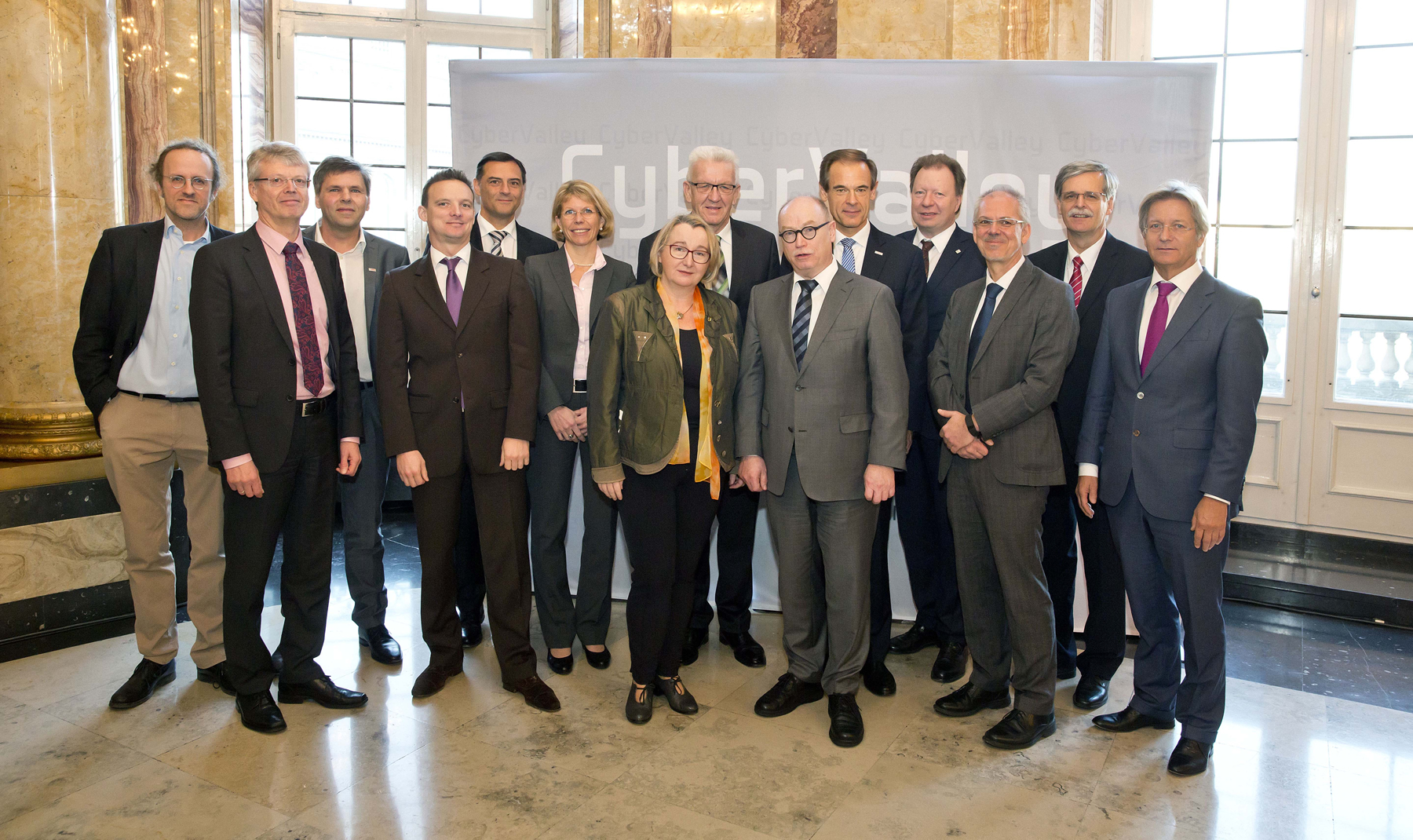
      "Cyber Valley will be a place where the technological foundations for our digital future will be laid", says Martin Stratmann. "We not only want to be a magnet and a talent factory for the best junior scientists, we also want to create space for dialogue with people. After all, the digital future affects us all."

      In Cyber Valley, the Max Planck Institute for Intelligent Systems, the State of Baden-Württemberg, the universities of Stuttgart and Tübingen, together with Bosch, Daimler, Porsche, BMW, ZF Friedrichshafen and Facebook are working together to boost research and development in artificial intelligence. The result is one of the largest research partnerships in Europe in the area of artificial intelligence. The State will invest more than EUR 50 million in the initiative in the coming years.

      A cycle of perception, understanding, action and learning

      The intelligent systems that will be researched and developed in Cyber Valley will be capable of completing the cycle of perception, understanding, action and learning. This ability, which humans and animals master as a matter of course, is vital in being able to act independently in complex and dynamic environments. The aim of the research cluster is to learn from nature and to understand the underlying regulatory and control mechanisms of perception, action and learning and to reproduce them in artificial systems.

      "A distant vision for so long, this is now within our reach: artificial intelligence is on the way", says Minister-President Winfried Kretschmann. "We are convinced that the establishment of Cyber Valley here in Baden-Württemberg can lead to the development of a hub for scientific excellence involving the brightest minds of tomorrow in the area of artificial intelligence. Our goal is not only to build the best machines but also the cleverest machines."

      Cyber Valley is designed to be more than an international centre for researching intelligent systems: its aim is also to promote company startups in this area in order to move as quickly as possible from basic research to marketable applications. A key element of the project will be the training of up to 100 doctoral students.


      New Research Groups and professorships

      As a first step, nine and later five Cyber Valley Research Groups will be set up. These will be funded by the State, the core partners and a consortium of foundations in Baden-Württemberg. Ten professorships at the universities of Stuttgart and Tübingen will also lend additional weight to Cyber Valley in an international context: the universities will each host two professorships as 'bridging professors' with the Max Planck Institute for Intelligent Systems and thus will make a significant and long-term contribution to the initiative. The State will supplement these efforts by financing two additional professorships in each case. The companies are also committed to the establishment of a total of two Endowment Chairs in Stuttgart and Tübingen. In summer 2017, the Max Planck Institute for Intelligent Systems and the universities of Stuttgart and Tübingen will set up a joint graduate school (International Max Planck Research School – Intelligent Systems). In a second development phase, the State will use special funding to support a shared new building project that will be the physical centre of Cyber Valley.

      "Thanks to their various areas of research, the universities of Stuttgart and Tübingen form the ideal interface between humans and machines", says Theresia Bauer, Minister of Science, Research and the Arts. "The partnership with the Max Planck Institute is an excellent opportunity to light a beacon for science in the area of AI in Baden-Württemberg."