CV Tag: AI in Medicine

  • AI & Health

    AI & Health

    Schedule

    • Opening remarks
    • Start-Ups
    • Investors
    • Discussion
    • Closing Remarks
    Opening

    Alex Diehl

    Senior Advisor Cyber Valley

    Start-Ups

    Computomics GmbH (Start-Up, Tübingen)

    Sebastian Schultheiss

    "Computomics’ data analysis experts offer custom services for next-gen sequencing projects – from crop science to metagenomics."


    AIRAmed GmbH (Start-Up, Tübingen)

    Christiane Lindig & Tobias Lindig

    "Artificial intelligence makes neuroradiology measurable, Individual and objective."


    Curedatis (Early Stage Start-Up, Stuttgart)

    Robert Radloff

    "Current methods for evidence generation and synthesis do not scale to meet the demands, imposed by the exponentional growth of the evidence base."


    eye2you GmbH (Start-Up, Tübingen)

    Jörn-Philipp Lies

    "We want to make retinal eye care more accessible to everybody by leveraging the power of cutting-edge AI with the ubiquity of smartphones."


    Grazia Equity GmbH (Investor, Stuttgart)

    Benedikt Battke

    "Capital for entrepreneurs."


    Apollo Health Ventures (Investor, Hamburg)

    Victor Bustos

    "Apollo Health Ventures develops interventions with the potential to prevent or reverse age-related diseases and extend healthy human lifespan."

    Discussion

    Wieland Brendel

    Machine learning researcher at the University of Tübingen & Co-Founder of Layer7 AI


    Alexander Brem

    Chaired Professor of Entrepreneurship in Technology and Digitization, 
    endowed by the Daimler Fund in the Stifterverband, at the University of Stuttgart

    -Moderator-

    Closing

    Alex Diehl

    Senior Advisor Cyber Valley

  • Cyber Valley Research Forum (virtual)

    Cyber Valley Research Forum (virtual)

    At this edition of the event, we will focus on the University of Stuttgart's Cyber Valley groups as well as on a recently established group at the University of Tübingen. In addition, our partners from Fraunhofer IPA and IAO will present the AI Innovation Center "Learning Systems" and their AI-related areas of research.

    Due to COVID-19 restrictions, the workshop will be held online (Zoom). If you would like to participate, please register here.


    Schedule
    13:30 Welcome
    13:30 – 13:40 AI Innovation Center “Learning Systems”
    https://www.ki-fortschrittszentrum.de
    13:40 – 14:00

    Dr. Tian Qiu

    Biomedical Microsystems, Institute of Physical Chemistry, University of Stuttgart

    Title: Augmented Reality Organ Phantom for the Generation of Biomedical Data

    Abstract:
    Biomedical data of the human body is complex and difficult to acquire for safety, ethical, legal, and technical reasons.  Building a realistic organ phantom based on rapid prototyping and augmented reality technologies is one of our group's research focuses. The phantom system represents the anatomy and the material properties of real organs. Moreover, the model can sense what it experiences and generate a large amount of data, which is not even possible with a real organ. The data will offer unique opportunities to train surgeons and optimize surgeries, and to develop new medical instruments and life protection systems.

    14:00 – 14:20

    Prof. Dr. Michael Sedlmair

    Virtual Reality and Augmented Reality, Visualization Research Center (VISUS), University of Stuttgart

    Title: VR/AR research at VISUS

    Abstract:
    I will introduce several examples of current Virtual/Augmented Reality (VR/AR) projects from the Visualization Research Center (VISUS) at the University of Stuttgart. Much of our work focuses on how data visualization can be meaningfully combined with VR/AR. Also referred to as Immersive Analytics, this combination is a popular topic. However, many things can go wrong. We will look at some of these pitfalls, identify ways of overcoming them, and outline scenarios that could have a truly significant and lasting effect.

    14:20 – 14:40

    Prof. Dr. Jakob Macke

    Machine Learning in Science, Cluster of Excellence "Machine Learning", University of Tübingen

    Title: Simulation-based inference: Bridging the gap between machine learning and scientific modelling

    Abstract:
    Many fields of science and engineering make extensive use of complex simulations that describe the structure and dynamics of the process being investigated. These models are derived from knowledge of the underlying mechanisms and are of critical importance for scientific hypothesis-building. However, linking such complex models to high-dimensional empirical data can be challenging. My group develops computational tools that aim to bridge the gap between data-driven machine learning and theory-driven, scientific modelling, with a focus on applications in the life sciences. In this talk, I will focus on our recent work on using neural conditional density estimators to perform Bayesian inference on simulation-based models. I will demonstrate the efficiency and flexibility of this approach and highlight applications to dynamical models of biological systems and source-reconstruction in biological imaging.

    14:40 – 15:00

    Prof. Dr. Alexander Brem

    Entrepreneurship in Technology and Digitization, Institute of Entrepreneurship in Technology and Science, University of Stuttgart

    Title: How AI-driven applications enhance Innovation and Entrepreneurship

    Abstract:
    Artificial intelligence (AI) is changing how entrepreneurs and companies innovate. Startups and established companies are developing a wide range of AI-driven applications, addressing different tasks along the innovation process. These tasks include, just to mention a few, the detection of emerging technologies and trends, the identification of customer needs or lead users, the generation of user feedback from emotional facial recognition, or the automated creation of new product designs.
    In light of such rapid developments, we offer an overview on how AI is being current used in creativity, innovation, and entrepreneurship. We describe how technology and management researchers in these fields are studying the applications and impact of AI. Finally, we outline the current research areas (still emerging) and suggest areas for further management research using AI and research on AI’s impact on innovation and entrepreneurship processes.

    15:00 – 15:25

    Fraunhofer Institute for Manufacturing Engineering and Automation (IPA)

    Dependable AI built on Explainability, Verification and Uncertainty Quantification
    (Nina Schaaf, Xinyang Wu, Marcel Albus)

    Computer Vision for Quality Control and Robotics
    (Bernd Meese, Johannes Stoll)

    Cognitive Robotics: Deep Learning for Robotic Grasping and Assembly
    (Marius Moosmann, Arik Lämmle)

    15:25 – 15:50

    Fraunhofer Institute for Industrial Engineering (IAO)

    X-tended Reality@Fraunhofer IAO – Labs and Usecases in the field of Building Construction
    (Alexandros Giannakidis, Günter Wenzel)

    AI-based solutions for text documents analysis
    (Maximilien Kintz)

    Applied Neuroscience and Neuroadaptive Technology
    (Katharina Lingelbach, Mathias Vukelic)

    Variable and adaptive driving behaviour and vehicle interior: Robust, safe and fun with AI
    (Frederik Diederichs, Mathias Vukelic, Matthias Bues)

    15:50 – 16:00 Wrap-up
  • No one size fits all: Artificial Intelligence as Key Technology for Personalised Medicine

    No one size fits all: Artificial Intelligence as Key Technology for Personalised Medicine

    Artificial intelligence is one of the technologies that are key to Europe’s future. The areas of application are manifold, but not yet fully anchored in society. In the field of healthcare, the crucial role that data collection and analysis can play in the treatment of diseases has already been recognised. Personalised medicine is one out of many key applications of this modern data-driven approach to healthcare. Cross-disciplinary collaboration and a strong European network of AI hubs are needed to lever the full potential of AI.

    With the Cyber Valley, Baden-Württemberg has created a powerful hub for AI. Different universities and university hospitals, research institutes and industry are working closely together in an integrated approach, having established a globally recognised European network.

    We will discuss with our distinguished panellists the interfaces between AI and medicine, the cooperation between science and industry as well as the future funding instruments for health and AI planned by the European Commission.


    Programme

    01:30 p.m.


    Welcome

    Bodo Lehmann, Head of the Representation of the State of Baden-Württemberg to the European Union


                      Introduction

                   Dr. Julia Stamm, Founder and Director, Science Leads, Berlin


    01:35 p.m.


    Keynote speech

    Minister Theresia Bauer MdL, Ministry of Science, Research and Arts of the State of Baden-Württemberg


    afterwards


    Keynote speech

    Prof. Dr. Bernhard Schölkopf, Director, Max Planck Institute for Intelligent Systems, Co-Founder of the Cyber Valley and Member of the Board of ELLIS Society (European Laboratory for Learning and Intelligent Systems)


    01:45 p.m. 


    Panel discussion with

    Dr. Karim Berkouk, Deputy Head of Unit Combatting Diseases, DG Research and Innovation, European Commission

    Dr. Nuria Oliver, Chief Data Scientist, Data-Pop Alliance, Member of the Board of ELLIS Society (European Laboratory for Learning and Intelligent Systems) and ELLIS Unit Alicante

    Dr. Oliver Stegle, Head of Division, Computational Genomics and Systems Genetics, German Cancer Research Center Heidelberg and European Molecular Biology Laboratory Heidelberg

    Moderator: Dr. Julia Stamm, Founder and Director, Science Leads, Berlin


    afterwards


    Q&A with the audience


    02:45 p.m.


    Outlook

    Priorities in research and innovation under the German EU Council Presidency

    Michael Vorländer, Head of Unit Education and Research, Permanent Representation of Germany to the European Union


    02:55 p.m.


    Closing remarks

    Dr. Julia Stamm, Founder and Director, Science Leads, Berlin


    Please use this link for your registration.
    You will receive the link for the online stream in your registration confirmation by email.
    We look forward to your participation!
    Yours sincerely,
    Bodo Lehmann
    Head of the Representation of the State of Baden-Württemberg
    to the European Union
    Please see attached for information on our data protection policy according to the General Data Protection Regulation.
    Note:
    With your registration, you give permission to publish photos and videos that will be taken or recorded during the event and you agree with the storage of your personal data.


  • Machine Learning for Covid-19 Risk Awareness from Contact Tracing – Max Planck Lecture

    Machine Learning for Covid-19 Risk Awareness from Contact Tracing – Max Planck Lecture

    The Covid-19 pandemic has spread rapidly worldwide, overwhelming manual contact tracing in many countries, resulting in widespread lockdowns for emergency containment. Large-scale digital contact tracing (DCT) has emerged as a potential solution to resume economic and social activity without triggering a second outbreak. Various DCT methods have been proposed, each making trade-offs between privacy, mobility restriction, and public health. Many approaches model infection and encounters as binary events. With such approaches, called binary contact tracing, once a case is confirmed by a positive lab test result, it is propagated to people who were contacts of the infected person, typically recommending that these individuals should self-quarantine. This approach ignores the inherent uncertainty in contacts and the infection process, which could be used to tailor messaging to high-risk individuals, and prompt proactive testing or earlier self-quarantine. It also does not make use of observations such as symptoms or pre-existing medical conditions, which could be used to make more accurate risk predictions. Methods which may use such information have been proposed, but these typically require access to the graph of social interactions and/or centralization of sensitive personal data, which is incompatible with reasonable privacy and security constraints. We use an agent-based epidemiological simulation to develop and test ML methods that can be deployed to a smartphone to locally predict an individual's risk of infection from their contact history and other information, while respecting strong privacy and security constraints. We use this risk score to provide personalized recommendations to the user via an app, an approach we call probabilistic risk awareness (PRA). We show that PRA can significantly reduce spread of the disease compared to other methods, for equivalent average mobility and realistic assumptions about app adoption, and thereby save lives.


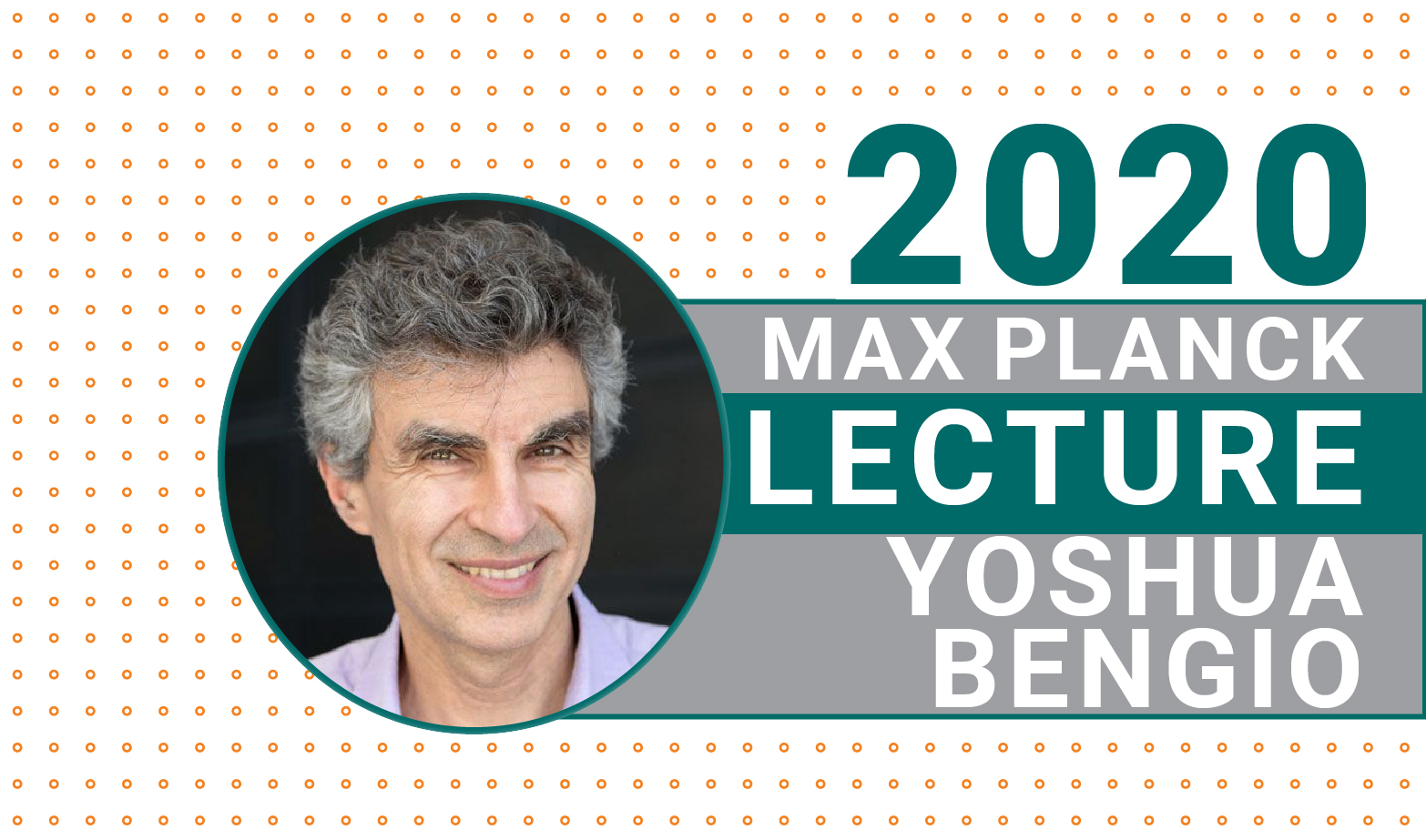
    As you may have read on Twitter, Professor Geoffrey Hinton has decided to cancel his talk at the 2020 Max Planck Lecture for scientific reasons. While we are very sorry that Professor Hinton will not be able to speak, we are pleased to announce that one of his fellow Alan Turing Award recipients has generously offered to hold the lecture. 


    Live transmission will take place on the event website on the day of the talk at 5:30 pm CEST.


    Biography: 

    Yoshua Bengio is recognized as one of the world’s leading experts in artificial intelligence and a pioneer in deep learning. Since 1993, he has been a professor in the Department of Computer Science and Operational Research at the Université de Montréal. He is the founder and scientific director of Mila, the Quebec Institute of Artificial Intelligence, the world’s largest university-based research group in deep learning. He is a member of the NeurIPS board and co-founder and general chair for the ICLR conference, as well as program director of the CIFAR program on Learning in Machines and Brains.In 2018, Yoshua Bengio ranked as the computer scientist with the most new citations, worldwide, thanks to his many publications. In 2019, he received the ACM A.M. Turing Award, “the Nobel Prize of Computing”, jointly with Geoffrey Hinton and Yann LeCun for conceptual and engineering breakthroughs that have made deep neural networks a critical component of computing. In 2020 he was nominated Fellow of the Royal Society of London.


    About the Max Planck Lecture

    In the past, Max Planck Lecture was hosted by Stuttgart’s Max Planck institutes, the Max Planck Institute for Intelligent Systems (MPI-IS) and the Max Planck Institute for Solid State Research (MPI-FKF). Since 2003, these two institutes have alternately organized the Max Planck Lecture once per year. 

    The Max Planck Lecture is given by outstanding scientists and leaders who are internationally recognized in their field. MPI-IS is delighted to announce that our 2020 speaker is Professor Yoshua Bengio from Université de Montréal.

    Max Planck Lectures are designed to be accessible to a wide audience including scientists, industry practitioners, government decision makers, and the general public interested in science and technology.

    Previous Max Planck Lectures.


  • ELLIS against Covid-19

    ELLIS against Covid-19

    Agenda

    * Speakers and talk titles are subject to change

    * All times in Central European Summer Time (CEST)

    Time Session
    1:30pm 1:35pm

    Introduction

    • Sepp Hochreiter
    1:35pm – 2:20pm

    Epidemiology & modeling

    • Peter Grünwald (10 min): The BCG CORONA and BCG-CORONA-ELDERLY Clinical Trials.
    • Alessandro Betti, Marco Gori (10 min): Learning the Dynamic SIR Model: An Optimal Control Approach
    • Johannes Zierenberg (10 min): Inferring COVID-19 spreading rates and potential change points for case number forecasts
    • Questions & discussion (15 min)

    2:20pm – 3:05pm

    Data, privacy and ML challenges

    • Antti Honkela (10 min): Privacy-preserving contact statistics collection for COVID-19 epidemic management
    • Thomas M. Hermans and Andre Loesekrug-Pietri (5 min):  The JEDI Grand Challenge
    • Kostas Kavoussanakis (5 min): Rapid Assistance in Modelling the Pandemic (RAMP)
    • Rolf Apweiler (10 min):  The European COVID-19 Research Data Platform 
    • Questions & discussion (15 min)

    3:05pm – 3:30pm

    Images

    • Victoria Schpacovitch, Katharina Morik (10 min): Resource optimising real-time analysis of artifactious image sequences for the detection of nano-objects
    • Plamen Angelov (5 min): COVID-19 CT Scan Classification via Explainable Deep Learning
    • Questions & discussion (10 min)
    3:30pm – 3:35pm

    Concluding discussion


    Send questions and comments to the speakers here: https://forms.gle/pBohVJyVQBYNbNy36

    The event will be livestreamed. You can watch it on YouTube: https://youtu.be/3VsKaiJB4Mc

  • ELLIS against Covid-19

    ELLIS against Covid-19

    Agenda

    * Speakers and talk titles are subject to change

    * All times in Central European Summer Time (CEST)

    Time Session
    1:30pm 1:40pm

    Introduction

    • Max Welling
    1:40pm – 2:40pm

    Diagnostics: molecular and imaging

    • Fabian Theis (15 min): "Leveraging single-cell transcriptomics to understand the molecular basis for SARS-CoV-2 distribution in the population"
    • Victor Greiff (15 min): "Methods for mining the adaptive immune repertoire for SARS-CoV-2 diagnostics and therapeutics"
    • Clarisa Sanchez (15 min): "CT analysis using machine learning to address COVID-19"
    • Questions & Discussion (15 min)
    2:40pm – 3:20pm

    Modeling and tracing

    • Bernhard Schölkopf (15 min): "COVID-19 machine learning projects at Max Planck Institute"
    • Luca Feretti (15 min): "Quantifying SARS-CoV-2 transmission suggests epidemic control with digital contact tracing"
    • Questions & Discussion (10 min)
    3:20pm – 3:50pm

    Data & platforms

    • Mads Nielsen (5 min): "Overview of Danish ICU risk assessment study"
    • Russ Taylor (5 min): "Telerobotics for Intensive Care Unit"
    • Cecilia Mascolo (5 min): "Mobile Health Diagnostics through Audio Signals: a COVID-19 case study"
    • Questions & Discussion (15 min)
    3:50pm – 4:00pm

    Concluding discussions

    • General Discussion and Wrap-Ups (10 min)
    • End of meeting


    Send questions and comments to the speakers here: https://forms.gle/u1YngqpimVPuwYZT6

  • ELLIS against Covid-19

    ELLIS against Covid-19

    Agenda

    * Speakers and talk titles are subject to change

    * All times in Central European Summer Time (CEST)

    Time Session
    1:30pm 1:45pm

    Introduction

    1:45pm – 2:30pm

    Outbreak prediction / tracking & epidemiological modelling

    • Nuria Oliver (15 min): "Data Science to fight against COVID-19" (link to recording)
    • Richard Neher (15 min): "Tracking SARS-Cov-2 using viral genomes and projecting its spread" (link to recording)
    • Questions & Discussion
    2:30pm – 2:55pm

    Viral & host genome sequencing

    • Chris Mason (15 min): "A Rapid, International COVID-19 and Microbial Monitoring Network" (link to recording)
    • Questions & Discussion
    2:55pm – 3:40pm

    Drug development

    • Guenter Klambauer (15 min): "Screening for SARS-CoV inhibitors" (link to recording)
    • Yoshua Bengio (15 min): "COVID-19 research at MILA" (link to recording)
    • Questions & Discussion
    3:40pm – 4:05pm

    Healthcare management

    • Mihaela van der Schaar (15 min): "Using machine learning and PHE data to help hospitals cope with COVID-19" (link to recording)
    • Questions & Discussion
    4:05pm – 4:30pm

    Data, resource, open challenges & community platforms

    • Fred Hamprecht (5 min): "COVID: volunteering for machine learners" (link to recording)
    • Devvret Rishi (5 min): "Understanding COVID-19 with the help of a million data scientists" (link to recording)
    • Questions
    4:30pm – 5:00pm

    Concluding discussions

  • Vortrag: Die Dynamik des Laufens – von Tieren und Robotern mit Beinen

    Vortrag: Die Dynamik des Laufens – von Tieren und Robotern mit Beinen

    Warum tun einem nach zwei Stunden im Museum die Beine mehr weh als nach zwei Stunden Wandern? Warum wirkt der 50km Gehen Wettbewerb bei den Olympischen Spielen so seltsam? Warum ist es bei niedrigen Geschwindigkeiten besser zu gehen und bei hohen zu rennen und warum galoppieren wir nicht wie Pferde?


    Auf solch grundsätzliche Fragen an der Schnittstelle von Biologie, Mechanik und Robotik stößt man unweigerlich, wenn man Robotern beibringen möchte auf den eigenen Beinen zu stehen. Dabei realisiert man auch, wie schwierig Laufen ist und wie wenig wir eigentlich darüber wissen – und das, obwohl fast jeder von uns selbst problemlos Laufen kann.

    Der Professor der Universität Stuttgart David Remy hält hierzu einen Vortrag.

    Kursnr.: 201-00511

    Beginn: Di., 21.04.2020, 19:00 – 20:30 Uhr

    Dauer: 1

    Kursort: TREFFPUNKT Rotebühlplatz, Rotebühlpl. 28, 70173 Stuttgart

    Gebühr: Eintritt frei