User Group: Journalist:innen

  • Ministerin Olschowski besucht Cyber Valley in Stuttgart

    Ministerin Olschowski besucht Cyber Valley in Stuttgart

    Zukunftstechnologien wie intelligente Robotik, generative und logische Künstliche Intelligenz (KI), Medizinroboter oder Sensorik für die Onkologie: Cyber Valley präsentierte Wissenschaftsministerin Petra Olschowski, wie am Standort Stuttgart KI-Grundlagenforschung in intelligente Systeme integriert wird.

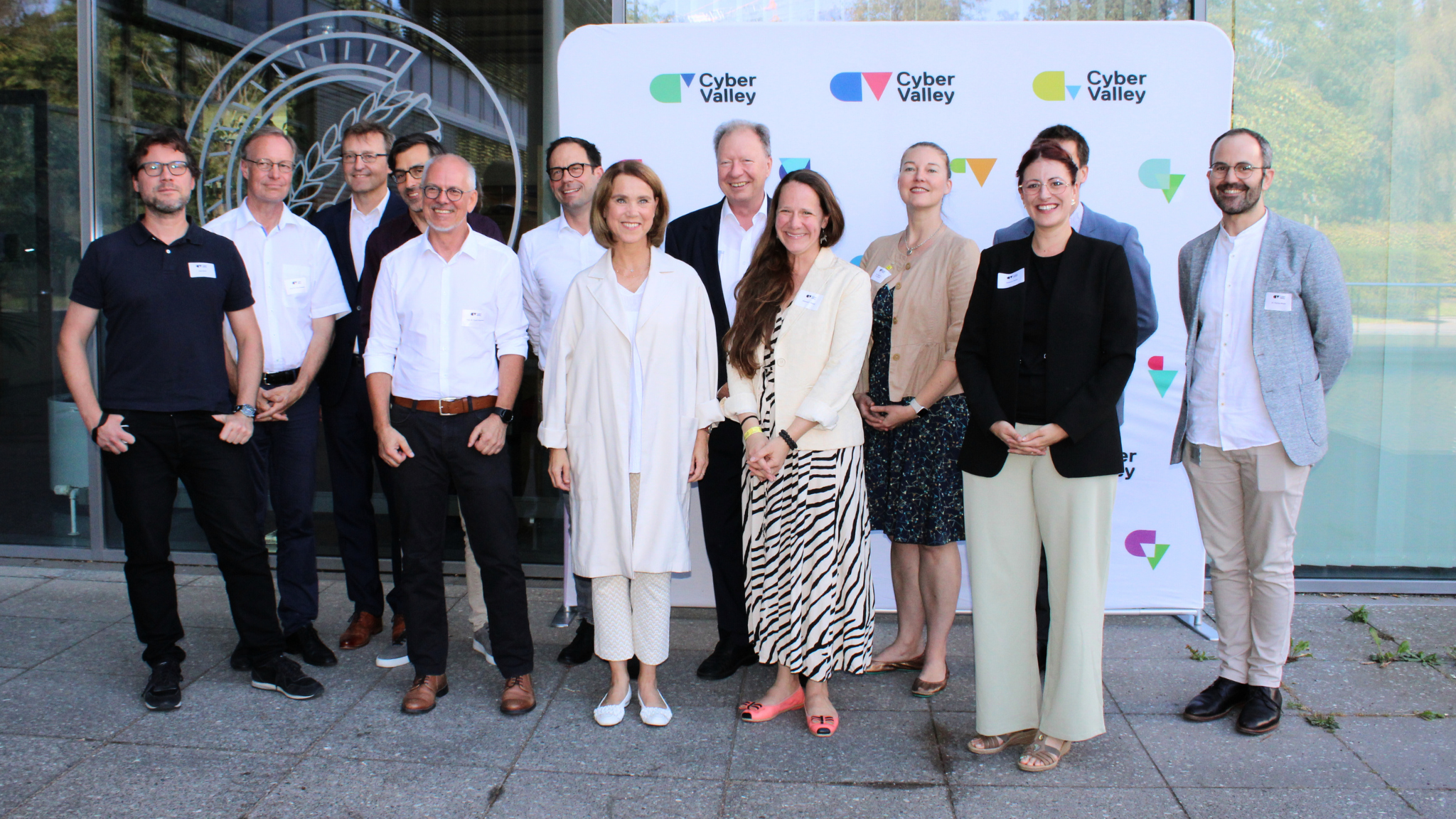
    Während ihrer einwöchigen „Sommertour zu den Zukunftsthemen Digitalisierung und KI“  besuchte Petra Olschowski am 11. September 2023 Cyber Valley und die Universität Stuttgart. Am Max-Planck-Institut für Intelligente Systeme (MPI IS) in Stuttgart informierte sich Olschowski über die KI-Forschung, die an der Universität Stuttgart und in Cyber Valley betrieben wird. Cyber Valley, Europas größtes KI-Forschungskonsortium, stellte ausgewählte Projekte vor, an denen Spitzenwissenschaftler:innen der Universität Stuttgart beteiligt sind.

    Starke Projekte am Cyber Valley in Stuttgart

    Rebecca C. Reisch, Geschäftsführerin der Cyber Valley GmbH, Rektor Professor Wolfram Ressel und Professor Christoph Keplinger (MPI IS und Universität Stuttgart) betonten in ihrer gemeinsamen Begrüßung, wie wichtig KI als Zukunftstechnologie geworden ist. Die Universität Stuttgart, die neben der Universität Tübingen, dem MPI IS und weiteren Partnern Gründungsmitglied des Cyber Valley ist, habe sich langfristig dem Thema Intelligente Systeme verschrieben und es sowohl in ihre Vision „Intelligente Systeme für eine zukunftsfähige Gesellschaft“ als auch in viele ihrer Studienprogramme integriert. Die Stärke am Standort Stuttgart liege im Bereich der Überführung von KI-Grundlagenforschung in cyber-physikalische Systeme und gesellschaftlich relevante Anwendungen. Aber auch die Reflexion der Auswirkungen dieser Technologien auf die Gesellschaft sei am Standort Stuttgart immer mitgedacht.

    Intelligente Robotik und Bionische Intelligenz

    Professor Frank Allgöwer zeigte am Beispiel eines autonom fahrenden E-Scooters, wie intelligente Robotik zu nachhaltiger Mobilität beitragen kann – erst auf dem Campus als Testfeld und dann in komplexeren Umgebungen, wie zum Beispiel ganzen Städten. Wie Medizinroboter durch patientenspezifische Unterstützungsformen künftig Leiden mindern und gesellschaftliche Teilhabe auch im hohen Alter ermöglichen können, erläuterte Professor Syn Schmitt. Gemeinsam mit Professor Christoph Keplinger arbeitet er an neuartigen Muskelrobotern, die Patient:innen künftig ganz individuell bei alltäglichen Bewegungsabläufen helfen können. Das Projekt ist ein Musterbeispiel des Teamspirits in Cyber Valley, da es eine Kooperation zwischen den beiden Universitäten Stuttgart und Tübingen und des MPI IS ist.

    Nachhaltige Mobilität dank intelligenter Robotik. Prof. Allgöwer präsentiert einen autonom fahrenden E-Scooter. Foto: Universität Stuttgart

    Professorin Katherine Kuchenbecker und Professor Metin Sitti zeigten auf einer Tour durch ihre Labore eindrucksvoll, welche Beiträge zur internationalen Forschung im Bereich der haptischen Intelligenz in Stuttgart entstehen. Alle drei Max-Planck-Forschende, Keplinger, Kuchenbecker und Sitti, haben zugleich eine Professur an der Universität Stuttgart inne.

    Einblicke ins neue KI-Institut und ins Graduiertenkolleg

    Welche Forschung er gemeinsam mit Professor Kai Arras und drei weiteren Professuren am kürzlich gegründeten Institut für KI an der Universität Stuttgart betreibt, präsentierte Professor Steffen Staab. Sein Fokus liegt auf KI in der Simulation und Intelligenter Robotik. Eine wichtige Rolle in seiner Forschung spielen KI-basierte Verknüpfungen von Fakten und Wissensbeständen. Ein mögliches Anwendungsszenario für die entwickelten Technologien ist beispielsweise die KI-gestützte Auswertung von Patientendaten. Spannende Einblicke gab auch Professor Oliver Sawodny, als er berichtete, woran Nachwuchswissenschaftler:innen am Graduiertenkolleg „Intraoperative multisensorische Gewebedifferenzierung in der Onkologie“ forschen: Sie verbinden mittels maschineller Lernverfahren verschiedene neuartige Sensoriken und möchten damit Ärztinnen und Ärzten während Krebs-Operationen eine Entscheidungshilfe bieten, ob das individuelle Gewebe erhalten werden kann oder entfernt werden muss.

    Olschowski: Hier wird Zukunft gemacht

    Wissenschaftsministerin Olschowski war beeindruckt, wie am Standort Stuttgart Zukunftstechnologien in Forschung und Lehre entwickelt und eingebunden sowie direkt in Anwendungen gebracht werden. Dies sei auch essentiell, um künftige Studierende zu gewinnen. Sie sagte: „Im Cyber Valley wird Zukunft gemacht: die Künstliche Intelligenz von morgen. Was die KI uns etwa in der Medizin an Möglichkeiten eröffnet, das ist sehr beeindruckend: von intelligenten Robotern mit Tastsinn bis zu KI-unterstützen Operationen. Diese Chancen müssen wir nutzen, um unserer Gesundheit, unserer Lebensqualität und unserem Wohlstand willen. Genau deswegen haben wir das Cyber Valley mit Partnern aus Wissenschaft und Wirtschaft gegründet. Besuche wie dieser heute bestätigen für mich immer wieder, wie wichtig unser Engagement in solche Innovationen ist und welche Früchte es trägt.“

    Forschung im Cyber Valley zeigt, wie KI die Möglichkeiten der Medizin erweitert. Foto: MWK

    Der Rektor der Universität Stuttgart, Professor Wolfram Ressel, hob hervor, dass es durch das große Engagement aller beteiligten Universitäten, Forschungseinrichtungen und Partner gelungen sei, Cyber Valley in kurzer Zeit zu einem bedeutenden Innovationsnetzwerk zu machen. Die langjährige fruchtbare Zusammenarbeit mit der Universität Tübingen und dem MPI IS zeige etwa, wie wichtiger gesellschaftlicher Fortschritt durch die Kombination von Expertise in den Bio- und Ingenieurwissenschaften in Forschung und Lehre erzielt werden kann.


  • EuroEAP 2024 comes to Stuttgart

    EuroEAP 2024 comes to Stuttgart

    What is the topic of this conference?

    The 21st century is experiencing a paradigm change from the age of passive synthetic materials to the age of stimuli-responsive and multi-functional materials. Among them, soft transducers and electromechanically active materials represent a fast growing scientific field of research and development. Soft transducers consist of soft polymeric materials, devices, or systems that react or adapt to external stimulus, such as electrical, magnetic, and mechanical forces. This leads to changes in shape, size, force, stiffness, surface texture, or even colour.

    These transducers can be used for various needs, including actuation, sensing and energy harvesting. These applications make this research field inherently and highly interdisciplinary, bridging the gap between chemistry and physics of materials, electrical and mechanical engineering, user interface science, and intelligent systems.

    These technologies will play an increasingly important role in the future, thanks to their unique combination of stimuli-responsiveness and soft structure. They are already opening numerous possibilities of application in various fields, such as soft robotics, biomedical devices, human-machine interaction, wearables, and smart textiles, to name a few. 

    What is EuroEAP?

    The EuroEAP international conference, organized by the EuroEAP Society with a not-for-profit distinctive character and always held in Europe, primarily aims to share the latest advances and findings in this emerging field. It gathers experts from all over the world in a highly multidisciplinary event driven by scientific quality and industrial impact, with an organization that enables significant opportunities for one-to-one discussions in a friendly atmosphere. Since 2011, the conference has been focused on electromechanically active polymers. Today, the event expands its scope to the larger international and diverse research community of soft smart materials and soft transducers.

    About the venue

    The goal of the Max Planck Institute for Intelligent Systems is to investigate and understand the organizing principles of intelligent systems and the underlying perception-action-learning loop. The Max Planck Institute for Intelligent Systems combines – within one center – theory, software, and hardware expertise in the research field of intelligent systems. Research at the Stuttgart campus of the institute covers small-scale robotics, self-organization, haptic perception, bio-inspired systems, medical robotics, robotic materials, and physical intelligence; that is, the embodiment of intelligent behavior in physical, rather than computational, systems. 

    The program will be released closer to the conference.

  • Journalist-in-Residence Programm 2024

    Journalist-in-Residence Programm 2024

    The Cyber Valley Journalist-in-Residence (JIR) program is targeted at experienced journalists who wish to consider the relationship between journalism and AI. During their stay, the Journalist-in-Residence has the opportunity to learn about the latest developments in machine learning, computer vision, and robotics. They will have full access to researchers from the Max Planck Institute for Intelligent Systems, and the Universities of Tübingen and Stuttgart. The residency offers space for creativity and free thinking about the methods, future tools, and developments for AI-driven or AI-supported journalism. 

    Interested journalists can apply until February 29, 2024 for a three- to six-month paid stay at Cyber Valley's campus in Tübingen. During this time, the Journalist-in-Residence can conduct independent research on a topic of his or her choice in conversation with AI researchers. Cyber Valley does not expect the Journalist-in-Resident to report on AI topics or about Cyber Valley during this time.

    The job advertisement is expressly aimed at staff and freelance journalists. Remuneration via a work contract is based on TV-L E13. The stay can be undertaken full- or part-time. 

    “I recommend applying to anyone willing to take a deep dive into research on intelligent systems – and at the same time wants to be in a city that closely follows such developments,” says data journalist Christina Elmer, who was 2021's Journalist-in-Residence and is now Germany's first professor of data journalism at TU Dortmund University. After the 2021 pilot, the JIR program has become a permanent part of Cyber Valley's public engagement strategy. Other Journalists-in-Residence include Julia Merlot from Der Spiegel, Bettina Friedrich from MDR, freelance journalist Tobias Asmuth, and Elena Riedlinger from WDR.

     
    What does Cyber Valley offer?

    • Introduction to the basics of machine learning, computer vision, and robotics 
    • Access to a network of researchers 
    • Insights into the Cyber Valley Community 
    • Freedom for creativity and reflection on the methods, tools, and AI-supported journalism 
    • Remunerated work contract 
    • Budget for own events (e.g. workshops, expert talks, travel) 
    • Office and accommodation
    • Full-/part-time
    • Salary based on TV-L E13

    How do you apply?

    Interested journalists can apply until February 29, 2024 by sending a cover letter, a CV, and an idea paper by e-mail to Patrick Klügel. The two-page idea paper illustrates which journalistic challenge they will address during their stay. The selection criteria are journalistic quality, scope, previous data journalism experience and creativity, relevance, and feasibility of the self-selected project. Applications may be made in German or English.

    An independent jury will propose up to two candidates from the applications received for the program by the end of March. The final decision will be made by the jury by the beginning of April 2024. 

    The JIR program offers space for two journalists, each seeking a three-month stay, or one journalist for six months. The residency must begin in 2024. For more information on the call for applications and the Cyber Valley JIR program process, please contact Patrick Klügel.

    The JIR program is a collaboration of the Center for Rhetorical Science Communication on Artificial Intelligence (RHET AI) and Cyber Valley, funded by the Volkswagen Foundation.

    Contact

    Patrick Klügel
    Public Engagement Manager

    Eberhard Karls Universität Tübingen
    Zentrale Verwaltung · Dez. II Abt. 1, Forschungs- und Exzellenzstrategie
    Rümelinstr. 32 · 72070 Tübingen

    patrick.kluegel@uni-tuebingen.de
    +49 151/74238237

  • AI House Davos: Catalyzing AI tech transfer in Europe

    AI House Davos: Catalyzing AI tech transfer in Europe


    It will address the facilitation of cross-sector AI innovation (like ELLIS), discussing the synergy between academia, industry, and government to accelerate tech transfer, drive economic growth, and meet societal needs with cutting-edge AI solutions.


    When?

    Wed, 17. January 2024, 10:30 – 10:55


    Format

    • Round table
    • Open to the press


    Speakers

    • Bernhard Schölkopf, Professor – Max Planck Institute for Intelligent Systems & ETH
    • Alexander Diehl, Investor & Entrepreneur
    • Rebecca C. Reisch, CEO Cyber Valley


    Moderator

    • Julian Enz, Chief Innovation Office, Cyber Valley


    Further information


  • AI House Davos: From lab to market

    AI House Davos: From lab to market


    The roundtable will center on the transition of AI from scientific discovery to economic implementation. We'll dissect the mechanisms that enable scientific AI innovations to be adapted for economic use, including intellectual property, licensing, and market strategy. The conversation will highlight collaborative models between research institutions and industry partners that facilitate the transfer of AI technologies into commercial ventures.


    When?

    Thursday January 18, 2024, 10:00-10:55 CET


    Where?

    Partner Room 2, AI House Davos, Promenade 68, 7270 Davos Platz


    Format

    • Round table
    • Open to the press


    Speakers

    • Evan Sparks, Vice President of AI and High Performance Computing at HP

    • Max-Frederik Gerken, CEO of Optocycle

    • Alexander Diehl, Investor & Entrepreneur, Cyber Valley


    Moderator

    • Julian Enz, Chief Innovation Office, Cyber Valley


    Further information

    Register

  • AI House Davos: AI & Sustainability

    AI House Davos: AI & Sustainability


    This roundtable will explore how AI technologies are being applied to tackle critical sustainability challenges. Discussions will examine real-world AI innovations in areas such as renewable energy, resource conservation, and climate change mitigation. Emphasizing actionable solutions, we'll consider the role of AI in driving environmental progress, enhancing global sustainability efforts, and the partnerships propelling this mission forward.


    When?

    Wednesday, January 17 2024, 11:30-12:00 CET


    Where?

    Partner Room 2, AI House Davos, Promenade 68, 7270 Davos Platz


    Format

    • Roundtable
    • Open to the press
    • Interactive panel discussion
    • Audience Q&A


    Speakers

    • Christoph Kellenberger, Sustainable Architect
    • Max Gercken, CEO Optocycle
    • Dieter Gerdemann, MD & Partner Sustainability, A.T. Kearney
    • Samuel Widmann, Entrepreneur and ex-Google Maps CEO
       

    Moderators

    • Julian Enz, Director Innovation & Economy (CIO), Cyber Valley
    • Rebecca Beiter, Director Communications & Society (CCO), Cyber Valley


    Further information

    Register


  • AI House Davos: Frontiers of AI & ML

    AI House Davos: Frontiers of AI & ML


    Exploring cutting-edge developments in machine learning and AI, this discussion delves into recent research breakthroughs including related fields like computational neuroscience. Focused on advanced algorithms, neural network innovations, and deep learning techniques, we'll address challenges and future directions in AI, with insights from leading European AI researchers. Emphasis will be on scientific depth, practical applications, and ethical considerations. 


    When?

    Wednesday, January 17, 2024, 16:15-16:45


    Where?

    Partner Room 3, AI House Davos, Promenade 68, 7270 Davos Platz


    Format

    • Round table
    • Open to the press


    Speakers

    • Bernhard Schölkopf, Director of the ELLIS-Institute, Director Max Planck Institute for Intelligent Systems & Cyber Valley Speaker
    • Tobias Bonhoeffer, Director of the Max Planck Institute for Biological Intelligence
    • Auguste von Bayern, Group Leader Max Planck Institute for Biological Intelligence
    • Evan Sparks, Vice President of AI and High Performance Computing at HPI


    Moderator

    • Alexander Diehl, Investor & Entrepreneur, Cyber Valley 


    Further information

    Register

  • Hype oder Hoffnung?

    Hype oder Hoffnung?


    Maschinelles Lernen ist nicht das Wundermittel, mit dem wir unseren Planeten retten können. Keine einzelne Lösung wird den Klimawandel "reparieren". Aber viele Anwendungen, die auf maschinellem Lernen basieren, haben großes Potenzial. Manchmal wird Künstliche Intelligenz bereits eingesetzt. Oft sind die Anwendungen noch Ideen. Wie kann man über die faszinierenden Lösungen berichten ohne falsche Erwartungen zu wecken?
     

    Wann?

    25. Januar, 2024, 12:00-13:00 Uhr


    Wie?

    Zur Anmeldung via zoom: Registrierung zum Event


    Was?

    Tobias Asmuth, “Journalist-in-Residence" im Cyber Valley, spricht mit Prof. Dr. Lynn Kaack (Assistenzprofessorin für Informatik und öffentliche Ordnung an der Hertie School) und Wieland Brendel, der am Max-Planck-Institut für Intelligente Systeme die unabhängige Forschungsgruppe „Robust Machine Learning“ leitet.

    Um an dieser Veranstaltung teilzunehmen, registrieren Sie sich bitte hier und wir senden Ihnen einen Link zur Online-Veranstaltung.
    Die Veranstaltung wird aufgezeichnet. Die Veranstaltung findet auf Deutsch statt. 


    Über Cyber Valley Journalist-in-Residence 

    In einem drei- bis sechsmonatigen Aufenthalt erforschen ein oder zwei Journalisten, wie KI-Anwendungen für guten Journalismus genutzt werden können und wie Journalist*innen sicherstellen können, dass ihre Berichterstattung über die Technologien hinter dem Schlagwort "künstliche Intelligenz" angemessen und evidenzbasiert ist. Die Journalist*innen werden von einer unabhängigen Jury ausgewählt. In dieser Zeit kann der oder die Journalist-in-Residence zu einer selbst gewählten Fragestellung im Austausch mit KI-Forschenden unterschiedlicher Disziplinen recherchieren – absolut unabhängig. Cyber Valley erwartet in dieser Zeit ausdrücklich keine Berichterstattung über KI-Themen oder über Cyber Valley. Das Programm findet zweimal jährlich in einer Kooperation zwischen Cyber Valley und dem Zentrum für Rhetorische Wissenschaftskommunikation – Forschung zur Künstlichen Intelligenz (RHET AI Center) statt. Es wird von der Volkswagen Stiftung gefördert.

  • AI House Davos: Leading the Global Conversation on AI

    AI House Davos: Leading the Global Conversation on AI

    Das AI House Davos bringt internationale Branchenführende, Tech-Gründer:innen, Forschende, Unternehmen, Investor:innen und politische Entscheidungsträger:innen zusammen. Gemeinsam reflektieren wir über die Auswirkungen von künstlicher Intelligenz auf unsere Welt. Diskutiere mit Cyber Valley im schweizerischen Davos vom 15. bis 19. Januar 2024 während des Weltwirtschaftsforums, wie KI die Welt von morgen gestalten wird.

    Diese Pressemitteilung ist auf Englisch verfügbar.

    The AI House connects industry leaders, tech founders, research, companies, investors and policy makers to discuss the impact of artificial intelligence on the world. Join us in Davos during the World Economic Forum Annual Meeting from January 15 to 19 to discuss how AI will shape the world of tomorrow.

    We are thrilled to announce the launch of AI House Davos 2024: A Global Forum for AI Progress during the World Economic Forum (WEF) Annual Meeting. AI House Davos will convene thought-leaders, academics, industry experts, government officials, investors, and entrepreneurs to foster discussions that will influence the responsible scaling, integration, and regulation of artificial intelligence. This inclusive and multidisciplinary platform will embrace diverse stakeholders, including academia, government, industry, finance, civil society, and entrepreneurship. It aims to provide solutions for addressing the global impact of artificial intelligence.

    The AI House

    AI was one of the main topics during the last annual meeting of the World Economic Forum and the conversation has only accelerated since then. Today, there is an urgent need for a global discussion that includes policymakers, academics, civil society, venture, and industry. The AI House Davos provides an independent platform to have this global conversation on neutral ground and invites you to join us as we embark on this remarkable endeavor.

    During the Annual Meeting of the World Economic Forum, the AI House Davos will unite prominent figures to engage in discussions on the most critical issues concerning artificial intelligence, exploring its impact on society. By establishing a long-term presence and fostering a community of AI thought-leaders during the Annual Meeting of the World Economic Forum, the AI House will have enduring global effects on a long-term scale. Together with other partners, sponsors, contributors, and media partners, we are poised to make a significant impact on the future of AI.

    The Leaders of the Global Conversation on AI

    AI House Davos is a joint initiative by Merantix and the ETH AI Center together with Swisscom, UTokyo Institute for AI and Beyond, and Hewlett Packard Enterprise (HPE). Cyber Valley is a contributor to the planned program.

    Stay tuned for more updates, and mark your calendars for AI House Davos from January 15 to January 19, 2024. More information can be found here: Cyber Valley at AI House Davos


    Media contact

    Dr. Hazel Rowland
    Media Manager, Cyber Valley GmbH
    Email: hazel.rowland@cyber-valley.de