User Group: Journalist:innen

  • Faktenüberprüfung und Desinformation im Zeitalter der KI

    Faktenüberprüfung und Desinformation im Zeitalter der KI

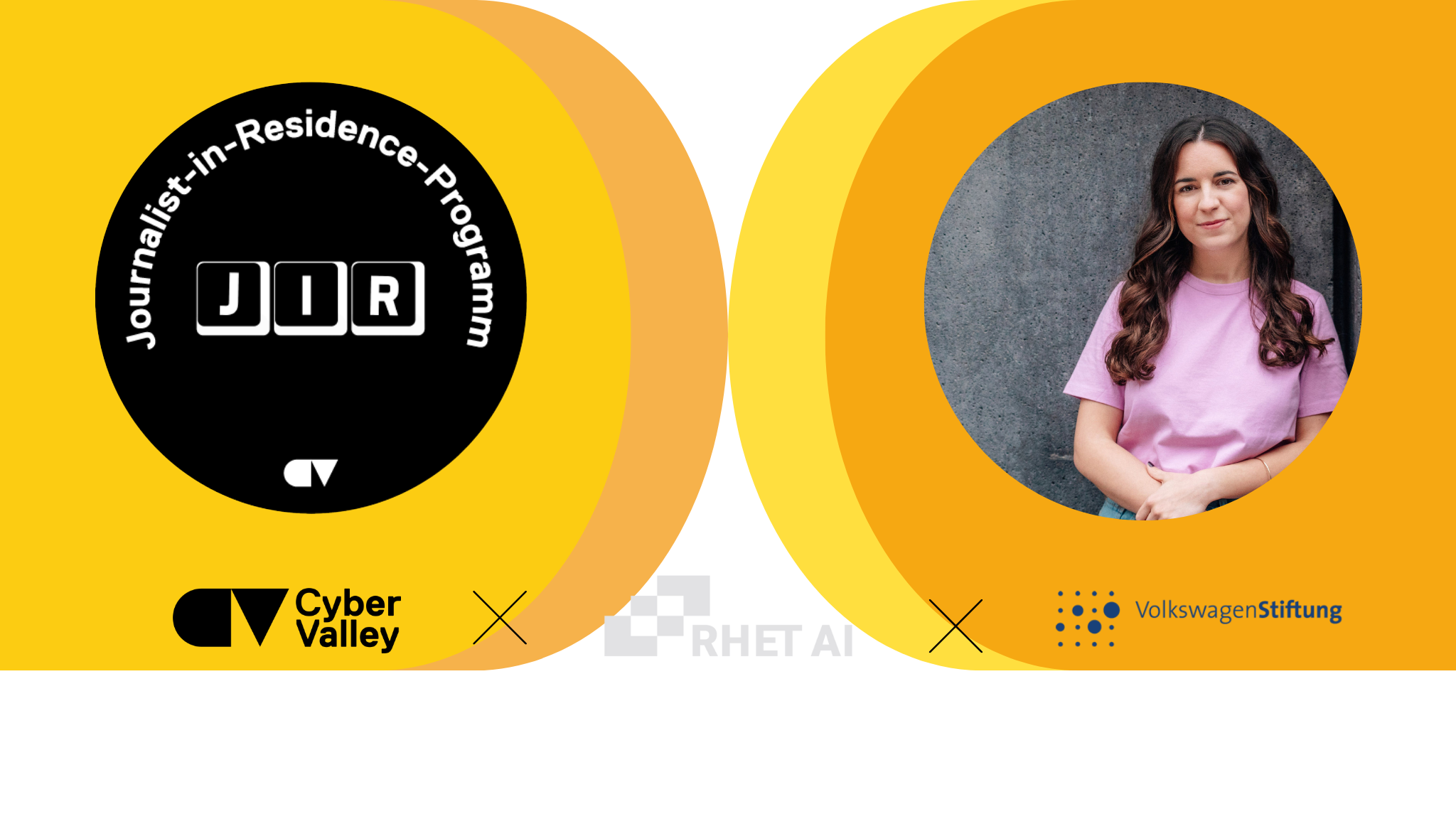
    Elena is currently an editor at WDR in Cologne. Her experience as a data journalist and in digital product development means that she can work at the interface between journalism and IT. Together with Stefan Domke, she recently led the Grimme Online Award-winning app and web project “Stolpersteine NRW – gegen das Vergessen” 

    During her residency, Elena will undertake independent research on the impact of intelligent systems on today’s society. The residency grants journalists unrestricted access to Cyber Valley’s Community so they can explore the interplay between journalism and intelligent systems and find the best approach to producing well-researched journalism that inspires public interest. She will explore the capabilities of AI-powered tools that can verify content and ensure the reliability of information for editorial work. The Cyber Valley team took this opportunity to find out more about what Elena hopes to achieve during her residency. 

    What sparked your interest in AI? 

    My work takes place at the interface between journalism and IT, which means I come into contact with the topic of AI time and again. However, I have noticed that I don't have enough time in my day-to-day editorial work to deal intensively with the possibilities of AI. That's what I want to do now at Cyber Valley.  

    Why do you think reporting on AI is important? 

    AI is already influencing our everyday lives in many ways – without most people being aware of it. I think it's important to educate and inform people about the topic so that we as a society can have important discussions about the use of AI. 

    To what extent do you think AI impacts society? 

    The influence of AI on society will certainly continue to increase. The issue of disinformation is an example of this. The problem has existed for a long time, but new AI technologies are making it worse. We have to deal with such risks as a society. 

    How would you describe your knowledge and experience of AI?  

    I have a basic understanding of what machine learning is about, but my experience is limited to that of a user, for example, of a very useful translation software.

    What is your main focus for this residency? 

    I want to find out whether AI tools can help journalists with fact checking – and, above all, learn a lot of new things in the process. 

    What are your expectations? What do you hope to accomplish? 

    I am most looking forward to the exchange with the scientists who deal with the topic of AI from very different perspectives and would be happy if what I learn here can in turn help others in the end. 
     

    Cyber Valley wishes Elena a successful residency. This is the fourth iteration of the Journalist-in-Residence program. It is organized in cooperation with RHET AI Center and is funded by the Volkswagen Foundation. For queries regarding the program, please contact Hazel Rowland (Media Manager) at hazel.rowland@cyber-valley.de. 
  • Erforschung der Auswirkungen von KI auf den Klimawandel

    Erforschung der Auswirkungen von KI auf den Klimawandel

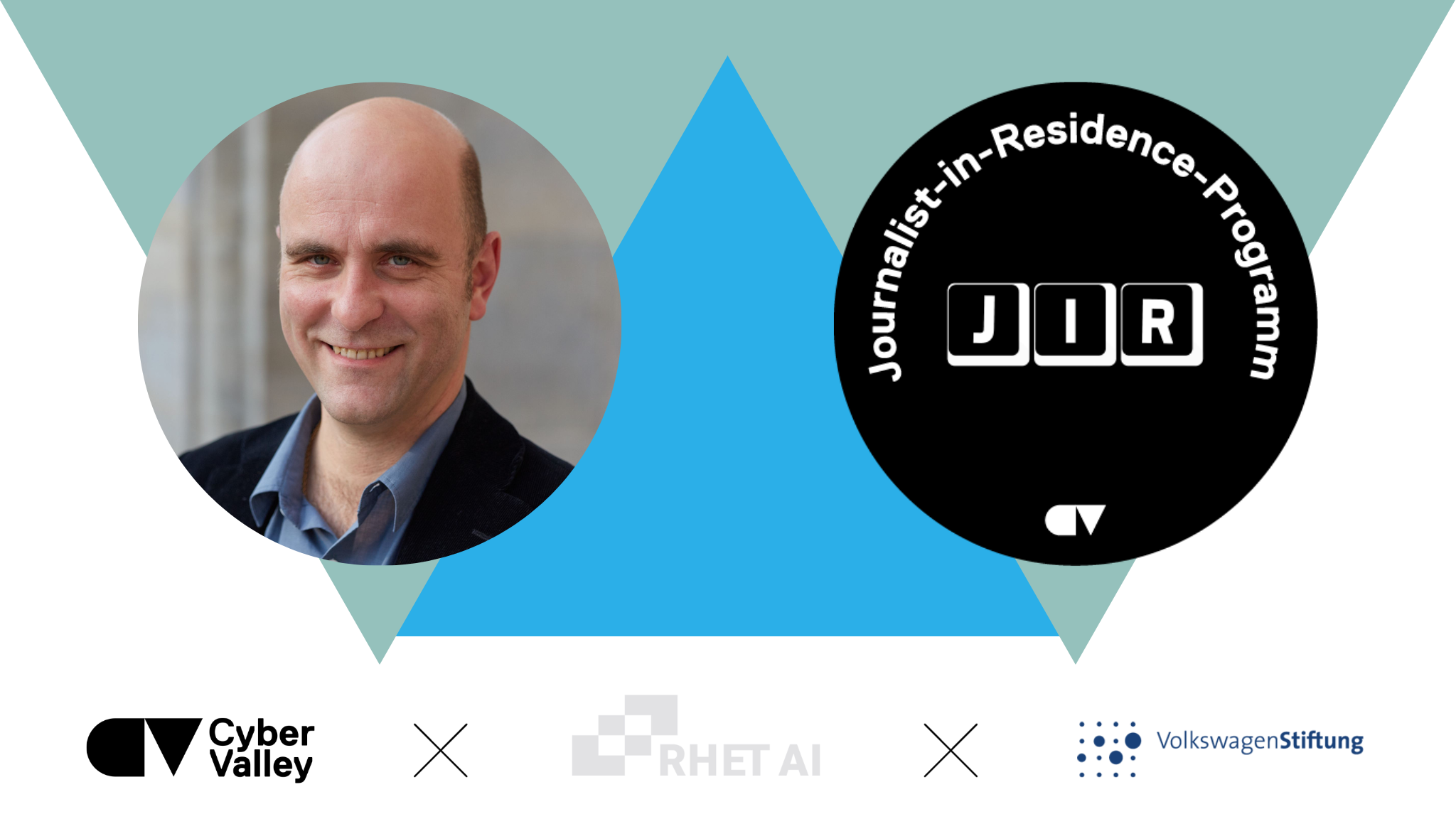
    Tobias is currently a freelance journalist based in Berlin. He primarily covers social and ecological topics for magazines from abroad. Tobias has gained notable recognition for his reports on a planned lithium mine in Portugal and the overexploitation of the Amazon. 

    During his residency, Tobias will research artificial intelligence’s impact on climate change. The residency grants journalists access to Cyber Valley’s Community so they can explore the relationship between journalism and intelligent systems and find the best approach to producing well-researched journalism that inspires public interest. The Cyber Valley team took this opportunity to find out how Tobias became interested in artificial intelligence and what he hopes to gain from his time as a JIR.

    What sparked your interest in artificial intelligence? 

    Three or four years ago, there were progressively more articles about AI, which quickly aroused my curiosity. The more I learned about AI, the more interested I became in the possibilities that AI opens for using our planet more considerately in the future. I also asked myself to what extent artificial intelligence can help us to preserve our democratic societies and our liberal way of life even in the climate crisis.

    Why do you think coverage of AI in the media is important? 

    Reporting on AI has virtually exploded over the past year. On the one hand, this is good, because AI is likely to be a real revolutionary game-changer for many areas of our lives. On the other hand, many reports only address the fears that people have about new technology. In addition, many journalists have a view of artificial intelligence that focuses on distant and fantastic visions. There is still relatively too little written and broadcasted about the future impact of AI on our lives and the environment.

    To what extent do you think AI will impact society? 

    I think AI will turn over many areas of our society. Work, leisure, traffic, cities… We're only now seeing the beginnings of it. In this respect, it's an extremely exciting time for journalists right now.

    How would you describe your knowledge and experience with AI? 

    I probably know more about AI, including the emergence and functioning of AI, than many people. I have already written a few articles about artificial intelligence and realized film projects. But the feeling I still have is that I'm still somewhere at the beginning with my understanding. I think that's certainly because AI itself is evolving so rapidly.

    What is your main goal for this residency? 

    In short, I want to learn. I want to better understand how AI works so that I can more accurately assess if and how AI can help us deal with the consequences of climate change.

    What are your expectations? What do you hope to accomplish? 

    For me, I want to find answers to the questions: how great is AI’s potential with regards to climate change? If it goes well, then I want to share my experiences – ‘findings’ already sounds too massive to me – with colleagues: So how can we report on AI and climate change in a serious and understandable way? 

    Cyber Valley wishes Tobias a successful residency. This is the fourth iteration of the Journalist-in-Residence program. It is organized in cooperation with RHET AI Center and is funded by the Volkswagen Foundation. For queries regarding the program, please contact Hazel Rowland (Media Manager) at hazel.rowland@cyber-valley.de. 

  • September 2023 Newsletter

    September 2023 Newsletter

    Receive this newsletter directly in your inbox by signing up here.

    News

    #bettertogether

    Cyber Valley gains another strong partner through its collaboration with German Federal AI Association (KI Bundesverband), a network comprising over 400 AI companies.

    How is AI changing journalism?

    Two journalists have been carefully selected for this year's second Journalist-in-Residence program, starting in October 2023. Elena Riedlinger and Tobias Asmuth will examine the influence and impact artificial intelligence has on journalism and our society.

    The AI Incubator Batch #3

    The next round of The AI Incubator will start in October, where participants will learn how to transfer their AI research into real prototypes and applications. They will connect with investors, learn from experienced start-up coaches, and gain industry insights.

    Upcoming Events


    Workshop: AI Regulation

    October 18, 19:00 – 21:00, Online

    Who decides what AI should be able to do? Not only will this question be answered in this free German workshop, but an overiew of the AI regulations will also be discussed. This is in collaboration with the the entrepreneurial women’s network unique! e.V. 

    Cyber Valley Meet-up #08

    October 25, 17:45 – 19:45, Stuttgart

    Join us at our next Meet-up on October 25th at the Hochschule der Medien in Stuttgart. Take part in a relaxed meeting with open discussions and find out how you can benefit from the Cyber Valley community. Missed our last Meet-up? See what you missed

    Startup:con

    October 12, 17:00 – 20:00, Tübingen

    The ninth round of the Tübingen Startup:con will take place in collaboration with Cyber Valley. Experts and founders report on their experiences and provide valuable tips. Local start-up supporters and young start-ups will also introduce themselves.

    Start-Up Network News

    Sereact secures seed funding

    Sereact has raised seed funding, with major investments from Point Nine and Air Street Capital. As a member of the Cyber Valley Start-up Network since 2021, they've taken part in its vibrant AI ecosystem of exchange between research and business. 

    Synthavo increases efficiency for machine manufacturers

    Cyber Valley welcomes synthavo to their ecosystem. The Stuttgart-based start-up introduced a Software-as-a-Service (SaaS) solution that uses AI to identify defective spare parts within a machine or solution, with a single photo taken from a smartphone.

    Parameter Lab enables responsible AI evolution

    Parameter Lab has joined the Cyber Valley Start-up Network. Through the extensive research of trustworthy intelligent systems, the start-up provides user-friendly tools to safely bring software and applications to market.

    Showzone provides presentation delivery platform

    Cyber Valley has welcomed Showzone into their Start-up Network. The start-up is a member of the ETH AI Center and has developed the first AI presentation delivery system, which makes every presentation interactive and impactful.

    Community & Partners News

    Bots under control: Who should regulate AI?

    Thilo Hagendorff and other experts will discuss the ethical and legal implications of ChatGPT in an interdisciplinary round table. Along with the exploration of the social responsibility associated with today's technical innovations. This event is in German.

    Web Science Conference: Calls for paper

    Web Science has announced a call for papers for the 16th ACM Web Science Conference that will take place in May 2024 in Stuttgart. The focus for this conference is reflecting on the web, AI, and society.

    Jobs

    Business Development Manager – Cyber Valley (f/m/d)

    In this role, you will play an integral part in the acceleration of the Cyber Valley investor ecosystem. Your primary focus will be to expand the network of investors to help build Europe’s leading start-up ecosystem in modern artificial intelligence and robotics.

    Public Engagement Manager – Cyber Valley (f/m/d)

    Your role as Public Engagement Manager is to continue the existing measures in line with the Public Engagement Principle and to develop and implement strategic public engagement for Cyber Valley.

    Program Manager – Cyber Valley (f/m/d)

    You will play an integral role in the acceleration of the Cyber Valley ecosystem. Your primary focus will be to strategically expand our network of start-ups, corporates, and investors to build robust AI enthusiasts that seek to develop state-of-the-art AI innovation.

    Customer Solution Engeneer – Aleph Alpha

    Junior Consultant Venture Capital – Internship – synthavo

    Postdoctoral Researcher – MPI-IS

  • Wie verändert KI den Journalismus?

    Wie verändert KI den Journalismus?

    Beginning in October 2023, the winners of this year's Journalist-in-Residence program will research ways to make sense of artificial intelligence in journalism.

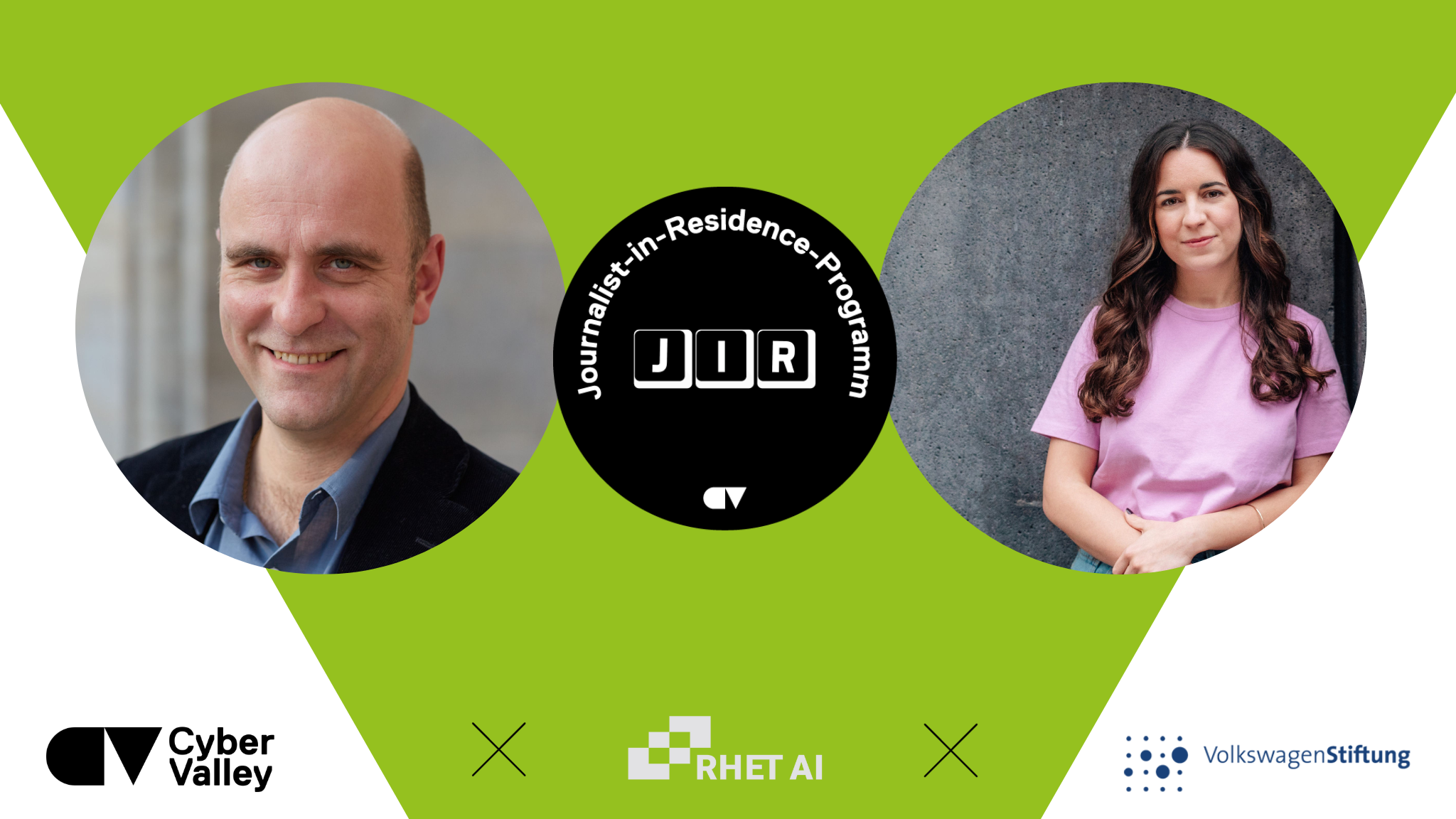
    During their three-month residency in Tübingen, the two journalists, Elena Riedlinger (data journalist) and Tobias Asmuth (freelance journalist), will examine the influence and impact artificial intelligence has on today’s society. Both applied for the 2023 Journalist-in-Residence program and won. 

    Thanks to the collaboration between the Center for Rhetorical Artificial Intelligence Science Communication (RHET AI) and Cyber Valley, journalists can conduct research on their own topics related to artificial intelligence reporting. The Volkswagen Foundation supports the Journalist-in-Residence program. 

    The program gives journalists the opportunity to dig deep into the research of intelligent systems, including machine learning, computer vision, and other AI applications, that is being undertaken at Cyber Valley. During their residency, both journalists will conduct independent research on AI development and its potential, with direct access to researchers and entrepreneurs from the Cyber Valley community.  

    Elena Riedlinger wants to use AI against disinformation

    As a data journalist, Elena Riedlinger is concerned with the spread of disinformation on the internet and identifying ways to detect it.

    "The central task of journalistic research is fact-checking. But how do journalists manage to fulfill this task despite the flood of AI-generated content? And can AI tools possibly help them? That's what I want to find out at Cyber Valley,” says Elena Riedlinger. 

    In particular, the rapid advancement of AI tools that generate text, images, and video presents journalists with new challenges in assessing the authenticity of content: it has become more difficult to verify alleged evidence and to make factual claims. AI can help solve this problem. During her residency at Cyber Valley, Riedlinger will talk with experts about the methods and AI-powered tools that verify content and ensure reliable information for editorial work.

    After completing her master's degree at the University of Leipzig, Elena first joined WDR for a traineeship, where she now works as a data journalist and in digital product development at the interface between journalism and IT. Together with Stefan Domke, she recently oversaw the Grimme Online Award-winning app and web project "Stolpersteine NRW – gegen das Vergessen". 

    Tobias Asmuth explores the benefits of AI for the climate

    As a freelance journalist working mostly for the DACH region, Tobias Asmuth has in recent years dedicated his work to the research of environmental issues. During the Journalist-in-Residency program, he will investigate how intelligent systems can reduce or even prevent climate change. Furthermore, Asmuth wants to explore how journalists can communicate and explain difficult topics, instead of falling into sensationalist reporting that overemphasizes risks and scandals.  

    Tobias Asmuth further explains, "Most people have a fairly clear idea of climate change. Their picture of AI, on the other hand, is rather diffuse. How could this be drawn more clearly? In what words would we have to describe it?” 

    His goal is to create guidelines for well-grounded reporting on artificial intelligence that inspires public interest. Tobias hopes to answer the following questions: What information about an AI application should a journalist pay attention to? What indications of relevance are there? What needs to be explained for the audience to understand? 

    Tobias Asmuth resides in Berlin. He has previously worked as a reporter for the Süddeutsche Zeitung and completed his traineeship at the Frankfurter Allgemeine Zeitung. He has been awarded prizes and scholarships for his reporting on a planned lithium mine in Portugal and the overexploitation of the Amazon, among other things. 

    About Cyber Valley 

    Cyber Valley is Europe’s largest and leading research consortium in the field of artificial intelligence (AI) and modern robotics. Cyber Valley has a public mandate: As advocates for entrepreneurship, research, development, application, and acceptance of technologies and methods in the field of intelligent systems are at the forefront. The company envisions a future where the full potential of intelligent systems is leveraged for the greater good of the world.


    About Cyber Valley Journalist-in-Residence 

    In a three-to-six-month residency, one or two journalists explore how AI applications can be used for good journalism and how journalists can ensure that their reporting on the technologies behind the buzzword "artificial intelligence" is appropriate and evidence-based. The journalists are selected by an independent jury.  During this time, the journalist-in-residence can conduct research on a topic of his or her own choice in exchange with AI researchers from different disciplines – absolutely independently. Cyber Valley explicitly does not expect any reporting on AI topics or about Cyber Valley during this time. The program takes place twice a year in a cooperation between Cyber Valley and the Center for Rhetorical Science Communication Research on Artificial Intelligence (RHET AI Center). It is funded by the Volkswagen Foundation. 

  • Institut für Künstliche Intelligenz gegründet

    Institut für Künstliche Intelligenz gegründet

    "AI is changing the world. But this change must also be reflected in new structures for research and teaching“
    Petra Olschowski, Minister of Science of Baden-Württemberg.

    “With the Institute for Artificial Intelligence, the University of Stuttgart is sending a clear signal for AI as an independent research area and is combining a broad range of scientific activities. The result is greater visibility for the topic of AI. Two state-funded “Cyber Valley” professorships will become part of the new institute, thereby building a bridge to our Innovation Campus. This will further strengthen the Cyber Valley Innovation Campus and the Stuttgart/Tübingen AI region," says Petra Olschowski, Minister of Science of Baden-Württemberg.

    Pooled expertise for interdisciplinary AI research

    With the founding of the institute, the University of Stuttgart is taking a further step towards realizing its vision of "Intelligent Systems for a Sustainable Society": "We are pooling our expertise in AI in order to explore AI applications across disciplines for the benefit of people. One area of specialization will be intelligent robotics, which will be used to achieve advances in medicine and production technologies, among other things," says Prof. Wolfram Ressel, Rector of the University of Stuttgart.

    AI institute with five working groups – more are planned

    Prof. Steffen Staab, the first executive director of the new institute, emphasizes: "The Institute for Artificial Intelligence aims to achieve three things: First, to conduct internationally outstanding research; second, to be a qualified research partner for other scientific disciplines that use AI to advance their research; and third, to promote the transfer of AI methods to industry and society." The AI Institute comprises the two "Cyber Valley" professorships "Analytic Computing" (Steffen Staab) and "Autonomous Systems" (Kai Arras), the professorship "Machine Learning in Simulation Sciences" (Mathias Niepert) located in the Cluster of Excellence "Data-Integrated Simulation Science" (SimTech), the junior professorship "Autonomous Sensing and Perception Systems" (Alina Roitberg), and the professorship for "Machine Learning and Robotics", which are currently being filled. There are also plans to expand the institute by adding professorships in the field of intelligent robotics.

    Networked via Cyber Valley, ELLIS, Clusters of Excellence, and more

    The close networking of the institute with numerous international and internal university initiatives related to AI is demonstrated by the participation of Cyber Valley and SimTech. The second Cluster of Excellence of the University of Stuttgart, "Integrative Computational Design and Construction for Architecture" (IntCDC), also relies on advances in artificial intelligence for its research tasks. As part of the international network "European Laboratory for Learning and Intelligent Systems", the ELLIS Unit Stuttgart is promoting the exchange of knowledge with top-class universities throughout Europe. The Artificial Intelligence Software Academy (AISA) links interdisciplinary research and education at the Stuttgart site, and the Interchange Forum for Reflecting on Intelligent Systems (IRIS) and critically examines the societal implications of intelligent systems.

    Expert Contact:

    Prof. Dr. Steffen Staab, University of Stuttgart, Institute for Artificial Intelligence, Phone: +49 (0)711 685-88100, E-Mail: steffen.staab@ipvs.uni-stuttgart.de

  • Eröffnungssymposium des Tübingen AI Centers

    Eröffnungssymposium des Tübingen AI Centers

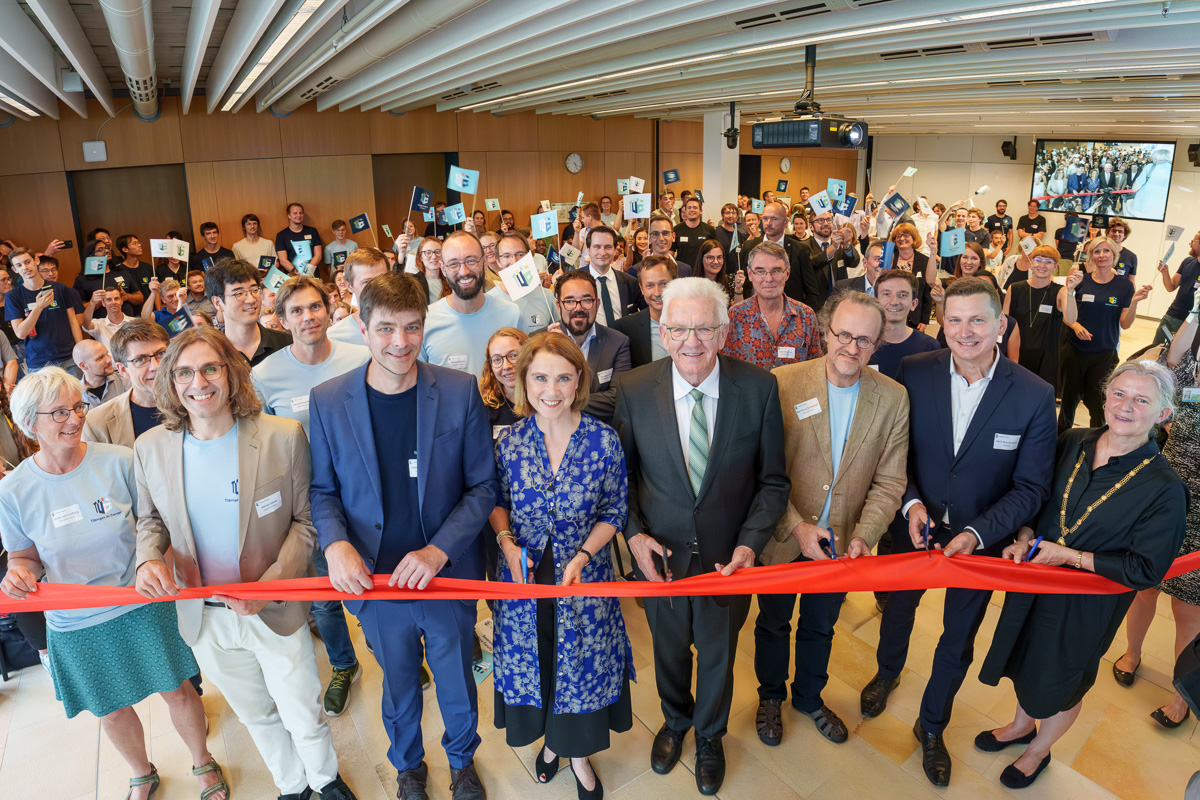
    Am Dienstag, den 18. Juli 2023, hat das Tübinger KI-Zentrum mit einem Symposium seine dauerhafte Einrichtung als nationales KI-Zentrum gefeiert. Seit dem 1. Juli 2022 wird es mit 20 Millionen Euro pro Jahr durch den Bund und das Land Baden-Württemberg gefördert.

    Die Pressemitteilung ist nur auf Englisch verfügbar. 

    The President of the University of Tübingen, Professor Karla Pollmann, opened the program alongside the directors of the Tübingen AI Center, Professor Matthias Bethge and Professor Bernhard Schölkopf. In her address, Pollmann spoke of the scientific excellence and agility of AI researchers and the rapid growth of the AI ecosystem in the region. In particular, she stressed the special role of AI in the ongoing development of the University and praised the close cooperation with the Cluster of Excellence for Machine Learning which aims to make the best possible use of the new opportunities offered by AI for research in various scientific disciplines.
     
    Matthias Bethge thanked the Baden-Württemberg and federal governments for their long-term support for the Tübingen AI Center. Over the next few years this will enable a doubling of the founding team of professors, Max Planck directors and research group leaders and the creation of an attractive academic research environment. Bethge advocated maximum agility so that research, transfer and education can keep up with the pace of global AI development: “We are facing major challenges and questions about the future, and our scientists are intensely dedicated to making our society here in Germany and in Europe fit for shaping the future.” 
     
    Bernhard Schölkopf added that the Tübingen AI Center works closely with the European Laboratory for Intelligent Systems (ELLIS). Generous funding from the Hector Foundation has enabled the first ELLIS institute which is currently being built in Tübingen, and which together with the Tübingen AI Center will recruit the best brains.
     
    In his speech, Minister-President Winfried Kretschmann emphasized that the Federal State of Baden-Württemberg had already laid the foundations for an innovation campus for Artificial Intelligence and intelligent systems with the establishment of Cyber Valley back in 2016. “Today, Tübingen heads the list of European locations for AI research, has the only Master’s degree program in machine learning in Germany, and with ELLIS is forming a network to attract the best brains from across Europe to Baden-Württemberg,” said Kretschmann. And Tübingen’s appeal is increasing, he said. With annual funding of ten million euros each from federal and state governments until at least 2028, the AI Center is a magnet for top researchers. “Technological sovereignty is more essential than ever for a strategically independent Europe which can compete against China and the USA,” said Kretschmann: “So Artificial Intelligence is not an option – it is essential.”

    The Parliamentary State Secretary of the Federal Ministry for Education and Research (BMBF), Mario Brandenburg, emphasized the importance of the AI centers of excellence: “Artificial Intelligence is a key technology that above all offers many opportunities. To make the most of these opportunities, we must continue to strengthen AI research and the training of specialists. At the same time, we also have to intensify the realization of real-life applications, and expedite national and European networking. The Tübingen AI Center and the entire Stuttgart-Tübingen region stand as an example of this vision. Together with other AI centers of excellence, this is a strong foundation for Germany as an AI location.”

    After the ceremony, scientists from the Tübingen AI Center presented current research. This covered topics such as explainable machine learning (XAI) or the use of machine learning for sustainable AI. The CEO of Cyber Valley GmbH, Rebecca Reisch, described the importance of technology transfer from basic research to industry. What transfer like this can actually mean was presented by the start-ups Maddox AI, a spin-off from the Tübingen AI Center, and Aleph Alpha, a member of the Cyber Valley start-up network.

    Foto: Tübingen AI Center / Wolfram Scheible


    Then, the Baden-Württemberg Minister of Science, Research and the Arts, Petra Olschowski, spoke about the new social challenges and opportunities associated with AI: “AI research has made impressive progress recently. Machine Learning methods like those being researched at the Tübingen AI Center have special potential here and are an increasing part of our lives – examples range from personalized medical diagnosis through to chatbots. But the social effects of these future AI technologies also need thought and molding. So the new AI Center places humans at its heart,” said the minister. “The new center is a valuable addition to our Cyber Valley innovation campus model, combining basic research and transfer with the education of the highly sought-after specialists of tomorrow.” In conclusion, she congratulated two former winners of the Bundeswettbewerb für Künstliche Intelligenz (BWKI), which was launched by the Tübingen AI Center together with Bosch in 2018, and now receives significant funding from the Carl Zeiss Foundation.
     
    Other guests represented two projects that had successfully applied for funding from the Agile Transfer Fund. This new program from the Tübingen AI Center aims to help researchers and students realize socially useful ideas with the aid of Artificial Intelligence: the objective of the Polybot project headed by Wieland Brendel is to use swarms of flexible mini-robots to create the technological conditions for the automation of a regenerative form of agriculture. Financial support has allowed the team to attract highly-qualified staff rapidly. “KI macht Schule” looks to make AI technology accessible to school pupils and to help ensure quick and competent integration of the subject into the syllabus. Using funds from the Agile Transfer Fund, the team can develop interactive teaching and learning materials based on the latest research.

    About the Tübingen AI Center

    The Tübingen AI Center is a research institute of the University of Tübingen in cooperation with the Max Planck Institute for Intelligent Systems (MPI-IS) and part of the Cyber Valley Ecosystem. The goal of the researchers is to advance the development of robust learning systems for the benefit of society and the economy. Learning algorithms will require less data and be able to cope successfully with external and unforeseen influences. At the same time, machines’ decision-making processes will become fairer and more easy to interpret. The center intends to pursue new ways of combining basic research with transfer and education, and together with other researchers within Europe contribute to socially-valuable technologies being developed under the label “AI made in Europe”.

    Like with four other centers backed by the Federal Ministry for Education and Research, since July 1, 2022, it has received 20 million euros a year from the German Federal Ministry for Education and Research (BMBF) and the Baden-Württemberg Ministry of Economy and Culture (MWK). Embedded in the rapidly-growing Tübingen campus of science and technology, the scientists at Tübingen AI Center work closely with the Europe-wide Research Network ELLIS as well as Cyber Valley.
     
     
    Press contact

    Tübingen AI Center, University of Tübingen 
    Claudia Brusdeylins
     +49 7071 29-77910
    claudia.brusdeylins@tuebingen.ai

  • KI made in BW: Cyber Valley und Ipai unterzeichnen Grundsatzvereinbarung

    KI made in BW: Cyber Valley und Ipai unterzeichnen Grundsatzvereinbarung

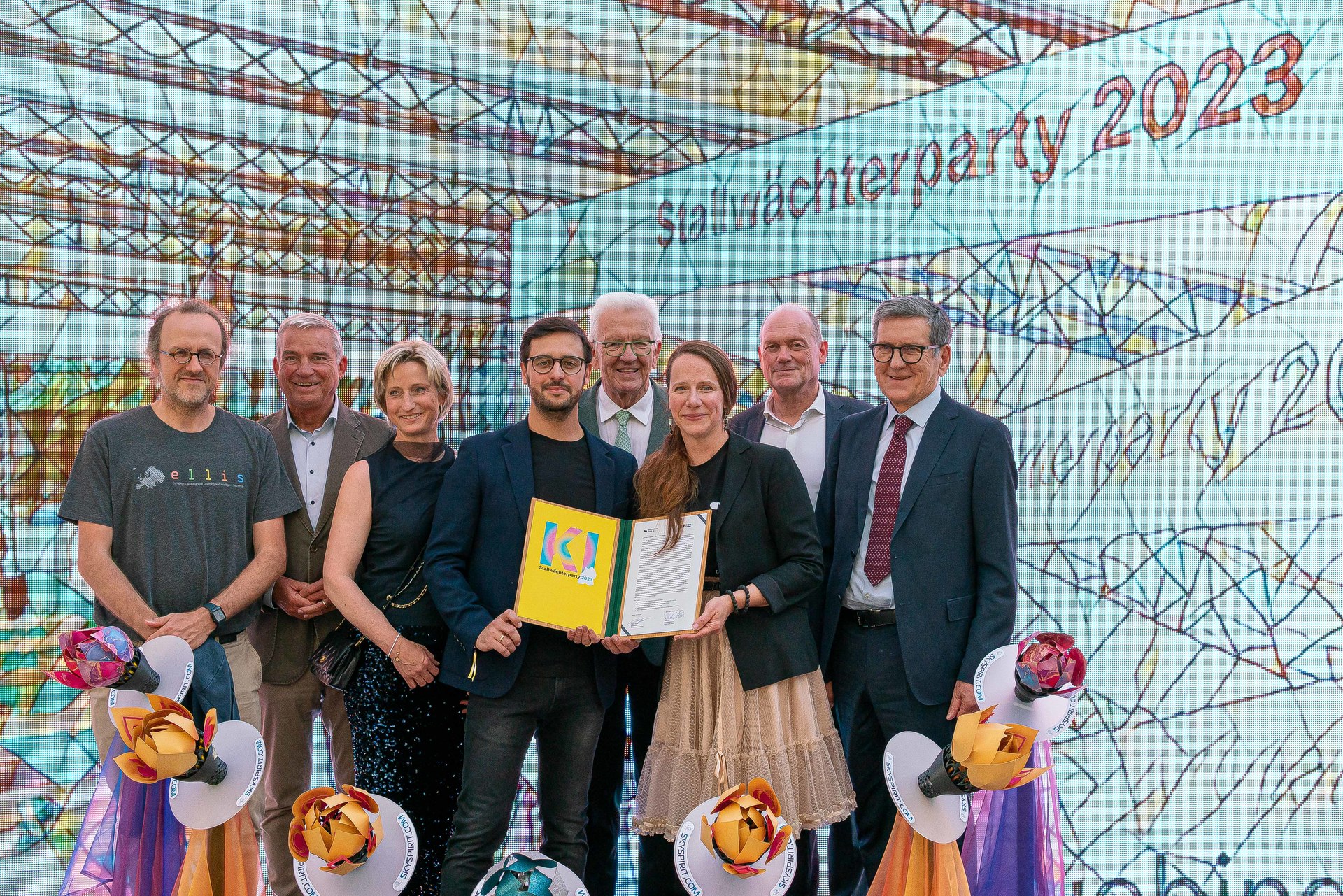
    Berlin, 6. Juli 2023 – Der Innovationscampus Cyber Valley aus der Region Stuttgart/Tübingen und der neu etablierte Innovation Park Artificial Intelligence (Ipai) in Heilbronn haben bei der Stallwächterparty, dem politischen Sommerfest der baden-württembergischen Landesvertretung in Berlin, die Intensivierung ihrer Zusammenarbeit bekanntgegeben. Die gemeinsame Absichtserklärung soll den Transfer exzellenter Forschung in die Anwendung unterstützen und den nachhaltigen Auf- und Ausbau der Wertschöpfung durch Künstliche Intelligenz (KI) fördern. Hierdurch soll Baden-Württemberg als Wirtschaftsstandort gestärkt, und die Position des Landes als europäischer Leuchtturm für KI ausgebaut werden.

    Cyber Valley ist Europas größte Forschungskooperation und führendes Zentrum für Exzellenz in moderner KI und Robotik. Das Ökosystem ermöglicht die Zusammenarbeit und einen schnellen Wissensaustausch zwischen den Partnern aus Wissenschaft, Wirtschaft und Gesellschaft. Cyber Valley stärkt Forschung, Entwicklung, Anwendung und den Dialog über Technologien intelligenter Systeme.

    Mit Ipai entsteht in Heilbronn ein Innovationsökosystem mit anwendungsorientiertem Schwerpunkt, das optimale Bedingungen für Unternehmen, Startups, Forschung und Wissenschaft schafft, um KI entlang der gesamten Wertschöpfungskette in die praktische Anwendung zu bringen.

    Ministerpräsident Winfried Kretschmann befürwortet die zukünftige enge Zusammenarbeit der beiden Institutionen: „Künstliche Intelligenz ist der „Schlüssel zur Welt von morgen“. Als Land der Tüftler und Macher muss es unser Anspruch sein, diesen Schlüssel auch selbst herzustellen. Denn wir als Wirtschaftsstandort stehen in einem harten globalen Wettbewerb, etwa zum Silicon Valley oder dem chinesischen Shenzen. Wenn wir bei der Zukunftstechnologie KI vorne mitspielen wollen, müssen wir auch hier zwei Dinge miteinander verbinden: ERSTENS: exzellente Wissenschaft und ZWEITENS: unternehmerische Schaffenskraft. Das ist die DNA von Baden-Württemberg. Und genau diese DNA stärken wir mit dem engen Schulterschluss von Ipai und Cyber Valley“.

    „Die bald siebenjährige Erfolgsgeschichte des Cyber Valleys wird zukünftig auch in Kooperation mit dem Ipai fortgeschrieben”, sagt Petra Olschowski, Ministerin für Wissenschaft, Forschung und Kunst des Landes Baden- Württemberg.

    „Ich begrüße sehr, dass der Innovation Park Artificial Intelligence und Cyber Valley als zwei wesentliche Leuchtturmvorhaben der Landesregierung Baden-Württemberg im Bereich KI künftig noch enger zusammenarbeiten wollen. Auf diese Weise können die Aktivitäten des Cyber Valleys als Europas größte Forschungskooperation für KI mit den Aktivitäten des Innovation Park Artificial Intelligence als KI-Wertschöpfungszentrum im Weltklasse-Format optimal zusammenwirken. Das gemeinsame Ziel muss sein, exzellente Forschungserkenntnisse schnell zu wirtschaftlichen Erfolgen zu machen. Denn der harte globale Wettbewerb hat sich durch mächtige Foundation-Modelle der Generativen KI aktuell nochmals verstärkt. Ich bin überzeugt, dass unser „KI-Power-Tandem“ im weltweiten Wettbewerb eine Spitzenposition einnehmen wird – und damit ein Gewinn für das ganze Land sein wird“, sagt Dr. Nicole Hoffmeister-Kraut, Ministerin für Wirtschaft, Arbeit und Tourismus.

    „Wir freuen uns, mit dem Ipai einen weiteren KI-Standort in Baden- Württemberg dazugewonnen zu haben“, sagt Rebecca C. Reisch, Cyber Valley Geschäftsführerin. „So können wir gemeinsam eine technologisch- souveräne Zukunft gestalten, in der das Potential intelligenter Systeme und moderner Robotik zum Wohle aller eingesetzt wird. Mit KI „made in THE LÄND“ festigen wir unsere europäische Führungsrolle – forschungsstark und unternehmerisch.“

    „Die unterschiedlichen Akteure schnellstmöglich in einen Zustand zu versetzen, selbst handlungsfähig zu sein, hat höchste Priorität – um den Anschluss beim Thema KI nicht zu verlieren und damit Wettbewerbsfähigkeit langfristig zu erhalten“, ergänzt Moritz Gräter, CEO von Ipai. „Dafür ist es wichtig, gegenseitig den Zugang zu unseren unterschiedlichen Netzwerken zu öffnen und die Communities zu noch mehr Interaktion anzuregen.“

    Über Cyber Valley

    Cyber Valley ist Europas führendes Zentrum für Exzellenz in moderner KI und Robotik. Als Botschafter für Unternehmergeist hat Cyber Valley die Aufgabe, die Forschung, Entwicklung und Anwendung von intelligenten Systemen sowie den Austausch zwischen den wissenschaftlichen Disziplinen zu stärken. Mit einem Schwerpunkt auf den ethischen und gesellschaftlichen Aspekten der KI fördert Cyber Valley den Dialog zwischen den Partnern aus Politik, Wissenschaft, Wirtschaft und Gesellschaft und strebt eine Zukunft an, in der das volle Potenzial intelligenter Systeme zum Wohle aller eingesetzt wird. Cyber Valley ist in der Region Stuttgart- Tübingen ansässig und wird durch das Land Baden-Württemberg gefördert.

    Über Ipai

    Mit dem Innovation Park Artificial Intelligence (Ipai) in Heilbronn, entsteht mit einer Anschubfinanzierung des Landes Baden-Württemberg ein Zentrum für KI mit internationalem Format. Im Ipai soll die gesamte KI- Wertschöpfungskette abgebildet werden – von der Qualifizierung von Fachkräften über die Forschung bis hin zur Entwicklung, Anwendung und Kommerzialisierung von ethisch verantwortungsbewusster KI. In einem europaweit einmaligen, innovationsfördernden Ökosystem werden zukünftig unterschiedlichste Unternehmen, Startups, Forschung und Wissenschaft sowie Akteure aus dem öffentlichen Sektor zusammenkommen.

    Lesen Sie hier den gemeinsamen Letter of Intent 

    Download der Pressebilder (ab 19 Uhr)

  • Europaweit erstes ELLIS Institut geht in Tübingen an den Start 

    Europaweit erstes ELLIS Institut geht in Tübingen an den Start 

    (The press release is only available in German.)

    • Wissenschaftsministerin Petra Olschowski: „Das ELLIS Institut in Tübingen wird ideale Rahmenbedingungen für weltweit führende KI-Wissenschaftlerinnen und Wissenschaftler bieten.“
    • Dr. h.c. Hector: „Es liegt an uns, die transformative Kraft der Künstlichen Intelligenz zu nutzen und sie zum Wohl der Menschen einzusetzen.“
    • Prof. Dr. Schölkopf: „Wir wollen KI-Spitzenforschung ermöglichen, eingebettet in die Kultur Europas und verankert in europäischen Werten.“ 

    „Das ELLIS Institut wird als einzigartige Forschungseinrichtung dank der außerordentlich großzügigen Spende der Hector Stiftung ideale Rahmenbedingun-gen für KI-Spitzenforscherinnen und Spitzenforscher aus der ganzen Welt schaffen. Es wird damit auch konkurrenzfähig sein zu den Forschungs- und Entwicklungsabteilungen der großen Unternehmen im Bereich KI“, erklärte Wissenschaftsministerin Petra Olschowski am Freitag, 30. Juni 2023, in Stuttgart. „Das Land geht hier mit neuen innovativen Strukturen im Forschungsbereich bundes- und europaweit voran – wie bereits mit dem Aufbau des Cyber Valley als erfolgreiches Innovationsökosystem für KI. Das ELLIS Institut ist im europäischen ELLIS-Netzwerk das erste seiner Art. Es wird stilbildend sein.“

    Mit der Gründung des ersten ELLIS Institut am Standort Tübingen wird die internationale Sichtbarkeit und Strahlkraft sowie die Forschungsexzellenz des Innovationscampus Cyber Valley noch weiter gestärkt. Die Hector Stiftung fördert die Gründung mit 100 Millionen Euro.

    Dr. h.c. Hans-Werner Hector sagte: „Die Künstliche Intelligenz hat das Potential, unsere Gesellschaft und Wirtschaft grundlegend zu verändern. Es liegt an uns, diese transformative Kraft zu nutzen und sie zum Wohl der Menschen einzusetzen. Mit der Gründung des ELLIS Instituts wollen wir eine internationale Plattform schaffen, auf der Spitzenforscherinnen und Spitzenforscher gemeinsam an den Herausforderungen und Chancen der KI arbeiten. Denn nur durch For-schungsexzellenz können wir innovative Lösungen entwickeln und eine nach-haltige Zukunft gestalten.“

    „Die Gründung des ersten ELLIS-Instituts ist ein Meilenstein, erreicht durch eine vertrauensvolle Zusammenarbeit und ein gemeinsames Ziel: Wir wollen KI-Spitzenforschung ermöglichen, eingebettet in die Kultur Europas und verankert in europäischen Werten. Ich danke dem Land Baden-Württemberg, der Max-Planck-Gesellschaft, der Universität Tübingen und vor allem dem weitsichtigen und großzügigen Spender Hans-Werner Hector“, sagte Prof. Dr. Bernhard Schölkopf.

    Weitere Informationen:

    ELLIS Institut
    ELLIS steht für „European Laboratory for Learning and Intelligent Systems”. Am Institut erhalten die talentiertesten KI-Wissenschaftlerinnen und -Wissenschaftler aus der ganzen Welt die Gelegenheit, neue Ansätze und Ideen unter hervorragenden Arbeitsbedingungen zu entwickeln. Mit dem ELLIS Institut wird in Baden-Württemberg ein international sichtbarer Leuchtturm für die Erforschung Künstlicher Intelligenz errichtet. Dies innerhalb eines starken europäischen Netzwerks von mittlerweile 39 ELLIS-Units in 14 Ländern, in denen herausragende KI-Forschende arbeiten – vier Units davon alleine in Baden-Württemberg.

    Cyber Valley und das ELLIS Institut
    Der Innovationscampus Cyber Valley ist ein zentrales Element der KI-Strategie des Landes. Mit ihm wird seit 2016 in einer gemeinsamen Initiative von Wissenschaft und Wirtschaft in Kooperation mit dem Land Baden-Württemberg und der Max-Planck-Gesellschaft ein international führender Forschungsstandort in den Bereichen des maschinellen Lernens, des maschinellen Sehens und der Robotik aufgebaut.

    Mit dem ELLIS Institut soll für die Erforschung der Künstlichen Intelligenz ein neuer europäischer Leuchtturm in Baden-Württemberg errichtet werden. Das ELLIS Institut soll mit Hilfe der Förderung der Hector Stiftung das Cyber Valley um ein Institut ergänzen, das international rekrutierten und hoch qualifizierten Forschenden für eine befristete Zeit (in der Regel sechs Jahre mit der Möglichkeit der Verlängerung) größtmögliche Freiräume und außergewöhnlich attraktive und flexible Rahmenbedingungen bietet. 

    Mit dem ELLIS Institut positioniert sich Cyber Valley im globalen Wettbewerb sowohl im Hinblick auf wissenschaftliche Exzellenz als auch im Hinblick auf inspirierende Arbeitsmöglichkeiten als „the place to be“ und unterstützt damit eine globale und wertebasierte technologische Wettbewerbsfähigkeit des Landes, des Bundes und der Europäischen Union.
     

  • Der Bundeswettbewerb KI 2023 beginnt

    Der Bundeswettbewerb KI 2023 beginnt

    Further information on the competition and materials for pupils are only available in German.

    Meldet zunächst euch, euer Team und eure Idee bis zum 2. Juni 2023 unter www.bw-ki.de an und arbeitet anschließend euer Projekt bis zum 1. Oktober 2023 aus.

    Die Teilnahme ist, allein oder im Team, mit bis zu 4 Personen möglich. SchülerInnen der diesjährigen Abschlussklassen dürfen auch teilnehmen. Der Wettbewerb richtet sich an talentierte und interessierte SchülerInnen, die ihre Stärken in Informatik, Mathematik oder Physik einsetzen möchten, um innovative Lösungen für die Herausforderungen der Zukunft zu entwickeln. 

    KI-Kurs

    Ihr würdet gerne mehr über KI lernen oder im Unterricht behandeln? Vielleicht erst gemeinsam die Coding Skills erwerben, um zukünftig am Wettbewerb teilnehmen zu können? 

    In unserem kostenfreien Online KI-Kurs (ki-kurs.org) könnt ihr euch fit machen. Neben der Vermittlung der Programmierkenntnisse (Python Grundkurs, Trainingsmodule und KI-Tutorials), haben wir umfangreiche Kapitel zum Thema Maschinenethik und – Achtung Spoiler – in wenigen Tagen auch spannendes Material zum Thema Wissenschaftsgeschichte der KI.

    Als besonderes Schmankerl gibt es seit Kurzem auch die Möglichkeit einen virtuellen Klassenraum im Online KI Kurs einzurichten, so dass sich der Einsatz im Unterricht noch einfacher gestalten lässt. Nehmt fleißig am KI-Kurs teil! Die Schulen, die im Zeitraum von März bis Oktober am aktivsten im Kurs lernen, gehen ins Rennen um den Titel der KI-Schule des Jahres und können Sachpreise gewinnen.
     

    Weitere Links

    Alle Infos findet ihr unter www.bw-ki.de.

    Habt ihr schon in unseren Comic reingeschaut? Ein kostenfreies pdf findet ihr hier. 

    Wir freuen uns auf eure Teilnahme und wünschen euch einen guten Start in den Frühling.

    Hier noch ein kleine Ankündigung für ein Webinar, welches wir gemeinsam mit Zeit für die Schule am 28. März 2023 organisieren. Die Teilnahme ist kostenfrei und die Anmeldung ist aktuell offen.

    Das BWKI Team