User Group: Corporate

  • MARKT-PILOT secures seed financing

    MARKT-PILOT secures seed financing

    The start-up from Esslingen offers mechanical engineering companies a novel software-as-a-service (SaaS) solution that enables companies to automatically research competitive prices and delivery times for their entire spare parts portfolio. This enables them to proactively address the increasingly dynamic and complex spare parts market. The result: agile and market-driven sales pricing for spare parts, transparency regarding delivery times and availability.

    The two founders Tobias Rieker and Amin Oumhamdi have already been working on the AI-based SaaS solution since 2016, which determines spare parts price and delivery time information from several tens of thousands of national as well as international web stores on a daily basis at the push of a button and compares it with information from machine manufacturers.

    “Thousands of parts are continuously required worldwide and not a single one is benchmarked with the market. Due to this lack of transparency, parts prices have so far always been calculated on the basis of a traditional cost-plus logic. The only solution for this problem is provided by our software, which lays the foundation for the paradigm shift from cost-plus to market-oriented parts pricing”, said CEO Tobias Rieker.

    Since its official founding in April 2020, MARKT-PILOT has already realized more than 70 customer projects and grown from two to 58 employees. This has made the company the market leader in the category “market intelligence for industry parts”. In November 2021, a second location was opened in Chicago.

    With Capnamic on board, the MARKT-PILOT team plans to scale the business and strengthen its leadership position. The 6.2 million euros will be invested in three key areas: Scaling the US market, expanding the software solution capabilities and strategic growth in the newly created 7.8 billion euros software category ‘market intelligence for industry parts’.

  • Startup:con Tübingen #4

    Startup:con Tübingen #4

    Was sind Geschäftsmodelle der Zukunft? Diese Frage stellen wir uns bei der Startup:con Tübingen #4 am 31.03.2022,  ab 16:00 Uhr im Brauwerk Freistil, Wöhrdstraße 25, Tübingen.

    Das Startup Center der Uni Tübingen lädt herzlich angehende Gründerinnen und Gründer sowie Gründungsinteressierte aus allen Disziplinen ein.

    Freut euch auf spannende Interviews mit Gründerinnen und Gründern, Führungen durch den neuen KI-Makerspace und viele Gelegenheiten zum Netzwerken. Trefft außerdem Patrick Klügel (Public Engagement Manager) und Julia Schmaus (Innovation Manager) am Cyber Valley Stand.

     Das (vorläufige) Programm:

    16:00 – Begrüßung und Interview mit Vivat Lingua Gründerin Adelheid Kumpf und dem Co-Founder von NFT-MAKER Kristian Portz
    16:30 – Netzwerken und 1. Führung durch den KI-Makerspace   
    16:50 – Interviews mit den Gründern von A.S.S.I.S.T. und your.company   
    17:10 – Netzwerken und 2. Führung durch den KI-Makerspace   
    17:30 – Open Stage Pitches   
    18:00 – Netzwerken, Netzwerken, Netzwerken  

    Treffpunkt ist im Brauwerk Freistil in der Wöhrdstr. 25 in Tübingen (kurzfristige Änderungen sind aufgrund der Pandemielagemöglich) und die ersten 100 Anmeldungen erhalten ein Freigetränk.

    Registrierung

    Hier könnt ihr euch anmelden.

    Weitere Informationen findet ihr hier.

  • ATTENTION project to improve road safety

    ATTENTION project to improve road safety

    The funding is being provided by Germany’s Federal Ministry for Economic Affairs and Climate Action in response to its call for funding applications in the area of “Artificial intelligence as a key technology for the vehicle of the future”.

    Urban traffic has limited space, varying flows and different road users. Despite increasing automation and traffic networking, the fact that traffic areas are used by multiple parties is and will continue to be a major risk for vulnerable road users (“VRUs”). VRUs are road users whose risk is higher because they are not inside a protective enclosure like the body of a car. They include pedestrians and cyclists. To maximize safety in automated traffic, the severity of the injuries sustained by vulnerable parties in unavoidable collisions needs to be minimized. ATTENTION’s aim is to develop a method that uses learning algorithms to predict VRU injury in real time.

    Data-driven artificial intelligence (AI) methods are being used to determine the risk of injury for a specific situation based on video data from the automated vehicle, virtual tests and digital human models. This will help make traffic safer and more efficient thanks to risk minimization strategies for the automated vehicle. Prof. Dr. Syn Schmitt and his team at Stuttgart University’s Institute for Modelling and Simulation of Biomechanical Systems are concentrating specifically on this aspect. The research on a digital human model also reflects the vision of the SimTech Cluster of Excellence as well as creating a connection between the field of simulation science and the focus of Cyber Valley research. The work uses the whole-body and body-part human models developed by Schmitt’s team and combines them with AI methods to generate the models’ movements and thus synthetic training data. The latter will then be used for an injury prediction model that can be evaluated quickly and covers a variety of collisions. An important aspect of this modeling is the need to consider who the parties to the collision are. “The project enables us to start testing our models and computation methods under real conditions in an applied research environment, the aim being for our industry partners to drive the transfer to real-world application. I’m looking forward to it and can’t wait to see the results,” said Syn Schmitt.

    One of the main outcomes of the project will be a position and movement database for pedestrians and cyclists. This will draw on an analysis of data from Bosch’s accident research and will serve as the basis for biomechanical and AI-based prediction of movements. This will be followed by a crash simulation that will supply potential injury patterns. These will be compared against real accident data and stored in another collision and injury database. To predict injuries, AI will be used to create an injury risk index, which will provide the basis for determining action to be taken. The action will then be implemented in a virtual demonstrator.

    The project is being administered by TÜV Rheinland. Other partners are Robert Bosch GmbH and QualityMinds GmbH, representing industry. The research institutes involved are the Fraunhofer Institute for High-Speed Dynamics (EMI) and Stuttgart University’s Institute for Modelling and Simulation of Biomechanical Systems. Mercedes-Benz AG is an associate partner on the project.

    At a glance:

  • Cyber Valley networks continue to grow

    Cyber Valley networks continue to grow

    “As we enter the next phase of Cyber Valley, we are even more focused on helping new, innovative, AI companies grow”, said Michael J. Black, Cyber Valley spokesperson and Director at the Max Planck Institute for Intelligent Systems. “Consequently, we are expanding both our start-up and our investor networks. In MBG we've added an experienced, powerful and very well connected VC firm to our ecosystem. And with the addition of mxlar, preML and Bergsonne Labs our growing network of entrepreneurs and innovators has gained in strength, breadth, and excellence.”

    Austrian start-up mlxar (machine learning extended architecture) is using AI to create 3D architectural models for the gaming industry. The mlxar technology makes it possible to creatively build architecture assets faster than is currently common – earning the start-up the Main Award at AI GameDev last December, among other accolades. “Architecture design is a manual, inefficient and time-consuming process – this is a problem when designing one building, and it’s a huge problem when designing an entire city, level or world. Our AI innovation is not a replacement for the designer – it is a way of making expert knowledge scalable and ultimately creating new type of creative tool”, said Ben James, CEO of mlxar. “We joined the Cyber Valley Start-up Network because it offers our startup the opportunity to contribute to – and benefit from – an ecosystem in which research and entrepreneurship can further drive our innovations forward.”

    The start-up preML from Lahr in the Black Forest provides AI-based technologies for manufacturing companies to automate their visual quality inspection quickly and cost-effectively. “Our company is very technology-oriented and works at the forefront of the current state of science”, said David Fahrenbach, preML’ls co-founder and managing director. “As a former student of the University of Tübingen, I am particularly pleased about the admission and am looking forward to the contacts and projects that will arise through the network.”

    Bergsonne Labs is a Stuttgart-based company focused on bridging the gap between laboratory science and commercial technology, with a specific focus on the research and development of micro-scale mechatronic solutions for various applications including sports technology, robotics, and consumer products. “As a multi-disciplinary hub bringing together world-class scientists, researchers, entrepreneurs, and businesses from around the region, the Cyber Valley Start-up Network clearly provides the ideal setting in which to grow Bergsonne Labs”, said the company’s founder Jonathan Fiene.

    Investor Network now counts six members

    In addition to the Start-up Network, the circle of venture capital firms is also expanding. MBG joins the Cyber Valley Investor Network. Active in the market as an investment company for more than 50 years, MBG brings experience, network and continuity to start-ups. “Artificial intelligence is going to shape the world of the future. That is why it is important to us to support the growing ecosystem. Having Cyber Valley as a partner and multiplier enables us to get in contact with innovative AI startups that we can support together”, said MBG CEO Dirk Buddensiek.

    Cyber Valley regularly hosts networking events such as talks, meet-ups, and tech workshops. The next event of the Cyber Valley Entrepreneurship series is scheduled for March 31 and will feature high-profile speakers on the topic of “AI and architecture”. More information about the event and how to attend can be found here.

  • Expert advice on getting started in AI and robotics

    Expert advice on getting started in AI and robotics

    The high potential of AI and robotics technologies is undisputed. However, many companies, and medium-sized companies in particular, still have difficulty identifying the most suitable AI technologies for relevant use cases. This has been confirmed by numerous studies, including one by Bitkom in April of last year. According to this study, the lack of money, personnel and time are frequent obstacles to the use of AI. In order to provide companies with the best possible support, an individual expert assessment is required. This is precisely what the AI Innovation Center offers with its low-threshold services. Almost 200 companies have already taken advantage of this opportunity. An overview of the varied results can be found on the website linked below.

    Companies from startups to corporations can apply with their project outline until March 31, 2022. There are two project formats:

    • “AI Explorer”: This format provides basic knowledge for all companies that want to find out about possible uses of AI or robotics but do not yet have a concrete idea. In workshops, Fraunhofer employees offer an assessment of where AI and robotics stand in the company and what the best order of procedure would be to bring the technologies into practice. The experts help to assess the current situation and highlight the potential for process improvements or product and service innovations through AI and robotics applications.
    • “Quick Checks”: This project format allows companies to check the feasibility of an individual AI or robotics application, for example an existing idea. After the company has presented its specific use case, Fraunhofer employees investigate the extent to which the project is feasible. The result is a feasibility statement in the form of a short “proof of principle”.

    The current application deadline addresses companies that have not yet collaborated with the AI Innovation Center. The project formats are free of charge for companies based or located in Baden-Württemberg. This is possible because the AI Innovation Center receives extensive funding from the Ministry of Economic Affairs, Labour and Tourism of Baden-Württemberg.

    Successful project formats

    Both project formats require only a minimal application effort and have proven to be particularly successful in recent years. Together with the Center for Cyber Cognitive Intelligence (CCI), the two Fraunhofer Institutes have carried out the more than 200 projects already mentioned. This not only shows that many companies in Baden-Württemberg have already benefited from them. The projects also give Fraunhofer experts a thorough insight into the companies’ research and development needs – the basis for a targeted and successful technology transfer.

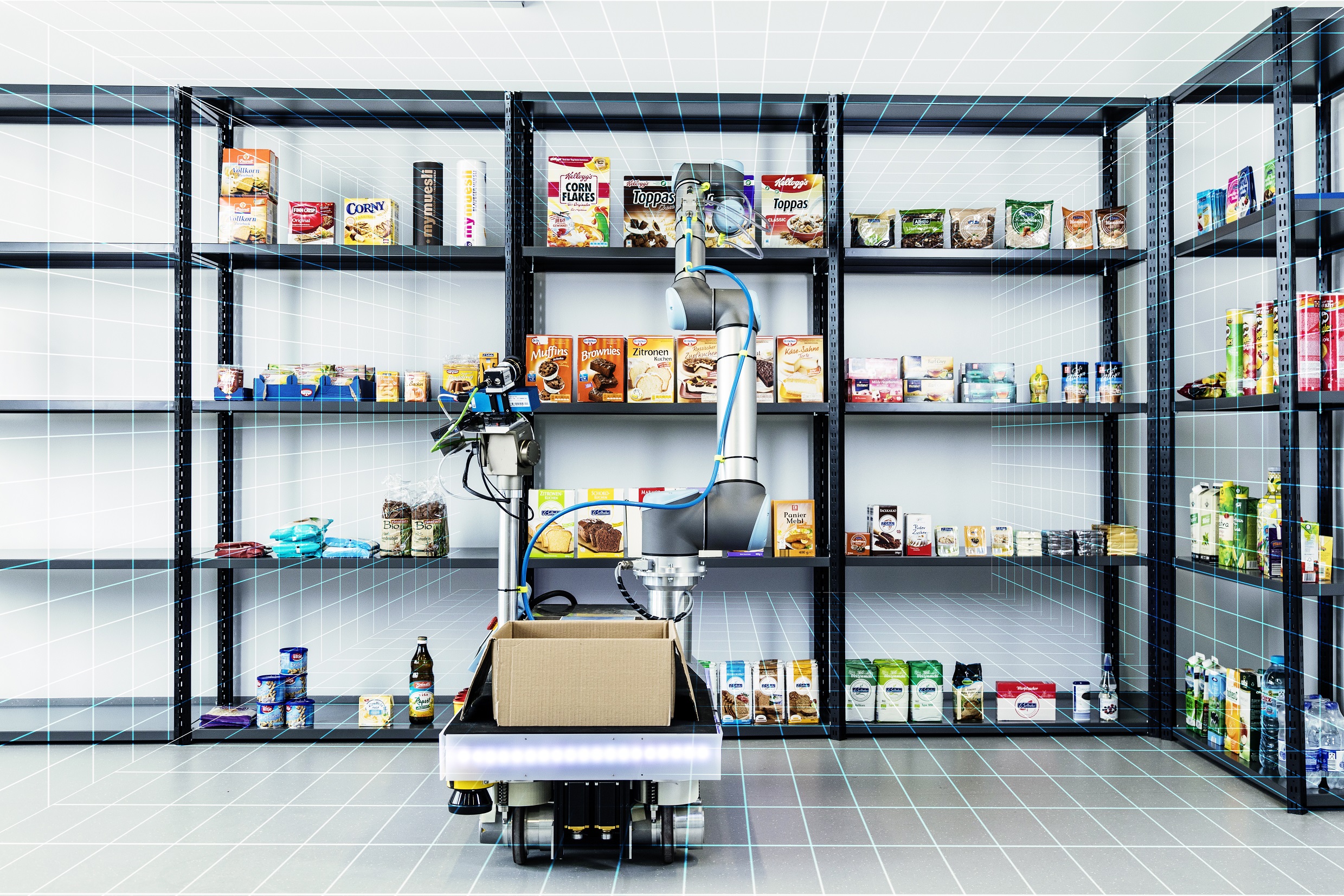
    The topics covered by the AI Innovation Center are very broad. Success stories include the Quick Check for automated end-of-line packaging using AI-based image processing and a robot. It was also examined to what extent image processing and the subfield of machine learning (ML) can be used to automatically detect damage to vehicle bodies, which provides important information to rental car companies or used car dealers, for example. Both Quick Checks led to further collaboration between the companies and Fraunhofer, resulting in the prototyping of the applications. In the context of the service economy, a Quick Check for a book wholesaler was able to demonstrate the possibility of predicting as accurately as possible, using AI, when which products will be ordered and in what quantity.

    Human-centered and application-oriented

    The projects of the AI Innovation Center focus on human-centered AI. This includes the explainability, verifiability, cooperation, integration and robustness of AI technologies. Only when people interact intuitively with new technologies and work together in a trusting manner an optimal utilization of their potential can be achieved. Companies also benefit from the fact that the AI Innovation Center is embedded in Europe's largest AI research network, Cyber Valley, in which it has the task of bridging the gap between top-class fundamental research at various institutions in the Stuttgart-Tübingen area and the technological needs on the user side.

    Statements from project partners

    Company Sick: “The colleagues from Fraunhofer have developed an excellent overview of existing methods for quality assurance of neural networks using the Quick Check. With their expertise, we hope to be able to take further steps in the direction of ‘Safe Artificial Intelligence’.”

    Knorr-Bremse Company: “In the Quick Check, the team at Fraunhofer evaluated the training of models using public datasets to pre-label video scenes. The obtained results are encouraging and form a very good basis for further examination. The very knowledgeable and professional execution of this project was also very well documented by the FhG partners, and we look forward to further possible collaboration with great optimism.”

    Company IDS: “A common goal of Fraunhofer IPA and us is to make AI applicable and explainable. During the Quick Check, Fraunhofer IPA brought us one step closer to this goal through competence and drive. The short project time has already shown that not only the decision of neural networks is important, but also which image features lead to the decision in order to detect data manipulation and distortions. We look forward to continuing this productive collaboration.”

  • AI & Architecture

    AI & Architecture

    Die nächste Ausgabe unserer Entrepreneurship-Serie steht vor der Tür, und wir betrachten erneut künstliche Intelligenz (KI) und dessen Auswirkungen auf eine bestimmte Branche. Diesmal konzentrieren wir uns auf KI als wirkungsvolles Instrument für Architekten und die Architektur-, Ingenieur- und Bauindustrie (AEC). Unsere Referent:innen aus den Bereichen Forschung, Start-up und Investment teilen ihre Perspektiven, Lösungen und die Chancen, die sie in KI sehen.

    Wissenschaftler:innen, Gründer:innen, Studierende und alle, die sich für das Thema interessieren, sind herzlich eingeladen, am Donnerstag, den 31. März, 14:00-15:30 Uhr dabei zu sein.

    Sprecher:innen

    David Weber
    CEO von Architizer

    Diellza Elshani
    Doktorandin am Institut für Computational Design und Construction und Exzellenzcluster IntCDC an der Universität Stuttgart

    Benjamin James
    Founder & CEO von mlxar GmbH

    David Fehrenbach
    Co-Founder & Managing Director von preML GmbH

    Alex Diehl
    Senior Advisor bei Cyber Valley & Angel Investor


    Registrierung

    Bitte hier registrieren. Das Event findet via Zoom und in englischer Sprache statt.


    Kontakt

    Julia Schmaus – Innovation Manager
    E-mail: julia.schmaus@cyber-valley.de
    Telefon: +49 7071 601 1546
    Mobil: +49 151 6452 0213

  • B2B Communications for Tech Start-ups

    B2B Communications for Tech Start-ups

    Effektive externe Kommunikation ist ein entscheidender Erfolgsfaktor für jedes Unternehmen. Start-ups stehen vor allem in der Anfangsphase vor der Herausforderung, den Bekanntheitsgrad zu steigern und eine erfolgreiche B2B-Kommunikation aufzubauen. Die Entwicklung und Umsetzung einer effektiven Kommunikationsstrategie kann jedoch herausfordernd sein.

    Die nächste Ausgabe der Entrepreneurship Series widmet sich daher dem Thema "B2B-Kommunikation für Tech-Start-ups". Erfahrene Kommunikationsexperten geben Einblicke in PR-Grundlagen, B2B-Kommunikation und den effektiven Einsatz von Social Media. Im Anschluss an ihre Vorträge findet eine Fragerunde statt.

    Wissenschaftler:innen, Gründer:innen, Studierende und alle, die sich für das Thema interessieren, sind herzlich eingeladen, am Donnerstag, den 24. Februar, 14:00-15:30 Uhr dabei zu sein.


    Sprecher:innen

    Mark Schiffhauer
    Chief Creative Officer, ZEIT Verlagsgruppe & Geschäftsführer, Studio ZX

    Lennart Schmid
    Communications Manager, Cyber Valley

    Johanna Hailer
    Kommunikationsmanagerin, Storymaker GmbH


    Registrierung

    Bitte hier registrieren. Das Event findet via Zoom und in englischer Sprache statt.


    Kontakt

    Julia Schmaus – Innovation Manager
    E-mail: julia.schmaus@cyber-valley.de
    Telefon: +49 7071 601 1546
    Mobil: +49 151 6452 0213


  • State government paves the way for Cyber Valley Campus

    State government paves the way for Cyber Valley Campus

    “As the heart of top AI research in Baden-Württemberg, the campus shall underline the ambition to be Europe’s hotspot for top researchers in global competition, also in terms of building structures,” said Science Minister Theresia Bauer. “Already on its fifth birthday, the growing Cyber Valley is overflowing. With the overall concept, we now have a roadmap so that we can still find working space for our young scientists and researchers after next year. I thank the Minister of Finance and the Rector of the University of Tübingen for enabling us to develop a viable overall concept instead of short-term solutions.”

    Minister of Science Theresia Bauer: “The concept underlines the ambition to be Europe’s hotspot for cutting-edge AI research”

    Finance Minister Danyal Bayaz said: “We are investing to make Baden-Württemberg the California of Europe. We strive to be at the forefront of artificial intelligence, and Cyber Valley is enormously important for that.”

    The Cyber Valley Campus will also host a planned ELLIS Institute, for which the state is currently in coordination with the Hector Foundation, and the University of Tübingen’s AI Competence Center, which is financed by Germany’s federal government and Baden-Württemberg’s state government and jointly operated with the Max Planck Institute for Intelligent Systems. The concept that has now been approved forsees the construction of two additional buildings for research, teaching and seminars, as well as the purchase of an existing building on the future campus site.

    Finance Minister Danyal Bayaz: “We want to become the California of Europe”

    Professor Dr. Bernd Engler, Rector of the University of Tübingen, said: “Cyber Valley has become a magnet for outstanding AI researchers from all over the world. Not only the state of Baden-Württemberg, but also the federal government, companies and private foundations are currently investing large sums in bright minds and will continue to do so in the future. However, the researchers also need office space, laboratories and computing capacity. Therefore, it has been essential to also increase investments in infrastructure and to significantly accelerate the pace of building up Cyber Valley now, in order to realize the enormous potential of the location.”

    ELLIS Institute:

    With outstanding support from funds pledged by the H. W. & J. Hector Foundations to attract top AI scientists, the ELLIS Institute, backed by a scientific association, will be established within the Cyber Valley ecosystem. The foundation's commitment requires financial participation by the state. The state is currently coordinating arrangements with the Hector Foundation in this regard.

    ELLIS stands for European Laboratory for Learning & Intelligent Systems and was founded by leading researchers from Europe who work closely with basic researchers from industry. The overarching goal of ELLIS is to establish European cutting-edge research in the field of artificial intelligence as internationally competitive. Europe should not only contribute to how AI and machine learning are changing the world, but also make an economic impact by creating new jobs.

    More information on ELLIS: https://ellis.eu

  • ML deployed to fast-track industrial optimization process

    ML deployed to fast-track industrial optimization process

    Microchips are a building component of practically every electrical product. One metal very common in the production of these chips is copper. This soft metal is essential in the manufacturing of microchip-based products, as it offers both electrical and thermal conductivity. However, for copper to unleash its full potential, its corrosion must be avoided. In the production process of microchips, it is therefore necessary to coat the copper with a thin layer of ceramic material: aluminum oxide. This encapsulating process is called Atomic Layer Deposition or ALD in short.

    The optimization of the coating process is tedious and costly

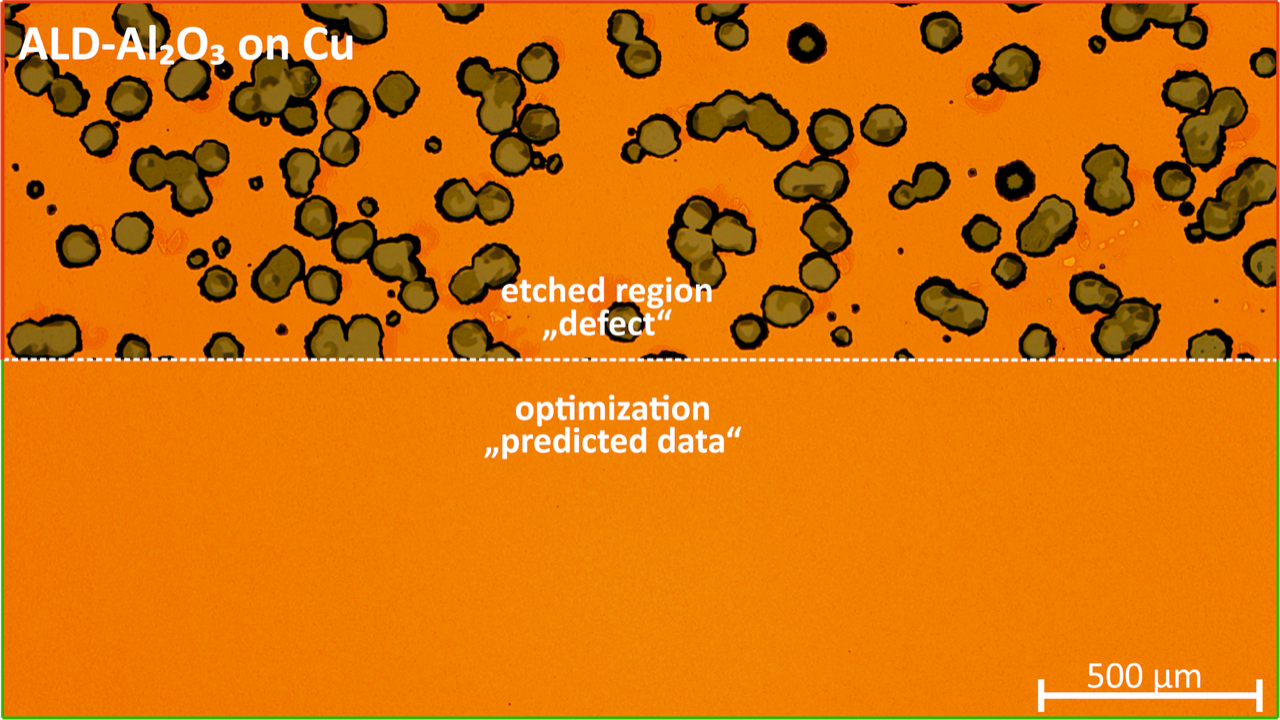
    The coating of copper is not a dip-and-go process. It takes a lot of engineering expertise, many hours of manual labor, and tedious trials to find the optimum deposition parameters for the layer to be defect-free (i.e., without any holes, dents, or gaps) and to be as thin as possible. Firstly, because there is little space in microchips often the size of a dust mite. Secondly, aluminum oxide is costly: scaled up to the production of thousands if not millions of microchips, even a few nanometers more width of the coating layer puts a dent in the margin. And thirdly, gaps and dents are the back door for corrosion to find its way in after all. 

    An interdisciplinary team of researchers at the Max Planck Institute for Intelligent Systems, the Max Planck Institute for Solid State Research, the Technical University of Munich, and Robert Bosch GmbH – an industrial partner in the Cyber Valley research network – has found a way to minimize defects in the layer, to fast-track the optimization process and to reduce the costs resulting from coating copper used in microchips. They deployed Bayesian Machine Learning methods and found that the optimization process can be speeded up fifteenfold compared to taking a conventional optimization approach.

    Bayesian optimization

    “Imperfections in the coating layer can be reduced by having a thicker coating film, however then it costs more and the layer takes up more space. Many iterations are necessary for engineers to find the ideal coating with little to few defects. On an industrial scale, it takes even more time, weeks maybe months, and hence it costs thousands of euros for each iteration. Therefore, reducing the optimization process from 30 or 40 steps to only two or three through Bayesian optimization is quite an achievement,” says Gül Dogan, a Ph.D. student both in the Modern Magnetic Systems Department at the Max-Planck-Institute for Intelligent Systems (MPI-IS) and with Robert Bosch GmbH. She is the first author of Bayesian Machine Learning for Efficient Minimization of Defects in ALD Passivation Layers, recently published in the journal Applied Materials and Interfaces.
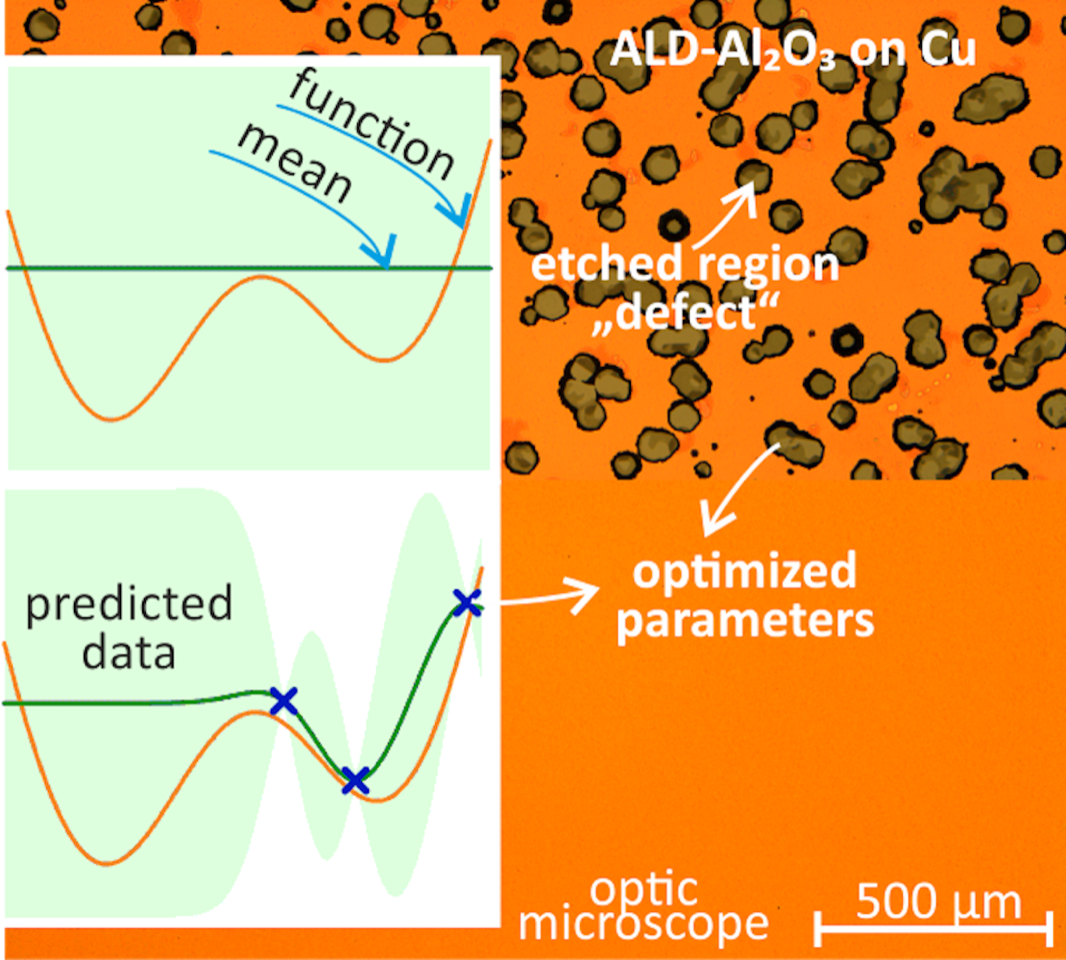
    Figure 1: As the system collects new data points – the blue markers in the lower image – it updates the prediction about the system and based on this prediction, Bayesian optimization suggests a new parameter set to be tested.

    “We use machine learning to perform better than exhaustive conventional search and optimization methods. Our algorithm collaborates with the experts and learns from their experience – with success: We have virtually no film-porosity and hence significantly reduce the corrosion,” Sinan Demir adds, who is a Ph.D. student in the Physical Intelligence Department at MPI-IS, led by Prof. Metin Sitti.

    Several parameters determine how good the coating outcome is: how long the copper surface is pretreated using Ar/H2 plasma to clean the material, the deposition temperature above 200 °C, and a 60 ms pulse time applying the aluminum oxide. All parameters and their interplay influence the corrosion resistance. The algorithm was capable of finding the optimal parameter set in only a few iterations.

    Learnings can be transferred

    “Let’s assume the system performance is defined by this orange function seen in Figure 1. Just assume that our parameters affect the production process according to this function. We start with no knowledge at all. As we collect new data points – the blue markers in the lower image – we update the prediction about the system and based on this prediction, Bayesian optimization suggests a new parameter set to be tested, which can improve the performance of the system. Then, we do the experiment by using this new parameter set. We continue testing and choosing new parameters sets until we reach our final goal or design criteria,” Demir continues.

    The coating of copper is one optimization challenge. In materials science, there are many more. “This is the advantage of Bayesian Machine Learning methods. The learnings you gain from one optimization process can be transferred to different materials and processes in all areas of materials science. You don’t start at zero, you can scale it up,” Demir concludes.