User Group: PhD Student

  • ML deployed to fast-track industrial optimization process

    ML deployed to fast-track industrial optimization process

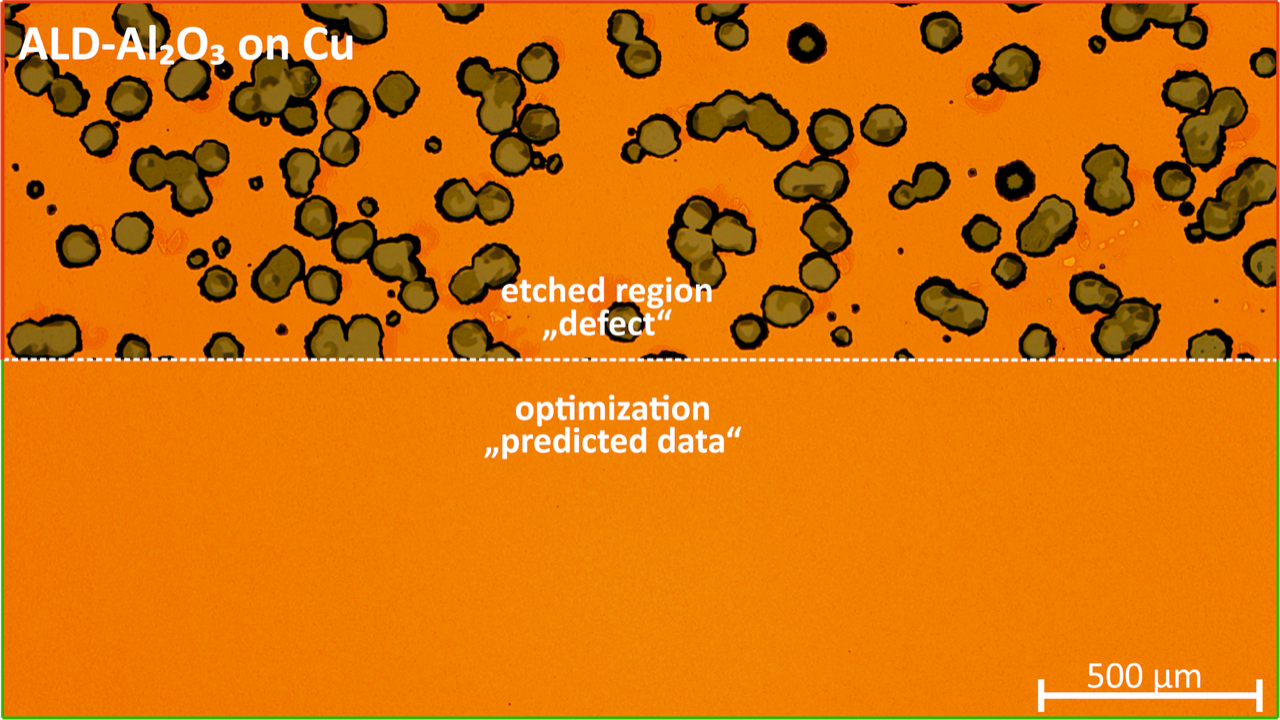
    Microchips are a building component of practically every electrical product. One metal very common in the production of these chips is copper. This soft metal is essential in the manufacturing of microchip-based products, as it offers both electrical and thermal conductivity. However, for copper to unleash its full potential, its corrosion must be avoided. In the production process of microchips, it is therefore necessary to coat the copper with a thin layer of ceramic material: aluminum oxide. This encapsulating process is called Atomic Layer Deposition or ALD in short.

    The optimization of the coating process is tedious and costly

    The coating of copper is not a dip-and-go process. It takes a lot of engineering expertise, many hours of manual labor, and tedious trials to find the optimum deposition parameters for the layer to be defect-free (i.e., without any holes, dents, or gaps) and to be as thin as possible. Firstly, because there is little space in microchips often the size of a dust mite. Secondly, aluminum oxide is costly: scaled up to the production of thousands if not millions of microchips, even a few nanometers more width of the coating layer puts a dent in the margin. And thirdly, gaps and dents are the back door for corrosion to find its way in after all. 

    An interdisciplinary team of researchers at the Max Planck Institute for Intelligent Systems, the Max Planck Institute for Solid State Research, the Technical University of Munich, and Robert Bosch GmbH – an industrial partner in the Cyber Valley research network – has found a way to minimize defects in the layer, to fast-track the optimization process and to reduce the costs resulting from coating copper used in microchips. They deployed Bayesian Machine Learning methods and found that the optimization process can be speeded up fifteenfold compared to taking a conventional optimization approach.

    Bayesian optimization

    “Imperfections in the coating layer can be reduced by having a thicker coating film, however then it costs more and the layer takes up more space. Many iterations are necessary for engineers to find the ideal coating with little to few defects. On an industrial scale, it takes even more time, weeks maybe months, and hence it costs thousands of euros for each iteration. Therefore, reducing the optimization process from 30 or 40 steps to only two or three through Bayesian optimization is quite an achievement,” says Gül Dogan, a Ph.D. student both in the Modern Magnetic Systems Department at the Max-Planck-Institute for Intelligent Systems (MPI-IS) and with Robert Bosch GmbH. She is the first author of Bayesian Machine Learning for Efficient Minimization of Defects in ALD Passivation Layers, recently published in the journal Applied Materials and Interfaces.
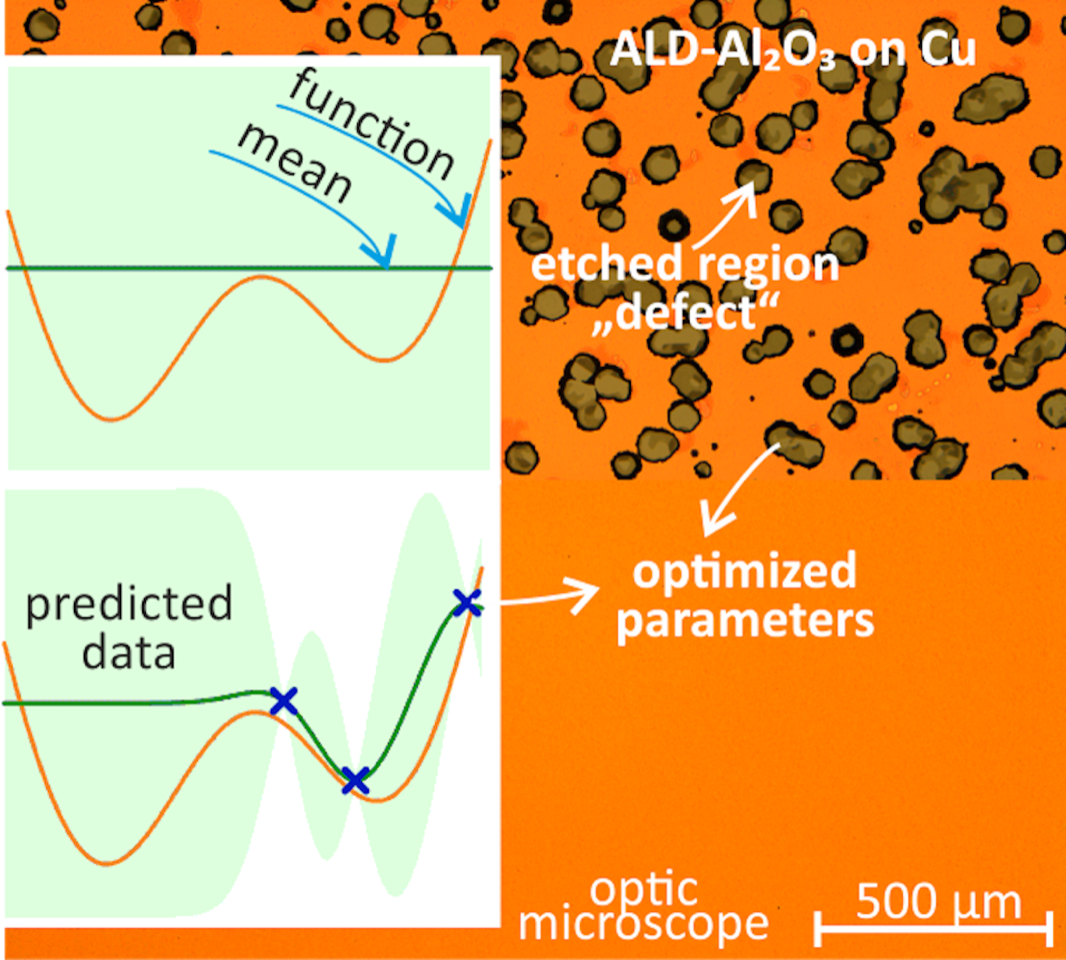
    Figure 1: As the system collects new data points – the blue markers in the lower image – it updates the prediction about the system and based on this prediction, Bayesian optimization suggests a new parameter set to be tested.

    “We use machine learning to perform better than exhaustive conventional search and optimization methods. Our algorithm collaborates with the experts and learns from their experience – with success: We have virtually no film-porosity and hence significantly reduce the corrosion,” Sinan Demir adds, who is a Ph.D. student in the Physical Intelligence Department at MPI-IS, led by Prof. Metin Sitti.

    Several parameters determine how good the coating outcome is: how long the copper surface is pretreated using Ar/H2 plasma to clean the material, the deposition temperature above 200 °C, and a 60 ms pulse time applying the aluminum oxide. All parameters and their interplay influence the corrosion resistance. The algorithm was capable of finding the optimal parameter set in only a few iterations.

    Learnings can be transferred

    “Let’s assume the system performance is defined by this orange function seen in Figure 1. Just assume that our parameters affect the production process according to this function. We start with no knowledge at all. As we collect new data points – the blue markers in the lower image – we update the prediction about the system and based on this prediction, Bayesian optimization suggests a new parameter set to be tested, which can improve the performance of the system. Then, we do the experiment by using this new parameter set. We continue testing and choosing new parameters sets until we reach our final goal or design criteria,” Demir continues.

    The coating of copper is one optimization challenge. In materials science, there are many more. “This is the advantage of Bayesian Machine Learning methods. The learnings you gain from one optimization process can be transferred to different materials and processes in all areas of materials science. You don’t start at zero, you can scale it up,” Demir concludes.

  • Communicate and inspire

    Communicate and inspire

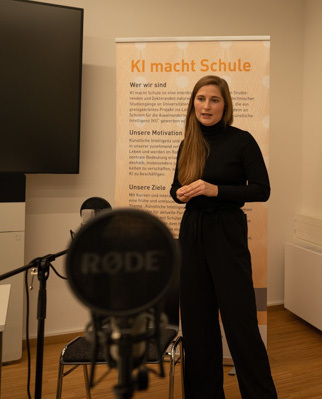
    “Machine learning and artificial intelligence are influencing our lives. Today – and even more so in the future,” Auguste Schulz notes. “People should understand this and reflect on it critically.” The idea behind the “KI macht Schule” (AI in school) initiative is that you can’t start early enough. It brings the discussion about artificial intelligence (AI) into secondary schools and gives students their first practical experience with the technologies and systems behind it.

    Together with eight other students and doctoral students, Schulz founded and coordinates the Tübingen local group of the nationwide project. As a team, they offer small workshops to students in grades 9 and up, which essentially have three components: First, Schulz and her colleagues give a brief introduction to a subarea of AI – for example, an image analysis system that can recognize and analyze faces. This technology is then used in a second step by the students to configure their own application that, for example, recognizes whether the people in selected pictures are wearing masks.

    At the end, the students reflect on the examples they have worked on before. “You have to try out technologies yourself in order to really understand them. And only when you have understood them properly can you deal with them consciously,” Schulz emphasizes. So, questions are discussed such as: What happens when someone wears glasses? What about people with different skin colors? How important is it that such intelligent systems are trained with the right data?

    Cyber Valley and the common mission

    Questions like these are also what drive Schulz beyond the core of her own research. And they connect her with the AI research consortium Cyber Valley. Because initiating social-ethical questions and discussions and thus contributing to the dialogue between researchers and society on the topics of AI and machine learning is a task that the Cyber Valley Public Engagement Team is happy to support.

    “AI systems and machine learning are so prevalent in our society that it’s just important to talk about these issues and engage with society,” Schulz says. The school workshops are a good example of how this can work. Because there the exchange is not a one-way street. Auguste Schulz also takes a lot away from the interaction with the pupils. “It’s really interesting that the students ask questions and don’t let up. Then you realize how well I really understood the topic myself,” says Auguste, whose enthusiasm for this exchange is plain to see.

    From physicist to physicist

    The doctoral student is particularly keen to attract children to scientific and technical subjects, the so-called STEM subjects. Especially children who have perhaps not yet thought about a career in science or technology – or who do not yet have the confidence to do so. Schulz, who studied physics herself, wants to show them that there are also female researchers in these fields. “You still sometimes stand out as a woman in your studies. Or you are often spoken to about the fact that you don’t really look like a physicist,” Schulz notes. That’s why it’s so important to break such thought patterns as early as possible – even before choosing a course of study.

    “It’s always hard to see yourself as a role model,” Schulz says. “But I can talk about my experiences. And just recently I met a young student who was very happy to meet a physicist for once.”

    Encourage exchange

    With her infectious enthusiasm, Auguste Schulz not only wins over students for herself and the topic of AI, she also shares it with colleagues from very different research fields. This collaboration across disciplinary boundaries is another focus for which Schulz finds support in Cyber Valley.

    For Auguste Schulz, interdisciplinary work already began during her physics studies at the University of Heidelberg. During her year abroad in England, she discovered her fascination for neurotechnology, which studies the nervous system and brain activity. Because that is simply more exciting than particle physics, Schulz says with a laugh. A Master’s degree in neuro engineering followed in Munich and then the aforementioned move to Tübingen, where she found a network of many like-minded people in very different research groups in Cyber Valley.

    “We are all united by our desire to develop new statistical methods and use machine learning to learn something from all the scientific data that is being ingested,” says Schulz, describing the bond in Cyber Valley.

    Brave new statistical worlds

    As part of her doctoral thesis, Schulz is currently researching the connections between brain activity and animal behavior. She is investigating what happens in our brain while animals exhibit a certain behavior – and which neuronal activity enables which behavior. Today’s behavior, for example, is also influenced by past behavior.

    If you want to explore and map these relationships, you are confronted with huge amounts of data. Normal static methods reach their limits here. Schulz therefore uses machine learning methods to extract as much as possible from these complex data. And to help the neuroscientists with whom she is working on the project to gain new insights.

    The overarching goal of Schulz’s work is to use machine learning, to develop new methods in exchange with colleagues from other disciplines, and then to make these methods usable for a whole range of other applications. For instead of brain data, health data, climate data or data from quantum physics can just as well be better analyzed in this way.

    Wishes for the future

    And it is precisely this collaboration and cooperation with other disciplines that Auguste Schulz finds particularly enriching. So, it’s hardly surprising what she would like to see in the future in the Cyber Valley network: “The support here is already great. But I would like to see even more interaction and exchange, especially after the pandemic. On campus in bars or cafés, but also in many new initiatives by researchers and students.” So that it will also be easy for new young researchers to arrive here in the future, to find an exciting research climate and to enter into dialogue with society.

  • Scientific Symposium

    Scientific Symposium

    Schedule (CET)

    Wednesday January 12
    12:45-1:00 pm Opening remarks
    1:00-2:30 pm Presentations | Part One
    2:30-3:00 pm Break
    3:00-4:30 pm Presentations | Part Two
    Thursday January 13
    8:45-9:00 am Opening remarks
    9:00-10:30 am Presentations | Part Three
    10:30-11:00 am Break
    11:00 am – 12:30 pm Presentations | Part Four

    Presentations:

    Towards Machines that See the World like Humans

    In the past few years, deep neural networks have surpassed human performance on a range of complex cognitive tasks. However, unlike humans, these models can be derailed by almost imperceptible perturbations, often fail to generalize beyond the training data and require large amounts of data to learn novel tasks. A core reason for this behavior is shortcut learning, i.e. the tendency of neural networks to pick up statistical signatures sufficient to solve a given task instead of learning the underlying causal structures and mechanisms in the data. My research ties together adversarial machine learning, disentanglement, interpretability, self-supervised learning, and theoretical approaches like nonlinear Independent Component Analysis to develop theoretically grounded yet empirically successful visual representation learning techniques that can uncover the underlying structure of our visual world and close the gap between human and machine vision.

    An Algorithmic Safety View of Learning in Human-centered Domains

    Machine Learning advances have revolutionized many domains such as machine translation, complex game playing, and scientific discovery. On the other hand, ML has only enjoyed modest successes in human-centered applications. To improve the utility, reliability, and robustness of Machine Learning (ML) models in human-centered domains, we need to address several foundational challenges. In this talk, I will demonstrate how an algorithmic-safety perspective can motivate specific technical challenges for learning in human-centered domains such as healthcare. Specifically, I will discuss the need to improve the utility of ML-robustness, explainability with an emphasis on decision-making, and post-hoc algorithmic safety to prevent harm. I will discuss my contributions on i) novel methods to improve causal robustness of ML methods designed for practical generative settings, ii) aiding safe decision-making in non-IID settings using time-series explainability intended to address clinicians’ requirements, and iii) novel learning algorithms to optimize for post-deployment safety in sequential decision-making settings. I will conclude with an overview of my future research vision on novel safety-based objectives for explainability in ML, expanding ML-based solutions to general and practical generative settings, and outlining novel ways of validating ML models targeting safety-based objectives.

    On Inferential Challenges in Modern Machine Learning

    Machine learning (ML) can be viewed as solving two types of inferential tasks: inferring models from data and inferring knowledge from models. Central to this perspective is the development of fast, accurate inference methods for model parameters and latent variables. In this talk, I will present my work on addressing inferential challenges in modern ML which are characterized by enhanced model complexity and massive datasets that demand algorithms at scale. I will focus on 1) theory and methods of score estimation, an emerging tool for dealing with intractable probability densities in today's highly expressive ML models, and 2) orthogonal inducing points, an inferential idea that advanced the state-of-the-art of scalable uncertainty models in ML. Finally, I will discuss future directions that connect these ideas to generative modeling, continual learning, and how they could help us understand deep learning.

    Computer Vision for Global-scale Biodiversity Monitoring

    We require a real-time, modular earth observation system that unites efforts across research groups in order to provide the vital information necessary for global-scale impact in sustainability and conservation in the face of climate change. The development of such systems requires collaborative, interdisciplinary approaches that translate diverse sources of raw information into accessible scientific insight. For example, we need to monitor species in real time and in greater detail to quickly understand which conservation efforts are most effective and take corrective action. Current ecological monitoring systems generate data far faster than researchers can analyze it, making scaling up impossible without automated data processing. However, ecological data collected in the field presents a number of challenges that current methods, like deep learning, are not designed to tackle. These include strong spatiotemporal correlations, imperfect data quality, fine-grained categories, and long-tailed distributions. My work seeks to overcome these challenges, and includes methods which can learn from imperfect data, systematic frameworks for measuring and overcoming performance drops due to domain shift, and the deployment of efficient human-AI systems that have made significant real-world conservation impact. My future research agenda will expand upon the strong foundation built by my past and current research. It will seek to make effective use of all available modalities of data, incorporate expert knowledge systematically, and ensure these systems are equitable and ethical – all fundamental and unresolved challenges for CV&ML.

    Open-World Learning for Biomedicine

    Biomedical data poses multiple hard challenges that break conventional machine learning assumptions. In this talk, I will highlight the need to move beyond our prevalent machine learning paradigms and methods to enable them to drive novel biomedical discoveries. I will focus on open-world deep learning methods that generalize to new scenarios never seen during training and demonstrate the impact they have in single-cell genomics. I will first present a method that transfers knowledge across heterogeneous datasets generated under different distributions, and then describe the paradigm needed to discover previously unobserved phenomena. I will discuss the biological findings enabled by these methods and the conceptual shift they bring in annotating comprehensive single-cell atlas datasets. Altogether, my work demonstrates that generalization to never-before-seen scenarios is not only possible, but it is a necessary component in developing next-generation methods that can reveal new scientific insights.

    Social Robots for Health and Education

    I build innovative social robots that address important challenges in health care and education. A unifying challenge that I address in my work is that most of the existing resources that treat complex health and learning problems are developed for professionals. My vision is to democratize health care and education by using social robots to break barriers of access to these critical domains. Towards this, I designed, developed, fabricated, and deployed robots capable of reciprocal interactions with humans to be used as valuable sources of knowledge and assistance that empower people to make decisions about their mental health, social-emotional learning, and creativity. My work probes the intersection of the fields of Human-Robot Interaction, Human-Centered Design, and Artificial Intelligence as essential building blocks for creating social robots that can empower human health and education.

    Intelligent Soft Systems – How Fundamental Physical Principles Enable Function

    Functional soft materials promise to revolutionize robotics hardware by providing entirely new functions and by allowing robots to perform better than traditional robots made from materials such as metals and electromagnetic motors. Over the last decade a large variety of intelligent systems based on functional soft materials have been successfully demonstrated. However, only the surface of the capabilities of these new types of materials has been skimmed, because the fundamental materials behavior, from which they derive their functionality, is often not sufficiently understood.

    In this talk, I discuss fundamental physical principles of soft materials, which can enable function in high-performing soft devices. First, I describe how snap-through instabilities in elastomeric structures can be exploited for electronics-free control of robots. Then, I discuss how the electromechanical coupling between electric fields and soft structures enables electroactive devices and artificial muscles. Finally, I outline nonlinear and thermomechanical effects, which have the potential to serve as the basis for the next generation of intelligent soft systems.

    Advanced Multimodal Locomotion and Multifunctionality of Soft-bodied Millirobots

    Large individually-controlled degrees of freedom (DOF) in animal epidermises enable the animals to dynamically and dexterously interact with their natural environment for diverse functions. This capability still holds at small length scales: flatworms, starfish larvae, corals, comb jellyfishes, and millipedes utilize their numerous individually-controlled cilia, tube feet, or tiny legs for highly adaptable locomotion and multiple functions, such as nutrient transportation, predation, and bio-mixing. Despite their significant future potential applications and numerous recent advances, current miniature (centi-/millimeter) robots still do not have similar tiny cilia, feet, or legs in their epidermises to dynamically and dexterously interact with their operation environment, which severely limits their locomotion capabilities and functionalities.

    The presentation will first walk through my previous projects of using physical intelligence, such as soft design, flow structure interaction, and metachronal coordination, to enhance miniature robots' locomotion capability and functions. Then, I will briefly discuss how I support these investigations on robotics by innovating on micro-fabrication and novel materials. At last, I will propose a new methodology to address the prementioned scientific challenge directly. Such an approach would immediately augment the functional interaction of various miniature robots with their surrounding environments, leading to disruptive locomotion and manipulation capabilities for various future applications.

    Structured Learning – Encoding Structure from Physics, Algorithms, and Geometry into Machine Learning for Robotics and Computer Vision

    This talk focuses on the interaction of structural assumptions and machine learning. While modern machine learning (aka deep learning) is able to leverage large amounts of data and computation to achieve important results, I believe that the recent shift of the community towards ever more general learning approaches is flawed. The progress of deep learning so far has relied heavily on advances in computation, data collection, and software libraries. But as such improvements are plateauing, future progress in AI requires us to reevaluate the role of structure in learning and to tightly integrate both for better data efficiency, generalization, and explainability. In this talk, I will present how structure from physics, algorithms, and geometry can be encoded in learning approaches to robotics and computer vision and why we need a better fundamental understanding of the interaction of structure, learning, and optimization.

    Towards Democratic Learning and Collective Intelligence

    An ability to generalize to unseen environments is of paramount importance in machine learning. In order to equip artificially intelligent systems with such capability, it is necessary to deal with various forms of distributional shifts and to distinguish between spurious correlations and genuine ones in the observed data. To this end, the first part of this talk will be about the Hilbert space embedding of distributions, or kernel mean embedding (KME) for short, which is a nonparametric kernel-based framework to represent probability distributions and model changes thereof. In particular, I will focus on how this framework can help improve the credibility of algorithmic decision making based on observational data by enabling us to reason about higher-order causal effects of policy interventions as well as by removing the effect of unobserved confounders through the use of an instrumental variable (IV) and a proxy variable. In the second part of this talk, we will take a sober look at the foundation of learning and generalization. In order to build intelligent systems that can truly generalize to the real world, we must take a step back and question the traditional definition of generalization and standard procedures in machine learning. Since society is made up of a set of diverse individuals, demographic groups, and institutions, learning and deploying algorithmic models across heterogeneous environments face a set of various trade-offs. I will argue that in such heterogeneous environments, creating machine learning frameworks that allow for real-world generalization is reminiscent of designing algorithms that respect the democratic principle.

    Diversity and Inequality in Social Networks

    Online social networks often mirror inequality in real-world networks, from historical prejudice, economic or social factors. Such disparities are often picked up and amplified by algorithms that leverage social data for the purpose of providing recommendations, diffusing information, or forming groups. In this talk, I discuss an overview of my research involving explanations for algorithmic bias in social networks, briefly describing my work in information diffusion, grouping, and general definitions of inequality. Using network models that reproduce inequality seen in online networks, we'll characterize the relationship between pre-existing bias and algorithms in creating inequality, discussing different algorithmic solutions for mitigating bias.

    Towards Principled Algorithmic Support of Human Decision-Making

    Many important applications such as hiring, healthcare, and scientific peer review rely on human decision-making. Recently, the scale of many of these applications has increased dramatically which is both an opportunity and a challenge. On the one hand, the large amount of data generated in these applications opens up an opportunity to take a novel data-centric perspective on the classical problems of human decision-making. On the other hand, the large scale makes it hard or even impossible for humans to do all the work manually; hence, there is a challenge of developing principled algorithmic tools to support human decision-makers. In this talk, I will discuss my work on exploring the opportunities and addressing the challenges in the context of scientific peer review. In that, I will talk about empirical and theoretical work that has impacted major Computer Science conferences such as NeurIPS and ICML. I will then outline ideas for future work.

  • It’s not the same river

    It’s not the same river

    Der Exzellenzcluster „Integrative Computational Design and Construction for Architecture“ (IntCDC) an der Universität Stuttgart veranstaltet die IntCDC Constructive Conversations, bei denen renommierte nationale und internationale Wissenschaftler und Industrieexperten zu aktuellen Themen und Herausforderungen im Bereich IntCDC sprechen.

    Die kommende IntCDC Constructive Conversations Session wird mit Aviad Almagor, Division Vice President, Emerging Technologies bei Trimble, stattfinden. Aviad Almagor hat sich auf einen sehr frustrierenden, aber auch sehr lohnenden Bereich spezialisiert – die Einführung und Umsetzung neuer Technologien in Unternehmensmärkten – kein Job für schwache Nerven. Seine Rolle erfordert flexible Hartnäckigkeit, sachkundige Ignoranz, Akrobatik und geistige Beweglichkeit. Aviad hat einen Master-Abschluss der Universität Cambridge, einen MBA-Abschluss der Heriot-Watt University, Schottland, und einen B.Arch-Abschluss des Israeli Institute of Technology.

    Aviad Almagor – Division Vice President, Emerging Technologies at Trimble

    Foto: Aviad Almagor – Division Vice President, Emerging Technologies, Trimble

    Die Veranstaltung findet digital über WebEx und in englischer Sprache statt. Um an der Veranstaltung teilzunehmen, klicken Sie hier.

  • Call for Papers

    Call for Papers

    IRIS aims to explore literature and culture both in relation to intelligent systems and as intelligent systems in a workshop. Representations of intelligent systems in literary texts will be discussed, as well as the extent to which literature and culture can themselves be considered intelligent systems. Contributions are welcome from scholars all career stages, backgrounds, and disciplines.

    Deadline is October 29.

    More information is available on the IRIS website.

  • Funded Ph.D. positions at the IMPRS-IS

    Funded Ph.D. positions at the IMPRS-IS

    This school is a key element of Cyber Valley to accelerate basic research and commercial development in artificial intelligence and robotics. The IMPRS-IS seeks students who want to earn a doctorate while contributing to world-leading research in areas such as:

    • Biomedical Technology
    • Computational Cognitive Science
    • Computer Vision and Graphics
    • Control Systems and Optimization
    • Data Science
    • Haptics and Human-Computer Interaction
    • Machine Learning
    • Micro- and Nano-Robotics
    • Neuroscience
    • Perceptual Inference
    • Robotics and Human-Robot Interaction
    • Soft Robotics and Materials

    You can apply at https://imprs.is.mpg.de/application before 11:59 p.m. (23:59) CET on November 1, 2021. Finalists will be invited to selection interviews that will take place online from January 18 to January 21, 2022.

  • ELLIS PhD Program: Call for applications

    ELLIS PhD Program: Call for applications

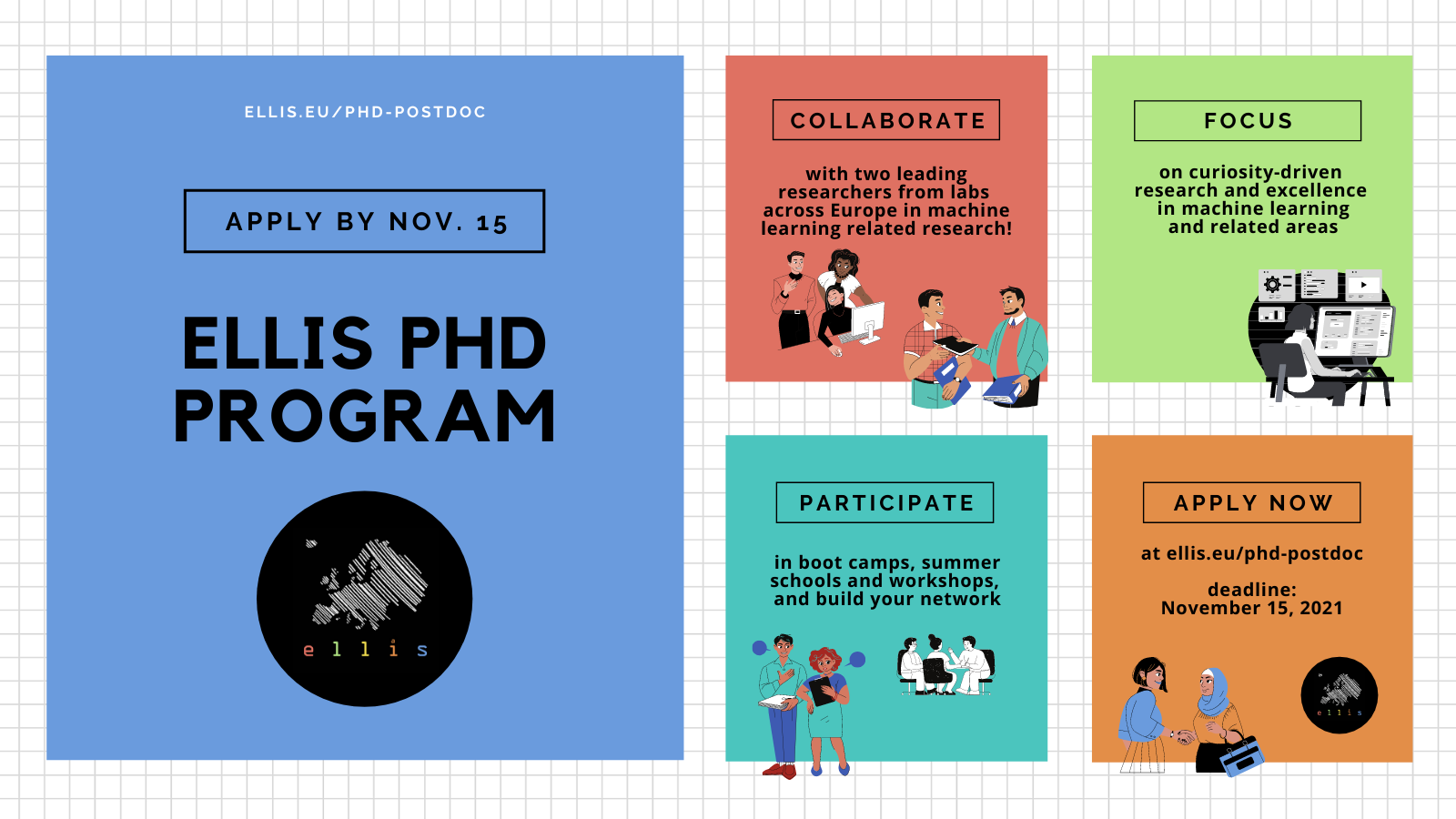
    The ELLIS PhD program has launched its second call for applications. A key element of the ELLIS initiative, its central aim is to foster and educate the best talent in machine learning and related research areas by pairing outstanding students with leading academic and industrial researchers in Europe. The program also offers a variety of networking and training activities, including summer schools and workshops. Each PhD student is co-supervised by an ELLIS faculty member at one unit. Over the course of their degree, they also complete a mandatory exchange of at least six months with a co-supervisor at a different institutoin within the European network. One of the advisors may also come from industry, in which case the student wilil collaborate closely with the private sector partner and spend their exchange conducting research at an industrial lab.

    The deadline for applications is November 15, 2021. Interested candidates should apply online through the ELLIS application portal, which will open in early October. For more detailed information on the program, specific research areas, and the application process, please consult the ELLIS website. 

  • What is the impact of AI on education?

    What is the impact of AI on education?

    The emergence of artificial intelligence (AI) and data use in education and training has triggered a discussion on its role and ethical implications. For example, AI-powered techniques can be used to record and assess details of students’ development, social relationships, behaviour, and educational performance in order to improve learning processes based on these data. This can be achieved by finding repetitive patterns of failure or success and by detecting areas for improvement. These approaches have led to a discussion about ethics and privacy in the context of AI and education-related data, as well as risks related to fundamental rights such as the right to non-discrimination, including gender equality. “Algorithms function like boxes. They are based on standards that are set by people and can therefore also be afflicted with their stereotypes. These stereotypes are often unconscious and thus find their way into the development of technology without being reflected upon. We need to be aware of this,” Wirzberger says. She is also newly appointed spokesperson for the Interchange Forum for Reflecting on Intelligent Systems (IRIS) which aims at answering the question what the impact of intelligent systems on society is.

    As the use of AI systems and thus the use of big data in education advances rapidly, there is a growing need to equip educators and students with a basic understanding of these technologies. This is essential to enable them to engage positively, but critically with questions about AI and data material in education and the ethics surrounding their implementation. To address these issues, the European Commission’s Directorate-General for Education, Youth, Sports and Culture (DG EAC) set up a group of experts on AI and data in education and training together with the Commission’s Directorate-General for Communications Networks, Content and Technology (DG CNECT). 

    What are the tasks of the expert group?

    The group’s primary task will be to assist DG EAC and DG CNECT with the preparation of practical guidelines for educators with concrete practices on the ethical implications of AI and data use in education and training. Members of the group will support cooperation and the exchange of information, expertise and best practices between the Commission and relevant stakeholders. The group will also help to raise awareness within education and training sectors about the opportunities and risks of the use of AI and education related data. 

    Background

    With the Digital Education Action Plan, the European Commission presented its strategic view on addressing the impact of the COVID-19 crisis, as well as the long-term digital transformation of education and training systems. The first strategic priority of the Action Plan – ‘fostering the development of a high-performing digital education ecosystem’ – which seeks to promote understanding of emerging technologies and their application education foresees the creation of ethical guidelines on AI and data use in education and training. The guidelines will be accompanied by a training programme for researchers and students on the ethical aspects of AI. The Digital Education Action Plan is a key initiative under the Commission’s European Education Area initiative, which outlines its vision for the future of education and training in the EU until 2025 and beyond.

  • Zweiter Workshop, Mental Effort

    Zweiter Workshop, Mental Effort

    Detaillierte Beschreibung des Workshops, der in englischer Sprache abgehalten wird:

    We can all feel exhausted after a day of work, even if we have spent it sitting at a desk. The intuitive concept of mental effort pervades virtually all domains of human information processing and has become an indispensable ingredient for general theories of cognition. However, inconsistent use of the term across cognitive sciences, including cognitive psychology, education, human-factors engineering and artificial intelligence, makes it one of the least well-defined theoretical constructs across fields.

    The purpose of our two-day workshop is to bridge this gap by (a) offering hands-on tutorials on different computational approaches used to model mental effort and by (b) fostering discussion about the operationalization of mental effort among scientists from different research communities and modeling backgrounds.

    Key questions of discussion will include (but are not limited to):

    ● What are the experimental phenomena that lay a foundation for theories of mental effort?

    ● What is the common ground in operationalizing mental effort across different domains of cognitive science?

    ● Which modeling approach(es) is (are) best suited to answer which questions regarding mental effort?

    The workshop is specifically designed to attract scholars with expertise in different modeling

    Call for abstracts and registration

    Are you working on a project or thesis related to mental effort and want to discuss your ideas?

    If so, we are inviting you to present a poster during our virtual poster session.

    Registration and Call for Submission Closes: July 15, 2021