User Group: PhD Student

  • First University Master’s Program in Machine Learning in Germany

    First University Master’s Program in Machine Learning in Germany

    Tübingen is the first German university to start a master's program in machine learning in the coming winter semester. Students from all around the world can apply to take part in this four-semester program. The language of instruction is English. The program teaches the basics of the subject and allows a choice of specialization in a broad range of theory and applications. When it comes to machine learning, Tübingen is a leading global location. It offers many opportunities, even early in the program, to take part in the latest research.

    Whether it is about Internet advertising or personalized medicine, autonomous learning machines make more than headlines – they are also already influencing our everyday life. Their use paves the way for major breakthroughs, for instance, in vehicle safety or improved cancer treatments. The field also provides researchers with new insights into the secrets of life and outer space. Machine learning is the study of algorithms which can gather “experiences” from data in order to identify patterns and regularities. As a result, it is one of the main drivers of current progress in the field of artificial intelligence (AI).

    The research-oriented study program is closely linked to the local research hub at the university. It gives students an opportunity to learn about applications in information technology, and related fields such as computer vision, bioinformatics, the neurosciences, medical informatics, the cognitive sciences, linguistics or robotics. “Things are developing really rapidly right now in machine learning. What is a very promising approach today could already be passé tomorrow,” explains computer sci-entist Ulrike von Luxburg. “That’s why we have made the course of study as flexible as possible. There are few required courses. Students are free to set their priorities,” she adds. They can also acquire interdisciplinary qualifications, for example through lectures in law, philosophy, or ethics.

    As one of the spokeswomen of the new cluster of excellence “Machine Learning: New Perspectives for Science,” Luxburg, together with her colleagues Matthias Hein, Philipp Hennig, and Kay Nieselt, has taken the initiative to incorporate the booming field with an instructional offer in the form of a Master’s program. “The University of Tübingen has made societally responsible and relevant research a maxim. We want to educate experts who understand not only the potential of the new technology, but also the risks it poses, i.e. experts who are able to consider them, and minimize those threats,” says Philipp Hennig. “Intelligent machines are going to change the world. We may not leave this process to others. Our students should be able to shape this process for the general good,” he adds.

    A solid foundation in mathematics is a prerequisite for students, explains Nieselt, the dean of studies in the Department of Computer Science, where the Master’s program will be based. “It’s not necessarily required to have a Bachelor’s degree in Computer Science, Mathematics, or Physics. The main thing is knowing the basics: programming, algorithms, data structures, and lots and lots of mathematics,” she says. Because the language of instruction for the international course of study is exclusively English, adds Nieselt, a corresponding level of proficiency in the language is also a prerequisite. 

    Tübingen is one of Germany’s leading research locations for machine learning. Around 40 percent of the German scholarly publications on the topic originate from the Swabian university town. The University of Tübingen is part of the research association Cyber Valley and the site of the Machine Learning Competence Center, which is supported by Germany’s Federal Ministry of Education and Research. 

    Applications for the Winter Semester 2019/2020 are open until 30 April. For all information please see: https://uni-tuebingen.de/fakultaeten/mathematisch-naturwissenschaftliche-fakultaet/fachbereiche/informatik/studium/studiengaenge/machine-learning/  

    Contact:

    Prof. Dr. Matthias Hein
    University of Tübingen
    Department of Computer Science
     +49 7071 29-70831
    matthias.hein@uni-tuebingen.de 

    Press Contact:

    Eberhard Karls Universität Tübingen
    Public Relations Department
    Dr. Karl Guido Rijkhoek
    Director
      
    Antje Karbe
    Press Officer
     +49 7071 29-76789
    Fax +49 7071 29-5566
    antje.karbe@uni-tuebingen.de 
    www.uni-tuebingen.de/en/university/news-and-publications.html 

  • New height in popularity: IMPRS-IS on track to double size in 2019

    New height in popularity: IMPRS-IS on track to double size in 2019

    Stuttgart/Tübingen – Launched just two years ago, the International Max Planck Research School for Intelligent Systems, also known as IMPRS-IS, has far exceeded its initial vision of recruiting 100 Ph.D. scholars over the course of its initial six-year grant. Since the third hiring symposium ended in February, 70 students from around the world have received offers for funded doctoral positions with IMPRS-IS faculty members at the Max Planck Institute for Intelligent Systems, the University of Stuttgart, and the University of Tübingen. 56 scholars are already pursuing their doctorates within IMPRS-IS.

    “We expect most of the 70 offers to be accepted, which means our young doctoral program will double in size this year,” says Katherine J. Kuchenbecker, Director at the Max Planck Institute for Intelligent Systems (MPI-IS) and IMPRS-IS spokesperson. “Once all the contracts have been signed, the IMPRS-IS will be one of the largest of the Max Planck Society’s IMPRS doctoral schools. These high enrollment numbers reflect the success of our faculty members at obtaining third-party funding, as well as their knack for creating attractive research projects that captivate qualified applicants.”

    Theresia Bauer, Baden-Württemberg's Minister of Science, Research and the Arts, is also very pleased with the international popularity of the doctoral school and its potential: “IMPRS is one of the most important activities within Cyber Valley. After all, young, talented people are the ones who will shape our future in the digital world, in science, in business, and in society. The high number of outstanding applications from around the world demonstrates how attractive Cyber Valley already is. An inspiring location has been created for learning and sharing ideas.“

    “It is just amazing to see how popular our school has become!” Leila Masri adds. She has coordinated IMPRS-IS since it was launched in early 2017. “This means many new, brilliant and talented students are joining us. And it means many new research projects and interactions between the universities and MPI-IS, making our ties even stronger. It’s fantastic!”

    The International Max Planck Research School for Intelligent Systems brings together the MPI for Intelligent Systems and the Universities of Tübingen and Stuttgart. Together, they form an interdisciplinary graduate school of 34 internationally renowned faculty working at the leading edge of computational cognitive science, computer graphics, computer vision, control systems, human-computer interaction, machine learning, micro- and nanorobotics, perceptual inference, and robotics. The doctoral program is a key element of the Cyber Valley research cooperation, which focuses on providing first-class education to the world’s top young researchers in the broad field of artificial intelligence.

    In the past two years, IMPRS-IS has gained high visibility within the scientific community, as the 675 applications received for the third hiring symposium clearly demonstrate. In February, 103 candidates were invited to hold talks and give presentations at the two MPI-IS sites in Stuttgart and Tübingen.

    “The 70 applicants who have just received an offer are presently studying and working as far away as New Zealand and as close as our participating institutions, plus everything in between,” Leila Masri says. In addition to Germany, the new recruits come from Brazil, China, Colombia, Croatia, Egypt, France, India, Indonesia, Iran, Poland, Russia, South Korea, Spain, Switzerland, Turkey, the UK, Ukraine, the US, and Venezuela. “Around 40 percent of this year’s recruits are German, and the rest come from abroad. The international part of our name really holds true.”

    Founded in early 2017, the IMPRS-IS aims to bring a new generation of young scientists and engineers into the highly multi-disciplinary research environment available in the Stuttgart/Tübingen region. The school is one of 67 IMPRS’s presently operating within the Max Planck Society. Common characteristics of these graduate programs are the close cooperation with one or more local universities, a curriculum with research seminars and soft-skills workshops, and a strong academic community that brings together students, faculty, and other researchers.

    The creation of IMPRS-IS was made possible by a central grant from the Max Planck Society to the MPI-IS for an initial duration of six years, as well as significant funding from the state of Baden-Württemberg for doctoral education at the Universities of Tübingen and Stuttgart. The school’s first class of 28 scholars from 11 countries began in the fall of 2017. The scholars, who were selected in a multi-stage process, have each completed a master’s degree in a field related to intelligent systems, such as mathematics, computer science, machine learning, physics, engineering, and robotics.

    Just seven months after the first class of Ph.D. students was recruited, a second class was selected in a similar selection process. The second generation of IMPRS-IS scholars, who started in 2018, includes another 28 young researchers. The IMPRS-IS gives these talented scholars an interdisciplinary doctoral research program with opportunities to study all key areas of intelligent systems, ranging from computer science to control theory, from mechanical engineering to neuroscience, and from mathematics to materials science.

  • Cyber Valley-Forscher bei den Science Notes in Tübingen

    Cyber Valley-Forscher bei den Science Notes in Tübingen

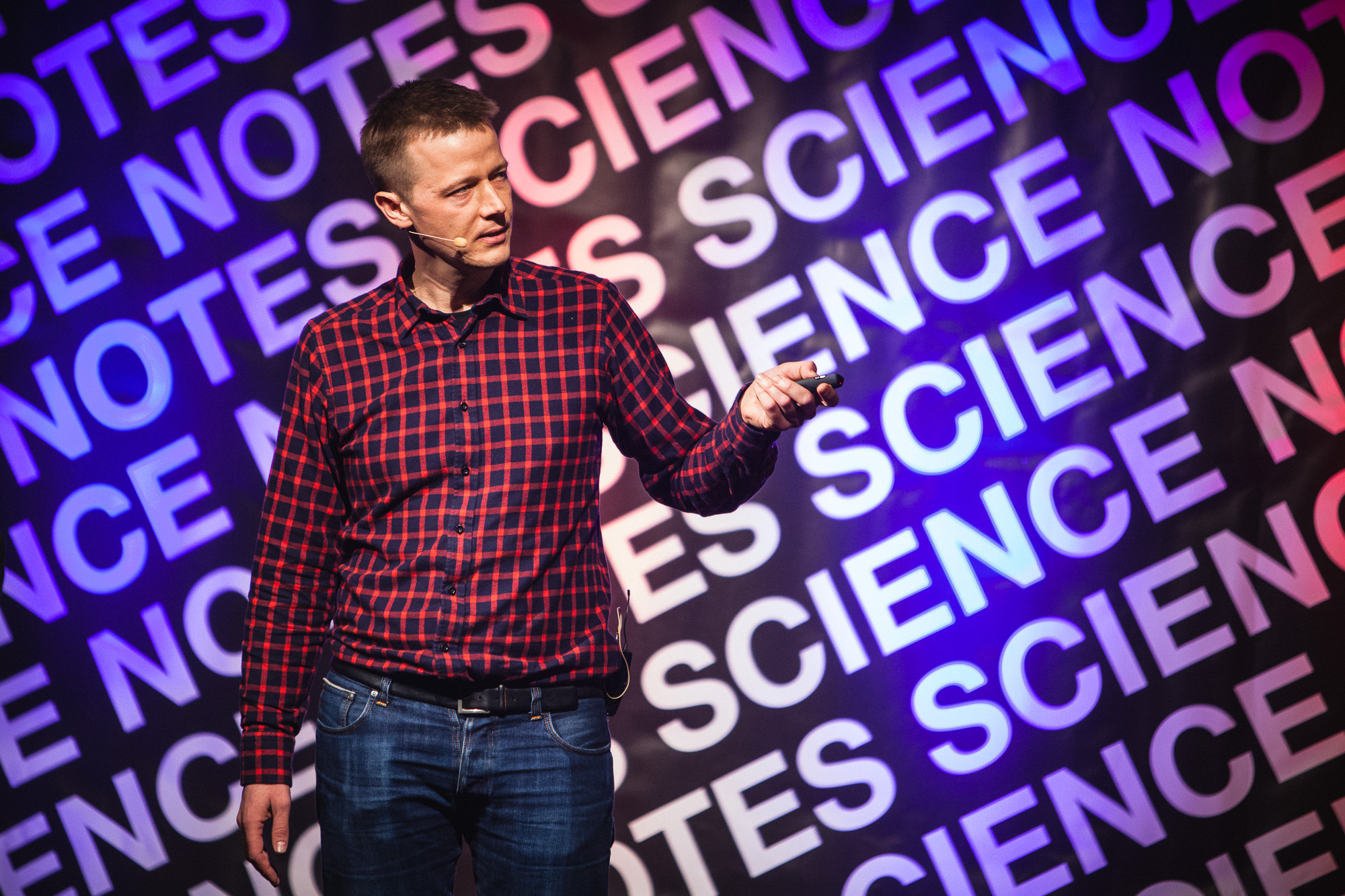
    Tübingen – Wissenschaft in Club-Atmosphäre mit Livemusik, eine Bühne, auf der Forscher in nur wenigen Minuten allgemeinverständlich ihre Forschungsgebiete vorstellen können: das sind die Science Notes, ein Projekt der Forschungsstelle Präsentationskompetenz des Seminars für Allgemeine Rhetorik der Eberhard Karls Universität Tübingen. Es ging wie schon einmal um Künstliche Intelligenz. Die vortragenden fünf Wissenschaftler sprachen in je 15 Minuten darüber, wo die Chancen, Grenzen und Gefahren dieser Technologie liegen und wie sie unser Leben verändern wird. Die Wissenschaftler mussten ihr Themengebiet verständlich, anschaulich und spannend erklären, das war die Voraussetzung, um teilnehmen zu können.

    Dieser Herausforderung stellten sich vier Forscher der Universität Tübingen am Donnerstag abend. Zuerst erklärte Dr. Wieland Brendel, wie Maschinen unsere Welt sehen – Stichwort Computer Vision. Im Anschluss präsentierte Prof. Dr. Philipp Hennig, Cyber Valley-Professor für Methoden des Maschinellen Lernens, die präzise Unsicherheit von Rechenalgorithmen für lernende Maschinen. Cyber-Valley-Forschungsgruppenleiterin Dr. Caterina De Bacco sprach über A physics perspective on inference and optimization on networks. Und Dr. Anna Levina erkundete im letzten Vortrag die Selbstorganisation des Gehirns. Teil 5 war eine Open Mic Session, in der es darum ging, das Thema „Künstliche Intelligenz und Wir“ mit Zuschauern und Vortragenden zu diskutieren.

    Die Veranstaltung fand im Schlachthaus Club in Tübingen am Donnerstag, den 17. Januar statt. Wer nicht dabei sein konnte – keine Sorge. Alle Vorträge wurden danach auf YouTube gestellt: https://www.youtube.com/watch?v=9QyoGiG8dmU

    Das komplette Programm finden Sie unter www.sciencenotes.de

  • Symposium Artificial Intelligence and Society

    Symposium Artificial Intelligence and Society

    The latest breakthroughs in artificial intelligence are based on machine learning. Using examples, computer programs can identify patterns and regularities in data sets and transfer these to similar situations in the future. The Stuttgart-Tübingen region is a leader in AI research and local research institutions occupy the top position in Germany for scientific publications in this field of research. The development is rapid and many questions about artificial intelligence and its significance for society need to be answered or at least discussed.

    Therefor the Max Planck Institute for Intelligent Systems in Tübingen is organizing a symposium on the topic of 'Artificial Intelligence and Society' on Friday, 14 September 2018, starting at 1 p.m.. The event is aimed in particular at the interested public.

    All interested parties are cordially invited to this symposium, which is organized together with the Cyber Valley Initiative and the Max Planck ETH Center for Learning Systems. Due to the limited space available, electronic registration is required by 03. September 2018:https://www.is.mpg.de/de/events/70-jahre-mpg/register

    Top-class speakers from science and industry were attracted to the symposium. The event is part of the Max Planck Day, the nationwide science festival of the Max Planck Society.

    The speakers at the KI Symposium are:

    • Dr. Michael Bolle / Robert Bosch GmbH
    • Prof. Dr. Dietmar Harhoff / Max Planck Institute for Innovation and Competition
    • Dr. Ralf Herbrich / Amazon Development Center Germany
    • Prof. Dr. Thomas Hofmann / ETH Zürich
    • Prof. Dr. Andreas L. Paulus / Georg-August-Universität Göttingen and member of the First Senate of the Federal Constitutional Court
    • Prof. Dr. Sarah Spiekermann / Vienna University of Economics and Business
    • Dr. Sandra Wachter/ Oxford Internet Institute

    The talks will be followed by a panel discussion. The event will take place in the lecture hall of the Max Planck Institute for Intelligent Systems, Max Planck Ring 4, in Tübingen. Since places in the lecture hall are limited, a video transmission will be set up on the Max Planck Campus Tübingen. The event will be held in German and simultaneous translation will be provided in English.

    The detailed program can be found here 

    The accompanying videos for the Symposium Artificial Intelligence and Society can be found here 

  • Go-ahead for Cyber Valley

    Go-ahead for Cyber Valley

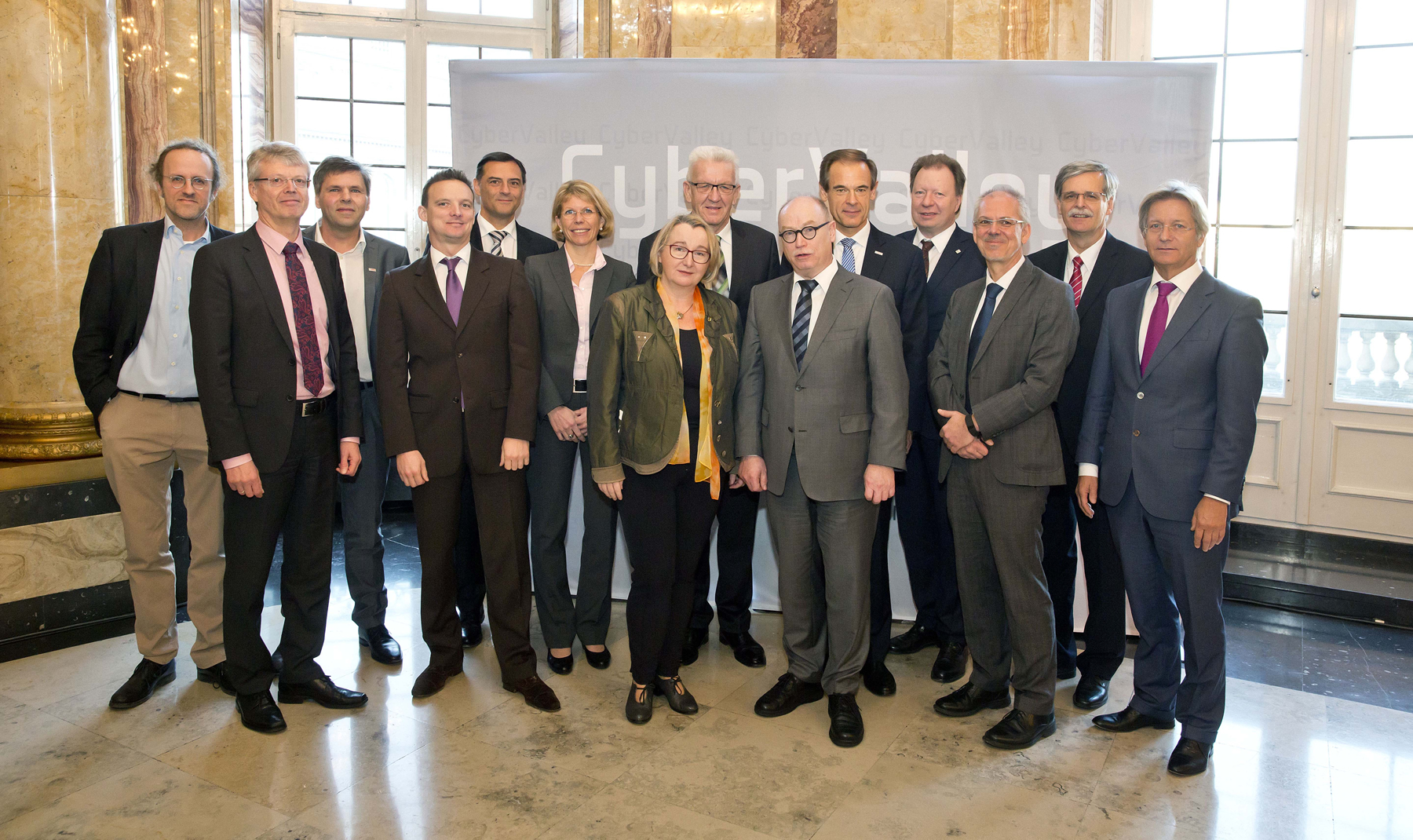
    "Cyber Valley will be a place where the technological foundations for our digital future will be laid", says Martin Stratmann. "We not only want to be a magnet and a talent factory for the best junior scientists, we also want to create space for dialogue with people. After all, the digital future affects us all."

    In Cyber Valley, the Max Planck Institute for Intelligent Systems, the State of Baden-Württemberg, the universities of Stuttgart and Tübingen, together with Bosch, Daimler, Porsche, BMW, ZF Friedrichshafen and Facebook are working together to boost research and development in artificial intelligence. The result is one of the largest research partnerships in Europe in the area of artificial intelligence. The State will invest more than EUR 50 million in the initiative in the coming years.

    A cycle of perception, understanding, action and learning

    The intelligent systems that will be researched and developed in Cyber Valley will be capable of completing the cycle of perception, understanding, action and learning. This ability, which humans and animals master as a matter of course, is vital in being able to act independently in complex and dynamic environments. The aim of the research cluster is to learn from nature and to understand the underlying regulatory and control mechanisms of perception, action and learning and to reproduce them in artificial systems.

    "A distant vision for so long, this is now within our reach: artificial intelligence is on the way", says Minister-President Winfried Kretschmann. "We are convinced that the establishment of Cyber Valley here in Baden-Württemberg can lead to the development of a hub for scientific excellence involving the brightest minds of tomorrow in the area of artificial intelligence. Our goal is not only to build the best machines but also the cleverest machines."

    Cyber Valley is designed to be more than an international centre for researching intelligent systems: its aim is also to promote company startups in this area in order to move as quickly as possible from basic research to marketable applications. A key element of the project will be the training of up to 100 doctoral students.


    New Research Groups and professorships

    As a first step, nine and later five Cyber Valley Research Groups will be set up. These will be funded by the State, the core partners and a consortium of foundations in Baden-Württemberg. Ten professorships at the universities of Stuttgart and Tübingen will also lend additional weight to Cyber Valley in an international context: the universities will each host two professorships as 'bridging professors' with the Max Planck Institute for Intelligent Systems and thus will make a significant and long-term contribution to the initiative. The State will supplement these efforts by financing two additional professorships in each case. The companies are also committed to the establishment of a total of two Endowment Chairs in Stuttgart and Tübingen. In summer 2017, the Max Planck Institute for Intelligent Systems and the universities of Stuttgart and Tübingen will set up a joint graduate school (International Max Planck Research School – Intelligent Systems). In a second development phase, the State will use special funding to support a shared new building project that will be the physical centre of Cyber Valley.

    "Thanks to their various areas of research, the universities of Stuttgart and Tübingen form the ideal interface between humans and machines", says Theresia Bauer, Minister of Science, Research and the Arts. "The partnership with the Max Planck Institute is an excellent opportunity to light a beacon for science in the area of AI in Baden-Württemberg."