User Group: General Public

  • Bosch is expanding its involvement in Cyber Valley

    Bosch is expanding its involvement in Cyber Valley

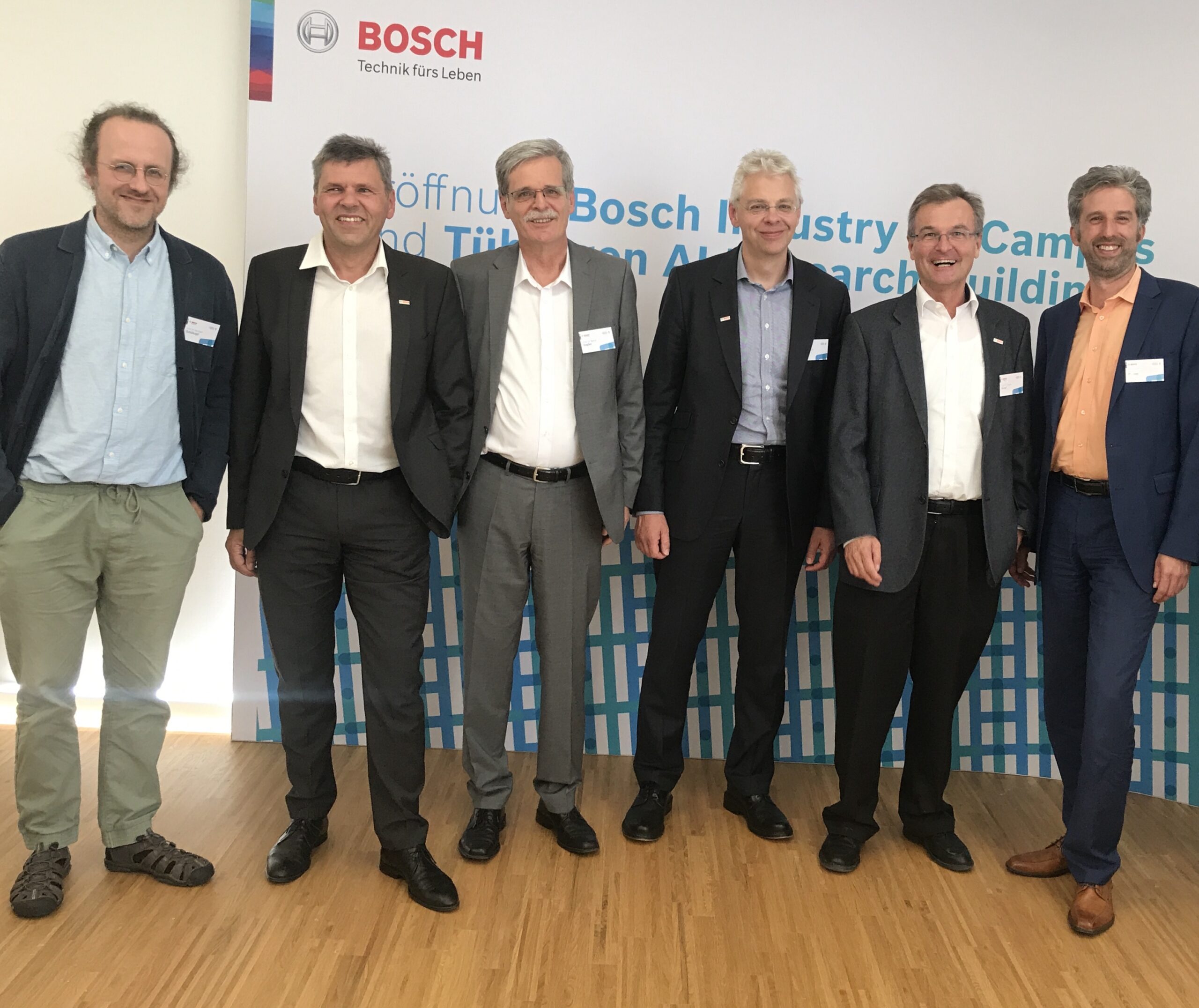
    Stuttgart/Tübingen − Bosch plans to ramp up its activities in the emerging technology of artificial intelligence (AI): in Tübingen in Germany’s Cyber Valley, the supplier of technology and services intends to invest some 35 million euros in a new “Bosch AI Campus.” Bosch is currently in talks with the city of Tübingen to negotiate the purchase of a rough 12,000 square-meter plot on which to build the campus. The move into the new research complex is planned for the end of 2022. Roughly 700 experts will work on applied AI there. “Bosch aims to be among the global leaders in industrial AI research,” said Bosch CDO/CTO Dr. Michael Bolle. “The new Bosch AI Campus will bring us a step closer to achieving this goal.”

    Space for startups and in-depth exchange

    The Bosch AI Campus in Tübingen will be situated close to the research facilities of the Max Planck Institute for Intelligent Systems and the University of Tübingen’s AI research building. Besides laboratories and offices, the campus will offer spaces in which startups and external AI research groups can take up temporary residence. Freely accessible areas on the first floor of the campus will serve to foster exchange among Cyber Valley experts. Other parts of the facility will also be open to the public. “In the new building, experts from the Bosch Center for Artificial Intelligence (BCAI) will work on projects together with experts from other Bosch divisions and from startups. The campus structure will do a lot to foster an exchange of ideas,” Bolle said.

    Bosch is a founding member of Cyber Valley, which was established in 2016. This joint research venture brings together partners from industry, academia, and politics to drive forward AI research in the German state of Baden-Württemberg. The idea is to quickly transfer research findings into real-world industrial applications. “Excellence clusters like Cyber Valley are important, as they make Germany even more attractive to top AI experts and strengthen our position in international competition,” Bolle continued. “The Bosch AI Campus also enhances Baden-Württemberg’s international appeal as an AI hub.”

    From research to practical application

    Bosch is researching artificial intelligence that is safe, robust, and explainable. Its investment in the new AI campus is yet another step by the company to strengthen AI research in Cyber Valley. Last year, Professor Matthias Hein was appointed to a Bosch-endowed chair at the University of Tübingen. The company sponsors two Industry on Campus professorships, which allow the university to integrate practical industrial expertise into its research and teaching.

    These professorships focus on the issues that arise when preparing for industrial applications. One example is predictive diagnostics, which makes it possible to predict machine breakdowns long before a fault actually occurs. Well-timed maintenance can avoid protracted machine downtimes. Predictive diagnostics is an example of machine learning, which is the focus of the research conducted at the BCAI. Currently, the BCAI has some 200 associates at a total of six locations in Germany, the United States, India, and Israel.

    Contact person for press inquiries:

  • Cyber Valley präsentiert KI-Spitzenforschung in Berlin

    Cyber Valley präsentiert KI-Spitzenforschung in Berlin

    Berlin, 27.06.2019 – Die Cyber Valley Initiative wird heute auf der traditionellen Stallwächterparty der Landesvertretung Baden-Württemberg in Berlin vertreten sein. Schon seit 1964 gehört die Stallwächterparty zu den Höhepunkten des Berliner Sommers, mit hochrangigen Gästen aus Politik und Wirtschaft. Unter dem Motto „im Herzen Europas“ zeigt die diesjährige Veranstaltung die Stärken des Standorts Baden-Württembergs. Mit einem Infostand und Mitmachaktionen gibt die Cyber Valley Initiative, Europas größte Forschungskooperation in Bereich künstliche Intelligenz, Einblicke in die Forschungsexzellenz der Region Stuttgart-Tübingen. 

    „Cyber Valley zieht Spitzenwissenschaftler von den Top-Universitäten der ganzen Welt an. Es ist ein Forschungsstandort, der das Zusammenspiel von exzellenter Grundlagenforschung und leistungsstarken Unternehmen fördert und damit wissenschaftliche Durchbrüche und eine hohe Gründungsdynamik ermöglicht. Damit bringen wir die europäische Zusammenarbeit in der KI-Spitzenforschung weiter voran“, sagt Theresia Bauer, Ministerin für Wissenschaft, Forschung und Kunst. 

    Das Ende 2016 gegründete Cyber Valley stärkt Forschung und Lehre in den Bereichen Machine Learning, Computer Vision und Robotik und fördert Technologietransfer und Ausgründungen in diesen Bereichen.Bereits heute ist das Cyber Valley der führende Forschungsstandort in Deutschland für künstliche Intelligenz und unter den zehn führenden KI-Forschungsstandorten weltweit. Knapp die Hälfte der Spitzenpublikationen von deutschen Forschungseinrichtungen im Bereich Machine Learning stammen derzeit aus der Region Stuttgart-Tübingen. Die Cyber Valley Initiative zielt unter anderem darauf ab, diese Position im globalen Wettbewerb um die besten Köpfe zu sichern und weiter auszubauen, um die Wettbewerbsfähigkeit europäischen KI-Forschung zu sichern.  

    „Die Zukunft wird maßgeblich durch neue Technologien gestaltet, die nicht an Ländergrenzen halt machen. Eine besonders schlagkräftige Rolle spielt dabei das Maschinelle Lernen, das gerade dabei ist, Industrie und Gesellschaft global im rasanten Tempo zu verändern,“ sagt Matthias Bethge, Professor für Computational Neuroscience und Machine Learning an der Universität Tübingen,und Mitgründer der European Laboratory for Learning and Intelligent Systems (ELLIS). DieELLIS-Initiative, die im Cyber Valley entstanden ist, fördert die Entwicklung eines starken europäischen KI-Forschungsnetzwerks. „Damit Europa die Zukunft gestalten kann, brauchen wir eine europäische Exzellenz-Institution, die in der Lage ist, Spitzenforscher aus aller Welt anzuziehen und in Europa tätig werden zu lassen. Das ist das Ziel der ELLIS-Initiative," so Bethge.

    „Ich freue mich, dass ELLIS bei der Stallwächterparty des Landes zum Thema Europa vertreten ist. Das Thema KI gehört neben der Landes- und Bundesebene unbedingt auf die europäische Ebene. ELLIS ist dabei ein zentrales Projekt, das die Landesregierung unterstützt“, sagt Ministerin Bauer.

    Das Landeskabinett hatte am 26. März 2019 ein Maßnahmenpaket von 20 Mio. € zur weiteren Stärkung der Künstliche Intelligenz bewilligt, ergänzend zu den 100 Millionen Euro, die bereits 2018 für die Ko-Finanzierung von Projekten des Bundes zu Künstlicher Intelligenz und für Batterieforschung vorgesehen wurden. Ziel ist es, Baden-Württemberg zum Vorreiter der europäischen Künstlichen Intelligenz zu machen. Das Cyber Valley soll dabei eine maßgebliche Rolle spielen.

  • Tag der Wissenschaft

    Tag der Wissenschaft

    Eintauchen in die Welt der Wissenschaft, sich begeistern lassen, staunen und selber zum Forscher werden: So lautet die Devise beim Tag der Wissenschaft der Universität Stuttgart am 29. Juni 2019. Rund 140 Institute, wissenschaftliche Einrichtungen und Gäste bieten von 13 bis 19 Uhr auf dem Uni-Campus in Stuttgart-Vaihingen ein spannendes Programm für Groß und Klein. 

    Das Programm finden Sie unter unter www.uni-stuttgart.de/tag und kann dort auch bestellt werden. 
    Ansprechperson: Claudia Berardis 
    E-Mail: tdw@uni-stuttgart.de

    Viel Spaß!

  • Eine Bundes- und eine Landesministerin zu Besuch im Cyber Valley in Tübingen

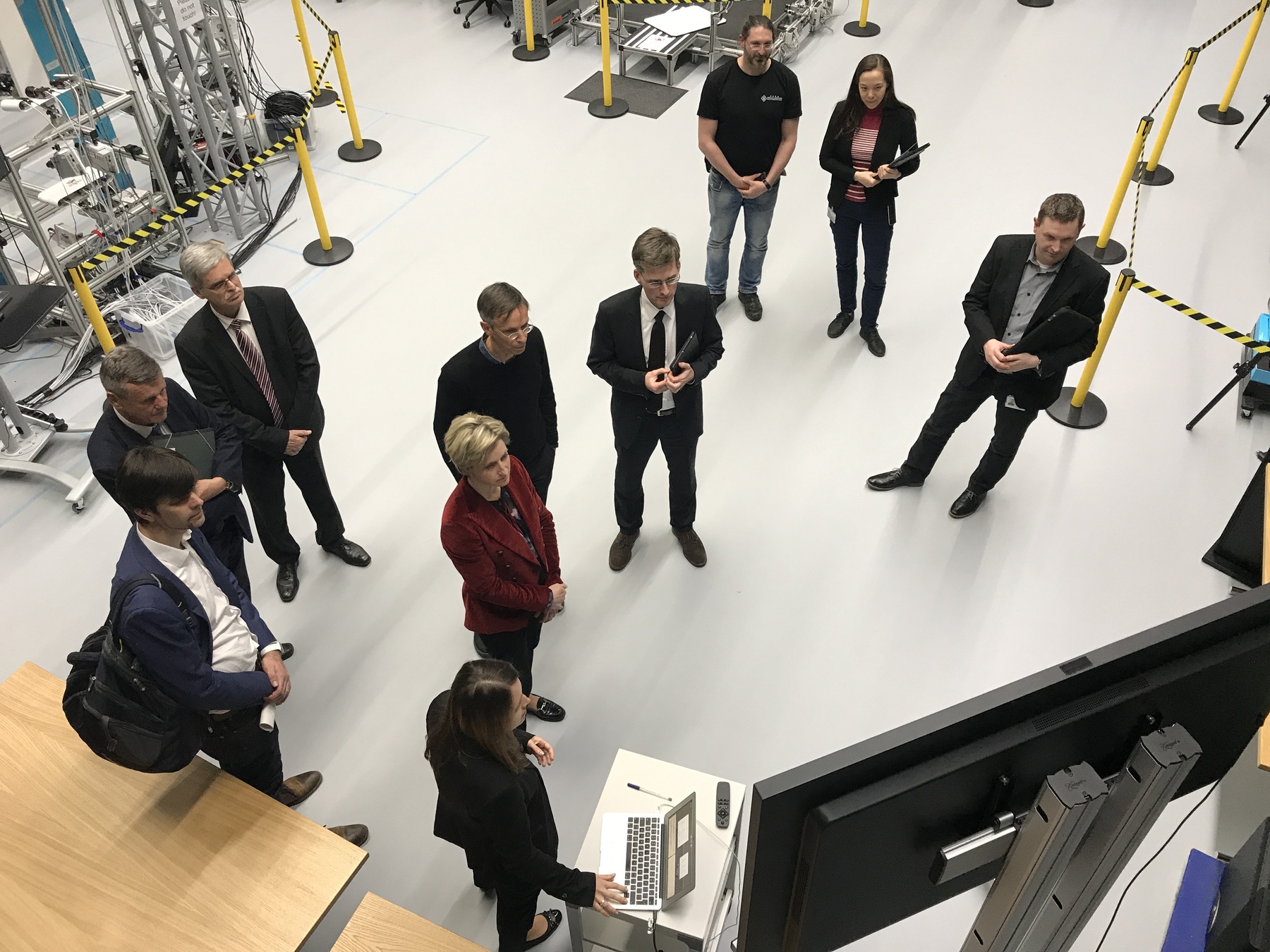
    Die Bundesministerin für Bildung und Forschung in Berlin, Anja Karliczek, besuchte am Donnerstag Vormittag das Kompetenzzentrum für Künstliche Intelligenz und Maschinelles Lernen im AI Research Building der Eberhard Karls Universität Tübingen und des Cyber Valley am Standort Tübingen und bekam auf ihrem Rundgang Einblicke in die Baupläne des Zentrums sowie in aktuelle Forschungsarbeiten zu Künstlicher Intelligenz und Maschinellem Lernen.

    Sie wurde dabei begleitet von der Ministerin für Wissenschaft, Forschung und Kunst in Baden-Württemberg, Theresia Bauer, dem Rektor der Universität Tübingen, Prof. Dr. Bernd Engler sowie Prof. Dr. Bernhard Schölkopf vom Max-Planck-Institut für Intelligente Systeme.

    Das Bundesministerium für Bildung und Forschung (BMBF) hatte zum ersten Oktober 2018 der Universität Tübingen und der Max Planck Gesellschaft eine Förderung in Höhe von 6,6 Millionen Euro für das neu entstehende Kompetenzzentrum für Künstliche Intelligenz und Maschinelles Lernen zugesagt.

    Die Universität Tübingen ist ebenso wie die Universität Stuttgart, das Max-Planck-Institut für Intelligente Systeme, das Land Baden-Württemberg sowie verschiedene Industriepartner sind Kooperationspartner für den Forschungsschwerpunkt Cyber Valley.

    Prof. Dr. Bernd Engler, Rektor der Universität Tübingen: „Der Besuch von Bundesministerin Anja Karliczek nur neun Monate nach dem Gründungstermin hat uns sehr gefreut. Wir haben die langfristige Entwicklungsstrategie, die Bauplanung und einzelne Forschungsprojekte vorgestellt und gezeigt, welche Vorteile Machine Learning für die Gesellschaft schaffen kann.“

    Prof. Dr, Matthias Bethge, Professor für Computational Neuroscience und Machine Learning an der Universität Tübingen, hat Projekte für die Ausbildung von der Schule bis in die Promotion vorgestellt. „Der frühe Zugang zu den digitalen Technologien ist von hohem Interesse für die Wettbewerbsfähigkeit von Deutschland und Europa gegenüber dem Rest der Welt,“ so Bethge.

  • Canada comes to Cyber Valley

    Canada comes to Cyber Valley

    Tübingen – During a visit to the Max Planck Institute for Intelligent Systems (MPI-IS) in Tübingen on Monday, a high-ranking delegation of Canadian AI experts gained insights into the institute’s research activities and engaged in discussions with Cyber Valley representatives. Cyber Valley is Europe's largest research cooperation in the field of artificial intelligence (AI) with partners from politics, science, and industry. The Canadian delegation was invited by the German Federal Foreign Office as part of the Federal Republic of Germany’s Visitors‘ Program. 

    "For us, the visit was a wonderful opportunity to learn more about the Canadian approach," said Matthias Tröndle, research coordinator at MPI-IS and representative of the Cyber Valley management office. "Canada recognized at a very early stage that machine learning showed promise for the future, acted accordingly. Canadian structures and institutions in the field of AI are already well established, and we can learn a great deal from them.” 

    The visit focused in part on AI and society. "Our societies are facing major changes. We need to work together to find solutions that will ensure AI is of benefit to humanity,” said Lyse Langlois, Managing Director of the Observatory on the Societal Impacts of AI and Digital Technologies in Québec City, which was founded at the end of 2018. "This is why we aim to strengthen exchange with European partners," she said. 

    The topic of AI and society are also a central part of the Cyber Valley initiative. "With its universities, research institutes and civil society, the Stuttgart-Tübingen region offers the best conditions to help shape the global discourse on the use of AI," said Matthias Tröndle.

    Press contacts: 

    Linda Behringer

    Public Relations
    c/o Max Planck Insitute for Intelligent Systems, Stuttgart

    T: +49 711 689 3552

    M: +49 151 2300 1111

    linda.behringer@cyber-valley.de

    Valérie Callaghan

    c/o Max Planck Institute for Intelligent Systems, Tübingen

    T: +49 7071 601 1832             
    M: +49 151 1560 4276

    valerie.callaghan@cyber-valley.de

  • Bundeswettbewerb Künstliche Intelligenz: Schüler programmieren eigenen Algorithmus

    Bundeswettbewerb Künstliche Intelligenz: Schüler programmieren eigenen Algorithmus

    Der Bundeswettbewerb Künstliche Intelligenz (KI) geht in die zweite Runde. Seit dem Start am 28. Februar haben mehr als 2.500 Schülerinnen und Schüler in über 1.700 Schulteams aus ganz Deutschland teilgenommen. Die meisten Teams kamen aus Nordrhein-Westfalen (355), gefolgt von Baden-Württemberg (332). Unter den Schulen belegt das Saarpfalz Gymnasium aus Homburg (Saarland) den Spitzenplatz mit 83 angemeldeten Teams, dicht gefolgt vom Gymnasium Heide-Ost (Schleswig-Holstein) mit 70 Teams. Die Teilnehmenden waren zwischen 14 und 19 Jahren alt, die größte Gruppe stellten mit einem Drittel die 17-Jährigen.

    Um die erste Runde zu bestehen, musste mindestens eines dieser drei Kriterien erfüllt sein: Die Teilnehmenden mussten eine ausreichende Punktzahl in den Quiz- und Programmieraufgaben erreichen, unter die besten 50 Prozent der Programmier-Challenge kommen oder eine überzeugende Projektidee liefern. Insgesamt 159 Teams reichten Projektvorschläge ein, die von einer unabhängigen Jury auf ihre praktische Relevanz, die Lösbarkeit durch KI, den Innovationsgehalt und die Durchführbarkeit bewertet wurden.

    In der zweiten Runde setzen Schülerinnen und Schüler nun die von ihnen eingereichten Projektideen um. Zugelassen wurden 398 Teams und 642 Schülerinnen und Schüler. Für die Teilnahme an dieser Runde genügt, dass mindestens ein Teammitglied die erste Runde bestanden hat: Dieses kann nun auch neue Mitstreiter ins Boot holen, um die Projektidee weiter zu bearbeiten. „Mit unserer offenen Bewertungsmatrix wollen wir sicherstellen, dass neben talentierten Programmierern auch kreative Denker ohne Coding Skills weiterkommen“, sagt Dr. Wieland Brendel, Wissenschaftler am Tübinger Kompetenzzentrum für Maschinelles Lernen.

    Im November 2019 endet der Schülerwettbewerb mit einer Abschlussfeier und Preisverleihung in Tübingen. Die viel-versprechendsten Projekte werden im Vorfeld zur AI CON 2019 eingeladen, einer vom Bosch Center for Artificial Intelligence in Kooperation mit dem Cyber Valley ausgerichteten Konferenz zum Thema Künstliche Intelligenz. Zudem wird Microsoft einen KI-Workshop für Schülerinnen und Schüler sowie Lehrkräfte anbieten. Als „KI-Schule des Jahres“ wird die Schule mit den meisten und erfolgreichsten Teilnehmenden geehrt.

    Der Bundeswettbewerb Künstliche Intelligenz ist eine gemeinsame Veranstaltung des Max-Planck-Instituts für Intelligente Systeme und der Universität Tübingen im Rahmen der Cyber Valley Initiative. Teilnehmen können Schülerinnen und Schüler im Alter zwischen 14 und 19 Jahren, die sich für naturwissenschaftliche Fächer wie Mathematik, Informatik oder Physik interessieren.

    Der baden-württembergische Ministerpräsidenten Winfried Kretschmann hat die Schirmherrschaft für den Wettbewerb übernommen. Hauptsponsor des Wettbewerbs ist die Robert Bosch GmbH. Weitere Sponsoren sind die Gemeinnützige Hertie-Stiftung, Google, Amazon, Microsoft, die Alexander von Humboldt Stiftung und die Hochschule der Medien.

    Informationen unter https://bw-ki.de

    Kontakt: 

    Dr. Wieland Brendel

    Universität Tübingen

    Tübinger Kompetenzzentrum AI

    Telefon +49 7071 29-70863
    wieland.brendel@cin.uni-tuebingen.de

  • Podiumsdiskussion zu Künstliche Intelligenz: Was kann sie, was soll sie, was darf sie?

    Podiumsdiskussion zu Künstliche Intelligenz: Was kann sie, was soll sie, was darf sie?

    Das Cyber Valley läd ein zu einer Podiumsdiskussion mit dem Titel „Künstliche Intelligenz: Was kann sie, was soll sie, was darf sie?" am 1. Juli um 18 Uhr im

    Neuen Schloss,

    Weißer Saal, 

    Schlossplatz 4,

    70173 Stuttgart

    Es handelt sich um eine Veranstaltung des Internationalen Zentrums für Kultur- und Technikforschung (IZKT) der Universität Stuttgart in Kooperation mit dem Ministerium für Wissenschaft, Forschung und Kunst des Landes Baden-Württemberg, dem Cyber Valley und der Landeshauptstadt Stuttgart, im Rahmen des Ersten Stuttgarter Wissenschaftsfestivals Smart und Clever. Dieses findet auf Initiative von Stuttgarts Oberbürgermeister Fritz Kuhn vom 26. Juni bis 6. Juli 2019 an vielen verschiedenen Orten in der Landeshauptstadt statt. Das Diskussionsthema wurde auch deshalb gewählt, weil das Land das Ziel verfolgt, sich zu einem wesentlichen Treiber für Künstliche Intelligenz mit internationaler Strahlkraft zu entwickeln.

    Auf dem Podium werden sitzen:

    • Theresia Bauer MdL, Ministerin für Wissenschaft, Forschung und Kunst des Landes Baden-Württemberg
    • Prof. Dr. Philipp Hennig, Inhaber der Cyber Valley Professur „Methoden des Maschinellen Lernens“ an der Universität Tübingen.
    • Prof. Dr. Cordula Kropp, Professorin an der Uni Stuttgart am Institut für Sozialwissenschaften mit dem Schwerpunkt Risiko- und Technikforschung.
    • Prof. Dr. Michael Resch, Direktor des Höchstleistungsrechenzentrum Stuttgart (HLRS) und Leiter des Instituts für Höchstleistungsrechnen

    Um Anmeldung wird bis 24.06.2019 gebeten:
    anmeldungen@izkt.uni-stuttgart.de

  • Minister of Economy Hoffmeister-Kraut visits Cyber Valley

    Minister of Economy Hoffmeister-Kraut visits Cyber Valley

    Tübingen – During a visit to the Max Planck Institute for Intelligent Systems (MPI-IS) in Tübingen on 15th April 2019, Dr. Nicole Hoffmeister-Kraut, Baden-Württemberg's Minister of Economic Affairs, Labour and Housing, once again emphasised the state's support for Cyber Valley, Europe's largest research cooperation in the field of artificial intelligence (AI) with partners from politics, science and industry.

    "Cyber Valley is already one of the world's top locations for AI research and thus a flagship for Baden-Württemberg as a high-tech hot spot. We want to further develop this potential. It is also a question of bringing the already existing excellence even more specifically to small and medium-sized companies," said Minister Hoffmeister-Kraut.

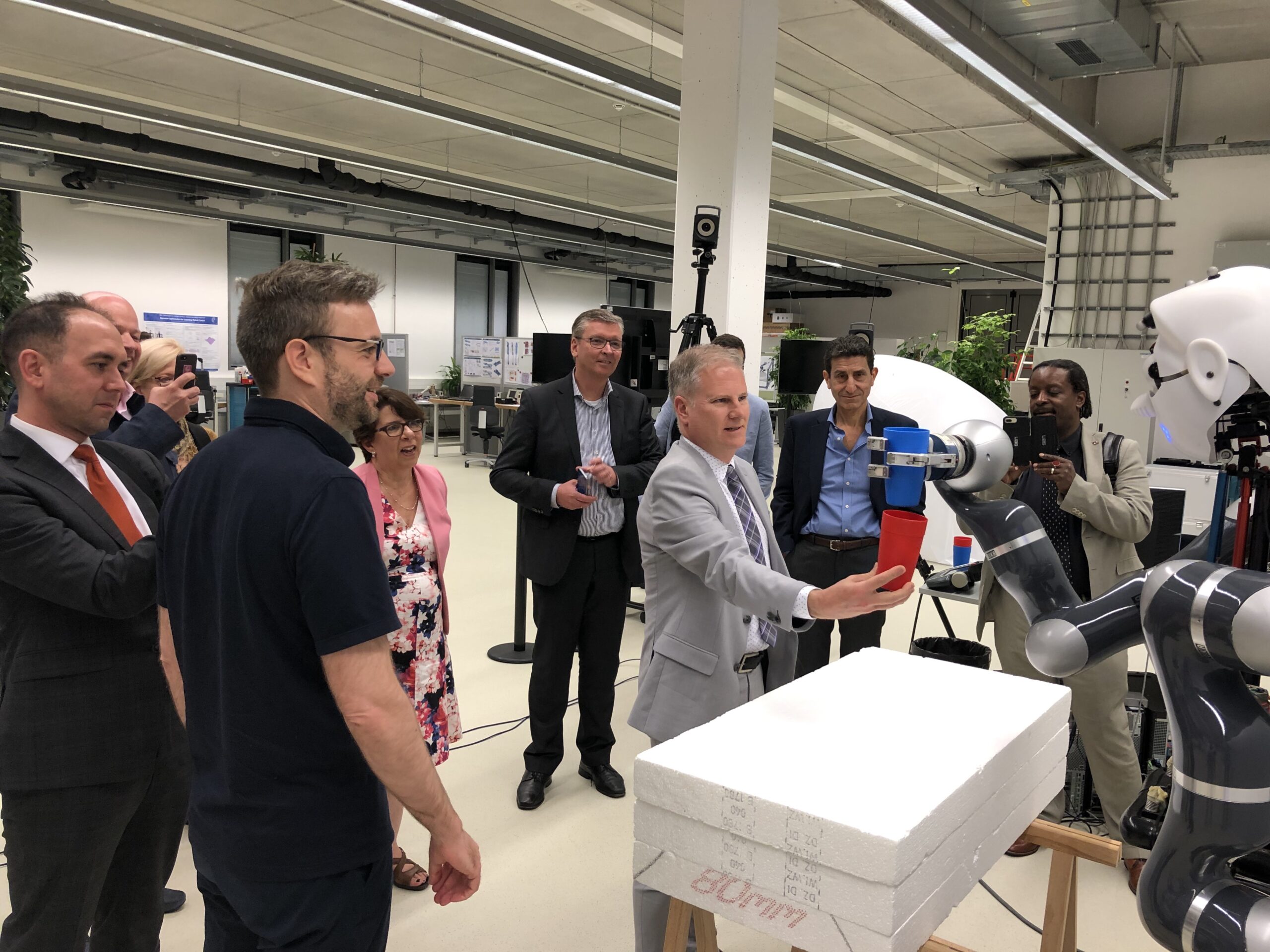
    During several lab visits and talks with leading AI scientists from the Max Planck Institute for Intelligent Systems and the University of Tübingen, Minister Hoffmeister-Kraut and a delegation from the Ministry of Economic Affairs discussed research topics as well as milestones and developments of the Cyber Valley Initiative.

    "We are delighted to have this opportunity to introduce our activities to Minister Hoffmeister-Kraut," said Professor Bernhard Schölkopf, Managing Director of the Max Planck Institute for Intelligent Systems and one of the world's leading researchers in the field of machine learning. "Machine learning and artificial intelligence will change the world. We want Europe to play a leading role in this. The support from policymakers will be crucial." He also stressed that the key motivation behind the Cyber Valley was to create an ecosystem for spin-offs, i.e. to offer doctoral students the opportunity to found start-ups in order to harness knowledge. This will boost the domestic economy and strengthen southern Germany as a business location. "In addition, we want the Cyber Valley to create a radiance and attract more companies and top talents. It works, as the current figures for our doctoral program show. In just two years, we have attracted over 100 doctoral students from all over the world to our International Max Planck Research School for Intelligent Systems. That's just the beginning."

    On 26th March 2019, the State Cabinet approved a €20 million package of measures to further strengthen artificial intelligence, in addition to the €100 million already earmarked in 2018 for co-financing federal projects on artificial intelligence and battery research. The goal is to make Baden-Württemberg a pioneer in the field of AI. Cyber Valley is expected to play an important role in this.

    The research network was founded at the end of 2016. The founding partners are the MPI-IS, the University of Stuttgart, the University of Tübingen, the State of Baden-Württemberg and the following seven industrial partners: Amazon, the BMW Group, IAV GmbH, Daimler AG, Porsche AG, Robert Bosch GmbH and ZF Friedrichshafen AG. Cyber Valley is also supported by the Christian Bürkert Foundation, the Gips-Schüle Foundation, the Vector Foundation and the Carl Zeiss Foundation. Together, the partners want to support the region by strengthening research activities, creating an ecosystem for start-ups and technology transfer and increasing the visibility of Baden-Württemberg as a global hotspot for AI research and development.

    As core elements of the Cyber Valley initiative, new research groups have been established at the Max Planck Institute for Intelligent Systems (MPI-IS), the University of Stuttgart and the University of Tübingen. The Cyber Valley Partners and the foundations finance these groups.

    In addition to the three existing Cyber Valley professorships, additional chairs will be established at the universities in the coming years.

    Another focus of the project is the promotion of young researchers with an internationally renowned, interdisciplinary doctoral programme: the International Max Planck Research School for Intelligent Systems. The IMPRS-IS is a key element of the Cyber Valley research cooperation, which aims, among other things, to offer the world's best young researchers in the field of artificial intelligence a first-class education.

    www.cyber-valley.de

  • Cyber Valley’s machine learning research makes a strong showing on the global stage

    Cyber Valley’s machine learning research makes a strong showing on the global stage

    Stuttgart/Tübingen, May 22, 2019 – In the coming weeks, the Cyber Valley initiative will shine on the global stage: researchers from the Max Planck Institute for Intelligent Systems (MPI-IS), the Universities of Tübingen and Stuttgart, and the Bosch Center for Artificial Intelligence will be well represented at the upcoming International Conference on Machine Learning (ICML) and Conference on Computer Vision and Pattern Recognition (CVPR), two of the leading conferences in global artificial intelligence (AI) research. Both conferences are being held in Long Beach, California: the ICML is set to run from June 9-15, and CVPR will follow from June 16-20.

    Founded at the end of 2016 in southwestern Germany, the Cyber Valley initiative is Europe’s leading research cooperation in the field of artificial intelligence. With a total of 27 papers accepted at both conferences, the initiative has once again demonstrated that the Stuttgart/Tübingen region is among the world’s top locations for research in the field of machine learning, computer vision, and robotics. 

    “These are highly competitive conferences. Only few submissions get accepted, and the leading researchers in the field present their best work. We are pleased to have an impressive display of publications from Cyber Valley”, said Professor Bernhard Schölkopf, Managing Director at MPI-IS and Director of the institute’s Empirical Inference department. 

    Submissions to both conferences reflect the incredible growth that the field of machine learning has seen in recent years: in 2019, ICML received 3424 papers, almost 1000 more than the previous year. At CVPR, submissions spiked 56 percent in 2019, to 5,165. Acceptance rates for the two conferences stand at around 25 percent.  

    At this year’s ICML, Cyber Valley is represented with 11 papers, nine of which are from Schölkopf’s team. Other papers include a cooperation between the head of the Cyber Valley Intelligent Control Systems research group, Dr. Sebastian Trimpe, the University of Stuttgart, and the Bosch Center for Artificial Intelligence, as well as a paper submitted by the team of Dr. Matthias Hein, the Bosch-Endowed Cyber Valley Professor at the University of Tübingen. 

    Researchers from Cyber Valley have been similarly successful at the 2019 CVPR: the research cooperation’s three academic partners are presenting 16 papers. “The success of our international team of scientists at this year’s CVPR demonstrates that Cyber Valley stands for outstanding research in AI,” said Andreas Geiger, Professor for learning-based computer vision at the University of Tübingen and leader of the Autonomous Vision research group at MPI-IS. Geiger’s team from the University of Tübingen has had nine papers accepted at the conference. Professor Matthias Hein of the University of Tübingen is also presenting one paper at CVPR.

    The Cyber Valley Spokesperson and MPI-IS Director Dr. Michael Black’s Perceiving Systems Department is also well represented at CVPR with six papers, one of which was written in cooperation with Professor Bernhard Schölkopf’s Empirical Inference Department. The Autonomous Learning Group, which is headed by Dr. Georg Martius, is also present at CVPR with one paper.

    A full list of papers and authors is available on the Cyber Valley website: 

    https://cyber-valley.de/en/websites/cyber-valley/pages/2019-icml

    About:

    For several years, the German Federal State of Baden Württemberg has been home to Cyber Valley, one of the largest research cooperations in Europe in the field of artificial intelligence, with partners from politics, science, business, and society. The partnership strengthens research and education in the fields of machine learning, computer vision, and robotics, as well as connections between these scientific disciplines.  

    Partners are the MPI-IS, the University of Stuttgart, the University of Tübingen, the State of Baden-Württemberg, and the following seven industrial partners: Amazon, the BMW Group, IAV GmbH, Daimler AG, Porsche AG, Robert Bosch GmbH, and ZF Friedrichshafen AG. With ten newly established research groups and ten new professorships at the Max Planck Institute for Intelligent Systems and the Universities of Stuttgart and Tübingen, Cyber Valley stands for independent basic research, and the initiative aims to attract the best young minds from around the world. In addition, with the recently founded International Max Planck Research School for Intelligent Systems (IMPRS-IS), well over 100 PhD students will graduate from Cyber Valley institutions in the coming years.

    http://www.cyber-valley.de

    Press Contacts: 

    Linda Behringer

    Cyber Valley Public Relations
    c/o Max Planck Institute for Intelligent Systems, Stuttgart

    T: +49 711 689 3552

    M: +49 151 2300 1111

    linda.behringer@cyber-valley.de

    Valérie Callaghan

    Cyber Valley Public Relations

    c/o Max Planck Institute for Intelligent Systems, Tübingen

    T: +49 7071 601 1832             
    M: +49 151 1560 4276

    valerie.callaghan@cyber-valley.de

  • Professor Matthias Hein auf dem Digitalgipfel 2019 in der Carl Benz Arena

    Professor Matthias Hein auf dem Digitalgipfel 2019 in der Carl Benz Arena

    Der Digitalgipfel 2019 – Wirtschaft 4.0 BW findet am 11. April in der Carl Benz Arena in Stuttgart statt. Er wird organisiert vom Ministerium für Wirtschaft, Arbeit und Wohnungsbau Baden-Württemberg, die Teilnahme ist kostenlos.

    Wo?

    Carl Benz Arena
    Mercedesstraße 73D
    70372 Stuttgart

    Mit dabei ist Cyber Valley Bosch-Stiftungsprofessor für Maschinelles Lernen an der Universität Tübingen, Matthias Hein. Er wird einen Impulsvortrag halten zum Thema "Kann KI Ethik?"

    Hier finden Sie das Programm.

    Und hier alle Informationen rund um den Gipfel.