User Group: Researcher

  • Engineering Intelligence – Cyber Valley at University of Stuttgart

    Engineering Intelligence – Cyber Valley at University of Stuttgart

    Cyber Valley ist Europas größte Forschungsallianz in den Bereichen Künstliche Intelligenz, Intelligente Systeme und Robotik. Als Mitgründerin prägt die Universität Stuttgart seit 2018 das Cyber Valley mit ihren besonderen Stärken in der Verbindung von Modellierung, Hardware und Künstlicher Intelligenz in integrierten cyber-physischen Systemen. Die Forschung in diesen Bereichen, beispielweise in der Intelligenten Robotik, bietet großes innovatives Potenzial. Gerade hier ist es möglich und wichtig, Grundlagenforschung mit Perspektiven der wirtschaftlichen Verwertung und der gesellschaftlichen Verantwortung zu verbinden.

    Die Veranstaltung „Engineering Intelligence – Cyber Valley at University of Stuttgart“ präsentiert Highlights und Aktivitäten am Standort Stuttgart am 29. und 30. November 2023 und fördert die weitere Vernetzung im Forschungsfeld der Intelligenten Systeme und der Künstlichen Intelligenz. An zwei Veranstaltungstagen erwartet die Teilnehmenden ein abwechslungsreiches Programm mit einer Vielzahl spannender Panels, Vorträge, Workshops, Poster Sessions und Ausstellungen, darunter:

      • Antrittsvorlesungen neuer Professorinnen und Professoren
          • Prof. Andrea Iannelli, Institut für Systemtheorie und Regelungstechnik – Mehr Informationen
      • Vorstellung des neuen Institutes für Künstliche Intelligenz (KI)
      • Einblicke in die Aktivitäten der Exzellenzcluster IntCDC und SimTech
      • Eröffnung des Transfercenters der Universität Stuttgart (TRACES)​​​​​​

    Registrierung

    Zur besseren Planung bitten wir Sie, sich bis spätestens 24. November über das Registrierungsformular für Ihre Teilnahme an der Veranstaltung “Engineering Intelligence – Cyber Valley at University of Stuttgart” anzumelden.

    Hier gehts es zur Registrierung.

    Programm

    Hier geht es zum Programmheft.

    Ort und Anfahrt

    “Engineering Intelligence – Cyber Valley at University of Stuttgart” findet am Campus Vaihingen der Universität Stuttgart statt, mit Veranstaltungen in Räumen des Gebäudes PWR 47 (Pfaffenwaldring 47) sowie dem frei[raum] (Pfaffenwaldring 45).

    Zur Entlastung der Umwelt sowie in Anbetracht der Parksituation bitten wie Sie, mit öffentlichen Verkehrsmitteln anzureisen.

    Ausgehend von Stuttgart-Mitte kann der Campus Vaihingen über die S-Bahn-Linien S1 (nach Vaihingen oder Herrenberg), S2 (nach Vaihingen oder Filderstadt) sowie S3 (nach Vaihingen oder Flughafen/Messe) erreicht werden. Ausstieg ist die Station “Universität”.

    Ausgehend vom Flughafen fahren die S-Bahn-Linien S2 (Schorndorf) und S3 (Backnang). Her ist ebenfalls “Universität” die gewünschte Haltestelle.

    PWR 47 befindet sich direkt gegenüber dem Ausgang “Universitätszentrum” der S-Bahn-Station, PWR 45 ist nur einen kurzen Fußweg entfernt:

    Lageplan Event

    Foto: OpenStreetMaps

  • Launch of Europe’s independent AI research lab: Kyutai

    Launch of Europe’s independent AI research lab: Kyutai

    Kyutai is a non-profit laboratory entirely dedicated to open research in artificial intelligence (AI). Its objective is to tackle the main challenges of modern AI, particularly by developing large multimodal models – using text but also sound, images, etc. – and by inventing new algorithms to enhance their capacities, reliability and efficiency. 

    Kyutai has already brought on board a team of researchers and a scientific committee with outstanding academic and business backgrounds. 

    Bernhard Schölkopf is known worldwide for his work in machine learning. After spending time working for corporations, he joined the Max Planck Institute for Intelligent Systems in Tübingen as a Director, where he headed the Empirical Inference department. He is also an Affiliated Professor at ETH Zürich and President of ELLIS (European Laboratory for Learning and Intelligent Systems). He has received numerous awards for his research work, including the Leibniz Prize in 2018 and the Royal Society Milner Prize in 2014.

    Resolutely committed to the democratization of AI, Kyutai is positioning itself as a leading player in AI open science. Its ambition is to share its advances with the entire AI ecosystem – the scien- tific community, developers, companies, society at large and decision-makers in democracies.

    Kyutai will also contribute to the training of future AI experts, by offering internships to students on Master’s programs and supervising PhD students and postdocs.

    Kyutai was founded jointly by the iliad Group, the CMA CGM Group and Schmidt Futures. Kyutai’s offices are based in Paris.

  • BMBF establishes ELLIS as the European networking platform for AI researchers

    BMBF establishes ELLIS as the European networking platform for AI researchers

    The German Federal Ministry for Education and Research (BMBF) is establishing ELLIS, the European Laboratory for Learning and Intelligent Systems, as a European and international networking platform for young AI researchers. This is part of the BMBF's AI action plan, which was presented by the Federal Minister of Education and Research, Bettina Stark-Watzinger, at Germany's AI strategy press conference on November 7th. As part of the Cyber Valley Community, ELLIS brings European research excellence to the German AI strategy.

    The successful use of AI requires excellence and networking on a large scale. At ELLIS, European AI excellence meets a European network. This AI network is now officially supported by the BMBF. To ensure that Germany continues to use AI successfully in the future, the country wants to "seek even greater European and international cooperation", as stated in the BMBF's "Artificial Intelligence" action plan ((https://www.bmbf.de/bmbf/de/forschung/digitale-wirtschaft-und-gesellschaft/kuenstliche-intelligenz/ki-aktionsplan.html). Market size is essential for the global technology competition and excellent cross-border alliances are a strategic advantage. Targeted collaboration between German stakeholders at a European level with international partners is therefore at the heart of the AI strategy. ELLIS now plays a key role in this.

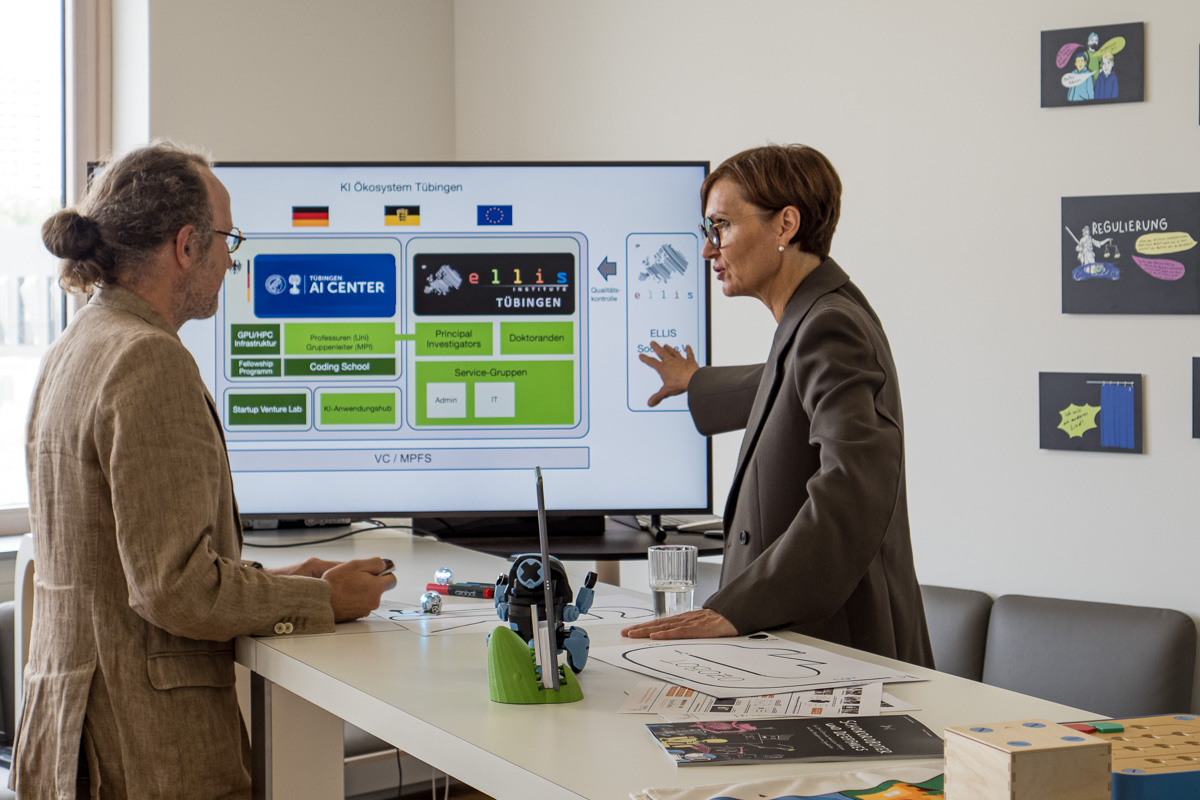
    Ahead of the press conference, State Secretary Prof. Sabine Döring and Prof. Bernhard Schölkopf, Director of the Tübingen AI Center, the ELLIS Institute and the Max Planck Institute for Intelligent Systems as well as Cyber Valley Speaker, discussed how Europe's strength in AI can be used and how the research challenges can be taken on.

    ELLIS – Connecting AI talent across Germany and Europe

    The European Laboratory for Learning and Intelligent Systems (ELLIS) is a pan-European AI network of excellence and part of the Cyber Valley Community. It has more than 1,000 members, 16 transnational research programs, a pan-European PhD program and 41 ELLIS units at world-class institutions such as the Max Planck Institute for Intelligent Systems, universities in Paris, the Universities of Cambridge and Oxford, ETH Zurich, EPFL in Lausanne and the Technion in Haifa. Founded in 2018, ELLIS aims to secure the international leadership of AI made in Europe by networking top researchers and creating a multi-center AI research laboratory.

    Germany is strongly represented in ELLIS: Ten entities are located at leading institutions in Germany (Berlin, Darmstadt, Freiburg, Heidelberg, Jena, Munich, Potsdam, Saarbrücken, Stuttgart and Tübingen). Funded by the Hector Foundation in the amount of 100 million euros, the first ELLIS institute in Tübingen began operations in July. It is set to become a globally recognized center for pioneering basic research in the field of artificial intelligence.

    Attracting and supporting the best young researchers

    One focus of ELLIS is to attract, retain and connect outstanding young AI talent in Europe through the ELLIS PhD and postdoc program. It has attracted more than 7,000 applications from all over the world since its inception in 2020. Students benefit from joint supervision by two leading AI researchers at different institutions in Europe, giving them an excellent starting point for their career in modern AI research.

    "Germany wants to create the basis for us to develop responsible European AI in science and application. This is precisely the goal of Cyber Valley and ELLIS, and we look forward to realizing this together", said Prof. Schölkopf.


    About Cyber Valley 

    ELLIS is embedded in Cyber Valley, Europe’s largest and leading research consortium in the field of artificial intelligence (AI) and modern robotics. Cyber Valley has a mission and a public mandate to advocate for entrepreneurship, research, development, application, and acceptance of technologies and methods in the field of intelligent systems.    

    The Cyber Valley Community connects partners from science, industry, and society, along with AI researchers and entrepreneurs. The Cyber Valley GmbH is funded by the state of Baden-Württemberg and acts as the central organizer, service provider, and host for the Cyber Valley Community. While the GmbH operates from Stuttgart and Tübingen, Cyber Valley has a larger scope: As a national and European driving force, it attracts the best people from all over the world to create the future with AI. Cyber Valley envisions a future where the full potential of intelligent systems is leveraged for the greater good of the world.
    www.cyber-valley.de 

    Press Contakt
    Hazel Rowland, Cyber Valley Media Manager 
    Hazel.rowland@cyber-valley.de 

    About ELLIS 

    Website: ellis.eu 
    For media: ellis.eu/formedia 

    Press Contact
    Barbara Weimer, ELLIS Communications Manager 
    Barbara.Weimer@ellis.eu  

  • AI House Davos: Leading the Global Conversation on AI

    AI House Davos: Leading the Global Conversation on AI

    We are thrilled to announce the launch of AI House Davos 2024: A Global Forum for AI Progress during the World Economic Forum (WEF) Annual Meeting. AI House Davos will convene thought-leaders, academics, industry experts, government officials, investors, and entrepreneurs to foster discussions that will influence the responsible scaling, integration, and regulation of artificial intelligence. This inclusive and multidisciplinary platform will embrace diverse stakeholders, including academia, government, industry, finance, civil society, and entrepreneurship. It aims to provide solutions for addressing the global impact of artificial intelligence.

    The AI House

    AI was one of the main topics during the last annual meeting of the World Economic Forum and the conversation has only accelerated since then. Today, there is an urgent need for a global discussion that includes policymakers, academics, civil society, venture, and industry. The AI House Davos provides an independent platform to have this global conversation on neutral ground and invites you to join us as we embark on this remarkable endeavor.

    During the Annual Meeting of the World Economic Forum, the AI House Davos will unite prominent figures to engage in discussions on the most critical issues concerning artificial intelligence, exploring its impact on society. By establishing a long-term presence and fostering a community of AI thought-leaders during the Annual Meeting of the World Economic Forum, the AI House will have enduring global effects on a long-term scale. Together with other partners, sponsors, contributors, and media partners, we are poised to make a significant impact on the future of AI.

    The Leaders of the Global Conversation on AI

    AI House Davos is a joint initiative by Merantix and the ETH AI Center together with Swisscom, UTokyo Institute for AI and Beyond, and Hewlett Packard Enterprise (HPE). Cyber Valley is a contributor to the planned program.

    Stay tuned for more updates, and mark your calendars for AI House Davos from January 15 to January 19, 2024. More information can be found here: Cyber Valley at AI House Davos


    Media contact

    Dr. Hazel Rowland
    Media Manager, Cyber Valley GmbH
    Email: hazel.rowland@cyber-valley.de

  • Bionic Intelligence in Cyber Valley

    Bionic Intelligence in Cyber Valley

    The new Center for Bionic Intelligence Tübingen Stuttgart (BITS) aims to optimize the interaction between humans and technical systems in a fundamentally new way.

    Scientists from the University of Stuttgart, the University of Tübingen, the Max Planck Institute for Intelligent Systems and the Max Planck Institute for Biological Cybernetics are conducting research on intelligent bionic systems that will aid understanding and treatment of certain diseases of the central nervous system. Diagnoses will become more accurate, treatments more efficient and the illnesses more tolerable. Those affected by such disorders already use orthoses or communication aids. However, these systems cannot fully adapt themselves to the needs of the patient or the environment in order to fully compensate limitations or restore failed bodily functions. In interdisciplinary projects, BITS members develop individually tailored medical aids.

    Bionic systems can be found almost everywhere in everyday life: A Velcro fastener on a backpack is inspired by the burdock, suction cups are modeled on the form of an octopus tentacle. Both inventions are based on phenomena from the animal and plant world. Researchers at the University of Stuttgart, the University of Tübingen, the Max Planck Institute for Intelligent Systems and the Max Planck Institute for Biological Cybernetics are taking this one step further: Their vision is to optimize interaction between humans and technical systems so that, by using various signals and intelligent physical principles, the technical system is able to provide support when humans need it. The users are in control at all times.

    "We want to push the boundaries of what has been possible until now," says Professor Syn Schmitt, BITS spokesperson at the University of Stuttgart. "With bionic systems, such as novel robotic prostheses, we aim to create new intelligent diagnostic and treatment options that offer support in everyday life for patients with physical and neurological limitations."


    Diagnosis and treatment: Smart, flexible and ethical

    Technical assistance systems are already being used for therapeutic purposes, but they fall far short of the efficiency and flexibility that would be required to replace missing or impaired functions, or to support the diagnosis and treatment of complex mental disorders. The scientists of the newly founded BITS are jointly researching the development of bionic systems to adapt them to meet patients' individual needs, to compensate for impaired motor function in the everyday lives of those affected, and to support diagnostic and rehabilitation procedures. Social and ethical dimensions are considered from the very beginning.

    "The goal is to develop alternatives that work perfectly for individuals," adds Professor Martin Giese, BITS spokesperson at the University of Tübingen. "Forging efficient interactions between people and technology, requires not only optimal data and information processing, but also the exploitation of intelligent physical principles in people and the technical system." 

    The challenge here is to design technical components that interact with the nervous systems and muscular apparatus in a highly efficiently way and that adapt flexibly and individually to the patient's position. "To do this, we rely on functional materials that respond to different body-specific stimuli," adds Professor Sabine Ludwigs, also a BITS spokesperson at the University of Stuttgart.


    Interdisciplinary collaboration: From biomedicine to robotics and computer science

    The key to success is interdisciplinary cooperation between experts from different fields, such as biomedicine, neuromechanics, materials science, soft and biorobotics, physics, electrical engineering, social science, ethics, neuroscience, and computer science. "Each and every member of our team is an expert in their field," says Schmitt. "We try to transfer all this knowledge into workable solutions that allow people to interact with technical systems on multiple levels. We believe that affected individuals will benefit from such systems, and that science will gain a better understanding of humans."

    The research work within BITS encompasses everything from robotic orthoses that function as an everyday aid for people with muscle tremors, for example, to wearable sensors to improve diagnostics for obsessive-compulsive disorders, to so-called in-body micro- and nano-robots that can transport drugs specifically to the brain or enable new forms of brain stimulation. "At BITS, we want to build on previous successes and strengthen our collaborations to permanently establish intelligent systems in medicine, treatment and rehabilitation," emphasizes Giese. 


    About Cyber Valley

    Cyber Valley is Europe’s largest and leading research consortium in the field of artificial intelligence (AI) and modern robotics. It has a mission and a public mandate to advocate for entrepreneurship, research, development, application, and acceptance of technologies and methods in the field of intelligent systems. The company envisions a future where the full potential of intelligent systems is leveraged for the greater good of the world. 
    The Cyber Valley Community brings together partners from science, industry, and society, along with AI researchers and entrepreneurs. The Cyber Valley GmbH is funded by the state of Baden-Württemberg and acts as the central organizer, service provider, and host for the community. While the GmbH operates from Stuttgart and Tübingen, Cyber Valley has a larger scope: As a national and European driving force, it attracts the best people from all over the world to create the future with AI.


    About the Center for Bionic Intelligence Tübingen Stuttgart

    At the interdisciplinary research center BITS, approximately 50 scientists have been engaged in various projects since May 2023. BITS members bring together wide-ranging expertise from a variety of disciplines, including biomedicine, neuromechanics, materials science, soft and biorobotics, physics, electrical engineering, social science, ethics, neuroscience and computer science. The research work is intended to contribute to the technical implementation of bionic systems and help to establish these in the medical sector. This will significantly reduce the ever-increasing social burden of mental and neurological disorders, as well as individual suffering. To this end, BITS combines the complementary expertise of the Universities of Stuttgart and Tübingen and the Max Planck Institutes for Intelligent Systems and Biological Cybernetics. BITS is part of Cyber Valley, Europe's largest research consortium in robotics and artificial intelligence.

    Expert Contact

    • Prof. Dr. Syn Schmitt, University of Stuttgart, Institute for Modelling and Simulation of Biomechanical Systems
    • Prof. Sabine Ludwigs, University of Stuttgart, Institute of Polymer Chemistry
    • Prof. Martin Giese, University of Tübingen, Section for Computational Sensomotorics

    About Cyber Valley

    Cyber Valley is Europe’s largest and leading research consortium in the field of artificial intelligence (AI) and modern robotics. Cyber Valley has a public mandate: As advocates for entrepreneurship, research, development, application, and acceptance of technologies and methods in the field of intelligent systems are at the forefront. The company envisions a future where the full potential of intelligent systems is leveraged for the greater good of the world.  

  • Finale: Demo Day for The AI Incubator

    Finale: Demo Day for The AI Incubator


    Bei dieser Veranstaltung werden die Teilnehmer des KI-Inkubatorprogramms ihre endgültigen Ideen einer Jury vorstellen. Die Veranstaltung findet in englischer Sprache statt. Weitere Informationen über das Programm auf Englisch sind unten.


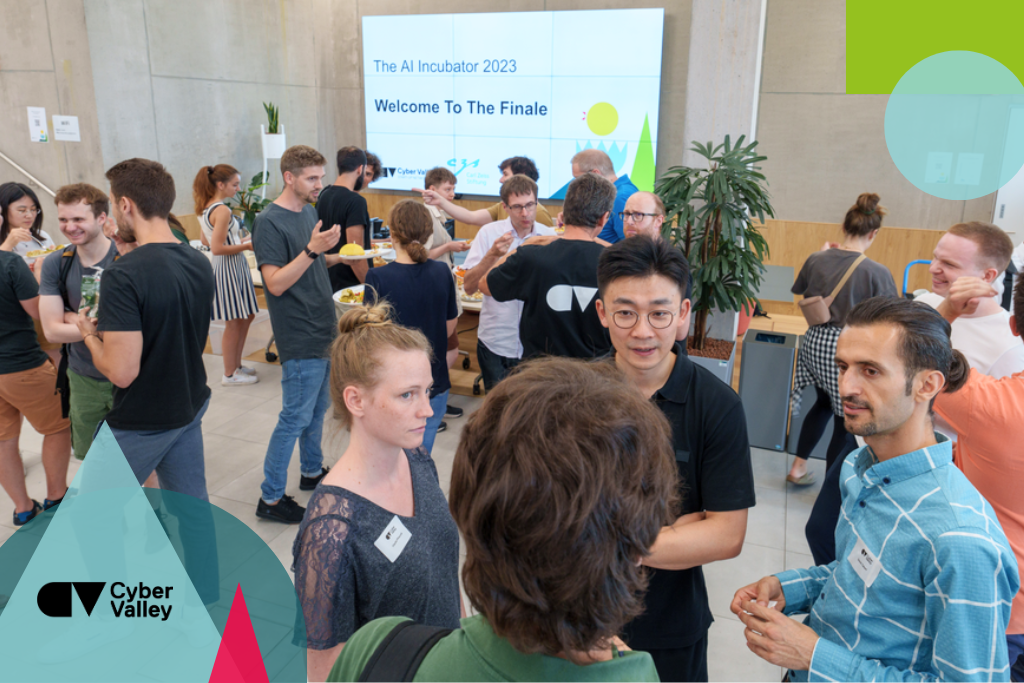
    Following six weeks of workshops and inspiring inputs, participants from Batch #3 of The AI Incubator will pitch their final ideas to a jury and a distinguished audience of investors, corporates, researchers, and entrepreneurs. The best teams will be awarded by the jury and have the chance to win attractive prices. Event attendees will have the chance to meet the teams during the concluding networking event with beverages and fingerfood.


    When? 

    November 23, 2023, 15:00-18:30 CEST


    Where? 

    Amazon Research & Development Center
    Friedrich-Miescher-Straße 4, 72076 Tübingen


    Jury

    Michael Black 
    Alex Diehl 
    Lukas Findeisen
    Naureen Mahmood
    Betty Mohler-Tesch
    Rebecca C. Reisch


    Special Guest Speaker

    Ingmar Hörr, Co-Founder CureVac


    Schedule

    15:00: Welcome & Intro from Rebecca C. Reisch (CEO of Cyber Valley)
    15:30: Team pitches
    17:45: Inspirational talk from Ingmar Hörr (Co-Founder of Curevac): “Sciencepreneur – How to turn science into commercial value”
    18:00: Award ceremony
    18:30 onwards: Networking with food and beverages


    Registration

    Registration is closed for this event. Please contact Paul-David Bittner if you have any questions. 


    The AI Incubator

    The AI Incubator is a six-week program for AI talents with brilliant ideas. The program encourages scientists, technologists, and business talent to found their own companies, fostering the next generation of AI start-ups.  The AI Incubator equips participants with the right knowledge, tools, and skills to transfer their cutting-edge AI and robotics research into products and applications.

    It covers topics such as, AI prototyping, product-market fit, business strategy, and funding. The program also provides participants with access to a network of experts, mentors, founders, and investors who offer guidance and inspiration on their journey into the AI business world.

    The AI Incubator is organized by Cyber Valley and funded by the Carl Zeiss Foundation. 

  • Cyber Valley forms a new partnership with ARENA2036

    Cyber Valley forms a new partnership with ARENA2036

    ARENA2036 is a research campus and innovation hub focused on shaping the future of mobility and production. Its location in Stuttgart ­– a focal point of the German automotive industry ­– offers a flexible factory space where partners from different professional backgrounds can collaborate under one roof. Here, scientists, engineers, and companies meet to create innovative solutions for not only the automotive and production industries but also other sectors.

    “ARENA2036 is committed to collaborating with leading experts in the field of artificial intelligence”, says Dr. Clemens Ackermann, Deputy Managing Director of ARENA2036. “The cooperation with Cyber Valley opens up additional opportunities for us in AI research and application. This helps us to rethink conventional production processes and develop intelligent, sustainable solutions for the mobility requirements of the future. With this powerful mix of AI know-how and our expertise in manufacturing and automotive, we are looking forward to an exciting time of innovation and transformation.”

    About Cyber Valley

    Cyber Valley is Europe’s largest research consortium in artificial intelligence (AI) and modern robotics. Cyber Valley has a public mandate to advocate for entrepreneurship, research, development, application, and acceptance of technologies and methods in the field of intelligent systems. The company envisions a future where the full potential of intelligent systems is leveraged for the greater good of the world.


    The Cyber Valley Community connects partners from science, industry, and society together, along with AI researchers and entrepreneurs. The Cyber Valley GmbH, funded by the state of Baden-Württemberg, acts as the central organizer, service provider, and host for this community. The GmbH is located in Stuttgart and Tübingen, but the Cyber Valley Community has a far wider reach: As a national and European driving force, we attract the best people from around the world to create the future with AI.

    About ARENA2036

    ARENA2036 stands for “Active Research Environment for the Next generation of Automobiles” and is the innovation platform for mobility and production of the future. The research campus is part of the funding initiative “Research Campus – Public-Private Partnership for Innovations” in Germany. ARENA2036 is supported by the Federal Ministry of Education and Research (BMBF) and is run as a registered association with over 50 members from science and industry. The innovation platform based in Stuttgart stands for cooperation under one roof between science and industry. ARENA2036 wants to contribute to actively shaping work, mobility, and production of the future in the context of digitalization. The partners are active in various disciplines – from the automotive industry, aerospace technology, textile, and materials research to industrial science.

  • Cyber Valley becomes a member of “KI Bundesverband”

    Cyber Valley becomes a member of “KI Bundesverband”

    In September 2023, Cyber Valley and the KI Bundesverband (German AI Association) signed a Letter of Intent (LOI), through which Cyber Valley became an associate member of the KI Bundesverband. With this letter of intent, Cyber Valley as well as the KI Bundesverband commit themselves to cooperation and working towards the establishment, promotion, and protection of the German AI ecosystem. 

    Artificial intelligence (AI) is a key technology of the future. The members of the Bundesverband are committed to applying this technology in the spirit of European and democratic values and to achieving European digital sovereignty. To achieve this, Germany and the EU must be an attractive AI location for entrepreneurs, where excellent AI research meets innovation and entrepreneurship.

    About KI Bundesverband

    The Bundesverband der Unternehmen der Künstlichen Intelligenz e.V. (Federal Association of Artificial Intelligence Companies) connects the most innovative AI and deep-tech companies with business and politics. With almost 400 AI companies, it is the largest AI network in Germany. The members of the Federal Association of Artificial Intelligence are committed to ensuring that this technology is used in the spirit of European and democratic values and that Europe achieves digital sovereignty.

    To the website

    About Cyber Valley

    Cyber Valley is Europe’s largest and leading research consortium in the field of artificial intelligence (AI) and modern robotics. Cyber Valley has a public mandate: As advocates for entrepreneurship, research, development, application, and acceptance of technologies and methods in the field of intelligent systems are at the forefront. The company envisions a future where the full potential of intelligent systems is leveraged for the greater good of the world.  


    Contact for Cyber Valley Ecosystem press inquiries

  • The AI Incubator 2023 Batch #3: Q&A Session 3

    The AI Incubator 2023 Batch #3: Q&A Session 3

    Q&A Dates:

      • September 20, 17:30–19:30, CEST, in person at Cyber Valley Meet-up #07, register here.

    The AI Incubator 2023

    The Cyber Valley AI Incubator encourages scientists, technologists, and business talent to found their own businesses and be part of the next generation of AI start-ups.

    Our six-week program encourages researchers to consider how they can transfer their cutting-edge AI and robotics research into products and applications. Topics include:

      • Product-market-fit
      • Business strategy
      • Funding opportunities

    We want to equip participants with knowledge, tools, and skills while connecting them with a network of experts, mentors, investors, and other founders to inspire their AI start-up journey. At the program’s conclusion, every team will have the opportunity to pitch their idea to a jury.

    If you’re interested in taking part in The AI Incubator, join one of our Q&A sessions to ask us about the application process, the program, or anything else. You can find more information on the application process and all the dates here.