User Group: Researcher

  • Pierre Schumacher receives RIG “Outstanding Doctoral Thesis Award” at the German Robotics Conference 2026

    Pierre Schumacher receives RIG “Outstanding Doctoral Thesis Award” at the German Robotics Conference 2026

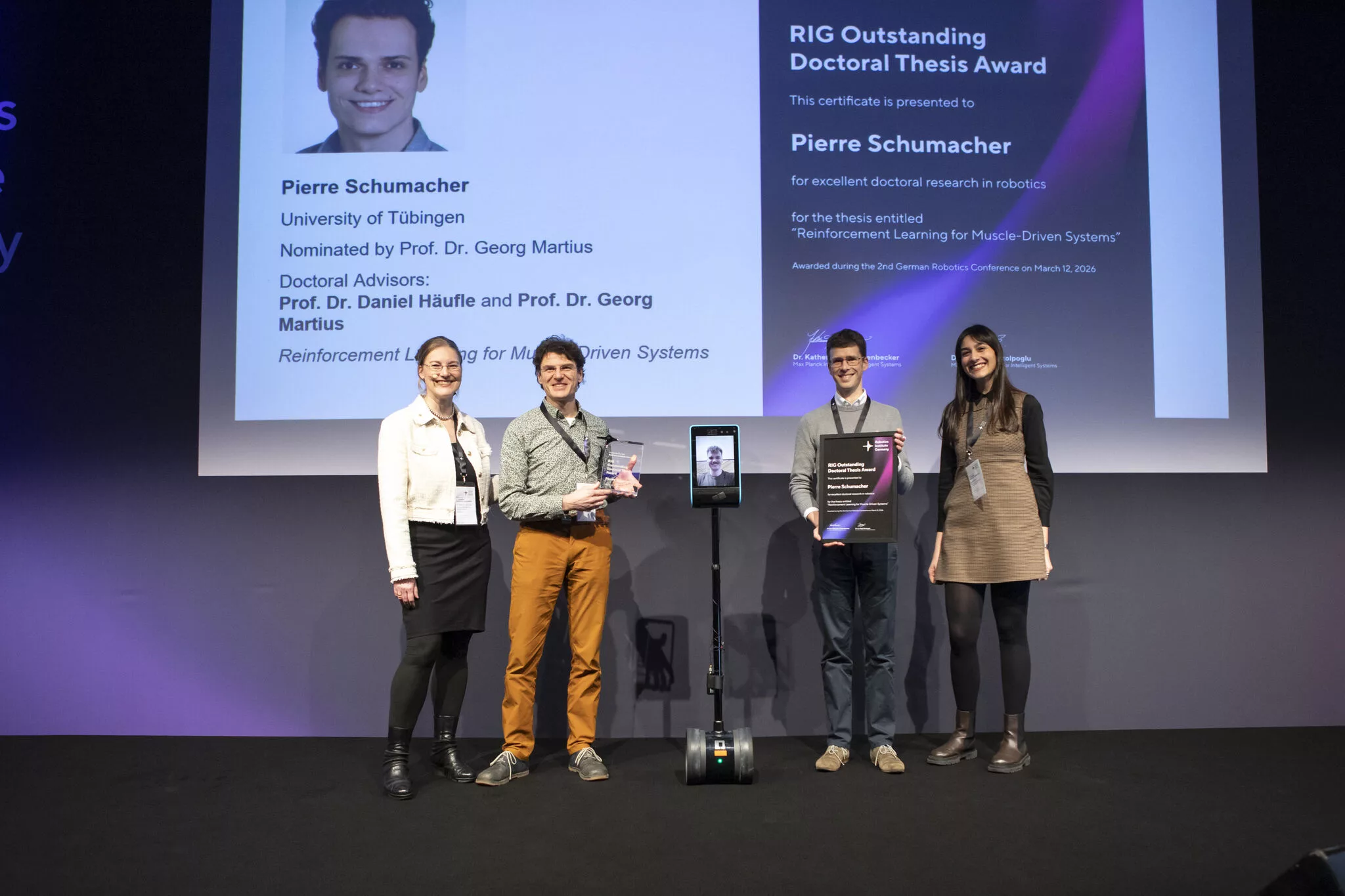
    Pierre Schumacher has been selected as one of the two recipients of the “RIG Outstanding Doctoral Thesis Award”, recognizing exceptional doctoral research in robotics in Germany. The award was officially announced during the “RIG Heroes Award Night 2026” at the German Robotics Conference 2026, organized by the Robotics Institute Germany (RIG), in Cologne on March 12.

    Schumacher’s dissertation, “Reinforcement Learning for Muscle-Driven Systems,” was selected from 27 nominations submitted by 16 institutions across Germany. Following an extensive evaluation process, an international selection committee chose two equal awardees, citing Schumacher’s work for its “scientific depth, originality, and impact”.

    Pierre Schumacher conducted his doctoral research at the Max Planck Institute for Intelligent Systems in Tübingen under the supervision of Prof. Georg Martius (University of Tübingen) and Prof. Daniel Häufle (Hertie Institute for Clinical Brain Research) funded by the Cyber Valley Research grant “Learning effcient control of non-linear muscle-driven systems: Morphological computation as guiding principle”. His project was part of the Cluster of Excellence “Machine Learning: New Perspectives for Science” and the Center for Bionic Intelligence Tübingen Stuttgart (BITS). His dissertation, “Reinforcement Learning for Muscle-Driven Systems,” addresses challenges in controlling complex, highly overactuated robotic and biomechanical systems by developing new machine learning methods.

    A central contribution of the work is the development of DEP-RL, a reinforcement learning approach that improves exploration and learning in systems with many redundant actuators, such as musculoskeletal models. Using this method, Schumacher demonstrated efficient learning for tasks involving complex simulated bodies, including a human model with dozens of muscles and animal-inspired locomotion systems.

    Pierre’s research also explored how muscle-like actuation can improve learning performance and robustness in robotic systems. In collaborative studies, Schumacher and colleagues showed that musculoskeletal models can lead to more data-efficient and stable learning in anthropomorphic control tasks. More recent work demonstrated that reinforcement learning can produce natural and robust bipedal walking in musculoskeletal simulations without relying on motion-capture demonstrations.

    Schumacher began his academic path with a trinational bachelor’s degree in physics that took him to universities in France, Luxembourg, and Germany. After completing his B.Sc. in physics in Saarbrücken 2017, he shifted toward computational approaches and pursued a master’s degree at Goethe University Frankfurt in Frankfurt am Main. In 2021, he joined the Max Planck Institute for Intelligent Systems and the Hertie Institute for Clinical Brain Research in Tübingen with Prof. Georg Martius and Prof. Daniel Häufle for his PhD in Computer Science, which he completed in 2025.Schumacher’s expertise has also attracted industry attention: he joined MyoLab, a startup based in New York focusing on musculoskeletal control technologies, last year.

    The RIG Outstanding Doctoral Thesis Award highlights emerging researchers whose doctoral work significantly advances robotics research in Germany. Schumacher’s selection underscores the growing importance of combining machine learning, biomechanics, and embodied intelligence to enable the next generation of adaptive robotic systems.

  • Biomedical Microsystems

    The Biomedical Microsystems group developed innovative devices and microsystems for biomedical applications, integrating actuation, recording, and computation to advance medical procedures. The group focused on tools that collect large amounts of data and learn from it to uncover underlying biological principles. A particular emphasis was placed on creating realistic surgical robot testing and simulation environments using rapid prototyping and augmented reality. Their work was supported by funding from the Vector Foundation.

    The group was active until April 2023. Tian Qiu is now Division Head at the German Cancer Research Centre (DKFZ) in Dresden.

  • 2018: Building a network of excellent scientists—interview with Caterina De Bacco

    2018: Building a network of excellent scientists—interview with Caterina De Bacco


    In 2016, important actors from science, industry, and politics founded the Cyber Valley Consortium, which became the first Innovation Campus in Baden-Württemberg. Ten years on in 2026, we’re revisiting the most important milestones from the last decade. Each month, we’ll focus on a particular year since Cyber Valley’s beginning. 

    This month, we’re looking back to 2018, when the first Cyber Valley Research Groups were established. One of these research groups was led by Caterina De Bacco: between 2018 and 2024, she led the Physics for Inference and Optimization group at the Max Planck Institute for Intelligent Systems before becoming an Associate Professor at Delft University of Technology.

    In the following interview, she explains how Cyber Valley’s network of scientists and innovators provided a thriving environment for her research, and how her research could be used for managing traffic in transportation networks.

    What were your research group’s main aims and outcomes?

    In my group, we were combining expertise from physics, mathematics, and statistics to effectively model complex systems; systems made of many individual elements that interact in complex ways, often referred to as networks. Our research approach aimed at developing mathematically rigorous models to learn patterns from network data or to optimize the design of these systems. We studied applications like clustering, anomaly detection, or optimal transport on networks, spanning various domains, in particular, the social sciences and engineering.

    How did your research address real-world challenges, and what kind of applications or long-term benefits could it have?

    Learning patterns from network data has applications in a variety of domains, as network data is ubiquitous. One of the challenges is to perform these inferences efficiently. Hence, special focus is given to the development of interpretable and principled models that are also computationally efficient, so that practitioners such as social scientists and engineers can use them without needing large resources, making these tools accessible to a wider audience. All the models we developed have a corresponding open-source implementation of the codes available online. With our models, practitioners can detect hidden clusters of similar nodes from network data or estimate the likelihood that certain observations are anomalous.

    In addition, our research on optimal transport has natural applications in managing traffic in transportation or communication networks. With our models, we can design optimal networks that can be used by network managers to assess the efficiency of existing transportation infrastructures.

    Cyber Valley is a network of leading research institutions, industry partners, and start-ups working in AI and robotics. How did being part of this network shape your research, skills, or career path?

    The exposure to this diverse network of experts was beneficial for the creative process of stimulating ideas, ideation. You have the feeling that there is always something cutting-edge going on around you, and you are among the first ones to know. There are not that many ecosystems connecting research and technology at this high level, so being immersed in it gives you valuable stimuli and ideas.


    The Cyber Valley Research Fund was also an important support for advancing our research (I obtained two grants from it). With little administrative burden and a smooth application and reporting process, I could focus mainly on the research itself, in contrast to other mainstream funding opportunities, where you end up spending much more time on non-research-related activities. As a result, our research thrived during these years, with an even higher level of productivity than we originally planned.

    How did your experience as a Cyber Valley Research Group Leader prepare you for your next career step?

    The opportunity to combine freedom and resources was unique and extremely valuable. This allowed me to grow in several aspects that are important for an academic career beyond pure research, for example, managerial responsibilities. Being able to independently manage a budget and to make key decisions (such as recruiting, deciding how to contribute to teaching) gives you a sense of responsibility and agency that makes you grow significantly faster compared to other young academics who are not as independent. As scientists, we are required to take on different roles (managers, mentors, supervisors, teachers, accountants, fundraisers) that we must learn on the job, as we are usually only trained in the science itself. To be able to effectively learn all these skills, I needed to be given the opportunity. The independence and support I got from Cyber Valley were key in this respect.

    As a result, I could start my next career step (as an Associate Professor at Delft University of Technology) with a significant advantage in terms of experience, compared to my peers. Needless to say, being a Cyber Valley Group Leader played a big role in increasing my chances of finding the right job for my next career step.

    To celebrate Cyber Valley’s ten-year anniversary, we’ll be sharing a variety of content across our website and social media channels reflecting on milestones from the last decade. Stay tuned for the next installments!

  • Intelligent Control Systems

    The Intelligent Control Systems group, led by Sebastian Trimpe, focused on decision-making, control, and learning for autonomous intelligent systems. It developed fundamental methods and algorithms that enable robots and other systems to interact with their environment through feedback, learn autonomously from data, and connect with each other in collaborative networks. A key aspect of the group’s work is translating mathematical and theoretical insights into improved autonomy and performance in real-world physical systems.

    The group was active until April 2021. Sebastian Trimpe is now Professor at RWTH Aachen University.

  • ACTrain: A Personalized Companion for Enhancing Executive Functions Based on Adaptive Meta-Cognitive Feedback

    Overview

    Staying focused in environments filled with digital distractions is a challenge for students and professionals. Led by Falk Lieder and Maria Wirzberger, this project developed ACTrain, a desktop application designed to support attention control during real computer-based work and study tasks.

    Users set a goal and a focus period, such as writing or studying. The system then identifies whether their current activity is consistent with that goal and provides feedback when they become distracted or regain focus. Its feedback system is based on computational models of self-regulation and is designed to make goal-directed behaviour more rewarding in the short term.

    Key results

    • Developed a desktop-based attention-training programme that can be used during everyday work and study rather than only in artificial exercises.
    • Implemented model-based “optimal” feedback that rewards staying focused and returning to a chosen task after a distraction.
    • Introduced a points system that links immediate feedback to progress toward a user-defined goal.
    • Evaluated the system in a 12-day randomized field experiment. Participants who received the feedback displayed more focused behaviour than the control group and reported higher task motivation, productivity, and ability to resist distractions.
    • The intervention improved six of eight task-specific measures, but it did not significantly improve general executive functions or participants’ overall progress toward longer-term goals.
    • Related work applied the same reward-shaping principle to self-directed learning. In a controlled online study with a simplified learning task, appropriately designed rewards improved learners’ choices and learning outcomes; the approach was proposed for integration into the educational game Dawn of Civilization.

    Why it matters

    The project demonstrates how digital tools can support attention regulation within ordinary work and learning activities. Instead of blocking distractions, ACTrain encourages users to notice when they have left their chosen task and helps them return to it. The approach could be useful in education, professional work, and digital learning environments.

    Publications and outputs

    • Wirzberger, M., Lado, A., Eckerstorfer, L., Oreshnikov, I., Passy, J. C., Stock, A., Shenhav, A., & Lieder, F. (2024). Optimal feedback improves behavioral focus during self-regulated computer-based work. Scientific Reports, 14, 3134. doi:10.1038/s41598-024-53388-3
    • Kukamjad, T., Pauly, R., Heindrich, L., Amo, V., & Lieder, F. (2024, May). Evaluation of Brain Point Intervention in The Dawn of Civilization. UCLA Psychology Undergraduate Research Conference.  https://doi.org/10.13140/RG.2.2.11284.48008
    • Pauly, R., Heindrich, L., Amo, V., & Lieder, F. (2022, June). What to learn next? Aligning gamification rewards to long-term goals using reinforcement learning. The 5th Multidisciplinary Conference on Reinforcement Learning and Decision Making (RLDM2022). https://doi.org/10.13140/RG.2.2.32661.19684
    • Wirzberger, M., Oreshnikov, I., Passy, J., Lado, A., Shenhav, A., Lieder, F. (2020). ACTrain: Ein KI-basiertes Aufmerksamkeitstraining für die Wissensarbeit. 66th Spring Conference of the German Ergonomics Society. https://doi.org/10.13140/RG.2.2.14709.50406 

  • From perception to constrained decisions

    From perception to constrained decisions


    Georg Martius’ project, “Embedding combinatorial reasoning into learning control policies” addressed a practical gap in AI’s basic machinery: connecting data-driven neural networks with decision-making so they can adhere to clear structures, rules, and constraints. The project developed foundations for integrating combinatorial optimization into learning systems. It has potential applications wherever planning and resource allocation are central, such as in robotics and logistics. The project was funded by the Cyber Valley Research Fund and was carried out between 2021 and 2024. 

    Martius’ project addressed a key limitation of today’s machine-learning systems. While neural networks can learn powerful representations from data (for example, from images or sensor signals), many real-world decisions must also follow strict rules, such as budgets, capacities, safety limits, or “must/ must not” constraints. These rule-based decisions are often handled by specialized optimization software, but such tools are traditionally difficult to integrate into learning-based systems.

    Martius’ research created methods that make it easier to combine neural networks with combinatorial optimization components. This enables systems to learn from data while also drawing on proven optimization techniques to make decisions that respect constraints. Rather than replacing classical solvers, the project developed ways to use them as trainable building blocks inside larger learning pipelines.

    The project also explored “neuro-algorithmic” approaches to decision-making and control, investigating how structured algorithms can improve generalization to new problems compared with purely data-driven approaches.

    Overall, the project provides a foundation for building AI systems that connect perception with constraint-aware decision modules. This is an important step toward robust solutions in areas such as robotics, planning, logistics, and resource allocation.

    This project produced the following peer-reviewed publications:  

    Anselm Paulus, Michal Rolínek, Vít Musil, Brandon Amos, and Georg Martius. “CombOptNet: Fit the Right NP-Hard Problem by Learning Integer Programming Constraints”. In: Proceedings of the 38th International Conference on Machine Learning. Vol. 139. Proceedings of Machine Learning Research. PMLR, July 2021, pp. 8443–8453. url: https://proceedings.mlr.press/v139/paulus21a.html. 

    Marin Vlastelica, Michal Rolinek, and Georg Martius. “Neuro-algorithmic Policies Enable Fast Combinatorial Generalization”. In: Proceedings of the 2021 International Conference on Machine Learning (ICML). July 2021. url: https://proceedings.mlr.press/v139/vlastelica21a.html. 

    Marco Bagatella, Mirek Olšák, Michal Rolínek, and Georg Martius. “Planning from Pixels in Environments with Combinatorially Hard Search Spaces”. In: Advances in Information Processing Systems (NeurIPS 2021). 2021. url: https://openreview.net/forum?id=XgGUUaKgips. 

    Subham Sahoo, Anselm Paulus, Marin Vlastelica, Vít Musil, Volodymyr Kuleshov, and Georg Martius. “Backpropagation through Combinatorial Algorithms: Identity with Projection Works”. In: Proceedings of the Eleventh International Conference on Learning Representations. May 2023. url:  https://openreview.net/forum?id=JZMR727O29. 

    A. Paulus, G. Martius, and V. Musil. “LPGD: A General Framework for Backpropagation through Embedded Optimization Layers”. In: Proceedings of the 41st International Conference on Machine Learning (ICML). Vol. 235. Proceedings of Machine Learning Research. PMLR, July 2024, pp. 39989–40014. url: https://proceedings.mlr.press/v235/paulus24a.html. 

    Georg Martius is a Professor in the Department of Computer Science at the University of Tübingen.


    About the Cyber Valley Research Fund

    The Cyber Valley Research Fund was established to support Cyber Valley research groups undertake basic research in the fields of artificial intelligence and robotics. The fund totaled five million euros, including contributions from six of Cyber Valley’s founding corporate partners: Amazon, BMW, Bosch, IAV, Mercedes-Benz, Porsche, and ZF. It supported 20 research projects, the first of which began in 2020, and the final of which will conclude in 2026.

  • Cyber Valley Impulse on Mobility and Aerospace

    Cyber Valley Impulse on Mobility and Aerospace

    Join us for the first event of our new series “Cyber Valley Impulse”. It is dedicated to the role of AI in shaping the future of mobility and aerospace. This event brings together leading scientists, innovative start-ups, corporates, and investors who will share their research, success stories, and AI-driven breakthroughs.

    As part of the Cyber Valley Impulse event series, this edition focuses on the application of intelligent systems in mobility and aerospace. These sectors are rapidly evolving through advances in artificial intelligence, robotics, and data-driven technologies, creating new opportunities and challenges across reseach and industry.  

    A highlight of the event is our research marketplace, an open space to explore emerging AI projects, exchange insights, and connect with entrepreneurs and potential collaborators from academia and industry.

    Program

    15:00: Registration and Check-in

    15:30: Cyber Valley Impulse Welcome

    15:40: Get-Together Circles

    16:30: Science Impulses

    • “Vision-based perception and autonomous control of aerial robots” by Aamir Ahmad, Institute of Flight Mechanics and Controls, University of Stuttgart
    • “ICM – Research and funding opportunities in manufacturing systems & mobility technologies” by Thilo Zimmermann, InnovationCampus Future Mobility (ICM)
    • “Usage of AI in aerospace systems” by Zamira Daw Perez, Institute of Aircraft Systems, University of Stuttgart
    • “Automated driving” by Ulrike Weinrich, Electronics & Mobility, FKFS Research Institute for Automotive Engineering and Powertrain Systems Stuttgart

    17:15: Break

    17:30: Start-up Impulses

    • Anand Waghmare, Yugen Space
    • Frederik Boenke, NUVUS

    17:50: Q&A

    18:15: Science Marketplace and Networking

  • Cyber Valley and UTokyo IPC Announce Yugen Space as Winner of ‘Valley and Sunrise’ – Market Exploration Program

    Cyber Valley and UTokyo IPC Announce Yugen Space as Winner of ‘Valley and Sunrise’ – Market Exploration Program

    STUTTGART/TÜBINGEN, TOKYO, March 3, 2026 – Cyber Valley GmbH und UTokyo Innovation Platform Co., Ltd. have announced Yugen Space as the winner of the ‘Valley and Sunrise’ Program’s first edition.

    The ‘Valley and Sunrise’ Program empowers start-ups working in AI and robotics to find entry into the Japanese market. Driven by its goal of fostering international growth, the program offers participants hands-on mentorship, strategic insights, and access to UTokyo IPC’s network of industry leaders and partners.

    ‘We designed Valley and Sunrise to help talented founders accelerate their impact,’ said Angelina Jukic, Program Manager of Valley and Sunrise at Cyber Valley GmbH. ‘The quality of applications was exceptional, and our judges were impressed with how Yugen Space combined a bold vision with real-world traction.’

    Yugen Space was selected from a highly competitive pool of applicants for its innovative approach as well as its strong market potential. The start-up was founded by Anand Waghmare (CEO) and Parikshit Joshi (CTO) in June 2025 and has its headquarters in Tübingen. Yugen Space’s mission is to build the intelligence engine for satellite-driven decisions.

    Yugen Space combines raw satellite imagery and real-world decisions. It integrates multi-source satellite data, applies scientific and machine learning models, and converts planetary signals into decision-ready intelligence. Users select a location, ask a question, and receive decision-ready insights within minutes. 

    Over the course of the program, Yugen Space will work closely with mentors and industry experts to refine its market strategy and develop a roadmap for scaling its products and services.

    Anand Waghmare, CEO of Yugen Space:

    ‘Being selected for the Valley and Sunrise program is a pivotal milestone for Yugen Space. It allows us to bridge two of the world’s most advanced AI and deep-tech ecosystems: Cyber Valley here in Germany and UTokyo IPC in Japan. For us, this is a vital opportunity to scale our mission of democratizing planetary intelligence internationally. We look forward to working with Japanese industry leaders to prove how our products can solve complex environmental and industrial challenges on a global scale.’ 

    Hideki Nagasaka, Partner and Director, 1stRound, UTokyo IPC:

    ‘This selection marks a meaningful milestone in the collaboration framework we have steadily built between Japan and Germany over the years. We are confident that this milestone will serve as a critical step for Yugen Space as it accelerates its business development with a clear view toward expansion into the Japanese market. Through this initiative, we hope not only to contribute to the continued growth of the German innovation community, including Cyber Valley, but also to further deepen the ties between the German and Japanese ecosystems. We remain committed to strengthening the Japan-Germany network and advancing sustainable, long-term collaboration.‘

    For more information about Valley and Sunrise and future opportunities, visit: https://cyber-valley.de/en/websites/cyber-valley/pages/valley-and-sunrise-program/

    About UTokyo IPC

    UTokyo Innovation Platform Co., Ltd. (UTokyo IPC) is a venture capital firm wholly owned by the University of Tokyo, established in 2016 to strengthen Japan’s global industrial competitiveness through startup investment and ecosystem building. As a public–private venture capital firm, UTokyo IPC has invested in more than 80 university-affiliated startups and venture funds both in Japan and overseas. Beyond investment, UTokyo IPC operates the Startup Building Program, which supports the commercialization of research outcomes; 1stRound, Japan’s largest academia-linked accelerator; and DeepTech Dive, a program dedicated to cultivating deep-tech talent. In 2024, UTokyo IPC launched the ASA Fund under the Tokyo Metropolitan Government’s initiative to promote global collaboration and establish Japan as a hub for deep-tech innovation.

    About Cyber Valley

    Cyber Valley is Europe’s largest and leading center for excellence in artificial intelligence and modern robotics. Its mission and public mandate are to advocate for research, development, application, and acceptance of technologies and methods in intelligent systems. Cyber Valley encourages entrepreneurship by uniting scientific excellence with innovation and technology transfer. In addition, Cyber Valley facilitates critical reflection on the ethical and social implications of AI through public engagement. Cyber Valley envisions a future in which the full potential of intelligent systems is leveraged for the greater good of the world.

    Media Contact

    Silke Dutz, Cyber Valley GmbH: silke.dutz@cyber-valley.de

    Akiko Tsuchiya, UTokyo IPC: info2@utokyo-ipc.co.jp

  • 2017: Training outstanding doctoral students at IMPRS-IS – Interview with Leila Masri

    2017: Training outstanding doctoral students at IMPRS-IS – Interview with Leila Masri


    In 2016, important actors from science, industry, and politics founded the Cyber Valley Consortium, which became the first Innovation Campus in Baden-Württemberg. Ten years on in 2026, we’re revisiting the most important milestones from the last decade. Each month, we’ll focus on a particular year since Cyber Valley’s beginning. 

    This month, we’re looking back to 2017 when Cyber Valley’s graduate school, the International Max Planck Research School for Intelligent Systems (IMPRS-IS), was founded. IMPRS-IS trains outstanding doctoral students from around the world and supports them in their PhD research so they can use their AI expertise to build a better future in Europe.

    Leila Masri has been the scientific coordinator at IMPRS-IS since 2017. She has supported its growth into one of Germany’s largest doctoral programs, now comprising more than 300 doctoral researchers and nearly 100 faculty members. Committed to fostering diversity in science, she also contributes to initiatives broadening access to research, including the CaCTüS and RIGI internship programs in Tübingen and Stuttgart. In the following interview, she reflects on IMPRS-IS’s founding and what makes the graduate school unique.

    When you helped launch IMPRS-IS in 2017, what vision did you have for the program, both for the students and for the broader research community?

    As a scientist myself, I completed my PhD in Tübingen and Kiel and later worked as a postdoctoral researcher in Austria. Throughout my academic career, I have been deeply committed to supporting students and teaching, an interest I further developed by earning a university teaching diploma from the University of Stuttgart. When Michael J. Black and Katherine J. Kuchenbecker at the Max Planck Institute for Intelligent Systems (MPI-IS) launched IMPRS-IS in 2017 and were looking for a coordinator, it felt like a natural fit. My vision was to help build a welcoming international community where doctoral researchers and faculty could connect, exchange ideas, and thrive together, while providing an environment in which excellent research can flourish. It has been incredibly rewarding to see this vision come to life.

    Looking back over the past years, which moments or milestones felt particularly defining for IMPRS-IS, and why do they stand out to you personally?

    Looking back, one of the defining milestones was how quickly IMPRS-IS grew. Our original goal was to build a doctoral program with around 100 PhD students over six years, so reaching that number in less than two years was incredibly encouraging. Over those six years, we ended up recruiting more than 400 doctoral researchers, making IMPRS-IS one of the largest yet youngest doctoral programs in Germany.

    Furthermore, we had long wanted to organize industry visits so our students could see how research works outside academia and exchange ideas with researchers working in industry. Interestingly, this happened quite naturally through our alumni, who started hosting us at companies like Bosch, with a visit to Amazon coming up soon; both also partners in Cyber Valley. That organic development has been particularly rewarding to see.

    From your perspective, what is unique about IMPRS-IS? What distinguishes it from other doctoral training programs? 

    What makes the program special is how it brings together the Max Planck Institute for Intelligent Systems with the Universities of Stuttgart and Tübingen. This gives doctoral researchers access to both cutting-edge research infrastructure and strong academic networks. The focus on intelligent systems naturally connects AI, robotics, engineering, and related fields, and the close ties to the Cyber Valley ecosystem help link fundamental research with industry and innovation.

    At the same time, the structured doctoral program – with thesis advisory committees, Think & Link gatherings, annual boot camps, and professional development opportunities – provides valuable support to its doctoral students as well as to its senior scientists. Furthermore, beyond all the institutional and program strengths, what truly sets IMPRS-IS apart for me is its people and culture. It genuinely feels like a home: a place defined by trust, support, warmth, and collaboration. 

    That strong sense of community, alongside research excellence, is what makes IMPRS-IS truly unique.

    IMPRS-IS students come from a broad range of backgrounds, but do you think that they share any particular mindsets or qualities?

    Yes – although IMPRS-IS students come from very different academic, cultural, and personal backgrounds, I do think they share common mindsets and qualities. The program is highly international, with doctoral researchers from over 35 countries, more than 60% non-German speakers, and about 28% female researchers, alongside a wide range of academic backgrounds and expertise. That diversity enriches the research they conduct, as people approach problems in different ways and contribute their own personal touch to the research they pursue.
    There’s a noticeable culture of empathy, openness, and mutual support – people are approachable, willing to exchange ideas, and genuinely invested in each other’s academic and personal success.

    What aspects of the program are you personally most proud of today?

    Honestly, I don’t think I can point to one single aspect in isolation – what I’m most proud of is really the people who make IMPRS-IS what it is. The program’s success stems from the collective effort and commitment of many individuals: the strong guidance from our spokesperson Katherine J. Kuchenbecker, the steady support of the executive board and coordination office, and the genuine engagement of faculty members and scholars who are consistently willing to support doctoral researchers. That level of dedication creates an environment where doctoral candidates feel encouraged, guided, and valued. We can now measure this success: IMPRS-IS has attracted top-tier scientists from around the world, involves nearly 100 faculty members, hosts over 300 doctoral candidates, and has graduated more than 150 PhD students since 2017.

    Combined with the program’s diversity, interdisciplinarity, and culture of openness and mutual support, IMPRS-IS is not just a strong academic program – it is a place where people can thrive both scientifically and personally.

    To celebrate Cyber Valley’s ten-year anniversary, we’ll be sharing a variety of content across our website and social media channels reflecting on milestones from the last decade. Stay tuned for the next installments!