News Category: Press Release

  • Wie verändert KI den Journalismus?

    Wie verändert KI den Journalismus?

    Beginning in October 2023, the winners of this year's Journalist-in-Residence program will research ways to make sense of artificial intelligence in journalism.

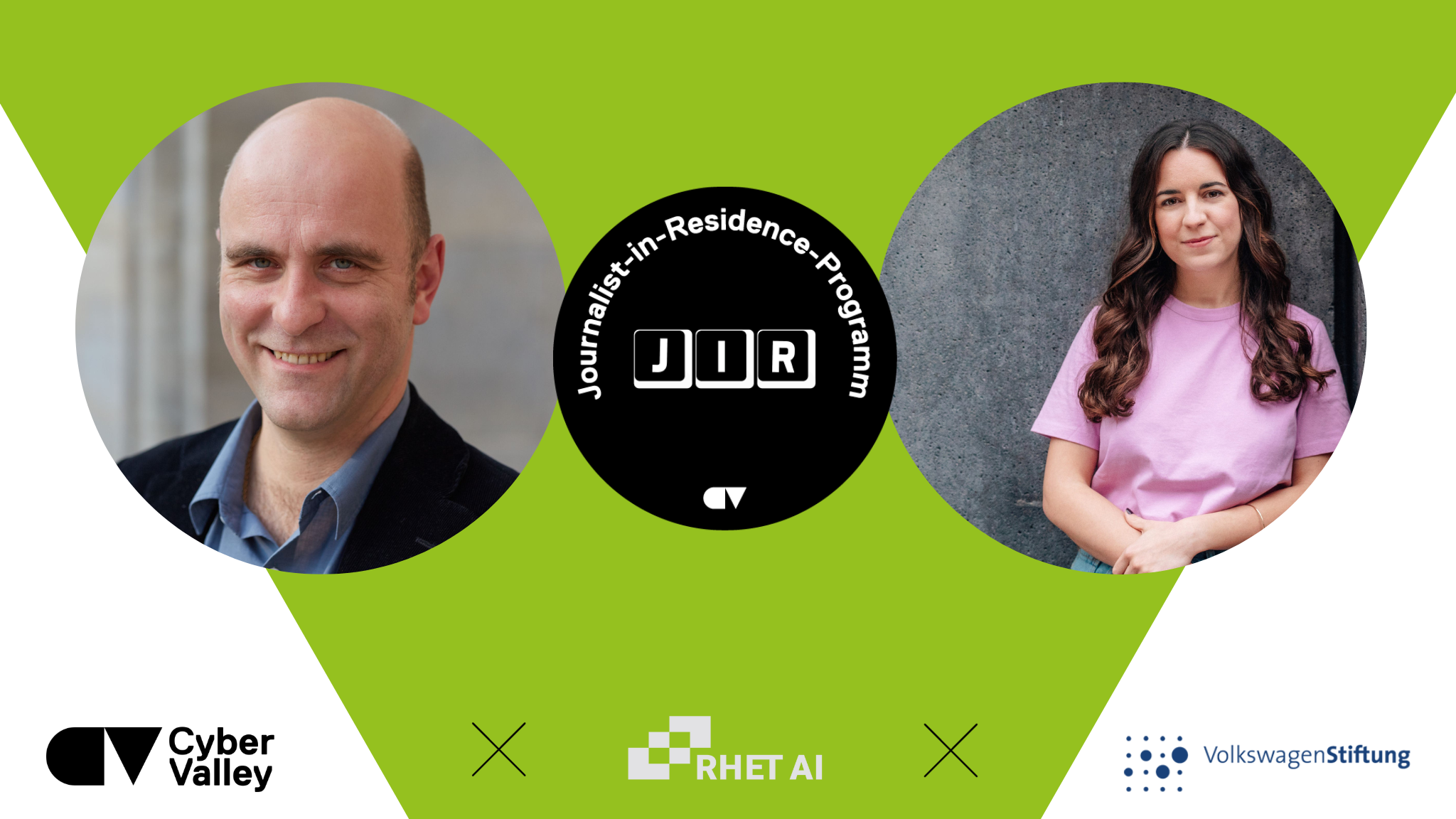
    During their three-month residency in Tübingen, the two journalists, Elena Riedlinger (data journalist) and Tobias Asmuth (freelance journalist), will examine the influence and impact artificial intelligence has on today’s society. Both applied for the 2023 Journalist-in-Residence program and won. 

    Thanks to the collaboration between the Center for Rhetorical Artificial Intelligence Science Communication (RHET AI) and Cyber Valley, journalists can conduct research on their own topics related to artificial intelligence reporting. The Volkswagen Foundation supports the Journalist-in-Residence program. 

    The program gives journalists the opportunity to dig deep into the research of intelligent systems, including machine learning, computer vision, and other AI applications, that is being undertaken at Cyber Valley. During their residency, both journalists will conduct independent research on AI development and its potential, with direct access to researchers and entrepreneurs from the Cyber Valley community.  

    Elena Riedlinger wants to use AI against disinformation

    As a data journalist, Elena Riedlinger is concerned with the spread of disinformation on the internet and identifying ways to detect it.

    "The central task of journalistic research is fact-checking. But how do journalists manage to fulfill this task despite the flood of AI-generated content? And can AI tools possibly help them? That's what I want to find out at Cyber Valley,” says Elena Riedlinger. 

    In particular, the rapid advancement of AI tools that generate text, images, and video presents journalists with new challenges in assessing the authenticity of content: it has become more difficult to verify alleged evidence and to make factual claims. AI can help solve this problem. During her residency at Cyber Valley, Riedlinger will talk with experts about the methods and AI-powered tools that verify content and ensure reliable information for editorial work.

    After completing her master's degree at the University of Leipzig, Elena first joined WDR for a traineeship, where she now works as a data journalist and in digital product development at the interface between journalism and IT. Together with Stefan Domke, she recently oversaw the Grimme Online Award-winning app and web project "Stolpersteine NRW – gegen das Vergessen". 

    Tobias Asmuth explores the benefits of AI for the climate

    As a freelance journalist working mostly for the DACH region, Tobias Asmuth has in recent years dedicated his work to the research of environmental issues. During the Journalist-in-Residency program, he will investigate how intelligent systems can reduce or even prevent climate change. Furthermore, Asmuth wants to explore how journalists can communicate and explain difficult topics, instead of falling into sensationalist reporting that overemphasizes risks and scandals.  

    Tobias Asmuth further explains, "Most people have a fairly clear idea of climate change. Their picture of AI, on the other hand, is rather diffuse. How could this be drawn more clearly? In what words would we have to describe it?” 

    His goal is to create guidelines for well-grounded reporting on artificial intelligence that inspires public interest. Tobias hopes to answer the following questions: What information about an AI application should a journalist pay attention to? What indications of relevance are there? What needs to be explained for the audience to understand? 

    Tobias Asmuth resides in Berlin. He has previously worked as a reporter for the Süddeutsche Zeitung and completed his traineeship at the Frankfurter Allgemeine Zeitung. He has been awarded prizes and scholarships for his reporting on a planned lithium mine in Portugal and the overexploitation of the Amazon, among other things. 

    About Cyber Valley 

    Cyber Valley is Europe’s largest and leading research consortium in the field of artificial intelligence (AI) and modern robotics. Cyber Valley has a public mandate: As advocates for entrepreneurship, research, development, application, and acceptance of technologies and methods in the field of intelligent systems are at the forefront. The company envisions a future where the full potential of intelligent systems is leveraged for the greater good of the world.


    About Cyber Valley Journalist-in-Residence 

    In a three-to-six-month residency, one or two journalists explore how AI applications can be used for good journalism and how journalists can ensure that their reporting on the technologies behind the buzzword "artificial intelligence" is appropriate and evidence-based. The journalists are selected by an independent jury.  During this time, the journalist-in-residence can conduct research on a topic of his or her own choice in exchange with AI researchers from different disciplines – absolutely independently. Cyber Valley explicitly does not expect any reporting on AI topics or about Cyber Valley during this time. The program takes place twice a year in a cooperation between Cyber Valley and the Center for Rhetorical Science Communication Research on Artificial Intelligence (RHET AI Center). It is funded by the Volkswagen Foundation. 

  • Cyber Valley wird Mitglied im KI Bundesverband

    Cyber Valley wird Mitglied im KI Bundesverband

    Die Cyber Valley Community wächst weiter: Mit dem Bundesverband Künstliche Intelligenz bekommt Cyber Valley einen weiteren starken Partner, in dessen Netzwerk knapp 400 KI-Unternehmen zusammenarbeiten.

    Im September 2023 unterzeichneten Cyber Valley und der KI Bundesverband einen Letter of Intent, wodurch Cyber Valley ein assoziiertes Mitglied des KI-Bundesverbands wird. Mit dieser Absichtserklärung verpflichtet sich Cyber Valley sowie der KI Bundesverband einer gemeinsamen Kooperation mit dem Ziel, sich für den Aufbau, die Förderung und den Schutz des deutschen KI-Ökosystems einzusetzen.

    Künstliche Intelligenz (KI) ist eine entscheidende Zukunftstechnologie. Die Mitglieder des Bundesverbandes setzen sich dafür ein, dass sie diese Technologie im Sinne europäischer und demokratischer Werte anwenden und Europa digitale Souveränität erreicht. Dafür muss die Bundesrepublik Deutschland und die EU ein attraktiver KI-Standort für Unternehmer:innen sein, in dem exzellente KI-Forschung auf Innovationswille und Entrepreneurship trifft.

    Über den KI Bundesverband

    Der Bundesverband der Unternehmen der Künstlichen Intelligenz e.V. vernetzt die innovativsten KI- und Deep-Tech-Unternehmen mit der etablierten Wirtschaft und Politik und ist mit knapp 400 KI-Unternehmen das größte KI-Netzwerk Deutschlands. Die Mitglieder des Bundesverbandes Künstliche Intelligenz setzen sich dafür ein, dass diese Technologie im Sinne europäischer und demokratischer Werte eingesetzt wird und Europa digitale Souveränität erlangt.

    Zur Webseite

    Über Cyber Valley

    Cyber Valley ist Europas größtes und führendes Zentrum für Exzellenz in künstlicher Intelligenz (KI) und moderner Robotik. Cyber Valley hat einen öffentlichen Auftrag: Als Botschafter für Unternehmergeist stärken wir die Forschung, Entwicklung, Anwendung und Akzeptanz von Methoden und Technologien intelligenter Systeme und moderner Robotik. Wir streben eine Zukunft an, in der das volle Potenzial intelligenter Systeme zum Gemeinwohl eingesetzt wird.


    Ansprechpartner für Presserückfragen zum Cyber Valley Ökosystem

  • Institut für Künstliche Intelligenz gegründet

    Institut für Künstliche Intelligenz gegründet

    "AI is changing the world. But this change must also be reflected in new structures for research and teaching“
    Petra Olschowski, Minister of Science of Baden-Württemberg.

    “With the Institute for Artificial Intelligence, the University of Stuttgart is sending a clear signal for AI as an independent research area and is combining a broad range of scientific activities. The result is greater visibility for the topic of AI. Two state-funded “Cyber Valley” professorships will become part of the new institute, thereby building a bridge to our Innovation Campus. This will further strengthen the Cyber Valley Innovation Campus and the Stuttgart/Tübingen AI region," says Petra Olschowski, Minister of Science of Baden-Württemberg.

    Pooled expertise for interdisciplinary AI research

    With the founding of the institute, the University of Stuttgart is taking a further step towards realizing its vision of "Intelligent Systems for a Sustainable Society": "We are pooling our expertise in AI in order to explore AI applications across disciplines for the benefit of people. One area of specialization will be intelligent robotics, which will be used to achieve advances in medicine and production technologies, among other things," says Prof. Wolfram Ressel, Rector of the University of Stuttgart.

    AI institute with five working groups – more are planned

    Prof. Steffen Staab, the first executive director of the new institute, emphasizes: "The Institute for Artificial Intelligence aims to achieve three things: First, to conduct internationally outstanding research; second, to be a qualified research partner for other scientific disciplines that use AI to advance their research; and third, to promote the transfer of AI methods to industry and society." The AI Institute comprises the two "Cyber Valley" professorships "Analytic Computing" (Steffen Staab) and "Autonomous Systems" (Kai Arras), the professorship "Machine Learning in Simulation Sciences" (Mathias Niepert) located in the Cluster of Excellence "Data-Integrated Simulation Science" (SimTech), the junior professorship "Autonomous Sensing and Perception Systems" (Alina Roitberg), and the professorship for "Machine Learning and Robotics", which are currently being filled. There are also plans to expand the institute by adding professorships in the field of intelligent robotics.

    Networked via Cyber Valley, ELLIS, Clusters of Excellence, and more

    The close networking of the institute with numerous international and internal university initiatives related to AI is demonstrated by the participation of Cyber Valley and SimTech. The second Cluster of Excellence of the University of Stuttgart, "Integrative Computational Design and Construction for Architecture" (IntCDC), also relies on advances in artificial intelligence for its research tasks. As part of the international network "European Laboratory for Learning and Intelligent Systems", the ELLIS Unit Stuttgart is promoting the exchange of knowledge with top-class universities throughout Europe. The Artificial Intelligence Software Academy (AISA) links interdisciplinary research and education at the Stuttgart site, and the Interchange Forum for Reflecting on Intelligent Systems (IRIS) and critically examines the societal implications of intelligent systems.

    Expert Contact:

    Prof. Dr. Steffen Staab, University of Stuttgart, Institute for Artificial Intelligence, Phone: +49 (0)711 685-88100, E-Mail: steffen.staab@ipvs.uni-stuttgart.de

  • Europaweit erstes ELLIS Institut geht in Tübingen an den Start 

    Europaweit erstes ELLIS Institut geht in Tübingen an den Start 

    (The press release is only available in German.)

    • Wissenschaftsministerin Petra Olschowski: „Das ELLIS Institut in Tübingen wird ideale Rahmenbedingungen für weltweit führende KI-Wissenschaftlerinnen und Wissenschaftler bieten.“
    • Dr. h.c. Hector: „Es liegt an uns, die transformative Kraft der Künstlichen Intelligenz zu nutzen und sie zum Wohl der Menschen einzusetzen.“
    • Prof. Dr. Schölkopf: „Wir wollen KI-Spitzenforschung ermöglichen, eingebettet in die Kultur Europas und verankert in europäischen Werten.“ 

    „Das ELLIS Institut wird als einzigartige Forschungseinrichtung dank der außerordentlich großzügigen Spende der Hector Stiftung ideale Rahmenbedingun-gen für KI-Spitzenforscherinnen und Spitzenforscher aus der ganzen Welt schaffen. Es wird damit auch konkurrenzfähig sein zu den Forschungs- und Entwicklungsabteilungen der großen Unternehmen im Bereich KI“, erklärte Wissenschaftsministerin Petra Olschowski am Freitag, 30. Juni 2023, in Stuttgart. „Das Land geht hier mit neuen innovativen Strukturen im Forschungsbereich bundes- und europaweit voran – wie bereits mit dem Aufbau des Cyber Valley als erfolgreiches Innovationsökosystem für KI. Das ELLIS Institut ist im europäischen ELLIS-Netzwerk das erste seiner Art. Es wird stilbildend sein.“

    Mit der Gründung des ersten ELLIS Institut am Standort Tübingen wird die internationale Sichtbarkeit und Strahlkraft sowie die Forschungsexzellenz des Innovationscampus Cyber Valley noch weiter gestärkt. Die Hector Stiftung fördert die Gründung mit 100 Millionen Euro.

    Dr. h.c. Hans-Werner Hector sagte: „Die Künstliche Intelligenz hat das Potential, unsere Gesellschaft und Wirtschaft grundlegend zu verändern. Es liegt an uns, diese transformative Kraft zu nutzen und sie zum Wohl der Menschen einzusetzen. Mit der Gründung des ELLIS Instituts wollen wir eine internationale Plattform schaffen, auf der Spitzenforscherinnen und Spitzenforscher gemeinsam an den Herausforderungen und Chancen der KI arbeiten. Denn nur durch For-schungsexzellenz können wir innovative Lösungen entwickeln und eine nach-haltige Zukunft gestalten.“

    „Die Gründung des ersten ELLIS-Instituts ist ein Meilenstein, erreicht durch eine vertrauensvolle Zusammenarbeit und ein gemeinsames Ziel: Wir wollen KI-Spitzenforschung ermöglichen, eingebettet in die Kultur Europas und verankert in europäischen Werten. Ich danke dem Land Baden-Württemberg, der Max-Planck-Gesellschaft, der Universität Tübingen und vor allem dem weitsichtigen und großzügigen Spender Hans-Werner Hector“, sagte Prof. Dr. Bernhard Schölkopf.

    Weitere Informationen:

    ELLIS Institut
    ELLIS steht für „European Laboratory for Learning and Intelligent Systems”. Am Institut erhalten die talentiertesten KI-Wissenschaftlerinnen und -Wissenschaftler aus der ganzen Welt die Gelegenheit, neue Ansätze und Ideen unter hervorragenden Arbeitsbedingungen zu entwickeln. Mit dem ELLIS Institut wird in Baden-Württemberg ein international sichtbarer Leuchtturm für die Erforschung Künstlicher Intelligenz errichtet. Dies innerhalb eines starken europäischen Netzwerks von mittlerweile 39 ELLIS-Units in 14 Ländern, in denen herausragende KI-Forschende arbeiten – vier Units davon alleine in Baden-Württemberg.

    Cyber Valley und das ELLIS Institut
    Der Innovationscampus Cyber Valley ist ein zentrales Element der KI-Strategie des Landes. Mit ihm wird seit 2016 in einer gemeinsamen Initiative von Wissenschaft und Wirtschaft in Kooperation mit dem Land Baden-Württemberg und der Max-Planck-Gesellschaft ein international führender Forschungsstandort in den Bereichen des maschinellen Lernens, des maschinellen Sehens und der Robotik aufgebaut.

    Mit dem ELLIS Institut soll für die Erforschung der Künstlichen Intelligenz ein neuer europäischer Leuchtturm in Baden-Württemberg errichtet werden. Das ELLIS Institut soll mit Hilfe der Förderung der Hector Stiftung das Cyber Valley um ein Institut ergänzen, das international rekrutierten und hoch qualifizierten Forschenden für eine befristete Zeit (in der Regel sechs Jahre mit der Möglichkeit der Verlängerung) größtmögliche Freiräume und außergewöhnlich attraktive und flexible Rahmenbedingungen bietet. 

    Mit dem ELLIS Institut positioniert sich Cyber Valley im globalen Wettbewerb sowohl im Hinblick auf wissenschaftliche Exzellenz als auch im Hinblick auf inspirierende Arbeitsmöglichkeiten als „the place to be“ und unterstützt damit eine globale und wertebasierte technologische Wettbewerbsfähigkeit des Landes, des Bundes und der Europäischen Union.
     

  • Jetzt bewerben für den AI Incubator 2023

    Jetzt bewerben für den AI Incubator 2023

    Stuttgart, Germany – Cyber Valley, Europe's leading center for excellence in advanced AI and robotics, is launching the AI Incubator, an artificial intelligence (AI) start-up program. The AI Incubator is funded by the Carl-Zeiss-Stiftung and supported by the partners of the Cyber Valley ecosystem.

    Incubators are programs that help people interested in founding their own company. The AI Incubator offers students and scientists the opportunity to develop ideas for a start-up from their AI research, put the ideas into practice and start their own successful AI business. 


    Target group

    The program is aimed at students, PhDs, scientists, technologists and business talent from the Cyber Valley ecosystem as well as interested individuals who focus on research, development and application of artificial intelligence and robotics. Applicants need to be enrolled or be an alumni in Baden-Württemberg or at ETH Zurich. Having your own team or idea is not a prerequisite and can be developed together during the course of the program.


    Dates and contents

    The program will start on June 7, 2023. Experienced entrepreneurs and start-up coaches will supervise the participants over a period of six weeks. One full-day workshop will be held per week, for example on topics such as deep tech market research, financing, and AI regulation. The workshops, mentoring sessions and the pitch event on July 10, 2023 at the end of the AI Incubator, will give the participants access to the world-class facilities and resources of the Cyber Valley Partners. A shuttle will transport participants to each workshop location.


    Application and further information

    Interested applicants can apply for the AI Incubator 2023 with their CV and a letter of motivation until June 1, 2023 (extended deadline). Further information on the requirements, the application process and the content of the one-day workshops is available on the website www.cyber-valley.de/ai-incubator. 

    "The AI Incubator offers young, talented scientists an excellent opportunity to benefit from the broad expertise in Cyber Valley and take the next step in shaping the future," says Dr. Felix Streiter, Managing  Director of the Carl-Zeiss-Stiftung. "We are pleased to be part of this program and thus promote the transfer from cutting-edge research into practice."


    Rebecca Reisch, Cyber Valley GmbH CEO, emphasized the importance of the AI Incubator for the start-up community. “We are proud and grateful to launch the AI Incubator and to add value to our ecosystem thanks to the generous support of the Carl-Zeiss-Stiftung. The program offers researchers a real opportunity to start their own company and network with investors. We want to support them in playing a leading role in shaping the next generation of AI startups made in THE LÄND.”


    About Cyber Valley

    Cyber Valley is Europe's leading center for excellence in advanced AI and robotics. Cyber Valley creates a vibrant ecosystem that enables seamless collaboration and rapid exchange between academia, business and society.
    As an ambassador for entrepreneurship, Cyber Valley's mission is to strengthen the research, development, and application of intelligent systems, providing a platform for collaboration, resource sharing, and advancement of modern AI and robotics. With a focus on the ethical and societal aspects of AI, Cyber Valley fosters dialogue between society and AI researchers and strives for a future in which the full potential of intelligent systems is used for the benefit of society.


    About the Carl-Zeiss-Stiftung

    The Carl-Zeiss-Stiftung’s mission is to create an open environment for scientific breakthroughs. As a partner of excellence in science, it supports basic research as well as applied sciences in the STEM subject areas (science, technology, engineering and mathematics). Founded in 1889 by the physicist and mathematician Ernst Abbe, the Carl-Zeiss-Stiftung is one of the oldest and biggest private science funding institutions in Germany. It is the sole owner of Carl Zeiss AG and SCHOTT AG. Its projects are financed from the dividend distributions of the two foundation companies.


    Cyber Valley Press Contact

    Rebecca Beiter
    rebecca.beiter@cyber-valley.de
     +49 160 9448 1797


  • Cyber Valley Journalist-in-Residence 2023

    Cyber Valley Journalist-in-Residence 2023

    Wie berichten Journalist:innen über aktuelle Entwicklungen in der Forschung zu künstlicher Intelligenz (KI)? Wie können maschinelles Lernen, Computer Vision und andere KI-Anwendungen für den Journalismus genutzt werden? In unserem Journalist-in-Residence-Programm entwickeln Sie Ihre eigenen Antworten im Gespräch mit unseren Forschenden.

    Spätestens mit der Veröffentlichung des Chatbots ChatGPT des Unternehmens Open AI wurde exemplarisch deutlich, welchen Einfluss KI-Technologien auf Textproduktion, Journalismus und Medienwelt haben können. Gleichzeitig schreiten die Gespräche der Europäischen Union zur umfassenden Regulierung der Technologie voran. Wie berichten Journalisten angemessen über künstliche Intelligenz? Und was steckt eigentlich hinter diesem Buzzword? Wie können Redaktionen KI-basierte Tools für sich nutzen?


    Um interessierten Journalist:innen einen Freiraum für eine eigene Recherche und eine freie Projektentwicklung zu bieten, schreibt RHET AI mit Unterstützung der Cyber Valley GmbH ein Journalist-in-Residence Programm aus. Das Programm wird von der VolkswagenStiftung im Tübinger Zentrum für Rhetorische Wissenschaftskommunikationsforschung zur Künstlichen Intelligenz (RHET AI) gefördert. Interessierte freie oder festangestellte Journalist:innen können sich ab jetzt bis zum 15. April für einen drei- bis sechsmonatigen vergüteten Aufenthalt bewerben.

    In dieser Zeit kann der oder die Journalist-in-Residence zu einer selbst gewählten Fragestellung im Austausch mit KI-Forschenden unterschiedlicher Disziplinen recherchieren – komplett unabhängig. RHET AI und Cyber Valley erwartet in dieser Zeit ausdrücklich keine Berichterstattung über KI-Themen oder über die Institutionen.

    Was bieten wir?

    Während des Aufenthalts erhält der oder die Journalist-in-Residence in Hintergrundgesprächen Einführungen in die Grundlagen von maschinellem Lernen, Computer Vision und Robotik und kann sein eigenes Netzwerk zu international renommierten Forschenden im Cyber Valley Ökosystem aufbauen. Wir bieten neben einer exklusiven Betreuung außerdem:

    • Einbettung ins Forschungsteam des RHET AI
    • Einblicke in das Cyber Valley Ökosystem 
    • Freiraum für Kreativität und Reflexion über Methoden, Werkzeuge und KI-gestützten Journalismus 
    • honorierter Werkvertrag 
    • Budget für eigene Veranstaltungen (z. B. Workshops, Expert:innengespräche, Reisen) 
    • Kosten für Unterkunft werden übernommen 

    Wie bewirbt man sich?

    Interessierte können sich bis zum 15. April mit einem Anschreiben, einem Lebenslauf sowie einem Ideenpapier per E-Mail bei Patrick Klügel bewerben. Das zweiseitige Ideenpapier illustriert, welche journalistische Herausforderung während des Aufenthalts mit Blick auf das Thema KI oder mithilfe von KI gelöst werden soll. Auswahlkriterien sind zum einen die journalistische Qualität, Reichweite, zum anderen die Kreativität, Relevanz und Realisierbarkeit der selbstgewählten Recherche- oder Projektaufgabe. Eine unabhängige Jury empfiehlt bis Anfang Mai bis zu zwei Kandidat:innen aus den eingegangenen Bewerbungen für das Programm.

    Das JIR-Programm bietet entweder Platz für zwei Journalist:innen, die jeweils einen dreimonatigen Aufenthalt anstreben, oder ein:e Journalist:in mit einer Aufenthaltsdauer von sechs Monaten. Das erste Zeitfenster für den dreimonatigen Aufenthalt beginnt im Juli, das zweite im Oktober 2023. Weitere Informationen zur Ausschreibung und zum Ablauf des Cyber Valley Journalist-in-Residence-Programms finden Sie in diesem Flyer.

    Ansprechpartner für das JIR-Programm

    Patrick Klügel
    Public Engagement Manager

    Eberhard Karls Universität Tübingen
    Zentrale Verwaltung · Dez. II Abt. 1, Forschungs- und Exzellenzstrategie
    Rümelinstr. 32 · 72070 Tübingen

    Patrick.kluegel@uni-tuebingen.de
    +49 151/74238237

  • Mit Deep Learning zu besseren Gehirnmodellen

    Mit Deep Learning zu besseren Gehirnmodellen

    The brain of Drosophila, which is one of the best known model organisms in biology, is interesting to both neuroscientists and computer scientists for several reasons. “Fruit flies only have tiny brains in comparison to mammals,” explains Macke, “Nevertheless, these animals have astonishing capabilities, such as highly precise control of their flight. They can use landmarks to orient themselves and respond rapidly when predators approach.” Despite its massive capacity, the brain of Drosophila only uses nanowatts of energy, making it far more energy-efficient than any computer.

    In recent decades biological research has succeeded in analyzing the brain of the fruit fly at a high level of detail. “We now have access to the brain’s circuitry, but until now we haven’t been able to build any models that can solve tasks which are as challenging as those solved by real Drosophila brains.” Meanwhile, recent advances in Deep Learning have made it possible to create artificial neuronal networks that can carry out extremely complicated calculations. However, these artificial networks have become very different in architecture and functioning to biological ones.

    “We want to bring these two worlds back together,” explains the AI researcher, “Our goal now is to create artificial neuronal networks that, in composition and structure, are similar to the brain of fruit flies, but at the same time can perform similarly complex computations.” This requires innovative machine learning methods, which will be developed and applied in the project, in close cooperation with Srinivas Turaga from the Janelia Research Campus in Ashburn, Virginia, and other researchers. Such methods could also be used for neuroscientific research into animals with more complex brains, such as fish or mammals.  
     

    About

    Dr. Jakob Macke (born 1982) has been appointed to the professorship for Machine Learning in Science at the Faculty of Mathematics and Natural Sciences at the University of Tübingen. This professorship was established in the Cluster of Excellence “Machine Learning – New Perspectives for the Sciences” as of the summer semester 2020. Macke is also a member of the Tübingen AI Center, which is funded by the federal government, and is speaker of the “Bernstein Center for Computational Neuroscience Tübingen”. 

    More Information

  • Forschungsprojekt zur künstlichen Intelligenz für den nachhaltigen Straßenbau gestartet

    Forschungsprojekt zur künstlichen Intelligenz für den nachhaltigen Straßenbau gestartet

    Road construction causes around 400 million tonnes of CO2 emissions globally every year. This corresponds to about 7.5 per cent of the maximum annual amount that may be emitted worldwide in order to still achieve the climate target of 1.5 degrees Celsius global warming. Even on medium-sized construction sites with 2,500 tonnes of asphalt to be laid, about 4,000 trees need a whole year to compensate for the CO2 emissions of about 50 tonnes. In the KInaStra research project, CO2 emissions in asphalt road construction are to be analysed transparently using digital technologies and reduced by AI-based optimisation algorithms, without any negative impact on quality, costs and time.

    The project results should help construction companies to carry out road construction projects more sustainably through CO2-optimised planning and process control. KInaStra thus creates the prerequisites for efficiently meeting the sustainability requirements of the coming years, including those of public clients. At the same time, the project strengthens economic sustainability as resources become scarcer and more expensive.

    The goal of the project team from practice and science is the development of intelligent, data-driven real-time control procedures by means of machine learning. The results will be digital tools for CO2 reporting and decision support. Sensors and interfaces will be used to collect data across the entire asphalt supply chain. In the cloud, this data will then be analysed in real time using AI processes. This will make it possible to derive recommendations for action for the personnel carrying out the construction work.

    Project participants

    Smart Site Solutions GmbH is launching the research project together with Reif Bauunternehmung GmbH & Co. KG, Makadamlabor Schwaben GmbH and the University of Hohenheim. Cyber Valley supports the KInaStra project consortium as an associated partner. Other associated partners are Bauwirtschaft Baden-Württemberg e.V., Bundesanstalt für Straßenwesen, Deutscher Asphaltverband e.V. and infraTest Digital Solutions GmbH. The KInaStra project is part of the innovation funding programme "InvestBw – Digitalisation and Artificial Intelligence" and is funded by the Baden-Württemberg Ministry of Economics, Labour and Tourism on the basis of a decision by the Baden-Württemberg state government.

    Contact

    Dr. Marcus Müller
    Smart Site Solutions GmbH, Zugäckerstrasse 42, 72622 Nürtingen
    +49 (0) 7022 2081847
    marcus.mueller@smartsitesolutions.de
     

  • Ausstellung: Cyber and the City

    Ausstellung: Cyber and the City


    The Exhibition

    Twelve students of Empirical Cultural Studies and 20 students of the Master's programme Machine Learning have developed and produced this exhibition together with the Stadtmuseum within three semesters. The exhibition clarifies the facts and developments and provides space for debates about the use and misuse of the new technologies. Hands-on stations show visitors how machine learning works and how it can be used. Protagonists from the AI location Tübingen, which is part of Cyber Valley, from science, politics and business have their say, as do the critics and protagonists of the protests. With her work "Humano[i]de", the artist Sabine Bloch has created a photographic-artistic commentary on the topic especially for this exhibition, which is presented in a cabinet room.

    Cyber and the City. Artificial Intelligence Moves Tübingen
    February 11 to October 22, 2023
    Wednesday to Sunday 11:00–17:00.
    City Museum Tübingen, Kornhausstraße 10
    Free admission
    www.tuebingen.de/stadtmuseum

    Opening

    All interested people are cordially invited to the opening of the exhibition on Friday, February 10, from 18:00 CET at Tübingen Stadtmuseum, Kornhausstraße 10. The opening will be held in German.

    Speakers:

    • Boris Palmer, Lord Mayor of the University City of Tübingen,
    • Prof. Dr. Karla Pollmann, Rector of the University of Tübingen,
    • Students from the Ludwig Uhland Institute for Empirical Cultural Studies and the Master's programme in Machine Learning, and
    • Prof. Dr. Thomas Thiemeyer and Prof. Dr. Ulrike von Luxburg, representing the team of curators.

    The speeches will take place outside in front of the Stadtmuseum (in case of bad weather inside).

    Invitation to the press conference

    We cordially invite media representatives to a tour of the exhibition on Friday, 10 February, 11:00 CET, at the Stadtmuseum, Kornhausstraße 10. Museum director Wiebke Ratzeburg, curators Prof. Dr. Thomas Thiemeyer and Guido Szymanska and students from the project group will be present.

    Contact for further information

    Claudia Salden
    Universitätsstadt Tübingen
    +49 (0)7071 204-1500
    presse@tuebingen.de

    Antje Karbe
    Universität Tübingen
    +49 (0)7071 29-76789
    antje.karbe@uni-tuebingen.de

  • Schokoroboter und Deepfakes

    Schokoroboter und Deepfakes

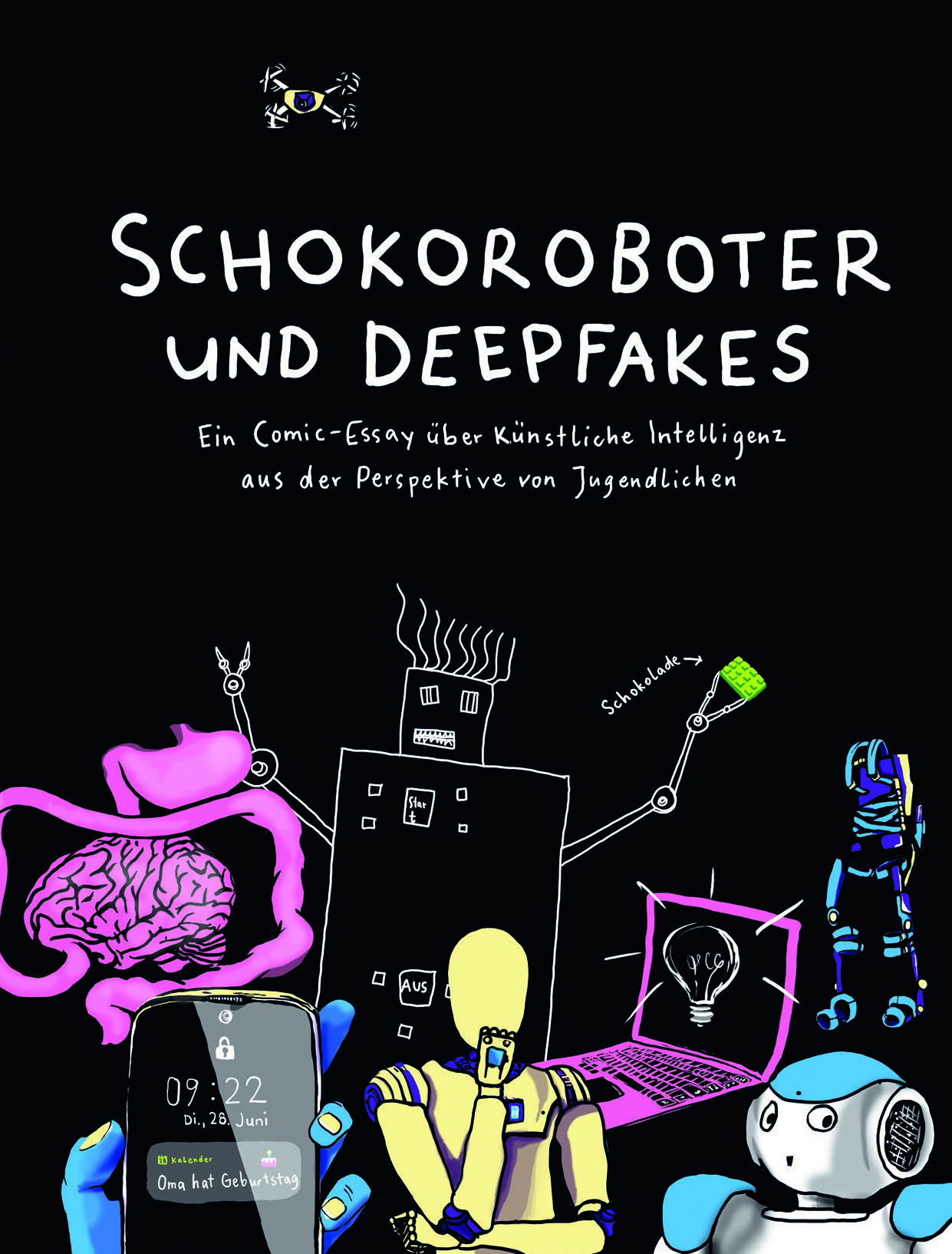
    Alle reden darüber, wie künstliche Intelligenz unseren Alltag verändert. Doch was denken junge Menschen über KI – also die Generation, deren Alltag von morgen am meisten von KI geprägt sein wird? Das Outreach-Team des Tübingen AI Center hat sich dazu mit Schülerinnen und Schülern ausgetauscht und die Antworten in Comic-Form veröffentlicht.

    „Schokoroboter und Deepfakes. Ein Comic-Essay über Künstliche Intelligenz aus der Perspektive von Jugendlichen” ist Zeitzeugnis und lädt gleichzeitig Jugendliche, Erwachsene und Forschende ein, sich an der Debatte zu beteiligen. Er steht zum kostenlosen Download unter https://schokofakes.ai/ bereit und kann dort sowie im Buchhandel auch als Softcover-Ausgabe erworben werden.

    Welche Probleme sollten mit KI gelöst werden? Wofür sollten sich Forschende einsetzen? Welche Ängste haben sie – und welche Bedürfnisse? Und welches Bild verbinden Jugendliche überhaupt mit KI? Diese Fragen stellte das Outreach Team des Tübingen AI Center rund 200 Schülerinnen und Schüler zwischen 11 und 19 Jahren: in einer Online-Umfrage, zu der auch Tübinger Machine-Learning-Forschende beigetragen haben.

    Zusätzlich besuchte das Team im Frühjahr 2022 Gesamtschulen und Gymnasien in Tübingen und Grimma, um in den Dialog zu treten und Geschichten zu sammeln. Meist kam das Thema KI erst allgemein zur Sprache: von „Alexa“ bis zu „Social Media“. Die Diskussionen wurden jedoch schnell vielschichtiger. Es ging um Zukunftsängste, Kriege und soziale Werte.

    Die Ergebnisse übersetzte die in Berlin lebende Comic-Essayistin Julia Schneider in pointierte Comictexte. Kristina Laube vom Tübingen AI Center ergänzte durch kompakte Wissenstexte zu den Themen, die aus ihren Gesprächen mit den Jugendlichen aufkamen. Das Ergebnis ist ein inhaltsstarker Comic, der seine expressive neonfarbene Bildsprache der Illustratorin Nele Konopka zu verdanken hat.

    In einer begleitenden Ausstellung zeigt das Tübingen AI Center Impressionen des Comics. Zur Vernissage sind Pressevertreterinnen und -vertreter herzlich eingeladen. Die Illustratorin und die Autorinnen werden vor Ort sein:

    Am Freitag, 2. Dezember 2022 um 18 Uhr
    im Kino Atelier & Café Haag (Vor dem Haagtor 1, Tübingen)

    Kontakt:

    Kristina Laube
    Universität Tübingen / Tübingen AI Center
    kristina.laube@uni-tuebingen.de
    https://tuebingen.ai/

    Über das Tübingen AI Center

    Das Tübinger KI-Zentrum ist eine Forschungseinrichtung der Universität Tübingen und des Max-Planck-Instituts für Intelligente Systeme, die gemeinsam vom Bund und Land getragen wird. Dort geht es darum, die Grenzen der KI-Forschung zu erweitern und die Zukunft in Europa mitzugestalten, mit dem Ziel, dass sich die Technik der Natur anpassen sollte und nicht umgekehrt.

    Über die Carl-Zeiss-Stiftung

    Die Carl-Zeiss-Stiftung fördert Forschung und Lehre in den MINT-Disziplinen Mathematik, Informatik, Naturwissenschaft und Technik. KI ist eines ihrer großen Fokus-Themen. Die Stiftung setzt sich dafür ein, Wissenschaft und ihre Erkenntnisse erklärbar zu machen. Daher unterstützt sie diesen Comic, den es sonst so nicht gäbe! Mehr unter carl-zeiss-stiftung.de.