News Category: Press Release

  • Europe’s first ELLIS Institute starts in Tübingen

    Europe’s first ELLIS Institute starts in Tübingen

    (The press release is only available in German.)

    • Wissenschaftsministerin Petra Olschowski: „Das ELLIS Institut in Tübingen wird ideale Rahmenbedingungen für weltweit führende KI-Wissenschaftlerinnen und Wissenschaftler bieten.“
    • Dr. h.c. Hector: „Es liegt an uns, die transformative Kraft der Künstlichen Intelligenz zu nutzen und sie zum Wohl der Menschen einzusetzen.“
    • Prof. Dr. Schölkopf: „Wir wollen KI-Spitzenforschung ermöglichen, eingebettet in die Kultur Europas und verankert in europäischen Werten.“ 

    „Das ELLIS Institut wird als einzigartige Forschungseinrichtung dank der außerordentlich großzügigen Spende der Hector Stiftung ideale Rahmenbedingun-gen für KI-Spitzenforscherinnen und Spitzenforscher aus der ganzen Welt schaffen. Es wird damit auch konkurrenzfähig sein zu den Forschungs- und Entwicklungsabteilungen der großen Unternehmen im Bereich KI“, erklärte Wissenschaftsministerin Petra Olschowski am Freitag, 30. Juni 2023, in Stuttgart. „Das Land geht hier mit neuen innovativen Strukturen im Forschungsbereich bundes- und europaweit voran – wie bereits mit dem Aufbau des Cyber Valley als erfolgreiches Innovationsökosystem für KI. Das ELLIS Institut ist im europäischen ELLIS-Netzwerk das erste seiner Art. Es wird stilbildend sein.“

    Mit der Gründung des ersten ELLIS Institut am Standort Tübingen wird die internationale Sichtbarkeit und Strahlkraft sowie die Forschungsexzellenz des Innovationscampus Cyber Valley noch weiter gestärkt. Die Hector Stiftung fördert die Gründung mit 100 Millionen Euro.

    Dr. h.c. Hans-Werner Hector sagte: „Die Künstliche Intelligenz hat das Potential, unsere Gesellschaft und Wirtschaft grundlegend zu verändern. Es liegt an uns, diese transformative Kraft zu nutzen und sie zum Wohl der Menschen einzusetzen. Mit der Gründung des ELLIS Instituts wollen wir eine internationale Plattform schaffen, auf der Spitzenforscherinnen und Spitzenforscher gemeinsam an den Herausforderungen und Chancen der KI arbeiten. Denn nur durch For-schungsexzellenz können wir innovative Lösungen entwickeln und eine nach-haltige Zukunft gestalten.“

    „Die Gründung des ersten ELLIS-Instituts ist ein Meilenstein, erreicht durch eine vertrauensvolle Zusammenarbeit und ein gemeinsames Ziel: Wir wollen KI-Spitzenforschung ermöglichen, eingebettet in die Kultur Europas und verankert in europäischen Werten. Ich danke dem Land Baden-Württemberg, der Max-Planck-Gesellschaft, der Universität Tübingen und vor allem dem weitsichtigen und großzügigen Spender Hans-Werner Hector“, sagte Prof. Dr. Bernhard Schölkopf.

    Weitere Informationen:

    ELLIS Institut
    ELLIS steht für „European Laboratory for Learning and Intelligent Systems”. Am Institut erhalten die talentiertesten KI-Wissenschaftlerinnen und -Wissenschaftler aus der ganzen Welt die Gelegenheit, neue Ansätze und Ideen unter hervorragenden Arbeitsbedingungen zu entwickeln. Mit dem ELLIS Institut wird in Baden-Württemberg ein international sichtbarer Leuchtturm für die Erforschung Künstlicher Intelligenz errichtet. Dies innerhalb eines starken europäischen Netzwerks von mittlerweile 39 ELLIS-Units in 14 Ländern, in denen herausragende KI-Forschende arbeiten – vier Units davon alleine in Baden-Württemberg.

    Cyber Valley und das ELLIS Institut
    Der Innovationscampus Cyber Valley ist ein zentrales Element der KI-Strategie des Landes. Mit ihm wird seit 2016 in einer gemeinsamen Initiative von Wissenschaft und Wirtschaft in Kooperation mit dem Land Baden-Württemberg und der Max-Planck-Gesellschaft ein international führender Forschungsstandort in den Bereichen des maschinellen Lernens, des maschinellen Sehens und der Robotik aufgebaut.

    Mit dem ELLIS Institut soll für die Erforschung der Künstlichen Intelligenz ein neuer europäischer Leuchtturm in Baden-Württemberg errichtet werden. Das ELLIS Institut soll mit Hilfe der Förderung der Hector Stiftung das Cyber Valley um ein Institut ergänzen, das international rekrutierten und hoch qualifizierten Forschenden für eine befristete Zeit (in der Regel sechs Jahre mit der Möglichkeit der Verlängerung) größtmögliche Freiräume und außergewöhnlich attraktive und flexible Rahmenbedingungen bietet. 

    Mit dem ELLIS Institut positioniert sich Cyber Valley im globalen Wettbewerb sowohl im Hinblick auf wissenschaftliche Exzellenz als auch im Hinblick auf inspirierende Arbeitsmöglichkeiten als „the place to be“ und unterstützt damit eine globale und wertebasierte technologische Wettbewerbsfähigkeit des Landes, des Bundes und der Europäischen Union.

     

  • Apply now for the AI Incubator 2023

    Apply now for the AI Incubator 2023

    Stuttgart, Germany – Cyber Valley, Europe's leading center for excellence in advanced AI and robotics, is launching the AI Incubator, an artificial intelligence (AI) start-up program. The AI Incubator is funded by the Carl-Zeiss-Stiftung and supported by the partners of the Cyber Valley ecosystem.

    Incubators are programs that help people interested in founding their own company. The AI Incubator offers students and scientists the opportunity to develop ideas for a start-up from their AI research, put the ideas into practice and start their own successful AI business. 


    Target group

    The program is aimed at students, PhDs, scientists, technologists and business talent from the Cyber Valley ecosystem as well as interested individuals who focus on research, development and application of artificial intelligence and robotics. Applicants need to be enrolled or be an alumni in Baden-Württemberg or at ETH Zurich. Having your own team or idea is not a prerequisite and can be developed together during the course of the program.


    Dates and contents

    The program will start on June 7, 2023. Experienced entrepreneurs and start-up coaches will supervise the participants over a period of six weeks. One full-day workshop will be held per week, for example on topics such as deep tech market research, financing, and AI regulation. The workshops, mentoring sessions and the pitch event on July 10, 2023 at the end of the AI Incubator, will give the participants access to the world-class facilities and resources of the Cyber Valley Partners. A shuttle will transport participants to each workshop location.


    Application and further information

    Interested applicants can apply for the AI Incubator 2023 with their CV and a letter of motivation until June 1, 2023 (extended deadline). Further information on the requirements, the application process and the content of the one-day workshops is available on the website www.cyber-valley.de/ai-incubator. 

    "The AI Incubator offers young, talented scientists an excellent opportunity to benefit from the broad expertise in Cyber Valley and take the next step in shaping the future," says Dr. Felix Streiter, Managing  Director of the Carl-Zeiss-Stiftung. "We are pleased to be part of this program and thus promote the transfer from cutting-edge research into practice."


    Rebecca Reisch, Cyber Valley GmbH CEO, emphasized the importance of the AI Incubator for the start-up community. “We are proud and grateful to launch the AI Incubator and to add value to our ecosystem thanks to the generous support of the Carl-Zeiss-Stiftung. The program offers researchers a real opportunity to start their own company and network with investors. We want to support them in playing a leading role in shaping the next generation of AI startups made in THE LÄND.”


    About Cyber Valley

    Cyber Valley is Europe's leading center for excellence in advanced AI and robotics. Cyber Valley creates a vibrant ecosystem that enables seamless collaboration and rapid exchange between academia, business and society.
    As an ambassador for entrepreneurship, Cyber Valley's mission is to strengthen the research, development, and application of intelligent systems, providing a platform for collaboration, resource sharing, and advancement of modern AI and robotics. With a focus on the ethical and societal aspects of AI, Cyber Valley fosters dialogue between society and AI researchers and strives for a future in which the full potential of intelligent systems is used for the benefit of society.


    About the Carl-Zeiss-Stiftung

    The Carl-Zeiss-Stiftung’s mission is to create an open environment for scientific breakthroughs. As a partner of excellence in science, it supports basic research as well as applied sciences in the STEM subject areas (science, technology, engineering and mathematics). Founded in 1889 by the physicist and mathematician Ernst Abbe, the Carl-Zeiss-Stiftung is one of the oldest and biggest private science funding institutions in Germany. It is the sole owner of Carl Zeiss AG and SCHOTT AG. Its projects are financed from the dividend distributions of the two foundation companies.


    Cyber Valley Press Contact

    Rebecca Beiter
    rebecca.beiter@cyber-valley.de
     +49 160 9448 1797


  • Cyber Valley Start-up Network continues to grow

    Cyber Valley Start-up Network continues to grow

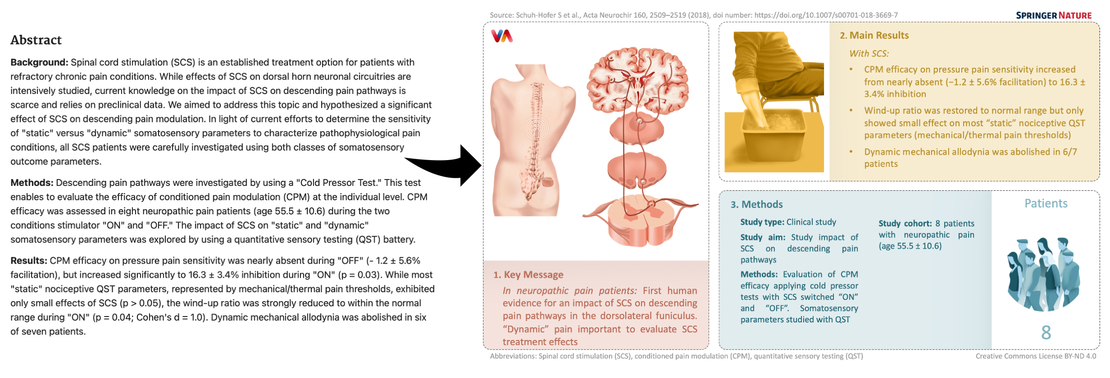
    What does Visual Abstract do?

    The start-up uses texts of scientific publications and transforms them into clearer graphics with the use of artificial intelligence (AI). 

    Visual Abstract AI

    Visual Abstract to Paper: Spinal cord stimulation modulates descending pain inhibition and temporal summation of pricking pain in patients with neuropathic pain (Schuh-Hofer et al., 2018). Image: Visual Abstract

    The start-up's goal is to make science accessible to everyone. On the one hand, the graphics support researchers and students in easily and quickly absorbing newly published research results. In this way, the start-up wants to stem the flood of information to which researchers are exposed. On the other hand, the public benefits when scientific results are presented in a visually clearer way and are more easily accessible to interested parties.

    “Industry and researchers face the challenge of adequately communicating their often complex research findings,” says Saribek Karapetyan, CEO of Visual Abstract. “Our graphical abstracts are easy to read, easy to understand, and easy to memorize – and quickly available to customers thanks to our AI-powered automated production process.”

    Cyber Valley Start-up Network

    The Mannheim-based startup is part of the Cyber Valley Start-up Network. “As an AI startup from #TheLänd, it is a must and an honor for us to be part of the ecosystem of Europe's largest AI research consortium,” says Karapetyan. Founded in November 2019, the Cyber Valley Start-up Network now has 43 members.

  • Using Deep Learning to make Better Models of the Brain

    Using Deep Learning to make Better Models of the Brain

    The brain of Drosophila, which is one of the best known model organisms in biology, is interesting to both neuroscientists and computer scientists for several reasons. “Fruit flies only have tiny brains in comparison to mammals,” explains Macke, “Nevertheless, these animals have astonishing capabilities, such as highly precise control of their flight. They can use landmarks to orient themselves and respond rapidly when predators approach.” Despite its massive capacity, the brain of Drosophila only uses nanowatts of energy, making it far more energy-efficient than any computer.

    In recent decades biological research has succeeded in analyzing the brain of the fruit fly at a high level of detail. “We now have access to the brain’s circuitry, but until now we haven’t been able to build any models that can solve tasks which are as challenging as those solved by real Drosophila brains.” Meanwhile, recent advances in Deep Learning have made it possible to create artificial neuronal networks that can carry out extremely complicated calculations. However, these artificial networks have become very different in architecture and functioning to biological ones.

    “We want to bring these two worlds back together,” explains the AI researcher, “Our goal now is to create artificial neuronal networks that, in composition and structure, are similar to the brain of fruit flies, but at the same time can perform similarly complex computations.” This requires innovative machine learning methods, which will be developed and applied in the project, in close cooperation with Srinivas Turaga from the Janelia Research Campus in Ashburn, Virginia, and other researchers. Such methods could also be used for neuroscientific research into animals with more complex brains, such as fish or mammals.  
     

    About

    Dr. Jakob Macke (born 1982) has been appointed to the professorship for Machine Learning in Science at the Faculty of Mathematics and Natural Sciences at the University of Tübingen. This professorship was established in the Cluster of Excellence “Machine Learning – New Perspectives for the Sciences” as of the summer semester 2020. Macke is also a member of the Tübingen AI Center, which is funded by the federal government, and is speaker of the “Bernstein Center for Computational Neuroscience Tübingen”. 

    More Information

  • Research project on artificial intelligence for sustainable road construction launched

    Research project on artificial intelligence for sustainable road construction launched

    Road construction causes around 400 million tonnes of CO2 emissions globally every year. This corresponds to about 7.5 per cent of the maximum annual amount that may be emitted worldwide in order to still achieve the climate target of 1.5 degrees Celsius global warming. Even on medium-sized construction sites with 2,500 tonnes of asphalt to be laid, about 4,000 trees need a whole year to compensate for the CO2 emissions of about 50 tonnes. In the KInaStra research project, CO2 emissions in asphalt road construction are to be analysed transparently using digital technologies and reduced by AI-based optimisation algorithms, without any negative impact on quality, costs and time.

    The project results should help construction companies to carry out road construction projects more sustainably through CO2-optimised planning and process control. KInaStra thus creates the prerequisites for efficiently meeting the sustainability requirements of the coming years, including those of public clients. At the same time, the project strengthens economic sustainability as resources become scarcer and more expensive.

    The goal of the project team from practice and science is the development of intelligent, data-driven real-time control procedures by means of machine learning. The results will be digital tools for CO2 reporting and decision support. Sensors and interfaces will be used to collect data across the entire asphalt supply chain. In the cloud, this data will then be analysed in real time using AI processes. This will make it possible to derive recommendations for action for the personnel carrying out the construction work.

    Project participants

    Smart Site Solutions GmbH is launching the research project together with Reif Bauunternehmung GmbH & Co. KG, Makadamlabor Schwaben GmbH and the University of Hohenheim. Cyber Valley supports the KInaStra project consortium as an associated partner. Other associated partners are Bauwirtschaft Baden-Württemberg e.V., Bundesanstalt für Straßenwesen, Deutscher Asphaltverband e.V. and infraTest Digital Solutions GmbH. The KInaStra project is part of the innovation funding programme "InvestBw – Digitalisation and Artificial Intelligence" and is funded by the Baden-Württemberg Ministry of Economics, Labour and Tourism on the basis of a decision by the Baden-Württemberg state government.

    Contact

    Dr. Marcus Müller
    Smart Site Solutions GmbH, Zugäckerstrasse 42, 72622 Nürtingen
    +49 (0) 7022 2081847
    marcus.mueller@smartsitesolutions.de