User Group: PhD Student

  • BMBF establishes ELLIS as the European networking platform for AI researchers

    BMBF establishes ELLIS as the European networking platform for AI researchers

    The German Federal Ministry for Education and Research (BMBF) is establishing ELLIS, the European Laboratory for Learning and Intelligent Systems, as a European and international networking platform for young AI researchers. This is part of the BMBF's AI action plan, which was presented by the Federal Minister of Education and Research, Bettina Stark-Watzinger, at Germany's AI strategy press conference on November 7th. As part of the Cyber Valley Community, ELLIS brings European research excellence to the German AI strategy.

    The successful use of AI requires excellence and networking on a large scale. At ELLIS, European AI excellence meets a European network. This AI network is now officially supported by the BMBF. To ensure that Germany continues to use AI successfully in the future, the country wants to "seek even greater European and international cooperation", as stated in the BMBF's "Artificial Intelligence" action plan ((https://www.bmbf.de/bmbf/de/forschung/digitale-wirtschaft-und-gesellschaft/kuenstliche-intelligenz/ki-aktionsplan.html). Market size is essential for the global technology competition and excellent cross-border alliances are a strategic advantage. Targeted collaboration between German stakeholders at a European level with international partners is therefore at the heart of the AI strategy. ELLIS now plays a key role in this.

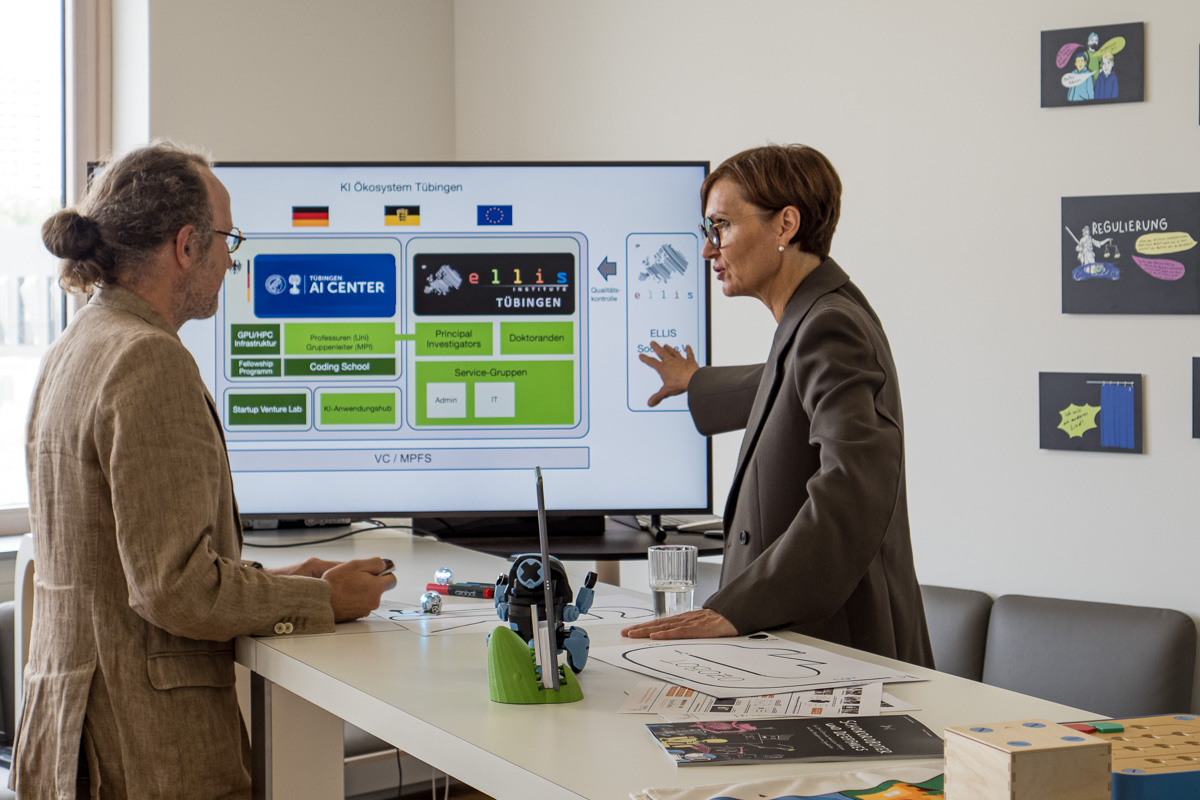
    Ahead of the press conference, State Secretary Prof. Sabine Döring and Prof. Bernhard Schölkopf, Director of the Tübingen AI Center, the ELLIS Institute and the Max Planck Institute for Intelligent Systems as well as Cyber Valley Speaker, discussed how Europe's strength in AI can be used and how the research challenges can be taken on.

    ELLIS – Connecting AI talent across Germany and Europe

    The European Laboratory for Learning and Intelligent Systems (ELLIS) is a pan-European AI network of excellence and part of the Cyber Valley Community. It has more than 1,000 members, 16 transnational research programs, a pan-European PhD program and 41 ELLIS units at world-class institutions such as the Max Planck Institute for Intelligent Systems, universities in Paris, the Universities of Cambridge and Oxford, ETH Zurich, EPFL in Lausanne and the Technion in Haifa. Founded in 2018, ELLIS aims to secure the international leadership of AI made in Europe by networking top researchers and creating a multi-center AI research laboratory.

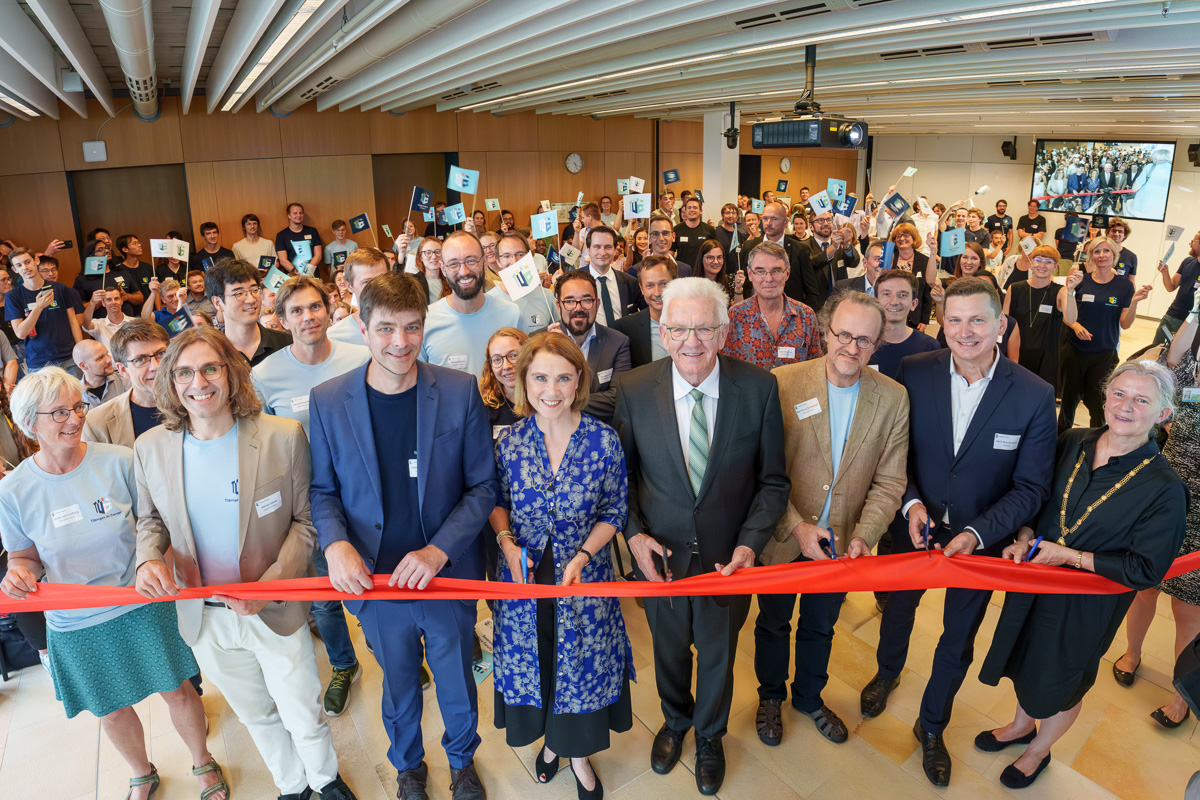
    Germany is strongly represented in ELLIS: Ten entities are located at leading institutions in Germany (Berlin, Darmstadt, Freiburg, Heidelberg, Jena, Munich, Potsdam, Saarbrücken, Stuttgart and Tübingen). Funded by the Hector Foundation in the amount of 100 million euros, the first ELLIS institute in Tübingen began operations in July. It is set to become a globally recognized center for pioneering basic research in the field of artificial intelligence.

    Attracting and supporting the best young researchers

    One focus of ELLIS is to attract, retain and connect outstanding young AI talent in Europe through the ELLIS PhD and postdoc program. It has attracted more than 7,000 applications from all over the world since its inception in 2020. Students benefit from joint supervision by two leading AI researchers at different institutions in Europe, giving them an excellent starting point for their career in modern AI research.

    "Germany wants to create the basis for us to develop responsible European AI in science and application. This is precisely the goal of Cyber Valley and ELLIS, and we look forward to realizing this together", said Prof. Schölkopf.


    About Cyber Valley 

    ELLIS is embedded in Cyber Valley, Europe’s largest and leading research consortium in the field of artificial intelligence (AI) and modern robotics. Cyber Valley has a mission and a public mandate to advocate for entrepreneurship, research, development, application, and acceptance of technologies and methods in the field of intelligent systems.    

    The Cyber Valley Community connects partners from science, industry, and society, along with AI researchers and entrepreneurs. The Cyber Valley GmbH is funded by the state of Baden-Württemberg and acts as the central organizer, service provider, and host for the Cyber Valley Community. While the GmbH operates from Stuttgart and Tübingen, Cyber Valley has a larger scope: As a national and European driving force, it attracts the best people from all over the world to create the future with AI. Cyber Valley envisions a future where the full potential of intelligent systems is leveraged for the greater good of the world.
    www.cyber-valley.de 

    Press Contakt
    Hazel Rowland, Cyber Valley Media Manager 
    Hazel.rowland@cyber-valley.de 

    About ELLIS 

    Website: ellis.eu 
    For media: ellis.eu/formedia 

    Press Contact
    Barbara Weimer, ELLIS Communications Manager 
    Barbara.Weimer@ellis.eu  

  • AI House Davos: Leading the Global Conversation on AI

    AI House Davos: Leading the Global Conversation on AI

    We are thrilled to announce the launch of AI House Davos 2024: A Global Forum for AI Progress during the World Economic Forum (WEF) Annual Meeting. AI House Davos will convene thought-leaders, academics, industry experts, government officials, investors, and entrepreneurs to foster discussions that will influence the responsible scaling, integration, and regulation of artificial intelligence. This inclusive and multidisciplinary platform will embrace diverse stakeholders, including academia, government, industry, finance, civil society, and entrepreneurship. It aims to provide solutions for addressing the global impact of artificial intelligence.

    The AI House

    AI was one of the main topics during the last annual meeting of the World Economic Forum and the conversation has only accelerated since then. Today, there is an urgent need for a global discussion that includes policymakers, academics, civil society, venture, and industry. The AI House Davos provides an independent platform to have this global conversation on neutral ground and invites you to join us as we embark on this remarkable endeavor.

    During the Annual Meeting of the World Economic Forum, the AI House Davos will unite prominent figures to engage in discussions on the most critical issues concerning artificial intelligence, exploring its impact on society. By establishing a long-term presence and fostering a community of AI thought-leaders during the Annual Meeting of the World Economic Forum, the AI House will have enduring global effects on a long-term scale. Together with other partners, sponsors, contributors, and media partners, we are poised to make a significant impact on the future of AI.

    The Leaders of the Global Conversation on AI

    AI House Davos is a joint initiative by Merantix and the ETH AI Center together with Swisscom, UTokyo Institute for AI and Beyond, and Hewlett Packard Enterprise (HPE). Cyber Valley is a contributor to the planned program.

    Stay tuned for more updates, and mark your calendars for AI House Davos from January 15 to January 19, 2024. More information can be found here: Cyber Valley at AI House Davos


    Media contact

    Dr. Hazel Rowland
    Media Manager, Cyber Valley GmbH
    Email: hazel.rowland@cyber-valley.de

  • Bionic Intelligence in Cyber Valley

    Bionic Intelligence in Cyber Valley

    The new Center for Bionic Intelligence Tübingen Stuttgart (BITS) aims to optimize the interaction between humans and technical systems in a fundamentally new way.

    Scientists from the University of Stuttgart, the University of Tübingen, the Max Planck Institute for Intelligent Systems and the Max Planck Institute for Biological Cybernetics are conducting research on intelligent bionic systems that will aid understanding and treatment of certain diseases of the central nervous system. Diagnoses will become more accurate, treatments more efficient and the illnesses more tolerable. Those affected by such disorders already use orthoses or communication aids. However, these systems cannot fully adapt themselves to the needs of the patient or the environment in order to fully compensate limitations or restore failed bodily functions. In interdisciplinary projects, BITS members develop individually tailored medical aids.

    Bionic systems can be found almost everywhere in everyday life: A Velcro fastener on a backpack is inspired by the burdock, suction cups are modeled on the form of an octopus tentacle. Both inventions are based on phenomena from the animal and plant world. Researchers at the University of Stuttgart, the University of Tübingen, the Max Planck Institute for Intelligent Systems and the Max Planck Institute for Biological Cybernetics are taking this one step further: Their vision is to optimize interaction between humans and technical systems so that, by using various signals and intelligent physical principles, the technical system is able to provide support when humans need it. The users are in control at all times.

    "We want to push the boundaries of what has been possible until now," says Professor Syn Schmitt, BITS spokesperson at the University of Stuttgart. "With bionic systems, such as novel robotic prostheses, we aim to create new intelligent diagnostic and treatment options that offer support in everyday life for patients with physical and neurological limitations."


    Diagnosis and treatment: Smart, flexible and ethical

    Technical assistance systems are already being used for therapeutic purposes, but they fall far short of the efficiency and flexibility that would be required to replace missing or impaired functions, or to support the diagnosis and treatment of complex mental disorders. The scientists of the newly founded BITS are jointly researching the development of bionic systems to adapt them to meet patients' individual needs, to compensate for impaired motor function in the everyday lives of those affected, and to support diagnostic and rehabilitation procedures. Social and ethical dimensions are considered from the very beginning.

    "The goal is to develop alternatives that work perfectly for individuals," adds Professor Martin Giese, BITS spokesperson at the University of Tübingen. "Forging efficient interactions between people and technology, requires not only optimal data and information processing, but also the exploitation of intelligent physical principles in people and the technical system." 

    The challenge here is to design technical components that interact with the nervous systems and muscular apparatus in a highly efficiently way and that adapt flexibly and individually to the patient's position. "To do this, we rely on functional materials that respond to different body-specific stimuli," adds Professor Sabine Ludwigs, also a BITS spokesperson at the University of Stuttgart.


    Interdisciplinary collaboration: From biomedicine to robotics and computer science

    The key to success is interdisciplinary cooperation between experts from different fields, such as biomedicine, neuromechanics, materials science, soft and biorobotics, physics, electrical engineering, social science, ethics, neuroscience, and computer science. "Each and every member of our team is an expert in their field," says Schmitt. "We try to transfer all this knowledge into workable solutions that allow people to interact with technical systems on multiple levels. We believe that affected individuals will benefit from such systems, and that science will gain a better understanding of humans."

    The research work within BITS encompasses everything from robotic orthoses that function as an everyday aid for people with muscle tremors, for example, to wearable sensors to improve diagnostics for obsessive-compulsive disorders, to so-called in-body micro- and nano-robots that can transport drugs specifically to the brain or enable new forms of brain stimulation. "At BITS, we want to build on previous successes and strengthen our collaborations to permanently establish intelligent systems in medicine, treatment and rehabilitation," emphasizes Giese. 


    About Cyber Valley

    Cyber Valley is Europe’s largest and leading research consortium in the field of artificial intelligence (AI) and modern robotics. It has a mission and a public mandate to advocate for entrepreneurship, research, development, application, and acceptance of technologies and methods in the field of intelligent systems. The company envisions a future where the full potential of intelligent systems is leveraged for the greater good of the world. 

    The Cyber Valley Community brings together partners from science, industry, and society, along with AI researchers and entrepreneurs. The Cyber Valley GmbH is funded by the state of Baden-Württemberg and acts as the central organizer, service provider, and host for the community. While the GmbH operates from Stuttgart and Tübingen, Cyber Valley has a larger scope: As a national and European driving force, it attracts the best people from all over the world to create the future with AI.


    About the Center for Bionic Intelligence Tübingen Stuttgart

    At the interdisciplinary research center BITS, approximately 50 scientists have been engaged in various projects since May 2023. BITS members bring together wide-ranging expertise from a variety of disciplines, including biomedicine, neuromechanics, materials science, soft and biorobotics, physics, electrical engineering, social science, ethics, neuroscience and computer science. The research work is intended to contribute to the technical implementation of bionic systems and help to establish these in the medical sector. This will significantly reduce the ever-increasing social burden of mental and neurological disorders, as well as individual suffering. To this end, BITS combines the complementary expertise of the Universities of Stuttgart and Tübingen and the Max Planck Institutes for Intelligent Systems and Biological Cybernetics. BITS is part of Cyber Valley, Europe's largest research consortium in robotics and artificial intelligence.

    Expert Contact

    • Prof. Dr. Syn Schmitt, University of Stuttgart, Institute for Modelling and Simulation of Biomechanical Systems
    • Prof. Sabine Ludwigs, University of Stuttgart, Institute of Polymer Chemistry
    • Prof. Martin Giese, University of Tübingen, Section for Computational Sensomotorics

    About Cyber Valley

    Cyber Valley is Europe’s largest and leading research consortium in the field of artificial intelligence (AI) and modern robotics. Cyber Valley has a public mandate: As advocates for entrepreneurship, research, development, application, and acceptance of technologies and methods in the field of intelligent systems are at the forefront. The company envisions a future where the full potential of intelligent systems is leveraged for the greater good of the world.  

  • Institute for Artificial Intelligence established

    Institute for Artificial Intelligence established

    "AI is changing the world. But this change must also be reflected in new structures for research and teaching“
    Petra Olschowski, Minister of Science of Baden-Württemberg.

    “With the Institute for Artificial Intelligence, the University of Stuttgart is sending a clear signal for AI as an independent research area and is combining a broad range of scientific activities. The result is greater visibility for the topic of AI. Two state-funded “Cyber Valley” professorships will become part of the new institute, thereby building a bridge to our Innovation Campus. This will further strengthen the Cyber Valley Innovation Campus and the Stuttgart/Tübingen AI region," says Petra Olschowski, Minister of Science of Baden-Württemberg.

    Pooled expertise for interdisciplinary AI research

    With the founding of the institute, the University of Stuttgart is taking a further step towards realizing its vision of "Intelligent Systems for a Sustainable Society": "We are pooling our expertise in AI in order to explore AI applications across disciplines for the benefit of people. One area of specialization will be intelligent robotics, which will be used to achieve advances in medicine and production technologies, among other things," says Prof. Wolfram Ressel, Rector of the University of Stuttgart.

    AI institute with five working groups – more are planned

    Prof. Steffen Staab, the first executive director of the new institute, emphasizes: "The Institute for Artificial Intelligence aims to achieve three things: First, to conduct internationally outstanding research; second, to be a qualified research partner for other scientific disciplines that use AI to advance their research; and third, to promote the transfer of AI methods to industry and society." The AI Institute comprises the two "Cyber Valley" professorships "Analytic Computing" (Steffen Staab) and "Autonomous Systems" (Kai Arras), the professorship "Machine Learning in Simulation Sciences" (Mathias Niepert) located in the Cluster of Excellence "Data-Integrated Simulation Science" (SimTech), the junior professorship "Autonomous Sensing and Perception Systems" (Alina Roitberg), and the professorship for "Machine Learning and Robotics", which are currently being filled. There are also plans to expand the institute by adding professorships in the field of intelligent robotics.

    Networked via Cyber Valley, ELLIS, Clusters of Excellence, and more

    The close networking of the institute with numerous international and internal university initiatives related to AI is demonstrated by the participation of Cyber Valley and SimTech. The second Cluster of Excellence of the University of Stuttgart, "Integrative Computational Design and Construction for Architecture" (IntCDC), also relies on advances in artificial intelligence for its research tasks. As part of the international network "European Laboratory for Learning and Intelligent Systems", the ELLIS Unit Stuttgart is promoting the exchange of knowledge with top-class universities throughout Europe. The Artificial Intelligence Software Academy (AISA) links interdisciplinary research and education at the Stuttgart site, and the Interchange Forum for Reflecting on Intelligent Systems (IRIS) and critically examines the societal implications of intelligent systems.

    Expert Contact:

    Prof. Dr. Steffen Staab, University of Stuttgart, Institute for Artificial Intelligence, Phone: +49 (0)711 685-88100, E-Mail: steffen.staab@ipvs.uni-stuttgart.de

  • Cyber Valley Meet-up #09

    Cyber Valley Meet-up #09

    We invite you to this relaxed meeting for all start-ups, research groups, PhD students and interested people who want to learn more about Cyber Valley. 

     
    What:

    • Wieland Brendel (Max Planck Research Group Leader- Robust Machine Learning)

    • Mohammed El Merouani (Manager – Business to Bridge Talent (B2BT))

    • Tagir Fabarisov, M.Sc. (PhD Student, University of Stuttgart)

    • The AI Incubator: 

      • Richard Schreiber 

      • Marko Pavlovic (Team: Iliaudia)  

      • Ghadeer Elmkaiel  

      • Arän Chalak 


    Want to pitch your idea at the Meet-up? Then contact us.


    Open discussion and exchange
    … while enjoying pizza, salad, and a cold drink of your choice. We would also like to know what your expectations are for Cyber Valley.

     
    When?

    Wednesday, November 22, 2023, 17:30–19:30 CEST.

     
    Where?

    Tübingen AI Center, Maria-von-Linden-Straße 6, 72076 Tübingen


    Travel arrangements

    Unfortunately travel arrangements are no longer available as as we have reached full capacity. 


    Registration

    Registration for this event has now closed.

    We look forward to meeting you as well as sharing some food, drinks and stimulating conversations!