User Group: General Public

  • Cyber Valley project awarded funding

    Cyber Valley project awarded funding

    The university competition invites researchers and citizens to actively participate in the research process and work together to meet the challenges of the future. The jury selected the best 15 project ideas from 270 submissions. The Stuttgart-based Cyber Valley project will receive 10,000 euros to run the short story competition until the end of 2022.

    Cyber Storys

    “Should a robot clean your room? Should a computer decide which school you can go to? How do you imagine your life with artificial intelligence? Shape the future with your ideas!” This is the call with which Cyber Storys will be launched from March 28, 2022. Pupils from Baden-Württemberg from the seventh school year onwards can submit their visions for the future with artificial intelligence online, either individually or as a class group, by June 3 and thus provide new impetus for future AI research in the form of narratives. The competition is open to all types of schools and is also aimed at vocational schools. A jury will select the winners at the Stuttgart Science Festival.

    Cyber Storys provides insight into AI research and makes AI ethics tangible with the help of one’s own creativity. The project focuses on young people and young citizens, in line with the motto of the Year of Science 2022 – “Nachgefragt!”. It enables them to contribute their visions of the future to research and science to learn from these impulses. Through the creative form of participation, Cyber Valley aims to awaken young people’s curiosity about AI and impart knowledge. After all, only those who have basic technology skills can classify AI, shape it, and represent their own interests.

    AI teaching materials and writing workshops

    To help create exciting stories, Cyber Storys offers a variety of support. Free educational materials such as an artificial intelligence e-learning course, a workbook, and a teacher’s guide provide basic AI knowledge. The materials will be available at the end of March on the short story contest website. How AI can be addressed in the classroom is the topic of the “Train the trainer” workshops for teachers. In writing workshops in city libraries in the Stuttgart/Tübingen area, young people are supported in the writing process and can meet researchers. Dates will be announced via the project website.

    Networking of institutions in the region

    Cyber Storys is coordinated by Cyber Valley and is created in cooperation with many institutions. The city libraries of Stuttgart, Tübingen, Leinfelden-Echterdingen and Esslingen are participating with, among other things, writing workshops, themed shelves with media related to AI, and readings of the winning stories. The educational materials are offered by Cyber Valley in collaboration with the Stuttgart Research Focus Interchange Forum for Reflecting on Intelligent Systems (SRF IRIS) at the University of Stuttgart and the Landeszentrale für politische Bildung Baden-Württemberg.

    Cyber Valley Public Engagement Manager Rebecca Beiter would like to use the prize money from the university competition for more dialogue: “Not only can we use it to host the writing competition, but we can use the stories as a low-threshold entry point for subsequent readings and dialogue formats between AI researchers and citizens.” Beiter is also excited about the networking and training in science communication, because in addition to financial support, the university competition offers workshops and training for the winning teams. The teams provide regular updates on progress and challenges in project implementation on the university competition blog: www.hochschulwettbewerb.net.

    The university competition is organized annually by Wissenschaft im Dialog (WiD) in cooperation with the German Association of University Communication and the German Rectors’ Conference and is funded by the German Federal Ministry of Education and Research as part of the Year of Science.

  • B2B Communications for Tech Start-ups

    B2B Communications for Tech Start-ups

    Effektive externe Kommunikation ist ein entscheidender Erfolgsfaktor für jedes Unternehmen. Start-ups stehen vor allem in der Anfangsphase vor der Herausforderung, den Bekanntheitsgrad zu steigern und eine erfolgreiche B2B-Kommunikation aufzubauen. Die Entwicklung und Umsetzung einer effektiven Kommunikationsstrategie kann jedoch herausfordernd sein.

    Die nächste Ausgabe der Entrepreneurship Series widmet sich daher dem Thema "B2B-Kommunikation für Tech-Start-ups". Erfahrene Kommunikationsexperten geben Einblicke in PR-Grundlagen, B2B-Kommunikation und den effektiven Einsatz von Social Media. Im Anschluss an ihre Vorträge findet eine Fragerunde statt.

    Wissenschaftler:innen, Gründer:innen, Studierende und alle, die sich für das Thema interessieren, sind herzlich eingeladen, am Donnerstag, den 24. Februar, 14:00-15:30 Uhr dabei zu sein.


    Sprecher:innen

    Mark Schiffhauer
    Chief Creative Officer, ZEIT Verlagsgruppe & Geschäftsführer, Studio ZX

    Lennart Schmid
    Communications Manager, Cyber Valley

    Johanna Hailer
    Kommunikationsmanagerin, Storymaker GmbH


    Registrierung

    Bitte hier registrieren. Das Event findet via Zoom und in englischer Sprache statt.


    Kontakt

    Julia Schmaus – Innovation Manager
    E-mail: julia.schmaus@cyber-valley.de
    Telefon: +49 7071 601 1546
    Mobil: +49 151 6452 0213


  • „Train the Trainer“: KI im Unterricht, Termin 3

    „Train the Trainer“: KI im Unterricht, Termin 3

    Als unterstützendes Material für den KI-Kurzgeschichtenwettbewerbs Cyber Storys entstand die Unterrichtseinheit „Künstliche Intelligenz – was ist das überhaupt und was hat das mit mir zu tun?”, die sowohl über einen E-Learning-Kurs als auch ohne Internetzugang umgesetzt werden kann. Tabea Berberena, wissenschaftliche Koordinatorin des Lehr- und Lernforums RISING an der Universität Stuttgart, gibt im Workshop einen Überblick über das kostenfreie Unterrichtsmaterial und dessen Umsetzung im Unterricht, ganz nach dem Motto „Train the Trainer“. 

    Zielgruppe sind Lehrkräfte aus allen Fachrichtungen und Personen der außerschulischen Jugendbildung, die sich über KI und die Umsetzung des Themas im Unterricht oder Workshops informieren möchten. Vorwissen zu KI ist nicht notwendig.


    Termine

    Für den Workshop steht Ihnen einer der drei folgenden Termine zur Auswahl:


    Kosten

    Der Workshop ist kostenfrei.


    Anmeldung

    Anmelden können Sie sich bis zum 24. März 2022 per Mail: rising@ife.uni-stuttgart.de, Ansprechpartnerin: Tabea Berberena. Nennen Sie bitte ihren Namen, ihre Schule oder Einrichtung und Ihren Terminwunsch.


    Cyber Storys

    Das Material unterstützt Lehrkräfte, die mit ihren Schulklassen am Kurzgeschichtenwettbewerb Cyber Storys teilnehmen möchten. Weitere Informationen zu Cyber Storys folgen zeitnah.


    Ein Angebot des Stuttgarter Research Focus Interchange Forum for Reflecting on Intelligent Systems (SRF IRIS) in Zusammenarbeit mit Cyber Valley und der Landeszentrale für politische Bildung Baden-Württemberg.

  • „Train the Trainer“: KI im Unterricht, Termin 2

    „Train the Trainer“: KI im Unterricht, Termin 2

    Als unterstützendes Material für den KI-Kurzgeschichtenwettbewerbs Cyber Storys entstand die Unterrichtseinheit „Künstliche Intelligenz – was ist das überhaupt und was hat das mit mir zu tun?”, die sowohl über einen E-Learning-Kurs als auch ohne Internetzugang umgesetzt werden kann. Tabea Berberena, wissenschaftliche Koordinatorin des Lehr- und Lernforums RISING an der Universität Stuttgart, gibt im Workshop einen Überblick über das kostenfreie Unterrichtsmaterial und dessen Umsetzung im Unterricht, ganz nach dem Motto „Train the Trainer“. 

    Zielgruppe sind Lehrkräfte aus allen Fachrichtungen und Personen der außerschulischen Jugendbildung, die sich über KI und die Umsetzung des Themas im Unterricht oder Workshops informieren möchten. Vorwissen zu KI ist nicht notwendig.


    Termine

    Für den Workshop steht Ihnen einer der drei folgenden Termine zur Auswahl:


    Kosten

    Der Workshop ist kostenfrei.


    Anmeldung

    Anmelden können Sie sich bis zum 24. März 2022 per Mail: rising@ife.uni-stuttgart.de, Ansprechpartnerin: Tabea Berberena. Nennen Sie bitte ihren Namen, ihre Schule oder Einrichtung und Ihren Terminwunsch.


    Cyber Storys

    Das Material unterstützt Lehrkräfte, die mit ihren Schulklassen am Kurzgeschichtenwettbewerb Cyber Storys teilnehmen möchten. Weitere Informationen zu Cyber Storys folgen zeitnah.


    Ein Angebot des Stuttgarter Research Focus Interchange Forum for Reflecting on Intelligent Systems (SRF IRIS) in Zusammenarbeit mit Cyber Valley und der Landeszentrale für politische Bildung Baden-Württemberg.

  • First ELLIS Institute in Tübingen gets go-ahead

    First ELLIS Institute in Tübingen gets go-ahead

    The ELLIS Institute will be funded by the Hector Foundation with a total of 100 million euros over the next ten years. This will add an institute to the Cyber Valley ecosystem that offers internationally recruited and highly qualified researchers the greatest possible freedom and exceptionally attractive and flexible framework conditions. Due to these framework conditions, the ELLIS Institute will also be perceived internationally as a particularly attractive proposition. The goal is to attract scientific talent from top-level research to move to Baden-Württemberg. The state of Baden-Württemberg is contributing an additional 25 million euros and will provide the structural accommodation and administration for the ELLIS Institute in addition to its previous commitment to Cyber Valley. With the ELLIS Institute, a new European lighthouse with model character is thus being created in Baden-Württemberg for research into artificial intelligence (AI).

    “With the ELLIS Institute, we are igniting the next stage in Cyber Valley. We are making this institute a node in the entire ELLIS network, a network in which top researchers from all over Europe come together. This with exactly one fixed location: the Cyber Valley here in Baden-Württemberg. In the future, the ELLIS Institute will attract the best minds in science from all over the world – the stars of the scene, but just as much our young scientists,” said Minister-President Winfried Kretschmann. “Those who come to the ELLIS Institute can expect the greatest possible legroom, the best possible equipment, an inspiring network of business and science, and the hottest topics on the AI scene. With the Hector Foundation’s generous funding of 100 million euros over the next ten years, ELLIS will be a true research ‘El Dorado’ in Baden-Württemberg.”

    The founder Dr. h. c. Hans-Werner Hector explains his commitment to the ELLIS Institute as follows: “AI is becoming a key technology for many research areas such as medicine, production processes, climate protection and transport – to name just a few. Due to the wide variety of application areas, our lives will be strongly influenced by it in the future. Germany should play an important role in the research field of AI. That’s why we want to support this development with our foundation.”

    Private funding can decisively advance public research

    “The ELLIS Institute is now turning a top European location for artificial intelligence into the top AI location in Europe: Here, experience and vision come together and meet with the outstanding support of the Hector Foundation and the state – we will support the new ELLIS Institute with 25 million euros. With these unique framework conditions, together we will succeed in playing at the very top in the competition for the best minds,” emphasized Science Minister Theresia Bauer.

    Bernhard Schölkopf, who as director at the Max Planck Institute for Intelligent Systems in Tübingen played a key role in the founding of Cyber Valley in 2016 and the European Learning and Intelligent Systems Laboratory (ELLIS) two years later, will chair the new ELLIS Institute as founding director. “Future systems will deal with the complexity of the world by learning from observations – from astronomy to climate research to medicine. We created Cyber Valley and the ELLIS initiative to help shape them. I was very grateful for the opportunity to share extensively with Dr. Hans-Werner Hector about this paradigm shift, and I am now grateful for his generous support. His vision and drive fall on fertile ground here. I hope that the ELLIS Institute will bring many talented people to Baden-Württemberg, radiate far beyond our borders, and contribute to an AI based on our European values,” Schölkopf said.
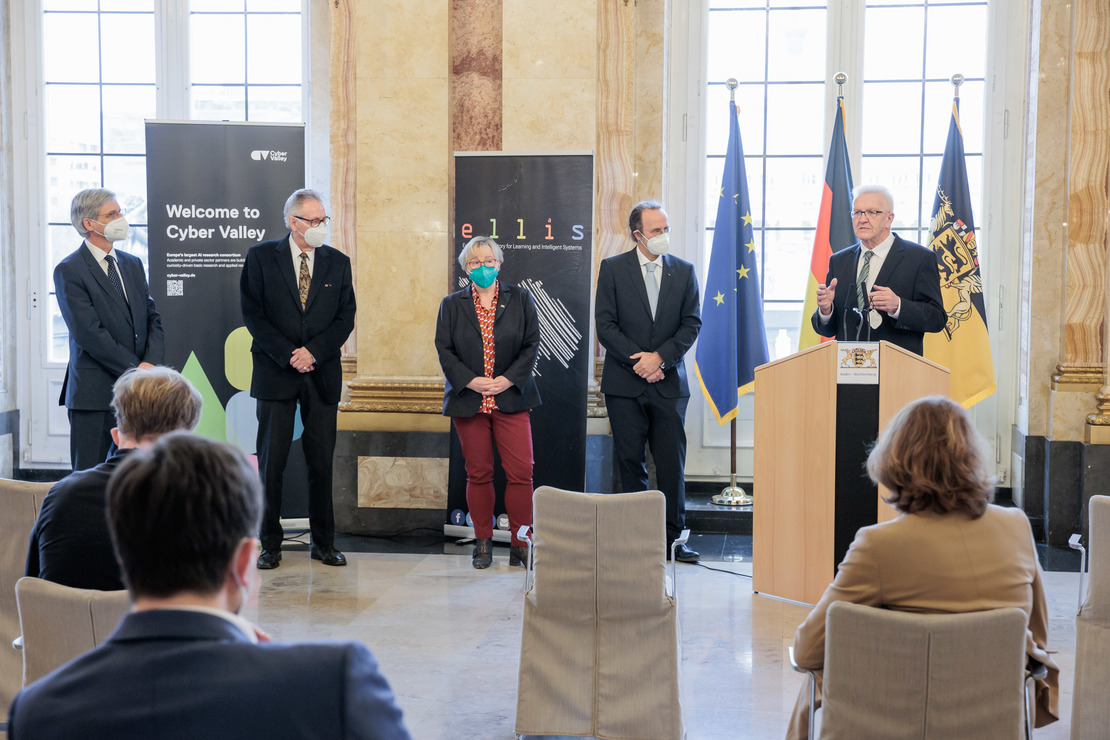
    “It is great that the Hector Foundation is further expanding its commitment to Tübingen as a research location with its extraordinarily generous support of the ELLIS Institute,” added President Engler. “With the Hector Institute for Empirical Educational Research at the University of Tübingen, which was founded in 2014, the foundation already showed that it is capable of setting forward-looking accents for building the profile of the location and proved that additional private funding can decisively advance public research. The ELLIS Institute is an important step towards positioning Tübingen at the European forefront of a research field that is essential for the further development of society and the economy. In addition, ELLIS will contribute significantly to permanently establish the Cyber Valley ecosystem as a beacon in the EU and beyond.”

    Cyber Valley in Tübingen to be further expanded

    A few weeks ago, the state government of Baden-Württemberg cleared the way for the expansion of the Cyber Valley Campus at the Tübingen site by several buildings with an investment of 180 million euros. One of these planned buildings (“Cyber Valley III”, Maria-von-Linden-Strasse 8) will be the future home of the ELLIS Institute, among others. With Cyber Valley – a central element of the state’s AI strategy – a leading international research location in the field of machine learning, machine vision and robotics has been established since 2016 in a joint initiative of science and industry in cooperation with the state of Baden-Württemberg and the Max Planck Society. With its sites in Stuttgart and Tübingen, Cyber Valley is already one of Europe’s largest research collaborations in the field of artificial intelligence on its fifth birthday in December 2021. Excellent basic research is combined with interdisciplinary and industrial research and a vibrant startup scene to form an innovation ecosystem.

    The research focus in Tübingen is on building learning systems that approach the versatility and robustness of natural intelligent systems. Many AI-based applications are locked into a specific problem, but stop working when that problem changes. They cannot recognize causal relationships. Research is underway in Tübingen on approaches to close this gap.

    ELLIS Institute aims to attract the world’s best AI talent

    One of the goals in Tübingen is also to establish the new ELLIS Institute, a research facility that will attract and retain the world’s top machine learning talent. The “Hector Endowed ELLIS Fellowships” will make it even easier in the future to attract highly qualified and globally sought-after researchers at all career levels, and to offer the greatest possible freedom as well as flexible framework conditions. “Scientists should be offered the best possible conditions to conduct pioneering basic research and to contribute with their research to breakthroughs in application areas,” Schölkopf said.

    The funded Hector Endowed ELLIS Fellows will find an excellent research environment and high-performance commercial enterprises in Cyber Valley. In particular, close cooperation with the Max Planck Institute for Intelligent Systems (MPI-IS) and the University of Tübingen is planned, for example in the form of joint appointments, doctorates and in the use of infrastructure. MPI-IS and the university already operate the Tübingen AI Center, one of Germany’s five AI competence centers, which is jointly funded by the federal and state governments.

    The ELLIS institute in Tübingen is to be followed by other institutes at other locations throughout Europe as part of the ELLIS initiative. The long-term goal of ELLIS is to build a pan-European research organization that can rival the leading AI sites worldwide and whose institutes each act as the nucleus of a highly innovative local ecosystem.

    About ELLIS:

    The European Laboratory for Learning and Intelligent Systems (ELLIS) aims to secure the lasting competitiveness of European AI by pooling the expertise of top researchers in machine learning and related fields across the continent. Founded in 2018, the ELLIS initiative has quickly grown into a pan-European network that counts 34 research units at world-class institutions in 20 countries, four of them in the state of Baden-Württemberg (Freiburg, Heidelberg, Stuttgart, Tübingen). At present, there are 14 ELLIS research programs as well as pan-European PhD program, which was launched in September 2020. With these and other initiatives, the members of the ELLIS network hope to promote excellence in basic research. This will enable European scientists to actively shape the technological and societal revolution of the 21st century with human-centered, beneficial AI.


  • Wohin gehst Du, Kolleg:in KI?

    Wohin gehst Du, Kolleg:in KI?

    Podiumsdiskussion mit Jun.-Prof. Dr. Maria Wirzberger, Prof. Dr. Steffen Staab, beide Sprecher:in des an der Universität Stuttgart neu gegründeten Interchange Forum for Reflecting on Intelligent Systems (IRIS) und Prof. Christina Elmer, bis 2019 stellvertretende Entwicklungschefin des Nachrichtenmagazins der SPIEGEL, jetzt Professorin für Digitalen Journalismus an der TU Dortmund.

    Moderation: PD Dr. Felix Heidenreich (IZKT)

    mit einem Beitrag von Studierenden der Hochschule der Medien und der Universität Stuttgart

    Eröffnungsveranstaltung des Projekts „Fragen an KollegIn KI“ im Rahmen des Wissenschaftsjahres 2022 – Nachgefragt!

    Das Projekt verfolgt das Ziel, Fragen der Bürger:innen zum Thema künstliche Intelligenz (KI) in einem ko-kreativen Dialog mit der Wissenschaft zu sammeln, zu diskutieren und auszuwerten. Damit will es Impulse für den zukünftigen Kurs von Wissenschaft, KI-Technologie und Kommunikation setzen.