User Group: General Public

  • Kick-off for AI in higher education

    Kick-off for AI in higher education

    With the funding initiative, the federal and state governments are striving to effectively develop the key technology of AI across the breadth of the higher education system. On the one hand, measures are supported that contribute to the qualification of future academic specialists. For example, universities will receive support in the development of degree courses or individual modules in the field of artificial intelligence. On the other hand, universities are supported in the design of AI-supported learning and examination environments.

    The project “Integrated AI in Teaching at the University of Stuttgart” (Integrierte KI in der Lehre der Universität Stuttgart, IKILeUS) aims to bundle the existing expertise of many collaborating departments on AI in order to both communicate AI to the breadth of the student body in an interdisciplinary view and to use AI-based technologies in teaching to relieve the burden on teachers and to improve teaching. The topics will be addressed with a focus on specific courses and software solutions, while at the same time looking at further potential of other user groups and areas.

    The Tübingen AI Training (Tübinger KI-Training, TüKIT) has set itself the goal of developing sustainable effective and curriculum-accompanying innovative teaching formats for students of medicine and medical-related life science courses. TüKITZ Med is designed to teach basic concepts and methods of artificial intelligence competently, effectively, compactly and in a way that accompanies the studies to students who are not familiar with AI.

    “AI is one of the key technologies that we are also working hard to advance in Baden-Württemberg. It is crucial for the economic success of our companies and the innovative strength of our state. Our universities, students and society as a whole will benefit from the new federal-state funding, in that university teaching can be improved through the use of artificial intelligence or future academic specialists can be better qualified for new professional fields,” said Science Minister Theresia Bauer. “I am thrilled by the diversity of the projects from Baden-Württemberg – it shows the commitment and innovative drive with which our universities are dedicating themselves to this topic of the future.”

    About the funding initiative “Artificial Intelligence in Higher Education”

    The legal basis for the funding initiative is the federal-state agreement “Artificial Intelligence in Higher Education” adopted by the Joint Science Conference (GWK) on December 10, 2020. The federal and state governments will provide up to around 133 million euros in funding. The funding will be provided in a ratio of 90:10 by the federal government and the respective state. The agreement runs until December 31, 2025, and an independent evaluation of the funding initiative is scheduled for 2024.

  • Cyber Valley on the Road

    Cyber Valley on the Road

    On this page, you will find an overview of our topics and FAQs about the process. Together with you, we will discuss which topic and format best suits your group and agree on a date. Simply drop us an email at: public.engagement@cyber-valley.de.


    Topics

    Workshop: Who determines what artificial intelligence should be able to do?
    An overview of current AI regulations

    What concerns do you have when you think of artificial intelligence (AI)? And what would an AI algorithm need to accomplish to make you feel good? Based on these questions, we provide an overview of current AI regulatory approaches, the ethical considerations behind them, and the relevant players. We explain in an easy-to-understand way how something as diverse as AI can be politically regulated and standardized, and show opportunities for citizens and companies to participate in this process. 

    Target group: The workshop is suitable for citizens without prior knowledge of AI as well as for people who would like to delve deeper into the current regulation of AI. 
    Duration: flexible, min. 45 minutes, max. 2.5 hours


    Offers in planning

    These offers are currently still being designed. Contact us if you are interested.

    (planned) The new form of science dialogue: public engagement

    As a growing and new orientation of science communication, public engagement aims to improve the dialogue between science and society and to interactively involve the public in research. The goal: a constructive-critical dialogue between society and researchers to bring in as many perspectives as possible for ethical, socially reflective and society-oriented research. Our public engagement managers provide insight into the Cyber Valley Public Engagement formats and their experiences. They will also present the Public Engagement Professional Code of Conduct project.

    Target audience: researchers and early career scientists, (science) journalists, and people working in science communication. 


    (planned) What is artificial intelligence?

    This workshop explains in an easy-to-understand way what artificial intelligence is and which topics are currently being researched in Cyber Valley. Afterward, participants can test some publicly available AI systems themselves. Previous knowledge is not necessary. More information will follow in due course.


    (planned) Artificial Intelligence in the working world

    Further information will follow in due course.


    FAQs

    What is the purpose of “Cyber Valley on the road”?
    Cyber Valley wants to encourage a dialog between science and society on the topic of AI. To this end, our public engagement managers regularly receive requests for topics and inquiries, which “Cyber Valley on the road” aims to bundle. We would like to offer our expertise to as many people as possible in the most uncomplicated way  and have developed this workshop concept for this purpose. 

    Who leads the workshops and gives the presentations?
    Our Cyber Valley Public Engagement Managers Rebecca Beiter and Patrick Klügel. 

    What does it cost to book a workshop or lecture?
    “Cyber Valley on the road” is free of charge. In-person events at your location may incur travel expenses and material costs.

    Who can book “Cyber Valley on the road”?
    Everyone who is interested and ideally already represents an interested group, e.g. youth groups or student groups, associations, educational institutions or NGOs. Interested private-sector corporations may also contact us. Preferably, more than eight people should register for the event. In the spirit of non-partisanship, we cannot offer workshops for individual political parties. 

    How do I book a workshop?
     Write us an email with the topics you would like to cover, the target group and the approximate date of the workshop at public.engagement@cyber-valley.de. We will contact you as soon as possible.

  • How does a robot learn to touch?

    How does a robot learn to touch?

    I would like you to concentrate on your hands. What do you feel right now?

    Actually, my hands are a little bit cold because it's winter. But beyond that, the sensations in my hands are most fascinating to me when I bring my hands into contact with objects in the world. Our hands are exquisitely sensitive to all kinds of different mechanical information and motions. Through our hands we accomplish just about everything we do in the world, whether it's picking up a glass of water, typing on a keyboard, driving a car, or hugging a loved one. All that physical interaction with the world passes through our sense of touch.

    When talking about the sense of touch, about “haptics”, what exactly do we talk about?

    I usually divide haptics into two main categories. The first category is about what you feel with your skin. Skin has little cells, mechanoreceptors, pain receptors and more that measure and detect what's happening, for example if the air is cooling or something is pressing, hurting, vibrating, or shifting back and forth. All those sensations are flowing through your peripheral nervous system up to your brain. And in the same way that all the little parts of an image are put together, your brain is making sense of this constant stream of different tactile sensations. 

    The other half of haptics is more about motion: Where is your body in space? If you curl your hand around, say a spoon, you feel its smoothness, coldness and edges against your skin. But how are your fingers shaped around it? Knowing the pose of your hand helps you interpret what your skin feels. These two categories of touch work together to both give you control over your body to accomplish what you want and help you understand the things that you're touching and doing in the world.

    If we build a robot with today’s technology, would its sense of touch be as good as that of a human?

    Definitely not. There are huge limitations. Most robots, whether it's a robot in a factory or a robot helping in a hospital, have almost no sense of touch. They have cameras and can see the world around them, and maybe they have other sensors, a network connection, access to data. Often the robot knows about its own body pose, but it almost never has skin. 

    That's because it's very expensive and difficult to fabricate artificial skin to make it both sensitive and robust. When things touch each other, they tend to get damaged, especially if they have little wires. And you do not only measure if something is touching you and where, but the vibrations, the transients, and the changes, like texture sliding over your skin. All of that happens really fast. So, we need a lot of measurements every second; it is not easy to fit that in the skin of a robot! 

    But if the human skin is already better than anything we can build right now, why should we build it? 

    Humans can do many jobs, but some jobs are dangerous, for example a disaster rescue, with radiation, or tasks deep under the ocean. And perhaps a human can do a task 
    once, but if you're going to do it thousands of times, this might be harmful and not the most stimulating or interesting job for humans. My father is a surgeon, and over his entire lifetime, his wrists and hands have started hurting because he's done repetitive motions. Robots tend to be good at that. So where could we use a robot to help? And can we automate pieces of the workflow? But still, in my systems, a human is usually in control of what's happening. 

    When you're at a party, how do you briefly explain to someone – who is not a scientist – what you are doing?

    Sometimes I give an example. Some people have seen in the press some of the projects we've done. For example, HuggieBot, a robot that can give good hugs to humans. 
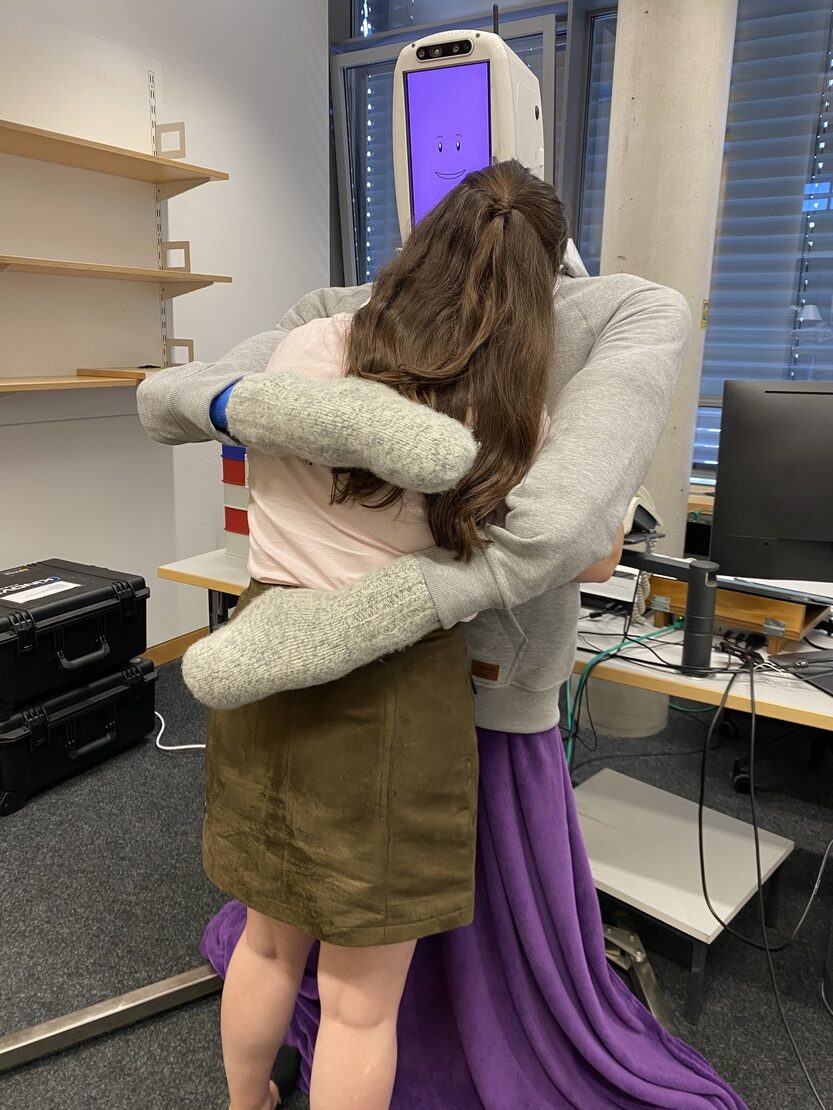
    HuggieBot

    Photo of HuggieBot; Max Planck Institute for Intelligent Systems

    Why should it do that?

    Creating an artificial system that simulates or replicates this interaction is highly beneficial. Hugs calm you down. They lower your stress, decrease your cortisol levels, and increase your oxytocin. During the pandemic we had to physically distance from our loved ones, but physical contact is a natural human need. By creating a hugging robot and adjusting how it behaves, we can test which factors are truly important. We varied how it physically reacted: We programed it to let go as soon as you let go, so it respects your wishes. We programed the robot also to proactively squeeze you gently. It was amazing to see how positively people responded then; they felt like the robot really cared about them.

    So, do we want robots to touch us as human-like as possible and or do we want a new way of interacting with machines, so we are not that much emotionally connected to something without feelings or emotions?

    Most of us have never hugged a robot before. This is the first robot of its kind, and I think you really have to try it to understand what it's like. In our studies, people actually hug much longer, like 20 seconds, whereas a typical hug with a friend is only two or three seconds long. We compared that to hugging a human. Many people mentioned feeling guilty about the actress we had hired to hug them. They said that she might feel uncomfortable at how long they would want to hug. With a robot, you don't have that. You don't have to worry about how the robot feels. 

    Haptic interaction is one way to interact with a robot. But you can also use speech, for example. Isn't it easier to just make the robot react to what you're saying it should do?

    It seems counterintuitive to humans because we're all so good at tasks like chopping up a carrot. But it is actually much easier for a robot to hear you say “robot, please chop the carrot” versus actually physically chopping the carrot. First, you have a dangerous thing, a knife. And a carrot is a natural material that is different every time. We have not yet mastered haptic intelligence nearly to the level of understanding speech. A robot can also look at the world and better understand what it's seeing compared to touching things or manipulating objects in the world.

    When I looked at your department’s research areas at the Max Planck Institute for Intelligent Systems and saw that one area was “understanding tactile contact”, I was actually a little bit surprised. I thought we already understand what touch is.

    Yes, we take our sense of touch for granted. Even think about how clumsy you become if your hand goes to sleep or if the dentist applies an anesthetic locally. You almost cannot talk or drink because you don't have this feedback of how your body is moving, which is tightly connected to how you activate your muscles. I guess touch is an under-appreciated sense because we're all so good at it through practice. Babies and children gain this experience through direct practice, and it takes years. I mean, I would not trust my four-year-old niece to chop a carrot. 

    How would you describe your department “Haptic Intelligence”, at the intersection of robotics and machine learning?

    That's close. We use machine learning in many aspects of our work, but I might say we're at the intersection of robotics and human-computer interaction. We're also trying to do curiosity-driven fundamental research to give some insights about how the human sense of touch works. 
     

    So where does the artificial intelligence come in?

    AI and machine learning are used for interpreting the signals. Let’s say I have a sensor on a robot, a fingertip sensor. There's some transformation which is often nonlinear and complicated. That's where the pattern recognition capabilities of machine learning really help. I chose the name of my department to be “Haptic Intelligence” because I believe that to create intelligent robot systems, we need not only the software side, but also improvements on the physical side.

    If someone wants to work in the field of tactile intelligence, what should they study?

    You should always follow your heart. Try a few things early in your career. If you know someone who's a computer scientist, ask them what they do. I think I could have been very happy as a computer scientist or as an electrical or a biomedical engineer. All of my degrees are in mechanical engineering, but I took a lot of classes in these other disciplines. A professor at Stanford used to tell us that we should try to be shaped like the letter “T”: broad, but then specialized in one area. You need to be able to speak to the other experts in relevant areas, so you can really build complex systems that are not only mechanical, but also involve electronics and a computer program. To me, it's very meaningful to create these integrated systems. It's complicated, it's tricky, but it's also fascinating.

    The interview has been edited and shortened for the written version. You can hear the longer version in the Cyber Valley Podcast Direktdurchwahl, Episode 06. Further information about the topic can be found here. 

    Graphic representation of a robot. Graphic: Cyber Valley / Beiter

  • Igniting the potential of AI

    Igniting the potential of AI

    Das virtuelle Event mit dem Titel „Igniting the potential of AI“ wird am 15. Dezember, 16:00–18:00 Uhr MEZ stattfinden. Zahlreiche renommierte Referent:innen geben Einblicke in Forschung und Innovation im Cyber Valley Ökosystem und beleuchten allgemein das Innovationspotenzial von KI.
     
    In diesem Event bringen wir spannende Eindrücke und Expert:innen aus Politik, Forschung, Start-up, Industrie und Investment zusammen. Eine detaillierte Agenda folgt in Kürze.

    Wir freuen uns darauf, viele von Ihnen bei unserem Jubiläumsevent zu begrüßen!


    Registrierung

    Bitte hier registrieren. Das Event findet via Zoom und in englischer Sprache statt.


    Sprecher:innen

    Grußwort von Winfried Kretschmann
    Ministerpräsident von Baden-Württemberg

    Grußwort von Theresia Bauer
    Ministerin für Wissenschaft, Forschung und Kunst Baden-Württemberg

    Michael Pfeiffer
    Global Head of AI Research, Bosch Center for Artificial Intelligence

    Michael J. Black
    Cyber Valley Sprecher und Direktor am Max-Planck-Institut für Intelligente Systeme

    Setareh Maghsudi
    Juniorprofessorin, Universität Tübingen

    Alexander Brem
    Direktor, Institut für Entrepreneurship und Innovationsforschung
    Inhaber des Lehrstuhls für Entrepreneurship in Technologie und Digitalisierung, gefördert vom Daimler-Fonds im Stifterverband

    Serina Pinar
    Gründerin und Chief Strategy Officer, Cytolytics GmbH

    Jonas Andrulis
    Gründer und CEO, Aleph Alpha GmbH

    Uwe Horstmann
    General Partner und Co-Founder, Project A Ventures


    Kontakt

    Julia Schmaus – Innovation Manager
    E-Mail: julia.schmaus@cyber-valley.de
    Telefon: +49 7071 601 1546
    Mobil: +49 151 6452 0213

  • Changing the world with AI

    Changing the world with AI

    On Friday, the projects of the finalists of the BWKI were presented in Tübingen. The award ceremony in the evening was broadcast live on YouTube. Beforehand, the top-class jury had decided on the winners of the competition.

    The main prize of the competition went to three 17-year-olds from the team “buffalo” from Erfurt, who developed an algorithm that analyzes pronunciation and detects speech abnormalities. In the future, the AI can be used in logopedic treatments or support the learning of foreign languages. The winners received a cash prize of 1500 euros.

    AI artist Mario Klingemann announced the winners of the young talent award. The team “SMAILE” from the boarding school Schloss Hansenberg in Geisenheim convinced with their AI, which allows to take photos intelligently and avoids unaesthetic, blurred or unsatisfactory shots. The team receives a cash prize of 500 euros and access to an online AI course.

    In the special category of environment and sustainability, juror and marine biologist Ute Wilhelmsen announced the winner. Katharina Bade from Magdeburg analyzed the breeding behavior of kestrels nesting in the walls of her high school with her project Siemens Falcons. The 17-year-old can look forward to a cash prize of 500 euros and an internship at a German marine research institute. The prize was donated by the German Alliance for Marine Research.

    The juror and moderator of the BWKI award ceremony, Philip Häusser, selected the winner in the special category of hardware. Maximilian Kraeft from Stollberg, Saxony, developed an autonomous robot in his project “tars” that has the ability to recognize obstacles and find its way through a maze. The 17-year-old will receive a cash prize of 750 euros.

    On Friday evening, viewers of the live broadcast had the opportunity to vote for their favorites, and thus for the winners of the audience award. This year’s audience award went to three 17- to 18-year-old young people from Erfurt, who use their AI “hateflow” to identify and punish hate and inflammatory comments on the Internet. The prize was endowed with 500 euros.

    The St. Augustin Gymnasium in Grimma, Saxony, defended its title as “AI School of the Year”. Thanks to the above-average participation of students from this school in the online AI course, the prize was awarded once again. As a prize, the high school received a class set of a sensory bionics construction kit (bionics4education).

    “AI is a real game changer”

    The BWKI final event had kicked off with the Hackathon on November 6 and 7, 2021. Together with the Badisches Landesmuseum and in cooperation with the Hack & Söhne initiative, challenges were set under the motto “Write Code – Write History”. Participants were asked to develop AI applications that would be used in museums of the future to optimize knowledge transfer. The winning project by a 16-year-old student uses augmented reality to bring museum objects to life. The four 17- and 18-year-old students on the “Hyperion” team generated new artworks based on museum data. The winning team will be supported by the Badisches Landesmuseum in the continuation of its project idea. Furthermore, book prizes and participation in different online courses were awarded to other teams.

    “Artificial intelligence is one of the most important and exciting topics of our time, it is a real game changer. In the BWKI, teenagers and young adults can actively shape this important topic of the future,” explained Baden-Württemberg’s Science Minister Theresia Bauer, Chairwoman of the Carl Zeiss Foundation Administration and patron of the BWKI. “Children have curiosity and fun. That makes them ideal researchers and they can live that out at BWKI,” said Professor Bernhard Schölkopf, Director at the Max Planck Institute for Intelligent Systems and one of the initiators of the competition. “It is just great and inspiring to see the creativity, skill and perseverance of the students in this competition. I dream of a society where we encourage each other a lot more to develop and try out good ideas,” added Professor Matthias Bethge, co-initiator of the competition and head of the Tübingen AI Center, BMBF Competence Center for Machine Learning.

    The jury of the competition this year included: Mario Klingemann (AI artist), TheMorpheus (YouTuber and computer scientist), Andrea Kranzer (business angel), Dr. Philip Häusser (physicist, TV presenter, web video producer), Dr. Ute Wilhelmsen (marine biologist), Prof. Dr. Veronika Eyring (climate scientist DLR and Univ. Bremen), Christoph Röscher (Bosch Center of Artificial Intelligence), Dr. Nina Gaissert (expert in bionics, Festo), Marlene Prautsch (Datascientist), Prof. Dr. Matthias Bethge, Dr. Wieland Brendel (initiators of the competition, University of Tübingen), Prof. Dr. Bernhard Schölkopf (initiator of the competition, Max Planck Institute for Intelligent Systems).

    More than 150 students had entered their project ideas in the 2021 competition. In the final, ten teams presented themselves to the jury and the audience. The basics of AI can be learned in a free online AI course offered by BWKI. So far, more than 4,000 students, teachers and interested parties have already taken advantage of the BWKI's offerings.

    The BWKI will be held again next year. The main sponsor of the competition is the Carl Zeiss Foundation. The competition was also supported by Bosch, Festo, paperspace, Google, Verlagshaus Droemer and Knaur, and was held in cooperation with Cyber Valley, the Media University and the German Alliance for Marine Research.


    About the BWKI:

    BWKI motivates students to use the tools of artificial intelligence to implement their own ideas for a better world of tomorrow. The national competition was launched in 2018 at the AI research site in Tübingen by the Competence Center for Machine Learning and enables young people to actively demonstrate their skills in the AI research environment. For more information, visit https://bw-ki.de and https://ki-kurs.org.


    About the Carl Zeiss Foundation:

    The Carl Zeiss Foundation’s mission is to create an open environment for scientific breakthroughs. As a partner of excellence in science, it supports basic research as well as applied sciences in the STEM subject areas (science, technology, engineering and mathematics). Founded in 1889 by the physicist and mathematician Ernst Abbe, the Carl Zeiss Foundation is one of the oldest and biggest private science funding institutions in Germany. It is the sole owner of Carl Zeiss AG and SCHOTT AG. Its projects are financed from the dividend distributions of the two foundation companies.