User Group: General Public

  • KI-Sprechstunde

    KI-Sprechstunde

    Am 18. Oktober stellt sich von 19:30 bis 20:30 Uhr Prof. Dr. Ulrike von Luxburg (Expertin für Methoden des maschinellen Lernens) den Fragen der Bürger:innen.


    Registrierung

    Diese Ausgabe der KI-Sprechstunde ist eine Kooperation mit der vhs Tübingen. Bitte registrieren Sie sich hier. Die Sitzung wird in deutscher Sprache via Zoom abgehalten.


    Kontakt

    Patrick Klügel – Public Engagement Manager
    Mobile: + 49 151 74238237
    E-mail: patrick.kluegel@cyber-valley.de


  • AI in art and science communications

    AI in art and science communications

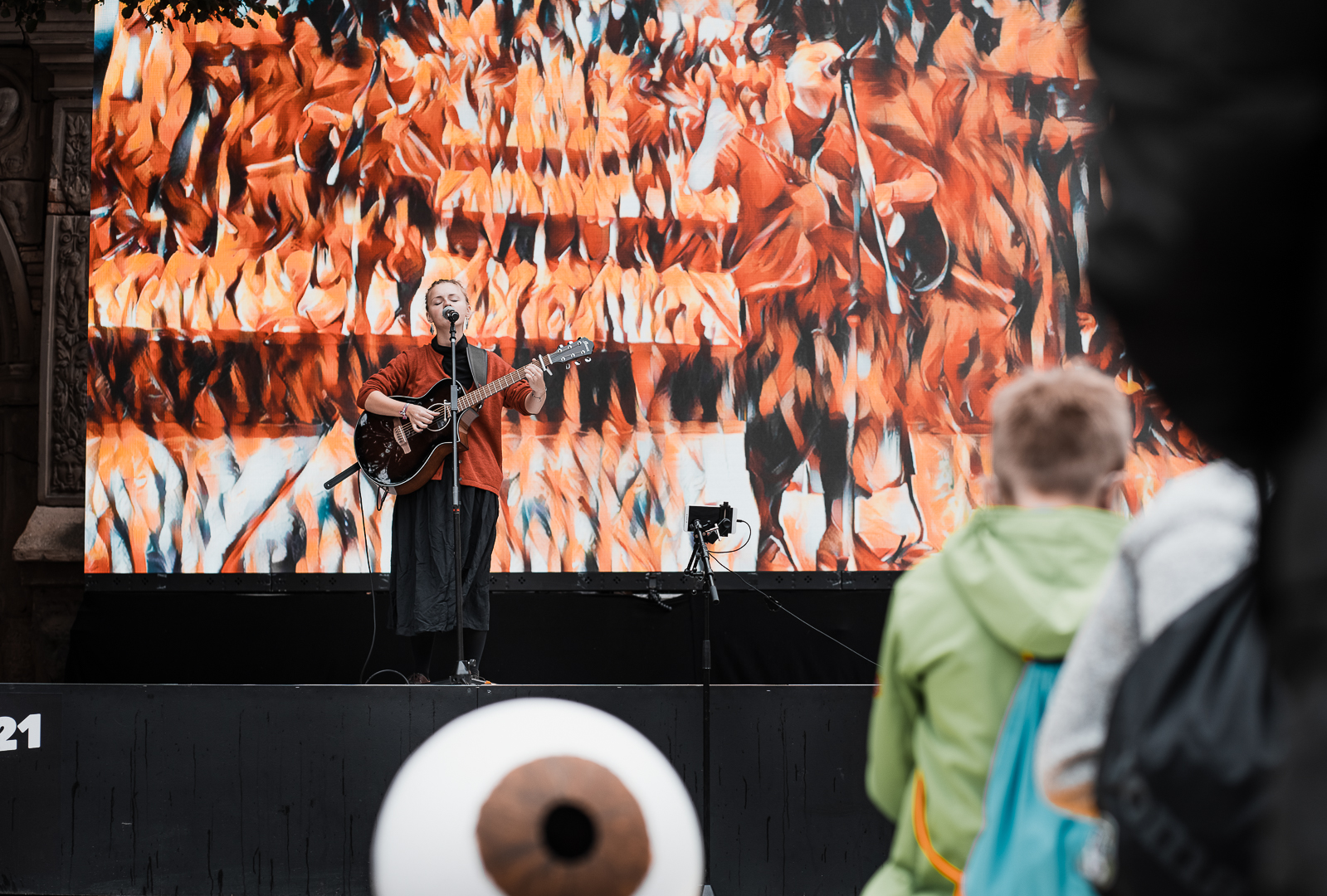
    Particularly visible was an installation by the Tübingen-based AI artists group Lunar Ring. Their installation “Augenblick” was a success as it accompanied and visually commented the opening and other events of the festival. The scientific mind behind it, Johannes Stelzer from the Cyber Valley start-up Colugo, expects significant changes in the arts and entertainment industry in the coming years through new creative AI tools.

    “The basic concept behind the installation ‘Augenblick’ was a combination of performance formats with AI visuals that were generated in real-time though various cameras and our AI supercomputer”, said Stelzer. “In so doing, a new format comes to life: ‘emergent creativity’. We also mounted a camera in a big, mobile ‘eye’ and left it for the audience to play with. People loved experimenting with it! Especially during the music performances, a new relation between dream world and the reality of moment was created. We want to continue to build on this.”

    Another Cyber Valley project was featured during the accompanying Silbersalz conference at the National Academy of Sciences Leopoldina. Six Cyber Valley AI MediaLab participants pitched their thought-provoking ideas on how to adequately present the importance and chances of AI research to a broad audience. These ideas for games, exhibitions and films were developed in close collaboration with creative minds from the very beginning. This kind of co-creation led to learning processes on both sides, as fellow Krikamol Muandet points out.

    “The extensive collaboration with creative artists helped me better communicate my research to the public and make it more impactful”, Muandet said. “It pushed me outside of my comfort zone by forcing me to think actively about important aspects of my research that I would not have thought about. The Silbersalz AI MediaLab allows me to step out of my research bubble and explore new and creative ways of making a real-world impact with my research.”

    The projects are now going to be implemented. We will report on the next steps and results in our public engagement newsletter.

  • Max Planck Institute celebrates double anniversary

    Max Planck Institute celebrates double anniversary

    The importance of both institutes for Baden-Württemberg – as well as Germany as a whole – as a center for research was also highlighted. In particular, the impact generated by recent research results in machine learning, computer vision and robotics has made the Stuttgart and Tübingen region and beyond one of the world’s leading centers for research into artificial intelligent systems.

    “When I started working on machine learning, it grew out of a scientific interest in understanding how to detect patterns in observations,” says the institute’s Managing Director, one of the world’s most cited AI researchers, Prof. Bernhard Schölkopf. “I had no idea how much our world would change, and how my home area would change, too. Technical systems of the future will deal with the complexity of the world by learning from observations. This is a paradigm shift that is universal, from astronomy and climate research to medicine. The path from basic research to application is short here, and the people involved are often one and the same. Our Max Planck Institute has been at the center of this development for ten years.”

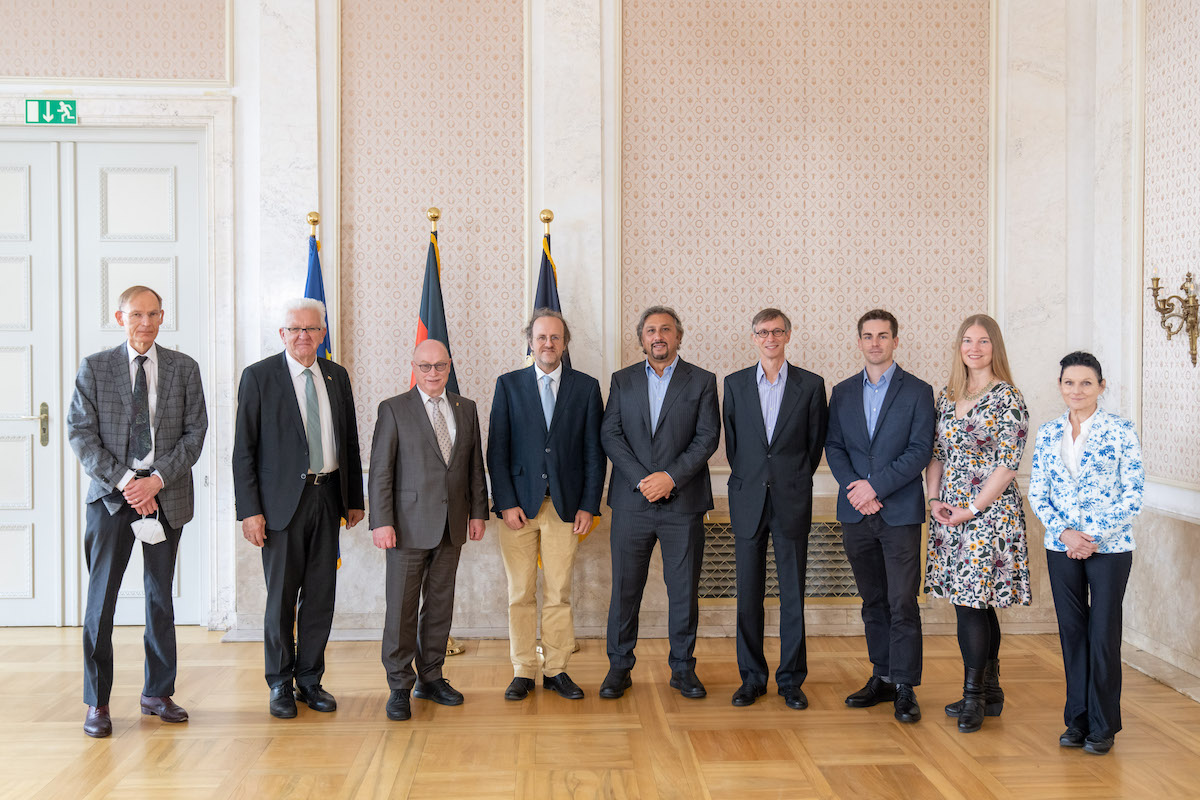
    Prominent guests, who have contributed significantly to the institute’s success and strongly supported it from the beginning, were invited to Stuttgart’s Neues Schloss. In attendance was Baden-Württemberg’s Minister President Kretschmann, who recognized the importance of the research field of machine learning early on and has strongly supported it over the years. Kretschmann was therefore full of praise: “Some observers wonder: How did they manage to do it? From my point of view, there are three factors: The right attitude. The right people. The right vision.”

    Referring to Europe’s largest research consortium, Cyber Valley, he said: “When we launched Cyber Valley in 2016, it was clear to us: if we do this now, we have to do it with our full commitment. That’s why the motto is:  We are not doing things by halves!” The Minister President also praised the vision behind the network of Europe’s leading AI centers, the European Laboratory for Learning and Intelligent Systems – ELLIS for short. “With Ellis, our region will finally become the hub for a dedicated AI competence in Europe.” He also emphasized that research must always serve to allow people to live in freedom and dignity. These values, he said, are precisely what drive researchers at the MPI for Intelligent Systems. “Therefore, I am looking forward to the future of the institute here in our land.”

    The Max Planck Society’s (MPG) President Stratmann also expressed his pride in the MPI for Intelligent Systems and the MPI for Metals Research. Although a metals researcher himself who had always admired the world-renowned materials research at the MPI-MF, Stratmann was the driving force in the Max Planck Society to attempt a radical transformation and reorientation. At the time the MPG’s vice president, he had strongly supported the shift toward intelligent systems in 2009.

    “The MPI for Metals Research was always modern in the best sense of the word and open to the future. So it was perhaps no wonder that, over ten years ago, people here were willing to embark on a completely new adventure,” says Stratmann. “At the time, we were discussing an interesting future field of research in the Chemical Physical Technical Section, the field of cognitive robotics. In the course of the deliberations, our view broadened beyond cognitive robotics into the field of machine learning and artificial intelligence in general – by the way, long before this field of research gained the importance it has today.”

    There seems to be an unspoken agreement in Baden-Württemberg, Stratmann continued, that if an idea makes sense, politics, business and research pull together. “I notice this here again and again, and it’s impressive. People think and act with a long-term view; but that’s precisely what can lead to success in the short term – if you make the right decisions at the right moment. As has happened here. By doing so, you have all performed a service not only to the state of Baden-Württemberg, but also, in my eyes, to Germany as a center of science.”

    President Stratmann therefore also appealed to all employees of the Max Planck Society to pursue the science that excites and fascinates them. “Take the paths that maybe no one else has taken before you, tread into uncharted territory. In science, as perhaps nowhere else, the saying holds true: only those who dare win.”

    The event also included two scientific presentations – one in the field of materials research and one in the field of machine learning. Prof. Dr. Claudia Felser, Director at the Max Planck Institute for Chemical Physics of Solids, gave a talk titled “From topology to green hydrogen.” Dr. Joaquin Quinonero-Candela, until recently Distinguished Technical Leader for Responsible AI at Facebook, spoke on the topic of “Responsible AI”. He spoke about the importance of not leaving the development and application of AI to the US and China alone. Europe, he said, must take a leadership role with its culture and values. The world needed Europe as a leading force in artificial intelligence and machine learning.

    The researchers at MPI-IS are committed to this mission. People are the ones at the center of research at the MPI for Intelligent Systems, Bernhard Schölkopf concluded: “Anchored in the process by which our institute reinvented itself was the shared belief of all involved that if we want to positively shape the future, it is primarily about people.”

  • ELLIS and Aleph Alpha receive German AI Prize

    ELLIS and Aleph Alpha receive German AI Prize

    With prize money totaling 100,000 euros, the 2021 AI Innovation Prize went to the European Laboratory for Learning and Intelligent Systems (ELLIS), which was co-initiated by scientists from the Tübingen AI Center and the Max Planck Institute for Intelligent Systems in April 2018 as the first European Network of Excellence in artificial intelligence (AI). The ELLIS mission is to create a diverse European network that promotes research excellence and advances breakthroughs in artificial intelligence (AI), as well as a pan-European PhD program to educate the next generation of AI researchers. ELLIS also aims to boost economic growth in Europe by leveraging AI technologies. For this purpose, it aims to create agile research institutions inspired by the Vector institute and EMBL. The initiative shares the prize with the Confederation of Laboratories for Artificial Intelligence Research in Europe.

    “We are honored to receive the shared German AI Prize for ELLIS,” said Nuria Oliver, co-founder and vice-president of ELLIS, in accepting the award. A multiple award-winning scientist, Oliver also co-founded the ELLIS Unit in Alicante, which focuses on research in the area of human-centric artificial intelligence. “From the moment we founded ELLIS in April 2018, our goal was to establish the best possible conditions for research and innovation in European AI. Our grassroots initiative aims to attract and retain the world’s best talent, intensify cross-border collaboration between Europe’s best research institutions, and build partnerships between academia and the private sector. We’ve made great progress in the last three years, and this prize is an important acknowledgement and recognition of our contributions,” said Oliver.

    In the AI User category, the prize was awarded to the AI start-up Aleph Alpha GmbH, a member of the Cyber Valley Start-Up Network. Headquartered in Heidelberg, the company researches and develops AI models for language and image data, as well as for strategies aiming to secure Europe’s digital sovereignty. “We see the German AI User Award not only as an acknowledgement of our work: it also encourages us to be even more determined in our efforts to help secure Europe’s position in the global AI landscape, which is driven by large AI models,” said Jonas Andrulis, founder and Chief Executive Officer of Aleph Alpha.

    Established in 2018, the annual German AI Prize honors outstanding contributions in research and development, as well as achievements and progress in the application and commercialization of AI. The prize winners are selected by an international jury comprising prominent personalities from science, research, and the private sector. In 2020, the AI Innovation Prize was awarded to Bernhard Schölkopf, Director at the Max Planck Institute for Intelligent Systems in Tübingen, co-founder of Cyber Valley, and co-founder of ELLIS. This year, the jury was chaired by the German entrepreneur Chris Boos, founder of the AI company Arago, Chief Technical Officer of the Swiss cybersecurity company Wisekey, and a leading global visionary in the field of artificial intelligence.

  • The emerging field of public engagement

    The emerging field of public engagement

    Professional ethics

    At the Berlin School of Public Engagement’s First Steps Symposium in September 2021, public engagement professionals from the field of science communications discussed challenging conflict situations they had encountered in their day-to-day work. “I don’t want to do public engagement for military projects,” said one participant. Another expressed concern about “starting from scratch” at his institution with regard to raising awareness on the importance of ethical guidelines in communications. In turn, other participants discussed encountering resistance when they attempted to present scientific results in an accessible manner, as some researchers worried that important details would be lost.
    By default, PE managers are committed the public as their most important stakeholder – however, they are not entirely neutral. Rather, they are responsible for interacting with the public in a way that ensures the values and transparency of scientific research, for instance when private sector partners are involved. This also goes beyond presenting research findings and sets PE apart from traditional public relations. Especially in critical situations, guiding principles for the field of public engagement can be of help, a professional code comparable to the well-established code of ethics that applies to journalists, for instance.

    What is public engagement?
    Public engagement actively involves the public in research and is thus more than simply communicating knowledge or science. Rather, PE facilitates a variety of constructive and critical interactions between society and researchers. The field’s ultimate aim is to ensure that research takes a broad range of perspectives into account, thus helping make scientific progress ethical, well thought through and in alignment with the affected people, and beneficial to society as a whole.

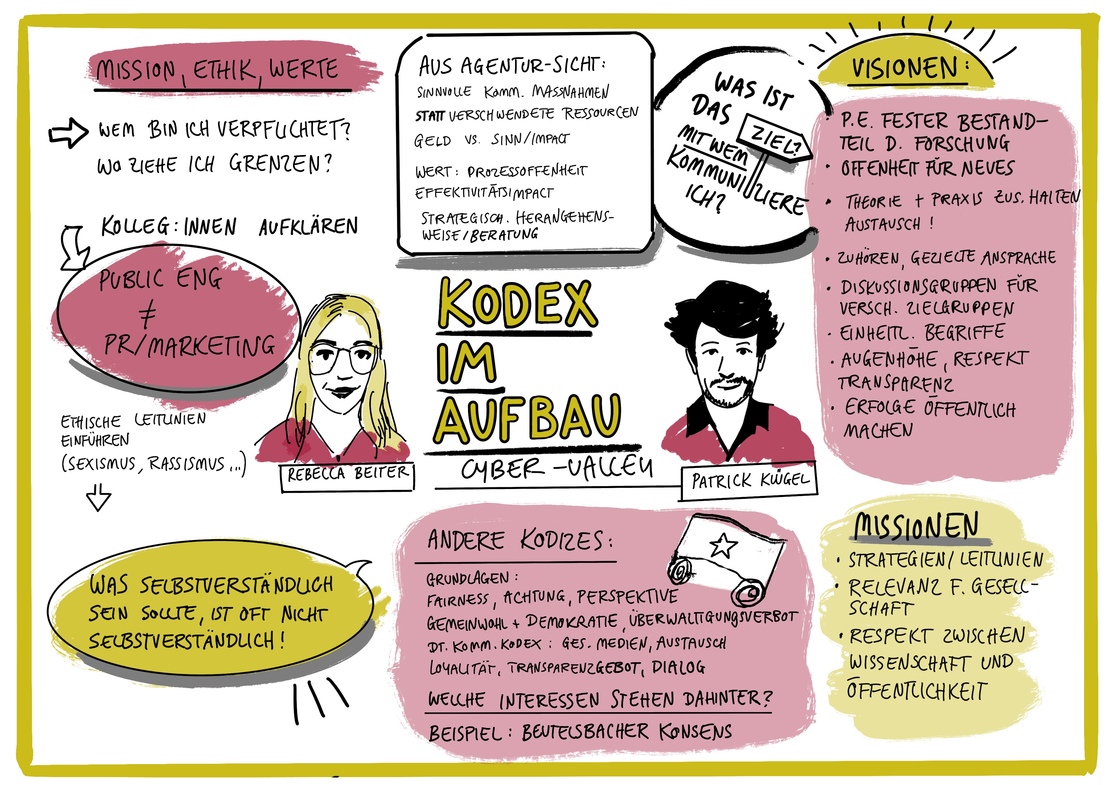
    The virtual “Code of Conduct in the Making” meeting, the results of which are documented here, was a first step toward establishing a professional code of conduct. Rebecca Beiter and Patrick Klügel chaired the meeting. The two Cyber Valley public engagement managers are among the first employees of German universities to have this professional title. Together, they are committed to professionalizing the field. With the support of the Berlin School of Public Engagement, they are overseeing the further development of a professional code of conduct. “Working on a professional code has helped us take a long, hard look at our values and the aims of public engagement, and to establish a universal basis for the field beyond the areas of research we represent,” says Beiter.


    Graphic: First Steps Symposium / Barbara Ott


    Public engagement: vision, mission, and guiding principles

    A look at other codes of conduct in science communication shows that principles such as transparency or a focus on the greater good are common elements. As the initial proposals of the working group show, public engagement sets itself apart from traditional science communication and public relations, despite overlapping content. [Overview of codes of conduct, in German.] In formulating a vision, participants began to define the central aims of public engagement:

    Public engagement links science and society. It encourages scientists to welcome the perspectives of other social actors. When scientists interact with society and members of the public are involved in scientific processes, the results of scientific research are more likely to be socially relevant. With a variety of interactive formats, citizens are given opportunities to interact directly with scientists. This not only helps increase the public’s understanding of scientific methods, it also provides insights into the perspectives of researchers. At the same time, public engagement makes dialog an integral part of the research process, enabling a continuous exchange and thus making it possible for researchers to take citizens’ suggestions into account. This, in turn, promotes social responsibility in science.
    PE is an established profession and the subject of research.

    The group also agreed on important principles that all public engagement activities should observe, including due diligence and a focus on facts in dealing with scientific findings. Transparency and a commitment to the common good are also important elements of any PE strategy, as are tools to encourage and facilitate researchers’ engagement with society. In a working paper, group members have collected additional points to consider in the development of a mission and vision.


    A work in progress: help shape the PE code of conduct

    The working paper is open for comments on the Berlin School of Public Engagement’s interactive platform: https://www.publicengagement.berlin/kodex-im-aufbau. The PE code of conduct working group is now drafting a preliminary document to be presented and discussed at another event.
    In line with the public engagement approach of including as many perspectives as possible and being open to all interested parties, we would also like to invite you to participate in our working paper and the working group. If you work in science communication, would like to be part of an ongoing dialog with society, and are interested in this open-ended process, please contact us at: public-engagement@cyber-valley.de.

    Cyber Valley public engagement

    As Europe’s largest consortium for research and innovation in the field of modern AI, Cyber Valley has a vested interest in helping shape a comprehensive long-term approach to public engagement. This includes finding ways to intensify the exchange between science and society, as well as developing formats that promote different levels of interaction. Doing so will plant the seed for a mature and diverse public engagement community. Ultimately, the success of the Cyber Valley public engagement strategy will be measured against the extent of society’s participation in complex basic research on artificial intelligence (AI) and intelligent systems.
    The aim is AI research that is ethical and beneficial to society. Established formats such as the Cyber Valley podcast Direktdurchwahl or the AI Office Hours complement long-term projects such as the development of an AI Makerspace for young people. An overview of our current activities can be found here: https://cyber-valley.de/en/public-engagement. In a guest article in Wissenschaftskommunikation.de, Cyber Valley public engagement managers Rebecca Beiter and Patrick Klügel describe their strategy in detail. If you would like to keep abreast of Cyber Valley public engagement activities, please subscribe to the PE newsletter.

  • Communicating AI to the general public

    Please meet the scientists and their media collaborators:

    • Alexis Block, Doctoral Fellow, Center for Learning Systems, a joint program between the Max Planck Institute for Intelligent Systems and ETH Zurich, USA  /  Felix Gaedtke, Creative Producer, NowHere Media, Germany
    • Egor Iuganov, Doctoral Candidate, International Max Planck Research School for Intelligent Systems, Germany / Avinash Kumar, Senior Data Scientist at Siemens
    • Viktoriia Kamska, Doctoral Student, Dynamic Locomotion Group of the Max-Planck Institute for Intelligent Systems, Germany / Sigrid Anita Haugen, Composer, Norway / Ben Carlin, Director, Megaverse, UK
    • Nicole Ludwig, Research Group Leader, University of Tübingen, Germany / JD Whitman, Installation Artist, USA
    • Krikamol Muandet, Research Group Leader, Empirical Inference department at Max Planck Institute for Intelligent Systems, Germany / Rachel Briscoe, Writer, Producer, Fast Familiar, UK / Jamie Perera, Sound Artist, UK
    • Sergey Prokudin, Postdoctoral Researcher, ETH Zurich, Switzerland

    Where other programs focus on embedding artists and creatives with scientists to inform their creative practice, the AI Media Lab puts scientists at the forefront of the collaboration. Each scientist developed a creative concept for their research and took part in a matchmaking process to forge a new collaboration with an artist or media producer. The final results will be pitched live at Silbersalz.

    Register for the conference and watch the livestream from National Academy of Sciences, Leopoldina: https://eveeno.com/145128153


    About Silbersalz Festival:

    “All human beings are born free and equal in dignity and rights”, as stated in the Universal Declaration of Human Rights. However, the reality is often quite different. What can science do to overcome injustice and discrimination in society, politics, and environmental issues? Using the motto “Inequality”, Silbersalz21 is looking for answer along with its audience – from 15 to 19 September 2021 at various locations in Halle (Saale).

  • NoBIAS Summer School 2021

    Die Liste der Referent:innen umfasst:

    • Krishna Gummadi,
    • Ricardo Baeza-Yates,
    • Alexandra Olteanu,
    • Stephanie Law,
    • Mathias Niepert,
    • Hinrich Schuetze,
    • Katharina Kinder-Kurlanda
    • und Annette Zimmermann.

    Termin: 20.–22. September 2021, ab 9:30 Uhr CEST.

    Die Anmeldung ist kostenlos. Sie können sich für eine, zwei oder alle drei Sitzungen anmelden. Einzelheiten zur Anmeldung, den detaillierten Zeitplan sowie Informationen zu den Abstracts und den Referent:innen finden Sie unter https://nobias-project.eu/index.php/nobias-summer-school/.