User Group: General Public

  • Life Improvement Science Conference

    Life Improvement Science Conference

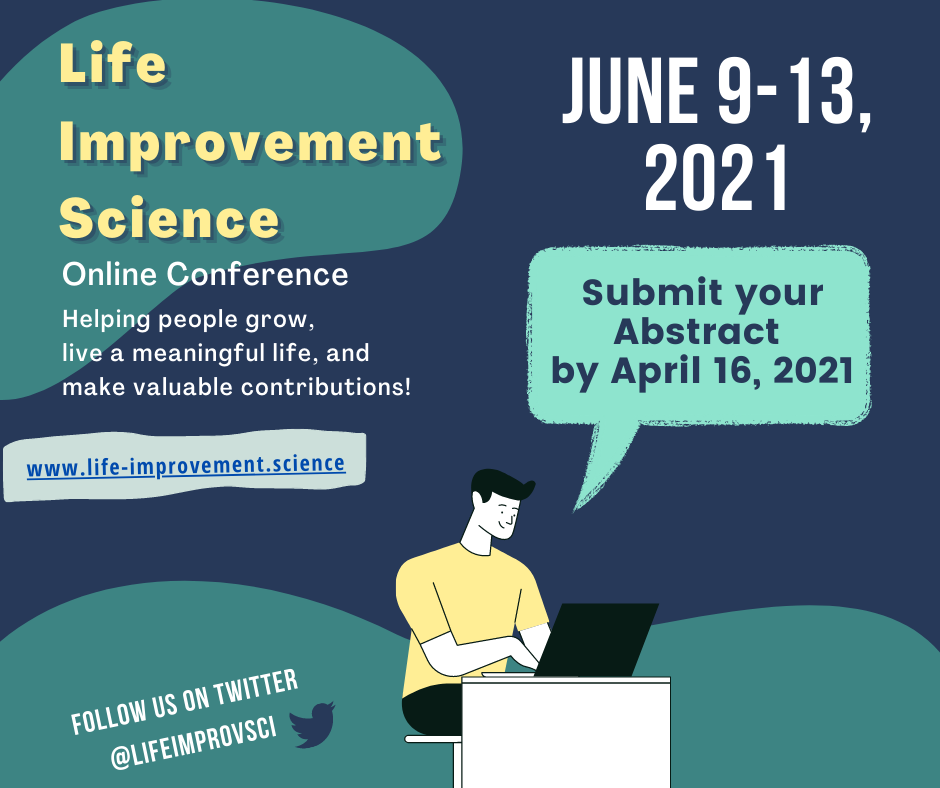
    The first Life Improvement Science conference will be held online between June 9 to June 13, 2021. The conference aims to:

    1. Build a supportive community of researchers and practitioners interested in life improvement science and its applications.

    2. Work towards a shared understanding of the most important open questions of the field and how they can be answered.

    3. Provide an overview of some of the most important research that has been done in different areas of life improvement science.

    4. Foster intellectual exchange and collaboration across different fields.

    The conference is open to the general public. Registration is currently open on the event website. The conference will include talks about promising approaches to life improvement science and its future directions, interactive discussions, a look at the field's most important open questions, presentations of recent work, and opportunities for scientists to collaborate on developing new ideas and establishing life improvement science. 

  • Your questions for artificial intelligence

    Your questions for artificial intelligence

    This impression is not deceptive. Neither is there a clear AI label, nor a directory for applications that contain learning algorithms. Getting an overview is nearly impossible. However, as AI systems are used in more and more areas and are increasingly involved in decision-making, there are now also calls at the political level to regulate them more closely. In April, the EU Commission presented a proposal for a new regulation. According to this, AI systems in high-risk areas must be provided with clear and concise information so that users can deal with them adequately.
     
    So there is likely to be some movement at the interfaces between humans and machines. Those who operate learning systems could be obliged to explain how they work. But here, too, communication has two sides: Whether an explanation is effective depends largely on whether it is understood. Therefore, it is not enough to ask the developers of AI systems for explanations. The focus should also be on the users – on their questions, their prior knowledge and their reservations. All of this must be taken into account in order to support people in dealing competently with AI systems.
     
    So how do we find out what is important to users? It’s simple – we ask them: Tell us what information about AI systems is really important from your point of view. We have prepared an anonymous survey for this purpose, in which you will also find suggestions for relevant questions. Participation will take 15 minutes. We are very much looking forward to learning more about your view!

  • New podcast online: AI in the world of work

    New podcast online: AI in the world of work

    “I see great opportunities in AI for inclusion and participation for all,” says Matthias Peissner, head of the Human-Technology Interaction research group at the Fraunhofer Institute for Industrial Engineering IAO. “We should avoid the mistake of trying to hold on to what we know. We have to acknowledge that this change is happening. If we don’t, we will miss out as a society.”

    To what extent can society help steer these developments? What should the future of work look like? Where do we even want to go? We address these and other questions in the second episode of “Direktdurchwahl”.

    The podcast is available free of charge at cyber-valley.de/podcast as well as on Spotify, Deezer, Google Podcast, and Amazon Music/Audible.

  • HR and Talents

    HR and Talents

    Wissenschaftler:innen, Gründer:innen, Studierende und alle, die sich für dieses Thema interessieren, sind am Donnerstag, 17. Juni, von 14:00 bis 15:30 Uhr herzlich eingeladen!

    Speakers

    Sophie Bieber

    Talent Attraction Experience Manager, SAP

    Nadine Roth

    Head of Talent, MARKT-PILOT

    Naureen Mahmood

    CEO, Meshcapade

    Registrierung

    Bitte hier registrieren. Das Meeting findet via Zoom und in englischer Sprache statt.

    Kontakt

    Oliwia Gust – Cyber Valley Event Manager
    Telefon: +49 7071 601 1554
    Mobil: +49 151 4075 6302 
    E-Mail: oliwia.gust@cyber-valley.de


  • “I see myself as a moderator who organizes dialog”

    “I see myself as a moderator who organizes dialog”

    What is public engagement? What it is about?
    “In essence, public engagement means public participation. The term is well known in the US and UK, where universities and research institutions have had well established and professional public engagement activities for many years. The basic idea here is that engagement is always an interactive, two-way process that involves speaking and listening in equal measure. While this may sound simple, it’s not as easy as it seems. Both the general public and the scientific community should benefit from this exchange. Ultimately, Cyber Valley Public Engagement is about creating opportunities for dialog on topics related to the research field of artificial intelligence. We assess and embrace society’s questions and need for knowledge and strive for a constructive, critical, and fact-based dialog with researchers.”

    Does that mean that public engagement is ultimately just a slight variation on public and media relations?
    “No, it isn’t. Of course, public engagement also involves a great deal of communication, but the focus here is on conversation. More specifically, we aim to give space to a broad range of perspectives. Ideally, something new can emerge from the exchange. This also means that we engage in a process to develop approaches that enable the open interaction I just mentioned. I see myself more as a moderator who organizes and supports this dialog for the benefit of both science and society. That is something fundamentally different from PR in the conventional sense.”

    Why is public engagement so important for Cyber Valley?
    “For structural reasons, the relationship between the public and science is out of balance. In recent years, however, it has become increasingly clear that both sides depend on each other. Public engagement activities can make a positive contribution here, for instance if our activities lead to more informed exchanges for both sides.

    “Artificial intelligence is a very broad field and many people have very different understandings of what AI is. Some ideas and expectations, including fears or even rejection of AI, are well-founded and understandable. Other associations are more reminiscent of Hollywood movies or exaggerated depictions of the technical possibilities. And, as I’ve noticed time and again in the course of my work, many people have only little understanding of the implications of AI in real life.

    “In the Cyber Valley research consortium, very different players are cooperating with each other in specific, clearly defined areas. People want to understand the structures and how they work. More importantly, the fields of machine learning, computer vision, and robotics, which are generally summarized as artificial intelligence, may give rise to technologies that can change society. That's why we also need a broad debate beyond academia that is conducted on the basis of good information. We aim to achieve this with our public engagement formats.”

    What is Cyber Valley from your perspective as a public engagement manager? What are the Cyber Valley’s goals?
    “At its core, Cyber Valley is a research network in which AI scientists from the University of Stuttgart, the University of Tübingen, and the Max Planck Institute for Intelligent Systems conduct free basic research. They are joined by other research partners such as the Fraunhofer-Gesellschaft and seven industry partners. In addition to promoting research, Cyber Valley is also explicitly concerned with training AI specialists. At a Max Planck research school, for example, hundreds of young scientists are studying for their PhDs.

    “It also includes promoting a culture of entrepreneurship and innovation. In other words, the contribution to the economy should not only be measured in terms of training specialists, but also in terms of securing or even creating new jobs. There are several ways to do this. It is still rare for researchers to found start-ups. Such spin-offs may pursue commercial purposes or operate without the intention of making a profit. Frequently, young researchers move to industrial companies once they have completed their training. Personally, I find it particularly exciting that Cyber Valley also aims to advance social discourse on the topic of AI.”

    The term ‘ecosystem’ comes up quite often in connection with Cyber Valley. What does it mean?
    “Many initiatives, institutions, and networks have developed within the Cyber Valley research network. For example, there's the AI Competence Center at the University of Tübingen, as well as the Cluster of Excellence for Machine Learning in Science. Then there is a master’s program in machine learning at the University of Tübingen, the ELLIS European research network, and the AI Progress Center Learning Systems, which is operated jointly with Fraunhofer. In addition, the spin-offs I already mentioned are connected to one another in the Cyber Valley Start-up Network. This AI environment in Stuttgart and Tübingen has become so complex that it can be confusing to people, but it’s what we mean when we talk about the Cyber Valley ecosystem. It is work in progress: a living, breathing project in which many different stakeholders cooperate with and benefit from one another.”

    What role do ethical considerations play in AI research?
    “They play a very important role, especially in publicly funded science. There is the dual-use issue: simply put, any tool, technology, or invention can in principle be used for both civilian purposes and non-civilian purposes. This also applies to artificial intelligence. For this reason, the allocation of research funds, for example, is very closely observed here. However, because research freedom and independence are secured in Article 5 of the German Basic Law, dual-use poses a challenge that is not easy to solve.

    “In the case of the Cyber Valley Research Fund, which is funded by industry partners, a Public Advisory Board (PAB) of independent ethics experts and civil society representatives reviews research proposals closely. This advisory board examines whether a research project might pose problems from an ethical point of view that could have dangerous consequences for society. This diverse advisory board is the first of its kind in public AI research.

    “Although AI researchers fundamentally want to and should contribute to the good of society with their research, they sometimes do not see certain risks themselves. They need to be made aware of these risks and trained to recognize them. Dialog with society can help in this regard. Cyber Valley researchers are very interested in engaging in this dialog – and that’s why it’s important that people from very different backgrounds get involved in our projects.”

  • Ready, steady, go!

    Ready, steady, go!

    Please find the full article below in German.

    KI lernen und verstehen!

    Das Team rund um den Bundeswettbewerb KI hat in den vergangenen Monaten am KI-Online Kurs gefeilt und geschliffen: neuer Look, neue Inhalte und neue Möglichkeiten das Mysterium KI zu verstehen. Wie baue ich eine KI?, Woher kommt KI? und Wie gehe ich mit KI um? sind die zentralen Fragen, die im Online Kurs, im Unterricht, der AG oder in der Freizeit, bearbeitet werden können. Brandneu: ein ehemaliges BWKI Finalisten-Projekt wurde als Tutorial aufgearbeitet und bietet dem Nutzer die Möglichkeit ein KI-basiertes Recycling tool zu entwickeln. Am besten einfach mal reinschauen: www.ki-kurs.org

    KI Schule des Jahres.

    Auch in diesem Jahr ist das Rennen um die KI Schule des Jahres eröffnet. Die Schule, welche mit den meisten Schüler*innen aktiv am Online KI-Kurs (www.ki-kurs.org) teilnimmt, wird im November bei der Abschlussveranstaltung des Wettbewerbes mit dem Titel ausgezeichnet.

    Teamwork rocks!

    Schüler:innen weiterführender Schulen haben zusätzlich die Möglichkeit, allein oder im Team, ihr eigenes KI-Projekt zu bearbeiten und beim Wettbewerb einzureichen. Egal ob ein KI-basierter Lösungsansatz für ein Alltagsproblem oder ein Algorithmus zur Überwachung von ökologischen Phänomenen entwickelt wird – den Ideen für ein Projekt sind keine Grenzen gesetzt. Alle Information rund um den Wettbewerb sind unter www.bw-ki.de zu finden.

    Poster auf Bestellung.

    In diesem Jahr verzichtet der BWKI aus Nachhaltigkeitsgründen auf flächendeckende Printwerbung. Werbematerialien (Poster und Postkarten) werden ausschließlich auf Anfrage (info@bw-ki.de) versendet.

    Nichts verpassen.

    Auf den Social-Media-Kanälen (Instagram, Twitter und Facebook) wird man neben den wichtigen Eckdaten des Wettbewerbes, auch über hot topics und fun facts aus dem Bereich KI informiert.

    Kontakt

    Dr. Caroline Schmidt

    Bundeswettbewerb Künstliche Intelligenz

    Tel: +49 7071 29 70880

    info@bw-ki.de