User Group: Researcher

  • Meet BirdBot, the avian-inspired robot

    Meet BirdBot, the avian-inspired robot

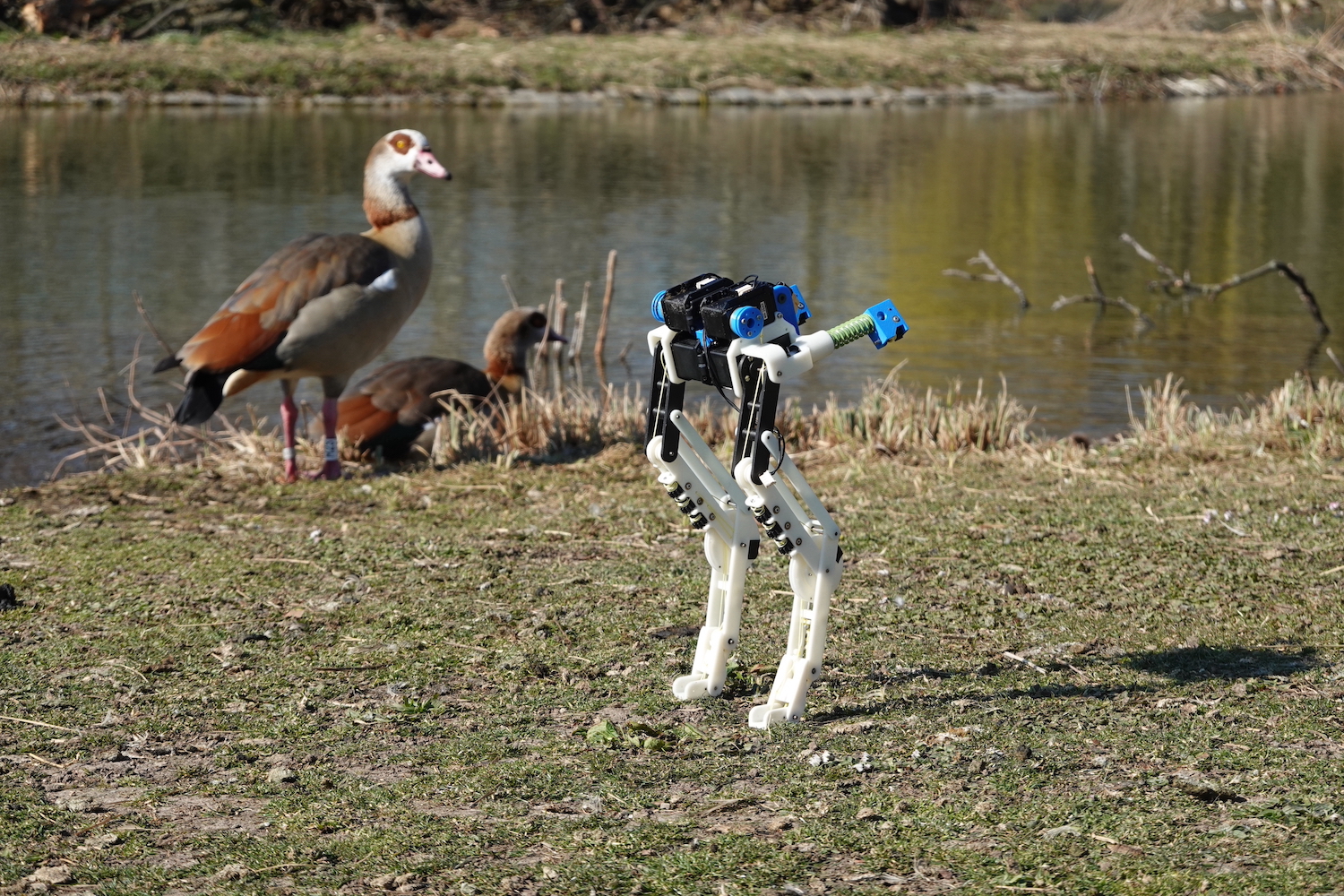
    If a Tyrannosaurus Rex living 66 million years ago featured a similar leg structure as an ostrich running in the savanna today, then we can assume bird legs stood the test of time – a good example of evolutionary selection.

    Graceful, elegant, powerful – flightless birds like the ostrich are a mechanical wonder. Ostriches, some of which weigh over 100 kg, run through the savanna at up to 55 kph. The ostriches outstanding locomotor performance is thought to be enabled by the animal’s leg structure. Unlike humans, birds fold their feet back when pulling their legs up towards their bodies. Why do the animals do this? Why is this foot movement pattern energy-efficient for walking and running? And can the bird’s leg structure with all its bones, muscles, and tendons be transferred to walking robots?

    Alexander Badri-Spröwitz has spent more than five years on these questions. At the Max Planck Institute for Intelligent Systems (MPI-IS), he leads the Dynamic Locomotion Group. His team works at the interface between biology and robotics in the field of biomechanics and neurocontrol. The dynamic locomotion of animals and robots is the group’s main focus.

    Together with his doctoral student Alborz Aghamaleki Sarvestani, Badri-Spröwitz has constructed a robot leg that, like its natural model, is energy-efficient: BirdBot needs fewer motors than other machines and could, theoretically, scale to large size. On March 16th, Badri-Spröwitz, Aghamaleki Sarvestani, the roboticist Metin Sitti, a director at MPI-IS, and biology professor Monica A. Daley of the University of California, Irvine, published their research in the renowned journal Science Robotics.

    Compliant spring-tendon network made of muscles and tendons

    When walking, humans pull their feet up and bend their knees, but feet and toes point forward almost unchanged. It is known that Birds are different — in the swing phase, they fold their feet backward. But what is the function of this motion? Badri-Spröwitz and his team attribute this movement to a mechanical coupling. “It’s not the nervous system, it’s not electrical impulses, it’s not muscle activity,” Badri-Spröwitz explains. “We hypothesized a new function of the foot-leg coupling through a network of muscles and tendons that extends across multiple joints. These multi-joint muscle-tendon coordinate foot folding in the swing phase. In our robot, we have implemented the coupled mechanics in the leg and foot, which enables energy-efficient and robust robot walking. Our results demonstrating this mechanism in a robot lead us to believe that similar efficiency benefits also hold true for birds.”

    The coupling of the leg and foot joints and the forces and movements involved could be the reason why a large animal like an ostrich can not only run fast but also stand without tiring, the researchers speculate. A person weighing over 100 kg can also stand well and for a long time, but only with the knees ‘locked’ in an extended position. If the person were to squat slightly, it becomes strenuous after a few minutes. The bird, however, does not seem to mind its bent leg structure; many birds even stand upright while sleeping. A robotic bird's leg should be able to do the same: no motor power should be needed to keep the structure standing upright.

    Robot walks on a treadmill

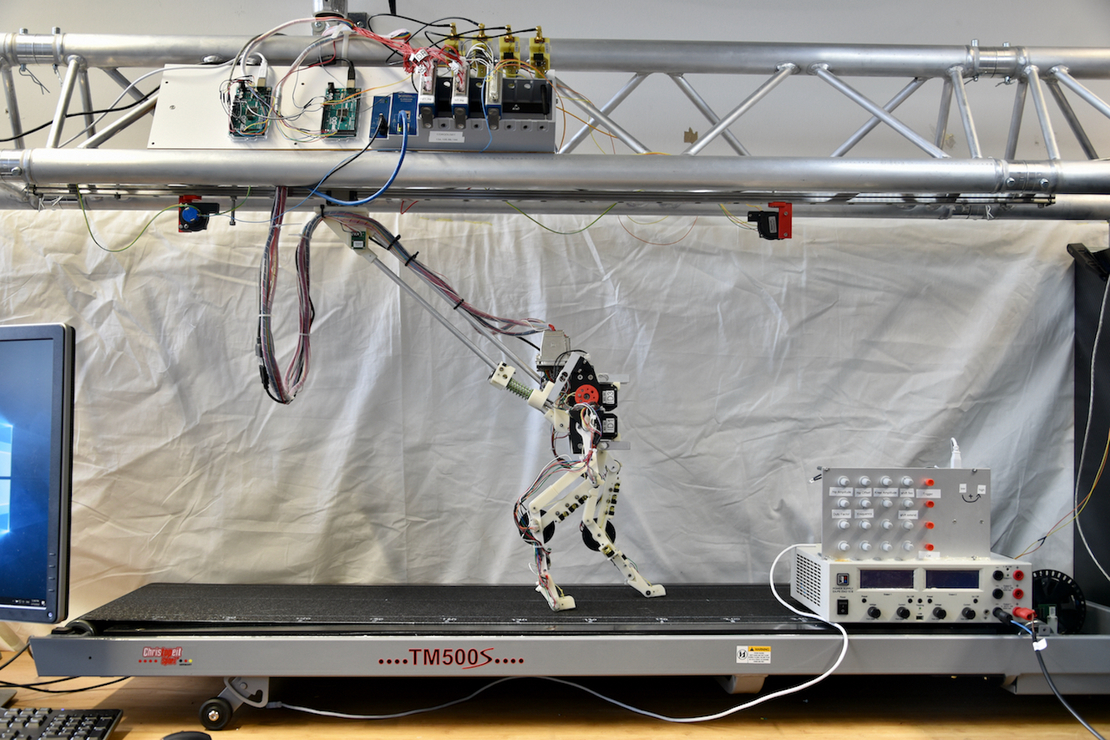
    To test their hypothesis, the researchers built a robotic leg modeled after the leg of a flightless bird. They constructed their artificial bird leg so that its foot features no motor, but instead a joint equipped with a spring and cable mechanism. The foot is mechanically coupled to the rest of the leg’s joints through cables and pulleys. Each leg contains only two motors— the hip joints motor, which swings the leg back and forth, and a small motor that flexes the knee joint to pull the leg up. After assembly, the researchers walked BirdBot on a treadmill to observe the robot’s foot folding and unfolding. “The foot and leg joints don’t need actuation in the stance phase,” says Aghamaleki Sarvestani. “Springs power these joints, and the multi-joint spring-tendon mechanism coordinates joint movements. When the leg is pulled into swing phase, the foot disengages the leg’s spring – or the muscle-tendon spring, as we believe it happens in animals,” Badri-Spröwitz adds. A video shows BirdBot walking in the research group’s laboratory.

    Zero effort when standing, and when flexing the leg and knee

    When standing, the leg expends zero energy. “Previously, our robots had to work against the spring or with a motor either when standing or when pulling the leg up, to prevent the leg from colliding with the ground during leg swing. This energy input is not necessary in BirdBot’s legs,” says Badri-Spröwitz and Aghamaleki Sarvestani adds: “Overall, the new robot requires a mere quarter of the energy of its predecessor.”

    The treadmill is now switched back on, the robot starts running, and with each leg swing, the foot disengages the leg’s spring. To disengage, the large foot movement slacks the cable and the remaining leg joints swing loosely. This transition of states, between standing and leg swing, is provided in most robots by a motor at the joint. And a sensor sends a signal to a controller, which turns the robot’s motors on and off. “Previously, motors were switched depending on whether the leg was in the swing or stance phase. Now the foot takes over this function in the walking machine, mechanically switching between stance and swing. We only need one motor at the hip joint and one motor to bend the knee in the swing phase. We leave leg spring engagement and disengagement to the bird-inspired mechanics. This is robust, fast, and energy-efficient,” says Badri-Spröwitz.
    Monica Daley observed in several of her earlier biology studies that the bird’s leg structure not only saves energy during walking and standing but is also adapted by nature so that the animal hardly stumbles and injures itself. In experiments with guineafowls running over hidden potholes, she quantified the birds’ remarkable locomotion robustness. A morphological intelligence is built into the system that allows the animal to act quickly – without having to think about it. Daley had shown that the animals control their legs during locomotion not only with the help of the nervous system. If an obstacle unexpectedly lies in the way, it is not always the animal’s sense of touch or sight that comes into play.

    “The structure with its multi-jointed muscle-tendons and its unique foot movement can explain why even heavy, large birds run so quickly, robustly, and energy-efficient. If I assume that everything in the bird is based on sensing and action, and the animal steps onto an unexpected obstacle, the animal might not be able to react quickly enough. Perception and sensing, even the transmission of the stimuli, and the reaction cost time,” Daley says.

    Yet Daley’s work on running birds over 20 years demonstrates that birds respond more rapidly than the nervous system allows, indicating mechanical contributions to control. Now that the team developed BirdBot, which is a physical model that directly demonstrates how these mechanisms work, it all makes more sense: the leg switches mechanically if there is a bump in the ground. The switch happens immediately and without time delay. Like birds, the robot features high locomotion robustness.

    Whether it’s on the scale of a Tyrannosaurus Rex or a small quail, or a small or large robotic leg. Theoretically, meter-high legs can now be implemented to carry robots with the weight of several tons, that walk around with little power input.

    The knowledge gained through BirdBot developed at the Dynamic Locomotion Group and the University of California, Irvine, leads to new insights about animals, which are adapted by evolution. Robots allow testing and sometimes confirming hypotheses from Biology, and advancing both fields.


  • AI & Architecture

    AI & Architecture

    Die nächste Ausgabe unserer Entrepreneurship-Serie steht vor der Tür, und wir betrachten erneut künstliche Intelligenz (KI) und dessen Auswirkungen auf eine bestimmte Branche. Diesmal konzentrieren wir uns auf KI als wirkungsvolles Instrument für Architekten und die Architektur-, Ingenieur- und Bauindustrie (AEC). Unsere Referent:innen aus den Bereichen Forschung, Start-up und Investment teilen ihre Perspektiven, Lösungen und die Chancen, die sie in KI sehen.

    Wissenschaftler:innen, Gründer:innen, Studierende und alle, die sich für das Thema interessieren, sind herzlich eingeladen, am Donnerstag, den 31. März, 14:00-15:30 Uhr dabei zu sein.

    Sprecher:innen

    David Weber
    CEO von Architizer

    Diellza Elshani
    Doktorandin am Institut für Computational Design und Construction und Exzellenzcluster IntCDC an der Universität Stuttgart

    Benjamin James
    Founder & CEO von mlxar GmbH

    David Fehrenbach
    Co-Founder & Managing Director von preML GmbH

    Alex Diehl
    Senior Advisor bei Cyber Valley & Angel Investor


    Registrierung

    Bitte hier registrieren. Das Event findet via Zoom und in englischer Sprache statt.


    Kontakt

    Julia Schmaus – Innovation Manager
    E-mail: julia.schmaus@cyber-valley.de
    Telefon: +49 7071 601 1546
    Mobil: +49 151 6452 0213

  • Sprechstunde: Cyber Valley Start-up Incubation Program

    Sprechstunde: Cyber Valley Start-up Incubation Program

    Das Cyber Valley Start-up Incubation Program bietet für Master-Studierende sowie für Forscherinnen und Forscher im April und Mai 2022 die Gelegenheit auszuprobieren, ein KI-Startup zu gründen – in nur sechs Wochen. Alle Informationen zum Cyber Valley Incubation Program findest du auf dieser Seite. Bewerbungsschluss ist am 13. März 2022.

    Hast du noch Fragen? Cyber Valley Innovationsmanager Tobias Dürr bietet Interessierten eine dreißigminütige Sprechstunde an, in denen er deine Fragen zum Programm beantwortet. Die Sprechstunde ist am 2. März um 14 Uhr, am 3. März um 11 Uhr und am 7. März um 15 Uhr. Über diesen Link können sich Interessierte zu diesen Zeiten einwählen. 

  • Fingertip sensitivity for robots

    Fingertip sensitivity for robots

    In a paper published on February 23, 2022 in Nature Machine Intelligence, a team of scientists at the Max Planck Institute for Intelligent Systems (MPI-IS) introduce a robust soft haptic sensor named “Insight” that uses computer vision and a deep neural network to accurately estimate where objects come into contact with the sensor and how large the applied forces are. The research project is a significant step toward robots being able to feel their environment as accurately as humans and animals. Like its natural counterpart, the fingertip sensor is very sensitive, robust, and high resolution.

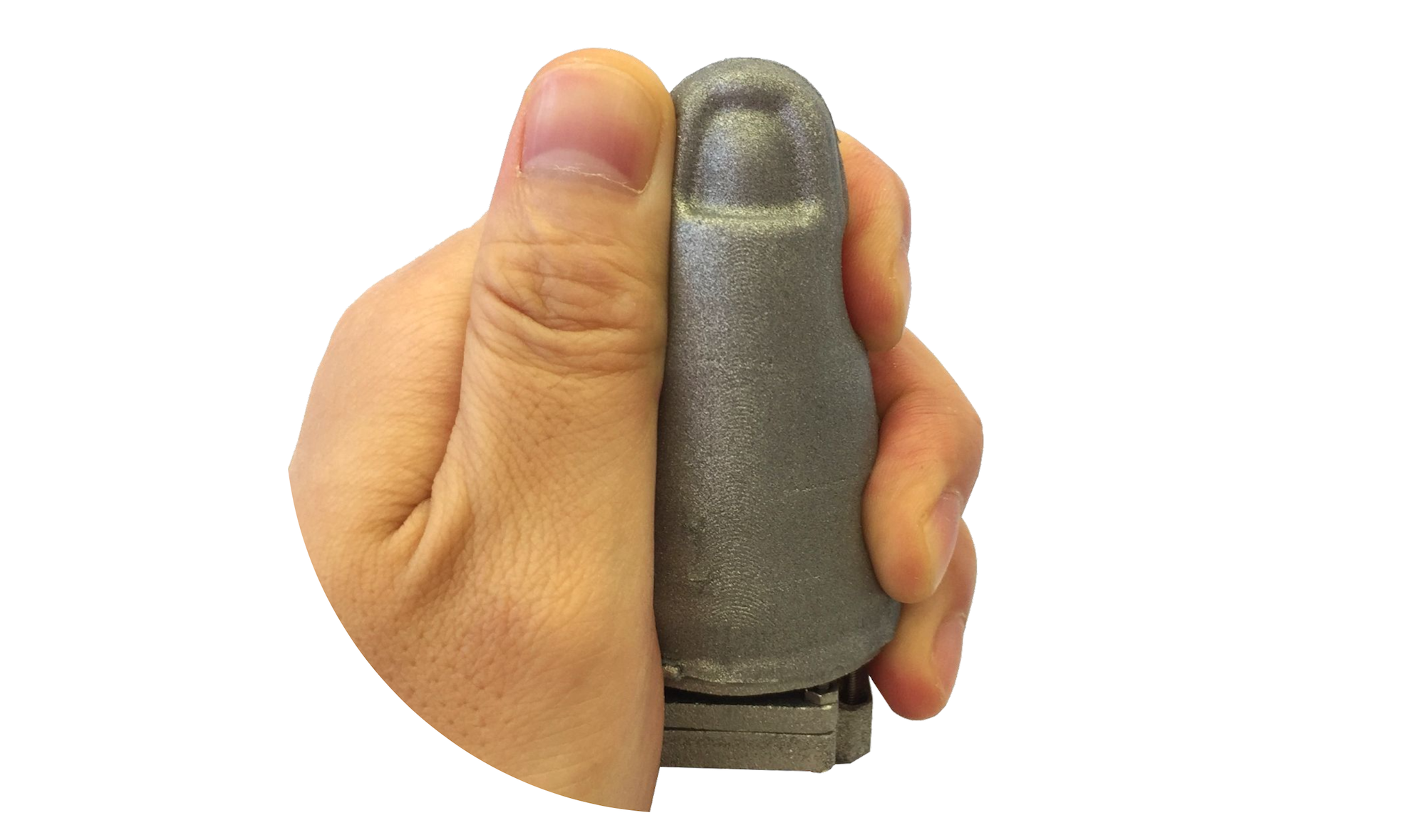
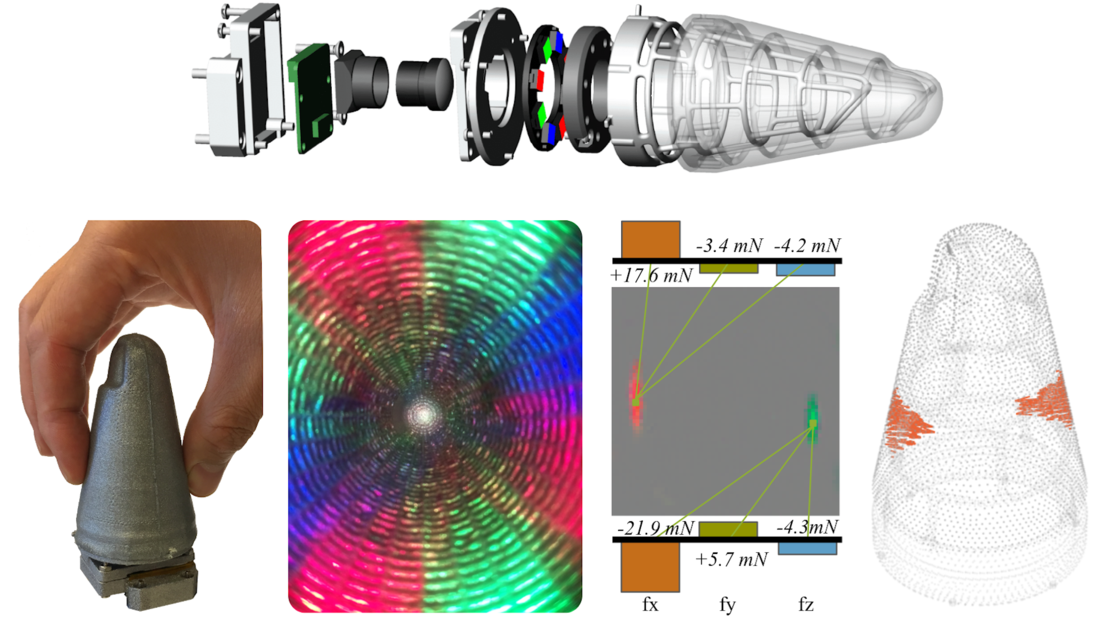
    The thumb-shaped sensor is made of a soft shell built around a lightweight stiff skeleton. This skeleton holds up the structure much like bones stabilize the soft finger tissue. The shell is made from an elastomer mixed with dark but reflective aluminum flakes, resulting in an opaque greyish color which prevents any external light finding its way in. Hidden inside this finger-sized cap is a tiny 160-degree fish-eye camera which records colorful images illuminated by a ring of LEDs.

    When any objects touch the sensor’s shell, the appearance of the color pattern inside the sensor changes. The camera records images many times per second and feeds a deep neural network with this data. The algorithm detects even the smallest change in light in each pixel. Within a fraction of a second, the trained machine-learning model can map out where exactly the finger is contacting an object, determine how strong the forces are and indicate the force direction. The model infers what scientists call a force map: it provides a force vector for every point in the three-dimensional fingertip.

    Figure 1 illustrates the sensor, the camera image generated inside the sensor, and the output of the deep neural network, which shows how accurately the position of contact, the force strength and the force direction can be estimated across the contacting areas. A video also shows the sensor’s functionality.

    “We achieved this excellent sensing performance through the innovative mechanical design of the shell, the tailored imaging system inside, automatic data collection, and cutting-edge deep learning,” says Georg Martius, Max Planck Research Group Leader at MPI-IS, where he heads the Autonomous Learning Group. His Ph.D. student Huanbo Sun adds: “Our unique hybrid structure of a soft shell enclosing a stiff skeleton ensures high sensitivity and robustness. Our camera can detect even the slightest deformations of the surface from one single image.” Indeed, while testing the sensor, the researchers realized it was sensitive enough to feel its own orientation relative to gravity.

    The third member of the team is Katherine J. Kuchenbecker, the Director of the Haptic Intelligence Department at MPI-IS. She confirms that the new sensor will be useful: “Previous soft haptic sensors had only small sensing areas, were delicate and difficult to make, and often could not feel forces parallel to the skin, which are essential for robotic manipulation like holding a glass of water or sliding a coin along a table,” says Kuchenbecker.

    But how does such a sensor learn? Huanbo Sun designed a testbed to generate the training data needed for the machine-learning model to understand the correlation between the change in raw image pixels and the forces applied. The testbed probes the sensor all around its surface and records the true contact force vector together with the camera image inside the sensor. In this way, about 200,000 measurements were generated. It took nearly three weeks to collect the data and another one day to train the machine-learning model. Surviving this long experiment with so many different contact forces helped prove the robustness of Insight’s mechanical design, and tests with a larger probe showed how well the sensing system generalizes.

    Another special feature of the thumb-shaped sensor is that it possesses a nail-shaped zone with a thinner elastomer layer. This tactile fovea is designed to detect even tiny forces and detailed object shapes. For this super-sensitive zone, the scientists choose an elastomer thickness of 1.2 mm rather than the 4 mm they used on the rest of the finger sensor.

    “The hardware and software design we present in our work can be transferred to a wide variety of robot parts with different shapes and precision requirements. The machine-learning architecture, training, and inference process are all general and can be applied to many other sensor designs,” Huanbo Sun concludes.

  • B2B Communications for Tech Start-ups

    B2B Communications for Tech Start-ups

    Effektive externe Kommunikation ist ein entscheidender Erfolgsfaktor für jedes Unternehmen. Start-ups stehen vor allem in der Anfangsphase vor der Herausforderung, den Bekanntheitsgrad zu steigern und eine erfolgreiche B2B-Kommunikation aufzubauen. Die Entwicklung und Umsetzung einer effektiven Kommunikationsstrategie kann jedoch herausfordernd sein.

    Die nächste Ausgabe der Entrepreneurship Series widmet sich daher dem Thema "B2B-Kommunikation für Tech-Start-ups". Erfahrene Kommunikationsexperten geben Einblicke in PR-Grundlagen, B2B-Kommunikation und den effektiven Einsatz von Social Media. Im Anschluss an ihre Vorträge findet eine Fragerunde statt.

    Wissenschaftler:innen, Gründer:innen, Studierende und alle, die sich für das Thema interessieren, sind herzlich eingeladen, am Donnerstag, den 24. Februar, 14:00-15:30 Uhr dabei zu sein.


    Sprecher:innen

    Mark Schiffhauer
    Chief Creative Officer, ZEIT Verlagsgruppe & Geschäftsführer, Studio ZX

    Lennart Schmid
    Communications Manager, Cyber Valley

    Johanna Hailer
    Kommunikationsmanagerin, Storymaker GmbH


    Registrierung

    Bitte hier registrieren. Das Event findet via Zoom und in englischer Sprache statt.


    Kontakt

    Julia Schmaus – Innovation Manager
    E-mail: julia.schmaus@cyber-valley.de
    Telefon: +49 7071 601 1546
    Mobil: +49 151 6452 0213


  • Gap in AI education addressed

    Gap in AI education addressed

    “With ‘AISA’, students from a wide range of disciplines are given the excellent opportunity to train to become top AI software experts. The talents gained in this way can work on future-oriented and practical solutions in the development of AI software and thus further advance the international appeal of Cyber Valley,” says Baden-Württemberg’s Science Minister Theresia Bauer. “Through the AI Software Academy, we are accelerating our international competitiveness in terms of digitalization and artificial intelligence across all disciplines by closing a previously unaddressed gap in education,” continues Prof. Wolfram Ressel, Rector of the University of Stuttgart. “In this way, AISA makes a twofold contribution to our vision of intelligent systems for a sustainable society.” Prof. Stefan Wagner, Head of the AISA Board of Directors and Director at the Institute of Software Engineering at the University of Stuttgart confirms, “Through our innovative education and research concept in combination with the powerful AISA infrastructure, we will significantly advance artificial intelligence and its use by means of powerful software.”

    AISA is dedicated to the challenges in business and science

    Rapidly advancing digitization and the extensive use of AI are influencing our everyday lives, as well as business and science. This results in many new types of challenges:

    • How is software for AI applications developed efficiently?
    • How do you make AI software robust and flexible?
    • How do you apply AI software in business and academia?
    • And how do you build didactics that is able to transfer knowledge about the development, use and maintenance of AI software into many different disciplines and thus shape the AI experts of tomorrow?

    In AISA Research, projects from a wide variety of fields are funded

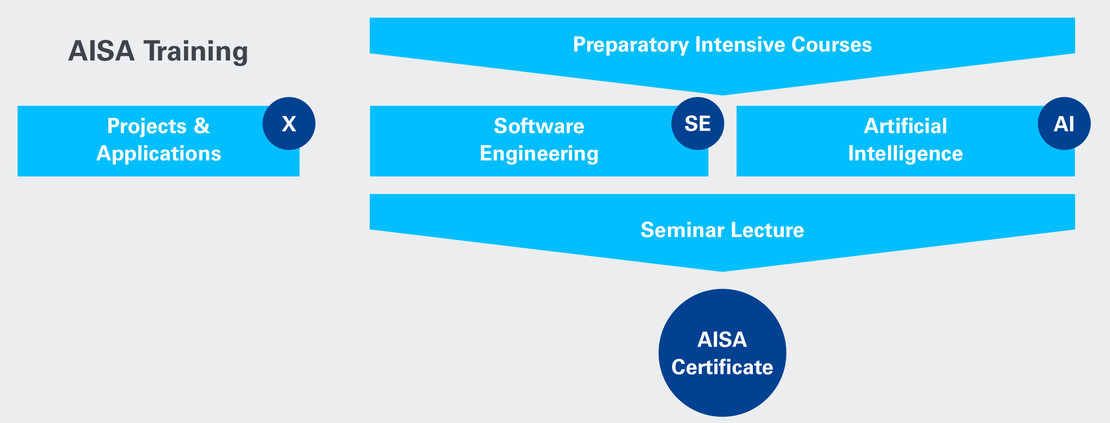
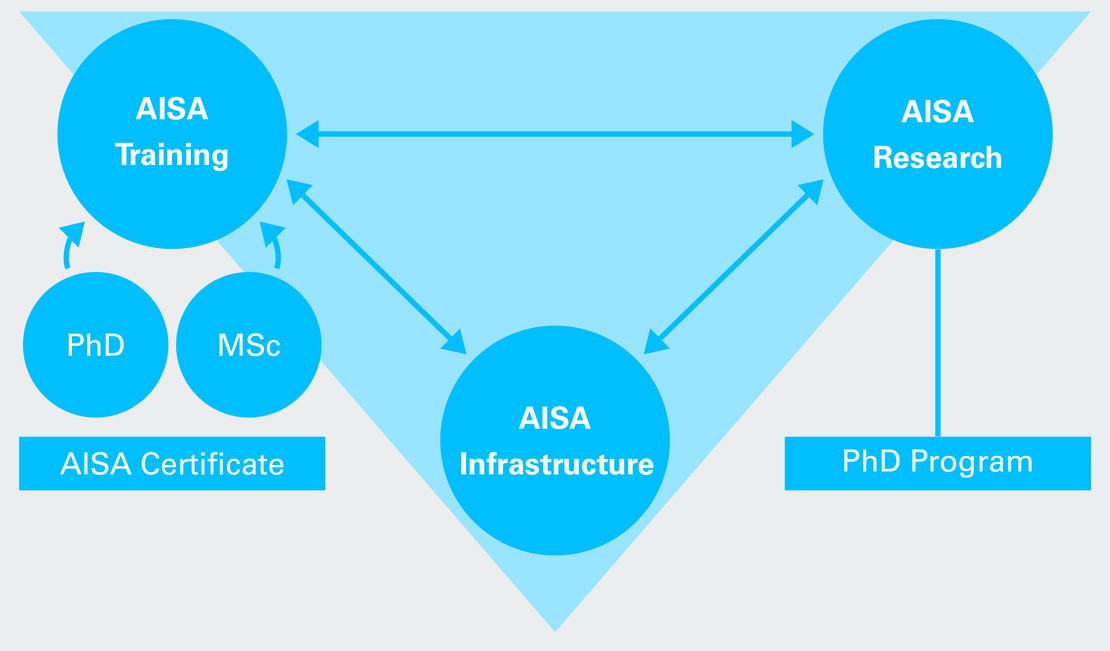
    In AISA Research, interdisciplinary research projects around the topic of AI are funded. Applications (X), software development (SE) and their didactics are linked with AI to the following: AI+SE+X. The AISA Board of Directors selected the first eleven Ph.D. projects for AISA Research in August 2021. The integration of the different fields can be seen in the funded projects: Researchers from architecture, biology, chemistry, didactics, computer science, mechanical engineering and environmental engineering cooperate. Projects closely related to the Clusters of Excellence SimTech and IntCDC are also represented.

    The doctoral researchers from AISA Research offer targeted teaching content for students in the master's area and for Cyber Valley doctoral students by means of AISA Training. In addition, project work, seminars and hackathons are organized and supervised here. The additional qualification is structured by an innovative, multi-level certificate program, which allows for a precise match to individual qualification needs, from thematically focused microcredentials to the Diploma of Advanced Studies.

    AISA consists of three components: Research, Training and Infrastructure

    The structure of AISA is based on the three elements of research (AISA Research), training (AISA Training) and a powerful infrastructure (AISA Infrastructure), which form the AISA Triangle. Both AISA Research and AISA Training rely on the AISA Infrastructure, which provides AI-specific high-performance computing. Good availability and easy access allow methods and AI pipelines to be developed efficiently. AISA is managed by a board of directors consisting of Prof. Stefan Wagner (chair), Tenure-Track Prof. Maria Wirzberger, Prof. Steffen Becker, Prof. Steffen Staab, and Prof. Felix Fritzen, who in turn represent the different disciplines in AISA.

    About the funding from the state of Baden-Württemberg

    AISA is another project from the “Zukunftsland BW – Stärker aus der Krise” package of measures. As part of this package, the state government is making targeted investments in important fields of the future, thereby sustainably strengthening the state as a location for business and innovation. The program lays the foundation for Baden-Württemberg to emerge stronger from the corona crisis.

    Related links:

  • State government paves the way for Cyber Valley Campus

    State government paves the way for Cyber Valley Campus

    “As the heart of top AI research in Baden-Württemberg, the campus shall underline the ambition to be Europe’s hotspot for top researchers in global competition, also in terms of building structures,” said Science Minister Theresia Bauer. “Already on its fifth birthday, the growing Cyber Valley is overflowing. With the overall concept, we now have a roadmap so that we can still find working space for our young scientists and researchers after next year. I thank the Minister of Finance and the Rector of the University of Tübingen for enabling us to develop a viable overall concept instead of short-term solutions.”

    Minister of Science Theresia Bauer: “The concept underlines the ambition to be Europe’s hotspot for cutting-edge AI research”

    Finance Minister Danyal Bayaz said: “We are investing to make Baden-Württemberg the California of Europe. We strive to be at the forefront of artificial intelligence, and Cyber Valley is enormously important for that.”

    The Cyber Valley Campus will also host a planned ELLIS Institute, for which the state is currently in coordination with the Hector Foundation, and the University of Tübingen’s AI Competence Center, which is financed by Germany’s federal government and Baden-Württemberg’s state government and jointly operated with the Max Planck Institute for Intelligent Systems. The concept that has now been approved forsees the construction of two additional buildings for research, teaching and seminars, as well as the purchase of an existing building on the future campus site.

    Finance Minister Danyal Bayaz: “We want to become the California of Europe”

    Professor Dr. Bernd Engler, Rector of the University of Tübingen, said: “Cyber Valley has become a magnet for outstanding AI researchers from all over the world. Not only the state of Baden-Württemberg, but also the federal government, companies and private foundations are currently investing large sums in bright minds and will continue to do so in the future. However, the researchers also need office space, laboratories and computing capacity. Therefore, it has been essential to also increase investments in infrastructure and to significantly accelerate the pace of building up Cyber Valley now, in order to realize the enormous potential of the location.”

    ELLIS Institute:

    With outstanding support from funds pledged by the H. W. & J. Hector Foundations to attract top AI scientists, the ELLIS Institute, backed by a scientific association, will be established within the Cyber Valley ecosystem. The foundation's commitment requires financial participation by the state. The state is currently coordinating arrangements with the Hector Foundation in this regard.

    ELLIS stands for European Laboratory for Learning & Intelligent Systems and was founded by leading researchers from Europe who work closely with basic researchers from industry. The overarching goal of ELLIS is to establish European cutting-edge research in the field of artificial intelligence as internationally competitive. Europe should not only contribute to how AI and machine learning are changing the world, but also make an economic impact by creating new jobs.

    More information on ELLIS: https://ellis.eu